DU SOL Question Paper 2018 BA (Hons.) English - Cultural Diversity, Linguistic Plurality and Literacy Traditions in India
Course : BA (Hons.) English
Semester: II Year-Annual
Paper Code: B-807
Subject: Cultural Diversity, Linguistic Plurality and Literacy Traditions in India
More Detail
Finished viewing? Save it for later —
Download DU SOL Question Paper 2018 BA (Hons.) English - Cultural Diversity, Linguistic Plurality and Literacy Traditions in India (PDF · 12 pages)About DU SOL Question Paper 2018 BA (Hons.) English - Cultural Diversity, Linguistic Plurality and Literacy Traditions in India
DU SOL Question Paper 2018 BA (Hons.) English - Cultural Diversity, Linguistic Plurality and Literacy Traditions in India is available here for free download. Published by Default for DU SOL, this question paper can be viewed online or downloaded as a PDF (12 pages). Candidates preparing for DU SOL can use DU SOL Question Paper 2018 BA (Hons.) English - Cultural Diversity, Linguistic Plurality and Literacy Traditions in India to understand the exam pattern, the type of questions asked, and the overall difficulty level.
Frequently Asked Questions
How can I download DU SOL Question Paper 2018 BA (Hons.) English - Cultural Diversity, Linguistic Plurality and Literacy Traditions in India?
Open this page and click the Download button to save DU SOL Question Paper 2018 BA (Hons.) English - Cultural Diversity, Linguistic Plurality and Literacy Traditions in India as a PDF. It is completely free on AglaSem Docs.
Is DU SOL Question Paper 2018 BA (Hons.) English - Cultural Diversity, Linguistic Plurality and Literacy Traditions in India free to download?
Yes. DU SOL Question Paper 2018 BA (Hons.) English - Cultural Diversity, Linguistic Plurality and Literacy Traditions in India can be viewed online and downloaded as a PDF free of cost on AglaSem Docs.
How many pages does DU SOL Question Paper 2018 BA (Hons.) English - Cultural Diversity, Linguistic Plurality and Literacy Traditions in India have?
DU SOL Question Paper 2018 BA (Hons.) English - Cultural Diversity, Linguistic Plurality and Literacy Traditions in India contains 12 pages, which you can read online or download together as a single PDF.
Where can I find more DU SOL study material?
You can find more DU SOL question papers, sample papers, syllabus, and answer keys on AglaSem Docs.
DU SOL Question Paper 2018 BA (Hons.) English - Cultural Diversity, Linguistic Plurality and Literacy Traditions in India – Text
Read the full text of this question paper below — useful to quickly search, copy and reference the content online without downloading the PDF.
📄 View text version (12 pages)
Page 1
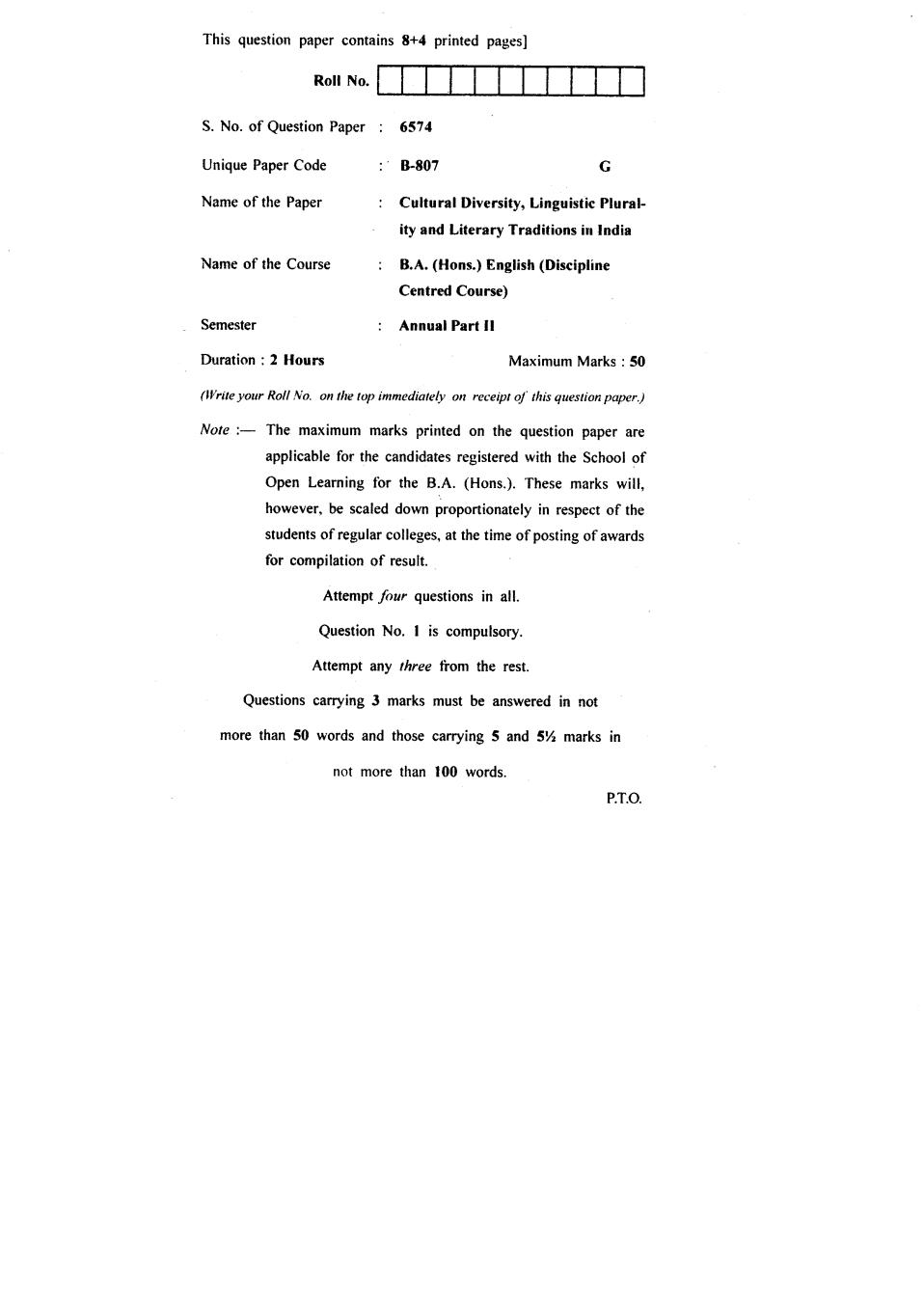
Roll No.
S. No. of Question Paper 6574
Unigue Paper Code 8-807 c
Name of the Paper Cultural Diversity, Linguistic Plural-
ity and Literary Traditions in India
Name of the Course B.A. (Hons.) English (Discipline
Centred Course)
Semester Annual Part Il
Duration : 2 Hours Maximum ll'larks : 50
(ll/rite your Roll No. on lhe top immediately on receipt oJ' this question paper.)
Note :- The maximum marks printed on the question paper are
applicable for the candidates registered with the School of
Open Learning fbr the B.A. (Hons.). These marks will,
however, be scaled down proportionately in respect of the
students of regular colleges, at the time of posting of awards
for compilation of result.
Attempt /ozr questions in all.
Question No, I is compulsory.
Attempt any three from the rest.
Questions carrying 3 marks must be answered in not
more than 50 words and those carrying 5 and 5% marks in
not more than 100 words.
P.T.O.
Page 2
l. Attemtrt 3n;.; 1tr,o of the tbllowing questions :
(a) What are the views of Su.iit Mukherjee about the new
approach to the rvriting uf the history of Indian litera-
ture ?
(e) What does classical Sanskrit drama teii us about the
multilingualism of our country ?
(c) Write a short note on the Ramayana tradition.
@ How does translation help in understanding lndian
Literature ?
(e) What role does Sujit Mukherjee attribute to the poet in
Indian society ?
(t) Comment on the use of \4ahabharuta as a rich literary
source for Indian writers. 5tti+5t/z:ll
Read the following lines and answer the questions that follow:
ta) Neither I know the secret of religion
Nor am I born of Adam and Eve.
I have given myself no name
I know not who I am.
(, Name the language and the fbrm of the above
passage.
Page 3
(ti) Why does the poet refuse to give himself a name 'l
(ilt Analyze these lines with reference to the Sufi
tradition. 2+3+3-8
(h
So, my lord, white as jasmine, is my husband
Take these husbands who die,
decay and feed them
to your kitchen fires
(t Name the poet and the form of the passage.
(ii) Explain the expression "my lord, white as jasmine".
(itt How does the passage reflect the relatiorrship
between man and god in the Bhakti tradition ?
2+3+3:8
(b) Discuss the concept of the 'mad lover in Sufi and Bhakti
traditions.
()'
Explain two reasons for the popularity of the Bhakti
movement. 5
P.T.C).
Page 4
a
Read the following lines and answer the questions
that follow:
(a) Long as tresses the night of parting,
The day of love is as short as tife.
If I see not my love, O friend,
How can I spend dark nights of grief ?
(t Name the poet and the form of the poem.
(rt Comment on the love relationship in the poem.
(iii) Analze the passage as an example of bilingualism
in India. 2+3+3=9
Or
He would say to himself, *lf I could get another chance,
just one more, I'd rehabilitate Laju in my
heart."
(t Name the writer of the passage and the language
from which it is translated.
(t) Discuss the relationship between the speaker and
t aju.
(iii) Explain "I'd rehabilitate Laju in my heart." 2+3+3:g
Page 5
6s74
(5)
status
about the independent
(b) Write a note on the debate {
of Hindi and Urdu'
U
politics as discussed
in the poem
Explair.r the language
5
'Hindf '
that follow :
lines and answer the questions
Read the fo'owing
(a) Oh mY beloved one
to ill luck
tf you lost your health due
I come forward here to. save You'
With this Emul'
5
To call back Your lost
health'
of the song' On what
(t) Name the original language
occasion is it sung
?
to as the 'beloved' ?
(rr) Who is being addressed
2)3+34
(trt) What does Emul mean ?
0
Take this and go awaY
came
Whichever way You
P.TO.
Page 6
Co back, return.
Don't inflict pain on us
After your departure.
(r) Name the original language of the poem. To what
tribe does this song belong ?
(ii) Who is being asked to return ? Why ?
(iii) Comment on the significance of the statement-
"Don't inflict pain on us/After your departure."
2+3+3:8
(b) Comment on the concepts of time and space in tribal
verse. 5
Or
Write a note on the Munda tribe.
.
Read the following lines and answer the questions that follow;
(a) A.ll the time I went to work for the Naikers, I knew I
should never come close to where they were, I should
always stand away to one side. These were their rules.
(r) Identifu the writer and the original language of the
above lines.
Page 7
(it) Why should the speaker "always stand away" ?
(iri) Whose "rules" are mentioned ? Should they be
followed ? Explain the context of the lines. 2+3+3:8
Or
Once you are used to it
you never afterwards
feel anything;
your blood neverrnore
congeals
nor flows.
(t Identifu the writer and the original language of the
above lines.
(rt) Who is the "you" in the first line ? What does
"you" get used to ?
(it, Explain the context of these lines. 2+3+34
{b) Why has the term "Dalit" found favour over other terms
like Untouchable, Harijan etc ? What is the achievement
of Dalit literature ?
0
Critically comment on N.T. Rajkumar's "Untitled Poem". 5
P.T.O.
Page 8
Read the following lines and answer the questions that follow:
(a) Give me, a quill, quicklY
She must be looking for me
The reed cut of its hand
Gave it to me and said
Take it.
I too am her servant.
(r) Name the poet and the original language of the
poem.
(t,) Who is the "she" referred to in these lines ?
(iii) Discuss the theme of the poem. 2+3+34
Or
We have neither punctuation nor the treacherous 'ats'
and 'ons' to bother us-we tell one interminable tale.
Episode follows episode, and when our thoughts stop
our breath stops, and we move on to another thought.
(, Identify the author and the original language of
the extract.
(rr) What is meant by an "interminable tale" ?
(iii) What is the context of the above lines ? 2+3+3:8
Page 9
(b) What is the "lndian pride" and "lndian prejudice"
thal
MK Naik refers to ?
a
to America"' 5
Discuss K Ayyappa Paniker's "Passage
the questions that follow:
7. Read the following lines and answer
nut
(a) The king at once offered her betel leaf and betel
(tambula) ceremonially on a silver
platter' as a symbolic
touch it' But the
offer of betrothal' She was afraid to
king forced it on her and sent her
home'
(t) Identiff the story from where this passage has
been taken' Name the author'
(r,) Who is the "she" referred to here ? Why is she
afraid ?
(t,r) What is the context of these lines ? 2+3+3:8
Or
She openly questions, challenges
and punctures
personal intrusions' and
the ideology of her times in her
a|soinherse|ectionofepisodes,depthofdetailand
silences'
PJ.o'
Page 10
(,) Name the author of the above lines and the text
being discussed.
(ii) What is the "ideology" that is being refered to ?
(iii) How does "she" challenge with her silences and
other methods ? 2+3+3:8
(b) Discuss the aptness of the metaphoric connections
between a flowering tree and the fertility of a woman'
5
Or
What makes Chandrabati Ramayan an epic which
challenges traditional literary values ?
5
Read the following lines and answer the questions that
follow :
8.
(a) Hind Svaraj is a prose of the dialogical in several senses
of the word. Many sorts of dialogic interaction had
emerged as Gujarati prose unfolded during the nineteenth
century, starting from the prose of'journalism and
travelogue, moving througlr the prose of diaries and
memories. and aniving at the prose of fictional narrative'
The public and the private, the realistic and the fictional'
theinclusiveandtheexclusive-differenttypesofprose
Page 11
( ll )
of lndia's
reflecting the simultancity
evolved gradually'
expel it
the West and to
needs to aecept
Nanre the author
ol these lines'
(,)
alld to
needs to accept the West
(rt) Ilxplain "lndia's
exPel it"'
2+3+3=8
(,,,) What is Hind Svarai
?
0r
conception'
ltas pointed out' this
As Vinay l)harwadker
Euro-
among late'eighteenth-centtrry
which was common
for the world-
laid the fbundation
pean literary tltinkers'
pariicularly
literary ltistories'
wide 'tradition' of
national
period of the twentieth century'
in the postcolonial
bonowed iiom the Euro-
Another important conception
composed in the
peans was that
wri$en texts' preferably
markers of
standards and
ancient past'
were the source'
knowledge'
high culture and
Name the author
of the above lines'
(t)
?
(,i) Who is VinaY Dharwadker
the
was borrowed from
(t,t) Which important conception
21"3+3=8
EuroPeans ? P.T.O.
Page 12
(b) The standardization of the Sindhi's script would not allow
it to sustain it's dynamic give and take relationship with
other languages and dialects. Discuss. 5
&
"Narsimha is considered Gujarati's first poet in the
same sense in which Valmiki was Sanskrit's first poet',.
Discuss.
65V4 l2 5m
Document Details
| Board / Org | Default |
| Exam | DU SOL |
| Type | Question Paper |
| Pages | 12 |
| Updated | 30 Apr 2026 |