JNUEE 2021 Question Paper Ph.D Philosophy
Finished viewing? Save it for later —
Download JNUEE 2021 Question Paper Ph.D Philosophy (PDF · 21 pages)About JNUEE 2021 Question Paper Ph.D Philosophy
JNUEE 2021 Question Paper Ph.D Philosophy is available here for free download. Published by NTA for JNUEE, this question paper can be viewed online or downloaded as a PDF (21 pages). Candidates preparing for JNUEE can use JNUEE 2021 Question Paper Ph.D Philosophy to understand the exam pattern, the type of questions asked, and the overall difficulty level.
Frequently Asked Questions
How can I download JNUEE 2021 Question Paper Ph.D Philosophy?
Open this page and click the Download button to save JNUEE 2021 Question Paper Ph.D Philosophy as a PDF. It is completely free on AglaSem Docs.
Is JNUEE 2021 Question Paper Ph.D Philosophy free to download?
Yes. JNUEE 2021 Question Paper Ph.D Philosophy can be viewed online and downloaded as a PDF free of cost on AglaSem Docs.
How many pages does JNUEE 2021 Question Paper Ph.D Philosophy have?
JNUEE 2021 Question Paper Ph.D Philosophy contains 21 pages, which you can read online or download together as a single PDF.
Where can I find more JNUEE study material?
You can find more JNUEE question papers, sample papers, syllabus, and answer keys on AglaSem Docs.
JNUEE 2021 Question Paper Ph.D Philosophy – Text
Read the full text of this question paper below — useful to quickly search, copy and reference the content online without downloading the PDF.
📄 View text version (21 pages)
Page 1
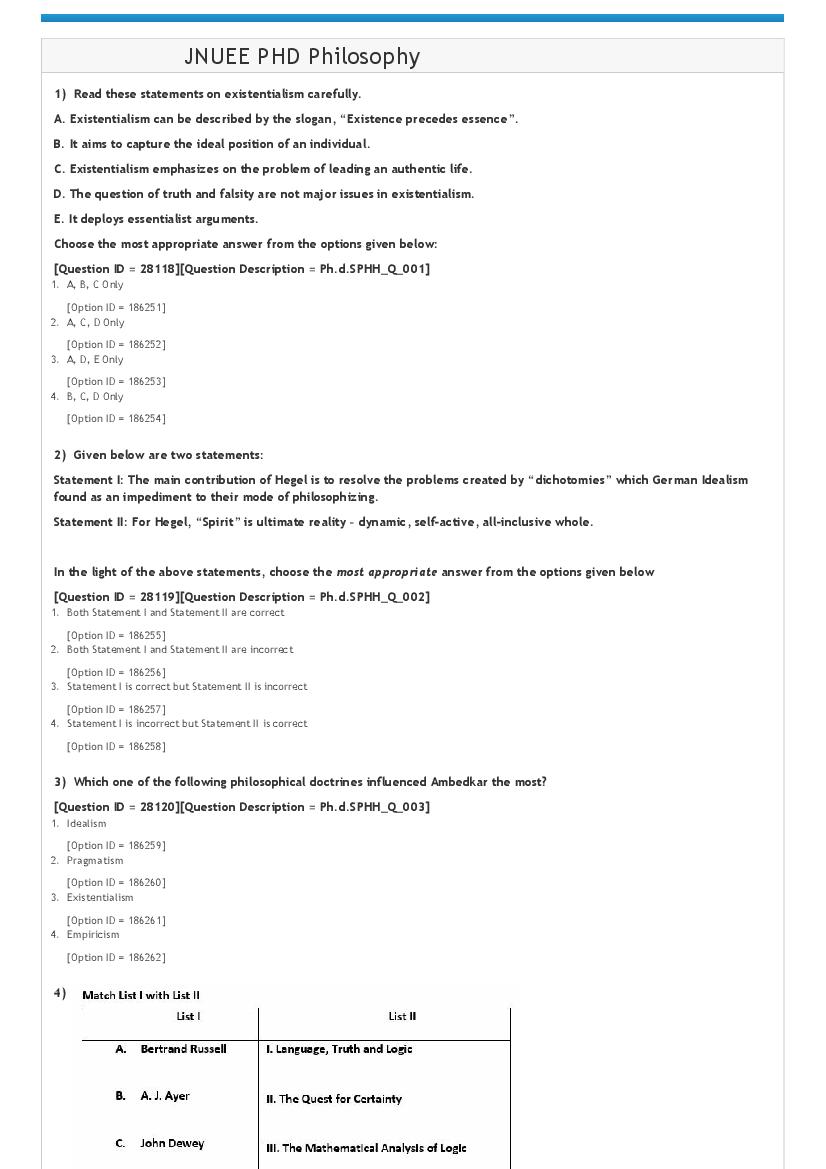
1) Read these statements on existentialism carefully.
A. Existentialism can be described by the slogan, “Existence precedes essence”.
B. It aims to capture the ideal position of an individual.
C. Existentialism emphasizes on the problem of leading an authentic life.
D. The question of truth and falsity are not major issues in existentialism.
E. It deploys essentialist arguments.
Choose the most appropriate answer from the options given below:
[Question ID = 28118][Question Description = Ph.d.SPHH_Q_001]
1. A, B, C Only
[Option ID = 186251]
2. A, C, D Only
[Option ID = 186252]
3. A, D, E Only
[Option ID = 186253]
4. B, C, D Only
[Option ID = 186254]
2) Given below are two statements:
Statement I: The main contribution of Hegel is to resolve the problems created by “dichotomies” which German Idealism
found as an impediment to their mode of philosophizing.
Statement II: For Hegel, “Spirit” is ultimate reality – dynamic, self‐active, all‐inclusive whole.
In the light of the above statements, choose the most appropriate answer from the options given below
[Question ID = 28119][Question Description = Ph.d.SPHH_Q_002]
1. Both Statement I and Statement II are correct
[Option ID = 186255]
2. Both Statement I and Statement II are incorrect
[Option ID = 186256]
3. Statement I is correct but Statement II is incorrect
[Option ID = 186257]
4. Statement I is incorrect but Statement II is correct
[Option ID = 186258]
3) Which one of the following philosophical doctrines influenced Ambedkar the most?
[Question ID = 28120][Question Description = Ph.d.SPHH_Q_003]
1. Idealism
[Option ID = 186259]
2. Pragmatism
[Option ID = 186260]
3. Existentialism
[Option ID = 186261]
4. Empiricism
[Option ID = 186262]
4)
Page 2
1. A‐III, B‐I, C‐II, D‐IV [Option ID = 186263]
2. A‐IV, B‐I, C‐II, D‐III [Option ID = 186264]
3. A‐II, B‐I, C‐IV, D‐III [Option ID = 186265]
4. A‐I, B‐II, C‐IV, D‐III [Option ID = 186266]
5) Given below are two statements:
Statement I: Swami Vivekananda propounded the philosophy of Visista Advaita Vedanta.
Statement II: Swami Vivekananda also propounded the philosophy of Practical Vedanta.
In the light of the above statements, choose the most appropriate answer from the options given below
[Question ID = 28122][Question Description = Ph.d.SPHH_Q_005]
1. Both Statement I and Statement II are correct
[Option ID = 186267]
2. Both Statement I and Statement II are incorrect
[Option ID = 186268]
3. Statement I is correct but Statement II is incorrect
[Option ID = 186269]
4. Statement I is incorrect but Statement II is correct
[Option ID = 186270]
6) Given below are two statements. One is labelled as Assertion A and the other is labelled as Reason R.
Assertion A: Objects continue to exist even when they are not perceived by any finite minds.
Reason R: Our beliefs about the future can only be rationally justified if the assumption that nature will continue uniformly
can be rationally justified.
In the light of the above statements, choose the most appropriate answer from the options given below
[Question ID = 28123][Question Description = Ph.d.SPHH_Q_006]
1. Both A and R are correct and R is the correct explanation of A
[Option ID = 186271]
2. Both A and R are correct but R is NOT the correct explanation of A
[Option ID = 186272]
3. A is correct but R is not correct
[Option ID = 186273]
4. A is not correct but R is correct
[Option ID = 186274]
7) Given below are two statements. One is labelled as Assertion A and the other is labelled as Reason R.
Assertion A: In sense perception, we perceive nothing but certain sensible qualities.
Reason R: All sensible qualities are nothing but ideas.
In the light of the above statements, choose the most appropriate answer from the options given below
[Question ID = 28124][Question Description = Ph.d.SPHH_Q_007]
1. Both A and R are correct and R is the correct explanation of A
[Option ID = 186275]
2. Both A and R are correct but R is NOT the correct explanation of A
[Option ID = 186276]
3. A is correct but R is not correct
[Option ID = 186277]
4. A is not correct but R is correct
[Option ID = 186278]
8) Which one of the following represents theory of meaning in Buddhism?[Question ID = 28125][Question Description =
Ph.d.SPHH_Q_008]
1. Apoha [Option ID = 186279]
2. Anvikshiki [Option ID = 186280]
3. Pratityaamutpada [Option ID = 186281]
4. Kshnikvada [Option ID = 186282]
Page 3
[Question ID = 28126][Question Description = Ph.d.SPHH_Q_009]
1. A‐lV, B‐ lll, C‐ll, D‐l [Option ID = 186283]
2. A‐l, B‐ll, C‐lll, D‐lV [Option ID = 186284]
3. A‐lV ,B‐lll, C‐l, D‐ll [Option ID = 186285]
4. A‐ll, B‐lV, C‐lll, D‐l [Option ID = 186286]
10) Which Indian thought allows performing an action which otherwise is not permitted by the traditional ethical principles.
[Question ID = 28127][Question Description = Ph.d.SPHH_Q_010]
1. Varna Dharma [Option ID = 186287]
2. Samanya Dharma [Option ID = 186288]
3. Jati Dharma [Option ID = 186289]
4. Aapad Dharma [Option ID = 186290]
11) Read the following statements carefully and sort out the incorrect one.
A. Betty Friedan is a second wave American Feminist.
B. Friedan has written a book, Feminine Mystique.
C. The book discusses various feminist theories on mysticism.
D. The book emphasizes on the question of women’s political hights.
Choose the most appropriate answer from the options given below:
[Question ID = 28128][Question Description = Ph.d.SPHH_Q_011]
1. A, B, C only
[Option ID = 186291]
2. B, C, D only
[Option ID = 186292]
3. A, B only
[Option ID = 186293]
4. B, C only
[Option ID = 186294]
12) Which among the following has direct correspondence with Rasa?[Question ID = 28129][Question Description =
Ph.d.SPHH_Q_012]
1. Alamkāra [Option ID = 186295]
2. Sthāyi Bhāva [Option ID = 186296]
3. Vyabhicāri Bhāva [Option ID = 186297]
4. Rūpaka [Option ID = 186298]
13)
Page 4
1. A‐III, B‐II, C‐IV, D‐I [Option ID = 186299]
2. A‐IV, B‐I, C‐III, D‐II [Option ID = 186300]
3. A‐II, B‐I, C‐IV, D‐III [Option ID = 186301]
4. A‐III, B‐IV, C‐II, D‐I [Option ID = 186302]
14) Which theory of truth subscribes to the following: “A belief is true if it has a one‐to‐one correlation to reality.”
[Question ID = 28131][Question Description = Ph.d.SPHH_Q_014]
1. Pragmatic theory
[Option ID = 186303]
2. Coherence theory
[Option ID = 186304]
3. Correspondence theory
[Option ID = 186305]
4. Inconsistency theory
[Option ID = 186306]
15) Given below are two statements. One is labelled as Assertion A and the other is labelled as Reason R.
Assertion A: According to Kant, there is only one thing which can be called good without qualification and that is good will.
Reason R: A good will is good only because it can be used instrumentally to achieve certain ethical means based on our
commitment toward duty.
In the light of the above statements, choose the most appropriate answer from the options given below.
[Question ID = 28132][Question Description = Ph.d.SPHH_Q_015]
1. Both A and R are correct and R is the correct explanation of A
[Option ID = 186307]
2. Both A and R are correct but R is NOT the correct explanation of A
[Option ID = 186308]
3. A is correct but R is not correct
[Option ID = 186309]
4. A is not correct but R is correct
[Option ID = 186310]
16) Which one of the following is respected when an informed consent is obtained from a subject?[Question ID = 28133]
[Question Description = Ph.d.SPHH_Q_016]
1. Knowledge [Option ID = 186311]
2. Character [Option ID = 186312]
3. Integrity [Option ID = 186313]
4. Autonomy and individuality [Option ID = 186314]
17) Given below are two statements:
Statement I: Actions are right in proportion as they tend to promote happiness, wrong as they tend to produce the reverse
of happiness.
Statement II: Happiness can be achieved only if you refrain from doing wrong actions.
In the light of the above statements, choose the most appropriate answer from the options given below.
[Question ID = 28134][Question Description = Ph.d.SPHH_Q_017]
1. Both Statement I and Statement II are correct
[Option ID = 186315]
2. Both Statement I and Statement II are incorrect
[Option ID = 186316]
3. Statement I is correct but Statement II is incorrect
[Option ID = 186317]
4. Statement I is incorrect but Statement II is correct
[Option ID = 186318]
18) Which one of the following Indian concept represents the idea of fairness in the principle of distributive justice in the
Mahabharata?
Page 5
1. Dharma
[Option ID = 186319]
2. Karma
[Option ID = 186320]
3. Anrasamsaya
[Option ID = 186321]
4. Vairagya
[Option ID = 186322]
19) Who raises the following dogmas – the first that there is a fundamental distinction between incorrigible (or analytic) and
corrigible (or synthetic) propositions, the second that every meaningful statement is a construction out of immediate
experiences.[Question ID = 28136][Question Description = Ph.d.SPHH_Q_019]
1. Hume [Option ID = 186323]
2. Locke [Option ID = 186324]
3. Moore [Option ID = 186325]
4. Quine [Option ID = 186326]
20) Which one of the following represents the Gandhian thought that the welfare of all can be achieved only through the
welfare of the weakest. [Question ID = 28137][Question Description = Ph.d.SPHH_Q_020]
1. Sarvodaya [Option ID = 186327]
2. Satyagraha [Option ID = 186328]
3. Antyodaya [Option ID = 186329]
4. Swaraj [Option ID = 186330]
21) In his preface to the ________________, Wittgenstein expressed himself: ‘the truth of the thoughts communicated
here seems to me unassailable and definitive.’[Question ID = 28138][Question Description = Ph.d.SPHH_Q_021]
1. Philosophical Investigations [Option ID = 186331]
2. An Inquiry into Meaning and Truth [Option ID = 186332]
3. Logical Theory [Option ID = 186333]
4. Tractatus Logico‐Philosophicus [Option ID = 186334]
22) Which among the following is a position held against capital punishment? [Question ID = 28139][Question Description =
Ph.d.SPHH_Q_022]
1. Pro life position [Option ID = 186335]
2. Anti life position [Option ID = 186336]
3. Doctrine of karma [Option ID = 186337]
4. Distributive justice [Option ID = 186338]
23) The term “Anviksiki” is proposed by few philosophers to be used in place of “Darsana”. What could be the reason?
[Question ID = 28140][Question Description = Ph.d.SPHH_Q_023]
1. Anviksiki is conceptually a broader category
[Option ID = 186339]
2. Darsana does not account for conceptual analysis
[Option ID = 186340]
3. Anviksiki conveys the sense of practical reasoning and comes close to Western concept of philosophy
[Option ID = 186341]
4. Anviksiki is the most appropriate term as it was first used by Kautilya in his Arthaśāstra
[Option ID = 186342]
24) Which is the area in which Gandhi and Ambedkar did not have contestation?[Question ID = 28141][Question Description
= Ph.d.SPHH_Q_024]
1. Varna vyavastha [Option ID = 186343]
2. Representation [Option ID = 186344]
3. Nationalism [Option ID = 186345]
4. Modernity [Option ID = 186346]
25) Who is the “Other” in the book The Second Sex written by Simone de Beauvoir? [Question ID = 28142][Question
Description = Ph.d.SPHH_Q_025]
1. Man as a Subject [Option ID = 186347]
2. Woman as a Subject [Option ID = 186348]
3. Man as an object [Option ID = 186349]
4. Woman as an object [Option ID = 186350]
26) In The Concept of Nature, ___________ writes the attainment of some unifying concept which will set in assigned
relations within itself all that there is for knowledge, feeling, and for emotion’.[Question ID = 28143][Question Description =
Ph.d.SPHH_Q_026]
1. G. E. Moore [Option ID = 186351]
Page 6
3. Durkheim [Option ID = 186353]
4. Whitehead [Option ID = 186354]
27) Meinog makes ____________ secondary to “factuality.”[Question ID = 28144][Question Description =
Ph.d.SPHH_Q_027]
1. Sense‐date [Option ID = 186355]
2. Falsity [Option ID = 186356]
3. Existence [Option ID = 186357]
4. Truth [Option ID = 186358]
28) According to Bharata, abhinayahas four components. Which of the following is the right combination?[Question ID =
28145][Question Description = Ph.d.SPHH_Q_028]
1. vak, anga, natta, natya [Option ID = 186359]
2. vak, sattva, anga, aharya [Option ID = 186360]
3. anga, natta, aharya, natya [Option ID = 186361]
4. bhava, raga, chanda, sattva [Option ID = 186362]
29) John Searle through his “Chinese Room argument” criticizes against:
[Question ID = 35383][Question Description = Ph.d.SPHH_Q_029]
1. Weak Artificial Intelligence
[Option ID = 186363]
2. Strong Artificial Intelligence
[Option ID = 186364]
3. Both weak and strong artificial intelligence
[Option ID = 186365]
4. The general theory of artificial intelligence
[Option ID = 186366]
30) Identify the name of the fallacy when all the premises in the syllogism are negative. [Question ID = 35384][Question
Description = Ph.d.SPHH_Q_030]
1. Fallacy of Exclusive Premises [Option ID = 186367]
2. Existential Fallacy [Option ID = 186368]
3. Fallacy of Undistributed Middle [Option ID = 186369]
4. Illicit Minor [Option ID = 186370]
31) Which one of the following statement is incorrect?
[Question ID = 35385][Question Description = Ph.d.SPHH_Q_031]
1. Vedic conception of Rta connotes the idea of inexorable, unswerving and pervasive order prevailing in the reality and the cosmos.
[Option ID = 186371]
2. Dharma has its genesis in the Vedic intuition of ‘rta’.
[Option ID = 186372]
3. Rta is also driven by kama in order to generate perfect order.
[Option ID = 186373]
4. The Vedic seers apprehended both rta and satya through tapas.
[Option ID = 186374]
32) 'Informed Consent’ can be applied if and only if an individual follows such conditions:
A. The patient is competent to decide.
B. She/He gets an adequate discloser of information.
C. She/He understands the information.
D. She/He involuntarily becomes the subject the treatment.
Choose the correct answer from the options given below:
[Question ID = 35386][Question Description = Ph.d.SPHH_Q_032]
1. A, B, D only
[Option ID = 186375]
2. A, B, C only
[Option ID = 186376]
3. A, C, D only
[Option ID = 186377]
4. B, C, D only
[Option ID = 186378]
Page 7
[Question ID = 35387][Question Description = Ph.d.SPHH_Q_033]
1. Atoms are infinite in number.
[Option ID = 186379]
2. Atoms are the smallest part of the object.
[Option ID = 186380]
3. Atoms can be created and destroyed easily.
[Option ID = 186381]
4. Atoms have different shape and size.
[Option ID = 186382]
34) Given below are two statements:
Statement I: K.C. Bhattacharya was of the view that political freedom/autonomy lies in the ability to think freely without
constraints.
Statement II: K.C. Bhattacharyya felt that the indigenous identity of the Indians can be preserved only when foreign
influences (thought and politics) are stopped.
In the light of the above statements, choose the most appropriate answer from the options given below.
[Question ID = 35388][Question Description = Ph.d.SPHH_Q_034]
1. Both Statement I and Statement II are correct
[Option ID = 186383]
2. Both Statement I and Statement II are incorrect
[Option ID = 186384]
3. Statement I is correct but Statement II is incorrect
[Option ID = 186385]
4. Statement I is incorrect but Statement II is correct
[Option ID = 186386]
35)
[Question ID = 35389][Question Description = Ph.d.SPHH_Q_035]
1. A‐II, B‐I, C‐IV, D‐III
[Option ID = 186387]
2. A‐III, B‐IV, C‐II, D‐I
[Option ID = 186388]
3. A‐IV, B‐II, C‐I, D‐III
[Option ID = 186389]
4. A‐II, B‐III, C‐IV, D‐I
[Option ID = 186390]
36)
Page 8
1. A‐I, B‐III, C‐IV, D‐II [Option ID = 186391]
2. A‐I, B‐II, C‐III, D‐IV [Option ID = 186392]
3. A‐IV, B‐III, C‐II, D‐I [Option ID = 186393]
4. A‐II, B‐IV, C‐I, D‐III [Option ID = 186394]
37) Identify the proof for the existence of God:
Our practical reason requires us to realize the highest good which therefore must be believed to be possible. The only way
we can believe that the highest good is possible, is on the condition that God exists.
[Question ID = 35391][Question Description = Ph.d.SPHH_Q_037]
1. Teleological Argument
[Option ID = 186395]
2. Ontological Argument
[Option ID = 186396]
3. Cosmological Argument
[Option ID = 186397]
4. Moral Argument
[Option ID = 186398]
38) Which of the following philosopher proclaims that “truly there is God, although the fool hath said in his heart, there is
no God”?[Question ID = 35392][Question Description = Ph.d.SPHH_Q_038]
1. St. Anselm [Option ID = 186399]
2. St. Augustine [Option ID = 186400]
3. St. Aquinas [Option ID = 186401]
4. St. Abdera [Option ID = 186402]
39) William James believes in which aspect of the religious experience?[Question ID = 35393][Question Description =
Ph.d.SPHH_Q_039]
1. Pragmatic Experience [Option ID = 186403]
2. Mythical Experience [Option ID = 186404]
3. Mystical Experience [Option ID = 186405]
4. Spiritual Experience [Option ID = 186406]
40) Which Indian philosopher advocated the concept “surplus of man” in his writings?[Question ID = 35394][Question
Description = Ph.d.SPHH_Q_040]
1. M.K. Gandhi [Option ID = 186407]
2. R.N. Tagore [Option ID = 186408]
3. J. Krishnamurty [Option ID = 186409]
4. Sri Aurobindo [Option ID = 186410]
41) Read the following statements carefully.
A. According to K.C. Bhattacharyya “Absolute Freedom” transcends even the meaning‐symbol of the subject.
B. So, subject’s function does not add any objective content to the actualization of subject‐consciousness.
C. It is like Hegel’s act of integration.
D. Subjective freedom is spiritual freedom which is not understandable in objective terms. E. So, Bhattacharyya’s “Subject
as Freedom” can be elaborated as “dialectic of association.”
Choose the correct answer from the options given below:
[Question ID = 35395][Question Description = Ph.d.SPHH_Q_041]
1. A, B, C only
[Option ID = 186411]
2. A, B, D only
[Option ID = 186412]
3. A, C, D only
[Option ID = 186413]
4. B, D, E only
[Option ID = 186414]
Page 9
Ph.d.SPHH_Q_042]
1. R. Balasubramanian [Option ID = 186415]
2. A.C. Mukherjee [Option ID = 186416]
3. Rajendra Prasad [Option ID = 186417]
4. Daya Krishna [Option ID = 186418]
43) Which one of the following is a part of “unfreedom” in the philosophy of Amartya Sen?[Question ID = 35397][Question
Description = Ph.d.SPHH_Q_043]
1. Nyaya [Option ID = 186419]
2. Niti [Option ID = 186420]
3. Happiness [Option ID = 186421]
4. Poverty [Option ID = 186422]
44) Which one of the following thought is absent in the philosophy of B.R. Ambedkar?[Question ID = 35398][Question
Description = Ph.d.SPHH_Q_044]
1. Ambedkar believed that the Hindu society is structurally exploitative. [Option ID = 186423]
2. Social exploitation is encouraged by a philosophy that is based on purity and impurity. [Option ID = 186424]
3. Any change in the worldview can be possible only when we adopt modern scientific education. [Option ID = 186425]
4. An ideal education can be imparted by adhering to traditional education. [Option ID = 186426]
45) Which one of the following can be excluded from the idea of the “veil of ignorance”?[Question ID = 35399][Question
Description = Ph.d.SPHH_Q_045]
1. By blinding oneself voluntarily, one will be conveniently ignorant about the others. [Option ID = 186427]
2. It will make the association of the members orderly. [Option ID = 186428]
3. There is need to hypothetically make every member of the association equal at the time of association. [Option ID = 186429]
4. Through veil of ignorance one can bracket any possible presuppositions about the other [Option ID = 186430]
46) Which one of the following misrepresents the philosophy of Michel Foucault?[Question ID = 35400][Question Description
= Ph.d.SPHH_Q_046]
1. Historical process about a community’s relationship to individuals. [Option ID = 186431]
2. Complex relationships between knowledge frameworks and ways of structuring human activities. [Option ID = 186432]
3. Essential temporal nature of human existence and authenticity. [Option ID = 186433]
4. Power anticipates resistance [Option ID = 186434]
47)
[Question ID = 35401][Question Description = Ph.d.SPHH_Q_047]
1. A‐II, B‐I, C‐IV, D‐III [Option ID = 186435]
2. A‐III, B‐IV, C‐I, D‐II [Option ID = 186436]
3. A‐IV, B‐III, C‐II, D‐I [Option ID = 186437]
4. A‐IV, B‐I, C‐II, D‐III [Option ID = 186438]
48) Given below are two statements. One is labelled as Assertion A and the other is labelled as Reason R.
Assertion A: The self is prior to the ends which are affirmed by it.
Reason R: The self is prior to its socially given roles and relationships.
In the light of the above statements, choose the correct answer from the options given below.
[Question ID = 35402][Question Description = Ph.d.SPHH_Q_048]
1. Both A and R are true and R is the correct explanation of A
[Option ID = 186439]
Page 10
[Option ID = 186440]
3. A is true but R is false
[Option ID = 186441]
4. A is false but R is true
[Option ID = 186442]
49) Given below are two statements:
Statement I: According to Kripke, not all necessities are apriori as there are also some a posteriori necessities.
Statement II: According to Kripke, all necessities are apriori,
In the light of the above statements, choose the Correct answer from the options given below
[Question ID = 28146][Question Description = Ph.d.SPHH_Q_049]
1. Both Statement I and Statement II are true
[Option ID = 186443]
2. Both Statement I and Statement II are false
[Option ID = 186444]
3. Statement I is correct but Statement II is false
[Option ID = 186445]
4. Statement I is incorrect but Statement II is true
[Option ID = 186446]
50) Given below are two statements:
Statement I: Axiom of Extensionality: For any sets A, B: A=B if and only if (for any x) (x є A iff x є B)
Statement II: For any condition C, there exists a Set A such that (for any x) (x є A iff x satisfies C)
In the light of the above statements, choose the Correct answer from the options given below.
[Question ID = 28147][Question Description = Ph.d.SPHH_Q_050]
1. Both Statement I and Statement II are true
[Option ID = 186447]
2. Both Statement I and Statement II are false
[Option ID = 186448]
3. Statement I is correct but Statement II is false
[Option ID = 186449]
4. Statement I is incorrect but Statement II is true
[Option ID = 186450]
51) Given below are two statements:
Statement I: When a fair die is thrown, the conditional probability of an even number, given a member less than three is
1/2.
Statement II: When a fair die is thrown, the conditional probability of an odd number, given a member greater than there is
1/3.
In the light of the above statements, choose the Correct answer from the options given below.
[Question ID = 28148][Question Description = Ph.d.SPHH_Q_051]
1. Both Statement I and Statement II are true
[Option ID = 186451]
2. Both Statement I and Statement II are false
[Option ID = 186452]
3. Statement I is correct but Statement II is false
[Option ID = 186453]
4. Statement I is incorrect but Statement II is true
[Option ID = 186454]
52) Given below are two statements:
Statement I: Subjective probabilities measure the extent to which agents expect outcomes
Statement II: Objective probabilities measure the real tendencies for those outcomes to occur.
In the light of the above statements choose the Correct answer from the options given below.
[Question ID = 28149][Question Description = Ph.d.SPHH_Q_052]
1. Both Statement I and Statement II are true
Page 11
2. Both Statement I and Statement II are false
[Option ID = 186456]
3. Statement I is correct but Statement II is false
[Option ID = 186457]
4. Statement I is incorrect but Statement II is true
[Option ID = 186458]
53) Which philosopher refuted the Referential Theory of Meaning for definite descriptions by showing that descriptions are
not genuinely singular terms because descriptions are complex expressions? [Question ID = 28150][Question Description =
Ph.d.SPHH_Q_053]
1. Saul Kripke [Option ID = 186459]
2. Bertrand Russell [Option ID = 186460]
3. Ludwig Wittgenstein [Option ID = 186461]
4. Donald Davidson [Option ID = 186462]
54) Who proposed that an elementary proposition is a configuration of terms, an atomic fact is a configuration of simple
objects, and an atomic fact corresponds to an elementary proposition when their configurations are identical? [Question ID =
28151][Question Description = Ph.d.SPHH_Q_054]
1. Alfred Whitehead [Option ID = 186463]
2. Rudolf Carnap [Option ID = 186464]
3. Ludwig Wittgenstein [Option ID = 186465]
4. Moritz Schlick [Option ID = 186466]
55) According to a robust form of relativism, there is no statement that is universally true for everyone at all times, all
places and in all contexts. However, if this were actually true, then this would mean that this principle itself would not be
true for everyone at all times, all places and in all contexts. But the principle is claimed to be true for everyone at all
times, all places and in all contexts. Now to assert the principle, then, is simultaneously to deny the very principle.
Which one of the following is true about this above methodical position?
[Question ID = 28152][Question Description = Ph.d.SPHH_Q_055]
1. Nonsensical position
[Option ID = 186467]
2. Self‐defeating position
[Option ID = 186468]
3. Circular argument
[Option ID = 186469]
4. Infinite regression
[Option ID = 186470]
56) A tourist is once shown all the colleges, streets, libraries and administrative buildings of a University by a very
competent tourist guide. But the tourist is not happy as he thinks what he has been shown is not what he originally wanted
to see. So he asked, “But where is the University? There is a particular mistake is taking place here. What is this mistake
called? [Question ID = 28153][Question Description = Ph.d.SPHH_Q_056]
1. Syntactical mistake [Option ID = 186471]
2. Category mistake [Option ID = 186472]
3. Semantic mistake [Option ID = 186473]
4. Mistake of circular reasoning [Option ID = 186474]
57) St. Anselm in his Proslogion proposed an argument for the existence of God and it goes like this‐
(i) Even a foolish person must admit that he understands the concept of God as “something than which nothing greater can
be conceived”.
(ii) This idea of God exists at least in our understanding.
(iii) This cannot exist merely in the understanding alone, since if we suppose it does then we will have to conceive it to
exist in reality, which is even greater.
(iv) Thus, if that than which nothing greater can be conceived exists in mere understanding, the very being than which
nothing greater can be conceived is one than which a greater can be conceived; and this is absurd.
(v) So, there must exist both in the understanding and in reality a being than which nothing greater can be conceived.
Which one of the following does St. Anselm take it to be true for the validity of the above argument?
[Question ID = 28154][Question Description = Ph.d.SPHH_Q_057]
1. God exists only in our thoughts
[Option ID = 186475]
2. God’s existence is to be validated by prediction
[Option ID = 186476]
3. Existence is a predicate
Page 12
4. God’s existence is relative from person to person
[Option ID = 186478]
58) Given below are two statements:
Statement I: Analytic judgments are those that do not contribute anything to what is included in their subject concepts.
Statement II: No analytic judgments can give any new information to their subject concepts.
[Question ID = 28155][Question Description = Ph.d.SPHH_Q_058]
1. Both Statement of I and Statement of II are correct
[Option ID = 186479]
2. Both Statement of I and Statement II are incorrect
[Option ID = 186480]
3. Statement of I is correct but Statement II is incorrect
[Option ID = 186481]
4. Statement I is incorrect but Statement II is correct
[Option ID = 186482]
59) When we are presented with a distinction but the either/or choice does not accurately represent the range of options
available to us, we meet a particular methodical confusion which is called:
[Question ID = 28156][Question Description = Ph.d.SPHH_Q_059]
1. False dichotomy
[Option ID = 186483]
2. Dilemma
[Option ID = 186484]
3. Category mistake
[Option ID = 186485]
4. Law of excluded middle
[Option ID = 186486]
60) Given below are two statements:
Statement I: According to Popper, you can’t prove a hypothesis true, or even have evidence that it is true by induction,
but you can refute it if it is false.
Statement II: According to Popper, a good scientific hypothesis is not the one from which many surprising predictions could
deductively follow.
[Question ID = 28157][Question Description = Ph.d.SPHH_Q_060]
1. Both Statement I and Statement II are correct
[Option ID = 186487]
2. Both Statement I and Statement II are incorrect
[Option ID = 186488]
3. Statement I is correct but Statement II is incorrect
[Option ID = 186489]
4. Statement I is incorrect but Statement II is correct
[Option ID = 186490]
61) Given below are two statements:
Statement I: If moral relativism is true, then there is more than one set of moral principles, and none of these sets of
principles is objectively superior to any other.
Statement II: If moral relativism is true then tolerance will be one virtue that has to be acceptable to everyone.
[Question ID = 28158][Question Description = Ph.d.SPHH_Q_061]
1. Both Statement I and Statement II are correct
[Option ID = 186491]
2. Both Statement I and Statement II are incorrect
[Option ID = 186492]
3. Statement I is correct but Statement II is incorrect
[Option ID = 186493]
4. Statement I is incorrect but Statement II is correct
[Option ID = 186494]
62) A philosopher famously raised a left hand and said, “here is my left hand”, and then raised his right hand said, “here is
Page 13
What is the view called? [Question ID = 28159][Question Description = Ph.d.SPHH_Q_062]
1. Phenomenological view of the world [Option ID = 186495]
2. Commonsense view of the world [Option ID = 186496]
3. Existentialist view of the world [Option ID = 186497]
4. Cartesian view of the world [Option ID = 186498]
63) Which one of the following comes closer to duty‐based theory of ethics? [Question ID = 28160][Question Description =
Ph.d.SPHH_Q_063]
1. Act utilitarianism [Option ID = 186499]
2. Preference utilitarianism [Option ID = 186500]
3. Rule utilitarianism [Option ID = 186501]
4. Ethical egoism [Option ID = 186502]
64) Which among the following explains Sir Mohammad Iqbal’s philosophy?[Question ID = 28161][Question Description =
Ph.d.SPHH_Q_064]
1. Enlightenment rationalism [Option ID = 186503]
2. Islamic rationalism [Option ID = 186504]
3. Islamic mysticism [Option ID = 186505]
4. Indian nationalism [Option ID = 186506]
65) Read the following passage carefully and answer the following question.
You wake up in the morning and find yourself back to back in bed with an unconscious violinist‐ a famous violinist. He has
been found to have a fatal kidney ailment, and the Society of Music Lovers has canvassed all the available medical records,
and found that you alone have the right blood type to help. They have therefore kidnapped you and last night the violinist
circulatory system was plugged into yours, so that your kidneys can be used to extract poisons from his blood as well as your
own. If he is unplugged from you now he will die, but in nine months from now he will have recovered from his ailment and
can safely be unplugged from you.
Now the important ethical question here is: Should you allow yourself to be used for the saving the life of the violinist or
not? If not on what ground?
Which one of the following is an ethical valid ground for saying “No” to what the Music Lovers are trying to do?
[Question ID = 28162][Question Description = Ph.d.SPHH_Q_065]
1. Love for music
[Option ID = 186507]
2. Informed Consent
[Option ID = 186508]
3. General unwillingness
[Option ID = 186509]
4. Giving the service
[Option ID = 186510]
66) Read the following passage carefully and answer the following question.
You wake up in the morning and find yourself back to back in bed with an unconscious violinist‐ a famous violinist. He has
been found to have a fatal kidney ailment, and the Society of Music Lovers has canvassed all the available medical records,
and found that you alone have the right blood type to help. They have therefore kidnapped you and last night the violinist
circulatory system was plugged into yours, so that your kidneys can be used to extract poisons from his blood as well as your
own. If he is unplugged from you now he will die, but in nine months from now he will have recovered from his ailment and
can safely be unplugged from you.
Now the important ethical question here is: Should you allow yourself to be used for the saving the life of the violinist or
not? If not on what ground?
The act of saving one's life normally outweights the moral wrongness of kidnapping. Which one of the following doctrine will
not have any objection to this assertion?
[Question ID = 28163][Question Description = Ph.d.SPHH_Q_066]
1. Kantian deontology
[Option ID = 186511]
2. Utilitarian consequentialism
[Option ID = 186512]
3. Value Pluralism
[Option ID = 186513]
4. Virtue ethics
[Option ID = 186514]
67) On what ground can one suggest that one should allow oneself to be used for saving somebody even if in the absence
of any prior agreement?
Page 14
1. Sanctity of life
[Option ID = 186515]
2. Equal treatment
[Option ID = 186516]
3. Principle of voluntariness
[Option ID = 186517]
4. Emergency situation
[Option ID = 186518]
68) Who proposes the view that to engage in radical interpretation is to set about investigating the meanings of utterances
in some completely unknown languages?[Question ID = 29898][Question Description = Ph.d.SPHH_Q_068]
1. Donald Davidson [Option ID = 186519]
2. Micheal Dummett [Option ID = 186520]
3. Alfred Tarski [Option ID = 186521]
4. Saul Kripke [Option ID = 186522]
69) Which theory posits that when one has a justified belief, this belief either is itself non‐inferentially justified or is
based, directly or indirectly, on one or more non‐inferentially justified beliefs? Furthermore, a belief is non‐inferentially
justified if it is justified to some degree in some way that does not depend on one’s having reasons for the belief.[Question
ID = 29899][Question Description = Ph.d.SPHH_Q_069]
1. Coherentism [Option ID = 186523]
2. Infinitism [Option ID = 186524]
3. Skepticism [Option ID = 186525]
4. Foundationalism [Option ID = 186526]
70)
[Question ID = 29900][Question Description = Ph.d.SPHH_Q_070]
1. A‐IV, B‐II, C‐I, D‐III
[Option ID = 186527]
2. A‐III, B‐II, C‐I ,D‐IV
[Option ID = 186528]
3. A – IV ,B – III ,C – I, D ‐ II
[Option ID = 186529]
4. A‐III, B‐II, C‐I ,D‐IV
[Option ID = 186530]
71) “Appeal to the Populace” which is an informal fallacy where the support given for some conclusion is an appeal to
popular belief. Which one of the following fallacy represents this kind?[Question ID = 29901][Question Description =
Ph.d.SPHH_Q_071]
1. Fallacies of Relevance [Option ID = 186531]
2. Fallacies of Defective Induction [Option ID = 186532]
3. Fallacies of Ambiguity [Option ID = 186533]
4. Fallacies of Presumption [Option ID = 186534]
72) What kind of Fallacy of Ambiguity is the following: an informal fallacy committed when a term or phrase has a meaning
in the conclusion of an argument different from its meaning in one of the premises, the difference arising chiefly from a
change in emphasis given to the words used?[Question ID = 29902][Question Description = Ph.d.SPHH_Q_072]
Page 15
2. Amphiboly [Option ID = 186536]
3. Accent [Option ID = 186537]
4. Equivocation [Option ID = 186538]
73) A principle that asserts that if any statement is true then it is true. Identify the principle.[Question ID = 29903]
[Question Description = Ph.d.SPHH_Q_073]
1. Principle of Non‐Contradiction [Option ID = 186539]
2. Principle of Excluded Middle [Option ID = 186540]
3. Principle of Identity [Option ID = 186541]
4. Principle of Charity [Option ID = 186542]
74) Identify the following valid argument form: if (p ﬤq) • (r ﬤs) is true, and p v r is also true, then q v s
must be true?
[Question ID = 29904][Question Description = Ph.d.SPHH_Q_074]
1. Constructive Dilemma
[Option ID = 186543]
2. Absorption
[Option ID = 186544]
3. Destructive Dilemma
[Option ID = 186545]
4. Hypothetical Syllogism
[Option ID = 186546]
75) Given below are two statements:
Statement‐I: Jainas accept Ether as a fifth element corresponding to the sense of hearing.
Statement‐II: Sound, according to Jainas, is said to be caused by particles of air impinging on one another and finally on the
ear‐drum.
In the light of the above statements, choose the most appropriate answer from the options given below
[Question ID = 29905][Question Description = Ph.d.SPHH_Q_075]
1. Both Statement I and Statement II are correct
[Option ID = 186547]
2. Both Statement I and Statement II are incorrect
[Option ID = 186548]
3. Statement I is correct but Statement II is incorrect
[Option ID = 186549]
4. Statement I is incorrect but Statement II is correct
[Option ID = 186550]
76) Which school among the following denounces the Theory of Karma?[Question ID = 29906][Question Description =
Ph.d.SPHH_Q_076]
1. Buddhism [Option ID = 186551]
2. Jainism [Option ID = 186552]
3. Nyaya [Option ID = 186553]
4. Carvaka [Option ID = 186554]
77) Given below are two statements:
Statement I: According to Vaisesikas, the essential nature of reals can be known through the method of similarity
(sadharmya).
Statement II: According to Vaisesikas, the essential nature of reals can be known through the method of dissimilarity
(vaidharmya).
In the light of the above statements, choose the most appropriate answer from the options given below
[Question ID = 29907][Question Description = Ph.d.SPHH_Q_077]
1. Both Statement I and Statement II are correct
[Option ID = 186555]
2. Both Statement I and Statement II are incorrect
[Option ID = 186556]
3. Statement I is correct but Statement II is incorrect
[Option ID = 186557]
4. tatement I is incorrect but Statement II is correct
[Option ID = 186558]
78) Which one of the following statements is true of Tagore?[Question ID = 29908][Question Description =
Page 16
1. Body represents the infinite side of human existence [Option ID = 186559]
2. Hunan body is not illusory [Option ID = 186560]
3. Body represents the highest nature of human existence [Option ID = 186561]
4. Body is illusory [Option ID = 186562]
79) Given below are two statements:
Statement I: Self has been defined as the substratum of knowledge or consciousness by the Vaisesikas and its nature has
been expounded as the knowing agent.
Statement II: The existence of Self has to be proved by implication or inference since it cannot be directly perceived by
sense organs, like mind, according to Vaisesikas.
In the light of the above statements, choose the most appropriate answer from the options given below
[Question ID = 29909][Question Description = Ph.d.SPHH_Q_079]
1. Both Statement I and Statement II are correct
[Option ID = 186563]
2. Both Statement I and Statement II are incorrect
[Option ID = 186564]
3. Statement I is correct but Statement II is incorrect
[Option ID = 186565]
4. Statement I is incorrect but Statement II is correct
[Option ID = 186566]
80) Who among the following schools of thought in Classical Indian Philosophy holds the view that “the self becomes
conscious when it is conjoined with consciousness, but remains unconscious without that conjunction, because we do not
hold consciousness to be anything else besides the manifestation/cognition of objects.”?
A. Nyaya
B. Vedanta
C. Vaisesika
D. Samkhya
Choose the correct answer from the options given below:
[Question ID = 29910][Question Description = Ph.d.SPHH_Q_080]
1. A and C Only
[Option ID = 186567]
2. A and B Only
[Option ID = 186568]
3. B and D Only
[Option ID = 186569]
4. C and D Only
[Option ID = 186570]
81) Read the statement carefully.
A. Regarding the Universal, Buddhists are not realist but Nominalists.
B. Regarding the Universal, Buddhists are realists but not Nominalists.
C. Regarding the Universal, Buddhists are not realist but Conceptualists.
D. Regarding the Universal, Buddhists are nominalists but not conceptualists.
Choose the correct answer from the options given below:
[Question ID = 29911][Question Description = Ph.d.SPHH_Q_081]
1. A and C Only
[Option ID = 186571]
2. A and B Only
[Option ID = 186572]
3. B and D Only
[Option ID = 186573]
4. C and D Only
[Option ID = 186574]
Page 17
Statement‐I: Sautrāntika believe that in perception our consciousness takes on the form of the object but this identity is
coincidental.
Statement‐II: Vaibhāṣikas believe that in perception our consciousness takes on the form of the object and this identity is
not real.
In the light of the above statements, choose the most appropriate answer from the options given below
[Question ID = 29912][Question Description = Ph.d.SPHH_Q_082]
1. Both Statement I and Statement II are correct
[Option ID = 186575]
2. Both Statement I and Statement II are incorrect
[Option ID = 186576]
3. Statement I is correct but Statement II is incorrect
[Option ID = 186577]
4. Statement I is incorrect but Statement II is correct
[Option ID = 186578]
83) Read the statement carefully.
A. Sautratikas accept the representative theory of perception and maintain that the existence of the object is only inferred
as the cause of the perception; and the inference is mediated by the idea in our consciousness.
B. Vaibhaṣikas maintain that there is absolute identity between the form in our consciousness and the form of the object.
C. Vijnanavadins maintain that the object of perception does not have an existence independent of our perception.
D. Both Vaibhasikas and Vijnanavadins accept presentative theory of perception.
E. Vijnanavadins believe in presentative theory of consciousness while Vaibhasikas believe in representative theory of
consciousness.
Choose the correct answer from the options given below:
[Question ID = 29913][Question Description = Ph.d.SPHH_Q_083]
1. A and B Only
[Option ID = 186579]
2. A, D and E Only
[Option ID = 186580]
3. B, C and D Only
[Option ID = 186581]
4. A, B, C and D Only
[Option ID = 186582]
84) Who among the following schools of Indian Philosophy accept the inference for oneself (svarthanumana) and inference
for another (pararthanumana)? A. Buddhists B. Naiyayikas C. Mimamsakas D. Carvakas Choose the correct answer from the
options given below: [Question ID = 29914][Question Description = Ph.d.SPHH_Q_084]
1. B and C Only [Option ID = 186583]
2. B and D Only [Option ID = 186584]
3. A, B and C Only [Option ID = 186585]
4. A, C and D Only [Option ID = 186586]
85) Read the statement carefully.
A. Naiyāyikas maintain that the inference for the other should have five parts or steps.
B. Mimāmsakas maintain that the inference for the other should have three parts or steps.
C. Buddhists maintain that the inference for the other should have two parts or steps.
D. Cārvakas maintain that the inference for the other should have one part or step.
Choose the correct answer from the options given below:
[Question ID = 29915][Question Description = Ph.d.SPHH_Q_085]
1. B and C Only
[Option ID = 186587]
2. B, C and D Only
[Option ID = 186588]
3. A, B and C Only
Page 18
4. A and C Only
[Option ID = 186590]
86) Read the statements carefully.
A. For the Jainas, mind (manas) is not a sense but is that which cognizes the objects of all the senses.
B. For the Jainas, mind is not a separate entity from the atman.
C. For the Jainas, mind is the function (vyapara) of the atman.
D. The relation between mind and atman, according to Jainas, is that of identity without difference
Choose the correct answer from the options given below:
[Question ID = 29916][Question Description = Ph.d.SPHH_Q_086]
1. B and C Only
[Option ID = 186591]
2. B, C and D Only
[Option ID = 186592]
3. A, and C Only
[Option ID = 186593]
4. A, B and C Only
[Option ID = 186594]
87) Read the statements carefully.
A. Moral luck occurs when an agent can be correctly treated as an object of moral assessment despite the fact that a
significant aspect of what one is assessed for depends on factors beyond one’s control.
B. Moral Luck occurs when a moral agent is assigned moral blame or praise for an action or its consequence even if it is clear
that the agent did not have control over either the action or its consequence.
C. Moral luck is an oxymoron.
D. Moral luck does not create any problem for any ethical theory.
E. Moral luck occurs because we seem to be committed to the principle of control.
Choose the correct answer from the options given below:
[Question ID = 28164][Question Description = Ph.d.SPHH_Q_087]
1. A, B, C and D only
[Option ID = 186595]
2. B, C, D and E only
[Option ID = 186596]
3. A, C, D and E only
[Option ID = 186597]
4. A, B, C, and E only
[Option ID = 186598]
88) Given below are two statements:
Assertion A: Problem of Evil raises the question of how to reconcile the existence of evil and suffering with an omnipotent,
omnipresent and omniscient God.
Reasons R: Problem of Evil creates no problem for the existence of God.
In the light of the above statements, choose the most appropriate answer from the options given below
[Question ID = 28165][Question Description = Ph.d.SPHH_Q_088]
1. Both A and R are correct and R is the correct explanation of A
[Option ID = 186599]
2. Both A and R are correct but R is NOT the correct explanation of A
[Option ID = 186600]
3. A is correct but R is not correct
[Option ID = 186601]
4. A is not correct but R is correct
[Option ID = 186602]
Page 19
[Question Description = Ph.d.SPHH_Q_089]
1. Aristotle [Option ID = 186603]
2. Mill [Option ID = 186604]
3. Rousseau [Option ID = 186605]
4. Kant [Option ID = 186606]
90) “Education is the manifestation of the perfection already in man.” Who made this statement?
[Question ID = 28167][Question Description = Ph.d.SPHH_Q_090]
1. M. K. Gandhi
[Option ID = 186607]
2. R. Tagore
[Option ID = 186608]
3. Swami Vivekananda
[Option ID = 186609]
4. S. Radhakrishnan
[Option ID = 186610]
91) According to M. N. Roy’s New Humanism which one of the following is incorrect?[Question ID = 28168][Question
Description = Ph.d.SPHH_Q_091]
1. Quest for freedom and search for truth constitute the basic urge of human progress. [Option ID = 186611]
2. The amount of freedom available to the individual is the measure of social progress. [Option ID = 186612]
3. Reason is not a biological property of human beings. [Option ID = 186613]
4. Morality is rooted in the innate rationality of human beings. [Option ID = 186614]
92) Which one of the following set is absent in the Gandhian philosophy?[Question ID = 28169][Question Description =
Ph.d.SPHH_Q_092]
1. Satyagraha, Ahimsa, and God [Option ID = 186615]
2. Swaraj, Dharma, and Swadeshi [Option ID = 186616]
3. Satya, Asatya, and Kāma [Option ID = 186617]
4. Tapas, Brahmacharya, and Karma [Option ID = 186618]
93) Which of the following will best explain the nature of Integral Yoga of Sri Aurobindo?[Question ID = 28170][Question
Description = Ph.d.SPHH_Q_093]
1. Spiritual meditation by strictly following celibacy [Option ID = 186619]
2. Spiritual withdrawal from the world of maya [Option ID = 186620]
3. To transform the earthly human life [Option ID = 186621]
4. To develop national consciousness [Option ID = 186622]
94) Given below are two statements:
Statement I: De dicto modal statements are those which contain no rigid designators, and in which the ‘necessarily’ or
‘possibly’ prefix takes wide scope.
Statement II: De re modal statements are those in which the ‘necessarily’ or ‘possibly’ prefix takes narrow scope, or which
contain rigid designators.
In the light of the above statements, choose the most appropriate answer from the options given below
[Question ID = 28171][Question Description = Ph.d.SPHH_Q_094]
1. Both Statement I and Statement II are correct
[Option ID = 186623]
2. Both Statement I and Statement II are incorrect
[Option ID = 186624]
3. Statement I is correct but Statement II is incorrect
[Option ID = 186625]
4. Statement I is incorrect but Statement II is correct
[Option ID = 186626]
95) Which of the following statements is true with reference to Nyāya view of valid knowledge (pramā)?
A. It is true and assured cognition
B. It is presentational cognition (anubhava)
C. Knowledge by memory is both true and definitely believed to be true
D. Knowledge by memory is of the nature of anubhava
Choose the correct answer from the options given below:
[Question ID = 28172][Question Description = Ph.d.SPHH_Q_095]
1. A and B Only
Page 20
2. B, C and D Only
[Option ID = 186628]
3. A, B and C Only
[Option ID = 186629]
4. A, B and D Only
[Option ID = 186630]
96) Which of the following statements is/are true with reference to Nyaya notion of anubhava?
A. Anubhava is knowledge of given facts.
B. It refers to the factors in knowledge that are imagined or supplied by the mind.
C. It is a cognition that follows uniformly and immediately on the presence of its special cause.
D. It refers to a cognition that is presentational in nature.
Choose the correct answer from the options given below:
[Question ID = 28173][Question Description = Ph.d.SPHH_Q_096]
1. A and B Only
[Option ID = 186631]
2. A, C and D Only
[Option ID = 186632]
3. A, B and C Only
[Option ID = 186633]
4. A, B and D Only
[Option ID = 186634]
97) According to Nyaya view of causation:
A. Cause is invariable and unconditional antecedent of an effect.
B. An effect is the invariable and unconditional consequent.
C. An effect is what begins to be and thereby negates its antecedent non‐existence.
D. There are two kinds of causes only namely constituent (samavayi) and efficient (nimitta).
Choose the correct answer from the options given below:
[Question ID = 28174][Question Description = Ph.d.SPHH_Q_097]
1. A and B Only
[Option ID = 186635]
2. B, C and D Only
[Option ID = 186636]
3. A, B and C Only
[Option ID = 186637]
4. A, B and D Only
[Option ID = 186638]
98) Who among the following schools of Classical Indian philosophy maintains that prama or valid knowledge must have the
characteristics of novelty and uncontradictedness (anadhigatābādhita)? [Question ID = 28175][Question Description =
Ph.d.SPHH_Q_098]
1. Nyāya [Option ID = 186639]
2. Bhatta Mimāmsā [Option ID = 186640]
3. Advaita Vedānta [Option ID = 186641]
4. Buddhism [Option ID = 186642]
99) Given below are two statements:
Statement I: The Vaiśesika system defines pramāna as the unique operative cause (karana) of presentational knowledge.
Statement II: The Vaiśesika system defines pramāna as the unique operative cause (karana) of memory.
In the light of the above statements, choose the most appropriate answer from the options given below
[Question ID = 28176][Question Description = Ph.d.SPHH_Q_099]
1. Both Statement I and Statement II are correct
[Option ID = 186643]
2. Both Statement I and Statement II are incorrect
[Option ID = 186644]
3. Statement I is correct but Statement II is incorrect
Page 21
4. Statement I is incorrect but Statement II is correct
[Option ID = 186646]
100) Which of the following statements is/are correct with reference to Prābhākara view of pramā or valid knowledge?
A. Valid knowledge is of the nature of immediate experience.
B. The truth of knowledge is guaranteed by its having the character of immediacy.
C. Memory is immediate knowledge conditioned by the past experiences.
D. All immediate experiences have intrinsic validity.
Choose the correct answer from the options given below:
[Question ID = 28177][Question Description = Ph.d.SPHH_Q_100]
1. A, B and D Only
[Option ID = 186647]
2. A, B and C Only
[Option ID = 186648]
3. B and C Only
[Option ID = 186649]
4. B and D Only
[Option ID = 186650]