WB SET 2020 Question Paper 2 Mathematical Sciences
Finished viewing? Save it for later —
Download WB SET 2020 Question Paper 2 Mathematical Sciences (PDF · 20 pages)About WB SET 2020 Question Paper 2 Mathematical Sciences
WB SET 2020 Question Paper 2 Mathematical Sciences is available here for free download. Published by Default for Govt Jobs Exams, this question paper can be viewed online or downloaded as a PDF (20 pages). Candidates preparing for Govt Jobs Exams can use WB SET 2020 Question Paper 2 Mathematical Sciences to understand the exam pattern, the type of questions asked, and the overall difficulty level.
Frequently Asked Questions
How can I download WB SET 2020 Question Paper 2 Mathematical Sciences?
Open this page and click the Download button to save WB SET 2020 Question Paper 2 Mathematical Sciences as a PDF. It is completely free on AglaSem Docs.
Is WB SET 2020 Question Paper 2 Mathematical Sciences free to download?
Yes. WB SET 2020 Question Paper 2 Mathematical Sciences can be viewed online and downloaded as a PDF free of cost on AglaSem Docs.
How many pages does WB SET 2020 Question Paper 2 Mathematical Sciences have?
WB SET 2020 Question Paper 2 Mathematical Sciences contains 20 pages, which you can read online or download together as a single PDF.
Where can I find more Govt Jobs Exams study material?
You can find more Govt Jobs Exams question papers, sample papers, syllabus, and answer keys on AglaSem Docs.
WB SET 2020 Question Paper 2 Mathematical Sciences – Text
Read the full text of this question paper below — useful to quickly search, copy and reference the content online without downloading the PDF.
📄 View text version (19 pages)
Page 1
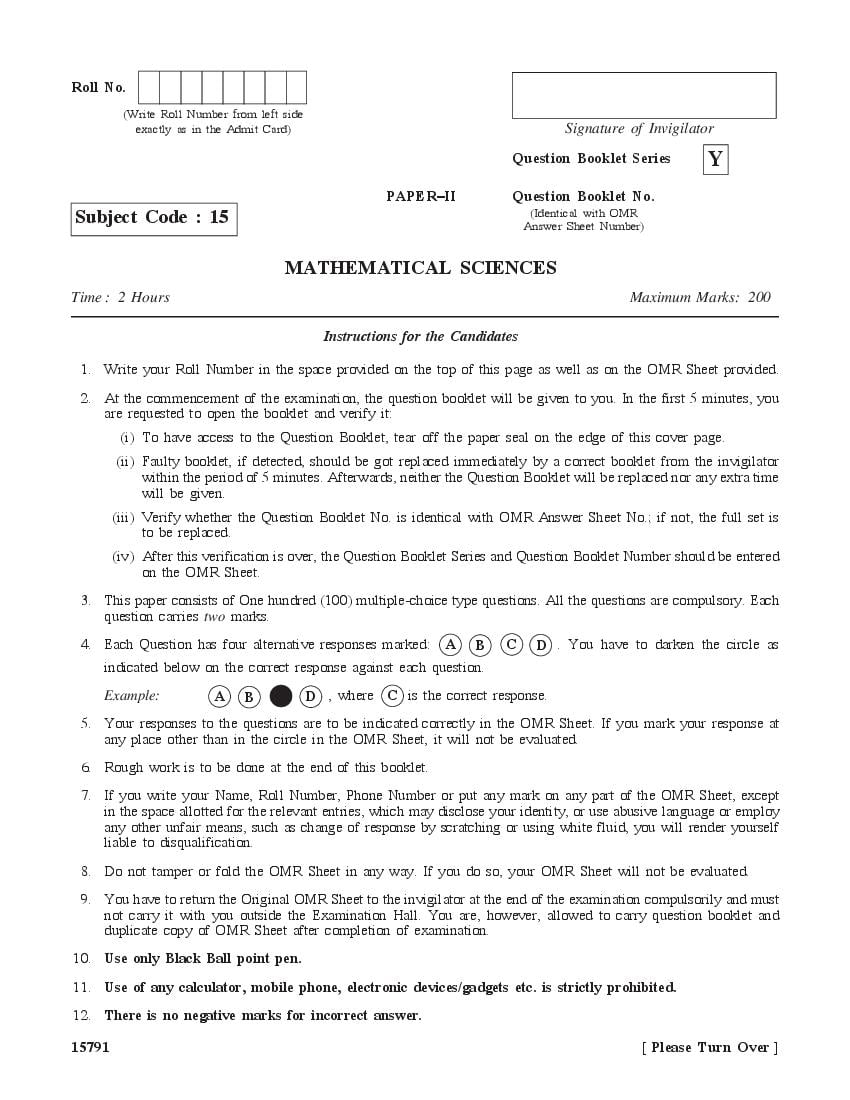
(Write Roll Number from left side
exactly as in the Admit Card) Signature of Invigilator
Question Booklet Series Y
PAPER–II Question Booklet No.
Subject Code : 15 (Identical with OMR
Answer Sheet Number)
MATHEMATICAL SCIENCES
Time : 2 Hours Maximum Marks: 200
Instructions for the Candidates
1. Write your Roll Number in the space provided on the top of this page as well as on the OMR Sheet provided.
2. At the commencement of the examination, the question booklet will be given to you. In the first 5 minutes, you
are requested to open the booklet and verify it:
(i) To have access to the Question Booklet, tear off the paper seal on the edge of this cover page.
(ii) Faulty booklet, if detected, should be got replaced immediately by a correct booklet from the invigilator
within the period of 5 minutes. Afterwards, neither the Question Booklet will be replaced nor any extra time
will be given.
(iii) Verify whether the Question Booklet No. is identical with OMR Answer Sheet No.; if not, the full set is
to be replaced.
(iv) After this verification is over, the Question Booklet Series and Question Booklet Number should be entered
on the OMR Sheet.
3. This paper consists of One hundred (100) multiple-choice type questions. All the questions are compulsory. Each
question carries two marks.
4. Each Question has four alternative responses marked: A B C D . You have to darken the circle as
indicated below on the correct response against each question.
Example: A B C D , where C is the correct response.
5. Your responses to the questions are to be indicated correctly in the OMR Sheet. If you mark your response at
any place other than in the circle in the OMR Sheet, it will not be evaluated.
6. Rough work is to be done at the end of this booklet.
7. If you write your Name, Roll Number, Phone Number or put any mark on any part of the OMR Sheet, except
in the space allotted for the relevant entries, which may disclose your identity, or use abusive language or employ
any other unfair means, such as change of response by scratching or using white fluid, you will render yourself
liable to disqualification.
8. Do not tamper or fold the OMR Sheet in any way. If you do so, your OMR Sheet will not be evaluated.
9. You have to return the Original OMR Sheet to the invigilator at the end of the examination compulsorily and must
not carry it with you outside the Examination Hall. You are, however, allowed to carry question booklet and
duplicate copy of OMR Sheet after completion of examination.
10. Use only Black Ball point pen.
11. Use of any calculator, mobile phone, electronic devices/gadgets etc. is strictly prohibited.
12. There is no negative marks for incorrect answer.
15791 [ Please Turn Over ]
Page 3
MATHEMATICAL SCIENCES
PAPER II
1. A fluid element has a velocity v y 2 xi 2 yx2 j . 5. If a function f : ( a, a) \ {0} (0, ) satisfies
1 1
The motion at ( x, y ) , 1 is lim f ( x) 2 , then
2 x 0 f ( x )
(A) rotational and incompressible. (A) lim f ( x) 0 .
x 0
(B) rotational and compressible.
(C) irrotational and compressible. (B) lim f ( x ) 1 .
x 0
(D) irrotational and incompressible.
(C) lim f ( x) 2 .
x 0
2. If is an estimator of 1 such that
5 5 (D) lim f ( x) does not exist.
P ( 1) 1 n 2 and P ( n 1) n 2 , then x 0
(A) is not consistent
(B) is consistent and MSE 0 as n .
6. Let S ci be an infinite orthonormal set in an
(C) is consistent but MSE 0 as n . incomplete inner product space V. If S is complete, then
n
(D) is consistent but MSE as n .
(A) lim || x x, ci ci || 0 x V
n
i 1
3. Force of mortality at age x, x is
(B) || x || | x, ci | x V
2 2
1 d lx i 1
(A) .
l x dx
(C) for any x, y V , x, ci y, ci
d lx
(B) i x y
dx
(C)
d lx (D) x, y V , x, y x, ci ci , y
dx i 1
1 dl
(D) . x
lx dx
7. Suppose X 1 , X 2 , ..., X n are iid Cauchy (0, 1)
4. Consider the dihedral group
D4 {e, r , r 2 , r 3 , f , rf , r 2 f , r 3 f } variables. Which of the following is not ancillary?
with r 4 e f 2 and rf f r 1 (A) Max ( X , ..., X ) Min ( X , X , ..., X )
1 n 1 2 n
Then the product r3 f r1 f 1 r3 fr corresponds to (B) Min ( X1 , ..., X n ) X
(A) f
Max ( X1, ..., X n ) Min ( X1 , X 2 , ..., X n )
(B) rf (C)
| Max ( X1, ..., X n ) Min ( X1 , X 2 , ..., X n ) |
(C) r 2 f
(D) X | X |
(D) r 3 f
Page 4
8. Trend value of a time series of each time point is
12. The subspace ( x, y ) | y e x of the usual
not available in use of the method of
topological space 2 is homeomorphic to
(A) graphical
(A) Unit circle
(B) least squares
(B) Q
(C) moving averages
(C)
(D) None of the above
(D) – Q
9. If X ,Y is the correlation between X and Y, the 13. The number of positive integers between
correlation between U and V, when U = a + cX and 1 and 1000 which are divisible neither by 2 nor by 5 is
V = b – dY (a, b, c, d > 0) is (A) 100
(A) X ,Y (B) 300
ab (C) 200
(B) cd X ,Y
(D) 400
cd 14. A second degree polynomial regression of y on x
(C) c d X ,Y
was fitted based on A pairs of (xi, yi) values. The following
actual and fitted values are obtained
(D) X ,Y
i 1 2 3 4
10. Consider a one-way ANOVA set up with 5
treatments. However, after scrutiny, it was found that all yi 3 7 9 11
observations were multiplied wrongly by 10 and obtained
SS (Treatment) = 7·50 and SS(Error) = 3·25. If Fc and Yi 5 6 7 *
Fw are the F values based on the correct and wrong set
of observations, respectively, then
However, Ŷ4 was missing. Then
(A) Fw = 10Fc
(A) nothing can be said about the value of Y4
(B) Fw = Fc based on these
(C) Fw < Fc (B) Y4 = 10
(D) Fw = 102Fc (C) Y4 = 11
(D) Y4 = 12
1
11. The zeros of the function f z sin are 15. The equation of Cauchy stress quadratic at
1 z
given by, 1 0 0
P( x1 , x2 , x3 ) for a state stress (ij ) 0 2 0 is
1 0 0 3
(A) zn , n 1, 2, ...
n
(A) 5 x12 2 x2 2 3 x3 2 = constant
1
(B) zn 1 , n 1, 2, ...
n (B) x12 2 x2 2 2 x32 = constant
1
(C) zn 1 , n 1, 2, ... (C) 2 x12 2 x2 2 3 x3 2 = constant
n
1 (D) x12 2 x2 2 3 x32 = constant
(D) zn n , n 1, 2, ...
n (where symbols have their usual meaning)
Page 5
16. Consider literacy rate estimation in a certain 19. Consider the boundary value problem
locality. The investigator wants the estimation error to be u xx u yy 0, x (0, ), y (0, ) ,
at most 2% with at least 90% confidence. What will be u ( x, 0) u ( x, ) u (0, y ) 0 .
the minimum sample size (rounded to the next integer) Any solution of this boundary value problem is of
the form
for the study?
(A) 625 (A) a n sinh nx sin ny
n 1
(B) 1200
(C) 97
(B) a n cosh nx sin ny
n 1
(D) 59
(C) a n sinh nx cos ny
n 1
17. The relation between standarized death rate and (D) a n cosh nx cos ny
n 1
crude death rate of a region A is (STDR)A = Ĉ (CDR)A.
Here the expression of the adjustment factor Ĉ with the
usual notation is
mx Px Px
s s A
(A)
Px mx Px
s s A
20. If X i , i 1(1)5 are iid observation from a N (, 1)
A s A
mx Px Px 5
(B)
distribution, X i is observed as 25. If it is known that
s s A
Px mx Px
i 1
mx Px Px
A s A 0 , then maximum likelihood estimate satisfies
(C)
Px mx Px
s A A
(A) 5
(D) None of the above
(B) 2
(C) 1
18. Consider the following statements:
(D) 0
S1 : Every monotone function on [a, b] is of
bounded variation on [a, b].
S2 : Every continuous function on [a, b] is of
bounded variation on [a, b].
S3 : Every function of bounded variation on
[a, b] is absolutely continuous on [a, b].
S4 : Every absolutely continuous function on
[a, b] is a function of bounded variation on 3 y
21. x log is a homogeneous function of x and
[a, b]. x
Then, y of degree
(A) only S1 and S2 are correct. (A) 0
(B) only S1 and S3 are correct. (B) 1
(C) only S1 and S4 are correct. (C) 2
(D) only S2 and S4 are correct. (D) 3
Page 6
22. State which of the following is not correct. 25. A nonconstant entire function
(A) Point transformations are also canonical (A) has at least one zero in .
transformation.
(B) cannot have finite number of real zeros.
(B) Contact transformations are canonical
transformations in extended phase space. (C) cannot have countable number of zeros in a
bounded region of .
(C) Gauge transformations are canonical
transformation. (D) cannot have uncountable number of zeros
in .
(D) Under canonical transformation Hamiltonian
equations need not be invarient.
26. Consider the optimization problem,
Maximize z 2 x1 x1 x2 3 x2
subject to x12 x2 3 .
23. Suppose E ( y1 ) E ( y2 ) ,
Then Global maximum of z
Var ( y1 ) 5 2 , Var ( y2 ) 2 2 13 .
(A) is equal to
2
Cov ( y1 , y2 ) 2 .
(B) is equal to
19 .
Which of the following is BLUE of ? 43
(C) occurs at more than one point.
y y2
(A) 1
2 (D) does not exist.
y y
(B) 1 2
5 2 15 12
2 y1 3 y2
(C)
5 27. The equation of the circular hellix is
y1 4 y2 (A) x a cos t , y b sin t , z ct
(D)
5
(B) x a cos t , y a sin t , z bt
2
(C) x a cos t , y a sin t , z ct
(D) x a cos t , y b sin t , z c
where a, b, c are constants.
24. In control chart for fraction defective for varying
subgroup sizes, the control limits in standardized method is
p(1 p) p (1 p ) 28. Among the designs CRD, RBD, LSD
(A) LCL p 3 ni
,UCL p 3
ni
(A) only CRD is orthogonal.
(B) LCL p 3 p(1 p),UCL p 3 p(1 p) (B) only RBD is orthogonal.
(C) LCL = –3, UCL = 3 (C) only LSD is orthogonal.
(D) None of the above (D) all are orthogonal.
Page 7
29. Suppose y1 , y2 , y3 are iid observations from 33. The complete graph of n vertices contains two
edge disjoint spanning tree if and only if
N ( 1 2 , 1) distribution. Then
(A) n < 3
(A) ML estimator of 1 is Y1 . (B) n 4
(C) n < 4
(B) ML estimator of 2 is Y .
(D) n 3
(C) The family of distribution is not identifiable.
(D) 2 and 1 are separately estimable by the
method of moments.
34. If N is the incidence matrix of a symmetric BIBD
(v = b, r = k, ), which of the following is not true?
30. Let G be a commutative group of order 202. Then (A) (r – ) is always a perfect square.
the number of element(s) of order 2 in G is
(B) N N (r ) I v 1 1
(A) 1
(C) |N| is any positive real number.
(B) 2
(C) 4 (D) NN (r ) I v 1 1
(D) 101
35. State which of the following is correct:
31. Let A be a 3 × 3 matrix with real entries such that
det (A) = 6 and the trace of A is 0. If det (A + I) = 0 where (A) Derived sets in a topological space are closed.
I denotes the 3 × 3 identity matrix, then the eigenvalues (B) Derived set of a subset of (real line) under
of A are usual topology is closed.
(A) –1, 2, 3 (C) Closed subsets of a compact topological space
(B) –1, 2, –3 are not compact.
(C) 1, 2, –3 (D) Compact subsets of a Hausdorff space are
not closed.
(D) –1, –2, 3
32. Let E be a subset of . Then cos(e z )
(A) if E is Lebesgue measurable then E is a Borel
36. The value of the integral z
dz is given
| z |1
set.
by
(B) if E is not a Borel set then E is Lebesgue
measurable. (A) 2i cos(e)
(C) if E is a Borel set then E is Lebesgue (B) i cos(1)
measurable.
(C) 2i sin(e)
(D) If E is a Borel set then E is not Lebesgue
measurable. (D) i ei e i
Page 8
37. Which of the following statements is not true 41. Which of the following curve can give an
( z ) ? extremum of the functional,
J ( y ( x )) ( y 2 12 xy ) dx ,
(A) z n and z n2 have the same radius of
n
0
dy
convergence. y (0) 0, y (1) 1, y ?
dx
(B) z n converges nowhere on the boundary of (A) y x 2
the disk of convergence. (B) y 2 x 2
(C) z n2 converges everywhere on the
n (C) y x 3
boundary of the disk of convergence. (D) y 2 x3
(D) z n converges everywhere on the boundary
of the disk of convergence.
42. A characteristic number and the corresponding
characteristic function ( x ) of the homogeneous
Fredholm integral equation with Kernel
38. Let x1 and x2 be two real numbers. Then which
of the following is a convex set?
K ( x , t ) x (t 1), 0 x t are
t ( x 1), t x 1
(A) X 1 ( x1 , x2 ) : x12 x2 2 16 (A) 2 , ( x ) sin x
(B) X 2 ( x1 , x2 ) : x2 2 4 x1 (B) 2 2 , ( x ) sin 2 x
(C) X 3 ( x1 , x2 ) : x1x2 4 (C) 2 2 , ( x ) cos x
(D) 2 , ( x ) cos 2 x
(D) X 4 ( x1, x2 ) : x1 5, x2 3
43. In a primal problem, the 4th constraint is an
39. Let (X, S, ) be an arbitrary signed measure space. equation and the 3rd variable is unrestricted in sign. Then
Then the nature of the 4th dual variable and the 3rd dual
constraint will be respectively
(A) (X, S, ) may not admit a Hahn decomposition.
(A) unrestricted in sign and equation.
(B) (X, S, ) admits a Hahn decomposition.
(B) non-negative and equation.
(C) may not admit a Jordan decomposition.
(C) non-negative and inequation.
(D) admits a Jordan decomposition which is
not necessarily unique. (D) unrestricted in sign and inequation.
44. Total number of zeros of the function
40. Let X1, X2, X3, X4 be independent N(0, 1) random
variables. The distribution of Y = X1 X2 – X3 X4 is f ( z ) z 4 5 z 1 within the annulus 1 | z | 2 is
(A) Logistic (A) 1
(B) Cauchy (B) 2
(C) Normal (C) 3
(D) Laplace (D) 4
Page 9
45. Which of the following is not correct? 48. If M and N be two smooth functions from 2 to ,
then the form “Mdx + Ndy” is exact if and only if which
(A) Bounded operators defined on normed linear
of the following is/are true?
spaces are continuous.
(i) a smooth function f such that Mdx + Ndy = f
(B) Compact operators need not be a completely
continuous operator. (ii) M N for all x and y
y x
(C) Identity operator is not always continuous.
(D) Identity operator is always continuous. (iii) curl ( Mi Nj ) 0
(A) (i) and (ii)
(B) (i) and (iii)
(C) (ii) and (iii)
46. Consider a finite population U {1, 2, 3} with (D) (i), (ii) and (iii)
p ({1, 2}) 1 ,
2
p ({1, 3}) 1 , p ({2, 3}) 1 .
4 4
Then which of the following is not true?
3 3
x3
(A) 3
49. On evaluating y dxdy numerically by
1 4 1 1
Simpson’s 1 rd rule one would get the value
3
(B) 2 3 4
(A) 26
3
(C) 1 2 3 1
(B) 100
9
(D) 1 2 3 2 (C) 20
9
[ k : first order inclusion probability of the k-th (D) 200
9
unit]
47. The partial differential equation of the set of all
right circular cones whose axes coincide with z-axis is 50. Let An be a sequence of events such that
z z { a , b , c , d } , if n is odd
(A) x y An
x y .
{b , d , e , f } , if n is even
z z Then which of the following is correct?
(B) y x
x y
(A) limAn lim An
2 2 z y2 2 z
(C) x (B) lim An {b, c, d , e, f }
x 2 y 2
(C) lim An {b , d }
2 2 z x2 2 z
(D) y (D) nlim An doesn’t exist.
x 2 y 2
Page 10
51. In the group of all invertible 4 × 4 matrices with
55. Let X n n 0 be a branching process with
entries in the field of three elements, any Sylow
3-subgroup has cardinality X 0 1 and P s be the probability generating function
(A) 3
of X1 . Let Yn X1 X 2 ... X n be the total number of
(B) 81
individuals up to the nth generation and H n s be the
(C) 243
probability generating function of Yn . Then H n1 s is
(D) 729
(A) sH n s
(B) sP H n s
52. Let and be two positive real numbers. If the
number of optimal solutions of the LPP
P Hn s
max z x y (C)
s
subject to
Hn s
3x 4 y 7 (D)
s2
x y 20
x 0, y 0 56. Let F(x) be a distribution function (d.f.) given by
is infinite, then which of the following is possible?
0 , x 0
(A) = 3, = 4
F x 1 1
2 2 1 e , x 0.
x
(B) = 4, = 3
(C) = 3, = 3
3 Then which of the following is correct?
(D) = , = 2
2 (A) F is a discrete d.f.
(B) F is a continuous d.f.
53. Suppose X is distributed with PDF (C) F is a mixture of d.f.s
f ( x) e x , x . (D) None of the above statement is correct.
(1 e x )2
57. The number of subfields of a field of cardinality
Then P{X – X = 0} equals
3100 is
(A) 0 (A) 3
(B) 1 (B) 9
(C) 1 (C) 25
2
(D) 100
(D) 1
4
58. Which of the following statement is not true?
(A) Every Euclidean ring is a unique factorization
54. A three unit parallel system has independent domain.
components with reliabilities 0·2, 0·3 and 0·4 respectively. (B) Every unique factorization domain is an
Then the reliability of the system is Euclidean ring.
(A) 0·024 (C) Every integral domain can be embeded in a
(B) 0·336 field.
(C) 0·664 (D) Ring of polynomials F[x], where F is a field,
(D) 0·886 is a principal ideal ring.
Page 11
59. The Lagrangion L of a dynamical system is 63. Let L { y (t )} denote the Laplace transformation
L q12 q22 K1q12 and p1 , p2 are the generalised
o o
t
momenta corresponding to the generalised coordinates of y (t ) and y ( x ) y (t x) dx 16 sin(4t ) . Then
q1 , q2 (with K1 , a constant). Then the Hamiltonian H is 0
given by L { y (t )} is given by
(A) H p12 p2 2 K1q12 (A)
8
p 2 42
(B) H p12 p22 K1q12
1
2 18
(B)
(C) H 4 p12 p2 2 K1q12 p 2 42
4p
(D) H
4 1 2
1 p2 p 2 K q2
1 1
(C)
p 2 42
(D) 4
60. If the P value of a test is 0·02, then p 2 42
(A) it must be rejected at 1% level of where p is the transformed variable.
significance.
(B) it cannot be rejected at 5% level of
significance.
(C) it must be accepted at 1% level of
significance.
(D) it is rejected at 5% level of significance.
64. The rate of convergence of the interation process
x 2
61. For the first order auto-regressive series xn1 1 xn 6 3a2 n if xn a is
8 xn a
Ut 1 a. U t t 1 ,| a | 1, where t ’s are independent
with zero mean, then the correlogram is (A) 2
(A) ak (B) 3
(B) a k (C) 1
1 (D) 4
(C) a k
1
(D) a k
62. For a symmetric distribution, which of the
following is not necessarily true?
(A) Mean = Median 65. If E is uncountable, then
(B) Mean = Median = Mode (A) E has no limit point.
(C) First and third quartiles are equidistant from (B) E has countably many limit points.
median.
(C) E has uncountably many limit points.
(D) First and third quartiles are equidistant from
mean. (D) E has finitely many limit points.
Page 12
66. Let f : [0, 1] (0, 1) be a continuous function 69. Let X i , i 1(1) n be iid Poisson ( ) variables. If
and f n ( x) f ( x) for all n . Then
n
T X 2 X , then
n
(A) { f n } converges to f pointwise but not (A) T is MVUE of 2 and attains Crammer-Rao
uniformly. lower bound.
(B) { f n } converges to f uniformly. (B) T is not MVUE of 2 and attains Crammer-
Rao lower bound.
1 1
(C) lim f n ( x )dx f ( x )dx . (C) T is MVUE of 2 and attains Crammer-
n
0 0 Rao lower bound.
1
(D) T is MVUE of 2.
(D) lim f n ( x )dx 0 .
n
0
70. A solution (upto third approximation) of the
dy
equation y x such that y 1 when x 0 by
dx
67. Let T1 be the topology generated by the family of Picard’s process of successive approximation is
all open disks on 2 and let T2 be the topology generated 3 4 5
by the family of all open squares on 2. Then (A) y 1 x x 2 x x x
3 12 120
(A) T1 and T2 are non-comparable. 3 4
(B) y 1 x x 2 x x
(B) T1 is strictly smaller than T2. 3 24
3
(C) T2 is strictly smaller than T1 (C) y 1 x x 2 x
6
(D) T1 = T2
2 3
(D) y 1 x x x
2 6
68. Suppose X1 , ..., X n are iid observations from 71. If μ̂ and ̂ are the maximum likelihood estimators
Bernoulli ( ) distribution. If it is known apriori that of μ and based on a random sample of size N from
1 2 , then expected Fisher information, N p μ, , then
3 3 I ( )
based on n observations is (A) μ̂ and ̂ are unbiased estimators of μ and
respectively.
(1 )
(A) I ( )
n (B) μ̂ is unbiased for μ where as ̂ is not
(B) I ( )
n unbiased for .
(1 )
(C) ̂ is unbiased for where as μ̂ is not
(C) I ( ) 9 n unbiased for μ .
2
(D) not defined (D) None of the above statement is correct.
Page 13
72. The eigenvalues of the integral equation 75. Let {xn } be a sequence of real numbers. Then
2
lim xn exists if and only if
y ( x ) sin ( x t ) y (t ) dt are n
0
(A) lim x2 n and lim x2n 1 exist.
(A) 1 , 1 n n
2 2
(B) lim x2 n and lim x2 n 2 exist.
(B) 1 , 1 n n
(C) , (C) lim x2 n , lim x2 n 1 and lim x3n exist.
n n n
(D) 2 , 2
(D) lim x3n and lim x2n exist.
n n
dz
76. The value of , where C : z 3i 1 , is
73. The solution of the initial value problem z ( z i)
C
2 u 4 2 u , t 0, x satisfying the
t 2 x 2 (A) i
u ( x, 0) 0 (B) i
conditions u ( x, 0) x, is
t
(C) 2i
(A) x
(B) 2x (D) 0
2
(C) x
2
77. Zero opportunity cost in the optimal transportation
(D) 2t table for a non-basic variable indicates
(A) unbounded solution.
(B) no feasible solution.
(C) degenerate solution.
74. For what value of K, the function (D) the existence of alternative optimal solution.
1
sin ( xy 2)
1 , ( x, y ) (1, 2)
tan (3xy 6)
f ( x, y ) 78. Suppose 6 observations 5·1, 5·6, 7·8, 8·1, 9·2 and
K ( x, y ) (1, 2)
10·3 are available from a continuous population indexed
is continuous at (1, 2)? by F ( x ) . A level 0·05 sign test for H 0 : 0 against
H1 : 0 rejects the null hypothesis if number of positive
1
(A) observations is either at least 5 or at most 1. Then a
2
1 confidence interval of with confidence coefficient at
(B)
3 least 95% (but less than 100%) is
1 (A) [5·6, 9·2)
(C)
4 (B) [5·6, 10·3)
3 (C) [5·1, 9·2)
(D)
4 (D) [5·1, 10·3)
Page 14
Z 82. Let X1, X2, X3, X4 be independent and identically
79. Let Fp denote the field pZ , where p is a prime
distributed random variables with probability density
and Z is the set of integers. Let Fp [ x ] be the associated function
polynomial ring. Then which of the following ring(s)
1 , 0 x 1
is/are field? f x
0 , otherwise.
(i) F5 [ x ] / [ x 2 x 1] If X (4) and X (1) are order statistics, then
(ii) F2 [ x ] / [ x3 x 1]
E X 4 X 1
(iii) F3 [ x] / [ x3 x 1]
3
(A) Both (i) and (ii) (A) 5
(B) Both (ii) and (iii) 1
(B)
5
(C) Both (i) and (iii)
10
(D) All of the above (C)
7
5
(D) 8
80. Which of the following matrices is a Jordan
block?
2 1 0
(A) 0 2 1
0 0 7
83. Based on a single observation X, consider testing
3 0 0 H 0 : X ~ p0 ( x ) against H1 : X ~ p1 ( x ) , where
(B) 0 3 1
0 0 3 x p0 ( x ) p1 ( x )
4 1 0 –1 0·02 0·03
(C) 0 4 1 0 0·03 0·07
0 0 4
1 0·45 0·03
3 1 0 2 0·03 0·07
(D) 0 3 0
0 0 3
3 0·02 0·50
4 0·02 0·10
5 0·03 0·05
| x|
81. The Fourier transform of f ( x ) e is 6 0·02 0·05
2 1 7 0·03 0·03
(A) K2 4 8 0·30 0·02
1 9 0·05 0·05
(B) 2 K2 4 Then the number of non-randomized size 0·05
tests for the above problem is
1
(C) 2 K 2 1 (A)
2 1 (B) 12
(D) K 2 1 (C) 17
(where K is the transform variable) (D) 10
Page 15
87. Let A = { z : z – 2+ z + 1 3}. Then
84. Let A~W p n, , A and are partitioned as
(A) A is a bounded, closed subset of .
A11 A12 12
A and 11 respectively, (B) A is an unbounded proper subset of .
A A22
21 21 22
(C) A = .
where A11 and 11 are matrices of order q × q, q < p.
(D) A is an unbounded subset of which is not
Which of the following statement is correct? closed.
(A) A12 ~ W p q n, 12
88. If f is a real valued function which is continuous
on and satisfies
(B) A11·2 A11 A12 A22 A21 ~ Wq n, 11·2
1
x y f ( x) f ( y)
where 11·2 11 12 221 21
f x, y , f (0) 1
2 2
and f (0) 2 , then f (2) is equal to
(C) A11 ~ Wq n, 22
(A) 2
(D) None of the above statement is correct.
(B) 0
(C) 5
(D) 3
85. If the Hamiltonian of a dynamical system is given
by H p1 q1 p2 q2 aq12 bq2 2 where a and b are 89. For a non-homogenous Poisson process
constants, then
p2 bq2
is N t , t 0 , the correlation coefficient between N(s)
q1
and N(t) for s < t is
(A) a function of q1 only. s
(A) t
(B) a function of q1 and q2 .
s
(B)
(C) a constant. t
(C) st
(D) a function of p1 , q1 , p2 , q2 .
(D) st
90. Which of the following is/are correct?
86. The norm of the linear functional f defined on (i) Centre of special linear group SLn (3) is a cyclic
0 1 group.
C [–1, 1] by f ( x) x(t ) dt x (t )dt is (ii) Order of centre of complex special orthogonal
1 0
(A) 0 group SO3 (n) is 2.
(B) 1 (iii) SLn (3) / Z , Z is the set of integers, is simple.
(C) 2 (iv) SOn (3) / Z , Z is the set of integers, is simple.
(D) 3
(A) Only (i) and (ii)
where C [–1, 1] denotes the Banach space of all (B) Only (iii) and (iv)
real valued continuous functions x(t ) on [–1, 1] with (C) Only (i) and (iv)
norm given by || x || max | x(t ) | .
t[ 1, 1] (D) All of the above
Page 16
91. Which of the following is not a characteristic 95. Let A be a 2 × 2 real matrix such that trace of
function? A is 5 and determinant of A is 6. Then the eigenvalues of
the matrix A2 – 2A + I2 (where I2 is 2 × 2 identity matrix)
1 are
(A) cos ht
(A) 1, 4
(B) cos t (B) 2, 3
2
(C) 1 cos t (C) 5, 6
(D) 11, 30
|t|
(D) e ,0 2.
92. Let X be a non-negative integer-valued random
variable satisfying the condition
P X m 1| X m P X 1
for every non-negative integer m.
96. Let R a a | a . Then with respect to usual
aa
Then the distribution of X is addition and multiplication of matrices R forms a(an)
(A) Exponential (A) Noncommutative Ring without identity.
(B) Poisson (B) Commutative Ring with identity but not an
integral domain.
(C) Geometric
(C) Integral domain but not a field.
(D) Binomial
(D) Field.
93. Solution of the Cauchy problem u x xu y 0
with u (0, y ) sin y is
1
(A) u ( x, y ) sin y x 2
2
(B) u ( x, y ) sin x y
1 2 97. For a positive integer n, let Pn denote the space of
2
all polynomials p ( x ) with coefficients in such that
(C) u ( x, y ) sin xy
1 deg p( x ) n and let Bn denote the standard basis of
2
Pn given by Bn {1, x, x 2 , ..., xn } . If T : P3 P4 is the
(D) u ( x, y ) sin xy
1
linear transformation defined by
2
x
T p ( x ) x 2 p( x ) p(t ) dt and A ( aij )
94. Let f be a real-valued continuous function on . 0
is the 5 × 4 matrix of T with respect to the
Let A {x | 2 f ( x) 5} , B = Q and C be the
standard bases B3 and B4 , then
Cantor ternary set. Then
3 7
(A) A, B, C all are Borel sets. (A) a32 and a33
2 3
(B) only A is a Borel set, but B, C are not Borel 3
sets. (B) a32 2 and a33 0
(C) only A, B are Borel sets, but C is not a Borel 7
(C) a32 0 and a33
set. 3
(D) none of the A, B, C is a Borel set. (D) a32 0 and a33 0
Page 17
2u 2 y 2 u 4 x 2 u 0 99. The degree of splitting field of f ( x) x 4 2
98. The nature of xy is
x 2 y 2 over Q(set of rationals) is
(A) parabolic on the parabola y 2 4 x in the (A) 8
xy-plane (B) 2
(B) elliptic outside the parabola y 2 4 x in the (C) 4
xy-plane. (D) 6
(C) hyperbolic inside the parabola y 2 4 x in
the xy-plane. 100. Let V be a vector space of all 4 × 4 real matrices
(D) parabolic everywhere in the xy-plane. and T : V be a map, defined by
T(A) = trace A, A V .
Then
(A) T is not a linear map.
(B) T is a linear map and dim (Ker T) = 8.
(C) T is a linear map and dim (Im T) = 1.
(D) T is a linear map and dim (Ker T) = 16.
Page 18
ROUGH WORK
Page 19
ROUGH WORK
Page 20
ROUGH WORK
Document Details
| Board / Org | Default |
| Exam | Govt Jobs Exams |
| Type | Question Paper |
| Pages | 20 |
| Updated | 30 Apr 2026 |