WB SET 2020 Question Paper 2 Geography
Finished viewing? Save it for later —
Download WB SET 2020 Question Paper 2 Geography (PDF · 16 pages)About WB SET 2020 Question Paper 2 Geography
WB SET 2020 Question Paper 2 Geography is available here for free download. Published by Default for Govt Jobs Exams, this question paper can be viewed online or downloaded as a PDF (16 pages). Candidates preparing for Govt Jobs Exams can use WB SET 2020 Question Paper 2 Geography to understand the exam pattern, the type of questions asked, and the overall difficulty level.
Frequently Asked Questions
How can I download WB SET 2020 Question Paper 2 Geography?
Open this page and click the Download button to save WB SET 2020 Question Paper 2 Geography as a PDF. It is completely free on AglaSem Docs.
Is WB SET 2020 Question Paper 2 Geography free to download?
Yes. WB SET 2020 Question Paper 2 Geography can be viewed online and downloaded as a PDF free of cost on AglaSem Docs.
How many pages does WB SET 2020 Question Paper 2 Geography have?
WB SET 2020 Question Paper 2 Geography contains 16 pages, which you can read online or download together as a single PDF.
Where can I find more Govt Jobs Exams study material?
You can find more Govt Jobs Exams question papers, sample papers, syllabus, and answer keys on AglaSem Docs.
WB SET 2020 Question Paper 2 Geography – Text
Read the full text of this question paper below — useful to quickly search, copy and reference the content online without downloading the PDF.
📄 View text version (15 pages)
Page 1
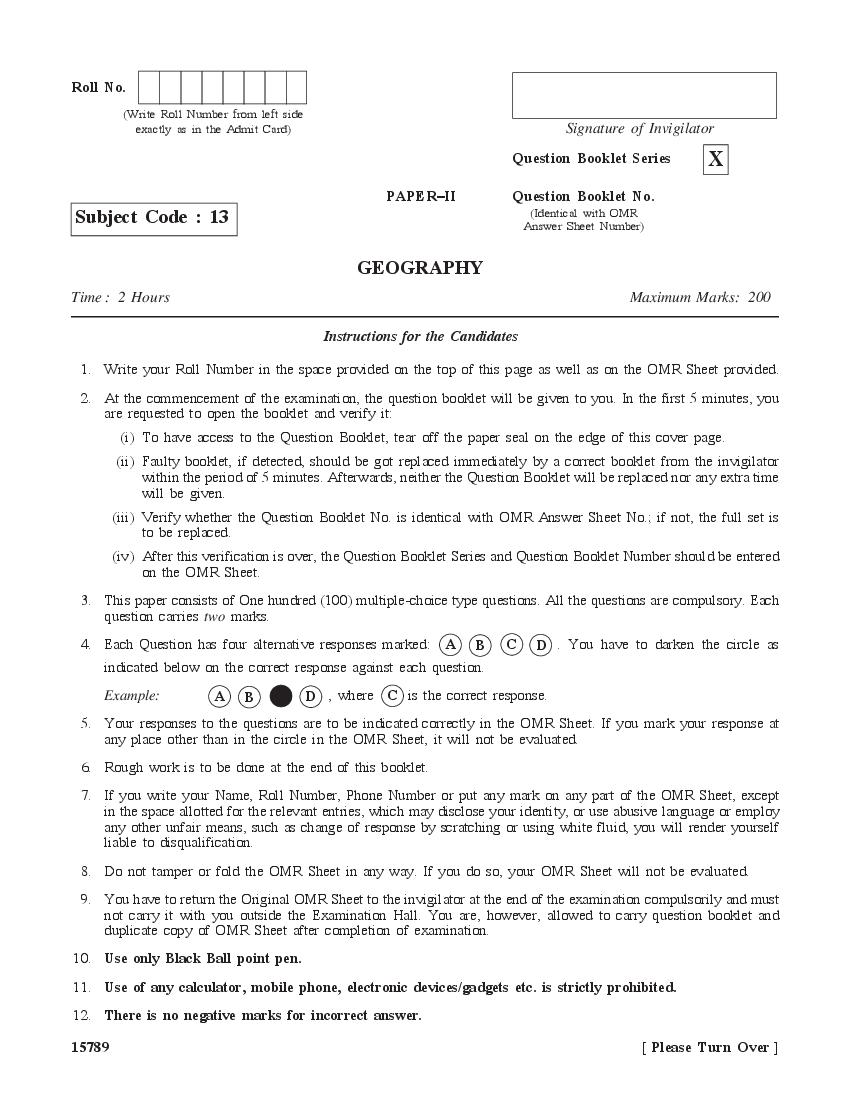
(Write Roll Number from left side
exactly as in the Admit Card) Signature of Invigilator
Question Booklet Series X
PAPER–II Question Booklet No.
Subject Code : 13 (Identical with OMR
Answer Sheet Number)
GEOGRAPHY
Time : 2 Hours Maximum Marks: 200
Instructions for the Candidates
1. Write your Roll Number in the space provided on the top of this page as well as on the OMR Sheet provided.
2. At the commencement of the examination, the question booklet will be given to you. In the first 5 minutes, you
are requested to open the booklet and verify it:
(i) To have access to the Question Booklet, tear off the paper seal on the edge of this cover page.
(ii) Faulty booklet, if detected, should be got replaced immediately by a correct booklet from the invigilator
within the period of 5 minutes. Afterwards, neither the Question Booklet will be replaced nor any extra time
will be given.
(iii) Verify whether the Question Booklet No. is identical with OMR Answer Sheet No.; if not, the full set is
to be replaced.
(iv) After this verification is over, the Question Booklet Series and Question Booklet Number should be entered
on the OMR Sheet.
3. This paper consists of One hundred (100) multiple-choice type questions. All the questions are compulsory. Each
question carries two marks.
4. Each Question has four alternative responses marked: A B C D . You have to darken the circle as
indicated below on the correct response against each question.
Example: A B C D , where C is the correct response.
5. Your responses to the questions are to be indicated correctly in the OMR Sheet. If you mark your response at
any place other than in the circle in the OMR Sheet, it will not be evaluated.
6. Rough work is to be done at the end of this booklet.
7. If you write your Name, Roll Number, Phone Number or put any mark on any part of the OMR Sheet, except
in the space allotted for the relevant entries, which may disclose your identity, or use abusive language or employ
any other unfair means, such as change of response by scratching or using white fluid, you will render yourself
liable to disqualification.
8. Do not tamper or fold the OMR Sheet in any way. If you do so, your OMR Sheet will not be evaluated.
9. You have to return the Original OMR Sheet to the invigilator at the end of the examination compulsorily and must
not carry it with you outside the Examination Hall. You are, however, allowed to carry question booklet and
duplicate copy of OMR Sheet after completion of examination.
10. Use only Black Ball point pen.
11. Use of any calculator, mobile phone, electronic devices/gadgets etc. is strictly prohibited.
12. There is no negative marks for incorrect answer.
15789 [ Please Turn Over ]
Page 3
GEOGRAPHY
PAPER II
1. Green data book containing a list of 5. The luxurient growth of natural vegetation in
(A) Rare plant species tropical rain forests is due to
(B) Rare plants and animals 1. the fertile soil.
(C) Endangered plants 2. hot and wet weather throughout the year.
(D) Extinct animal only 3. the intense sunlight for photosynthesis.
4. seasonal change to facilitate nutrient absorption.
Select the correct answer from the codes given below:
2. The following two lists state the name of Bird (A) 1 and 4
Sanctuaries and the States where they are situated. (B) 2 and 3
Match the Bird Sanctuary with their respective State. (C) 1, 2 and 3
List-I (Bird Sanctuary) List-II (Name of States) (D) 2, 3 and 4
(a) Sultanpur (i) Hariyana
(b) Bharatpur (ii) Rajasthan
(c) Nawabganj (iii) Uttar Pradesh
(d) Ranganthithu (iv) Karnataka 6. Which of the following is not a greenhouse gas?
Select the correct answer from the codes given below: (A) Methane
(a) (b) (c) (d) (B) Argon
(A) (ii) (i) (iii) (iv) (C) Carbon dioxide
(B) (ii) (i) (iv) (iii) (D) Water vapour
(C) (i) (ii) (iv) (iii)
(D) (i) (ii) (iii) (iv)
7. Assertion (A) : Soil management is fundamental
3. The terms ‘Pedocals’ and ‘Pedalfers’ were first to agricultural system.
proposed by Reason (R) : Managing the soil nutrients, water
(A) Hilgard and air within soil system is
(B) Marbut fundamental to plants’ growth.
(C) Dakuchaev (A) Both (A) and (R) are correct and (R) is the
(D) Neustreuev correct explanation of (A).
(B) Both (A) and (R) are correct but (R) is not the
correct explanation of (A).
4. Which of the following leaf modifications occur (C) (A) is true but (R) is false.
in the desert areas to inhibit water loss? (D) (A) is false but (R) is true.
1. Hard and waxy leaves
2. Tiny leaves or no leaves
3. Drip-tip leaves
4. Thorn instead of leaves 8. Which one of the following is the main source of
Select the correct answer using the codes given below: CO pollution by human practices?
(A) 1, 2 and 3 (A) Heavy Industries
(B) 2 and 3 (B) Automobile Industries
(C) 1, 2 and 4 (C) Advanced Agricultural Practices
(D) 1 and 4 (D) Mining Activities
Page 4
9. Which of the following countries has the longest 13. Greta Thurnberg, who delivered a sensational
stretch of the proposed Asian Highway Network? speech on a panel at the UN climate summit in New York
(A) Kazakhstan on 23 September 2019 is a citizen of
(B) Iran (A) Sweden
(C) India (B) Iceland
(D) Thailand (C) Norway
(D) Finland
10. A lake created by meteorite impact in India is
(A) Lonar 14. Geostrophic Wind is originated when
(B) Sambar (A) pressure gradient force is equal to Coriolis
(C) Tso Kar force.
(D) Loktak (B) pressure gradient force is balanced by
Coriolis force acting in opposite direction.
(C) pressure gradient force is balanced by
Coriolis force and centrifugal acceleration
acting together.
11. Between which of the following mountain ranges (D) divergence is equal to convergence.
the valley of Kashmir is situated?
(A) The Karakoram and the Pir Panjal Ranges
(B) The Pir Panjal and the Zaskar Ranges
(C) The Ladakh and the Zaskar Ranges
(D) The Kirthar and the Sulaiman Ranges 15. The ratio of the weight of water vapour in a parcel
of the atmosphere to the total weight of moist air is
(A) Specific humidity
(B) Absolute humidity
(C) Relative humidity
12. As per India Meteorological Department (IMD)
(D) Mixing ratio
which of the following statements is true?
1. July is the rainiest month in India.
2. Withdrawal of the South-West Monsoon and
setting in of Winter Monsoon take place in the
middle of October.
16. The correct sequence of the cloud types with
3. The South-West Monsoon usually covers the height from the ground level is
whole country by the end of July.
(A) Altocumulus, Cirrocumulus, Stratocumulus,
4. June to September is the normal period of Cumulus
occurence of the South-West Monsoon.
(B) Cumulus, Stratocumulus, Altocumulus,
Select the correct answer from the codes given below: Cirrocumulus
(A) 1, 2 and 3 (C) Stratocumulus, Altocumulus, Cumulus,
(B) 1, 2, 3 and 4 Cirrocumulus
(C) 2, 3 and 4 (D) Cumulus, Altocumulus, Cirrocumulus,
(D) 1, 2 and 4 Stratocumulus
Page 5
17. Images from which of the following Satellites 20. Assertion (A) : Mackinder’s theory of Heartland
does not provide information on weather elements? put forward a key formula “who
(A) RESOURCESAT-I rules Europe, commands the
Heartland; who rules Heartland,
(B) INSAT-1
commands the World Island; who
(C) METEOSAT rules the World Island command
(D) NOAA the world.”
Reason (R) : Mackinder’s formula offered
Stalin’s strategy for territorial
expansion and international
supremacy.
(A) Both (A) and (R) are true but (R) is not the
correct explanation of (A).
18. Which of the following conditions are favourable
(B) Both (A) and (R) are true and (R) is the
for the formation of dew?
correct explanation of (A).
1. Nocturnal radiative cooling below dew point
(C) (A) is true but (R) is false.
temperature of the air resting near earth’s surface.
(D) (A) is false but (R) is true.
2. Warm previous day to raise the moisture content
of air.
3. Calm evening without turbulence in the
atmosphere.
4. Clear sky. 21. Form a group of three most closely-related words
by selecting one from each of the three columns.
Select the correct answer from the codes given below:
(a) Kerghelen (e) Continental (i) Ninety east
(A) 1 and 2
Hotspot convergence Ridge
(B) 1, 2 and 3
(b) Central Asia (f) Eruption of (j) Formation of
(C) 1, 2, 3 and 4 ocean island Pangaea
(D) 2, 3 and 4 basalt
(c) Red Sea (g) Strike-slip (k) Normal
faults faults
(d) Appalachian (h) Continental (l) Indentation
mountain rifting tectonics
(A) a-f-j; b-e-i; c-h-k; d-g-i
19. Which among the following is/are the major (B) a-f-k; b-g-i; c-h-i; d-e-j
factor/factors responsible for the monsoon type of (C) a-f-i; b-g-l; c-h-k; d-e-j
climate in India?
(D) a-h-i; b-g-j; c-f-k; d-e-l
1. Location
2. Thermal contrast
3. Upper air circulation
4. Inter-tropical convergence zone 22. The most significant plate-driving force is
Select the correct answer from the codes given below: considered to be
(A) 1 (A) Ridge-push
(B) 2 and 3 (B) Slab-pull
(C) 2, 3 and 4 (C) Basal drive
(D) 1, 2, 3 and 4 (D) Trench suction
Page 6
23. A river’s channel pattern may alter from braided 28. Arrange the following concepts in order in which
to meandering due to the following change in its they evolved. Select the correct answer from the codes
catchment area: given below the concepts.
(A) Increase in rainfall I. Principle of Uniformitarianism
(B) Decrease in rainfall II. Theory of Continental Drift
(C) Urbanisation III. Dynamic Equilibrium Theory
(D) Deforestation IV. Theory of Convection Current
Codes:
24. Which of the following is the most ideal conditions (A) (I) (III) (IV) (II)
for the chemical weathering of rocks? (B) (II) (I) (IV) (III)
(A) Cold and dry climate
(C) (IV) (I) (II) (III)
(B) Hot and humid climate
(D) (I) (II) (IV) (III)
(C) Hot and dry climate
(D) Cold and humid climate
29. When two meander necks do not come closer but
25. Which of the following features is the indication a channel from one neck joins to other and the main flow
of a rejuvenation process in a river valley? turns on that channel is termed as
(A) Braiding stream (A) Parallel channel flow
(B) Structural terrace (B) Semi-neck cut off
(C) Alluvial fans (C) Chute cut off
(D) Entrenched meanders (D) Non-neck cut off
26. Rock-walled steep depressions caused by the 30. Superimposed profile is drawn to understand the
collapse of ground surface in Karst geomorphology is (A) break of slope.
called as
(B) ruggedness of topography.
(A) Cockpits (C) panoramic view.
(B) Poljes (D) cyclic nature of landscape.
(C) Grykes
(D) Sinkholes
31. In a periglacial environment, pingos form due to
27. Assertion (A) : By far the most common and (A) Ice wedge coalescence
widespread topographic form in a (B) Ice core growth
Karst terrain is the sinkhole. (C) Ice action
Reason (R) : Topographically, a sinkhole is a (D) Ice penetration from active zone
depression that varies in depth from
less than a meter to few hundred
meters. 32. Trunks of trees growing on the banks of natural
(A) Both (A) and (R) are true and (R) is the water bodies are often seen to take U-shaped bends. This
correct explanation of (A). primarily occurs due to
(B) Both (A) and (R) are true and (R) is not the (A) Phototropism
correct explanation of (A). (B) Gravitropism
(C) (A) is true but (R) is false. (C) Water-level fluctuations
(D) (A) is false but (R) is true. (D) Creep of the bank materials
Page 7
33. Assertion (A) : Portions of glacial troughs may 37. Consider the following statements:
exhibit remarkably flat floors. Short duration leptokurtic storm hydrograph is
Reason (R) : The flat floor in a glacial trough is produced at the outlet of a drainage basin when
produced by uniform glacial 1. the shape of the basin is circular.
erosion.
2. the intensity of rainfall is very high.
(A) Both (A) and (R) are correct and (R) is the
3. the average slope is less.
correct explanation of (A).
4. the drainage density is high.
(B) Both (A) and (R) are correct but (R) is not the
correct explanation of (A). Which of the above statements is correct?
(C) (A) is true but (R) is false. (A) 1 and 2
(D) (A) is false but (R) is true. (B) 3 and 4
(C) 1 and 3
(D) 2 and 3
38. In a socio-economic survey when data is collected
34. Transportation cost does not play a major role in through a questionnaire in the form of a natural order
the location of textile industry, because like— high, medium and low, such data is classified as
(A) cotton is a weight loosing material. (A) Nominal Data
(B) cotton is a weight gaining material. (B) Ordinal Data
(C) weight loss in cotton during manufacturing (C) Interval Data
is very high.
(D) Ratio Data
(D) weight of cotton is more or less equal to the
weight of the finished product.
39. Law of stream number confirms to the
mathematical model of
(A) Positive Exponential Function
(B) Negative Exponential Function
35. Which one of the following methods is considered (C) Positive Arithmatic Function
as the segregated set of relationship among the factors of (D) Negative Arithmatic Function
an event?
(A) Flow Analysis
(B) Principal Component Analysis 40. In articulating the idea of ‘Possibilism’ La Blache
(C) Weighted Index was influenced by the idea of
(D) Gravity Analysis (A) Cosmos of Humboldt
(B) Anthropogeography of Ratzel
(C) Erdkunde of Ritter
(D) The Morphology of Landscape of Sauer
36. Ecotone is an area that can be depicted by
quantitative method through 41. Darwinism in Social Ecology was first applied by
(A) Neutral Set (A) W. M. Davis
(B) Singular Set (B) T. H. Huxley
(C) Intersection Set (C) H. Spencer
(D) Union Set (D) Carl O. Sauer
Page 8
42. The social theory that appeared as the sequel to 47. The major agricultural regions of the world were
Behaviouralism is first identified by
(A) Radicalism (A) Johann Heinrich von Thunen
(B) Structuralism (B) Derwent Wittlesey
(C) Game Theory (C) William J. Peters
(D) Feminism (D) David Grigg
48. Which of the following correctly describes the
characteristics of deep ecology?
1. Holistic view
43. La Terre is authored by whom of the following? 2. Anthropocentric environmentalism
(A) Réclus
3. Green movements
(B) Kropotkin
4. Simple living
(C) Ritter
Select the correct answer from the codes given below:
(D) Huxley
(A) 1, 2 and 3
(B) 1, 3 and 4
(C) 2, 3 and 4
(D) 1, 2 and 4
44. Who used ‘Grand Theory’ for the first time?
(A) D. Harvey 49. Field capacity with reference to soil-water-plant
(B) M. Foucault relationships refers to
(C) C. W. Mills (A) Capillary water
(D) T. Parsons (B) Capillary and hygroscopic water
(C) Capillary, hygroscopic and confined water
(D) Capillary, hygroscopic, confined water and
water vapour
45. Environmental Impact Assessment (EIA) was
first introduced in which country? 50. Match List-I with List-II.
List-I List-II
(A) Canada
(Geologic Periods/Epochs) (Life Forms)
(B) Sweden
(a) Triassic (i) Origin of man
(C) Norway
(b) Jurassic (ii) Rise of birds and
(D) U.S.A.
flying reptiles
(c) Pleistocene (iii) Rise of archaic
animals
(d) Pliocene (iv) Rise of dinosaurs
On the basis of above information choose the correct
46. Scholastic relationship under bivariate analysis is alternative from the following codes:
primarily a (a) (b) (c) (d)
(A) Probable relationship (A) (iv) (ii) (iii) (i)
(B) Estimated relationship (B) (i) (ii) (iii) (iv)
(C) Linear relationship (C) (i) (iv) (iii) (ii)
(D) Non-linear relationship (D) (iii) (iv) (ii) (i)
Page 9
51. Due to presence of natural levee of main stream, 55. ‘Fordism’ is used to describe
tributary of the main stream sometimes may flow parallel (A) manufacturing technique only.
to the main stream before joining is called
(B) societal condition only.
(A) Anabranching stream
(C) Neither (A) nor (B)
(B) Braided channel
(D) Both (A) and (B)
(C) Yazoo stream
(D) Anastomosing channel
56. The ‘γ’ value of a correlation coefficient varies
between
52. Which of the following geological era is associated (A) + 1·0 to –1·0
with the folding of the Himalayan mountain system? (B) 0 to + 1·0
(A) Caenozoic (C) –1·0 to 0·0
(B) Mesozoic (D) 1·00 to 10·0
(C) Palaeozoic
(D) Azoic
57. Which one of the following pairs is incorrect?
(A) Isobar–Pressure
(B) Isotherm–Temperature
53. Match the following:
(C) Isohels–Wind Velocity
Pressure Belts:
(D) Isohytes–Rainfall
(a) Equatorial Low Pressure Belt
(b) Subtropical High Pressure Belt
(c) Subpolar Low Pressure Belt 58. The Hill Areas Development Programme in India
(d) Polar High Pressure Belt was initiated during
Latitudes: (A) the Seventh 5 Year Plan Period.
(1) 25º–35º North and South (B) the Second 5 Year Plan Period.
(2) 5º–5º North and South (C) the Fourth 5 Year Plan Period.
(3) 60º–65º North and South (D) the Fifth 5 Year Plan Period.
(4) 85º–90º North and South
Codes:
59. The growth centre programme to promote
(a) (b) (c) (d) industrialisation of backward areas in India was introduced
(A) (2) (1) (3) (4) in which year?
(B) (1) (2) (3) (4) (A) 1951
(C) (3) (4) (2) (1) (B) 1973
(C) 1988
(D) (4) (3) (2) (1)
(D) 1991
54. In which of the following continents the range of 60. The data of estimation of India’s National Income
temperatures ever recorded had been the minimum? is issued by
(A) Asia (A) Census of India
(B) Africa (B) National Data Centre
(C) Australia (C) Central Statistical Organisation
(D) Antarctica (D) NITI Aayog
Page 10
61. The Second Five Year Plan in India was based on 66. Which of the following activities is performed
(A) Herold-Domar Model quite close to the market as per Von Thunen’s model of
Agricultural Location?
(B) P.C. Mahalanobis Model
(A) Extensive grain farming
(C) V.T. Stanberry Model
(B) Dairying and market gardening
(D) A.R. Kuklinski Model
(C) Mixed farming
(D) Extensive stock raising
62. Which one of the following is not the essential
characteristics of post-Fordism?
(A) Reliance on e-transaction of capital
67. The classic essay “The Tragedy of the Commons”
(B) Reliance on heavy industries was written by
(C) Reliance on market linked production (A) David Harvey
(D) Reliance on share market (B) Charles Darwin
(C) David Smith
(D) Garrett Hardin
63. The theory of Mobility Transition Model is
conditioned by
(A) birth rate, death rate and migration of
population of a region. 68. The ‘Multiple Nuclei Model’ states that
(B) birth rate and death rate of a region. (A) urban land use shows a series of circular
(C) population growth, level of urbanization belts around the city centre.
and change of technology. (B) cities do not develop any recognizable zones
(D) import, export and capital flow. of land use.
(C) wedge-shaped zones radiate outward from
the central business district.
(D) cities develop several nodes of growth each
64. The abstract belief systems that pass over from with specialised use.
generation to generation is called
(A) Artifact
(B) Mentifact
(C) Sociofact
69. Who introduced the idea of ‘Garden City’?
(D) Cultural diffusion
(A) Le Corbusier
(B) Robert Owen
(C) Ebenzer Howard
65. Which of the following characterises Mixed (D) Fran Llyod Wright
Farming?
(A) Practice of cultivation of crops and raising
livestock simultaneously.
(B) Practice of growing two or more crops
70. Which among the following is odd?
simultaneously in the same field.
(A) Mercantile model : Vance
(C) Practice of growing different crops in
succession in the same field. (B) Metropolitan evolution : Borchert
(D) Practice of raising alternate crops successively (C) Selective urban growth : Muller
for subsistence and marketing. (D) Central Place theory : Christaller
Page 11
71. As per the classification of towns by the Census of 76. The Boserupian theory of population growth is
India 2011, Class-III towns have a population of most appropriate for which society?
(A) 50,000 to 99,999 (A) All societies
(B) 20,000 to 49,999 (B) Developed societies
(C) 10,000 to 19,999 (C) Subsistence societies
(D) 5,000 to 9,999 (D) Bourgeoise society
77. As per the United Nations, when did the world
population reach the one billion mark for the first time?
72. Which one of the following rural settlements has
the best road network? (A) 1787
(A) Street village (B) 1804
(B) Peri-urban village (C) 1857
(C) Transit village (D) 1927
(D) Cruciform village
78. For small distance migration, female migration
overtakes male due to
(A) demographic structure of the society.
73. Which one is considered as the best combination (B) occupational structure of the society.
as precondition of pre-industrial urban growth?
(C) economic structure of the society.
(A) Population–Environment–Technology–
Social organization (D) patriarchal structure of the society.
(B) Population–Political organization–Social
Organization–Technology–Trade
79. Which district of West Bengal among the
(C) Population–Environment–Technology– following has the highest concentration of Sabaras?
Trade
(A) Purulia
(D) Population–Trade–Transport–Political
Organization (B) Bankura
(C) Paschim Medinipur
(D) Jhargram
74. Gowth of population through the successive stage of
80. Two-thirds of the world population live in
‘Demographic Transition Model’ has the appearance of a
(A) the northern hemisphere.
(A) Geometric curve
(B) the areas between 20º and 50º South.
(B) Exponential curve
(C) the areas between 20º and 60º North.
(C) Sigmoid curve
(D) the temperate areas of the world.
(D) Parabolic curve
81. The third stage of demographic transition is marked
by
75. ‘Fecundity’ is (A) declining birth rate and low population
(A) Capacity to reproduce growth.
(B) Actual reproductive performance (B) high birth and death rates.
(C) Actual births taken place (C) low birth and death rates.
(D) Inability to reproduce (D) high natural increase of population.
Page 12
82. In which part of the oceans and seas oozes are 87. The concept of ‘Lebensraum’ in Political
quite uncommon in their occurences? Geography refers to
(A) Abyssal plain (A) a living space sought for occupation by a
(B) Oceanic deeps nation with expanding population.
(C) Summits of sea mounts (B) a territory not occupied by any nation.
(D) Submarine canyons (C) a buffer zone between two nations.
(D) a boundary area with rich natural resources.
88. A continuous spiral motion of water as it flows
83. Which of the following types of tides have the along a river channel is termed as
highest amplitude given the other factors remaining the (A) Helical flow
same? (B) Laminer flow
(A) Spring tides (C) Steady flow
(B) Perigean neap tides (D) Base flow
(C) Perigean spring tides
(D) Apogean spring tides
89. Residual Hums landscape feature is found in
(A) Karst topography
(B) Desert landscape
84. The CaCO3 compensation depth in seas is (C) Glacio-fluvial landscape
usually about (D) Areas of marine transgression
(A) 4,000 m
(B) 4,500 m
(C) 5,000 m 90. Shingles are the water-worn rounded stones,
(D) 5,500 m usually associated with
(A) Fluvial process
(B) Glacial process
(C) Aeolian process
(D) Marine process
85. The average global rate of sea-level rise as present
is about
(A) 1·6 mm/yr 91. The time interval between two steady state or
(B) 2·1 mm/yr equilibrium conditions is called
(C) 2·6 mm/yr (A) Relaxation time
(D) 3·3 mm/yr (B) Steady time
(C) Geosync time
(D) Alteration time
86. Past records of sea-level changes are best 92. Compared to true dip, the value of apparent dip of
deciphered from a sedimentary stratum is
(A) Sandy coasts (A) either higher or lower.
(B) Rocky coasts (B) always higher.
(C) Mangrove-fringed coasts (C) always lower.
(D) Ice-fringed coasts (D) different by 90º in strike direction.
Page 13
93. Lahars are best described as mass-movement 97. The term ‘Geopiety’ was coined by whom?
features associated with (A) C.O. Sauer
(A) Volcanoes (B) A. Buttimer
(B) Mud banks (C) J.K. Wright
(C) Valley sidewalls (D) Yi-Fu Tuan
(D) Landslide scars
98. Arrange the following binaries and identify the
94. The Globe was divided into ‘geostrategic realms’ correct option:
by whom?
a. General I. Emotional
(A) Bassin
b. Explanation II. Complexity
(B) Cohen
c. Objectivity III. Particular
(C) Kjellen
d. Order IV. Interpretation
(D) Parker
e. Rational V. Subjectivity
(A) a–II, b–I, c–III, d–V, e–IV
(B) a–V, b–IV, c–III, d–II, e–I
(C) a–III, b–IV, c–V, d–II, e–I
95. The ‘Rimland Theory’ was propounded by whom (D) a–I, b–III, c–V, d–IV, e–II
among the following?
(A) Bernard Grofman
(B) Richard Morrill
(C) Martin Glassner
(D) Nicholas Spykman 99. Empiricism is associated with whom?
(A) John Locke
(B) David Hume
(C) August Comte
(D) Edmund Husserl
96. Which of the following are basic elements in Peter
Haggett’s model for the Study of Spatial Systems?
(I) Channels (II) Diffusion (III) Hierarchies
(IV) Movements (V) Surfaces
Codes: 100. S.B. Jones’ view of states was based on the idea of
(A) (I) and (II) (A) Deutsch, Gottman and Hartshorne
(B) (I), (II) and (IV) (B) Mackinder, Gottman and Hartshorne
(C) (III) only (C) Deutsch, Gottman and Mackinder
(D) (I), (II), (III), (IV) and (V) (D) Ratzel, Hartshorne and Johnston
Page 14
ROUGH WORK
Page 15
ROUGH WORK
Page 16
ROUGH WORK
Document Details
| Board / Org | Default |
| Exam | Govt Jobs Exams |
| Type | Question Paper |
| Pages | 16 |
| Updated | 30 Apr 2026 |