Edudel Syllabus Class 6 English
Finished viewing? Save it for later —
Download Edudel Syllabus Class 6 English (PDF · 10 pages)About Edudel Syllabus Class 6 English
Edudel Syllabus Class 6 English is available here for free download. Published by Delhi Board for Class 6, this syllabus can be viewed online or downloaded as a PDF (10 pages). Candidates preparing for Class 6 can use Edudel Syllabus Class 6 English to understand the exam pattern, the type of questions asked, and the overall difficulty level.
Frequently Asked Questions
How can I download Edudel Syllabus Class 6 English?
Open this page and click the Download button to save Edudel Syllabus Class 6 English as a PDF. It is completely free on AglaSem Docs.
Is Edudel Syllabus Class 6 English free to download?
Yes. Edudel Syllabus Class 6 English can be viewed online and downloaded as a PDF free of cost on AglaSem Docs.
How many pages does Edudel Syllabus Class 6 English have?
Edudel Syllabus Class 6 English contains 10 pages, which you can read online or download together as a single PDF.
Where can I find more Class 6 study material?
You can find more Class 6 question papers, sample papers, syllabus, and answer keys on AglaSem Docs.
Edudel Syllabus Class 6 English – Text
Read the full text of this syllabus below — useful to quickly search, copy and reference the content online without downloading the PDF.
📄 View text version (7 pages)
Page 1
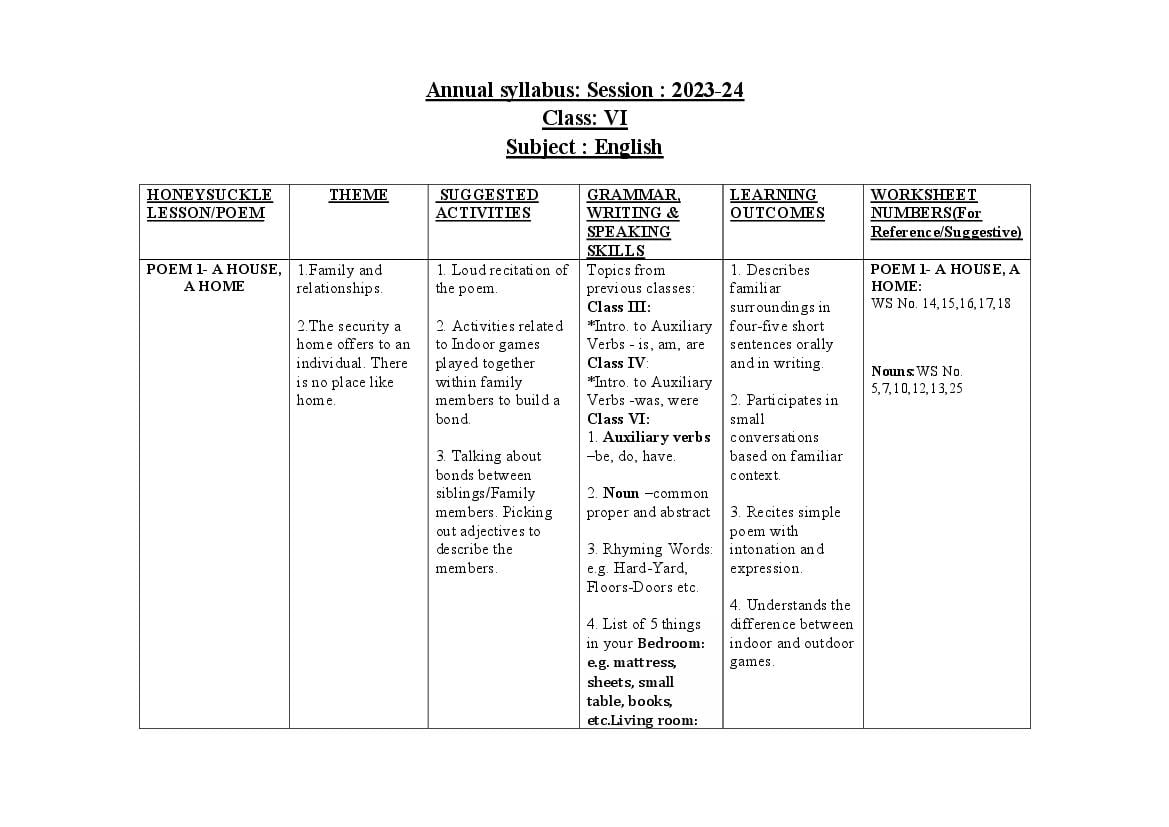
Class: VI
Subject : English
HONEYSUCKLE THEME SUGGESTED GRAMMAR, LEARNING WORKSHEET
LESSON/POEM ACTIVITIES WRITING & OUTCOMES NUMBERS(For
SPEAKING Reference/Suggestive)
SKILLS
POEM 1- A HOUSE, 1.Family and 1. Loud recitation of Topics from 1. Describes POEM 1- A HOUSE, A
A HOME relationships. the poem. previous classes: familiar HOME:
Class III: surroundings in WS No. 14,15,16,17,18
2.The security a 2. Activities related *Intro. to Auxiliary four-five short
home offers to an to Indoor games Verbs - is, am, are sentences orally
individual. There played together Class IV: and in writing. Nouns:WS No.
is no place like within family *Intro. to Auxiliary 5,7,10,12,13,25
home. members to build a Verbs -was, were 2. Participates in
bond. Class VI: small
1. Auxiliary verbs conversations
3. Talking about –be, do, have. based on familiar
bonds between context.
siblings/Family 2. Noun –common
members. Picking proper and abstract 3. Recites simple
out adjectives to poem with
describe the 3. Rhyming Words: intonation and
members. e.g. Hard-Yard, expression.
Floors-Doors etc.
4. Understands the
4. List of 5 things difference between
in your Bedroom: indoor and outdoor
e.g. mattress, games.
sheets, small
table, books,
etc.Living room:
Page 2
blanket,
television, etc.
Bathroom:
Emptyshampoo
bottles,
toothbrushes, etc
5.Guided
Paragraph
Writing – e.g. My
favourite bird.
Lesson 2- HOW 1.Reading a folk 1. Play word search Topics from 1. Reads a story CHAPTER 2- HOW
THE DOG FOUND tale for fun - A in class. previous classes: and answers in a THE DOG FOUND
HIMSELF A NEW tale which is Class III: sentence in HIMSELF A NEW
MASTER passed on from 2. Ask students to *Suffix –er,ful, ly, writing. MASTER
WS No.19,20,21,22
one generation to find 5 Nouns ,5 ish
another and also Adjectives and 5 *Change the verb ( 2. Understands
conveys a collective Nouns 2nd form of verb) basic structures of
message. from the story. *Intro. to correct grammar.
form of verbs VERBS: WS No. 26,27
3.Ask questions Class IV: 3. Speaks four to
related to the story, *Singular - plural five sentences in a
seek answers in one *Prefix - ness, ity, guided format.
word and single ty, ly, est, er
lines. *Suffix - dis, in, 4. Participates in
un- small conversation
4. Divide students in CLASS V: based on familiar
groups and ask them *Use of is/are + in context.
to make a short form of verb
summary of the *Definition of 5. Enjoys solving a
story. Noun puzzle in English.
*Suffix - ness, ly,
5. Compare the less 6. Learns to
summary made by *Example of three summarise a story.
the different groups. forms of verbs.
Page 3
6. Encourage a loud 1. Opposite Words
reading of the same. 2. Nouns –
Collective Nouns,
7. In continuation Common Nouns ,
with word search, Abstract Nouns
now ask the class to
search for new 3. The homes of
words from the different animals.
puzzle given in the 4. Forming new
text. words using ‘ ness
‘ , ‘ ty ‘ , ‘ ity ‘.
5. Three forms of
Verbs
6. Formal Letter
Writing: e.g.
Application to
principal asking for
two days leave for
attending relative’s
wedding.
7. Speaking: Ask
students to speak a
story based on
points given by the
teacher froma
similar story they
have heard in
another
language.(Can be
taken as
groupactivity)
The following lessons from Supplementary Reader ‘A Pact With the Sun’ are not meant for
Evaluation/ Assessment purpose and should be done for learning enrichment. Read only for pleasure.
Lesson 1: A Tale of Two Birds
Lesson 2: The Friendly Mongoose
Page 4
Note:
Above mentioned Syllabus is to be completed by 15th September 2023.
Revision of syllabus for Mid Term Examination.
The above said syllabus is for the assessment purpose and remaining topics/
chapters may be taught as Subject Learning Enrichment.
MID TERM EXAMINATION
HONEYSUCKLE THEME SUGGESTED GRAMMAR, LEARNING WORKSHEET
Lesson/Poem ACTIVITIES WRITING & OUTCOMES NUMBERS (For
SPEAKING Reference/Suggestive)
SKILLS
POEM:2 THE KITE 1.Outdoor 1. Poem recitation Topics from 1. Draws simple POEM:2 THE KITE :
Activities Flying with gestures . previous classes: and specific WS No. 23,24
Kites on special Class III: information from
occasions can be 2. Making colourful *Intro. to correct familiar
fun . kites in class. form of verbs surroundings.
Class IV:
2.Flying kites is 3. Finding pairs of *Prepositions ( in, 2. Participates in
suggestive of a Rhyming Words. into, at ) small
flight of a bird . CLASS V: conversations
4. Dictation *Example of three based on familiar
forms of verbs. context
5. “If you had *Prepositions
wings to fly , where - to, at, off, on, in, 3. Recites simple
would you fly and into, with poem with
why?” Class VI: intonation and
Page 5
Speaking/ Writing
activity) 2. Prepositions – 4. Forms pairs of
in , into , among , rhyming words.
between , over , in
front of , behind ,
from , with , at ,
for , of .
POEM:4 BEAUTY 1.Beautiful things 1. Discussion on the Topics from 1. Participates in TENSES : WS No.
in our topic – ‘Beautiful is previous classes: small 33,34,35,36,37
surroundings. who beautiful Class IV: conversations
does’.A person does *Future Tense, based on familiar
2.Beauty within not become Simple past, past context.
us. beautiful only on continuous,
the surface one Simple present and 2. Recites simple
must have a present continuous poem with
beautiful presence tense intonation and
and must believe in CLASS V: expression.
behaviour which *Intro. To Present
pleases everyone. perfect & past 3. Understands the
perfect tense, actual meaning of
2. Talk about some Present continuous ‘beauty’
famous tense
personalities who Class VI: 4. Understands
have left a mark on 1. Tense – Simple poetic devices .
human history e.g. Past and Past
social workers , Continuous.
scientists, teachers.
etc 2. Introduction to
some poetic
3. Seek devices likevisual
responses/ideas imagery and
from class about auditory imagery.
Page 6
(Written/Spoken) scheme,
Repetition,
Alliteration
3. Paragraph
Writing –e.g. A
short paragraph on
the topic –“A
beautiful day in
winters” .
Lesson 7- FAIRPLAY 1.A story about 1. Discussion on the Class III: 1. Uses newly CHAPTER 7-
relationships. relevance of the line *Change the verb learnt vocabulary FAIRPLAY:
‘The voice of the (2nd form of verb) while speaking and WS No. 41,42,43,44,45
2.Importance of Panch is the voice *Intro. to correct writing. (E.g.
PREPOSITION:
bonds with our of God’… in form of verbs Grudge, Nominate,
WS NO. 46
kith and kin and today’s context . Class IV: Seldom, Tight spot
with friends . Prepositions ( in, etc.) Makes new
2. Discussion on the into, at ) sentences with
3.Justice prevails topic ‘Honesty and CLASS V: those words.
and the truth truth always pay in *Example of three
always wins . the end’. forms of verbs. 2. Participates in
*Prepositions small
4.Fair Play also 3. Role Play in class - to, at, off, on, in, conversations
encourages by students. into, with based on familiar
students to *Modals-Use of context.
inculcate values 4. Dictation would
like being fair Class VI: 3. Participates in
which helps in 1. Phrasal verbs. roles assigned
resolving the inner during role play
conflict . 2. Prepositions –
in,into , on ,in over
, behind , beside ,
below.
3. Forms of Verbs.
4. Antonyms: e.g.
Page 7
Seldom- Often,
Abide-Reject
Make sentences
with these words.
5. Modals
6. Practice writing
e.g. about
‘Honesty is the
best policy’
7. Informal
Letter Writing:
e.g. To a friend
inviting him/her
for your birthday
party.
The following lessons from Honeysuckle and Supplementary Reader ‘A Pact With the Sun’ are not meant for Evaluation/
Assessment purpose and should be done for learning enrichment. Read only for pleasure.
Lesson 4: Tansen (‘A Pact With the Sun’)
Lesson 6: The Wonder Called Sleep (‘A Pact With the Sun’)
Lesson 7: A Pact with the Sun (‘A Pact With the Sun’)
Lesson 4: “An Indian-American Woman in Space: KalpanaChawla (Honeysuckle)
Note:
Above mentioned Syllabus is to be completed by 31st January 2024.
Revision of Syllabus for Annual Examination.
Whole syllabus will be evaluated in the Annual Examination.
The above said syllabus is for assessment purpose and remaining topics/ chapters may be taught as
subject Learning Enrichment.
ANNUAL EXAMINATION
Document Details
| Board / Org | Delhi Board |
| Exam | Class 6 |
| Type | Syllabus |
| Pages | 10 |
| Updated | 22 Jul 2026 |