JNUEE 2021 Question Paper Ph.D Physical Sciences
Finished viewing? Save it for later —
Download JNUEE 2021 Question Paper Ph.D Physical Sciences (PDF · 14 pages)About JNUEE 2021 Question Paper Ph.D Physical Sciences
JNUEE 2021 Question Paper Ph.D Physical Sciences is available here for free download. Published by NTA for Jawaharlal Nehru University Entrance Examination, this question paper can be viewed online or downloaded as a PDF (14 pages). Candidates preparing for Jawaharlal Nehru University Entrance Examination can use JNUEE 2021 Question Paper Ph.D Physical Sciences to understand the exam pattern, the type of questions asked, and the overall difficulty level.
Frequently Asked Questions
How can I download JNUEE 2021 Question Paper Ph.D Physical Sciences?
Open this page and click the Download button to save JNUEE 2021 Question Paper Ph.D Physical Sciences as a PDF. It is completely free on AglaSem Docs.
Is JNUEE 2021 Question Paper Ph.D Physical Sciences free to download?
Yes. JNUEE 2021 Question Paper Ph.D Physical Sciences can be viewed online and downloaded as a PDF free of cost on AglaSem Docs.
How many pages does JNUEE 2021 Question Paper Ph.D Physical Sciences have?
JNUEE 2021 Question Paper Ph.D Physical Sciences contains 14 pages, which you can read online or download together as a single PDF.
Where can I find more Jawaharlal Nehru University Entrance Examination study material?
You can find more Jawaharlal Nehru University Entrance Examination question papers, sample papers, syllabus, and answer keys on AglaSem Docs.
JNUEE 2021 Question Paper Ph.D Physical Sciences – Text
Read the full text of this question paper below — useful to quickly search, copy and reference the content online without downloading the PDF.
📄 View text version (13 pages)
Page 1
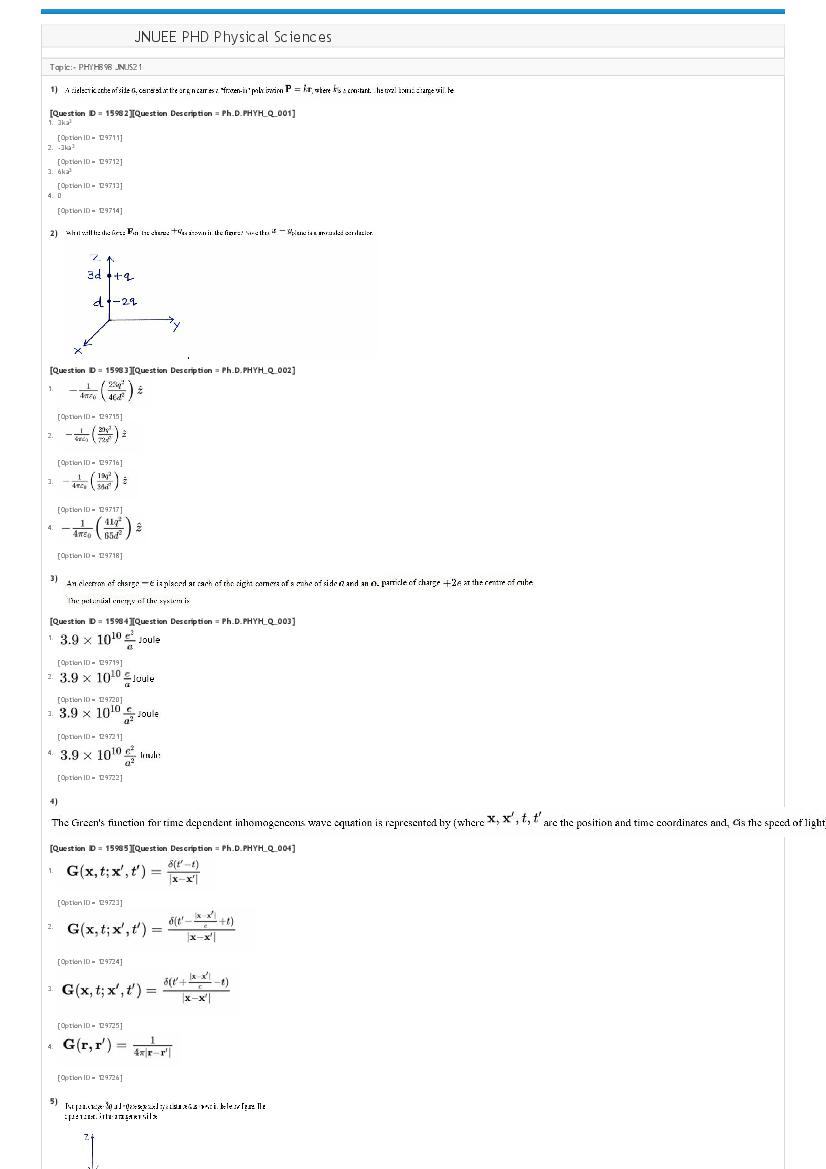
Topic:‐ PHYH898 JNUS21
1)
[Question ID = 15982][Question Description = Ph.D.PHYH_Q_001]
1. 3ka3
[Option ID = 129711]
2. ‐3ka3
[Option ID = 129712]
3. 6ka3
[Option ID = 129713]
4. 0
[Option ID = 129714]
2)
[Question ID = 15983][Question Description = Ph.D.PHYH_Q_002]
1.
[Option ID = 129715]
2.
[Option ID = 129716]
3.
[Option ID = 129717]
4.
[Option ID = 129718]
3)
[Question ID = 15984][Question Description = Ph.D.PHYH_Q_003]
1.
[Option ID = 129719]
2.
[Option ID = 129720]
3.
[Option ID = 129721]
4.
[Option ID = 129722]
4)
[Question ID = 15985][Question Description = Ph.D.PHYH_Q_004]
1.
[Option ID = 129723]
2.
[Option ID = 129724]
3.
[Option ID = 129725]
4.
[Option ID = 129726]
5)
Page 2
1.
[Option ID = 129727]
2.
[Option ID = 129728]
3.
[Option ID = 129729]
4.
[Option ID = 129730]
6) Which of the following correctly lists electromagnetic waves in order from largest to shortest wavelength?
[Question ID = 15987][Question Description = Ph.D.PHYH_Q_006]
1. gamma rays, ultraviolet, infrared, microwaves
[Option ID = 129731]
2. microwaves, ultraviolet, visible light, gamma rays
[Option ID = 129732]
3. radio waves, infrared, gamma rays, ultraviolet
[Option ID = 129733]
4. radio waves, infrared, visible, X‐rays
[Option ID = 129734]
7)
[Question ID = 15988][Question Description = Ph.D.PHYH_Q_007]
1. 0.0075 [Option ID = 129735]
2. 0.075 [Option ID = 129736]
3. 0.75 [Option ID = 129737]
4. 75 [Option ID = 129738]
8) In conductors, which two parameters are same?[Question ID = 15989][Question Description = Ph.D.PHYH_Q_008]
1. Wavelength and phase constant [Option ID = 129739]
2. Phase and attenuation constant [Option ID = 129740]
3. Attenuation constant and skin depth [Option ID = 129741]
4. Skin depth and wavelength [Option ID = 129742]
9) Which of the following material is ferrimagnetic?
[Question ID = 15990][Question Description = Ph.D.PHYH_Q_009]
1. Fe
[Option ID = 129743]
2. Sn
[Option ID = 129744]
3. Fe2O3
[Option ID = 129745]
4. FeCl
[Option ID = 129746]
10) For a critical angle of 60 degree and the refractive index of the first medium as 1.732, the refractive index of the second medium is (approx.)
[Question ID = 15991][Question Description = Ph.D.PHYH_Q_010]
1. 1
[Option ID = 129747]
2. 1.5
[Option ID = 129748]
3. 1.6
[Option ID = 129749]
4. 1.8
[Option ID = 129750]
11) If a C14 has a halflife of 5730 years, then how long will it take for the number of C14 in a sample to drop to 1/8 of initial quantity?
[Question ID = 15536][Question Description = N_Ph.D.PHYH_Q_011]
1. 2.58 X 10⁴ years
[Option ID = 109284]
2. 1.44 X 10⁴ years
[Option ID = 109285]
3. 1.72 X 10⁴ years
[Option ID = 109286]
4. 3.5 X 10⁴ years
[Option ID = 109287]
12) In quantum electrodynamics (QED), electromagnetic forces are mediated by[Question ID = 15993][Question Description = Ph.D.PHYH_Q_012]
1. hadrons [Option ID = 129755]
2. the interaction of electrons [Option ID = 129756]
3. the weak nuclear interaction [Option ID = 129757]
4. the exchange of virtual photons [Option ID = 129758]
13) A particle moves in such a way that its kinetic energy just is equal to its rest mass energy. The velocity of this particle is (where c is speed of light)
[Question ID = 15994][Question Description = Ph.D.PHYH_Q_013]
1. 0.866c
[Option ID = 129759]
2. 0.67c
[Option ID = 129760]
3. 0.707c
Page 3
4. 0.92c
[Option ID = 129762]
14)
[Question ID = 15995][Question Description = Ph.D.PHYH_Q_014]
1. 3.121 MeV
[Option ID = 129763]
2. 4.105 MeV
[Option ID = 129764]
3. 5.292 MeV
[Option ID = 129765]
4. 6.243 MeV
[Option ID = 129766]
15) The Charge of the particle with quark content dds is
[Question ID = 17058][Question Description = N_Ph.D.PHYH_Q_015]
1.
[Option ID = 134086]
2.
[Option ID = 134087]
3.
[Option ID = 134088]
4.
[Option ID = 134089]
16)
[Question ID = 15997][Question Description = Ph.D.PHYH_Q_016]
1. 7.20 MeV [Option ID = 129771]
2. 6.16 MeV [Option ID = 129772]
3. 5.87 MeV [Option ID = 129773]
4. 4.35 MeV [Option ID = 129774]
17)
[Question ID = 15998][Question Description = Ph.D.PHYH_Q_017]
1. 0.542 MeV [Option ID = 129775]
2. 0.625 MeV [Option ID = 129776]
3. 0.731 MeV [Option ID = 129777]
4. 0.824 MeV [Option ID = 129778]
18)
[Question ID = 15999][Question Description = Ph.D.PHYH_Q_018]
1. 0.623 amu [Option ID = 129779]
2. 0.488 amu [Option ID = 129780]
3. 0.541 amu [Option ID = 129781]
4. 0.341 amu [Option ID = 129782]
19) If 200 MeV energy is released in the fission of a single nucleus of U‐23, how many fissions must occur per second to produce a power of one kilowatt?[Question ID = 16000][Question
Description = Ph.D.PHYH_Q_019]
1. 3125 [Option ID = 129783]
2.
[Option ID = 129784]
3.
[Option ID = 129785]
4.
[Option ID = 129786]
20)
[Question ID = 16001][Question Description = Ph.D.PHYH_Q_020]
1. baryon number [Option ID = 129787]
2. lepton number [Option ID = 129788]
3. isospin [Option ID = 129789]
4. strangeness [Option ID = 129790]
21) In equilibrium at temperature T, suppose the particles of a gas follow a velocity distribution not necessarily of Maxwellian form. The probability that magnitude of the velocity of a particle
lies between v and v + dv is written as f(v)dv in terms of an appropriate function f(v). The root mean square velocity and the mean velocity of the particle are respectively denoted as vrms and
v av. Identify the correct statement.
[Question ID = 16002][Question Description = Ph.D.PHYH_Q_021]
1. v rms can never exceed vav.
Page 4
2. whether vav can exceed vrms or not depends on the value of T.
[Option ID = 129792]
3. whether vav can exceed vrms or not depends on the value of f(v).
[Option ID = 129793]
4. v av can never exceed vrms.
[Option ID = 129794]
22) The Chemical potential of a gas is equal to its free energy per particle. Therefore, _______.
[Question ID = 16003][Question Description = Ph.D.PHYH_Q_022]
1. This free energy refers to the Helmholtz free energy of the gas.
[Option ID = 129795]
2. This free energy refers to the Gibbs free energy of the gas.
[Option ID = 129796]
3. This free energy can be either Gibbs or Helmholtz free energy of the gas depending on the temperature of the gas.
[Option ID = 129797]
4. This free energy refers to neither Gibbs free energy, nor Helmholtz free energy of the gas.
[Option ID = 129798]
23)
[Question ID = 16004][Question Description = Ph.D.PHYH_Q_023]
1.
[Option ID = 129799]
2.
[Option ID = 129800]
3.
[Option ID = 129801]
4. It only depends on the temperature T of the gas. [Option ID = 129802]
24) A classical one‐dimensional harmonic oscillator has fixed energy E > 0. Consider the motion of its representative point in the phase space and identify the correct statement.
[Question ID = 16005][Question Description = Ph.D.PHYH_Q_024]
1. It remains at a fixed point and does not move at all.
[Option ID = 129803]
2. It goes to every point on a two dimensional surface.
[Option ID = 129804]
3. It goes to every point on a one dimensional curve.
[Option ID = 129805]
4. It goes to every point of a three dimensional volume.
[Option ID = 129806]
25) In a typical PV diagram for considerations of coexisting phases, Maxwell’s construction is used. This construction ensures that at co‐existence ________ .
[Question ID = 16006][Question Description = Ph.D.PHYH_Q_025]
1. The pressure remains constant.
[Option ID = 129807]
2. The temperature remains constant.
[Option ID = 129808]
3. The chemical potential remains constant.
[Option ID = 129809]
4. The Helmholtz free energy remains constant.
[Option ID = 129810]
26) If all the translational kinetic energy of the molecules in a room of size 3m x 4m x 4m (at STP, T = 273K) could be converted into electrical energy, it can operate a 100W light bulb for
about:
[Question ID = 16007][Question Description = Ph.D.PHYH_Q_026]
1. 20 hours
[Option ID = 129811]
2. 40 minutes
[Option ID = 129812]
3. 30 seconds
[Option ID = 129813]
4. 4 days
[Option ID = 129814]
27) One mole of helium gas, initially at 300 K, is allowed to expand adiabatically to twice of its original volume. How much work is done by the gas in this process?
[Question ID = 16008][Question Description = Ph.D.PHYH_Q_027]
1. 299 J
[Option ID = 129815]
2. 24 J
[Option ID = 129816]
3. 1380 J
[Option ID = 129817]
4. 6250 J
[Option ID = 129818]
28) A long and thin cylindrical tube containing helium gas rotates about one end of the cylinder in a horizontal plane with a constant angular velocity. How will the density of the gas depend on
the radial distance r from the axis of rotation?
[Question ID = 16009][Question Description = Ph.D.PHYH_Q_028]
1. exp(‐ar) [a > 0]
[Option ID = 129819]
2. exp(ar2) [a > 0]
[Option ID = 129820]
3. c + ar2 [a > 0]
[Option ID = 129821]
4. c ‐ ar [a > 0]
[Option ID = 129822]
29) Consider the following two heat reservoirs: a 1 kg piece of iron, initially at 1300 K, and a swimming pool at 300 K. What is the maximum amount of work obtainable from an engine using
Page 5
[Question ID = 16010][Question Description = Ph.D.PHYH_Q_029]
1. 1.1 x 10⁵ J
[Option ID = 129823]
2. 4.5 x 10⁵ J
[Option ID = 129824]
3. 3.4 x 10⁵ J
[Option ID = 129825]
4. 2.5 x 10⁵ J
[Option ID = 129826]
30) The Doppler width of a line of wavelength 546 nm from a mercury (Hg‐198) vapour lamp operating at 400 ºC is:
[Question ID = 16011][Question Description = Ph.D.PHYH_Q_030]
1. 5.3 x 10⁶ Hz
[Option ID = 129827]
2. 2.4 x 10¹⁰ Hz
[Option ID = 129828]
3. 3.1 x 10⁸ Hz
[Option ID = 129829]
4. 7.1 x 10⁹ Hz
[Option ID = 129830]
31)
[Question ID = 16038][Question Description = Ph.D.PHYH_Q_031]
1. three real non‐zero eigen values.
[Option ID = 130095]
2. complex eigen values.
[Option ID = 130096]
3. two non‐zero eigen values.
[Option ID = 130097]
4. only one non‐zero eigen value.
[Option ID = 130098]
32)
[Question ID = 16041][Question Description = Ph.D.PHYH_Q_032]
1. Zero
[Option ID = 130106]
2. 1
[Option ID = 130107]
3. ∞
[Option ID = 130108]
4.
[Option ID = 130109]
33) What is the Fourier transform of the unit step function?
[Question ID = 16012][Question Description = Ph.D.PHYH_Q_033]
1.
[Option ID = 129831]
2.
[Option ID = 129832]
3.
[Option ID = 129833]
4.
[Option ID = 129834]
34) The Legendre polynomial Pn (x) has –[Question ID = 16013][Question Description = Ph.D.PHYH_Q_034]
1. n real zeros between 0 and 1 [Option ID = 129835]
2. n zeros of which only one is between ‐1 and 1 [Option ID = 129836]
3. (2n – 1) real zeros between – 1 and 1 [Option ID = 129837]
4. None of these [Option ID = 129838]
35) For the differential equation (1 ‐ x2) y" ‐ 6xy' ‐ 4y = 0, point x = 0 is called .............. point.
[Question ID = 16014][Question Description = Ph.D.PHYH_Q_035]
1. Ordinary
[Option ID = 129839]
2. Irregular Singular
[Option ID = 129840]
3. Regular Singular
[Option ID = 129841]
4. Singular
[Option ID = 129842]
36) A cubic polynomial takes the following values y(0) = 1, y(1) = 0, y(2) = 1 and y(3) = 10. What will be the value of y(4) ?
[Question ID = 16015][Question Description = Ph.D.PHYH_Q_036]
1. 24
[Option ID = 129843]
2. 33
[Option ID = 129844]
3. 36
[Option ID = 129845]
4. 42
[Option ID = 129846]
37) If the following system has non‐trivial solution,
px + qy + rz = 0
Page 6
rx + py + qz = 0
Then which statement is correct?
[Question ID = 16016][Question Description = Ph.D.PHYH_Q_037]
1. p – q + r = 0 or p = q = ‐r
[Option ID = 129847]
2. p + q – r = 0 or p = ‐q = r
[Option ID = 129848]
3. p + q + r = 0 or p = q = r
[Option ID = 129849]
4. p – q + r = 0 or p = ‐q = ‐r
[Option ID = 129850]
38)
[Question ID = 16017][Question Description = Ph.D.PHYH_Q_038]
1.
[Option ID = 129851]
2.
[Option ID = 129852]
3.
[Option ID = 129853]
4.
[Option ID = 129854]
39)
[Question ID = 16018][Question Description = Ph.D.PHYH_Q_039]
1. 2.2 [Option ID = 129855]
2. 3.4 [Option ID = 129856]
3. 4.3 [Option ID = 129857]
4. None of these [Option ID = 129858]
40)
[Question ID = 17217][Question Description = Ph.D.PHYH_Q_040]
1. 1 [Option ID = 129859]
2. 2 [Option ID = 129860]
3. 3 [Option ID = 129861]
4. 4 [Option ID = 129862]
41) Consider two crystalline solids, one of which has a simple cubic structure and the other has a tetragonal structure. The effective spring constant between atoms in the c‐direction is half of
the spring constant between atoms in the a and b directions. At low temperatures, the behavior of the lattice contribution to the specific heat will depend on temperature T as
[Question ID = 17218][Question Description = Ph.D.PHYH_Q_041]
1. T 2 for tetragonal solid and T3 for the simple cubic solid
[Option ID = 129863]
2. T for tetragonal solid and T3 for the simple cubic solid
[Option ID = 129864]
3. T 3 for both solids
[Option ID = 129865]
4. T for both solids
[Option ID = 129866]
42) The third nearest neighbour distance in a body‐centered cubic (bcc) crystal with lattice constant a0 is[Question ID = 16039][Question Description = Ph.D.PHYH_Q_042]
1. a0 [Option ID = 130099]
2.
[Option ID = 130100]
3.
[Option ID = 130101]
4.
[Option ID = 130102]
43) Comparing the electrical conductivity to the lattice thermal conductivity, which of the following statements is true?
[Question ID = 17219][Question Description = Ph.D.PHYH_Q_043]
1. The electrical conductivity can be positive or negative, but the lattice thermal conductivity is always positive.
[Option ID = 129867]
2. The lattice thermal conductivity varies over many orders of magnitude.
[Option ID = 129868]
3. The electrical conductivity varies over many orders of magnitude.
[Option ID = 129869]
4. Both are related by the Wiedemann‐Franz Law.
[Option ID = 129870]
44) Which of the following metal crystallizes in the face‐centered cubic (fcc) structure ?
[Question ID = 17220][Question Description = Ph.D.PHYH_Q_044]
1. Aluminium
[Option ID = 129871]
2. Zinc
[Option ID = 129872]
3. Sodium
[Option ID = 129873]
4. Chromium
Page 7
45) At low temperature (T), the mean free path and collision time of an electron in a metal are proportional to[Question ID = 17221][Question Description = Ph.D.PHYH_Q_045]
1. 1/T [Option ID = 129875]
2. 1/T2 [Option ID = 129876]
3. 1/T3 [Option ID = 129877]
4. Independent of T [Option ID = 129878]
46) Energy of the neutron beam used in the phonon‐dispersions and lattice dynamic studies of the solid is of the order of
[Question ID = 17222][Question Description = Ph.D.PHYH_Q_046]
1. Few 10's of MeV
[Option ID = 129879]
2. Few 10’s of meV
[Option ID = 129880]
3. Few 10’s of keV
[Option ID = 129881]
4. Few 10’s of GeV
[Option ID = 129882]
47) Consider the BCS theory of superconductors, which one of the following facts is not true ? (h is Planck’s constant and e is the electronic charge)
[Question ID = 17223][Question Description = Ph.D.PHYH_Q_047]
1. Presence of energy gap at temperatures below the critical temperature
[Option ID = 129883]
2. Different critical temperatures for isotopes
[Option ID = 129884]
3. Quantization of magnetic flux in superconductor in the unit of h/e
[Option ID = 129885]
4. Presence of Meissner effect
[Option ID = 129886]
48) The susceptibility of a diamagnetic material is essentially independent of temperature
[Question ID = 17224][Question Description = Ph.D.PHYH_Q_048]
1. Under all circumstances.
[Option ID = 129887]
2. As long as the electronic structure is independent of temperature.
[Option ID = 129888]
3. At very low temperature of the order of 10 K.
[Option ID = 129889]
4. At very high temperature.
[Option ID = 129890]
49) The reverse saturation current in silicon diode is of the order of[Question ID = 17225][Question Description = Ph.D.PHYH_Q_049]
1. 1 nano‐ampere [Option ID = 129891]
2. 1 milli‐ampere [Option ID = 129892]
3. 1 micro‐ampere [Option ID = 129893]
4. 1 ampere [Option ID = 129894]
50) Interaction between the neighbouring dipoles is negligible in the case of a[Question ID = 17226][Question Description = Ph.D.PHYH_Q_050]
1. Diamagnetic material [Option ID = 129895]
2. Paramagnetic material [Option ID = 129896]
3. Antiferromagnetic material [Option ID = 129897]
4. Ferrimagnetic material [Option ID = 129898]
51) Which of the following is true for the Trigonal crystal structure?
[Question ID = 17227][Question Description = Ph.D.PHYH_Q_051]
1. α ≠ β ≠ γ ≠ 90o; a ≠ b ≠ c
[Option ID = 129899]
2. α = β = γ ≠ 90o; a = b ≠ c
[Option ID = 129900]
3. α = β = γ ≠ 90o; a = b = c
[Option ID = 129901]
4. α = β = 90o and γ = 120o; a = b ≠ c
[Option ID = 129902]
52) The Operational amplifier can able to amplify[Question ID = 17228][Question Description = Ph.D.PHYH_Q_052]
1. d.c. signals only [Option ID = 129903]
2. a.c. signals only [Option ID = 129904]
3. Both a.c. and d.c. signals [Option ID = 129905]
4. Neither d.c. nor a.c. signals [Option ID = 129906]
53) A full adder can be constructed using[Question ID = 17229][Question Description = Ph.D.PHYH_Q_053]
1. Three half adders and an OR gate [Option ID = 129907]
2. Three half adders and a NOT gate [Option ID = 129908]
3. Two half adders and an OR gate [Option ID = 129909]
4. Two half adders and a NOT gate [Option ID = 129910]
54) Which material is used as an insulating layer in the fabrication of MOSFET?
[Question ID = 17230][Question Description = Ph.D.PHYH_Q_054]
1. Silicon Dioxide
[Option ID = 129911]
2. Silicon Nitride
[Option ID = 129912]
3. Aluminium Sulphate
[Option ID = 129913]
4. Copper Sulphate
[Option ID = 129914]
55) In the following circuit, the voltage drop across the ideal diode in the forwad bias condition is 0.7 V
Page 8
[Question ID = 17231][Question Description = Ph.D.PHYH_Q_055]
1. 0 mA
[Option ID = 129915]
2. 1.0 mA
[Option ID = 129916]
3. 1.5 mA
[Option ID = 129917]
4. 2.0 mA
[Option ID = 129918]
56) The input and output impedance for achieving the best performance of an operational amplifier based current to voltage converter circuit should be[Question ID = 17232][Question
Description = Ph.D.PHYH_Q_056]
1. High input impedance and high output impedance [Option ID = 129919]
2. High input impedance and low output impedance [Option ID = 129920]
3. Low input impedance and high output impedance [Option ID = 129921]
4. Low input impedance and low output impedance [Option ID = 129922]
57) In the toggle mode, a J K flip‐flop has[Question ID = 17233][Question Description = Ph.D.PHYH_Q_057]
1. J = 0, K = 1 [Option ID = 129923]
2. J = 0, K = 0 [Option ID = 129924]
3. J = 1, K = 1 [Option ID = 129925]
4. J = 1, K = 0 [Option ID = 129926]
58) In a Hall effect experiment, the Hall voltage for an intrinsic semiconductor is Negative. This is because of (Symbols carry usual meaning)
[Question ID = 17234][Question Description = Ph.D.PHYH_Q_058]
1. n ≈ p
[Option ID = 129927]
2. n > p
[Option ID = 129928]
3. μe> μh
[Option ID = 129929]
4.
[Option ID = 129930]
59) An RC network produces a phase shift of 60°. How many such RC networks should be cascaded together and connected to a common emitter amplifier so that the final circuit behaves as an
oscillator?
[Question ID = 17235][Question Description = Ph.D.PHYH_Q_059]
1. Three
[Option ID = 129931]
2. Six
[Option ID = 129932]
3. Nine
[Option ID = 129933]
4. Twelve
[Option ID = 129934]
60) Let Y denotes the output in the following logical circuit
[Question ID = 17236][Question Description = Ph.D.PHYH_Q_060]
1. OR and NAND
[Option ID = 129935]
2. NOR and OR
[Option ID = 129936]
3. AND and NAND
[Option ID = 129937]
4. NAND and OR
[Option ID = 129938]
61) For a cononical conjugate pair (q,p) of certain generalized Coordinate (q) and generalized momentum (p), which one of the following also forms a cononical conjugate pair?
[Question ID = 16019][Question Description = Ph.D.PHYH_Q_061]
1. (p,‐q)
[Option ID = 129939]
2. (q,‐p)
[Option ID = 129940]
3. (q2,p2)
[Option ID = 129941]
4. (p2,‐q2)
[Option ID = 129942]
62) An X‐ray tube with Cu target is operated at 28 kV. The smallest glancing angle for NaCl crystal for the Cu Kα line is 15.8◦. Find the wavelength of this line. And also find the glancing angle
for photons at the short‐wavelength limit. Consider the d value of NaCl is 0.282 nm.
[Question ID = 16020][Question Description = Ph.D.PHYH_Q_062]
1. 0.0496 nm , 5.1°
[Option ID = 129943]
2. 0.096 nm , 6.1°
[Option ID = 129944]
3. 0.496 nm , 7.1°
[Option ID = 129945]
4. 0.06 nm , 5.1°
Page 9
63) Which crystal structure has three mutually orthogonal and 2‐ fold rotation axes?[Question ID = 16021][Question Description = Ph.D.PHYH_Q_063]
1. Cubic [Option ID = 129947]
2. Monoclinic [Option ID = 129948]
3. Orthorhombic [Option ID = 129949]
4. All of the above [Option ID = 129950]
64) What will be the velocity of bob of a simple pendulum at its mean position if it is able to rise a vertical height of 10 cm without loosing circular path anywhere?
[Question ID = 16022][Question Description = Ph.D.PHYH_Q_064]
1. 0 m/s
[Option ID = 129951]
2. 0.98 m/s
[Option ID = 129952]
3. 1 m/s
[Option ID = 129953]
4. 1.4 m/s
[Option ID = 129954]
65)
[Question ID = 16023][Question Description = Ph.D.PHYH_Q_065]
1.
[Option ID = 129955]
2.
[Option ID = 129956]
3.
[Option ID = 129957]
4. There is no point of unstable equillibrium.
[Option ID = 129958]
66) Which are the correct postulates of the special theory of relativity ?
[Question ID = 16024][Question Description = Ph.D.PHYH_Q_066]
1. (i) All physical laws are the same in all inertial frame of reference which is moving with constant velocity relative to each other.
(ii) The speed of the light in vacuum is the same in some inertial frames and may be different for others.
[Option ID = 129959]
2. (i) All physical laws are not same in all inertial frame of reference which are moving with constant velocity relative to each other.
(ii) The speed of the light in vacuum is constant .
[Option ID = 129960]
3. (i) All physical laws are the same in all inertial frame of reference which are moving with constant velocity relative to each other.
(ii) The speed of the light in vacuum is not same in every inertial frame.
[Option ID = 129961]
4. (i) All physical laws are the same in all inertial frame of reference which are moving with constant velocity relative to each other.
(ii) The speed of the light in vacuum is the same in every inertial frame.
[Option ID = 129962]
67) What is the amount of work done to increase the speed of an electron from 0.6 c to 0.8 c ? Consider the rest mass energy of an electron is 0.5 MeV.[Question ID = 16025][Question
Description = Ph.D.PHYH_Q_067]
1. 3.36 x 10 ‐14 J [Option ID = 129963]
2. 2.36 x 10 ‐14 J [Option ID = 129964]
3. 3.26 x 10 ‐14 J [Option ID = 129965]
4. 3.16 x 10 ‐14 J [Option ID = 129966]
68) What is the wavelength separation between the two‐component lines which are observed in the normal Zeeman effect? The magnetic field used is 0.4 weber/ m2, the specific charge is
1.76 x 10 11 Ckg‐1 and wavelength is 600 nm.
[Question ID = 16026][Question Description = Ph.D.PHYH_Q_068]
1. 0.01 nm
[Option ID = 129967]
2. 0.1 nm
[Option ID = 129968]
3. 0.01 mm
[Option ID = 129969]
4. 0.1 mm
[Option ID = 129970]
69) A particle executes Simple Harmonic Motion. Where will the total energy of the particle be maximum?
[Question ID = 16027][Question Description = Ph.D.PHYH_Q_069]
1. Same at all positions
[Option ID = 129971]
2. At extreme positions
[Option ID = 129972]
3. At mean position
[Option ID = 129973]
4. At midway between mean and extreme positions
[Option ID = 129974]
70) Identify the correct set where all three elements cannot be detected by some of the scanning electron microscopes (SEM)?
[Question ID = 16028][Question Description = Ph.D.PHYH_Q_070]
1. H, He, and Li
[Option ID = 129975]
2. C, He and Mg
[Option ID = 129976]
3. Mg, He and Au
[Option ID = 129977]
4. None of these
[Option ID = 129978]
71) Which laser wavelengths are used for Raman spectroscopy in near‐infra‐red region?[Question ID = 16029][Question Description = Ph.D.PHYH_Q_071]
1. 660‐830 nm [Option ID = 129979]
2. 210‐400 nm [Option ID = 129980]
3. 420‐620 nm [Option ID = 129981]
Page 10
72) A train which is moving with constant velociy is
[Question ID = 16030][Question Description = Ph.D.PHYH_Q_072]
1. a non‐inertial frame.
[Option ID = 129983]
2. an inertial frame.
[Option ID = 129984]
3. Sometimes inertial, sometimes non‐inertial frame.
[Option ID = 129985]
4. Neither inertial nor non‐inertial frame.
[Option ID = 129986]
73)
Which property can be measured using the arrangement as shown in figure? T.C. in the figure stands for Therme couple.
[Question ID = 16031][Question Description = Ph.D.PHYH_Q_073]
1. Bulk modulus
[Option ID = 129987]
2. Raman effect
[Option ID = 129988]
3. viscousity
[Option ID = 129989]
4. Seebeck coefficient and electrical conductivity
[Option ID = 129990]
74) What is the vacuum level, one can create easily using the diffusion pump?
[Question ID = 16032][Question Description = Ph.D.PHYH_Q_074]
1. 10‐2 to 10‐3 Torr
[Option ID = 129991]
2. 10‐2 to 10‐6 Torr
[Option ID = 129992]
3. 10‐2 to 10‐8 Torr
[Option ID = 129993]
‐12
4. 10‐2 to 10 Torr
[Option ID = 129994]
75) Which transformation generates the identity transformation?
[Question ID = 16033][Question Description = Ph.D.PHYH_Q_075]
1.
[Option ID = 129995]
2.
[Option ID = 129996]
3.
[Option ID = 129997]
4.
[Option ID = 129998]
76) Electron microscopes have a much higher resolution than either the human eye or any light microscope because
[Question ID = 16034][Question Description = Ph.D.PHYH_Q_076]
1. The lens used is of much higher capacity
[Option ID = 129999]
2. The images are viewed on high resolution screen
[Option ID = 130000]
3. An electron has short wavelength
[Option ID = 130001]
4. None of these
[Option ID = 130002]
77) A particle mass m is moving in a plane under an inverse square low attractive force. What will be the lagrangian for its moion?
[Question ID = 16035][Question Description = Ph.D.PHYH_Q_077]
1.
[Option ID = 130003]
2.
[Option ID = 130004]
3.
[Option ID = 130005]
4.
[Option ID = 130006]
78) Consider the following XRD and TEM pictures,
Page 11
A. One can clearly view the broadening of the main peak as the particle size decreases from bulk to 15 nm.
B. Particle sizes estimated by XRD and TEM are in good agreement with each other.
C. We can't say anything about particle size from given pictures.
D. Particle sizes estimated by XRD and TEM are not in good agreement with each other.
Which are correct?
[Question ID = 16036][Question Description = Ph.D.PHYH_Q_078]
1. Only B
[Option ID = 130007]
2. Only C
[Option ID = 130008]
3. Both A and B
[Option ID = 130009]
4. Only D
[Option ID = 130010]
79) Considering the following picture and identify the correct statement?
[Question ID = 19928][Question Description = Ph.D.PHYH_Q_079]
1. The above image shows an amorphous Si thin film deposited on a crystalline silicon substrate.
[Option ID = 130011]
2. The above image shows a crystalline Si thin film deposited on a crystalline silicon substrate.
[Option ID = 130012]
3. The above image shows crystalline Si thin film deposited on an amorphous Si substrate.
[Option ID = 130013]
4. The above image shows an amorphous Si thin film deposited on a amorphous silicon substrate.
[Option ID = 130014]
80) Four dimensional volume element 'dxdydzdt' is invariant under
[Question ID = 19929][Question Description = Ph.D.PHYH_Q_080]
1. Laplace transformation
[Option ID = 130015]
2. Galilean transformation
[Option ID = 130016]
3. Lorentz transformation
[Option ID = 130017]
4. All of the above
[Option ID = 130018]
81) Which of the following electronic transition in Neon is not responsible for LASER action in He‐Ne LASER?
[Question ID = 19930][Question Description = Ph.D.PHYH_Q_081]
1. 6s→ 5p
[Option ID = 130019]
2. 5s→ 4p
[Option ID = 130020]
3. 5s→ 3p
[Option ID = 130021]
4. 4s→ 3p
[Option ID = 130022]
82) The hyperfine structure of Na ( 32Na3/2) with nuclear spin I=3/2 has how many number of states?
[Question ID = 19931][Question Description = Ph.D.PHYH_Q_082]
1. 1 State
[Option ID = 130023]
2. 2 States
[Option ID = 130024]
3. 3 States
[Option ID = 130025]
4. 4 States
[Option ID = 130026]
83) The ground state of Sodium atom (Na) is 2s1/2 state. The energy level difference arising in the presence of weak external magnetic field B is
[Question ID = 19932][Question Description = Ph.D.PHYH_Q_083]
1. 2μBB
[Option ID = 130027]
2. 4μB B
[Option ID = 130028]
3. 6μB B
[Option ID = 130029]
Page 12
[Option ID = 130030]
84) The first Stokes line of a rotational Raman spectrum is observed at 12.96 cm‐1. The rotational constant is given by[Question ID = 19933][Question Description = Ph.D.PHYH_Q_084]
1. 8.16 cm‐1 [Option ID = 130031]
2. 6.16 cm‐1 [Option ID = 130032]
3. 4.16 cm‐1 [Option ID = 130033]
4. 2.16 cm‐1 [Option ID = 130034]
85)
[Question ID = 19934][Question Description = Ph.D.PHYH_Q_085]
1. A ‐I , B ‐II , C ‐III , D ‐IV [Option ID = 130035]
2. A ‐I , B ‐II , C ‐IV , D ‐III [Option ID = 130036]
3. A ‐I , B ‐IV , C ‐III , D ‐II [Option ID = 130037]
4. A ‐IV , B ‐I , C ‐II , D ‐III [Option ID = 130038]
86) The spectrum of radiation emitted by a black body at temperature 1000 K peaks in the [Question ID = 19935][Question Description = Ph.D.PHYH_Q_086]
1. Visible range [Option ID = 130039]
2. Infrared range [Option ID = 130040]
3. Ultraviolet range [Option ID = 130041]
4. Microwave range [Option ID = 130042]
87) In case of a He‐Ne laser, the transition takes place in
[Question ID = 19936][Question Description = Ph.D.PHYH_Q_087]
1. He only
[Option ID = 130043]
2. Ne only
[Option ID = 130044]
3. Ne first, then He
[Option ID = 130045]
4. He first, then Ne
[Option ID = 130046]
88) The degeneracy of the spectral term 3F is[Question ID = 19937][Question Description = Ph.D.PHYH_Q_088]
1. 7 [Option ID = 130047]
2. 9 [Option ID = 130048]
3. 11 [Option ID = 130049]
4. 13 [Option ID = 130050]
89) The Lande g‐ factor for the level 3D3 is
[Question ID = 19938][Question Description = Ph.D.PHYH_Q_089]
1. 3/2
[Option ID = 130051]
2. 2/3
[Option ID = 130052]
3. 5/2
[Option ID = 130053]
4. 2/5
[Option ID = 130054]
90) Cesium has a nuclear spin of 7/2. The hyperfine spectrum of d lines of Cesium atom will be
[Question ID = 19939][Question Description = Ph.D.PHYH_Q_090]
1. 4 lines
[Option ID = 130055]
2. 6 lines
[Option ID = 130056]
3. 10 lines
[Option ID = 130057]
4. 14 lines
[Option ID = 130058]
91) Consider a particle located in a potential well V(x) given by: V(x) = ∞ for x ≤ 0, V(x) = ‐Vo for 0 < x ≤ a and,v(x) = 0 for x > a
[Question ID = 19940][Question Description = Ph.D.PHYH_Q_091]
1. The number of energy levels increases as the well width decreases
[Option ID = 130059]
2. The number of energy levels decreases with increasing well depth
[Option ID = 130060]
3. The number of energy levels increases as the well depth increases
[Option ID = 130061]
4. None of the above
[Option ID = 130062]
92) Which of the following wave function cannot describe a particle?
[Question ID = 19941][Question Description = Ph.D.PHYH_Q_092]
1. Φ(x) = A x exp(‐α2x 2)
[Option ID = 130063]
2. Φ(x) = Ax(4 ‐ x)
[Option ID = 130064]
3. Φ(x) = A / (1‐ x)
[Option ID = 130065]
4. Φ(x) = Ax(2 ‐ x2)
[Option ID = 130066]
93) Which of the following is an allowed wave function for a particle in a bound state? N is a constant and α, β > 0.
[Question ID = 16040][Question Description = Ph.D.PHYH_Q_093]
1.
[Option ID = 130103]
2.
Page 13
3.
[Option ID = 130105]
4. None of these
[Option ID = 145324]
94) The probability current density for the real wavefunction is
[Question ID = 19942][Question Description = Ph.D.PHYH_Q_094]
1. 1
[Option ID = 130067]
2. ℏk/2m
[Option ID = 130068]
3. h k/m
[Option ID = 130069]
4. 0
[Option ID = 130070]
95) Consider the motion of a particle along the x‐axis in a potential V(x) = F|x|. Its ground state energy E0 is estimated using the uncertainty principle. Then E0 is proportional to[Question ID =
19943][Question Description = Ph.D.PHYH_Q_095]
1. F1/ 3 [Option ID = 130071]
2. F1/ 2 [Option ID = 130072]
3. F 2/ 5 [Option ID = 130073]
4. F 2/ 3 [Option ID = 130074]
96)
[Question ID = 19944][Question Description = Ph.D.PHYH_Q_096]
1.
[Option ID = 130075]
2.
[Option ID = 130076]
3.
[Option ID = 130077]
4.
[Option ID = 130078]
97) Any wave function can be written as a linear combination of [Question ID = 19945][Question Description = Ph.D.PHYH_Q_097]
1. Eigen Values [Option ID = 130079]
2. Eigen Functions [Option ID = 130080]
3. Operators [Option ID = 130081]
4. All of the above [Option ID = 130082]
98) Consider a one‐dimensional potential well of width 3 nm. Using the uncertainty principle, an estimate of the minimum depth of the well such that it has at least one bound state for an
electron is (me = 9.31 × 10‐31 Kg , h = 6.626× 10‐34 Joule‐second, e =1.602 ×10‐19 C)
[Question ID = 19946][Question Description = Ph.D.PHYH_Q_098]
1. 1 µeV
[Option ID = 130083]
2. 1 meV
[Option ID = 130084]
3. 0
[Option ID = 130085]
4. 1 MeV
[Option ID = 130086]
99) The degeneracy of the second excited energy level of a 3‐dimensional isotropic quantum harmonic oscillator is[Question ID = 19947][Question Description = Ph.D.PHYH_Q_099]
1. 6 [Option ID = 130087]
2. 12 [Option ID = 130088]
3. 8 [Option ID = 130089]
4. 10 [Option ID = 130090]
100)
The probeblity of a particle being present in the interval [0,a/3] is equal to:
[Question ID = 16037][Question Description = Ph.D.PHYH_Q_100]
1. 1/2
[Option ID = 130091]
2. 1/3
[Option ID = 130092]
3. 1/4
[Option ID = 130093]
4. 0
[Option ID = 130094]
Document Details
| Board / Org | NTA |
| Exam | Jawaharlal Nehru University Entrance Examination |
| Type | Question Paper |
| Pages | 14 |
| Updated | 22 Jul 2026 |