Kerala Plus Two Question Paper 2022 Electronics
Finished viewing? Save it for later —
Download Kerala Plus Two Question Paper 2022 Electronics (PDF · 12 pages)About Kerala Plus Two Question Paper 2022 Electronics
Kerala Plus Two Question Paper 2022 Electronics is available here for free download. Published by Kerala Board for Class 12, this question paper can be viewed online or downloaded as a PDF (12 pages). Candidates preparing for Class 12 can use Kerala Plus Two Question Paper 2022 Electronics to understand the exam pattern, the type of questions asked, and the overall difficulty level.
Frequently Asked Questions
How can I download Kerala Plus Two Question Paper 2022 Electronics?
Open this page and click the Download button to save Kerala Plus Two Question Paper 2022 Electronics as a PDF. It is completely free on AglaSem Docs.
Is Kerala Plus Two Question Paper 2022 Electronics free to download?
Yes. Kerala Plus Two Question Paper 2022 Electronics can be viewed online and downloaded as a PDF free of cost on AglaSem Docs.
How many pages does Kerala Plus Two Question Paper 2022 Electronics have?
Kerala Plus Two Question Paper 2022 Electronics contains 12 pages, which you can read online or download together as a single PDF.
Where can I find more Class 12 study material?
You can find more Class 12 question papers, sample papers, syllabus, and answer keys on AglaSem Docs.
Kerala Plus Two Question Paper 2022 Electronics – Text
Read the full text of this question paper below — useful to quickly search, copy and reference the content online without downloading the PDF.
📄 View text version (12 pages)
Page 1
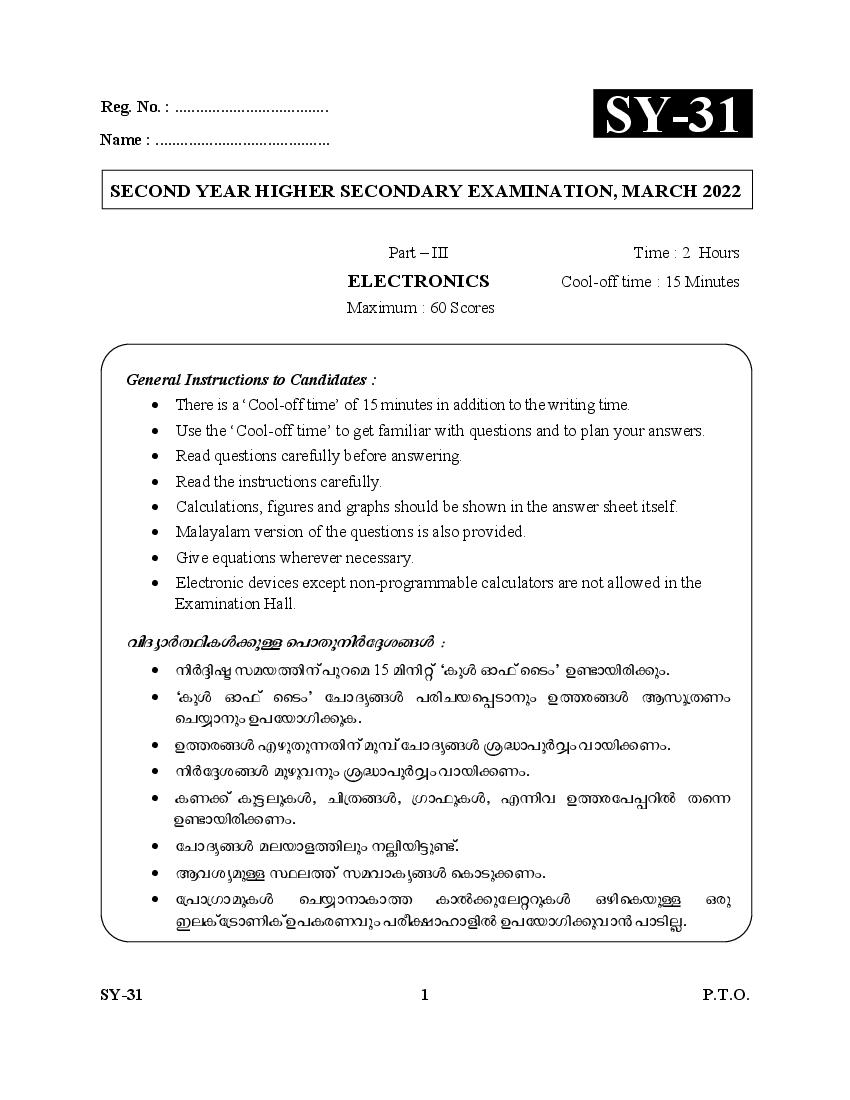
Name : ..........................................
SY-31
SECOND YEAR HIGHER SECONDARY EXAMINATION, MARCH 2022
Part – III Time : 2 Hours
ELECTRONICS Cool-off time : 15 Minutes
Maximum : 60 Scores
General Instructions to Candidates :
There is a ‘Cool-off time’ of 15 minutes in addition to the writing time.
Use the ‘Cool-off time’ to get familiar with questions and to plan your answers.
Read questions carefully before answering.
Read the instructions carefully.
Calculations, figures and graphs should be shown in the answer sheet itself.
Malayalam version of the questions is also provided.
Give equations wherever necessary.
Electronic devices except non-programmable calculators are not allowed in the
Examination Hall.
15 ‘ ’ .
‘ ’
.
.
.
, , ,
.
.
.
.
SY-31 1 P.T.O.
Page 2
A. Answer any five questions from 1 to 9. Each carries 1 score. (5 1 = 5)
1. The output voltage of IC 7806 is _________, when its input is greater than 8.3 V.
(a) 5V (b) 6V
(c) 9V (d) 10V
2. When the non-inverting amplifier is configured for unity gain is called ________.
3. ________ is a device that allows digital information from several sources to be routed
to a single line.
4. In an AM, other name of modulating signal is ________.
(a) Carrier signal (b) High frequency signal
(c) Base band signal (d) High amplitude signal
5. Which one of the wave is often called ionospheric wave ?
(a) Ground wave (b) Surface wave
(c) Space wave (d) Sky wave
6. In Data Communication, round off the sample values to predetermined fixed number of
levels is called ________.
7. Write any two applications of satellites.
SY-31 2
Page 3
A. 1 9 5 .
1 . (5 1 = 5)
1. 8.3 V 7806 IC
_________ .
(a) 5V (b) 6V
(c) 9V (d) 10V
2. -
________
3.
, ________.
4.
________.
(a) (b)
(c) (d)
5.
?
(a) (b)
(c) (d)
6.
________.
7. .
SY-31 3 P.T.O.
Page 4
(a) 3:4 (b) 4:3
(c) 2:3 (d) 2:4
9. Which one of the below is an output device of a computer ?
(a) Monitor (b) Keyboard
(c) Mouse (d) Scanner
B. Answer all questions from 10 to 13. Each carries 1 score. (4 1 = 4)
10. Write the number of any one of the fixed negative voltage regulator IC.
11. In amplitude modulation, the range of value of modulation index is ________.
12. ________ is a medium for carrying information from one point to another in the form
of light.
13. Write the full-form of HTTP.
PART – II
A. Answer any two questions from 14 to 17. Each carries 2 score. (2 2 = 4)
14. Draw the input and output wave-forms of a positive clipper.
15. Draw the graphical symbol and truth table of a D flip-flop.
16. Define Sampling theorem.
17. Explain the term ‘Dispersion’ related to optical fiber communication.
SY-31 4
Page 5
(a) 3:4 (b) 4:3
(c) 2:3 (d) 2:4
9. ?
(a) (b)
(c) (d)
B. 10 13 . 1 . (4 1 = 4)
10.
.
11. ,
________ .
12.
________.
13. HTTP .
PART – II
A. 14 17 2 .
2 . (2 2 = 4)
14. .
15. D - –
.
16. .
17. ‘’
..
SY-31 5 P.T.O.
Page 6
(2 2 = 4)
18. What are the advantages of an interlaced scanning over a normal scanning in Television
system ?
19. Write any two input device of a computer.
20. Explain the term FTP (File Transfer Protocol) related to computer networking.
PART – III
A. Answer any three questions from 21 to 24. Each carries 3 score.
(3 3 = 9)
21. Draw the block diagram of a regulated power supply.
22. What is the need for modulation in radio communication ? Explain shortly.
23. Draw the block diagram of Time Division Multiplexing (TDM).
24. Explain the below terms related to cellular communication :
(a) Macro cells (1)
(b) Micro cells (1)
(c) Pico cells (1)
SY-31 6
Page 7
2 . (2 2 = 4)
18.
?
19. .
20. FTP ( )
.
PART – III
A. 21 24 3 .
3 . (3 3 = 9)
21. .
22.
.
23. (TDM) .
24.
:
(a) (1)
(b) (1)
(c) (1)
SY-31 7 P.T.O.
Page 8
(2 3 = 6)
25. Draw the diagram and explain, one bit digital comparator.
26. Draw the diagrams of the below, network topologies.
(i) Point to point (1)
(ii) Bus topology (1)
(iii) Star topology (1)
27. What is your idea about GPS (Global Positioning System) ? Explain shortly.
PART – IV
A. Answer any three questions from 28 to 31. Each carries 4 score.
(3 4 = 12)
28. Match the following :
(i) +ve clipper (a) Removes the –ve half cycles of the input signal (1)
(ii) –ve clipper (b) Places the –ve peak to a signal at a desired level (1)
(iii) +ve clamper (c) Removes the +ve half cycles in the input signal (1)
(iv) –ve clamper (d) Places the +ve peak of a signal at a desired level (1)
29. Draw the circuit diagram of the below :
(i) Positive clipper (1)
(ii) Negative clipper (1)
(iii) Biased clipper (1)
(iv) Combinational clipper (1)
SY-31 8
Page 9
3 . (2 3 = 6)
25. .
26. .
(i) (1)
(ii) (1)
(iii) (1)
27. GPS ( )
.
PART – IV
A. 28 31 3 .
4 . (3 4 = 12)
28. :
(i) (a) (1)
.
(ii) (b) (1)
.
(iii) (c) (1)
.
(iv) (d) (1)
.
29. :
(i) (1)
(ii) (1)
(iii) (1)
(iv) (1)
SY-31 9 P.T.O.
Page 10
(ii) Write any two applications of a multiplexer. (2)
31. Draw the diagram of a basic communication system and explain each block shortly.
B. Answer any one question from 32 to 33. Carries 4 score.
(1 4 = 4)
32. Explain the below terms related to regulated power supply :
(i) Load Regulation (2)
(ii) Line Regulation (2)
33. A computer memory is used to store data and instructions. Explain the below terms
related to a computer memory.
(i) Primary memory (2)
(ii) Secondary memory (2)
PART – V
Answer any two questions from 34 to 36. Each carries 6 score.
(2 6 = 12)
34. Draw a block diagram of a basic superheterodyne receiver and explain each block.
35. (i) Draw the block diagram of basic optical fibre communication system. (3)
(ii) Write any three advantages of an optical fibre communication system. (3)
36. Draw the block diagram of Monochrome Television Receiver.
____________
SY-31 10
Page 11
(ii) . (2)
31.
.
B. 32 33 1 .
4 . (1 4 = 4)
32.
:
(i) (2)
(ii) (2)
33.
.
.
(i) (2)
(ii) (2)
PART – V
34 36 2 .
6 . (2 6 = 12)
34.
.
35. (i)
. (3)
(ii)
. (3)
36. .
____________
SY-31 11 P.T.O.
Page 12
Document Details
| Board / Org | Kerala Board |
| Exam | Class 12 |
| Type | Question Paper |
| Pages | 12 |
| Updated | 22 Jul 2026 |