JNUEE 2021 Question Paper Ph.D Political Studies
Finished viewing? Save it for later —
Download JNUEE 2021 Question Paper Ph.D Political Studies (PDF · 40 pages)About JNUEE 2021 Question Paper Ph.D Political Studies
JNUEE 2021 Question Paper Ph.D Political Studies is available here for free download. Published by NTA for JNUEE, this question paper can be viewed online or downloaded as a PDF (40 pages). Candidates preparing for JNUEE can use JNUEE 2021 Question Paper Ph.D Political Studies to understand the exam pattern, the type of questions asked, and the overall difficulty level.
Frequently Asked Questions
How can I download JNUEE 2021 Question Paper Ph.D Political Studies?
Open this page and click the Download button to save JNUEE 2021 Question Paper Ph.D Political Studies as a PDF. It is completely free on AglaSem Docs.
Is JNUEE 2021 Question Paper Ph.D Political Studies free to download?
Yes. JNUEE 2021 Question Paper Ph.D Political Studies can be viewed online and downloaded as a PDF free of cost on AglaSem Docs.
How many pages does JNUEE 2021 Question Paper Ph.D Political Studies have?
JNUEE 2021 Question Paper Ph.D Political Studies contains 40 pages, which you can read online or download together as a single PDF.
Where can I find more JNUEE study material?
You can find more JNUEE question papers, sample papers, syllabus, and answer keys on AglaSem Docs.
JNUEE 2021 Question Paper Ph.D Political Studies – Text
Read the full text of this question paper below — useful to quickly search, copy and reference the content online without downloading the PDF.
📄 View text version (40 pages)
Page 1
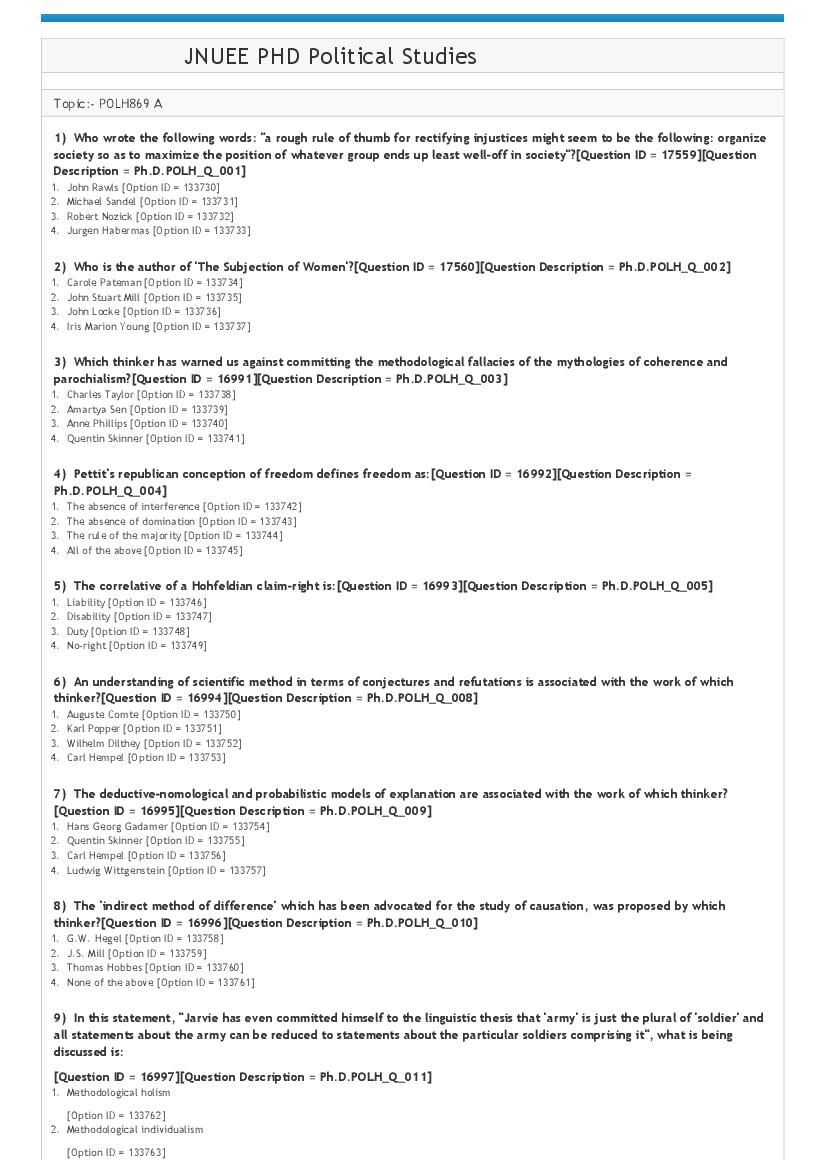
Topic:‐ POLH869 A
1) Who wrote the following words: "a rough rule of thumb for rectifying injustices might seem to be the following: organize
society so as to maximize the position of whatever group ends up least well‐off in society"?[Question ID = 17559][Question
Description = Ph.D.POLH_Q_001]
1. John Rawls [Option ID = 133730]
2. Michael Sandel [Option ID = 133731]
3. Robert Nozick [Option ID = 133732]
4. Jurgen Habermas [Option ID = 133733]
2) Who is the author of 'The Subjection of Women'?[Question ID = 17560][Question Description = Ph.D.POLH_Q_002]
1. Carole Pateman [Option ID = 133734]
2. John Stuart Mill [Option ID = 133735]
3. John Locke [Option ID = 133736]
4. Iris Marion Young [Option ID = 133737]
3) Which thinker has warned us against committing the methodological fallacies of the mythologies of coherence and
parochialism?[Question ID = 16991][Question Description = Ph.D.POLH_Q_003]
1. Charles Taylor [Option ID = 133738]
2. Amartya Sen [Option ID = 133739]
3. Anne Phillips [Option ID = 133740]
4. Quentin Skinner [Option ID = 133741]
4) Pettit's republican conception of freedom defines freedom as:[Question ID = 16992][Question Description =
Ph.D.POLH_Q_004]
1. The absence of interference [Option ID = 133742]
2. The absence of domination [Option ID = 133743]
3. The rule of the majority [Option ID = 133744]
4. All of the above [Option ID = 133745]
5) The correlative of a Hohfeldian claim‐right is:[Question ID = 16993][Question Description = Ph.D.POLH_Q_005]
1. Liability [Option ID = 133746]
2. Disability [Option ID = 133747]
3. Duty [Option ID = 133748]
4. No‐right [Option ID = 133749]
6) An understanding of scientific method in terms of conjectures and refutations is associated with the work of which
thinker?[Question ID = 16994][Question Description = Ph.D.POLH_Q_008]
1. Auguste Comte [Option ID = 133750]
2. Karl Popper [Option ID = 133751]
3. Wilhelm Dilthey [Option ID = 133752]
4. Carl Hempel [Option ID = 133753]
7) The deductive‐nomological and probabilistic models of explanation are associated with the work of which thinker?
[Question ID = 16995][Question Description = Ph.D.POLH_Q_009]
1. Hans Georg Gadamer [Option ID = 133754]
2. Quentin Skinner [Option ID = 133755]
3. Carl Hempel [Option ID = 133756]
4. Ludwig Wittgenstein [Option ID = 133757]
8) The 'indirect method of difference' which has been advocated for the study of causation, was proposed by which
thinker?[Question ID = 16996][Question Description = Ph.D.POLH_Q_010]
1. G.W. Hegel [Option ID = 133758]
2. J.S. Mill [Option ID = 133759]
3. Thomas Hobbes [Option ID = 133760]
4. None of the above [Option ID = 133761]
9) In this statement, "Jarvie has even committed himself to the linguistic thesis that 'army' is just the plural of 'soldier' and
all statements about the army can be reduced to statements about the particular soldiers comprising it", what is being
discussed is:
[Question ID = 16997][Question Description = Ph.D.POLH_Q_011]
1. Methodological holism
[Option ID = 133762]
2. Methodological individualism
[Option ID = 133763]
Page 2
[Option ID = 133764]
4. Revolution
[Option ID = 133765]
10) Which order correctly represents the ranking of these regions in terms of a higher to lower female labour participation
rate in the last few years?[Question ID = 16998][Question Description = Ph.D.POLH_Q_012]
1. East Asia & Pacific, South Asia, European Union, Sub‐Saharan Africa [Option ID = 133766]
2. European Union, Sub‐Saharan Africa, East Asia & Pacific, South Asia [Option ID = 133767]
3. South Asia, European Union, East Asia & Pacific, Sub‐Saharan Africa [Option ID = 133768]
4. Sub‐Saharan Africa, East Asia & Pacific, European Union, South Asia [Option ID = 133769]
11) Only one of the following was not a member of the Constituent Assembly of India. What is the name of that person?
[Question ID = 16999][Question Description = Ph.D.POLH_Q_015]
1. Hansa Mehta [Option ID = 133770]
2. Mahatma Gandhi [Option ID = 133771]
3. Rajendra Prasad [Option ID = 133772]
4. K. M. Munshi [Option ID = 133773]
12) Match the authors in List I with the books they have authored in List II:
List I List II
A. Roy Bhaskar I. A Realist Theory of Science
B. Jurgen Habermas II. The Structure of Scientific Revolutions
C. Peter Winch III. Knowledge and Human Interests
D. Thomas Kuhn IV. The Idea of Social Science and Its Relation to Philosophy
[Question ID = 17000][Question Description = Ph.D.POLH_Q_016]
Page 3
2. A ‐ I; B ‐ III; C ‐ II; D ‐ IV [Option ID = 133775]
3. A ‐ I; B ‐ III; C ‐ IV; D ‐ II [Option ID = 133776]
4. A ‐ IV; B ‐ I; C ‐ III; D ‐ IV [Option ID = 133777]
13) The author of the 'Theses on Feuerbach' is:[Question ID = 17001][Question Description = Ph.D.POLH_Q_019]
1. Immanuel Kant [Option ID = 133778]
2. Thomas Hobbes [Option ID = 133779]
3. Karl Marx [Option ID = 133780]
4. Aristotle [Option ID = 133781]
14) In the framework of capitalist patriarchy, reproductive labour adds to surplus value because it is:[Question ID = 17002]
[Question Description = Ph.D.POLH_Q_020]
1. Performed by women [Option ID = 133782]
2. Largely unpaid labour [Option ID = 133783]
3. The opposite of productive labour [Option ID = 133784]
4. None of the above [Option ID = 133785]
15) Match List I with List II
List I List II
Characteristic Approach
A. Institutions as codified systems of ideas and practicesI. Rational Choice Institutionalism
B. Cultural conventions, norms, cognitive frames II.Historical Institutionalism
C. Institutional actors, strategies, preferences III. Sociological Institutionalism
Page 4
Choose the correct answer from the options given below:
[Question ID = 17003][Question Description = Ph.D.POLH_Q_021]
1. A III, B IV, C I, D II [Option ID = 133786]
2. A IV, B III, C I, D II [Option ID = 133787]
3. A III, B IV, C II, D I [Option ID = 133788]
4. A IV, B III, C II, D I [Option ID = 133789]
16) Which one of the following approaches emphasises the asymmetries of power associated with the operation and
development of institutions?
[Question ID = 17004][Question Description = Ph.D.POLH_Q_022]
1. Historical Institutionalism
[Option ID = 133790]
2. Rational Choice Institutionalism
[Option ID = 133791]
3. Constructivist Institutionalism
[Option ID = 133792]
4. Sociological Institutionalism
[Option ID = 133793]
17)
Which one of the following statements is the correct description of the book The Indian Constitution: Cornerstone of a Nation by
Granville Austin?
[Question ID = 17005][Question Description = Ph.D.POLH_Q_023]
1. It is a political history of the framing of the Constitution of India.
[Option ID = 133794]
2. It is a history of the working of the Indian Constitution.
[Option ID = 133795]
3. It adopts a legal approach and discusses the legal antecedents of the Constitution of India.
[Option ID = 133796]
4. It adopts a post‐structural approach and sees the Constitution of India as a text with conflicting narratives.
[Option ID = 133797]
18) Fidelity to the universal principles of liberty, equality and fraternity makes the Constitution of India:[Question ID =
17006][Question Description = Ph.D.POLH_Q_024]
1. Transformative [Option ID = 133798]
2. Eclectic [Option ID = 133799]
3. Cosmopolitan [Option ID = 133800]
4. Popular [Option ID = 133801]
19) Match List I with List II
Page 5
Book Author
A. Politics in India I. Granville Austin
B.Working a Democratic Constitution II.Valerian Rodrigues
C. The Indian Parliament: Democracy at Work III. Upendra Baxi
D. Transformative Constitutionalism IV. Rajni Kothari
Page 6
[Question ID = 17007][Question Description = Ph.D.POLH_Q_025]
1. A I, B IV, C II, D III
[Option ID = 133802]
2. A IV, B III, C II, D I
[Option ID = 133803]
3. A II, B III, C I, D IV
[Option ID = 133804]
4. A IV, B I, C II, D III
[Option ID = 133805]
20) Which among the following statements are appropriate descriptions of the working of accountability in Indian
parliamentary democracy?
A. Parliament is an agency through which the government is held accountable.
Page 7
C. Parliament has an unfettered mandate to hold the government accountable through formal mechanisms.
D. The effectivity of formal mechanisms is limited because of the power of poltical parties over individual legislators.
Choose the correct answer from the options given below:
[Question ID = 17008][Question Description = Ph.D.POLH_Q_026]
1. A, B and D only [Option ID = 133806]
2. A, B and C only [Option ID = 133807]
3. A, C and D only [Option ID = 133808]
4. B, C and D only [Option ID = 133809]
21) The principle that the Constitution cannot be changed through the normal law making procedure by a popularly elected
assembly is called:[Question ID = 17009][Question Description = Ph.D.POLH_Q_027]
1. Constitutional Entrenchment [Option ID = 133810]
2. Constitutional Authoritarianism [Option ID = 133811]
3. Constitutional Flexibility [Option ID = 133812]
4. Constitutional Democracy [Option ID = 133813]
22) Match List I with List II
List I List II
Page 8
A. 246 I. Definition of Gram Sabha
B. 13 II. Distribution of legislative powers
C. 243 III. Laws inconsistent with fundamental rights to be void
D. 12 IV. Definition of 'The State' as it figures in the fundamental rights provisions
Choose the correct answer from the options given below:
[Question ID = 17010][Question Description = Ph.D.POLH_Q_028]
1. A II, B III, C IV, D I [Option ID = 133814]
2. A II, B III, C I, D IV [Option ID = 133815]
3. A IV, B II, C I, D III [Option ID = 133816]
4. A II, B IV, C III, D I [Option ID = 133817]
23) Article 141 of the Constitution of India lays down that the law declared by the Supreme Court should be binding on all
courts within the territory of India. This is called the doctrine of:[Question ID = 17011][Question Description =
Ph.D.POLH_Q_029]
1. Precedent [Option ID = 133818]
2. Antecedent [Option ID = 133819]
3. Basic Structure [Option ID = 133820]
4. Good Faith [Option ID = 133821]
24) In an article on The Congress 'System' written in 1964, Rajni Kothari desribed the party system in India as:[Question ID
= 17012][Question Description = Ph.D.POLH_Q_030]
1. A system of 'one party hegemony' [Option ID = 133822]
2. A system of 'one party dominance' [Option ID = 133823]
3. A 'one party system' [Option ID = 133824]
4. A system 'offering choice between alternatives' [Option ID = 133825]
25) What according to Lloyd Rudolph and Susanne Rudolph was the most striking feature of the first thirty five years of
India's electoral democracy?[Question ID = 17013][Question Description = Ph.D.POLH_Q_031]
1. A robust civil society [Option ID = 133826]
2. Non‐party political formation [Option ID = 133827]
3. Three distinct political idioms [Option ID = 133828]
4. A persistent centrism [Option ID = 133829]
26) Arrange the following in an ascending order according to chronology
A. Cabinet Mission Plan
B. Mountbatten Plan
C. Cripps Mission
Page 9
Choose the correct answer from the options given below
[Question ID = 17014][Question Description = Ph.D.POLH_Q_032]
1. C, B, A, D [Option ID = 133830]
2. C, A, D, B [Option ID = 133831]
3. D, B, A, C [Option ID = 133832]
4. C, A, B, C [Option ID = 133833]
27) The concept that the First Past the Post System leads to aggegation of votes around the leading party and its principal
rival, eliminating third parties/alliances, is called:[Question ID = 17015][Question Description = Ph.D.POLH_Q_033]
1. Nash's Equilibrium [Option ID = 133834]
2. Democratic Dilemma [Option ID = 133835]
3. Duverger's Law [Option ID = 133836]
4. Majority‐rule Instability Problem [Option ID = 133837]
28) In the article 'On the Enchantment of the State', what according to Sudipta Kaviraj is the type of organisation of
political authority, which makes the 'modern' state?[Question ID = 17016][Question Description = Ph.D.POLH_Q_039]
1. Sovereignty [Option ID = 133838]
2. Subsidiarity [Option ID = 133839]
3. Subsumption [Option ID = 133840]
4. Hegemony [Option ID = 133841]
29) Match List I with List II
List I List II
Page 10
A. Towards Equality Report I. Anti‐separatist Manifesto
B. Malimath Committee Report II. Status of Muslims in India
C. Nehru Committee Report III. Status of Women in India
D. Gopal Singh Committee ReportIV. Reform of the Criminal Justice System
Choose the correct answer from the options given below:
[Question ID = 17017][Question Description = Ph.D.POLH_Q_040]
1. A II, B I, C IV, D III [Option ID = 133842]
2. A III, B IV, C I, D II [Option ID = 133843]
3. A II, B IV, C III, D I [Option ID = 133844]
4. A III, B IV, C II, D I [Option ID = 133845]
30) Which of the following was not available originally in the Preamble of the Constitution of India?[Question ID = 17018]
[Question Description = Ph.D.POLH_Q_041]
1. Democratic [Option ID = 133846]
2. Republic [Option ID = 133847]
3. Secular [Option ID = 133848]
4. Sovereign [Option ID = 133849]
31) Given below are two statements
Statement I:The term "Politicization of Caste" is associated with Rajni Kothari.
Statement II:Caste associations did not play role in the "Politicization of Caste".
In light of the above statements, choose the correct answer from the options given below
Page 11
1. Both Statement I and Statement II are true
[Option ID = 133850]
2. Both Statement I and Statement II are false
[Option ID = 133851]
3. Statement I is true but Statement II is false
[Option ID = 133852]
4. Statement I is false but Statement II is true
[Option ID = 133853]
32) The book 'Public Institutions in India: Performance and Design' written by Devesh Kapur and Pratap Bhanu Mehta does
not discuss the following institution:[Question ID = 17020][Question Description = Ph.D.POLH_Q_043]
1. Indian Parliament [Option ID = 133854]
2. The Prime Minister's Office [Option ID = 133855]
3. Presidency [Option ID = 133856]
4. Reserve Bank of India [Option ID = 133857]
33) Given below are two statements, one is labelled as Assertion A and the other is labelled as Reason R
Assertion A :Separate electorates were introduced for effective representation by the British
Reason R :Joint electorates were considered as not providing genuine leadership to minorities
In light of the above statements, choose the correct answer from the options given below
[Question ID = 17021][Question Description = Ph.D.POLH_Q_044]
1. Both A and R are true and R is the correct explanation of A
[Option ID = 133858]
2.
Both A and R are true but R is NOT the correct explanation of A
[Option ID = 133859]
3. A is true but R is false
[Option ID = 133860]
4. A is false but R is true
[Option ID = 133861]
34) Match List I with List II
Choose the correct answer from the options given below:
Page 12
(Book) (Editor/ Author)
I. Anthony D. Smith
1. Development Planning and
the Indian State.
II. T.V. Satyamurthy
1. India: Globalization and
Change
III. Pamela Shurmer Smith
1. Industry and Agriculture in
India Since independence
IV. Partha Chatterjee
1. Theories of Nationalism
Page 13
1. A ‐ IV, B ‐ III, C ‐ II, D ‐I
[Option ID = 133862]
2. A ‐ IV, B ‐ I, C ‐ II , D ‐ III
[Option ID = 133863]
3. A ‐ I, B ‐II , C ‐ IV, D ‐III
[Option ID = 133864]
4. A ‐ II, B ‐ III, C ‐ IV, D ‐ I
[Option ID = 133865]
35) Which among the following is not identified by Timothy Luke as a trait of new social movements?[Question ID = 17023]
[Question Description = Ph.D.POLH_Q_046]
1. New Social Opposition [Option ID = 133866]
2. Programs of Post Marxists [Option ID = 133867]
3. Postproletarian [Option ID = 133868]
4. Self determination [Option ID = 133869]
36) Which among the following is not associated with conflict theory?[Question ID = 17024][Question Description =
Ph.D.POLH_Q_047]
1. Power [Option ID = 133870]
2. Exploitation [Option ID = 133871]
3. Alienation [Option ID = 133872]
4. Identity [Option ID = 133873]
37) The book Social Movements in India written by Ghanshyam Shah, does not talk about:[Question ID = 17025][Question
Description = Ph.D.POLH_Q_048]
1. Peasant Movements [Option ID = 133874]
2. Tribal Movements [Option ID = 133875]
3. Middle Class Movements [Option ID = 133876]
Page 14
38) The Planning Commission of India was established not in the background of:[Question ID = 17026][Question Description
= Ph.D.POLH_Q_049]
1. Bombay Plan [Option ID = 133878]
2. Antodaya Plan [Option ID = 133879]
3. People's Plan [Option ID = 133880]
4. Gandhian Plan [Option ID = 133881]
39) Which states have Coalition governments at present (in July 2021)?
A. Haryana
B. Delhi
C. Kerala
D. West Bengal
[Question ID = 17027][Question Description = Ph.D.POLH_Q_050]
1. A, B and D only [Option ID = 133882]
2. A and C only [Option ID = 133883]
3. D only [Option ID = 133884]
4. A only [Option ID = 133885]
40) Ascending order of coalition formations in India is:
1. National Front
2. National Democratic Alliance
3. United Front
4. United Progressive Alliance
Choose the correct answer from the options given below
[Question ID = 17028][Question Description = Ph.D.POLH_Q_051]
1. A, B, C, D
[Option ID = 133886]
2. C, D, A, B
[Option ID = 133887]
3. A, C, B, D
[Option ID = 133888]
4. B, C, A, D
[Option ID = 133889]
41) Given below are two statements
Statement I: National Front and United Front governments were led by Janta Party and Janta Dal respectively.
Statement II: Atal Bihari Vajpayee led National Democratic Alliance regime in late 1990s.
Page 15
[Question ID = 17029][Question Description = Ph.D.POLH_Q_052]
1. Both Statement I and Statement II are true [Option ID = 133890]
2. Both Statement I and Statement II are false [Option ID = 133891]
3. Statement I is true but Statement II is false [Option ID = 133892]
4. Statement I is false but Statement II is true [Option ID = 133893]
42) The following is not a feature of Exploratory Research:[Question ID = 17030][Question Description =
Ph.D.POLH_Q_053]
1. Become familiar with the basic facts, settings and concerns. [Option ID = 133894]
2. Create a general mental picture of conditions. [Option ID = 133895]
3. Formulate and focus questions for future research. [Option ID = 133896]
4. Test a theory’s predictions of principle. [Option ID = 133897]
43) Behavioural Approach in Political Science:[Question ID = 17031][Question Description = Ph.D.POLH_Q_054]
1. Interrelates fact and value. [Option ID = 133898]
2. Separates fact from value. [Option ID = 133899]
3. Ties fact and value to action and relevancy. [Option ID = 133900]
4. Makes fusion of fact and theory. [Option ID = 133901]
44) Who among the following is considered to be the precursor to positivist thought and its conception of science?[Question
ID = 17032][Question Description = Ph.D.POLH_Q_055]
1. Vilfredo Pareto [Option ID = 133902]
2. Gabriel Almond [Option ID = 133903]
3. Thomas Kuhn [Option ID = 133904]
4. David Hume [Option ID = 133905]
45) Nicos Poulantzas’ conception of state is based on:[Question ID = 17033][Question Description = Ph.D.POLH_Q_056]
1. Corporatism [Option ID = 133906]
2. Pluralism [Option ID = 133907]
3. Instrumentalism [Option ID = 133908]
4. Structuralism [Option ID = 133909]
46) Subjectification involves the simultaneous imposition and active take‐up of the gendered conditions of existence. This
statement in feminist research is associated with:[Question ID = 17034][Question Description = Ph.D.POLH_Q_057]
1. Judith Butler [Option ID = 133910]
2. Deleuze [Option ID = 133911]
3. B. Davis [Option ID = 133912]
4. Anne Phillips [Option ID = 133913]
47) What is true about Hypothesis
A. Hypothesis is a statement
B. Hypothesis has minimum two variables
C. Hypothesis needs to be proved not disproved
D. Hypothesis is an assumption
Page 16
[Question ID = 17035][Question Description = Ph.D.POLH_Q_058]
1. A, B and D only
[Option ID = 133914]
2. A and C only
[Option ID = 133915]
3. A and B only
[Option ID = 133916]
4. C and D only
[Option ID = 133917]
48) Who among the following is/are leading exponents of twentieth century hermeneutics?
A. Paul Ricoeur
B. Charles Taylor
C. Herbert Marcuse
D. Jurgen Habermas
Choose the correct answer from the options given below:
[Question ID = 17036][Question Description = Ph.D.POLH_Q_059]
1. B only [Option ID = 133918]
2. A and D only [Option ID = 133919]
3. C only [Option ID = 133920]
4. B and C only [Option ID = 133921]
49) Which among the following are the components of Case Study approach?
A. Conceptual Validity
B. Heuristic Impact
C. Holisic Elaboration
D. Causal Mechanisms Identification
Page 17
[Question ID = 17037][Question Description = Ph.D.POLH_Q_060]
1. A and B only [Option ID = 133922]
2. C and D only [Option ID = 133923]
3. B, C and D only [Option ID = 133924]
4. All of the above [Option ID = 133925]
50) Match List I with List II
List I List II
Book Author
A.
I. Kenneth Waltz
Politics among Nations: The Struggle for Power and Peace
II. Hans J Morgenthau
B. Theory of International Politics
C.
III. Hedley Bull
The Twenty Years’ Crisis, 1919‐1939: An Introduction to the Study of International
Relations
D. The Anarchical Society: A Study of Order in World Politics IV. Edward H. Carr
Page 18
[Question ID = 17038][Question Description = Ph.D.POLH_Q_061]
1. A ‐ II, B ‐I , C ‐IV , D ‐ III [Option ID = 133926]
2. A ‐ I, B ‐III, C ‐II , D ‐IV [Option ID = 133927]
3. A ‐ IV, B ‐III , C ‐ I, D ‐II [Option ID = 133928]
4. A ‐ III, B ‐II , C ‐IV , D ‐I [Option ID = 133929]
51) Joseph Nye defines soft power in international politics as;
[Question ID = 17039][Question Description = Ph.D.POLH_Q_062]
1. The ability to supplement military power with cultural resources
[Option ID = 133930]
2. The ability to achieve goals through ideological persuation
[Option ID = 133931]
3. The ability to get others to act in ways that are contrary to their initial preferences and strategies.
[Option ID = 133932]
4. The ability to disseminate effective propaganda
[Option ID = 133933]
52) Who among the following has proposed the concept of historical structures in International Relations theory?[Question ID
= 17040][Question Description = Ph.D.POLH_Q_063]
1. Karl Polanyi [Option ID = 133934]
2. Robert W. Cox [Option ID = 133935]
3. Paul Kennedy [Option ID = 133936]
4. David Held [Option ID = 133937]
53) Given below are two statements
Statement I: Structural realism argues that the characteristic of international system is non‐competitive equilibrium.
Statement II: According to structural realism, the behavior of states can be deduced from the properties of the state system
which is anarchical in nature.
In light of the above statements, choose the most appropriate answer from the options given below
[Question ID = 17041][Question Description = Ph.D.POLH_Q_064]
1. Both Statement I and Statement II are correct [Option ID = 133938]
2. Both Statement I and Statement II are incorrect [Option ID = 133939]
3. Statement I is correct but Statement II is incorrect [Option ID = 133940]
4. Statement I is incorrect but Statement II is correct [Option ID = 133941]
54) Identify the book which proposed that social capital is key to effective institutional performance in democracy;
[Question ID = 17042][Question Description = Ph.D.POLH_Q_065]
1. Elinor Ostrom, Governing the Commons: The Evolution of Institutions for Collective Action
[Option ID = 133942]
2. Arend Lijphart, Democracy in Plural Societies: A Comparative Exploration
[Option ID = 133943]
3.
Robert Putnam, Making Democracy Work: Civic Traditions in Modern Italy
[Option ID = 133944]
4. Clifford Geertz, The Interpretation of Cultures
[Option ID = 133945]
55) Match List I with List II
Page 19
Approach Exponent
A. Systems Analysis I. Talcott Parsons
B.Political Culture II.David Easton
C. Structural Functionalism III. Lucian Pye
D. Political Development IV.Gabriel Almond
Page 20
[Question ID = 17043][Question Description = Ph.D.POLH_Q_066]
1. A ‐III , B ‐I , C ‐IV , D ‐II
[Option ID = 133946]
2. A ‐II , B ‐IV , C ‐I , D ‐III
[Option ID = 133947]
3. A ‐IV , B ‐II , C ‐III , D ‐ I
[Option ID = 133948]
4. A ‐ I, B ‐II , C ‐ III, D ‐IV
[Option ID = 133949]
56) Given below are two statements
Statement I: Under state corporatism , trade union representation is restricted to the state recognized organization
Statement II: Under state corporatism, only the Trade Unions recognized by the business corporations are allowed to
function
Page 21
[Question ID = 17044][Question Description = Ph.D.POLH_Q_067]
1. Both Statement I and Statement II are true
[Option ID = 133950]
2. Both Statement I and Statement II are false
[Option ID = 133951]
3. Statement I is true but Statement II is false
[Option ID = 133952]
4. Statement I is false but Statement II is true
[Option ID = 133953]
57) The case of Asian fascism examined in Barrington Moore’s Social Origins of Democracy and Dictatorship is:
[Question ID = 17045][Question Description = Ph.D.POLH_Q_068]
1. China during the Republican Period [Option ID = 133954]
2. Indonesia under Suharto [Option ID = 133955]
3. Japan after Meiji Restoration [Option ID = 133956]
4. Cambodia under Pol Pot [Option ID = 133957]
58) What does the concept of longue duree stand for?
[Question ID = 17046][Question Description = Ph.D.POLH_Q_069]
1. A structural time as defined by Braudel [Option ID = 133958]
2. An epoch defined by modern political regimes [Option ID = 133959]
3. Chronicles of great events [Option ID = 133960]
4. Periodization based on dynasties in history [Option ID = 133961]
59) Given below are two statements
Statement I: In world –systems analysis, the unit of analysis is world‐ systems which encompasses different national states
Statement II: The unit of analysis in world – systems analysis is capitalist economy within each nation state.
In light of the above statements, choose the most appropriate answer from the options given below
[Question ID = 20214][Question Description = Ph.D.POLH_Q_070]
1. Both Statement I and Statement II are correct
[Option ID = 133962]
2. Both Statement I and Statement II are incorrect
[Option ID = 133963]
3. Statement I is correct but Statement II is incorrect
[Option ID = 133964]
4. Statement I is incorrect but Statement II is correct
Page 22
60) Which of the following book analyses international politics from the experiences of women’s lives?
[Question ID = 20215][Question Description = Ph.D.POLH_Q_071]
1. Naomi Klein ’s No Logo
[Option ID = 133966]
2.
Christine Sylvester’s, Feminist Theory and International Relations in a Post‐Modern Era
[Option ID = 133967]
3. Cynthia Enloe’s Bananas, Beaches and Bases : Making Feminist Sense of International Politics
[Option ID = 133968]
4. Alexandra Kollantai’s, The Social Basis of the Women’s Question
[Option ID = 133969]
61) Match List I with List II
List I List II
Events and programmes Corresponding U S administration
A. Cuban Missile Crisis I. Harry S. Truman
B.America – China Rapprochement II. John F Kennedy
C. New Deal III. Richard Nixon
D. Marshall Plan IV. Franklin D Roosevelt
Page 23
[Question ID = 20216][Question Description = Ph.D.POLH_Q_072]
1. A ‐III , B ‐ IV, C ‐ I, D ‐ II [Option ID = 133970]
2. A ‐ II, B ‐ III, C ‐IV , D ‐ I [Option ID = 133971]
3. A ‐ IV, B ‐I , C ‐ II, D ‐ III [Option ID = 133972]
4. A ‐I , B ‐II , C ‐ III, D ‐ IV [Option ID = 133973]
62) Who among the following Russian writers was a Soviet dissident awarded Nobel Prize in Literature?[Question ID =
20217][Question Description = Ph.D.POLH_Q_073]
1. Anton Chekhov [Option ID = 133974]
2. Ivan Turgenev [Option ID = 133975]
3. Fyodor Dostoyevsky [Option ID = 133976]
4. Alexander Solzhenitsyn [Option ID = 133977]
63) Member countries of BRICS are:[Question ID = 20218][Question Description = Ph.D.POLH_Q_074]
1. Brazil, Russia, India, China and Singapore [Option ID = 133978]
2. Bangladesh, Russia, India, China and South Africa [Option ID = 133979]
3. Britain, Russia, Indonesia, China and Singapore [Option ID = 133980]
4. Brazil, Russia, India, China, and South Africa [Option ID = 133981]
64) Match List I with List II
Page 24
Idea / Concept Exponent
A. Global Village I. Donald Janelle
B.Time – Space Convergence II.Marshal McLuhan
C. Runaway World III. David Harvey
D. Time – Space Compression IV. Anthony Giddens
Page 25
[Question ID = 20219][Question Description = Ph.D.POLH_Q_075]
1. A ‐ I, B ‐IV , C ‐III , D ‐ II
[Option ID = 133982]
2. A ‐ II, B ‐I , C ‐ IV, D ‐ III
[Option ID = 133983]
3. A ‐IV , B ‐ II, C ‐ I, D ‐ III
[Option ID = 133984]
4. A ‐ III, B ‐II , C ‐ I, D ‐ IV
[Option ID = 133985]
65) Select from below the Non‐Governmental Organization (NGO) involved in international campaign.[Question ID = 20220]
[Question Description = Ph.D.POLH_Q_076]
1. World Vision [Option ID = 133986]
2. Save the Children [Option ID = 133987]
3. Green peace [Option ID = 133988]
4. Grameen Bank [Option ID = 133989]
66) Name the diplomat who was India’s Ambassador to China during the Nationalist regime and after the Communist
revolution.[Question ID = 20221][Question Description = Ph.D.POLH_Q_077]
1. V P Menon [Option ID = 133990]
2. K M Panikkar [Option ID = 133991]
3. K P S Menon [Option ID = 133992]
4. K R Narayanan [Option ID = 133993]
67) Who among the following has defined nationalism as, “primarily a political principle which holds that the political and
the national unit should be congruent”? [Question ID = 20222][Question Description = Ph.D.POLH_Q_078]
1. Partha Chatterjee [Option ID = 133994]
2. Ernest Gellner [Option ID = 133995]
3. Benedict Anderson [Option ID = 133996]
4. Frantz Fanon [Option ID = 133997]
68) Given below are two statements
Statement I: The phrase ‘Fordism to Toyotism’ denotes the organizational changes in capitalism in the late twentieth
century
Statement II:Fordism and Toyotism represent same principles of organizing industrial production and therefore represent the
same capitalist model.
Page 26
[Question ID = 20223][Question Description = Ph.D.POLH_Q_079]
1. Both Statement I and Statement II are correct
[Option ID = 133998]
2. Both Statement I and Statement II are incorrect
[Option ID = 133999]
3. Statement I is correct but Statement II is incorrect
[Option ID = 134000]
4. Statement I is incorrect but Statement II is correct
[Option ID = 134001]
69) Which of the following is a developmental agency not associated with United Nations ?[Question ID = 20224][Question
Description = Ph.D.POLH_Q_080]
1. World Food Programme (WFP) [Option ID = 134002]
2. World Health Organization (WHO) [Option ID = 134003]
3. Oxfam [Option ID = 134004]
4. Food and Agriculture Organization (FAO) [Option ID = 134005]
70) What is biographical research?
[Question ID = 20225][Question Description = Ph.D.POLH_Q_081]
1. Collecting information about the events and achievements of a great leader
[Option ID = 134006]
2. Historical context of person’s life
[Option ID = 134007]
3. Detailed exploration into the life and times of the person
[Option ID = 134008]
4. Finding the problems and truths in particular individual’s life
[Option ID = 134009]
71) Feminist research methods intend to
[Question ID = 20226][Question Description = Ph.D.POLH_Q_082]
1. Establish women as the sole researchers
[Option ID = 134010]
2. Engage only with the female respondents during the interviews
[Option ID = 134011]
3. Challenge the conventional research methods dominated by patriarchal
assumptions
[Option ID = 134012]
4. Design courses about women’s participation in household works
[Option ID = 134013]
72) Arrange the following Thinkers chronologically, based on their births:
A. Auguste Comte B. Karl Marx C. Descartes D. Emile Durkheim
[Question ID = 20227][Question Description = Ph.D.POLH_Q_083]
1. A, B, C, D [Option ID = 134014]
2. C, A, B, D [Option ID = 134015]
3. C, A, D, B [Option ID = 134016]
4. A, C, D, B [Option ID = 134017]
73) Karl Popper is known for [Question ID = 20228][Question Description = Ph.D.POLH_Q_084]
1. Theory of Falsification [Option ID = 134018]
2. Theory of class struggle [Option ID = 134019]
3. Theory of justice [Option ID = 134020]
4. Ethnography [Option ID = 134021]
74) Research Methods under Positivism is indifferent to
[Question ID = 20229][Question Description = Ph.D.POLH_Q_085]
1. Empirical purity
[Option ID = 134022]
Page 27
[Option ID = 134023]
3. Applying the methods of natural sciences
[Option ID = 134024]
4. Metaphysical introspections
[Option ID = 134025]
75) Ethnography is the study of[Question ID = 20230][Question Description = Ph.D.POLH_Q_086]
1. Earth and environment [Option ID = 134026]
2. Language and literature [Option ID = 134027]
3. Particular set of people [Option ID = 134028]
4. Class conflicts [Option ID = 134029]
76) One of the following is not the function of Data collection:
[Question ID = 20231][Question Description = Ph.D.POLH_Q_087]
1. Schedule Interviews
[Option ID = 134030]
2. Case Studies
[Option ID = 134031]
3. Ethnography
[Option ID = 134032]
4. Hypothesis testing
[Option ID = 134033]
77) What is Pilot Survey?
[Question ID = 20232][Question Description = Ph.D.POLH_Q_088]
1. Aerial view of the research site
[Option ID = 134034]
2. Seeking permission from the airport authority to conduct the survey
[Option ID = 134035]
3. Informal exploratory investigation
[Option ID = 134036]
4. Random data collection
[Option ID = 134037]
78)
One of the following is not the function of Quantitative Research Design
[Question ID = 20233][Question Description = Ph.D.POLH_Q_089]
1. To propose a theoretical judgment to the research problems
[Option ID = 134038]
2. To enable investigation and anticipate potential problems
[Option ID = 134039]
3. To understand the boundaries of the research activity
[Option ID = 134040]
4. To provide a time line for the research
[Option ID = 134041]
79) What do you understand by the term "Anusandhan"?[Question ID = 17047][Question Description = Ph.D.POLH_Q_090]
1. Goal‐oriented [Option ID = 134042]
2. Following an aim [Option ID = 134043]
3. Attaining an aim [Option ID = 134044]
4. Praying to achieve an aim [Option ID = 134045]
80) Which of the following is/are not written by Dr. B. R. Ambedkar?
A. Annihilation of Caste
B. The Problem of Rupee: its Origin and its Solutions
Page 28
D. Caste and Race in India
[Question ID = 17048][Question Description = Ph.D.POLH_Q_091]
1. B, C and D [Option ID = 134046]
2. C and D [Option ID = 134047]
3. D only [Option ID = 134048]
4. B and D [Option ID = 134049]
81) 92.
Match List I with List II
Page 29
(Author) (Theory)
A. Quentin Skinner I. Metaphysical Principles of Virtue
B. Emile Durkheim II. Meaning and Understanding in the History of Ideas
III.
C. Thomas Kuhn
The Division of Labour in Society
D. Immanuel Kant IV. The Structure of Scientific Revolution
Page 30
[Question ID = 17049][Question Description = Ph.D.POLH_Q_092]
1. A ‐ IV, B ‐I , C ‐III , D ‐ II
[Option ID = 134050]
2. A ‐II , B ‐III , C ‐I , D ‐ IV
[Option ID = 134051]
3. A ‐II , B ‐ III, C ‐ IV, D ‐ I
[Option ID = 134052]
4. A ‐ IV , B ‐ III, C ‐I , D ‐ II
[Option ID = 134053]
82) Match List I with List II
List I List II
Films Film Directors
Page 31
B. Netaji Subhash Chandra Bose: the Unforgotten HeroII. Jabbar Patel
III.
C. The Legend of Bhagat Singh
Rajkumar Santoshi
D. Sardar IV. Shyam Benegal
V. Richard Attenborough
Choose the correct answer from the options given below:
[Question ID = 17050][Question Description = Ph.D.POLH_Q_093]
1. A‐IV, B‐V, C‐I, D‐III [Option ID = 134054]
2. A‐II, B‐IV, C‐III, D‐I [Option ID = 134055]
3. A‐II, B‐III, C‐V, D‐I [Option ID = 134056]
4. A‐V, B‐IV, C‐II, D‐III [Option ID = 134057]
83) The 42nd Amendment to the Constitution of India in 1976 was introduced to add three new terms to the Preamble.
What are these terms?
[Question ID = 17051][Question Description = Ph.D.POLH_Q_094]
1. Secular. Democratic. Republic.
[Option ID = 134060]
2. Socialist. Secular. Integrity.
[Option ID = 134061]
3. Sovereign. Socialist. Secular.
[Option ID = 134058]
4. Socialist. Secular. Democratic.
[Option ID = 134059]
84) Arrange the following names in ascending order of their occupancy in Prime Minister's office in India.
A, Charan Singh
B. Indira Gandhi
C. Gulzarilal Nanda
D. Morarji Desai.
[Question ID = 17052][Question Description = Ph.D.POLH_Q_095]
1. CBDA
[Option ID = 134062]
2. CDAB
[Option ID = 134063]
3. CBAD
[Option ID = 134064]
4. BCDA
[Option ID = 134065]
85) Match List I with List II
Page 32
Author Book
A. Francis Fukuyama I. End of History and the Last Man
B. Karl Mannhein II. The End of ideology
C. Daniel Bell III. The World is Flat
IV.
D. Thomas Friedman
Ideology and Utopia
Page 33
[Question ID = 17053][Question Description = Ph.D.POLH_Q_096]
1. A‐IV, B‐I, C‐ II, D‐III
[Option ID = 134066]
2. A‐1, B‐IV, C‐II, D‐III
[Option ID = 134067]
3. A‐III, B‐IV, C‐II, D‐I
[Option ID = 134068]
4. A‐I, B‐II, C‐IV, D‐III
[Option ID = 134069]
86) Examine the following assertions related to M.K. Gandhi's book 'Hind Swaraj':
A. Opposition to technology, science and Western civilization
B. Defence of 'Swadeshi' (Self Reliance)
C. Opposition to Untouchability and Caste inequalities
D. Defence of Hindu‐Muslim Unity
[Question ID = 17054][Question Description = Ph.D.POLH_Q_097]
1. All the above assertions are true [Option ID = 134070]
2. Only A and B are true but C and D are false [Option ID = 134071]
3. Only A, B and C are true but D is false [Option ID = 134072]
Page 34
87) Match List I with List II
List I List II
Author Book
A. Swami Shraddhanand I. Integral Humanism
II.
B. VD Savarkar Hindutva: Who is a Hindu
C.
III.
Page 35
We or Our Nationhood Defined
D. IV.
Deendayal Upadhyaya Indianization? What, Why and How
Choose the correct answer from the options given below:
Page 36
1. A ‐I , B ‐ III , C ‐ II , D ‐ IV
[Option ID = 134074]
2. A ‐IV , B ‐ III, C ‐ II, D ‐ I
[Option ID = 134075]
3. A ‐IV, B ‐II , C ‐III , D ‐I
[Option ID = 134076]
4. A ‐I , B ‐II , C ‐III , D ‐IV
[Option ID = 134077]
88) From the following statements, select the closely associated statements with the Postcolonial Studies.
A. Study of Cultural legacy of colonialism and Imperialism
B. Study of the institutional practices of newly independent nations
C. The social and psychological impact of colonialism on indigneous people
D. The establishment of International organizations like UNO and SAARC
[Question ID = 17056][Question Description = Ph.D.POLH_Q_099]
1. A, B and C are true but D is false [Option ID = 134078]
2. A and B are true but C and D are false [Option ID = 134079]
3. A and D are true but B and C are false [Option ID = 134080]
4. All the statements are true. [Option ID = 134081]
89) Match the Thinkers (List I) with Theoretical Concepts (List 2)
Page 37
Thinker Theoretical Concept
A. I.
Karl Marx Veil of Ignorance
B. II.
Max Weber Charismatic Authority
C. III.
Emile Durkheim Anomie
D. IV.
John Rawls Proletariat Revolution
Page 38
[Question ID = 17057][Question Description = Ph.D.POLH_Q_100]
1. A ‐ IV , B ‐ II, C ‐ I, D ‐ III
[Option ID = 134082]
2. A ‐ IV, B ‐ II, C ‐ III , D ‐ I
[Option ID = 134083]
3. A ‐ II, B ‐IV , C ‐ III, D ‐ I
[Option ID = 134084]
4. A ‐II , B ‐IV , C ‐ I, D ‐ III
[Option ID = 134085]
Topic:‐ POLH869 B
1) In the passage above, economic inequalities are not a way of :[Question ID = 17059][Question Description =
Ph.D.POLH_Q_006]
1. Rewarding moral desert [Option ID = 134090]
2. Incentivising individuals [Option ID = 134091]
3. Compensating for costs [Option ID = 134092]
4. All of the above [Option ID = 134093]
2) The writer of the above passage is seeking to fill up positions beneficial for all in society without giving up on:
[Question ID = 17060][Question Description = Ph.D.POLH_Q_007]
1. Benevolent despotism
[Option ID = 134094]
2. Freedom of occupation
[Option ID = 134095]
3. A laissez faire system
[Option ID = 134096]
4. None of the above
[Option ID = 134097]
Topic:‐ POLH869 C
1) In the passage above, the 'soft' approach to learning can also be characterized as
[Question ID = 17061][Question Description = Ph.D.POLH_Q_013]
1. A quantitative approach
[Option ID = 134098]
2. An ethnographic approach
[Option ID = 134099]
3. A large‐N method
[Option ID = 134100]
4. A statistical study
[Option ID = 134101]
Page 39
[Question ID = 17062][Question Description = Ph.D.POLH_Q_014]
1. We must choose between alternative methods
[Option ID = 134102]
2. Only one method must be used
[Option ID = 134103]
3. Different methods or approaches are complementary
[Option ID = 134104]
4. All of the above
[Option ID = 134105]
Topic:‐ POLH869 D
1) Read carefully the passage below and asnwer the questions that follow:
Most institutions depend for their effectiveness on the performance of other institutions. The Indian experience is replete
with examples of institutions failing because one critical link in their ties with other institutions was found to be deficient.
The deficiency of one institution cannot be removed by focusing only on that institution. One of the weaknesses of attempts
at reforming institutions has been the lack of attention to the external links of these institutions (to other institutions).
Indeed, this is the point at which the conflict between institutions is most palpable and institutional politics becomes a
significant obstacle. Analytically, there are three different approaches to this problem. One approach is analogous to a chain
being as strong as its weakest link...A different insight comes from multiple veto points inherent in multiple
institutions...Finally, systemic effects depend considerably on coordinating mechanisms.
Which one among the following statements represents the argument made in the paragprah most appropriately?[Question ID
= 17063][Question Description = Ph.D.POLH_Q_034]
1. The effectiveness of institutions depends on their design. [Option ID = 134106]
2. Institutions become efficient because of effective leadership. [Option ID = 134107]
3. Effectiveness of institutions can be studied by evaluating the decision making practices
and performance of particular institutions.
[Option ID = 134108]
4. Institutions function within an institutional matrix and depend on other institutions
to perform effectively.
[Option ID = 134109]
2) In order to reform institutions, policy makers must pay attention to:
[Question ID = 17064][Question Description = Ph.D.POLH_Q_035]
1. Weaknesses that exist within institutional structures.
[Option ID = 134110]
2. The structure of incentives in institutional design.
[Option ID = 134111]
3. The inter‐relationship among institutions which are potential sites of conflcit.
[Option ID = 134112]
4. Institutional autonomy, by ensuring that the institution draws its powers from a statute.
[Option ID = 134113]
3) The Election Commission of India, during election time, puts on hold governmental decisions that might influence
electoral outcome. According to the passage above, this is an example of:[Question ID = 20254][Question Description =
Ph.D.POLH_Q_036]
1. A chain being as strong as its weakest link [Option ID = 134114]
2. Veto points that exist among institutions to ensure democratic uncertainty of elections [Option ID = 134115]
3. Delays which may result in opportunity costs [Option ID = 134116]
4. Limiting damaging conflicts through institutional coordination [Option ID = 134117]
4) According to the Andre Gunder Frank and Marta Fuentes, 'new social movements' are distinct because:[Question ID =
20255][Question Description = Ph.D.POLH_Q_037]
1. They seek social transformation by capturing social power. [Option ID = 134118]
2. They seek social transformation by organising themselves as political parties. [Option ID = 134119]
3. They demand social justice without aspiring for political power. [Option ID = 134120]
4. They seek autonomy without blurring the boundaries between social and political power. [Option ID = 134121]
5) The paradigm of new social movements presented by Frank and Fuentes can be described as committed to:[Question ID
= 20256][Question Description = Ph.D.POLH_Q_038]
1. Examining political power as an aggregage of power relations in society. [Option ID = 134122]
2. Looking at the political implications of movements for social justice. [Option ID = 134123]
3. Making social power central to changing political power. [Option ID = 134124]
4. A process of 'depoliticisation of the social realm'. [Option ID = 134125]
Page 40
1) Read carefully the passage below and answer the questions that follow.
Social phenomena are complex...virtually all everyday events show causal complexity...human understanding of causation
and of events in general is fundamentally holistic. Parts are not viewed in isolation but in context of the whole they
form...causal complexity, of the multiple conjunctural kind is when an outcome results from several different combinations
of conditions.
In the passage above, when theorists claim that the complexity of social phenomena is because of conjunctural causation,
they are referring to:
[Question ID = 20257][Question Description = Ph.D.POLH_Q_017]
1. The importance of contextual factors [Option ID = 134127]
2. The viewing of parts in the context of the whole they form [Option ID = 134128]
3. All of the above [Option ID = 134129]
4. Outcomes resulting from a combination of several factors [Option ID = 134126]
2) Read carefully the passage below and answer the questions that follow.
Social phenomena are complex...virtually all everyday events show causal complexity...human understanding of causation
and of events in general is fundamentally holistic. Parts are not viewed in isolation but in context of the whole they
form...causal complexity, of the multiple conjunctural kind is when an outcome results from several different combinations
of conditions.
In the passage above, causality is being identified as:
[Question ID = 20258][Question Description = Ph.D.POLH_Q_018]
1. Complex [Option ID = 134130]
2. Multiple [Option ID = 134131]
3. Conjunctural [Option ID = 134132]
4. All of the above [Option ID = 134133]