WB SET 2020 Question Paper 2 Education
Finished viewing? Save it for later —
Download WB SET 2020 Question Paper 2 Education (PDF · 16 pages)About WB SET 2020 Question Paper 2 Education
WB SET 2020 Question Paper 2 Education is available here for free download. Published by West Bengal Exams for WB SET, this question paper can be viewed online or downloaded as a PDF (16 pages). Candidates preparing for WB SET can use WB SET 2020 Question Paper 2 Education to understand the exam pattern, the type of questions asked, and the overall difficulty level.
Frequently Asked Questions
How can I download WB SET 2020 Question Paper 2 Education?
Open this page and click the Download button to save WB SET 2020 Question Paper 2 Education as a PDF. It is completely free on AglaSem Docs.
Is WB SET 2020 Question Paper 2 Education free to download?
Yes. WB SET 2020 Question Paper 2 Education can be viewed online and downloaded as a PDF free of cost on AglaSem Docs.
How many pages does WB SET 2020 Question Paper 2 Education have?
WB SET 2020 Question Paper 2 Education contains 16 pages, which you can read online or download together as a single PDF.
Where can I find more WB SET study material?
You can find more WB SET question papers, sample papers, syllabus, and answer keys on AglaSem Docs.
WB SET 2020 Question Paper 2 Education – Text
Read the full text of this question paper below — useful to quickly search, copy and reference the content online without downloading the PDF.
📄 View text version (15 pages)
Page 1
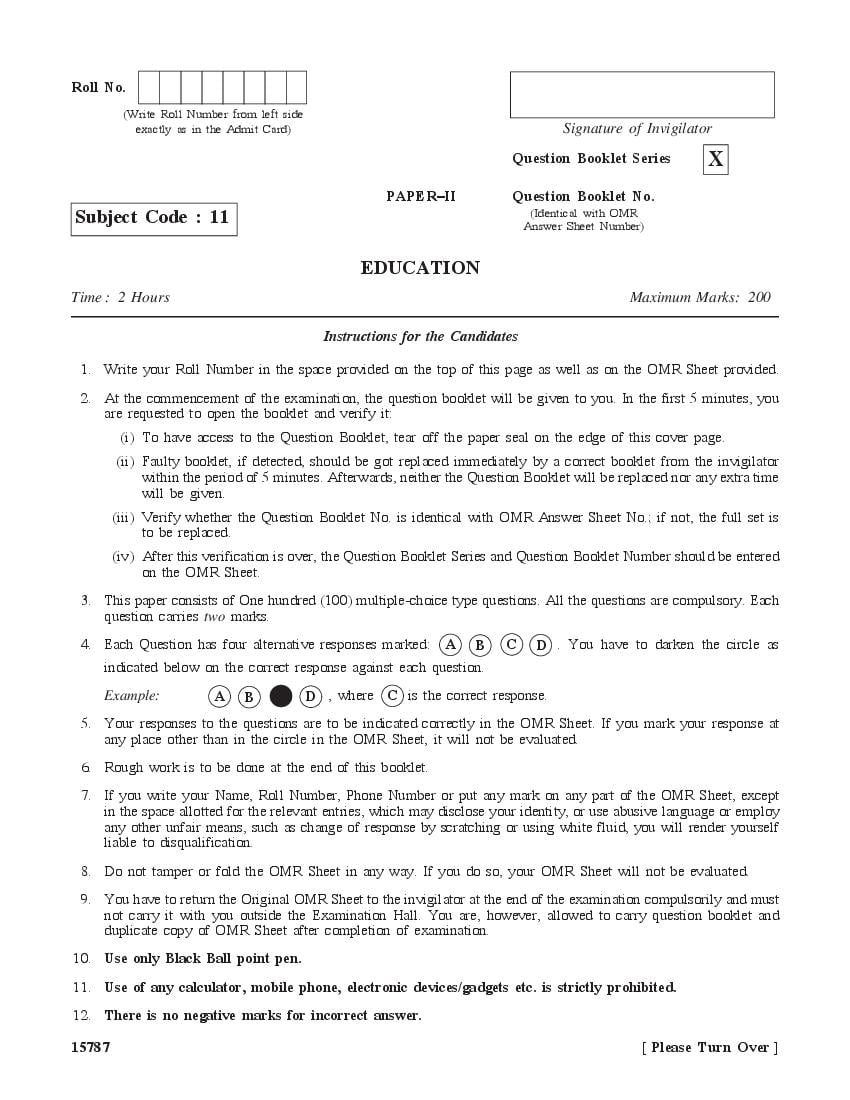
(Write Roll Number from left side
exactly as in the Admit Card) Signature of Invigilator
Question Booklet Series X
PAPER–II Question Booklet No.
Subject Code : 11 (Identical with OMR
Answer Sheet Number)
EDUCATION
Time : 2 Hours Maximum Marks: 200
Instructions for the Candidates
1. Write your Roll Number in the space provided on the top of this page as well as on the OMR Sheet provided.
2. At the commencement of the examination, the question booklet will be given to you. In the first 5 minutes, you
are requested to open the booklet and verify it:
(i) To have access to the Question Booklet, tear off the paper seal on the edge of this cover page.
(ii) Faulty booklet, if detected, should be got replaced immediately by a correct booklet from the invigilator
within the period of 5 minutes. Afterwards, neither the Question Booklet will be replaced nor any extra time
will be given.
(iii) Verify whether the Question Booklet No. is identical with OMR Answer Sheet No.; if not, the full set is
to be replaced.
(iv) After this verification is over, the Question Booklet Series and Question Booklet Number should be entered
on the OMR Sheet.
3. This paper consists of One hundred (100) multiple-choice type questions. All the questions are compulsory. Each
question carries two marks.
4. Each Question has four alternative responses marked: A B C D . You have to darken the circle as
indicated below on the correct response against each question.
Example: A B C D , where C is the correct response.
5. Your responses to the questions are to be indicated correctly in the OMR Sheet. If you mark your response at
any place other than in the circle in the OMR Sheet, it will not be evaluated.
6. Rough work is to be done at the end of this booklet.
7. If you write your Name, Roll Number, Phone Number or put any mark on any part of the OMR Sheet, except
in the space allotted for the relevant entries, which may disclose your identity, or use abusive language or employ
any other unfair means, such as change of response by scratching or using white fluid, you will render yourself
liable to disqualification.
8. Do not tamper or fold the OMR Sheet in any way. If you do so, your OMR Sheet will not be evaluated.
9. You have to return the Original OMR Sheet to the invigilator at the end of the examination compulsorily and must
not carry it with you outside the Examination Hall. You are, however, allowed to carry question booklet and
duplicate copy of OMR Sheet after completion of examination.
10. Use only Black Ball point pen.
11. Use of any calculator, mobile phone, electronic devices/gadgets etc. is strictly prohibited.
12. There is no negative marks for incorrect answer.
15787 [ Please Turn Over ]
Page 3
EDUCATION
PAPER II
1. UDL is helpful for __________ . 6. Which one of the following is not correct for
(A) socially disadvantaged children mixed methods research?
(B) children with learning & attention problem (A) It provides in-depth understanding of a
(C) physically challenged children problem.
(D) slum children (B) It involves qualitative and quantitative data
as two distinct types.
(C) It combines experimental research with
narrative research.
(D) It integrates ‘numbers’ and ‘stories’.
2. Who is not Quality Gurus among the following?
(A) E. Deming
(B) W. Shewart
(C) C. K. Pralhad 7. Linguistic, logical-mathematical, spatial, musical,
(D) A. D. Jain bodily - kinesthetic, inter-personal and intra-personal are
types of intelligence suggested by
(A) Sternberg
(B) Cattell and Horni
(C) Gardner
(D) Jensen
3. Which of the following is not an use of ICT for
evaluation?
(A) Preparing test items
8. Who headed the Secondary Education Commission
(B) Administering test (1952-53)?
(C) Scoring subjective test (A) Dr. S. Radhakrishnan
(D) Disseminating examination result (B) Dr. A. Lakshmanaswami Mudaliar
(C) Dr. D. S. Kothari
(D) Dr. Yash Pal
4. Rubric is _________ .
(A) list of questions used for assessment 9. Which School of Philosophy maintains that
‘the effect pre-exists in the cause in a potential
(B) set of criteria used for assessment
condition’?
(C) step used for conducting test (A) Nyaya
(D) key for evaluating answer sheet (B) Vaisesika
(C) Samkhya
(D) Jainism
5. The National Institute for Empowerment of persons
with Multiple Disabilities is located at __________ . 10. The importance of Curriculum in any system of
(A) Secunderabad education is
(B) Dehradun (A) preparation of students for life.
(B) inculcation of constitutional values.
(C) Chennai
(C) development of knowledge.
(D) Kolkata (D) All of the above
Page 4
11. One whose educational needs are not being met by 16. Flander’s interaction analysis is based on
traditional educational programs, and who requires a __________.
special education program, is referred as: (A) verbal and non-verbal behaviour of teacher
(A) Student with special needs (B) non-verbal behaviour of teacher
(B) Gifted student (C) verbal behaviour of teacher
(C) Exceptional student (D) verbal and non-verbal behaviour of student
(D) Student with a disability
17. Which of the following is a typical characteristic
of the grounded theory research?
12. In case of PERT, the shortest time within which (A) A culture-sharing group
any activity can be completed is (B) Chronology of an individual’s experiences
(A) Expected time (C) High response rate from participants
(B) Optimistic time (D) Theoretical sampling
(C) Most likely time
(D) Unexpected time
18. If two or more methods are mixed up for teaching,
the teaching method will be known as
(A) Combined Method
(B) Homogeneous Method
13. The full form of MOOC is
(C) Eclectic Method
(A) Massive Open Online Course
(D) Single Method
(B) Massive Online Open Course
(C) Mega Open Online Course
(D) Multiple Online Open Course
19. Prakriti is made of which set of philosophical
components?
(A) Essence, Energy & Inertia
(B) Cause, Effect & Existence
14. In India, all the general teacher education (C) Purusa, Prama & Aprama
programmes are governed by __________. (D) None of the above
(A) UGC
(B) NCERT
(C) NCTE
(D) RCI 20. The Secondary Education commission
(1952-53), recommended the aims of secondary education
as—
(i) To develop democratic citizenship
(ii) To improve the vocational efficiency
15. Taylor’s Level Theory of Creativity describes (iii) To develop leadership
creativity as existing in (iv) To develop personality
(A) 4 levels (A) (i) & (ii) are correct.
(B) 5 levels (B) (i) & (iii) are correct.
(C) 2 levels (C) (iii) & (iv) are correct.
(D) 3 levels (D) (i), (ii), (iii) & (iv) are correct.
Page 5
21. ‘The Concept of caring rooted in receptivity, 26. In Sternberg’s Triarchic theory of Intelligence,
relatedness and responsiveness is a basic approach to the experiential sub theory refers to
ethics’. Who said it? (A) internal mechanisms that underlie intelligent
(A) Wollstonecraft behaviour.
(B) Tagore (B) cognitive self-motivation and organisation
(C) Noddings skills.
(D) Friere (C) meta components, performance components
and knowledge-acquisition components.
(D) how experince interacts with intelligence in
22. Rogers adopted which technique to measure terms of the individual’s internal world, and
clients’ self-concepts? the external world.
(A) Q - Jump
(B) Q - List
(C) Q - Sort
(D) Q - V - C
27. The social process which allows an objective
comparison between the situation of the individual or
23. The main purpose of in-service teacher education group and to the rest of the society is termed as
is to (A) Resource Mobilization
(A) provide additional degree. (B) Relative Deprivation
(B) promote teachers.
(C) Social Movement
(C) update teachers knowledge and skills.
(D) None of the above
(D) develop interest in teaching.
24. CAI is used for
(A) Instructional purpose
(B) Teaching purpose 28. The components of special education that should
(C) Individual variation be considered by teachers when working with students
(D) All of the above with disabilities include instructional
(A) procedures, content and environment.
(B) content, procedures and technology.
25. In case of correlation between any two variables, (C) specifications, content, procedures and
the following relationship occurs: environment.
(i) There is increase in both variables. (D) content, procedures, environment and
(ii) There is decrease in both variables. technology.
(iii) One variable increases and the other
decreases.
(iv) No consistency in the nature of increase or
decrease in any variables.
Which of the above stated set is correct for
positive correlation? 29. Which of the following is not an essential
component of pre-service teacher education?
(A) (i) and (iii) (A) Internship in teaching
(B) (iii) and (ii) (B) Field engagement
(C) (ii) and (i) (C) School exposure
(D) (i) and (iv) (D) Teaching aid exhibition
Page 6
30. Match the List-I (psychologist) with List-II 34. Which of the following gives “National Awards
(contribution): for Innovative practice and Experiments in Education for
List-I List-II Schools and Teacher Education Institutions”?
(a) Erikson (i) Cognitive development theory (A) NCERT
(b) Bandura (ii) Psychosocial stages of
development (B) UGC
(c) Piaget (iii) Social learning theory (C) SCERTs
(d) Kohlberg (iv) Development Task (D) NCTE
(v) Moral development theory
Codes:
(a) (b) (c) (d)
(A) (ii) (iii) (i) (v)
(B) (i) (v) (ii) (iv) 35. A class teacher administered Thematic
(C) (v) (ii) (iii) (iv) Apperception Test to a group of students to assess their
(D) (iii) (i) (ii) (iv) (A) Achievement
(B) Awareness
(C) Attitude
(D) Personality
31. Assertion (A) : The purpose of assessment is to
improve the quality of teaching-
learning.
Reason (R) : Assessment must be held
continuously to develop holistic 36. Which school of philosophy belives that the
understanding of child. ‘self is an impermanent mind-body complex’?
(A) (A) and (R) both are correct but (R) is not the
(A) Samkhya
explanation of (A).
(B) (A) and (R) both are correct and (R) is the (B) Yoga
correct explanation of (A). (C) Buddhism
(C) (A) and (R) both are false. (D) Vedanta
(D) (A) is correct but (R) is false.
37. Which one of the following Commission
32. A type of curriculum presented by experts is recommended for the establishment of Indian Education
called Service?
(A) Entitlement Curriculum (A) University Education Commission
(B) Intended Curriculum (B) Secondary Education Commission
(C) Recommended Curriculum (C) Kothari Education Commission
(D) Supported Curriculum (D) National Knowledge Commission
33. Which of the following statement is not applicable 38. The direct cognition of an object and its contact
to Buddhism? with some sense is termed as
(A) It aims at removal of ignorance. (A) Perception
(B) All phenomena are subject to law of causation. (B) Inference
(C) All is transitory. (C) Testimony
(D) The world is permanent due to transmigration. (D) Anubhava
Page 7
39. Curriculum is a fixed programme of courses is 44. The National Commission on Teachers
(A) A contemporary concept (1983-85) has not envisioned the following for teachers:
(B) An old concept (A) To communicate to pupils the importance of
(C) A logical concept national integrity and unity.
(D) Both (A) and (B) (B) To develop scientific attitude in pupils.
(C) To be committed to society.
(D) To conduct extra coaching for the poor and
downtrodden students.
40. Which of the followings is not a principles of
Malcolm Knowles’ theory of andragogy?
(A) Adults are involved in planning of instruction.
(B) Adult learning is content oriented.
(C) Adult learning is based on the experience of
adult. 45. Assertion (A) : External validity of any
(D) Adult learn the subject that have immediate educational research refers to the
relevance to them. extent the findings are
generalizable to populations.
Reason (R) : Generalization of research results
41. Arrange the following measurement scales from is questionable in case of large
‘the most precise’ to ‘the least precise’ method of sample size.
quantification:
Select the correct code from the followings:
(i) Ordinal scale
(ii) Ratio scale (A) Both (A) and (R) are not correct.
(iii) Nominal scale (B) (A) is correct while (R) is not correct.
(iv) Interval scale (C) Both (A) and (R) are correct and (R) is the
correct explanation of (A).
Codes:
(D) Both (A) and (R) are correct and (R) is not the
(A) (iii) (iv) (ii) (i) correct explanation of (A).
(B) (ii) (iv) (i) (iii)
(C) (iv) (i) (iii) (ii)
(D) (ii) (iv) (i) (iii)
46. Which of the followings is key element of Total
42. The leader is not functioning well when
Quality Management?
(A) most participants are enjoying the task.
(A) Finance
(B) interpersonal and organizational conflicts
(B) Interpersonal relation
occur.
(C) Individual work
(C) the reward system is adequate.
(D) Team work
(D) the participants are interacting with each
other.
43. Which of the following step is not a part of 5E
model of teaching? 47. Triangulation in research essentially refers to
(A) Engage (A) multiple sampling techniques.
(B) Explain (B) multiple methods of conducting research.
(C) Explore (C) a technique of data analysis.
(D) Extend (D) a qualitative cross-validation.
Page 8
48. Who viewed that rote learning ability (level-I), 53. Any reliability coefficients practically remains
may be a necessity but not sufficient condition for within the following range:
emergence of problem solving (level-II)? (A) 0·00 to 1·00
(A) E. G. Boring (B) – 1·00 to 1·00
(B) J. S. Burner (C) 0·01 to 1·00
(C) C. R. Jensen (D) – 1·00 to 0·00
(D) Cyril Burt
49. A teacher is strict in maintaining discipline in 54. Which of the following is not a defence
class. But he/she always gives room for discussion to mechanism?
students for clarifying doubts. What is the approach of
(A) Projection
teacher towards students?
(B) Regression
(A) Autocratic
(C) Ingratiation
(B) Democratic
(D) Sublimation
(C) Flexible
(D) Rigid
55. Which of the following set is a correct sequence in
50. Giftedness from teacher’s point of view is a
a research study?
combination of
(A) Formulation of purpose statement, hypotheses
(A) High ability–High creativity–High
and objectives.
commitment
(B) Formulation of objectives, hypotheses and
(B) High motivation–High commitment–High
purpose statement.
talent
(C) Formulation of purpose statement, hypotheses
(C) High Ability–High Talent–High commitment
and objectives.
(D) High Talent–High creativity–High Memory
(D) Formulation of purpose statement, objectives
and hypotheses.
51. List of all teachers serving in teacher education
institutions of India during 2018-19 constitute.
(A) A population 56. Match the following items of List-I with List-II.
(B) A target population
List-I List-II
(C) A target sample (a) Pudgala (i) Space
(D) A sample (b) Dharma (ii) Medium of rest
(c) Adharma (iii) Time
(d) Akasa (iv) Medium of motion
(v) Matter
52. Which of the following is not a feature of Codes:
profession? (a) (b) (c) (d)
(A) Short duration of training (A) (v) (iv) (ii) (iii)
(B) Professional body (B) (v) (iv) (ii) (i)
(C) Code of ethics (C) (i) (iii) (ii) (iv)
(D) Accountability (D) (v) (iv) (i) (iii)
Page 9
57. ‘F’ value for a difference between boys and girls 62. Vindication of the Rights of Women (1792) is
in achievement is 16 what will be its ‘t’ value? written by
(A) 32 (A) Wollstonecraft
(B) 4 (B) Noddings
(C) 256 (C) Friere
(D) 16 (D) Sabitri Phoole
58. Which of the following is not the objective of
pedagogical analysis? 63. Which of the following is used in Curriculum
evaluation?
(A) To identify the learning difficulties of class.
(A) Tyler’s objectives – Centered Model
(B) To break the content into meaningful
components. (B) Stake’s Responsive Model
(C) To design suitable learning resources. (C) An Eclectic Approach
(D) To anticipate activities for evaluation. (D) A Singular – Focused Approach
59. Which one of the following teacher education 64. According to Piaget during Concrete Operational
programme is recently introduced by the NCTE? Stage children have difficulty with __________.
(A) B. A. B. Ed. (A) Perspective thinking
(B) M. Ed. (Integrated) (B) Deductive logic
(C) B. Sc. B. Ed. (C) Inductive logic
(D) 4-years Integrated Teacher Education (D) Conversation
Programme (Arts and Science Stream)
60. The ·95 confidence interval for a given Mpop lies 65. Which philosophy does not believe in any standard
within the fiduciary limits of the following: value in the world?
(A) M ± 2·58 × m (A) Pragmatism
(B) M ± 1·64 × m (B) Idealism
(C) Naturalism
(C) M ± 2·33 × m
(D) Realism
(D) M ± 1·96 × m
61. A schema is __________. 66. Which statement is not true about expository
(A) category of knowledge that allows to interpret transactional approach in teacher education?
or understand the world (A) Provide new knowledge that students will
(B) the process of balancing old knowledge and need to understand.
new information (B) Used when learning material is unfamiliar to
(C) the process of taking new information learner.
(D) the process of memorizing knowledge from (C) Beneficial for team teaching.
external world (D) Relate what the learner already knows.
Page 10
67. Which of the following is correct about trait theory 72. Which of the following defines Sanskritization?
of leadership? (A) Social change of caste system
(A) Specific behaviour differentiate leaders from (B) Caste system in terms of upward mobility
non-leaders. (C) Upward mobility in a social strata
(B) Personal characteristics differentiate leaders (D) None of the above
from non-leaders.
(C) Leadership style differentiate leaders from
non-leaders.
(D) Organisation differentiate leaders from 73. Which of the followings is not a correct principle
non-leaders. of development?
(A) Development follows an orderly sequence
(B) Development is interrelated
(C) Development is fixed
68. Which of the following explain the Relative
Deprivation Theory of social movements? (D) Development proceeds from specific to
general
(A) Relative Deprivation is the lack of Resources.
(B) Deprivation can result to the rise of social
change.
(C) Absolute deprivation is a potentially life
threatning situation. 74. Which one of the following was suggested by the
National Curriculum Framework for Teacher Education
(D) All of the above
(2009)?
(A) School Complex
(B) Single Teacher School
69. The written, the taught and the tested curricula are (C) Three Language Formula
closely congruent of (D) Laboratory Schools
(A) Curriculum evaluation
(B) Curriculum compilation
(C) Curriculum integration
(D) Curriculum alignment 75. The amygdala is
(A) Brain
(B) An area of the brain that is linked to emotions
(C) An area of the brain that makes man different
70. In which of the following research tools tendency
from apes
to give socially desirable response is a potential obstacle
to sound research? (D) An area of the brain that is linked to creativity
(A) Observation
(B) Questionnaire
(C) Rating scale
(D) Interview 76. Which statement is not true for interpreting
Naturalism?
(A) Naturalism is an attitude rather than a specific
system of philosophy.
71. A group of successive hypotheses generated in a
(B) Philosophy is perceived from purely scientific
given event may form
point of view.
(A) A belief
(B) A bunch of assumptions (C) It excludes what is supernatural.
(C) A body of universal principles (D) Naturalism is a doctrine which integrates
(D) A theory nature and God.
Page 11
77. Which one of the following is a most objective 82. In the subject central curriculum the important
tool for assessing reflective teaching? element is
(A) Teaching portfolio (A) Division of knowledge
(B) Teaching inventories (B) Influence of social values
(C) Reflective journal (C) Mixing of activities
(D) Video recording (D) Psychomotor Development
78. Which of the following combination influence to 83. If a distractor in a given multiple choice item is not
make decision by a Headmaster as manager? selected by any subject during try-out, then
the distractor should be
(i) Personal attitudes
(A) revised as per requirement.
(ii) Public options
(B) eliminated outrightly.
(iii) Ethical considerations
(C) retained as it is.
(iv) Socio-economic conditions
(D) altered its position.
Codes:
(A) (ii) and (iii)
(B) (i) and (ii)
(C) (iii) and (iv) 84. The importance of motivation and reciprocity was
brought out in the learning theories by
(D) (i) and (iii)
(A) Jerome Bruner
(B) Wolfgang Kohler
(C) B. F. Skiner
79. Which of the followings is a part of educational (D) Jean Piaget
guidance?
(A) Adjustment with peers
(B) Selection course and subject
85. Which of the following is related to counselling?
(C) Dealing with adolescence problems (A) Giving advice to client
(D) Developing personal trait
(B) Solving client problem
(C) Making decision for client
(D) Making client independent
80. The National Advisory Committee Report (1993)
headed by Yash Pal is entitled __________ .
(A) Education and National Development 86. Which statement is not considered as basic tenet
(B) Load of School Bag of Idealism?
(C) Renovation and Rejuvenation of Higher (A) Reality is mental and spiritual.
Education in India (B) Ideas are more important than objects.
(D) Learning without Burden (C) Values are absolute and unchanging.
(D) Higher knowledge is based on application.
81. Which of the followings does not define social
Institution? 87. When findings of a given study are generalized for
(A) Pattern of behaviour a population, it involves
(B) Regulation of behaviour of individuals in (A) both Type-I and Type-II error.
society (B) neither Type-I nor Type-II error.
(C) Involvement of a definite social order (C) Type-I error.
(D) Representation of social organization (D) Type-II error.
Page 12
88. Which of the following Committee 94. The scheme of Operation Blackboard was the
recommended for the formation of National outcome of __________ .
Commission for Higher Education and Research? (A) New policy on Education (1986)
(A) Yash Pal Committee (B) Yash Pal Committee (2009)
(B) Acharya Ramamurthi Committee (C) Justice Verma Committee (2012)
(C) T. S. R. Subramaniam Committee (D) Right to Education Act, 2009
(D) K. Kasturirangam Committee
95. In experimental procedure of the content selection,
the content is selected by
89. Within groups variance of F-ratio refers to (A) analysis of experiences
(A) Influence of treatment variable (B) the opinion of the experts
(B) Sampling error (C) concerns of subject specialist
(C) Measurement error (D) the scientific pattern
(D) Influence of intervening variable
96. Which component is not the epistemological source
of Jainism?
90. Which of the following is the correct sequence of (A) Perception
learning objectives from simple to complex? (B) Inference
(A) Remembering, Analysing, Creating, (C) Testimony
Evaluating
(D) Comparison
(B) Remembering, Creating, Analysing,
Evaluating
97. Protocol means
(C) Remembering, Analysing, Evaluating,
(A) Interchange of data between two devices
Creating
(B) Linkage between two computers
(D) Remembering, Evaluating, Analysing,
Creating (C) Linkage between two devices
(D) Interchange of data between two computers
91. An example of a Developmental Disorder is 98. Quantity of Education in India is currently moving
(A) ADHD in the following direction:
(B) Dyslexia (A) Schooling to Learning
(C) Mental Retardation (B) Inputs and Processes
(D) Autistic Spectrum Disorder (C) Processes to Learning outcomes
(D) Equality to Utility
92. Who explored the concept of experimental learning 99. Mail correspondence, message board forums,
at first? e-mail video and audio recording are different forms of
(A) David Kolb (A) Synchronous learning
(B) John Dewey (B) Asynchronous learning
(C) Montessori (C) Miscellaneous learning
(D) Paulo Freire (D) Mobile learning
100. The __________ of a disability refers to the total
93. Programmed instruction is based on the principle number of individuals who are in a given category at a
of particular point in time.
(A) Operant Conditioning (A) Incidence
(B) Classical Conditioning (B) Prevalence
(C) Verbal Learning (C) Categorization
(D) Trial and Error Learning (D) Identification
Page 13
ROUGH WORK
Page 14
ROUGH WORK
Page 15
ROUGH WORK
Page 16
ROUGH WORK
Document Details
| Board / Org | West Bengal Exams |
| Exam | WB SET |
| Type | Question Paper |
| Pages | 16 |
| Updated | 23 Oct 2026 |