Kerala Plus Two Question Paper 2022 Electronic Systems
Finished viewing? Save it for later —
Download Kerala Plus Two Question Paper 2022 Electronic Systems (PDF · 12 pages)About Kerala Plus Two Question Paper 2022 Electronic Systems
Kerala Plus Two Question Paper 2022 Electronic Systems is available here for free download. Published by Kerala Board for Class 12, this question paper can be viewed online or downloaded as a PDF (12 pages). Candidates preparing for Class 12 can use Kerala Plus Two Question Paper 2022 Electronic Systems to understand the exam pattern, the type of questions asked, and the overall difficulty level.
Frequently Asked Questions
How can I download Kerala Plus Two Question Paper 2022 Electronic Systems?
Open this page and click the Download button to save Kerala Plus Two Question Paper 2022 Electronic Systems as a PDF. It is completely free on AglaSem Docs.
Is Kerala Plus Two Question Paper 2022 Electronic Systems free to download?
Yes. Kerala Plus Two Question Paper 2022 Electronic Systems can be viewed online and downloaded as a PDF free of cost on AglaSem Docs.
How many pages does Kerala Plus Two Question Paper 2022 Electronic Systems have?
Kerala Plus Two Question Paper 2022 Electronic Systems contains 12 pages, which you can read online or download together as a single PDF.
Where can I find more Class 12 study material?
You can find more Class 12 question papers, sample papers, syllabus, and answer keys on AglaSem Docs.
Kerala Plus Two Question Paper 2022 Electronic Systems – Text
Read the full text of this question paper below — useful to quickly search, copy and reference the content online without downloading the PDF.
📄 View text version (12 pages)
Page 1
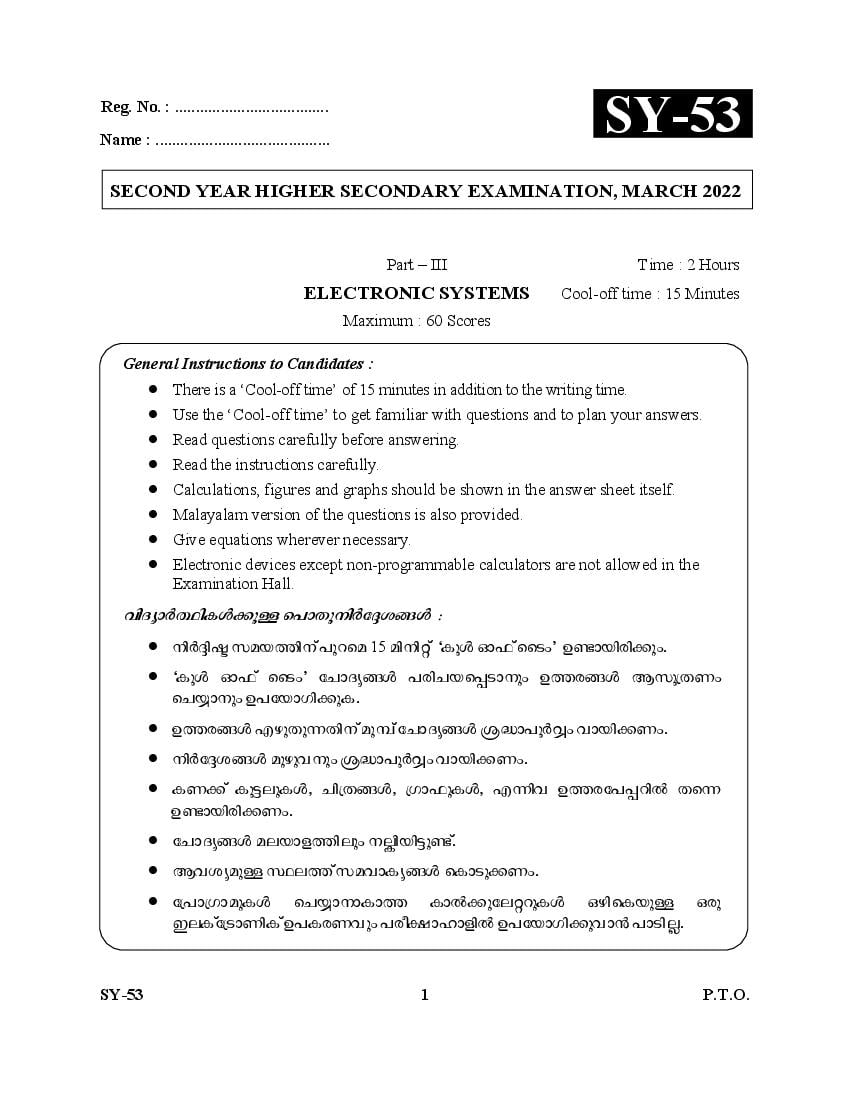
Name : ..........................................
SY-53
SECOND YEAR HIGHER SECONDARY EXAMINATION, MARCH 2022
Part – III Time : 2 Hours
ELECTRONIC SYSTEMS Cool-off time : 15 Minutes
Maximum : 60 Scores
General Instructions to Candidates :
There is a ‘Cool-off time’ of 15 minutes in addition to the writing time.
Use the ‘Cool-off time’ to get familiar with questions and to plan your answers.
Read questions carefully before answering.
Read the instructions carefully.
Calculations, figures and graphs should be shown in the answer sheet itself.
Malayalam version of the questions is also provided.
Give equations wherever necessary.
Electronic devices except non-programmable calculators are not allowed in the
Examination Hall.
15 ‘ ’ .
‘ ’
.
.
.
, , ,
.
.
.
.
SY-53 1 P.T.O.
Page 2
A. Answer any 5 questions from 1 to 9. Each carries 1 score. (5 1 = 5)
1. An integrator act as ________ filter.
2. The amplifier used in RC phase shift oscillator is _______.
(CE Amplifier, CB Amplifier, CC Amplifier, None of these)
3. Total phase shift of an oscillator is ________.
(180º, 270º, 360º, 90º)
4. The output wave form of a Hartley Oscillator is ________.
(Sine wave, Square wave, Triangular wave, Saw tooth wave)
5. In IC fabrication, selectively removing unwanted material from the surface of the
wafer is ________.
(Deposition, Lithography, Etching, None of these)
6. The transistors in SMPS switches between ________ regions.
(Active and Saturation, Saturation and Cutoff, Cutoff and Active, None of these)
7. A Toggle flip-flop has _______ number of data inputs.
8. ________ is the angle of incidence above which total internal reflection occurs.
9. ________ is a 8 bit micro-processor.
(8086, 8085, 80286, None of these)
SY-53 2
Page 3
A. 1 9 5 .
1 . (5 1 = 5)
1. Integrator ________ .
2. RC phase shift oscillator- _______ .
(CE Amplifier, CB Amplifier, CC Amplifier, None of these)
3. oscillator- phase shift ________ .
(180º, 270º, 360º, 90º)
4. Hartley ________ .
(Sine wave, Square wave, Triangular wave, Saw tooth wave)
5. IC
________.
(Deposition, Lithography, Etching, None of these)
6. SMPS- transistors ________ regions- .
(Active and Saturation, Saturation and Cutoff, Cutoff and Active, None of these)
7. Toggle flip-flop- _______ .
8. ________ Angle- total .
9. ________ 8 .
(8086, 8085, 80286, None of these)
SY-53 3 P.T.O.
Page 4
10. The cutoff frequency of a RC high pass filter is ______.
1 1
, , 2RC, 3.14 RC
2LC 2RC
1
11. f= is the frequency of oscillation of _______ oscillator.
2π LC
(Crystal, Hartley, RC phase shaft, None of these)
12. What does LSI stands for ?
(Logic System Integration, Large Scale Integration, Logic System Input, None of
these)
13. Defibrillator is a ________ group equipment.
(Diagnostic, Analytical, Therapeutic, None of these)
PART – II
A. Answer any 2 questions from 14 to 17. Each carries 2 scores. (2 2 = 4)
14. Draw the output wave form of a positive clamper whose input is a sinusoidal voltage
with peak to peak amplitude is 2 Vm.
15. Define CMRR of an OP-AMP.
16. Write the truth table of SR flip-flop.
17. Write short note on GSM.
SY-53 4
Page 5
(4 1 = 4)
10. RC cutoff ______ .
1 1
, , 2RC, 3.14 RC
2LC 2RC
1
11. f = _______ Frequency of
2π LC
.
(Crystal, Hartley, RC phase shaft, None of these)
12. LSI ?
(Logic System Integration, Large Scale Integration, Logic System Input, None of
these)
13. Defibrillator ________ .
(Diagnostic, Analytical, Therapeutic, None of these)
PART – II
A. 14 17 2 .
2 . (2 2 = 4)
14. 2 Vm peak to peak amplitude sinusoidal
output .
15. OP-AMP- CMRR .
16. SR flip-flop .
17. GSM .
SY-53 5 P.T.O.
Page 6
18. Draw the circuit diagram of a series voltage regulator.
19. Name the four different types of shift registers.
20. What is graded index optical fiber ?
PART – III
A. Answer any 3 questions from 21 to 24. Each carries 3 scores. (3 3 = 9)
21. With a neat circuit diagram explain the working of RC phase shift oscillator.
22. What are the different steps of IC fabrication ?
23. (a) What does RADAR stands for ? (1)
(b) Draw the block diagram of a RADAR. (2)
24. What are the advantages of fibre optic communication ?
B. Answer any 2 questions from 25 to 27. Each carries 3 scores. (2 3 = 6)
25. (a) Draw the circuit diagram of a voltage follower using Op-Amp 741. (2)
(b) Give one application of voltage follower. (1)
26. Distinguish between analog and digital TV.
27. Write short note on Blue Tooth Communication.
SY-53 6
Page 7
2 . (2 2 = 4)
18. Series .
19. shift registers .
20. Graded index optical fiber ?
PART – III
A. 21 24 3 .
3 . (3 3 = 9)
21. RC phase shift
.
22. IC .
23. (a) RADAR- . (1)
(b) RADAR- Block diagram . (2)
24. .
B. 25 27 2 .
3 . (2 3 = 6)
25. (a) Op-Amp 741
. (2)
(b) . (1)
26. TV TV . .
27. Blue Tooth .
SY-53 7 P.T.O.
Page 8
A. Answer any 3 questions from 28 to 31. Each carries 4 scores. (3 4 = 12)
28. With the help of a neat circuit diagram, explain the working of an Astable
multivibrator using IC 555.
29. (a) Draw the block diagram of a SMPS. (3)
(b) Give one application of SMPS. (1)
30. (a) Draw the circuit diagram of a 4 : 1 multiplexer. (2½)
(b) Write the truth table of 4 : 1 multiplexer. (1½)
31. Draw a neat block diagram of ECG machine.
B. Answer any 1 question from 32 to 33. Carries 4 scores. (1 4 = 4)
32. (a) Draw the circuit diagram and output wave form of RC differentiator for a square
wave input signal. (3)
(b) Write one advantage of an active filter over passive filter. (1)
33. Draw the circuit diagram of a 3 bit Serial In Serial Out (SISO) shift register using
flip-flop and explain its working.
SY-53 8
Page 9
A. 28 31 3 .
4 . (3 4 = 12)
28. IC 555 Astable multivibrator –
.
29. (a) SMPS- block diagram . (3)
(b) SMPS- . (1)
30. (a) 4 : 1 . (2½)
(b) 4 : 1 . (1½)
31. ECG .
B. 32 33 1 .
4 . (1 4 = 4)
32. (a) RC differentiator square wave
output . (3)
(b) Active filter . (1)
33. Flip-flop 3 (SISO)
circuit diagram .
SY-53 9 P.T.O.
Page 10
Answer any 2 questions from 34 to 36. Each carries 6 scores. (2 6 = 12)
34. (a) What is a clipper ? (1)
(b) Draw the circuit diagram of a clipper circuit for obtaining the given output wave
from a sine wave input. (3)
(c) Draw the output wave form of given clamper circuit. (2)
35. (a) Draw the block diagram of JK Master Slave flip-flop and write the Truth Table. (4)
(b) Compare asynchronous and synchronous counter. (2)
36. (a) With the help of a block diagram, explain the working of a Public Address
System. (3)
(b) Explain the constructional details of a Loud Speaker. (3)
__________
SY-53 10
Page 11
34 36 2 .
6 . (2 6 = 12)
34. (a) clipper ? (1)
(b) sine wave output
wave from clipper . (3)
(c) clamper circuit . (2)
35. (a) JK Master Slave flip-flop Truth Table
. (4)
(b) Asynchronous synchronous counter . (2)
36. (a) block diagram- Public Address System-
. (3)
(b) Loud Speaker- Constructional details . (3)
__________
SY-53 11 P.T.O.
Page 12
Document Details
| Board / Org | Kerala Board |
| Exam | Class 12 |
| Type | Question Paper |
| Pages | 12 |
| Updated | 22 Jul 2026 |