WB Class 12 Semester 3 Model Paper 2027 Statistics
Finished viewing? Save it for later —
Download WB Class 12 Semester 3 Model Paper 2027 Statistics (PDF · 35 pages)About WB Class 12 Semester 3 Model Paper 2027 Statistics
WB Class 12 Semester 3 Model Paper 2027 Statistics is available here for free download. Published by West Bengal Board for Class 12, this sample paper can be viewed online or downloaded as a PDF (35 pages). Candidates preparing for Class 12 can use WB Class 12 Semester 3 Model Paper 2027 Statistics to understand the exam pattern, the type of questions asked, and the overall difficulty level.
Frequently Asked Questions
How can I download WB Class 12 Semester 3 Model Paper 2027 Statistics?
Open this page and click the Download button to save WB Class 12 Semester 3 Model Paper 2027 Statistics as a PDF. It is completely free on AglaSem Docs.
Is WB Class 12 Semester 3 Model Paper 2027 Statistics free to download?
Yes. WB Class 12 Semester 3 Model Paper 2027 Statistics can be viewed online and downloaded as a PDF free of cost on AglaSem Docs.
How many pages does WB Class 12 Semester 3 Model Paper 2027 Statistics have?
WB Class 12 Semester 3 Model Paper 2027 Statistics contains 35 pages, which you can read online or download together as a single PDF.
Where can I find more Class 12 study material?
You can find more Class 12 question papers, sample papers, syllabus, and answer keys on AglaSem Docs.
WB Class 12 Semester 3 Model Paper 2027 Statistics – Text
Read the full text of this sample paper below — useful to quickly search, copy and reference the content online without downloading the PDF.
📄 View text version (36 pages)
Page 1
WB Class 12 Semester
3 Model Paper 2027
Statistics
EXAM YEAR TYPE SUBJECT
West Bengal Class 12 2027 Sample Paper Statistics
Notes · Sample Papers · Previous Year Papers · Mock Tests
Page 2
m c. o
c. o
m
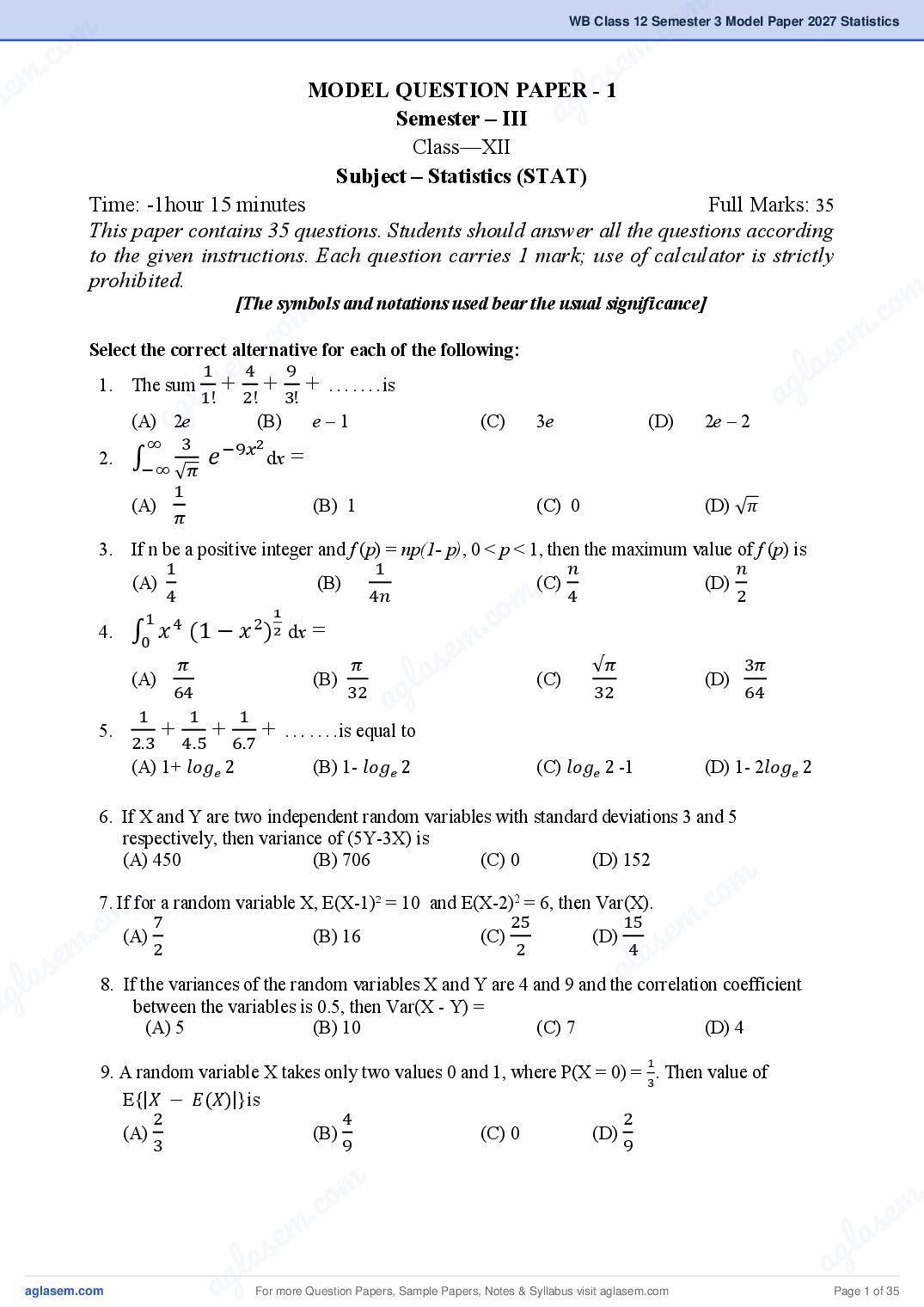
em MODEL QUESTION PAPERl-a1
se
s Semester – III a
g
Class—XII
Subject – Statistics (STAT)
Time: -1hour 15 minutes Full Marks: 35
This paper contains 35 questions. Students should answer all the questions according
to the given instructions. Each question carries 1 mark; use of calculator is strictly
m
.co
prohibited.
o m
[The symbols and notations used bear the usual significance]
c
. for each of the following: e m
1 em
Select the correct alternative
las
1. The sum s+ + + …….is g
l1!a 2! 3! a
4 9
(A) a2eg (B) e–1 (C) 3e (D) 2e – 2
∞ 3 2
2. ∫−∞ √𝜋 𝑒 −9𝑥 dx =
1
(A) (B) 1 (C) 0 (D) √𝜋
𝜋
3. If n be a positive integer and f (p) = np(1- p), 0 < p < 1, then the maximum value of f (p) is
1 1 𝑛 𝑛
m
(A) (B) (C) (D)
. co
4 4𝑛 4 2
em
1
1
4. ∫0 𝑥 4 (1 − 𝑥 2)2 dx =
l a s
g
𝜋 𝜋 √𝜋 3𝜋
a
(A) (B) (C) (D)
64 32 32 64
1 1 1
5. + + + …….is equal to
2.3 4.5 6.7
(A) 1+ 𝑙𝑜𝑔𝑒 2 (B) 1- 𝑙𝑜𝑔𝑒 2 (C) 𝑙𝑜𝑔𝑒 2 -1 (D) 1- 2𝑙𝑜𝑔𝑒 2
6. If X and Y are two independent random variables with standard deviations 3 and 5
respectively, then variance of (5Y-3X) is
m
(A) 450 (B) 706 (C) 0 (D) 152
m c. o
c. o m
7. If for a random variable X, E(X-1)² = 10 and E(X-2)2 = 6, then Var(X).
s e
em
7 25 15
l a
(A) (B) 16 (C) (D)
s
la 8. Ifbetween g
2 2 4
the variances of the random variables X and Y are 4 and 9 and a
ag the variables is 0.5, then Var(X - Y) =
the correlation coefficient
(A) 5 (B) 10 (C) 7 (D) 4
1
9. A random variable X takes only two values 0 and 1, where P(X = 0) = 3. Then value of
E{|𝑋 − 𝐸(𝑋)|}is
2 4 2
(A) (B) (C) 0 (D)
3 9 9
m .
.co s e m
e m l a
l a s a g
ag For more Question Papers, Sample Papers, Notes & Syllabus visit Page 1 of 35
Page 3
Statement B : Two uncorrelated random variables are independent, if each of the variables
assumes only two distinct values.
Select the correct option:
(A) Statement A is True but statement B is False
(B) Statement B is True but statement A is False
(C) Both the statements are False
(D) Both the statements are True
11. E {(|𝑋 − 𝑘|)}is minimum when
(A) k < E(X) (B) k > E (X) (C) k = E(X) (D) k = Median of X
12. If F(x) be a distribution function, then for any value a of x
(A) F(a+0) = F(a) (B) F(a - 0) = F(a) (C) F(a+0) = F(a - 0) (D) F(a ± 0) = F(a)
2
13. If f(x) = x, 1 ≤ x ≤ 2, represents p.d.f of X ,. Then harmonic mean of X is
3
1 2 3
(A) (B) (C) 1 (D)
2 3 2
14. Let F(x) be the cumulative distribution function of a random variable X. What is the value of
F(𝜇𝑒 ) ? (𝜇𝑒 = Median)
(A) 50% (B) 100% (C) 75% (D)25%
𝜆𝑥
15. If f(x) = k , = 1, 2, 3, …..,∞, k > 0 represents p.m.f of X, the constant k is equal to
𝑥!
1 𝑒 −𝜆
(A) 1 (B) 𝑒 −𝜆 (C) (D)
1−𝑒 −𝜆 1−𝑒 −𝜆
16.. The variance of 'number of success' in a set of 20 Bernoullian trials cannot exceed ________.
(A)10 (B) 5 (C) 0.25 (D) 0.125
17. The Geometric distribution is always
(A) negatively skew and platykurtic (B) positively skew and platykurtic
(C) positively skew and leptokurtic (D) positively skew and mesokurtic
18. If the mean of a binomial distribution is a positive integer, then
𝑚𝑜𝑑𝑒
(A) mean > mode (B) mean < mode (C) mean = mode (D) mean =
2
19. If X follows a Poisson distribution with parameter 8.3 then P(X = r) is maximum when the
value of r is
(A) 8.3 (B) 7 (C) 8 (D) 7 or 8
20. Two boys A and B toss a fair coin 3 times each. The probability of getting same number of
heads is
1 5 5 7
(A) (B) (C) (D)
16 16 8 16
21. For a bimodal binomial distribution one of the modes occur at the value 0, the coefficient of
variation of the distribution will be
(A) 50% (B) 100% (C) 10% (D) 25%
For more Question Papers, Sample Papers, Notes & Syllabus visit Page 2 of 35
Page 4
m c. o
c. o
e m
s
m 22. A random variable X follows Poisson distribution with parameter
la ‘𝜆’, then1 P(X is−2𝜆
se (A) (1 - 𝑒 −2𝜆 ) (B) (1 + 𝑒 −2𝜆 ) (C) (1 +a𝑒
1 g−2𝜆 ) (D) (1 - 𝑒
odd) is
)
2 2
23. If X~ B(m, θ), then what will be the Var of Y= m - X?
(A) mθ (B) mθ(1 – θ) (C) m(1 – θ) (D) θ(1 – θ)
24. For a Poisson distribution 4P(X=4) – P(X=3) = 2P(X=2). Then 𝛽2 of the distribution is
1 1 1
(A) (B) (C) 3.5 (D) 3 3
√3 3
m
.co
25. In method of least squares, the principle is to minimise
o m m
c
. curve there are ‘m’ normal equation, where m = e
(A) sum of errors (B) squares of errors (C) sum of squares of errors (D) none of these
e m las
s
26. In fitting an exponential
l a a g
g and direction of time series is provided by -
(A) 2 (B) 3 (C) 4 (D) cannot be said
a
27. The shape
(A) Seasonal Variation (B) Secular trend
(C) Cyclical fluctuation (D) Irregular fluctuation.
28. The number of trade values remain unestimated when we use the method of moving average of
period K = 6 is ________.
(A) 4 (B) 6 (C) 5 (D) 0
m
29. If the trend equation fitted from a given set of data of production (y, in thousand tonnes) of a
c. o
fertiliser factory is 13y = 8424 + 312t considering time (t) unit 1 year, the monthly increase in
em(C) 2
production of fertiliser in thousand tonnes is :
s
1
a
(A) 54 (B) 24 (D)
l
6
xg
30. Statement A: f(x) = ax (2 – x), 0 ≤ a
3
≤ 2 is a p.d.f, then a =
4
Statement B: The value of a p.d.f. may exceed 1 for some values of a random variable.
Select the correct option:
(A) Statement A is True but statement B is False
(B) Statement B is True but statement A is False
(C) Both the statements are False
m
(D) Both the statements are True
m c. o
c. o s e m
em
Read the following Assertion (A) and Reason (R) and choose the correct alternative:
s l a
ag
31. Assertion (A): The binomial distribution with parameter n = 2000 and p = 0.001 can be
la
approximated by a Poisson distribution.
ag Reason(R): n is sufficiently large.
(A) Both Assertion (A) and Reason (R) are true, and Reason (R) is the correct explanation of
Assertion (A).
(B) Both Assertion (A) and Reason (R) are true, but Reason (R) is not the correct explanation
of Assertion (A).
(C) Assertion (A) is true, but Reason (R) is false.
(D) Assertion (A) is false, but Reason (R) is true
m .
.co s e m
e m l a
l a s a g
ag For more Question Papers, Sample Papers, Notes & Syllabus visit Page 3 of 35
Page 5
Reason(R): Method of mathematical curves assumes no law of change.
(A) Both Assertion (A) and Reason (R) are true, and Reason (R) is the correct explanation of
Assertion (A).
(B) Both Assertion (A) and Reason (R) are true, but Reason (R) is not the correct explanation
of Assertion (A).
(C) Assertion (A) is true, but Reason (R) is false.
(D) Assertion (A) is false, but Reason (R) is true
33. Match the following with the component of time series data:
Colum A Colum B
1. Number of books borrowed from a i. Secular Trend
library increases during the
weekend.
2. General increase in sale of ii. Seasonal Variation
computers.
3. Increase of sale of sanitizers during iii. Cyclical Variation.
covid-19 situation.
4. An era of prosperity. iv. Irregular Variation.
(A) 1-ii, 2-iv, 3-i, 4-iii (B) 1-iii, 2-ii, 3-iv, 4-i
(C) 1-iv, 2-ii, 3-i, 4-iii (D) 1-ii, 2-i, 3-iv, 4-iii
34. Colum Matching
Colum A Colum B
1. A discrete probability distribution having same i. binomial distribution
mean and variance is
2. A discrete probability distribution having ii. uniform distribution
variance greater than mean is
3. A symmetric distribution iii. Poisson distribution
4. A discrete probability distribution having iv. geometric distribution
variance smaller than mean is
(A) 1-iii, 2-iv, 3-i, 4-ii (B) 1-iii, 2-ii, 3-iv, 4-i
(C) 1-iii, 2-ii, 3-i, 4-iv (D) 1-iii, 2-iv, 3-ii, 4-i
35. Colum Matching
Colum A Colum B
1 1 1 1
1.The sequence an = + 2.3 + 3.4 +….+𝑛.(𝑛+1) is i. divergent
1.2
2. The series 13+23+33+…..+n3+……. is ii. monotonic increasing
𝑛+1
3. The sequence { } is iii. convergent
2𝑛+1
3 5 7
4. The series 1 + + + + …….is iv. monotonic decreasing
2! 3! 4!
(A) 1-iv, 2-iii, 3-ii, 4-i (B) 1-iii, 2-iv, 3-ii, 4-i
(C) 1-ii, 2-i, 3-iv, 4-iii (D) 1-i, 2-ii, 3-iv, 4-iii
For more Question Papers, Sample Papers, Notes & Syllabus visit Page 4 of 35
Page 6
m c. o
c. o
e m
em
MODEL QUESTION PAPER - 2
l a s
s Semester – III
ag
Class—XII
Subject – Statistics (STAT)
Time: -1hour 30 minutes Full Marks: 35
This paper contains 35 questions. Students should answer all the questions according to the
given instructions. Each question carries 1 mark; use of calculator is strictly prohibited.
m
.co
[The symbols and notations used bear the usual significance]
m
.co
Select the correct alternative for each of the following:
s e m
e m la
1. The sum 2! + 3! +
1
l a
1+2
s 1+2+3
+ …….is
a g
ag
4!
(A) e/4 (B) 2e/3 (C) e/2 (D) 1/2e
∞ 3 −𝑥
2. ∫0 𝑥 𝑒 dx =
(A) 24 (B) 2 (C) 6 (D) 3
2 2
3. If f(x) = √𝜋 𝑒 −2(𝑥−3) , −∞ < 𝑥 < ∞, then the maximum value of f (x) is
1 2
(A) 3 (B) √𝜋 (C) 3 (D) does not exist
o m
c
3 7
(C) .
4. B(2 , 2)=
em
3𝜋 5𝜋 5𝜋 𝜋
s
(A) (B) (D)
+ …….is equal to la
64 32 128 16
g
1 1 1
(B) 1- 𝑙𝑜𝑔 2 a
5. + 1.2.3.5 + 1.2.3.4.5.7
1.3
(A) 1+ 𝑙𝑜𝑔𝑒 2 𝑒 (C) 2e -1 (D) e-1
6. For any random variable X, the valid relation is
(A) E{|𝑋|} < |𝐸(𝑋)| (B) |𝐸(𝑋)| ≤ E{|𝑋|} (C) |𝐸(𝑋)| = E{|𝑋|} (D) |𝐸(𝑋)| ≥ E{|𝑋|}
7. The probability mass function of a random variable X is zero except at the points, x = 0, 1, 2. At these
points it has the values 𝑓(0) = 3𝑐 3 , 𝑓(1) = 4c - 10𝑐 2 and 𝑓(2) = 5c – 1, for some c > 0. The value
m
c. o
of c is
m
1 1
o
(A) 3 (B) 1 (C) 2 (D) 3
. c e m
em (A) 5 (D) 25 la
s
s
8. E(X) = 3 E{X(X - 1)} = 22 then S.D. of random variable X is -
l a
(B) 16 (C) 4
a g
ag 9. A random variable X takes only two values 0 and 1, where P(X = 0) = . Then value of Var(X) is 1
3
2 4 2
(A) 3 (B) 9 (C) 0 (D) 9
2
10. Assertion (A): f(x) = kx, x = 1, 2, 3 ,....,n is a p.m.f, then k =
𝑛(𝑛+1)
Reason (R): f(x) ≥ 0 for all x.
Select the correct :
m .
(A) A and R are both true and R is the correct explanation of A
.co
(B) A and R are both true but R is not the correct explanation of A
s e m
(C) A is correct but R is incorrect
e m l a
l a
(D) A is incorrect but R is correct
s a g
ag For more Question Papers, Sample Papers, Notes & Syllabus visit Page 5 of 35
Page 7
(A) k < E(X) (B) k > E (X) (C) k = E(X) (D) k = Median of X
12. If F(x) be a distribution function, then which on is incorrect
(A) F(+∞) = 1 (B) F( - ∞) = 0 (C) F(x) is left continuous (D) F(x) is increasing
13. If f(x) = cx, 0 < x < 2, represents p.d.f of X, where c (> 0) is constant. Then value of P(X >1) is
1 3
(A) 2 (B) 0 (C) 1 (D) 4
14. Let F(x) be the cumulative distribution function of a random variable X. What is the value of F(𝑄3 ) ?
(A) 50% (B) 100% (C) 75% (D)25%
15. If f(x) = k (𝑛𝑥 )𝑝𝑥 (1 − 𝑝)𝑛−𝑥 , = 1, 2, 3, …..,n, k > 0 represents p.m.f of X, the constant k is equal to
1 1
(A) 1 (B) 𝑞 𝑛 (C) 1−𝑝𝑛 (D) 1−𝑞 𝑛
16. For a binomial distribution with n = 15 p = ¼ which of the following is correct -
(A) The variance of the distribution is 45/4 (B) The distribution is leptokurtic
(C) The distribution is positively skewed (D) The distribution is unimodal
17. Mode of Geometric distribution with parameter p , 0 < p < 1,
(A) 0 (B) 1 (C) ∞ (D) undefined
18. For a symmetrical binomial distribution, if number of trials is an even integer, then
𝑚𝑜𝑑𝑒
(A) mean > mode (B) mean < mode (C) mean = mode (D) mean = 2
19. In a Poisson distribution the second moment about the origin is 12, then its 𝛽2 is
1 1 1
(A) (B) (C) 30 (D) 3
√3 3 3
20. Two boys A and B toss a fair coin n times each. The probability of getting same number of heads is
(A) (2𝑛
𝑛
)𝑝𝑛 (B) (2𝑛
𝑛
)2𝑛 (C) (2𝑛
𝑛
)2−𝑛 (D) (2𝑛
𝑛
)2−2𝑛
21. For a bimodal Poisson distribution one of the modes occur at the value 0, the coefficient of variation
of the distribution will be
(A) 50% (B) 100% (C) 10% (D) 25%
22. If ‘m’ things are distributed among ‘a’ men and ‘b’ women, show that the probability that the
number of things received by men is odd, is
1 (𝑏+𝑎)𝑚 − (𝑏−𝑎)𝑚 1 (𝑏−𝑎)𝑚 − (𝑏+𝑎)𝑚 1 𝑏 𝑚 − 𝑎𝑚 1 𝑎𝑚 − 𝑏 𝑚
(A) 2 [ (𝑏+𝑎)𝑚
] (B) 2 [ (𝑏+𝑎)𝑚
] (C) 2 [ (𝑏+𝑎)𝑚 ] (D) 2 [ (𝑏+𝑎)𝑚 ]
23. If (m – X) ~ B(m, 1- θ), then what will be the expectation of X?
(A) mθ (B) mθ(1 – θ) (C) m(1 – θ) (D) θ(1 – θ)
24. For a Poisson distribution P(X=2) =9 P(X=4) + 90P(X=6). Then 𝜇4 of the distribution is
1
(A)1 (B) 4 (C) 30 (D) 4
25. The number of least square estimates
(A) is always 2 (B) is at most 3 (C) can exceed 2 (D) can never be 3
26. In fitting a quadratic trend by the method of least square, there are ‘m’ normal equation, where m =
(A) 2 (B) 3 (C) 4 (D) cannot be said
For more Question Papers, Sample Papers, Notes & Syllabus visit Page 6 of 35
Page 8
omA component of time series used for short-term forecast is - c. o
c. 27. e m
m (A) Seasonal Variation (B) Secular trend (C) Cyclical fluctuation a s
se ag
l (D) Irregular fluctuation.
28. The number of trade values remain unestimated when we use the method of moving average of
period K = 5 is ________.
(A) 4 (B) 6 (C) 5 (D) 0
29. If the annual trend equation is Yt = 60 + 12t (where t is the year), what is the new monthly rate of
increase?
m
.co
(A) 12 (B) 1 (C) 0.5 (D) 0.0833
m
30.
.co
Assertion (A): For a continuous random variable with p.d.f. f(x) = 2x, 0 < x < 1 the probability
s e m
P(X = 0.5) is zero.
em la
l a s
Reason (R): The probability of a continuous random variable taking any exact single value is zero
a g
ag
because the area under a single point is technically evaluated as an integral over a range of zero
width. [1, 2]
(A) Both Assertion (A) and Reason (R) are true, and Reason (R) is the correct explanation of
Assertion (A).
(B) Both Assertion (A) and Reason (R) are true, but Reason (R) is not the correct explanation of
Assertion (A).
(C) Assertion (A) is true, but Reason (R) is false.
(D) Assertion (A) is false, but Reason (R) is true
m
31.
. co
A machine has a 0.03 probability of breaking down in any given hour. If the machine runs for 100
em
hours, approximately what is the probability that it breaks down at most once?
l a s
g
(A) 3e-3 (B) 2e-3 (C) 4e-3 (D) 5e-3
32. a
Statement A: In seasonal variations the period is more than one year.
Statement B: Trend may be down ward.
Select the correct option:
(A) Statement A is true but Statement B is false
(B) Statement B is true but Statement A is false
(C) Both the Statements are false
(D) Both the Statements are true.
m
m c. o
33. Match the following with the component of time series data:
c. o e m
Colum A Colum B
em
1. Increase of sales of garments i. Secular Trend
l a s
las during Durgapuja is associated
ag
g
with
a 2. General increase in sale of
smartphones.
ii. Seasonal Variation
3. Fall of production in a cement iii. Cyclical Variation.
factory due to strike is associated
with
4. An era of recession. iv. Irregular Variation.
(A) 1-ii, 2-iv, 3-i, 4-iii (B) 1-iii, 2-ii, 3-iv, 4-i
m .
co
(C) 1-iv, 2-ii, 3-i, 4-iii (D) 1-ii, 2-i, 3-iv, 4-iii
. e m
e m l a s
l a s a g
ag For more Question Papers, Sample Papers, Notes & Syllabus visit Page 7 of 35
Page 9
Colum A Colum B
1. The number of misprints in a randomly i. binomial distribution
selected page of a book follows
2. Number of failures preceeding the first success ii. uniform distribution
in an indefinite series of Bernoullian trials
follows
3. A distribution having constant p.m.f. is iii. Poisson distribution
4. . Number of success in a finite series of iv. geometric distribution
Bernoullian trials follows
(A) 1-iii, 2-iv, 3-i, 4-ii (B) 1-iii, 2-ii, 3-iv, 4-i
(C) 1-iii, 2-ii, 3-i, 4-iv (D) 1-iii, 2-iv, 3-ii, 4-i
35. Colum Matching
Colum A Colum B
1. The series 13+23+33+…..+n3+……. is i.
𝑒 2 −1
2𝑒
1 1
2. 1 + 3! + 5! + …….is ii. convergent
2
1 𝑛 𝑒 2 +1
3. ∑{(1 − ) } is iii.
𝑛 2𝑒
1 1
4. 1 + + + …….is
2! 4!
iv. divergent
(A) 1-ii, 2-i, 3-iv, 4-iii (B) 1-iv, 2-iii, 3-ii, 4-i
(C) 1-ii, 2-i, 3-iii, 4-iv (D) 1-iv, 2-i, 3-ii, 4-iii
For more Question Papers, Sample Papers, Notes & Syllabus visit Page 8 of 35
Page 10
m c. o
c. o
e m
em l a s
s ag
Question Bank
Class—XII (Semester – III)
Subject – Statistics (STAT)
[The symbols and notations used bear the usual significance]
m
m c. o
c. o
Unit - 1
e m
s em answer out of the option given against each question: glas
Select the correct
g a
lsequence a
a
n
1. The {(-1) } is
(a) unbounded (b) not bounded above
(c) bounded below only (d) bounded
1
2. The upper bound of the sequence {2+ (-1)n } is
𝑛
(a) 1 (b) 2 (c ) 2.5 (d) 1.5
m
1
3. the greatest lower bound of the sequence { } is
. c )1 o
𝑛
eismbounded sequence
1
(a) 0 (b) (c (d) 0.5555555
s
2
la
4. Which of the following sequences
(b) {n } ag (c) {n}
2 𝑛
(a) {-n} (d) { }
𝑛+1
1 , 2, 3 , 4……..
5. The sequence is _____________sequence.
2 3 4 5
(a) unbounded (b) oscillatory (c ) divergent (d) convergent
1 , 1 , 1 , 1 ,…….., 1 ,……..
6. The sequence converges to
2 22 23 24 2𝑛
1
(a) 0 (b) (c) 1 (d) ∞
m
c. o
2
m
7. The sequence {-n2} is
c. o (a) diverges to ∞ s e m
em
(b) diverges to - ∞
s l a
ag
(c) converges to 1 (d) neither convergent not divergent
l a
ag
1 n
8. The sequence { (1- (-1)) }is
2
(a) divergent (b) convergent to 1
(c) converges to 0 (d) oscillatory
𝑛+1
9. The sequence { }is
2𝑛+1
(a) strictly monotonic increasing (b) strictly monotonic decreasing
(c) not monotonic (d) oscillatory
m .
.co s e m
e m l a
l a s a g
ag For more Question Papers, Sample Papers, Notes & Syllabus visit Page 9 of 35
Page 11
(a) 0 (b) 2 (c ) 1 (d) ∞
11. Which of the following sequence is neither monotonically increasing nor
monotonically increasing
1 1
(a) {-n} (b) {(-1)n} (c) {1+ } (d) { 𝑛 }
𝑛𝑛 2
1 1 1 1 1
12. The series 𝑘 + 𝑘 + 𝑘 + 𝑘 +……+ +… is convergent if
1 2 3 4 𝑛𝑘
(a) k > 1 (b) k > 2 (c ) k ≤ 1 (d) k > 0
1
13. The series Σ 𝑛 converges to________
2
1
(a) 0 (b) 2 (c ) 1 (d)
2
2 3 4
14. The sum + + + …….is
1! 2! 3!
(a) 2e (b) e–1 (c) 2e +1 (d) 2e – 1
1 1 1
15. + + + …….is equal to
1.3 1.2.3.5 1.2.3.4.5.7
(a) 1+ 𝑙𝑜𝑔𝑒 2 (b) 1- 𝑙𝑜𝑔𝑒 2 (c) 2e-1 (d) e-1
1 1 1
16. + + + …….is equal to
2.3 4.5 6.7
(a) 1+ 𝑙𝑜𝑔𝑒 2 (b) 𝑙𝑜𝑔𝑒 2 -1 (c) 1- 2𝑙𝑜𝑔𝑒 2 (d)1- 𝑙𝑜𝑔𝑒 2
𝑥 𝑥2 𝑥3 𝑥4
17. The series + + + +….
1 2 3 4
(a) divergent if x ≤ 1 (b) convergent if x < 1
(c) convergent if x > 1 (d) divergent if x < 1
1 1 1 1
18. The series + 2
+ 3
+ +….
𝑥 2𝑥 3𝑥 4𝑥 4
(a) convergent if x ≥ 1 (b) convergent if x < 1
(c) convergent if x > 1 (d) divergent if x > 1
3 32 33
19. If A = 1 + + + +….., then 𝑙𝑜𝑔𝑒 𝐴3 =
1! 2! 3!
(a) 3 (b) 9 (c ) 𝑒 3 (d) 𝑒 9
𝑥2 𝑥3 𝑥4
20. If y = x - + - +……, then x =
2! 3! 4!
1 1
(a) 𝑙𝑜𝑔𝑒 (1 − 𝑦) (b) (c) 𝑙𝑜𝑔𝑒 (d) 𝑙𝑜𝑔𝑒 (1 + 𝑦)
𝑙𝑜𝑔𝑒(1−𝑦) 1−𝑦
42 44
21. 1 + + + …..∞ =
3! 5!
𝑒 +𝑒−4
4 𝑒 4 − 𝑒−4 𝑒 4 +𝑒 −4 𝑒 4 − 𝑒−4
(a) (b) (c ) (d)
4 4 8 8
n 𝑎+𝑏𝑥
22. Find the coefficient of x in the expansion of 𝑒 in power of x
𝑏 𝑏 𝑛 𝑏 𝑛 𝑏
(a) 𝑒 𝑎 ( ) (b) 𝑒 𝑎 ( ) (c) 𝑒 𝑎 ( ) (d) 𝑒𝑎( )
𝑛! 𝑛! 𝑛 𝑛
For more Question Papers, Sample Papers, Notes & Syllabus visit Page 10 of 35
Page 12
m c. o
c. o
em
em l a s
s ag
1 1+2 1+2+3
23. The sum + + + …….is
2! 3! 4!
𝑒 2
(a) (b) e (c) 2e (d)
2 𝑒
1 1 1
24. The sum (1 + + + …….) is
3.22 5.24 7.26
(a) 𝑙𝑜𝑔𝑒 3 (b) 𝑙𝑜𝑔𝑒 4 (c) 𝑙𝑜𝑔𝑒 5 (d) 𝑙𝑜𝑔𝑒 2
m
c. o
∞
m
25. ∫0 𝑥 4 𝑒 −3𝑥 dx =
40
.co 8 8
s e m
e m la
(a) (b) (c) 120 (d)
s g
81 27 81
l a a
ag3𝜋
1 3 5
26. ∫0 𝑥 2 (1 − 𝑥)2 dx =
3𝜋 15𝜋 3𝜋
(a) (b) (c) (d)
64 32 256 256
𝛤(3)𝛤(5)
27. The value is
𝛤(4)
(a) 2 (b) 8 (c) 15 (d) 30
4 5
28. The value of B( , ) is
o m
3 3
. c 3 √3
1 2𝜋 1 2𝜋 1 𝜋 1 𝜋
(a)
em
(b) (c) (d)
9 √3 3 √3 9 √3
11
29. 𝛤( ) =
l a s
105√𝜋g
a
2
105√𝜋 945√𝜋 945√𝜋
(a) (b) (c) (d)
16 32 16 32
1+𝑎 1+𝑎+𝑎2 1+𝑎+𝑎2 +𝑎3
30. The sum 1+ + + + …….is
2! 3! 4!
𝑒 𝑎 −𝑒 𝑒 𝑎 +𝑒 𝑒 𝑎 +𝑒 𝑒 𝑎 −𝑒
(a) (b) (c) (d)
𝑎−1 𝑎+1 𝑎−1 𝑎+1
31. ________is the maximum value of the product of two numbers when their sum
m
c. o
is 24
m
c. o m
(a) 140 (b) 144 (c ) 280 (d) 143
s e
em a
32. If n is positive integer and f(p) = np(1-p), 0 < p < 1, the maximum value of f(p)
s l
a ag (d) 𝑛
is
l
ag
𝑛 1 1
(a) (b) (c)
2 2 4 4
33. If f(x) = √𝜋2 𝑒 −2(𝑥−3) , −∞ < 𝑥 < ∞, then the maximum value of f (x) is
2
1 2
(a) (b) √𝜋 (c) 3 (d) does not exist
3
34. If f(x,y) = x3 –x2y2 + y3, then 𝛿 2 f(x,y)/ 𝛿x 𝛿𝑦 will be
m .
c. o
(c ) - 4xy2
m
(a) 4xy (b) - 4xy (d) – 4y
s e
sem g l a
la a
ag For more Question Papers, Sample Papers, Notes & Syllabus visit Page 11 of 35
Page 13
(a) 12y2 – 6x3y (b) 2x – 6x3y (c ) 2x – 9x2y2 (d) 12y2 – 9x2y2
𝑥 2
∞ |𝑥|
36. ∫−∞ 𝑒 − 2 dx =
√2𝜋
∏ 2 1
(a) (b) √𝜋 (c) 1 (d)
2 2
37. 𝛤(𝑛 + 1) =
(a) (n -1)𝛤(𝑛 − 1) (b) n 𝛤(𝑛 − 1)
(c) (n -1)𝛤(𝑛) (d) n 𝛤(𝑛)
1 1 𝑒 −1 + 𝑒
38. Statement I : The sum 1 + + +……∞ is
2! 4! 2
1 4 9
Statement II : The sum The sum + + + …….is 2e
1! 2! 3!
Choose the correct alternative:
(a) Statement A is True but statement B is False
(b)Statement B is True but statement A is False
(c) Both the statements are False
(d)Both the statements are True
39. Statement I: Given the value of (a + b), a2 +b2 is minimum when a = b
Statement II : If a+b = 18 then maximum value of ab is 81
Choose the correct alternative:
(a) Statement A is True but statement B is False
(b)Statement B is True but statement A is False
(c) Both the statements are False
(d)Both the statements are True
40.
Colum A Colum B
1 1 1
1. The series 1+ + + +….……. is i. 5e
2 3 4
1 1 ii. convergent
2. 1-1 + - + …….is
2! 3!
1 1 1 1
3. The series 1- + - +….……. is iii.
2 3 4 𝑒
𝑛3
4. ∑∞
𝑛=0 𝑛! iv. divergent
Select the right combination:
(a) 1-ii, 2-i, 3-iv, 4-iii (b) 1-iv, 2-iii, 3-ii, 4-i
(c) 1-ii, 2-i, 3-iii, 4-iv (d) 1-iv, 2-i, 3-ii, 4-iii
For more Question Papers, Sample Papers, Notes & Syllabus visit Page 12 of 35
Page 14
m c. o
c. o
e m
em l a s
s ag
Unit - 2
Select the correct answer out of the option given against each question:
1. If in a table all possible values of a random variable are given their
corresponding probabilities, then this table is called as:
m
(a) Probability density function (b) Distribution function
m
(c) Probability distribution
o
(d) Continuous distribution
c. o
c
2. A variable that .can assume any possible value between two points is called: e m
em random variable. l a s
(c)la
s
(a) Discrete (b) Continuous random variable
a g
ag
Discrete sample space (d) Random variable
3. A variable which can assume finite or countably infinite number of values is
known as:
(a) Continuous (b) Discrete (c) Qualitative (d) Time series
4. A formula or equation used to represent the probability distribution of a
continuous random variable is called:
m
co
(a) Probability distribution (b) Distribution function
.
em
(c) Probability density function (d) Mathematical expectation
l a s
g
5. If X is A discrete random variable and f(x) is the probability of X, then the
a
expected value of this random variable is equal to:
(a) ∑f(x) (b) ∑[x+f(x)] (c) ∑f(x)+x (d) ∑xf(x)
6. Given E(X) = 5 and E(Y) = - 2 then E(X - Y) is:
(a) 3 (b) 5 (c) 7 (d)-2
7. Which of the following is not possible in probability distribution?
m
c. o
(a) p(x) ≥ 0 (b)Σp(x) = 1 (c) Σxp(x) = 2 (d) p(x) = - 0.5
m
c. 8.o If X = C is a constant (Where X is a random variable), then E(X)
s e mis:
s em (a) 0 (b) 1 (c) cf(c)
g l a (d) C
l a a
ag 9. A discrete probability distribution may be represented by:
(a) Table (b) Graph
(c) Mathematical function (d) All of the above
10. A listing of all the outcomes of an experiment and the probability associated
with each outcome is called:
(a) Probability distribution (b) Attributes
m .
co
(b) Probability density function (d) Distribution function
. e m
e m l a s
l a s a g
ag For more Question Papers, Sample Papers, Notes & Syllabus visit Page 13 of 35
Page 15
(a) Variance (b) Standard deviation
(c) Mean (d) Covariance
12. A random variable which can assume finite or countably infinite number of
values is known as:
(a) Continuous (b) Discrete
(c) Qualitative (d) None of them
13. If C is a constant in a continuous probability distribution of X, then P(X = C)
is always equal to:
(a) Zero (b) One (c) Negative (d) Impossible
14. E[X - E(X)] is equal to:
(a) E(X) (b) Var(X) (c) 0 (d) E(X) – X
15. Let the random variable X assume the values 1, 2, 3, ...such that
P(X = k) = 1/(2k) . k = 1, 2, 3 ,..., then P(X is odd) is
(a)2/3 (b) 1/3 (c) ¼ (d) ½
16.Var(X) is equal to:
(a) E(X²) (b) [E(X)]²
(c) E (X²) - [E(X)]2 (d) E (X²) + [E(X)]²
17. If E(X) = 3 E{X(X - 1)} = 22 then the standard deviation of the random
variable X is
(a) 5 (b) 4 (c) 16 (d) 25
18. A random variable X takes only two values 0 and 1 where P(X = 0) = 1/4 ,
then E(X2) is equal to
(a) ¼ (b) 0 (c) 1 (d) ¾
19. If Var(X) = 9, then Var(45 - 3X) is
(a) 36 (b) 18 (c) 81 (d) 27
20. If P(X < 0) = 1 then E(X) & Var(X) are respectively
(a) positive & positive (b) zero & positive
(c) negative & positive (d) negative & negative
21. If E(X) = 7 E(Y) = 12 then E(5X - 3Y + 1) equals
(a) 1 (b) 2 (c)-1 (d) 0
22. √𝐸(𝑋 − 𝐴)2 is minimum when
(a) A > E(X) (b) A = E(X) (c) A median of X (d) A < E(X)
For more Question Papers, Sample Papers, Notes & Syllabus visit Page 14 of 35
Page 16
m c. o
c. o
e m
em l a s
s ag
23. An unbiased coin is tossed until at least one head and at least one tail appears.
The expected number of tosses required is
(a) 4 (b) 6 (c) 2 (d) 3
24. E(X) = - 8, E(Y) = 9 then E(XY)
(a) 72 (b) -72 (c) 0 (d) cannot be determined
m
m
25. If X and Y are independent random variables, then Var(X±Y) =
c. o
.co
(a) Var(X) Var(Y) (b) Var(X) + Var (Y)
s e m
me
(c) Var(X)-Var(Y) (d) Var(X) ± Var (Y)
la
a s
26. For 2 lindependent random variables X and Y. Cov(Χ. X - Y) = a g
g Var(X)
a(a) (b) Var(Y)
(c) Var(X) + Var(Y) (d) Var(X) – Cov(X,Y)
27. If Var(X) = 25 and Var(Y) = 16, 𝜌𝑋𝑌 = 0.5, then Var(2X + Y) is:
(a) 156 (b) √156 (c) 116 (d) 136
m
28. A man gets n3 rupees for the n dots appearing on throwing an unbiased die.
. co
His expected gain (in Rs.) from a single throw is
em
(a) 15 (b) 87/6 (3) 95/6 (d) 73.50
l a s
(a) 24 (b) 33 a g
29. If E(X) = 6 E(Y) = 4 and Cov(X, Y) = 9, then E(XY) =
(c) 15 (d) 42
30. A random variable X is such that P(X = -1) = P(X = 1) = 1/2 , then P(|𝑋| = 1)
is
(a) ¼ (b) 1/3 (c )1/2 (d) 1
31. If for a random variable X.
m
c. o
E{(X - 2)2} = 1.5 and E{(X - 3)2} = 4.5 then Var(X) =
m
c. o m
(a) 0.25 (b) 0.5 (c) 1 (d) 1.5
s e
s em 32. Var(Y)
If X and Y are two independent random variables such that
g l a Var(X) = 18 and
l a a
ag
= 7, then the standard deviation of X - Y is
(a) 11 (b) 25 (c) 5 (d) 23
33. The p.d.f of a random variable X is f(x) = 1, - ½ ≤ x ≤ ½, then P(X = 0) is
(0) ¼ (b) 0 (c) 1 (d) ½
34. Let F(x) be the distribution function of a random variable X. Then the value
of 1- F(Q1), where Q1 is 1st quartile, is
(a) 1/10 (b) ¾ (c) ½ (d) ¼
m .
.co s e m
e m l a
l a s a g
ag For more Question Papers, Sample Papers, Notes & Syllabus visit Page 15 of 35
Page 17
(a) Non-negative (b) Negative (c) One (d) Zero
36. In a discrete probability distribution, the sum of all the probabilities is always
equal to:
(a) Zero (b) One (c) Minimum (d) Maximum
37. A variable which can assume all values in the range of a random variable, is
called:
(a) Finite (b) Infinite (c) Continuous (d) Discrete
38.Total area under the curve of a continuous probability density function is
always equal to:
(a) 0 (b)1 (c) -1 (d) 2
39. The probability of a continuous random variable "X" taking any particular
value, k is
(a) Negative (b) Zero (c) One (d) Cannot be determined
always:
40. A random variable X takes only four values, 0, 1, 2, 3 with probabilities 0.2,
0.1, 0.6, 0.1 respectively. Then the mode is
(a) 1 (b) 3 (c) 0 (d) 2
41. If the p.d.f. f(x) is maximum at x = k then k is
(a) mean (b) mode (c) median (d) standard deviation.
42. For a random variable X, which of the following is correct?
(a) √𝐸(𝑋2 ) ≤ E(X) (b) √𝐸(𝑋2 ) ≥ E(X)
(c) √𝐸(𝑋2 ) < E(X) (d) E(X2) < E(X)
43. If we have f(x) = 2x, 0 ≤ x ≤1, then f(x) is a:
(a) Probability distribution (b) Distribution function
(c) Probability density function (d) Continuous random variable
∞
44. If f(x) is a p.d.f. of r.v. X, then∫−∞ 𝑥𝑓(𝑥)𝑑𝑥 is always equal to:
(a) Zero (b) One (c) E(X) (d) f(x) + 1
45. The probability distribution of a random variable is defined as:
X=x 1 2 3 4 5 6 7
2 2
P(X = x) k 2k 2k 3k k 2k 7k2+k
Then k is equal to:
(a) Zero (b) ¼ (c) 1/10 (d) One
For more Question Papers, Sample Papers, Notes & Syllabus visit Page 16 of 35
Page 18
m c. o
c. o
e m
em l a s
s ag
46. If X and Y are two independent random variables, then
Cov(5X + 4, 3Y + 2) is
(a) 15 (b) 21 (c) 0 (d) 6
47. If F(x) is the distribution function of the random variable X, then which of the
following is correct?
m
(a) 0 < F(x) < 1 (b) 0 ≤ F(x) < 1
(c) 0 < F(x) ≤ 1
o m
(d) 0 ≤ F(x) ≤ 1
c. o
.c random variable X taking non-negative integer sem
e m1, 2, 3,…….} with c.d.f. F(x), the E(X) can be expressed as: la
48. For a discrete
(a)la
s
values {0,
a g
g ∑∞0{1 − 𝐹(𝑥)}
a(c)
∑∞0 𝐹(𝑥) (b) ∑∞
(d) ∑∞
0 𝑥 𝐹(𝑥)
0 {𝐹 (𝑥 ) − 1}
49. If the p.m.f. of a random variable X is proportional to 3-x, x = 0 1,2,..., ∞, then
P[X= at least 1] is-
(a) 1/3 (b) ½ (c) 2/3 (d) 1.
m
50. If E(X) = 3, Var(X) = 25, then E(X²) =______________
. co
(a) 16 (b) 28 (c) 34 (d) 22
em
51. For a random variable X, E{|𝑋|} _ √𝐸(𝑋2 )
(a)> (b) < (c)_ ≥
l a s
(d) ≤
(a) 3 (b) 4 a
(c)_ 2
g
52. Variance is 𝜇𝑟 , where r = ______________
_
(d) 1
_
53. For a random variable X, mean and variance are respectively 𝜇𝑋 and 𝜎𝑋2 ;
𝑋−𝜇𝑋
then Var( ) is ____________
𝜎𝑋
(a) 0 (b) 1 (c) 2 (d) 4
54. If a random variable X assumes only two values 2 and 1 such that
2P(X = - 2) = P(X = l) . then Var(X) =_______
m
c. o
(a) 1 (b) 0 (c) 2 (d) 4
om For a continuous random variable X, median
c. 55. e m (𝜇𝑒 )
m s
is
s e such that P(X ≥ 𝜇𝑒 ) =_________
(d) 0.2 g l a
l a a
ag
(a) 0.4 (b) 0.1 (c) 0.5
56. If f(x) is the p.m.f. of a discrete random variable X, then ∑ xf(x) =
(a) 1 (b) E(X) (c) 0 (d) Var(X)
57. Given that for two random variables X and Y, E(X) = 3, E(Y) = 4
and Cov(X, Y) = 6, then E(XY) =______.
(a) 18 (b) 6 (c) 12 (d) 24
m .
.co s e m
e m l a
l a s a g
ag For more Question Papers, Sample Papers, Notes & Syllabus visit Page 17 of 35
Page 19
(a) 6 (b) 5 (c) 25 (d) 26
59. For a random variable X, Var(X) = 25 & E(X) = 3, then E{X(X - 1)} =
(a) 37 (b) 31 (c) 34 (d) 30
60. If X and Y are independent random variables with standard deviations 2 and
3 respectively, then standard deviations of (7Y - 3X) is
(a) 165 (b) 477 (c) 405 (d) √477
61.For a continuous random variable X the probability density function f(x) is
𝑎(1 − 𝑥), 0 < 𝑥 < 1, 𝑎 > 0
such that f(x)={
0, 𝑒𝑙𝑠𝑒𝑤ℎ𝑒𝑟𝑒
then var (X) will be
(a) 1/6 (b) 1/9 (c) 1/12 (d) 1/18
62. Statement A: Expectation of a negative random variable is negative
Statement B: If E(X) is negative, X is not necessarily a negative random
variable
Choose the correct alternative:
(a) Statement A is True but statement B is False
(b)Statement B is True but statement A is False
(c) Both the statements are False
(d)Both the statements are True
63. Statement A: If Var(X) = 0, then all values of X are equal
Statement B: If all values of X are equal, then Var(X) = 0
Choose the correct alternative:
(a) Statement A is True but statement B is False
(b)Statement B is True but statement A is False
(c) Both the statements are False
(d)Both the statements are True
64. Statement A: If X and Y are independent, then cov(X, Y) = 0
Statement B: If Cov(X, Y) = 0, then X and Y are not linearly related
Choose the correct alternative:
(a) Statement A is True but statement B is False
(b) Statement B is True but statement A is False
(c) Both the statements are False
(d)Both the statements are True
For more Question Papers, Sample Papers, Notes & Syllabus visit Page 18 of 35
Page 20
m c. o
c. o
e m
em l a s
s ag
65. Statement A: If X and Y are independent random variables, then
E(XY) = E(X).E(Y)
Statement B: If X and Y are independent random variables, each with
standard deviation 3, then standard deviation of (3X-4Y) is 15
Choose the correct alternative:
(a) Statement A is True but statement B is False
m
(b)Statement B is True but statement A is False
m
(c) Both the statements are False
c. o
.co
(d) Both the statements are True
s e m
em la
l a s
66. Statement A: For a random variable X, E(X) always exists
a g
ag
Statement B: The variance of a random variable cannot be negative
Choose the correct alternative:
(a) Statement A is True but statement B is False
(b)Statement B is True but statement A is False
(c) Both the statements are False
(d) Both the statements are True
67. Statement A: Values of a random variable are always positive numbers
Statement B: For a negative random variable X. Var(X) must be positive
m
co
Choose the correct alternative:
.
em
(a) Statement A is True but statement B is False
a
(b)Statement B is True but statement A is False
l s
g
(c) Both the statements are False
(d) Both the statements are True a
68. Statement A: The mode of a discrete random variable is its high value
Statement B: For a continuous random variable X with p.d.f. f(x), the mode
is the value at which f(x) is minimum
Choose the correct alternative:
(a) Statement A is True but statement B is False
(b)Statement B is True but statement A is False
m
c. o
(c) Both the statements are False
m
c. o m
(d) Both the statements are True
s e
em
69. Statement A: If expectation of a random variable is zero, values of the
s l a
ag
random variable may be different
gla Statement B: If for a negative random variable X. |E(X)| is 3, then E(X) is
a equal to 3
Choose the correct alternative:
(a) Statement A is True but statement B is False
(b)Statement B is True but statement A is False
(c) Both the statements are False
(d) Both the statements are True
m .
.co s e m
e m l a
l a s a g
ag For more Question Papers, Sample Papers, Notes & Syllabus visit Page 19 of 35
Page 21
for a = 4/3.
Statement B: The value of a probability-density function may exceed 1 for
some real values of a random variable.
Choose the correct alternative:
(a) Statement A is True but statement B is False
(b)Statement B is True but statement A is False
(c) Both the statements are False
(d) Both the statements are True
71. Statement A: Expectation and variance of a negative random variable is
always negative.
Statement B: If E(X) is negative, X is not necessarily a negative random
variable.
Choose the correct alternative:
(a) Statement A is True but statement B is False
(b)Statement B is True but statement A is False
(c) Both the statements are False
(d) Both the statements are True
72.
Column A Column B
1. Var(X) a. 1
2. E(X) b. P(X ≤ x)
3. The distribution function F(x) is c. may be negative
4. For a continuous random d. is always non-negative
variable X with p.d.f f(x),
∞
∫−∞ 𝑓(𝑥)𝑑𝑥 𝑖𝑠
Select the right combination:
(a) 1-c, 2-d, 3-b, 4-a
(b) 1-d, 2-c, 3-b, 4-a
(c) 1-d, 2-a, 3-c, 4-b
(d) 1-c, 2-d, 3-a, 4-b
For more Question Papers, Sample Papers, Notes & Syllabus visit Page 20 of 35
Page 22
m c. o
c. o
e m
em l a s
s ag
73.
Column A
1. For a continuous random a. P(a ≤ X ≤ b)
variable X having p.d.f. f(x), if
G is GM of X, then
𝑥
2. If the p.m.f f(x) is f(x) = , x = b. MD about mean
m
10
c. o
1, 2, 3, 4 then is P(1/2 < X < 5/2)
m
co
∞
m
3. Let f(x) be a p.d.f then c. log G = ∫−∞ 𝑙𝑜𝑔𝑥. 𝑓(𝑥)𝑑𝑥
𝑏
m . s e
e la
∫𝑎 𝑓(𝑥)𝑑𝑥 𝑖𝑠
l a s
4. For a discrete random variable d. 0.3
a g
ag
X with p.m.f f(x), ∑ |x - E(X)|
f(x) is
Select the right combination:
(a) 1-d, 2-b, 3-a, 4-c
(c) 1-b, 2-d, 3-a, 4-c
(b) 1-a, 2-d, 3-b, 4-c
(d) 1-c, 2-d, 3-a, 4-b
o m
c
74. Assertion (A): f(x) = , x = 1, 2, 3, ...., ∞ is a p.m.f., then k is 2
m
1
Reason (R): f(x) ≥ 0 for all x se
𝑥
a
𝑘
Select the correct option: gl
(a) A and R are both Truea and R is the correct explanation of A
(b) A and R are both True but R is not the correct explanation of A
(c) A is correct but R is incorrect
(d) A is incorrect but R is correct
75. Assertion (A): For two independent random variables, X and Y
m
Var(X+Y) = Var(X-Y)
m
Reason (R): Cov(X, Y) = 0, when X and Y are independent
c. o
c. o Select the correct option:
s e m
em l a
(a) A and R are both True and R is the correct explanation of A
las (b)A and R are both True but R is not the correct explanation of A
ag
ag (c) A is correct but R is incorrect
(d) A is incorrect but R is correct
m .
.co s e m
e m l a
l a s a g
ag For more Question Papers, Sample Papers, Notes & Syllabus visit Page 21 of 35
Page 23
Select the correct answer out of the option given against each question:
1. A coin is tossed 5 times. What is the probability of getting exactly 3 heads?
(a) 10/32 (b) 10/64 (c) 5/32 (d) 1/32
2. In a binomial distribution, the mean is 6 and the variance is 4. What is the value
of 'n'?
(a) 10 (b) 12 (c) 15 (d) 18
3. In a Binomial distribution with n = 4, if 2 P( X=3) = 3 P (X =2), then value of p
is ................
(a) 9/13 (b) 4/13 (c) 6/13 (d) 7/13
4. Bernoulli distribution is a particular case of binomial distribution if n = ...........
(a) 4 (b) 10 (c) 2 (d)1
5. In binomial distribution probability of success in each trial remains _______.
(a)undefine (b) constant (c) zero (d) one
6. In binomial distribution each trial results in ______ possible outcomes.
(a) one (b) two (c) three (d) four
7. Which one is not a requirement of a binomial distribution?
(a)There are 2 outcomes for each trial
(b)There is a fixed number of trials
(c)The outcomes must be dependent on each other
(d)The probability of success must be the same for all the trials
1
8. For X having binomial distribution with parameters n =7 and p = , P(X = r), is
3
maximum when the value of r is
(a) 2.67 (b) 2 (c) 3 (d) 4
9. The random variable X follows binomial distribution with parameter n and p for
which the difference of the mean and the variance is 1. If 2P(X=2)=3 P(X=1)
then n2 P(X>1) is equal to
(a) 11 (b) 12 (c) 15 (d) 16
10. Suppose the coefficient of variation of a binomial random variable X with
parameters n and p is 100%. If n = 3, the variance of X will be
7 9 5 1
(a) (b) (c) (d)
16 16 16 2
For more Question Papers, Sample Papers, Notes & Syllabus visit Page 22 of 35
Page 24
m c. o
c. o
em
em l a s
s ag
11. A die is tossed twice. Getting a number greater than 4 is considered a success.
Then the variance of the probability distribution of the number of successes is:
(a) 4/9 (b) 2/9 (c) 5/9 (d) 1/3
12. A man make attempts to hit the target. The probability of hitting the target is 3/5.
m
Then the probability that A hit the target exactly 2 times in 5 attempts is:
(a)72/3125
o m
(b)144/625 (c)216/625 (d) 32/3125
c. o
.c examination has ten questions; each question has four sem
em exactly one correct answer. Suppose a student answers by l a
13. A multiple choice
alternativesswith
guessing,lathen the probability of getting at least one correct answer is a g
g
(a)a( )10
3 1
(b) ( )10
3
(c) 1 − ( )10
1
(d) 1 − ( )10
4 4 4 4
14. For binomial distribution having parameters n and p, the distribution is positively
skew when
1 1 1 7
(a) p = (b) p < (c) p > (d) p =
2 2 2 9
m
co
15. For of a symmetrical binomial distribution, if there are even number of trials,
.
em
then
a s
𝑚𝑜𝑑𝑒
l
(a) mean > mode (b) mean < mode (c) mean = mode (d) mean =
g
2
a
16. Two boys A and B toss a fair coin 3 times each. The probability of getting same
number of heads is
1 5 5 7
(a) (b) (c) (d)
16 16 8 16
17. For a bimodal binomial distribution one of the modes occur at the value 0, the
m
coefficient of variation of the distribution will be
m c. o
(a) 50% (b) 100% (c) 10% (d) 25%
. co m will show
Six ordinary dice are rolled. The probability that at least half ofethem
em at least 32is
18.
l a s
l as a g
ag
4 2 2 4 4
2 4
(a) 41 × 6
(b) 20 × (c) 6
(d) 40 × 6 6
3 3 3 3
19. For binomial distribution with parameters n and p, P(X = 0) =P(X = n). Then
the value of p is
(a) 0.5 (b) 0.25 (c) 0.75 (d) 1
m .
.co s e m
e m l a
l a s a g
ag For more Question Papers, Sample Papers, Notes & Syllabus visit Page 23 of 35
Page 25
20. A binomial distribution with parameters 5 and is
3
(a) leptokurtic (b) platykurtic (c) mesocratic (d) none of these.
21. If X follows a symmetric binomial distribution with n= 36, value E[X(X -1)]
(a) 9 (b) 630 (c) 315 (d)18
22. If for a Binomial variable with 5 trials the sum of mean and variance is 1.8, then
value of ‘p’ be:
(a) 0.2 (b) 0.8 (c) 0.3̇̇ (d) 0.6̇̇
23.The variance of number of successes in a set of 20 Bernoullian trials cannot
exceed
(a)10 (b) 5 (c) 0.25 (d) 0.0125
24. If X has binomial distribution with mean np and variance npq,
P(X=k)
then is
P(X=k-1)
𝑛−𝑘 𝑝 𝑛−𝑘+1 𝑝 𝑛+1 𝑞 𝑛−𝑘 𝑞
(a) (b) (c) (d)
𝑘−1 𝑞 𝑘 𝑞 𝑘 𝑝 𝑘−1 𝑝
25.The probability of a bomb hitting a bridge is ½ and two direct hits are needed to
destroy it. The least number of bombs required so that the probability of the
bridge being destroyed is greater than 0.9, is
(a) 8 (b) 7 (c) 6 (d) 9
26. A coin is tossed n times. The probability of getting at least 1 head is greater
than or equal to 99%. The minimum number of tosses required is:
a) 5 b) 6 c) 7 d) 8
27. In a binomial distribution, the mean is 4 and the variance is 3. Its mode is:
a) 4 b) 5 c) 6 d) Cannot be determined
28. Let X be a binomially distributed random variable with parameters n and p. If
the sum and the product of its mean and variance are 5 and 6 respectively, then
the value of (6(n + p - q)) (where (q = 1 - p) is:
a) 50 b) 51 c) 52 d) 53
29. For a binomial distribution with n = 15, p = ¼ which of the following is correct
- (a) The variance of the distribution is 45/4
(b) The distribution is leptokurtic
(c) The distribution is positively skewed
(d) The distribution is unimodal
For more Question Papers, Sample Papers, Notes & Syllabus visit Page 24 of 35
Page 26
m c. o
c. o
e m
em l a s
s ag
30 The value of
21
21 2 21−𝑥 1 𝑥
∑ 𝑥 (𝑥 − 1)(𝑥 − 2)[( ) ( ) ( ) ]
𝑥 3 3
𝑥=0
(a) 140/3 (b) 14/3 (c) 14 (d) 7.
m
c. o
31. For a random variable X satisfies the Poisson distribution with a mean 3, then
m
co m
the probability that X ≥ 2 is
a)1- 2e-3
m .
b) 4e-3 c) 1+ 4e-3 d) 1- 4e-3
s e
a s e g la
l a
a2g
32. If X is a Poisson random variate with mean 3, then P (|X- 3| < 1) will be:
9 9 9 99
a) e-3 b) 1- 2 e-3 c) 4 e-3 d) 8 e-3
33. Suppose that a book of 600 pages contains 40 printing mistakes. Assume that
these errors are randomly distributed throughout the book and X, the number of
errors per page has a Poisson distribution. What is the probability that 10 pages
selected at random will be free of errors?
2 2 2
1 −1
m
1
a) 2 𝑒 −3 b) 𝑒 −3 c) 𝑒 −3 d)
o
𝑒 3
c
. follows a Poisson distribution.
3 3
m
e deviation of this distribution will be
s
34. Consider a random variable X which
la
2
g
If, P(X = 1) = P(X = 2), then standard
a
3
a) 3 b) 1 c) √3 d) 2
35. If X∼Poisson(λ),what is P(X≠ 0)?
a) λ b) 1- e−λ c) 1−λ d) λe−λ
36. Which of the following is true for a Poisson distribution?
m
c. o
a) Mean > Variance b) Mean < Variance
m
c. o m
c) Mean = Variance d) Depends on λ
s e
s em37. Which of the following is not a property of Poisson distribution?
g l a
gla a) It is skewed a
b) It has an upper bound
a c) Mean = Variance d) It is discrete
38. For X∼Poisson, what is E[X(X−1)]?
a) λ2 b) λ c) λ+λ2 d) λ2−λ
39. For small values of λ, the Poisson distribution is:
a) Symmetric b) Left-skewed c) Right-skewed d) Uniform
m .
.co s e m
e m l a
l a s a g
ag For more Question Papers, Sample Papers, Notes & Syllabus visit Page 25 of 35
Page 27
a) 0 b) 1/λ c) √𝜆 d) 1/√𝜆
41. If X∼Poisson(λ), the P(X is even) is:
1 1
a) (1+e−2λ) b) (1- e−2λ) c) e−2λ d) 1−e−λ
2 2
42. The Poisson distribution is a good approximation for the Binomial when:
a) n is small, p is large b) n is large, p is small
c) n is large, p is large d) n and p are both small
43. If X ~ Poisson(λ), then E[etX] equals:
𝑡
a) 𝑒 𝜆(𝑒 −1) b) λet c) teλ d) etλ
44. What is the mode of a Poisson(λ) distribution if λ is non-integer?
a) λ b) [λ] c) λ and λ-1 d) λ ± 1
45. A queue has arrivals following a Poisson (4) distribution in one hour. What
is the probability of no arrivals in 15 minutes?
a) e−1 b) e−4 c) e−2 d) 2e−1
46. If a Poisson distribution has double mode at X = 3 and 4, then coefficient of
variation of the distribution is
a) 100% b) 200% c) 50% d) 25%
47. Which of these can a Poisson random variable not take?
a) 0 b) 1 c) 2 d) -1
48. For which λ is the Poisson distribution most skewed?
a) λ → ∞ b) λ = 1 c) λ = 10 d) λ = 100
49. A Poisson distribution has double modes 2 and 3.The 𝜇4 of the distribution
is
1
a) 2 b) 3 c) 30 d) 3
3
50. If coefficient of variation of a Poisson distribution is 25%.So the mean is
a)2 b) 16 c) 4 d) 8
51. For X having Poisson distribution with parameter 7.5, P (X = r) is maximum
when the value of r is
a) 7.5 b) 7 c) 8 d) 7 and 8
For more Question Papers, Sample Papers, Notes & Syllabus visit Page 26 of 35
Page 28
m c. o
c. o
e m
em l a s
s ag
52. If X and Y are independent Poisson variables such that, P(X = 2)= P(X = 3)
and P(Y = 4) = P(Y = 5) ,the standard deviation of (2X – Y) is
a) 17 b) 1 c) √11 d) √17
53. For a Poisson distribution with mean 1, the mean deviation about mean is
m
2
c. o
a) 2e b) 1 c) d) e-2
m
𝑒
co m
54. If the probability that an individual suffers a bad reaction from an injection
m . s e
la
of a given serum is 0.001, then using Poisson's distribution, the probability
s e g
a
that out of 2000 individuals, exactly 3 will suffer a bad reaction, is:
l a
a2g
9 9 4 4
a) e-3 b) e-2 c) e-3 d) e-2
2 3 3
𝜆𝑥
55. If f(x) = k , = 1, 2, 3, …..,∞, k > 0 represents p.m.f of X, the constant k is
𝑥!
equal to
1 𝑒 −𝜆
(A) 1 (B) 𝑒 −𝜆 (C) (D)
1−𝑒 −𝜆 1−𝑒 −𝜆
m
co
56. The fourth central moment of a Poisson distribution is 30, then its
.
em
standard deviation is
a) 9 b) √3
l a s c) 2 d) 3.
57. If X is a Poisson variate suchgthat P(X = 2) = 9 P (X = 4) + 90 P(X = 6),
then 𝛽1is a
a)1 b) √3 c) 2 d) 3.
58. If X is Poisson variate, then
∞
4𝑥
∑ 𝑥 (𝑥 − 1)(𝑥 − 2)𝑒 − 4
𝑥!
𝑥=0
m
c. o
a) 4 b) 16 c) 64 d) 2.
m binomial distribution requires:
c. o 59. a)A only s e m
em l a
s g
one trial b) two possible outcomes per trial
l a a
ag
c) infinite outcomes d) Continuous data
60. If p = 0.5, n = 10, then mean of a binomial distribution with parameters
(n, p ) is:
a) 2.5 b) 5 c) 10 d) 0.5
61. Which condition is necessary for binomial distribution?
a) trials must be dependent b) probability must change
m .
c) fixed number of trials d) Continuous variable
.co s e m
e m l a
l a s a g
ag For more Question Papers, Sample Papers, Notes & Syllabus visit Page 27 of 35
Page 29
the box. The expected number of defective items out of his selected items is :
a) 2 b) 3 c) 3/2 d) 2/3
63. A symmetric binomial distribution will be
a) mesokurtic b) leptokurtic
c) platykurtic d) cannot be determined
64. If the mean of a binomial distribution is a positive integer, then the
distribution must be
a) Unimodal b) bimodal c) Symmetric d) Positively skewed.
65. If the mean of a binomial distribution is a positive integer, then
a) mean˃ mode b) mean ˂ mode c) mean = mode d) none of them.
66. Poisson distribution is used for:
a) Continuous data b) Rare events
c) Large samples only d) Equal probabilities
67. The distribution possessing the memory less property is:
a) binomial distribution b) Poisson distribution
c) discrete uniform distribution d) Bernoulli distribution
68. Mean and s.d. may be same for
a) binomial distribution b) Poisson distribution
c) Discrete uniform distribution d) geometric distribution
69. Geometric distribution deals with:
a) Number of successes b) Number of failures before first success
c) Continuous outcomes d) Number of failures
70. The mean of geometric distribution with parameter p is:
a) p b) 1/p c) 1 – p d) p²
71. The variance of geometric distribution with parameter p is:
a) (1 − p)/p² b) p² c) 1/p d) p(1 − p)
72. The mode of Geometric distribution is:
a) 1 b) 0 c) ½ d) does not exit
For more Question Papers, Sample Papers, Notes & Syllabus visit Page 28 of 35
Page 30
m c. o
c. o
e m
em l a s
s ag
73. The coefficient of kurtosis of Poisson distribution with mean m is:
a) 1/m b) - 1/m c) m d) 3 + (1/m)
74. The coefficient of variation of Poisson distribution with mean 4 is:
a) 1/4 b) 1/2 c) 4 d) 2
m
m c. o
75. In a Poisson distribution, the second moment about origin is 12. Then its
.co
third moment about mean is
s e m
em la
s
a) 4 b) 6 c) 5 d) 0
a
and variance of a binomial distribution are 8 and 4 respectively,a
l g
g
a P(X=1) is equal to
76. The mean
Then,
1 1 1 1
a) 12 b) 4 c) 6 d) 8
2 2 2 2
77. If for a binomial distribution b(n,p), mean = 4, variance 4/3, the probability,
P(X ≥ 5) is equal to:
m3
c. o
2 2 1 1 2
a) ( )6 b) ( )5 ( ) c) ( )6 d) 4( )6
3 3 3 3
78. An experiment succeeds twice as often
s emas it fails. The chance that in the next
g la success is:
six trials there shall be at least four
a) 240/729 b) 489/ 729 a c) 496/729 d) 498/729
79. X is a binomial distribution with parameter n and p. If n= 1, the distribution of
X reduces to
a) binomial distribution b) Poisson distribution
c) discrete uniform distribution d) Bernoulli distribution
m
m c. o
c. o 80. The uniform distribution is
s e m
em l a
a) Positively skew b) Negatively skew
las c) Symmetric d) none of these.
ag
ag
m .
.co s e m
e m l a
l a s a g
ag For more Question Papers, Sample Papers, Notes & Syllabus visit Page 29 of 35
Page 31
Select the correct answer out of the option given against each question:
1. In method of least squares, the principle is to minimise
(a) sum of errors (b) squares of errors
(c) sum of squares of errors (d) squares of sum of errors
2. Method of least squares gives
(a) residual equations (b) exponential equations
(c) normal equations (d) linear equations
3. In fitting parabolic curve, the number of unknown constants is
(a) 1 (b) 2 (c) 4 (d) 3
4. In fitting an exponential curve, the equation is taken
(a) y= e(a+bx) (b) y=a+ebx (c) y=abx (d) y=a+bx
5.In fitting linear equation, the number of unknown constants is
(a) 1 (b) 2 (c) 4 (d) 3
6. Least square method is used in
(a) fitting a mathematical curve (b) deriving regression equations
(c) obtaining trend equation in a time series (d) all of these
7. Number of least square estimates
(a) is always 2 (b) is at most 3
(c) can exceed 2 (d) can never be 3
8. In fitting exponential curve, the number of unknown constants is
(a) 1 (b) 2 (c) 4 (d) 3
1
9. After conversion of the equation 𝑇𝑡 = 𝑡 (a ≠ 0, b≠ 0) into a linear equation, it
𝑎𝑏
becomes
(a) log(𝑇𝑡 ) = a + bt (b) log(𝑇𝑡 ) = log(a) + t log(b)
(c) log(𝑇𝑡 ) = - log(a) - t log(b) (d) log(𝑇𝑡 ) = - log(a) - b log(t)
10. Statement A: In exponential curve, logarithmic transformation is used
Statement B: The method of curve fitting may be used for fitting a curve other
than linear or exponential
Select the correct option:
(a) Statement A is True but statement B is False
(b)Statement B is True but statement A is False
(c) Both the statements are False
(d) Both the statements are True
For more Question Papers, Sample Papers, Notes & Syllabus visit Page 30 of 35
Page 32
m c. o
c. o
e m
em l a s
s ag
11. Statement A: Two normal equations are obtained in the least square method
Statement B: Observed value minus predicted value is called the error
Select the correct option:
(a) Statement A is True but statement B is False
(b)Statement B is True but statement A is False
(c) Both the statements are False
m
(d)Both the statements are True
m c. o
.co
12. Least square estimates of parameter of a trend line:
s e m
em
a) have minimum variance b) are unbiased
la
l a s
c) can exactly be obtained d) all the above
a g
ag
m
. co
s em
g l a
a
m
m c. o
c. o s e m
s em l a
gla ag
a
m .
.co s e m
e m l a
l a s a g
ag For more Question Papers, Sample Papers, Notes & Syllabus visit Page 31 of 35
Page 33
Select the correct answer out of the option given against each question:
1. In a time series trend means:
a) Long term regular movement b) Short term regular movement
c) Long term irregular movement d) Short term irregular movement
2. In a time series Depression is related with:
a) Secular Trend b) Seasonal variation
c) Cyclical variation d) Irregular Fluctuation
3. The method used for forecasting secular trend is:
a) Method of mathematical curve fitting b) Ratio to moving average method
c) Method of quarterly averages d) Ratio to trend method
4. If the trend line with 2000 as origin is y= 20.6+ 1.68x then trend line with 1995
as an origin will be:
a) y = 12.2+ 1.68x b) y = 29.0 + 1.68x
c) y = 20.6 + 1.68x d) y = 20.6 + 8.40 x
5. Which of the following component of the time series cannot be eliminated?
a) Secular trend b) Irregular variation
c) Cyclical variation d) Seasonal variation
6. General increase in sale of computer is associate with
a) Secular Trend b) Seasonal variation
c) Cyclical variation d) Irregular Fluctuation
7. The period of seasonal variation is
a) Less than 2 years b) More than 1 year
c) Not more than 1 year d) More than 1 year but less than 2 years.
8. Given the annual trend with 1981 as origin and unit of t = one year and Yt=
annual demand as Yt = 148.8 + 7.2t, the monthly trend equation is:
a) Yt = 12.4 + 0.05t b) Yt = 12.4 + 0.6t
c) Yt = 148.8 + 0.6t d) Yt = 148.8 + 7.2t
9. Given the annual trend with 1981 as origin and unit of t = one year and Yt=
annual demand as Yt = 148.8 + 7.2t, the quarterly trend equation is :
a) Yt = 12.4 + 1.8t b) Yt = 37.2 + 0.45t
c) Yt = 37.2+ 0.2t d) Yt = 12.4 + 0.2t
For more Question Papers, Sample Papers, Notes & Syllabus visit Page 32 of 35
Page 34
m c. o
c. o
e m
em l a s
s ag
10. Increase the sales of garments during Durgapuja is associated with
a) Secular Trend b) Seasonal variation
c) Cyclical variation d) Irregular Fluctuation
m
11. Fall of production in a cement factory due to strike is associated with
a) Secular Trend
m
b) Seasonal variation
c. o
.co
c) Cyclical variation d) Irregular Fluctuation
s e m
em la
l a s
12. Seasonal variation in a time series are caused by
a g
ag
a) Lockouts and strikes b) Epidemics
c) Floods d) climate change or human habits
13. What is a time series?
a) Data collected at different locations b) Data collected over time intervals
c) Random numbers d) Data without order
14. Which of the following is NOT a component of a time series?
m
co
a) Trend b) Seasonal variation
.
em
b) Cyclical variation d) Random sampling
l a s
g
15. The long-term movement in a time series is called:
a) Seasonal variation b) Trend a
c) Irregular variation d) Cyclical variation
16. Seasonal variation refers to:
a) Long-term increase or decrease
b) Short-term fluctuations repeating yearly
c) Random noise
m
c. o
d) Economic cycles
omCyclical variations usually last for:
c. 17. e m
em a)c) Less a s
s d) One month gl
than a year b) Exactly one year
l a a
ag
More than one year
18. Irregular variations are:
a) Predictable b) Constant
c) Random and unpredictable d) Seasonal
19. A 3-year moving average means:
a) Average of 3 random values b) Average of 3 consecutive years
m .
co
c) Average of 3 highest values d) Average of 3 lowest values
. e m
e m l a s
l a s a g
ag For more Question Papers, Sample Papers, Notes & Syllabus visit Page 33 of 35
Page 35
a) Tt + St + Ct + It b) Tt × St × Ct × It
c) Tt − St − Ct − It d) Tt ÷ St ÷ Ct ÷ It
21. Additive model of time series is:
a) Tt × St × Ct × It b) Tt + St + Ct + It
c) Tt ÷ St d) Tt – St
22. Which component reflects business cycles?
a) Seasonal b) Trend c) Cyclical d) Irregular
23. Moving average method suffers from:
a) the loss of information
b) the element of subjectivity
c) the decision about the number of years in group
d) all the above
24. Time series analysis helps to:
a) understand the behavior of a variable in the past
b) predict the future behavior of a variable
c) plan future operation
d) all the above
25. A group of moving average consists of:
a) 5- years period b) 3- years period
c) a period which forms a cycle d) 3- months period
26. Moving average method of fitting trend in a time series data removes the
effect of:
a) long- term movements b) short - term movements
c) cycle variation d) none of these.
27. Trend may be –
(a) upward (b) downward
(c) more or less at a constant level (d) all of these.
28. Number of models used in time series analysis is -
(a) 4 (b) 2 (c) 3 (d) 1
For more Question Papers, Sample Papers, Notes & Syllabus visit Page 34 of 35
Page 36
m c. o
c. o
e m
em l a s
s ag
29. Number of phases in “Business Cycle” is -
(a) 2 (b) 4 (c) 3 (d) 5
30. Which of the statement is not associated with “Method of mathematical curve
fitting for finding trend values –
(a) all trend values can be estimated
(b) satisfactory method for linear method
m
(c) calculation involved is not complicated
m
(d) used for prediction
o c. o
.c e m
emA: All trend values can be estimated by moving average method.
31. Consider the following statements:
l a s
l a
Statements B: Moving average method cannot be used for forecasting a
g
agStatement A is true but Statement B is false
Statement
(a)
(b) Statement B is true but statement a is false
(c) Both Statements are false
(d) Both Statements are true
m
. co
em
----------------------------------------------()-------------------------------------------
l a s
a g
m
m c. o
c. o s e m
s em l a
gla ag
a
m .
.co s e m
e m l a
l a s a g
ag For more Question Papers, Sample Papers, Notes & Syllabus visit Page 35 of 35
Document Details
| Board / Org | West Bengal Board |
| Exam | Class 12 |
| Type | Sample Paper |
| Pages | 35 |
| Updated | 03 Nov 2026 |