IIIT Hyderabad UGEE 2027 Sample Paper
Finished viewing? Save it for later —
Download IIIT Hyderabad UGEE 2027 Sample Paper (PDF · 16 pages)About IIIT Hyderabad UGEE 2027 Sample Paper
IIIT Hyderabad UGEE 2027 Sample Paper is available here for free download. Published by IIIT Hyderabad for IIIT Hyderabad UGEE, this sample paper can be viewed online or downloaded as a PDF (16 pages). Candidates preparing for IIIT Hyderabad UGEE can use IIIT Hyderabad UGEE 2027 Sample Paper to understand the exam pattern, the type of questions asked, and the overall difficulty level.
Frequently Asked Questions
How can I download IIIT Hyderabad UGEE 2027 Sample Paper?
Open this page and click the Download button to save IIIT Hyderabad UGEE 2027 Sample Paper as a PDF. It is completely free on AglaSem Docs.
Is IIIT Hyderabad UGEE 2027 Sample Paper free to download?
Yes. IIIT Hyderabad UGEE 2027 Sample Paper can be viewed online and downloaded as a PDF free of cost on AglaSem Docs.
How many pages does IIIT Hyderabad UGEE 2027 Sample Paper have?
IIIT Hyderabad UGEE 2027 Sample Paper contains 16 pages, which you can read online or download together as a single PDF.
Where can I find more IIIT Hyderabad UGEE study material?
You can find more IIIT Hyderabad UGEE question papers, sample papers, syllabus, and answer keys on AglaSem Docs.
IIIT Hyderabad UGEE 2027 Sample Paper – Text
Read the full text of this sample paper below — useful to quickly search, copy and reference the content online without downloading the PDF.
📄 View text version (16 pages)
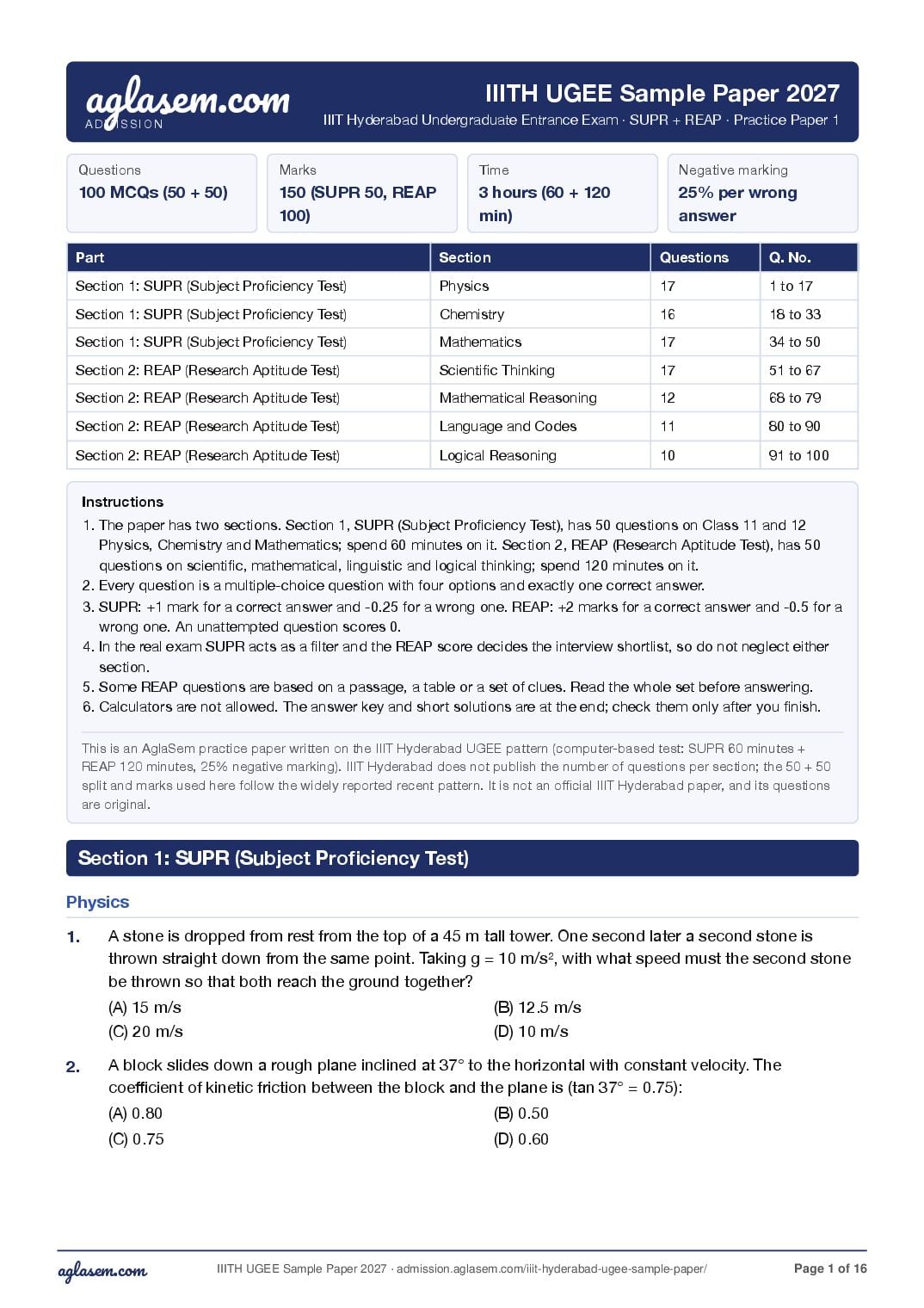
Page 1
IIITH UGEE Sample Paper 2027
IIIT Hyderabad Undergraduate Entrance Exam · SUPR + REAP · Practice Paper 1
Questions Marks Time Negative marking
100 MCQs (50 + 50) 150 (SUPR 50, REAP 3 hours (60 + 120 25% per wrong
100) min) answer
Part Section Questions Q. No.
Section 1: SUPR (Subject Proficiency Test) Physics 17 1 to 17
Section 1: SUPR (Subject Proficiency Test) Chemistry 16 18 to 33
Section 1: SUPR (Subject Proficiency Test) Mathematics 17 34 to 50
Section 2: REAP (Research Aptitude Test) Scientific Thinking 17 51 to 67
Section 2: REAP (Research Aptitude Test) Mathematical Reasoning 12 68 to 79
Section 2: REAP (Research Aptitude Test) Language and Codes 11 80 to 90
Section 2: REAP (Research Aptitude Test) Logical Reasoning 10 91 to 100
Instructions
1. The paper has two sections. Section 1, SUPR (Subject Proficiency Test), has 50 questions on Class 11 and 12
Physics, Chemistry and Mathematics; spend 60 minutes on it. Section 2, REAP (Research Aptitude Test), has 50
questions on scientific, mathematical, linguistic and logical thinking; spend 120 minutes on it.
2. Every question is a multiple-choice question with four options and exactly one correct answer.
3. SUPR: +1 mark for a correct answer and -0.25 for a wrong one. REAP: +2 marks for a correct answer and -0.5 for a
wrong one. An unattempted question scores 0.
4. In the real exam SUPR acts as a filter and the REAP score decides the interview shortlist, so do not neglect either
section.
5. Some REAP questions are based on a passage, a table or a set of clues. Read the whole set before answering.
6. Calculators are not allowed. The answer key and short solutions are at the end; check them only after you finish.
This is an AglaSem practice paper written on the IIIT Hyderabad UGEE pattern (computer-based test: SUPR 60 minutes +
REAP 120 minutes, 25% negative marking). IIIT Hyderabad does not publish the number of questions per section; the 50 + 50
split and marks used here follow the widely reported recent pattern. It is not an official IIIT Hyderabad paper, and its questions
are original.
Section 1: SUPR (Subject Proficiency Test)
Physics
1. A stone is dropped from rest from the top of a 45 m tall tower. One second later a second stone is
thrown straight down from the same point. Taking g = 10 m/s², with what speed must the second stone
be thrown so that both reach the ground together?
(A) 15 m/s (B) 12.5 m/s
(C) 20 m/s (D) 10 m/s
2. A block slides down a rough plane inclined at 37° to the horizontal with constant velocity. The
coefficient of kinetic friction between the block and the plane is (tan 37° = 0.75):
(A) 0.80 (B) 0.50
(C) 0.75 (D) 0.60
IIITH UGEE Sample Paper 2027 · admission./iiit-hyderabad-ugee-sample-paper/ Page 1 of 16
Page 2
ratio of their orbital speeds, v_A : v_B, is:
(A) 4 : 1 (B) 1 : 4
(C) 2 : 1 (D) 1 : 2
4. A solid sphere and a hollow sphere of the same mass and radius are released together from the top of
the same incline and roll down without slipping. Which one reaches the bottom first?
(A) It depends on their common mass
(B) Both reach together
(C) The hollow sphere
(D) The solid sphere
5. An 8 kg mass hangs from a spring balance fixed to the roof of a lift. The lift accelerates downwards at
g/4. Taking g = 10 m/s², the balance reads:
(A) 80 N (B) 100 N
(C) 20 N (D) 60 N
6. Helium (molar mass 4 g/mol) and oxygen (molar mass 32 g/mol) are at the same temperature. The ratio
of the rms speed of helium molecules to that of oxygen molecules is:
(A) 1 : 2√2 (B) 8 : 1
(C) 2√2 : 1 (D) 1 : 1
7. An ideal gas expands slowly at constant temperature. Which statement is TRUE?
(A) The heat absorbed equals the work done by the gas
(B) The pressure of the gas stays constant
(C) The internal energy of the gas increases
(D) No heat is exchanged with the surroundings
8. A particle performs simple harmonic motion with an amplitude of 4 cm. At what distance from the mean
position are its kinetic and potential energies equal?
(A) √2 cm (B) 1 cm
(C) 2√2 cm (D) 2 cm
9. An organ pipe 50 cm long is open at both ends. If the speed of sound in air is 340 m/s, the frequency of
its fundamental note is:
(A) 170 Hz (B) 340 Hz
(C) 85 Hz (D) 680 Hz
10. A thin hollow conducting sphere of radius R carries a charge Q. The electric field at a point at distance
R/2 from its centre is:
(A) zero (B) 4kQ/R²
(C) kQ/R² (D) kQ/(2R²)
11. A parallel-plate capacitor is charged and then disconnected from the battery. Its plates are now pulled
apart until the separation is doubled. The energy stored in it:
(A) halves (B) doubles
(C) becomes four times (D) stays the same
12. Two bulbs rated 25 W, 220 V and 100 W, 220 V are connected in series across a 220 V supply. The ratio
of the power actually consumed by the 25 W bulb to that consumed by the 100 W bulb is:
(A) 4 : 1 (B) 1 : 4
(C) 2 : 1 (D) 1 : 1
IIITH UGEE Sample Paper 2027 · admission./iiit-hyderabad-ugee-sample-paper/ Page 2 of 16
Page 3
metre length between them is (μ₀ = 4π × 10⁻⁷ T m/A):
(A) 1 × 10⁻⁴ N/m, attractive (B) 2 × 10⁻⁴ N/m, attractive
(C) 5 × 10⁻⁵ N/m, repulsive (D) 1 × 10⁻⁴ N/m, repulsive
14. A strong bar magnet is dropped down a long vertical copper tube held still. Ignoring air resistance, the
magnet:
(A) falls with acceleration less than g
(B) sticks to the wall of the tube
(C) falls with acceleration greater than g
(D) falls freely with acceleration g
15. A ray of light travels from glass (refractive index 1.5) into water (refractive index 4/3). The sine of the
critical angle at the glass-water surface is:
(A) 2/3 (B) 3/4
(C) 8/9 (D) 9/8
16. For the hydrogen atom, the ratio of the shortest wavelength of the Lyman series to the shortest
wavelength of the Balmer series is:
(A) 4 : 1 (B) 1 : 4
(C) 3 : 4 (D) 5 : 27
17. The number of gas molecules in 1 cm³ of air at room temperature and normal atmospheric pressure is
of the order of:
(A) 10¹⁹ (B) 10²³
(C) 10¹⁶ (D) 10²⁶
Chemistry
18. 6 g of carbon is burnt completely in excess oxygen. The volume of CO₂ formed, measured at STP, is:
(A) 11.2 L (B) 5.6 L
(C) 44.8 L (D) 22.4 L
19. Which set of quantum numbers (n, l, m_l, m_s) is NOT allowed?
(A) 4, 0, 0, +1/2 (B) 3, 2, −2, −1/2
(C) 2, 1, 1, +1/2 (D) 3, 3, 0, +1/2
20. Which of the following elements has the most negative electron gain enthalpy?
(A) Bromine (B) Fluorine
(C) Chlorine (D) Iodine
21. Which of the following molecules has a non-zero dipole moment?
(A) CCl₄ (B) BF₃
(C) CO₂ (D) NF₃
22. Which of the following species is diamagnetic?
(A) O₂²⁻ (B) O₂⁻
(C) O₂⁺ (D) O₂
23. For which process is the entropy change of the system negative?
(A) Water freezing to ice (B) Dry ice subliming
(C) Ice melting to water (D) Water evaporating
IIITH UGEE Sample Paper 2027 · admission./iiit-hyderabad-ugee-sample-paper/ Page 3 of 16
Page 4
2NO₂(g), the forward reaction is endothermic. The amount of NO₂ at
equilibrium can be increased by:
(A) increasing the pressure (B) raising the temperature
(C) adding a catalyst (D) lowering the temperature
25. A sparingly soluble salt MX₂ has a solubility product of 4.0 × 10⁻¹² at 25 °C. Its solubility in pure water is:
(A) 1.0 × 10⁻³ mol/L (B) 1.0 × 10⁻⁴ mol/L
(C) 2.0 × 10⁻⁶ mol/L (D) 1.6 × 10⁻⁴ mol/L
26. A solution is 0.1 M in acetic acid (pKa = 4.76) and 0.1 M in sodium acetate. Its pH is:
(A) 2.88 (B) 7.00
(C) 9.24 (D) 4.76
27. Given E°(Ag⁺/Ag) = +0.80 V and E°(Cu²⁺/Cu) = +0.34 V, the standard emf of the cell Cu | Cu²⁺ ‖ Ag⁺ | Ag
is:
(A) 1.14 V (B) 0.46 V
(C) −0.46 V (D) 1.26 V
28. The rate of a reaction becomes three times for every 10 °C rise in temperature. If the temperature is
raised from 20 °C to 50 °C, the rate becomes:
(A) 81 times (B) 90 times
(C) 27 times (D) 9 times
29. 6 g of urea (molar mass 60 g/mol) is dissolved in 1 kg of water. If Kf for water is 1.86 K kg/mol, the
depression in freezing point is:
(A) 0.372 K (B) 1.86 K
(C) 0.093 K (D) 0.186 K
30. How many structurally isomeric alcohols have the molecular formula C₄H₁₀O?
(A) 3 (B) 7
(C) 2 (D) 4
31. Which of the following carbocations is the most stable?
(A) CH₃⁺ (B) CH₃CH₂⁺
(C) (CH₃)₂CH⁺ (D) (CH₃)₃C⁺
32. Ethanal (CH₃CHO) is treated with dilute NaOH at room temperature. The main product is:
(A) Propanone (B) But-2-ene
(C) Ethanol and sodium ethanoate (D) 3-Hydroxybutanal
33. The number of unpaired electrons in the high-spin complex ion [CoF₆]³⁻ is:
(A) 2 (B) 4
(C) 0 (D) 6
Mathematics
34. Find the next term of the series: 1, 4, 10, 20, 35, ___
(A) 56 (B) 50
(C) 54 (D) 65
35. The remainder when 2¹⁰⁰ is divided by 7 is:
(A) 1 (B) 2
(C) 4 (D) 3
IIITH UGEE Sample Paper 2027 · admission./iiit-hyderabad-ugee-sample-paper/ Page 4 of 16
Page 5
(A) 24 (B) 40
(C) 64 (D) 56
37. The modulus of the complex number (1 + i)(2 + i)(3 + i) is:
(A) 5√2 (B) 10
(C) √10 (D) 100
38. If A = [[1, 2], [3, 4]], then A² − 5A equals:
(A) −2I (B) the zero matrix
(C) 2I (D) 5I
39. A committee of 4 is to be chosen from 6 men and 4 women so that it has at least 2 women. The number
of ways is:
(A) 130 (B) 115
(C) 210 (D) 90
40. The coefficient of x⁴ in the expansion of (1 − 2x)⁶ is:
(A) 240 (B) 160
(C) −240 (D) 60
41. A bag has 4 white and 6 black balls. Three balls are drawn at random without replacement. The
probability that exactly two of them are white is:
(A) 3/10 (B) 1/5
(C) 3/5 (D) 1/2
42. The reflection (mirror image) of the point (1, 2) in the line y = x + 3 is:
(A) (2, 1) (B) (−1, 4)
(C) (4, −1) (D) (−2, 4)
43. A hyperbola x²/a² − y²/b² = 1 passes through the point (4, 0) and has eccentricity 3/2. Then b² equals:
(A) 5 (B) 12
(C) 20 (D) 36
44. The maximum value of 5 sin x + 12 cos x + 2 is:
(A) 19 (B) 17
(C) 13 (D) 15
45. The value of lim(x→∞) (1 + 2/x)ˣ is:
(A) e (B) e²
(C) 1 (D) 2e
46. For −1 < x < 1, the derivative of sin⁻¹x + cos⁻¹x with respect to x is:
(A) 0 (B) π/2
(C) 2/√(1 − x²) (D) 1
47. An open box is made from a 12 cm × 12 cm square sheet by cutting equal squares from the four
corners and folding up the sides. The largest possible volume of the box is:
(A) 96 cm³ (B) 108 cm³
(C) 128 cm³ (D) 144 cm³
48. The value of ∫₀¹ x eˣ dx is:
(A) e (B) e − 1
(C) 2 (D) 1
IIITH UGEE Sample Paper 2027 · admission./iiit-hyderabad-ugee-sample-paper/ Page 5 of 16
Page 6
(A) 2 (B) 8/3
(C) 16/3 (D) 4/3
50. If |a| = 3, |b| = 4 and a · b = 6, then |a × b| equals:
(A) 6√3 (B) 6
(C) 3√3 (D) 12
Section 2: REAP (Research Aptitude Test)
Scientific Thinking
Read the situation and answer the next three questions:
Two bowls of the same shape, size and mass have been kept for several hours on a wooden table in a
room at 30 °C. Bowl P is made of steel and bowl Q of thick plastic. Two ice cubes of the same size are
taken from the same freezer and one is placed in each bowl at the same moment.
51. Which ice cube is likely to melt completely first?
(A) Both at the same moment, as the room temperature is the same for both
(B) It cannot be predicted unless the colour of the bowls is known
(C) The one in the plastic bowl Q
(D) The one in the steel bowl P
52. Which property of the bowls best explains the answer to the previous question?
(A) Transparency (B) Thermal conductivity
(C) Electrical resistance (D) Density
53. On a very hot afternoon the room is at 45 °C, above body temperature (about 37 °C). After the empty
bowls have stood in the room for hours, a person touches both. Which bowl feels hotter, and why?
(A) Neither, as both are at exactly 45 °C
(B) The plastic bowl, because plastic stores more heat than steel does
(C) The plastic bowl, as plastic absorbs sunlight
(D) The steel bowl, as it passes heat into the hand faster
A student times a simple pendulum at one place and records the results below. Answer the next
four questions:
Trial Length L (m) Mass of bob (g) Time for 10 oscillations (s)
1 0.25 50 10.0
2 0.25 100 10.0
3 1.00 50 20.0
4 2.25 50 30.0
54. Which conclusion is best supported by the data?
(A) The period depends on the length but not on the mass of the bob
(B) The period depends only on the mass of the bob
(C) The period is directly proportional to the length
(D) The period depends on both the length and the mass of the bob
55. Using the pattern in the table, what would be the time for 10 oscillations if the length were 0.64 m?
(A) 25.6 s (B) 8 s
(C) 12.8 s (D) 16 s
IIITH UGEE Sample Paper 2027 · admission./iiit-hyderabad-ugee-sample-paper/ Page 6 of 16
Page 7
analysis alone shows that T must be proportional to:
(A) L/g (B) √(g/L)
(C) √(L/g) (D) √(Lg)
57. The student wants a pendulum that makes 10 oscillations in exactly 25 s at the same place. The length
needed is closest to:
(A) 2.50 m (B) 6.25 m
(C) 1.25 m (D) 1.56 m
Read the experiment and answer the next three questions:
A student places a clean iron nail in each of three test tubes.
Tube 1: ordinary tap water, open to the air.
Tube 2: water that has been boiled and cooled, with a layer of oil on top and a stopper.
Tube 3: dry air kept dry with anhydrous calcium chloride, with a stopper.
After one week, only the nail in Tube 1 has rusted.
58. Tube 2 was set up mainly to test whether rusting needs:
(A) sunlight (B) dissolved salts
(C) air (oxygen) (D) warmth
59. Why was the water in Tube 2 boiled before use?
(A) To make the oil dissolve in the water
(B) To make the nail expand so it rusts faster
(C) To kill the bacteria that make iron rust
(D) To drive out the air dissolved in it
60. The student adds Tube 4: a clean nail half dipped in salt water, open to the air. After a week this nail is
more rusted than the one in Tube 1. Which conclusion is justified?
(A) Salt alone rusts iron, even without any water
(B) Salt speeds up rusting when air and water are present
(C) Iron does not need oxygen to rust in salt water
(D) Salt water contains no dissolved oxygen
A test tube of water at 20 °C is placed in a freezer at −18 °C and its temperature is read every
minute. Answer the next three questions:
Time (min) 0 1 2 3 4 5 6 7 8 9 10 11
Temperature (°C) 20 14 9 5 2 0 0 0 0 0 −3 −6
61. Why does the reading stay at 0 °C from the 5th to the 9th minute even though the freezer keeps
removing heat?
(A) Water at 0 °C has no heat left to lose
(B) The thermometer cannot read below 0 °C
(C) The freezer stops cooling when water reaches 0 °C
(D) The water is freezing and giving out latent heat
IIITH UGEE Sample Paper 2027 · admission./iiit-hyderabad-ugee-sample-paper/ Page 7 of 16
Page 8
smaller is:
(A) The freezer gets warmer as the water cools
(B) The specific heat of water rises sharply as it cools
(C) Evaporation stops completely below 10 °C
(D) Water cools faster when it is much hotter than its surroundings
63. From the 9th to the 11th minute the temperature falls by 3 °C each minute, faster than the 2 °C fall just
before freezing, although the sample is now closer to the freezer temperature. The most likely reason is
that:
(A) ice conducts no heat at all
(B) ice has a lower specific heat capacity than water
(C) ice has a higher specific heat capacity than water
(D) the freezer becomes colder after the water freezes
64. A survey finds that students who eat breakfast every day score higher marks than students who do not.
Which observation most weakens the claim that eating breakfast causes higher marks?
(A) Breakfast contains carbohydrates, which the brain uses for energy
(B) Some students who skip breakfast also score high marks in every subject
(C) Students with more support at home tend both to eat breakfast and to study more
(D) The survey covered students from many different schools
65. A student wants to find out whether a fertiliser makes bean plants grow taller. Which plan is the best
test?
(A) Grow two similar groups of plants in identical conditions and give the fertiliser to one group only
(B) Give the fertiliser to all the plants in the garden and measure their heights carefully after one month
(C) Give each plant a different amount of water and fertiliser
(D) Grow fertilised plants in sunlight and unfertilised plants in shade
66. A student studies how the height of a ramp affects how far a toy car rolls on the floor after leaving it.
Which pair of things must be kept the same in every trial?
(A) The ramp height and the distance
(B) The toy car and the floor surface
(C) The distance rolled and the floor
(D) The ramp height and the car
67. "Our company's sales have risen since we launched the new advertisement, so the advertisement is a
success." This argument assumes that:
(A) nothing else caused the rise in sales
(B) sales always rise after an advertisement
(C) the company sells only one product
(D) the advertisement was expensive to make
Mathematical Reasoning
68. How many solutions does a + b + c = 10 have, where a, b and c are non-negative integers and a ≥ 2?
(A) 66 (B) 45
(C) 36 (D) 55
IIITH UGEE Sample Paper 2027 · admission./iiit-hyderabad-ugee-sample-paper/ Page 8 of 16
Page 9
in all. How many people were at the party?
(A) 13 (B) 11
(C) 12 (D) 33
70. Four fair coins are tossed together. What is the probability of getting exactly two heads?
(A) 5/16 (B) 1/4
(C) 3/8 (D) 1/2
71. Two fair dice are rolled. What is the probability that the product of the two numbers is even?
(A) 2/3 (B) 1/2
(C) 3/4 (D) 1/4
72. What is the least number of people in a group that guarantees at least two of them were born in the
same month?
(A) 13 (B) 24
(C) 7 (D) 12
73. What is the area of the region enclosed by the graph of y = |x| and the line y = 2?
(A) 6 (B) 2
(C) 4 (D) 8
74. What is the minimum value of f(x) = x² − 4x + 7 for real x?
(A) 2 (B) 7
(C) −3 (D) 3
75. A frog is at the bottom of a well 20 m deep. Each day it climbs up 5 m, and each night it slips back 3 m.
On which day does it first get out of the well?
(A) Day 10 (B) Day 7
(C) Day 9 (D) Day 8
76. The numbers 1, 2, 3, …, 10 are written on a board. In each step, any two numbers a and b are erased
and |a − b| is written in their place. After 9 steps one number is left. What can be said about it?
(A) It must be an odd number (B) It must be an even number
(C) It must be 0 (D) It must be 1
77. How many three-digit numbers have digits that strictly increase from left to right (like 258)?
(A) 120 (B) 36
(C) 72 (D) 84
78. What is the smaller angle between the hour hand and the minute hand of a clock at 7:20?
(A) 100° (B) 90°
(C) 120° (D) 110°
79. 6 workers paint 6 walls in 6 hours. Working at the same rate, how many workers are needed to paint 12
walls in 3 hours?
(A) 18 (B) 6
(C) 24 (D) 12
IIITH UGEE Sample Paper 2027 · admission./iiit-hyderabad-ugee-sample-paper/ Page 9 of 16
Page 10
Kelva is an invented language. Study the sentences and their translations, then answer the next five
questions:
1. Vit dor osel. = The man sees the woman.
2. Nalet sela okaf. = The women fed the dog.
3. Na rom mip odora. = The child does not call the men.
4. Vitet kafa omip. = The dogs saw the child.
5. Rom sel okafa. = The woman calls the dogs.
80. What does the word nal mean?
(A) see (B) feed
(C) not (D) call
81. How would you say "The men saw the women" in Kelva?
(A) Vit dora osela (B) Vitet osela dora
(C) Vitet dor osela (D) Vitet dora osela
82. What does "Na nalet sel omipa" mean?
(A) The woman did not feed the children
(B) The children did not feed the woman
(C) The woman does not feed the children
(D) The women did not feed the child
83. Which rule of Kelva grammar is shown by the sentences?
(A) The object is placed first in the sentence
(B) The past tense is shown by the word na
(C) The doer comes right after the verb
(D) The plural is shown by the prefix o-
84. How would you say "The dog does not see the men" in Kelva?
(A) Na vit kaf odora (B) Na vitet kaf odora
(C) Vit na kaf odora (D) Na vit okaf dora
An invented counting system is shown below. Answer the next three questions:
en = 1, tu = 2, ri = 3, fa = 4, pak = 5
7 = pak tu; 12 = tu pak tu; 19 = ri pak fa; 23 = fa pak ri
25 = dom; 31 = dom pak en
85. What number is written as "ri pak tu"?
(A) 17 (B) 32
(C) 11 (D) 13
86. How is the number 24 written in this system?
(A) fa pak fa (B) fa fa pak
(C) dom en (D) tu pak fa
87. What number is written as "dom tu pak ri"?
(A) 38 (B) 63
(C) 33 (D) 36
IIITH UGEE Sample Paper 2027 · admission./iiit-hyderabad-ugee-sample-paper/ Page 10 of 16
Page 11
Coded message: WKLQN EHIRUH BRX DFW
Clue: the letter T is written as W.
88. Which rule was used to make the coded message?
(A) Each letter is replaced by the next letter
(B) Each letter is replaced by the letter 3 places after it
(C) Each letter is replaced by the letter 3 places before it
(D) Each letter is replaced by its mirror letter (A↔Z, B↔Y, …)
89. What does the coded word BRX stand for?
(A) OUR (B) TRY
(C) BOX (D) YOU
90. Using the same rule, how would the word IDEA be written?
(A) LHGD (B) LGHD
(C) JEFB (D) FABX
Logical Reasoning
Five students A, B, C, D and E sit on chairs numbered 1 to 5 from left to right. Answer the next three
questions:
1. A sits at one end of the row.
2. Exactly two students sit between A and C.
3. B sits immediately to the left of D.
4. E is not in chair 3.
5. B sits somewhere to the left of C.
91. Who sits in the middle chair (chair 3)?
(A) C (B) E
(C) D (D) B
92. Who sits at the right end (chair 5)?
(A) C (B) A
(C) D (D) E
93. How many people sit between B and E?
(A) 1 (B) 0
(C) 3 (D) 2
94. On an island, knights always tell the truth and knaves always lie. P says, "Q is a knave." Q says, "P and
I are both knights." What are P and Q?
(A) Both are knaves (B) Both are knights
(C) P is a knight and Q is a knave (D) P is a knave and Q is a knight
95. On the same island, X says, "Exactly one of the three of us is a knight." Y says, "All three of us are
knaves." Z says nothing. What can be concluded?
(A) Z is a knight; X and Y are knaves
(B) Y is a knight; X and Z are knaves
(C) X is a knight; Y and Z are knaves
(D) All three are knaves
IIITH UGEE Sample Paper 2027 · admission./iiit-hyderabad-ugee-sample-paper/ Page 11 of 16
Page 12
Statement 1: n² is even.
Statement 2: n + 3 is odd.
Which of the following is correct?
(A) Statement 1 alone is enough, but Statement 2 alone is not
(B) The two statements together are not enough
(C) Each statement alone is enough to answer
(D) Both statements together are needed
97. A row of five bulbs shows a number in binary: a lit bulb means 1 and an unlit bulb means 0, with the
leftmost bulb having the highest place value. The pattern lit, unlit, lit, lit, unlit shows the number:
(A) 11 (B) 22
(C) 26 (D) 13
98. Each row follows the same rule. Find the missing number.
3, 4, 25
5, 12, 169
6, 8, ?
(A) 196 (B) 14
(C) 100 (D) 48
99. There are 9 identical-looking coins, of which one is heavier than the rest. Using a two-pan balance, what
is the least number of weighings that always finds the heavy coin?
(A) 3 (B) 2
(C) 1 (D) 4
100. In a class of 40 students, 25 are in the Physics club, 20 are in the Maths club and 8 are in neither. How
many students are in both clubs?
(A) 13 (B) 17
(C) 12 (D) 5
IIITH UGEE Sample Paper 2027 · admission./iiit-hyderabad-ugee-sample-paper/ Page 12 of 16
Page 13
1 B 2 C 3 C 4 D 5 D 6 C 7 A 8 C 9 B 10 A
11 B 12 A 13 D 14 A 15 C 16 B 17 A 18 A 19 D 20 C
21 D 22 A 23 A 24 B 25 B 26 D 27 B 28 C 29 D 30 D
31 D 32 D 33 B 34 A 35 B 36 B 37 B 38 C 39 B 40 A
41 A 42 B 43 C 44 D 45 B 46 A 47 C 48 D 49 B 50 A
51 D 52 B 53 D 54 A 55 D 56 C 57 D 58 C 59 D 60 B
61 D 62 D 63 B 64 C 65 A 66 B 67 A 68 B 69 C 70 C
71 C 72 A 73 C 74 D 75 C 76 A 77 D 78 A 79 C 80 B
81 D 82 A 83 C 84 A 85 A 86 A 87 A 88 B 89 D 90 B
91 C 92 D 93 D 94 C 95 C 96 C 97 B 98 C 99 B 100 A
Solutions
Physics
1. (B) The first stone takes √(2 × 45/10) = 3 s, so the second has 2 s: 45 = 2u + (1/2)(10)(2²) gives u = 12.5 m/s.
2. (C) Constant velocity means mg sin θ = μ mg cos θ, so μ = tan θ = 0.75.
3. (C) v = √(GM/r), so v_A/v_B = √(r_B/r_A) = √4 = 2.
4. (D) Acceleration = g sin θ/(1 + I/MR²). I/MR² is 2/5 for the solid sphere and 2/3 for the hollow one, so the solid sphere
accelerates more.
5. (D) T = m(g − a) = 8 × (10 − 2.5) = 60 N.
6. (C) v_rms ∝ 1/√M at a fixed temperature: √(32/4) = √8 = 2√2.
7. (A) For an ideal gas U depends only on T, so ΔU = 0 and Q = W. Pressure falls as volume rises (PV = constant).
8. (C) PE = (1/2)kx² equals half the total energy (1/2)kA² when x² = A²/2, so x = 4/√2 = 2√2 cm.
9. (B) An open pipe has antinodes at both ends, so L = λ/2: f = v/2L = 340/1.0 = 340 Hz. (170 Hz would be a closed
pipe of the same length.)
10. (A) The charge sits on the outer surface, and by Gauss's law the enclosed charge for any surface inside is zero, so
the field inside is zero.
11. (B) Q stays fixed and C = ε₀A/d halves, so U = Q²/2C doubles. The extra energy comes from the work done in
pulling the plates apart.
12. (A) R = V²/P, so R₂₅ = 4R₁₀₀. In series the current is the same, so P = I²R is in the ratio of the resistances, 4 : 1.
13. (D) F/L = μ₀I₁I₂/(2πd) = 2 × 10⁻⁷ × 50/0.1 = 1 × 10⁻⁴ N/m. Opposite currents repel.
14. (A) The moving magnet induces eddy currents in the copper which, by Lenz's law, oppose its motion. Copper is
not magnetic, so it does not stick.
15. (C) sin C = n_water/n_glass = (4/3)/(3/2) = 8/9. Total internal reflection is possible because light goes from the
denser to the rarer medium.
16. (B) The series limits are 1/λ = R(1/1² − 0) = R for Lyman and R(1/2² − 0) = R/4 for Balmer, so λ_L : λ_B = 1 : 4.
17. (A) n = P/kT = 10⁵/(1.38 × 10⁻²³ × 300) ≈ 2.4 × 10²⁵ per m³, which is about 2.4 × 10¹⁹ per cm³.
Chemistry
18. (A) 6 g C = 0.5 mol, and C + O₂ → CO₂ gives 0.5 mol CO₂ = 0.5 × 22.4 = 11.2 L.
19. (D) l can take values only from 0 to n − 1, so l = 3 is impossible when n = 3.
20. (C) Fluorine is so small that incoming electrons are repelled by its compact 2p shell, so chlorine has the most
negative electron gain enthalpy among the halogens.
IIITH UGEE Sample Paper 2027 · admission./iiit-hyderabad-ugee-sample-paper/ Page 13 of 16
Page 14
symmetric.
22. (A) O₂²⁻ has 18 electrons, which fill both π* orbitals completely, so all electrons are paired. O₂ has 2 unpaired
electrons and O₂⁻ and O₂⁺ have 1 each.
23. (A) Freezing converts a liquid into a more ordered solid, so ΔS < 0. The other three increase disorder.
24. (B) An endothermic forward reaction is favoured by heating (Le Chatelier). Higher pressure favours fewer moles
(N₂O₄) and a catalyst does not shift equilibrium.
25. (B) MX₂ ⇌ M²⁺ + 2X⁻ gives Ksp = s(2s)² = 4s³ = 4.0 × 10⁻¹², so s³ = 10⁻¹² and s = 1.0 × 10⁻⁴ mol/L.
26. (D) Henderson equation: pH = pKa + log([salt]/[acid]) = 4.76 + log 1 = 4.76.
27. (B) E°cell = E°cathode − E°anode = 0.80 − 0.34 = 0.46 V.
28. (C) A 30 °C rise is three steps of 10 °C: 3³ = 27 times.
29. (D) Molality = 0.1 mol/kg and urea does not ionise, so ΔTf = 1.86 × 0.1 = 0.186 K.
30. (D) Butan-1-ol, butan-2-ol, 2-methylpropan-1-ol and 2-methylpropan-2-ol. (Seven isomers in all if the three ethers
are counted.)
31. (D) A tertiary carbocation is stabilised most by the inductive effect and hyperconjugation of its three methyl groups.
32. (D) Ethanal has α-hydrogens, so it undergoes aldol addition to give CH₃CH(OH)CH₂CHO. Cannizzaro needs
aldehydes without α-hydrogen.
33. (B) Co³⁺ is d⁶. F⁻ is a weak-field ligand, so the electrons spread out as t₂g⁴ e_g², leaving 4 unpaired.
Mathematics
34. (A) The differences 3, 6, 10, 15 are triangular numbers; the next is 21, so 35 + 21 = 56.
35. (B) 2³ = 8 ≡ 1 (mod 7). Since 100 = 3 × 33 + 1, 2¹⁰⁰ ≡ 2¹ = 2.
36. (B) α + β = 4, αβ = 2, so α³ + β³ = (α + β)³ − 3αβ(α + β) = 64 − 24 = 40.
37. (B) The modulus of a product is the product of moduli: √2 × √5 × √10 = √100 = 10.
38. (C) A² = [[7, 10], [15, 22]] and 5A = [[5, 10], [15, 20]], so A² − 5A = [[2, 0], [0, 2]] = 2I (Cayley-Hamilton: A² − 5A − 2I =
0).
39. (B) 2 women: ⁴C₂ × ⁶C₂ = 90; 3 women: ⁴C₃ × ⁶C₁ = 24; 4 women: 1. Total = 115.
40. (A) The term is ⁶C₄(−2x)⁴ = 15 × 16x⁴ = 240x⁴.
41. (A) (⁴C₂ × ⁶C₁)/¹⁰C₃ = (6 × 6)/120 = 3/10. (1/2 is the probability of exactly one white.)
42. (B) The midpoint of (1, 2) and (−1, 4) is (0, 3), which lies on the line, and the joining segment has slope −1,
perpendicular to the line.
43. (C) The point (4, 0) gives a = 4. b² = a²(e² − 1) = 16 × (9/4 − 1) = 20.
44. (D) a sin x + b cos x has maximum √(a² + b²) = 13, so the maximum is 13 + 2 = 15.
45. (B) (1 + 2/x)ˣ = [(1 + 2/x)^(x/2)]² → e².
46. (A) sin⁻¹x + cos⁻¹x = π/2, a constant, so its derivative is 0.
47. (C) V = x(12 − 2x)², V′ = (12 − 2x)(12 − 6x) = 0 gives x = 2, so V = 2 × 8 × 8 = 128 cm³.
48. (D) By parts, ∫x eˣ dx = (x − 1)eˣ. From 0 to 1: 0 − (−1) = 1.
49. (B) Area = 2∫₀¹ 2√x dx = 4 × (2/3) = 8/3.
50. (A) |a × b|² = |a|²|b|² − (a · b)² = 144 − 36 = 108, so |a × b| = 6√3.
Scientific Thinking
51. (D) Both bowls are at room temperature, but steel conducts heat far better than plastic, so heat from the table and
air reaches the ice in P faster.
52. (B) The rate at which heat flows through a material at the same temperature difference is set by its thermal
conductivity, which is much higher for steel.
53. (D) Both bowls are at 45 °C, but the hand judges the rate of heat flow. Steel conducts heat into the cooler hand
faster, so it feels hotter. (In a room cooler than the body, steel would feel colder.)
IIITH UGEE Sample Paper 2027 · admission./iiit-hyderabad-ugee-sample-paper/ Page 14 of 16
Page 15
times trebles it, so T ∝ √L, not L.
55. (D) The data fit T = 2√L s. For L = 0.64 m, T = 2 × 0.8 = 1.6 s, so 10 oscillations take 16 s.
56. (C) L/g has dimensions m ÷ (m s⁻²) = s², so √(L/g) is the only combination with the dimension of time.
57. (D) T = 2.5 s, and T = 2√L gives √L = 1.25, so L = 1.5625 m ≈ 1.56 m.
58. (C) Tube 2 has water but no air: boiling removed dissolved air and the oil layer and stopper keep fresh air out.
Since its nail did not rust, air is needed.
59. (D) Water normally contains dissolved air. Boiling expels it, so the tube tests water without oxygen.
60. (B) Tube 4 differs from Tube 1 only by the salt, and both air and water are present, so salt increases the rate of
rusting. Nothing was tested without water or air.
61. (D) During freezing, heat removed comes from the latent heat of fusion, so the temperature stays at the freezing
point until all the water has turned to ice.
62. (D) The rate of heat loss depends on the temperature difference between the water and the freezer (Newton's law
of cooling). As the water cools, the difference shrinks.
63. (B) The same rate of heat removal lowers the temperature more when the specific heat is smaller. Ice's specific
heat (about 2.1 J g⁻¹ K⁻¹) is about half that of water (4.2 J g⁻¹ K⁻¹).
64. (C) A third factor (home support) that causes both breakfast and good marks would explain the link without
breakfast causing the marks. A few exceptions do not weaken a trend.
65. (A) A fair test changes only one variable (fertiliser) and keeps a control group under the same conditions. The other
plans have no control or change two things at once.
66. (B) The ramp height is the variable being changed and the distance is what is measured. Everything else, such as
the car and the floor, must stay the same.
67. (A) The conclusion holds only if the advertisement, and not some other factor such as a festival season or a price
cut, caused the increase.
Mathematical Reasoning
68. (B) Put a = a′ + 2: a′ + b + c = 8 has C(8 + 2, 2) = C(10, 2) = 45 non-negative solutions.
69. (C) n(n − 1)/2 = 66 gives n(n − 1) = 132 = 12 × 11, so n = 12.
70. (C) ⁴C₂ = 6 of the 2⁴ = 16 equally likely outcomes have exactly two heads: 6/16 = 3/8.
71. (C) The product is odd only if both numbers are odd: (1/2)(1/2) = 1/4. So P(even) = 3/4.
72. (A) With 12 months, 12 people could all have different months. By the pigeonhole principle, 13 people force a
repeat.
73. (C) The region is a triangle with vertices (0, 0), (−2, 2) and (2, 2): area = (1/2) × 4 × 2 = 4.
74. (D) f(x) = (x − 2)² + 3, which is least (3) at x = 2.
75. (C) It gains 2 m per full day. At the start of day 9 it is at 16 m and climbs to 21 m, which gets it out. On day 8 it
reaches only 19 m.
76. (A) a + b and |a − b| have the same parity, so the parity of the total never changes. The starting total 55 is odd, so
the last number is odd (it need not be 1).
77. (D) Any 3 different digits from 1 to 9 can be arranged in increasing order in exactly one way (0 cannot be used, as it
would have to lead): C(9, 3) = 84.
78. (A) Hour hand: 210° + 20 × 0.5° = 220°. Minute hand: 20 × 6° = 120°. The difference is 100°.
79. (C) One worker paints 1 wall in 6 hours. 12 walls in 3 hours need 12 × (6/3) = 24 workers.
Language and Codes
80. (B) nal appears only in sentence 2, whose translation contains 'fed'. The ending -et marks the past tense, so nal
means feed.
81. (D) Verb + -et for past (vitet), then the doer (dora, plural with -a), then the object with o- (osela). Vit is present tense
and dor is singular.
IIITH UGEE Sample Paper 2027 · admission./iiit-hyderabad-ugee-sample-paper/ Page 15 of 16
Page 16
83. (C) Every sentence is Verb + Doer + Object (na comes before the verb). o- marks the object, -a the plural, -et the
past and na the negative.
84. (A) na before the present-tense verb vit, then the doer kaf, then the object odora (o- + dora).
85. (A) ri pak = 3 fives = 15, and tu = 2, so the number is 17.
86. (A) 24 = 4 × 5 + 4: fa pak (4 fives) followed by fa (4). dom en would be 26, and tu pak fa is 14.
87. (A) dom = 25, tu pak = 10, ri = 3: 25 + 10 + 3 = 38.
88. (B) The clue T → W is a shift of 3 forward, and it works for every word, e.g. H → K, I → L, N → Q, K → N in
WKLQN = THINK.
89. (D) Shift each letter 3 places back, wrapping round the alphabet: B → Y, R → O, X → U. The message reads THINK
BEFORE YOU ACT.
90. (B) I → L, D → G, E → H, A → D.
Logical Reasoning
91. (C) From clue 2, A and C are in chairs 1 and 4, or 5 and 2. Clue 5 rules out A = 5, C = 2 (then B, D would be in 3, 4,
right of C). So A = 1, C = 4; B, D fill 2, 3 (clue 3) and E is in 5. Order: A, B, D, C, E.
92. (D) The order from chair 1 to 5 is A, B, D, C, E.
93. (D) B is in chair 2 and E in chair 5, with D and C between them.
94. (C) If Q were a knight, both would be knights, but then P's statement 'Q is a knave' would be false: impossible. So
Q is a knave, P's statement is true and P is a knight.
95. (C) Y cannot be a knight (he would be calling himself a knave), so Y lies and at least one is a knight. If X lied, Z
would have to be the only knight, making X's statement true: impossible. So X is the one knight.
96. (C) If n² is even, n is even (the square of an odd number is odd). If n + 3 is odd, n is even. Each statement settles
the question.
97. (B) 10110 in binary = 16 + 4 + 2 = 22.
98. (C) The third number is the sum of the squares of the first two: 9 + 16 = 25, 25 + 144 = 169, 36 + 64 = 100.
99. (B) Weigh 3 against 3. The heavier pan (or, if they balance, the 3 left over) holds the coin. Then weigh 1 against 1 of
those 3 in the same way. One weighing cannot handle 9 coins, as it has only 3 outcomes.
100. (A) Students in at least one club = 40 − 8 = 32, so both = 25 + 20 − 32 = 13.
IIITH UGEE Sample Paper 2027 · admission./iiit-hyderabad-ugee-sample-paper/ Page 16 of 16
Document Details
| Board / Org | IIIT Hyderabad |
| Exam | IIIT Hyderabad UGEE |
| Type | Sample Paper |
| Pages | 16 |
| Language | english |
| Updated | 27 Oct 2026 |