Telangana Class 11 Syllabus 2024 Physics
Finished viewing? Save it for later —
Download Telangana Class 11 Syllabus 2024 Physics (PDF · 6 pages)About Telangana Class 11 Syllabus 2024 Physics
Telangana Class 11 Syllabus 2024 Physics is available here for free download. Published by Telangana Board for Class 11, this syllabus can be viewed online or downloaded as a PDF (6 pages). Candidates preparing for Class 11 can use Telangana Class 11 Syllabus 2024 Physics to understand the exam pattern, the type of questions asked, and the overall difficulty level.
Frequently Asked Questions
How can I download Telangana Class 11 Syllabus 2024 Physics?
Open this page and click the Download button to save Telangana Class 11 Syllabus 2024 Physics as a PDF. It is completely free on AglaSem Docs.
Is Telangana Class 11 Syllabus 2024 Physics free to download?
Yes. Telangana Class 11 Syllabus 2024 Physics can be viewed online and downloaded as a PDF free of cost on AglaSem Docs.
How many pages does Telangana Class 11 Syllabus 2024 Physics have?
Telangana Class 11 Syllabus 2024 Physics contains 6 pages, which you can read online or download together as a single PDF.
Where can I find more Class 11 study material?
You can find more Class 11 question papers, sample papers, syllabus, and answer keys on AglaSem Docs.
Telangana Class 11 Syllabus 2024 Physics – Text
Read the full text of this syllabus below — useful to quickly search, copy and reference the content online without downloading the PDF.
📄 View text version (6 pages)
Page 1
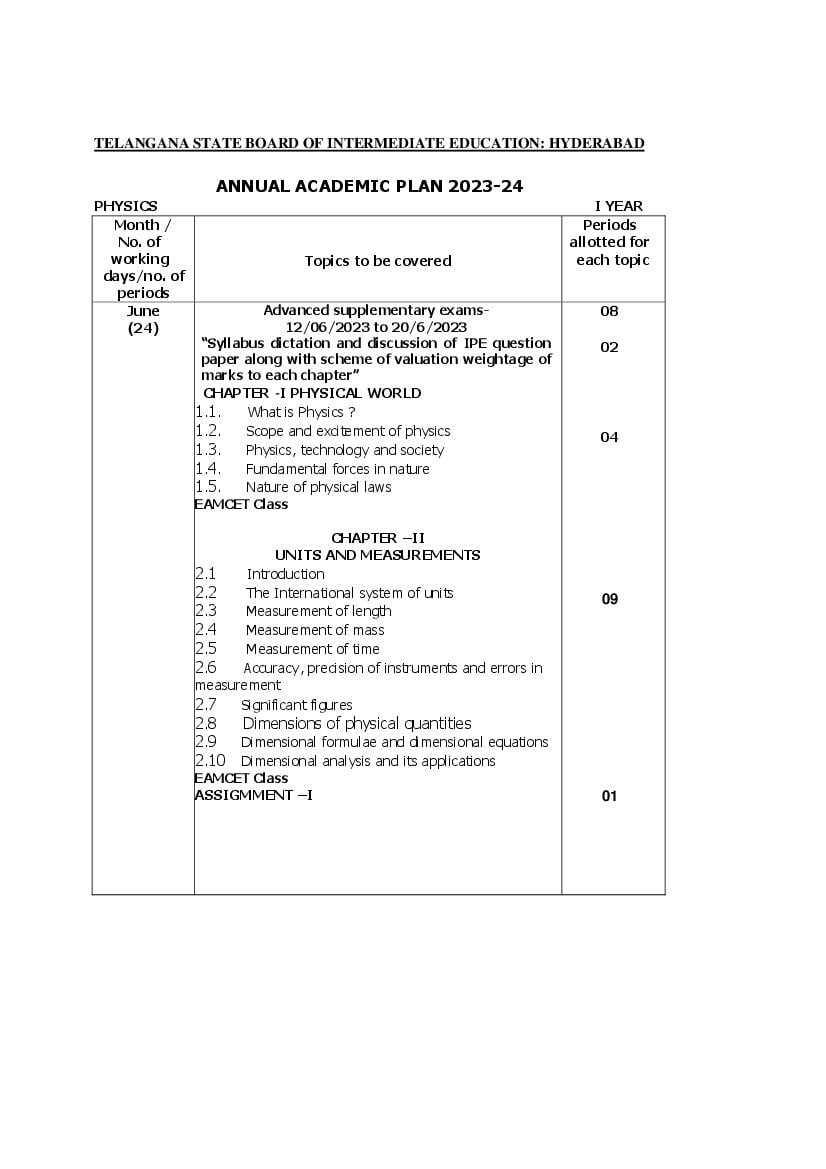
ANNUAL ACADEMIC PLAN 2023-24
PHYSICS I YEAR
Month / Periods
No. of allotted for
working Topics to be covered each topic
days/no. of
periods
June Advanced supplementary exams- 08
(24) 12/06/2023 to 20/6/2023
“Syllabus dictation and discussion of IPE question 02
paper along with scheme of valuation weightage of
marks to each chapter”
CHAPTER -I PHYSICAL WORLD
1.1. What is Physics ?
1.2. Scope and excitement of physics 04
1.3. Physics, technology and society
1.4. Fundamental forces in nature
1.5. Nature of physical laws
CHAPTER –II
UNITS AND MEASUREMENTS
2.1 Introduction
2.2 The International system of units 09
2.3 Measurement of length
2.4 Measurement of mass
2.5 Measurement of time
2.6 Accuracy, precision of instruments and errors in
measurement
2.7 Significant figures
2.8 Dimensions of physical quantities
2.9 Dimensional formulae and dimensional equations
2.10 Dimensional analysis and its applications
ASSIGMMENT –I 01
Page 2
(23) 3.1 Introduction
3.2 Position, path length and displacement
3.3 Average velocity and average speed
3.4 Instantaneous velocity and speed
3.5 Acceleration 10
3.6 Kinematic equations for uniformly accelerated
motion
3.7 Relative velocity
Chapter –IV: MOTION IN A PLANE
4.1 Introduction
4.2 Scalars and vectors
4.3 Multiplication of vectors by real members
4.4 Addition and subtraction of vectors graphical
method
4.5 Resolution of vectors
4.6 Vector addition Analytical method
4.7 Motion in a plane 11
4.8 Motion in a plane with constant
acceleration
4.9 Relative velocity in two dimensions
4.10 Projectile motion
4.11 Uniform circular motion
ASSIGMMENT –2 01
Unit test 1 01
1.Vernier callipers
2. Screw gauge
CHAPTER-V: LAWS OF MOTION
5.1 Introduction
5.2 Aristotle’s fallacy 11
5.3 The law of inertia
5.4 Newton’s first law of motion
5.6 Newton’s second law of motion
5.7 Newton’s third law of motion
5.8 Conservation of momentum
5.9 Equilibrium of a particle
AUGUST 5.10 Common forces in mechanics, friction
(25) Circular motion
5.11 Solving problems in mechanics
Page 3
6.1 Introduction
6.2 Notions of work and kinetic energy: The work
energy theorem.
6.3 Work
6.4 Kinetic Energy 12
6.5 Work done by a variable force
6.6 The work-energy theorem for a variable force.
6.7 The concept of potential energy
6.8 The conservation of mechanical energy
6.9 The potential energy of a spring
6.10 Various forms of energy: the law of conservation
of energy.
6.11 Power
6.12 Collisions
ASSIGNMENT-3
Unit test 2 01
Practicals: 01
3. Physical balance
4. CONCURENT FORCES
CHAPTER-VII
SYSTEM OF PARTICLES AND ROTATIONAL
MOTION
7.1 Introduction
SEPTEMBER 7.2 Centre of mass. Centre of gravity
(22) 7.3 Motion of Centre of mass
7.4 Linear momentum of a system of particles
12
7.5 Vector product of two vectors
7.6 Angular velocity and its relation with linear velocity,
kinematics of rotational motion about a fixed
axis.
7.7 Torque and angular momentum
7.8 Equilibrium of a rigid body
7.9 Moment of inertia
7.10 Theorems of perpendicular and parallel axis.
7.11 Dynamics of rotational motion about a fixed axis.
7.12 Angular momentum in case of rotations about a fixed
axis.
7.13 Rolling motion
Page 4
8.1 Introduction
8.2 Periodic and oscillatory motions
8.3 Simple Harmonic motions
8.4 Simple Harmonic motion and uniform circular
motion
8.5 Velocity and acceleration in simple harmonic
motion
8.6 Velocity and acceleration in simple harmonic 08
motion
8.7 Force law for simple harmonic motion
8.8 Energy in simple harmonic motion
8.9 Some systems executing simple harmonic motion
8.10 Damped simple harmonic motion
8.13 Forced oscillations and resonance
ASSIGMMENT –4
01
UNIT TEST – 3
01
5. SIMPLE PENDULUM
6. FORCE CONSTANT OF SPRING
CHAPTER –IX: GRAVITATION
OCTOBER 9.1 Introduction
(18) 9.2 Kepler’s laws
9.3 Universal law of gravitation
9.4 The gravitational constant
9.5 Acceleration due to gravity of the earth
9.6 Acceleration due to gravity below and above the
surface of earth. 09
9.7 Gravitational potential energy
9.8 Escape speed
9.9 Earth satellite
9.10 Energy of an orbiting satellite
9.11 Geostationary and polar satellites
9.12 weightlessness
CHAPTER –X
MECHANICAL PROPERTIES OF SOLIDS
10.1 Introduction
10.2 Elastic behaviour of solids
10.3 Stress and strain
08
10.4 Hook’s law
10.5 Stress – strain curve
10.6 Elastic moduli
10.7 Applications of elastic behaviour of materials
01
ASSIGNMENT 5
DUSSEHRA Holidays: 19-10-2023 TO 25-10-2023
Date of Reopening: 26-10-2023
Page 5
MECHANICAL PROPERTIES OF FLUIDS
November 11.1 Introduction
(24) 11.2 Pressure
11.3 Streamline flow
11.4 Bernoulli’s principle
11.5 Viscosity 08
11.6 Reynolds number
11.7 Surface tension
CHAPTER – XII
THERMAL PROPERTIES OF MATTER
12.1 Introduction
12.2 Temperature and Heat
12.3 Measurement of temperature
12.4 Ideal – gas equation and absolute temperature
12.5 Thermal expansion
12.6 Specific Heat capacity 10
12.7 Calorimetry
12.8 Charge of state
12.9 Heat transfer
12.10 Newton’s law of cooling.
7. Determination of surface tension of a liquid liquid
8. Apparent expansion of a liquid
HALF YEARLY EXAMINATIONS:
06
20-11-2023 TO 25-11-2023
CHAPTER –XIII: THERMODYNAMICS
13.1 Introduction
13.2 Thermal equilibrium
DECEMBER
(23) 13.3 Zeroth law of thermodynamics
13.4 Heat, internal energy and work
13.5 First law of thermodynamics 12
13.6 Specific heat capacity
13.7 Thermodynamic state variables and equation of state
13.8 Thermodynamic processes
13.9 Heat engines
13.10 Refrigerators and heat pumps
13.11 Second law of thermodynamics
13.12 Reversible and irreversible processes
13.13 Carrot engine, Carnot’s theorem.
Page 6
14.1 Introduction
14.2 Molecular nature of matter
14.3 Behaviour of gases
14.4 Kinetic theory of an ideal gas
14.5 Laws of equipartition of energy
14.6 Specific heat capacity
14.7 Mean free path
ASSIGNMENT – 6
UNIT TEST – 4 01
Practicals: 01
9. Boyle’s law
10.Specific heat of a solids
17
January Theory Revision
(23)
SANKRANTRI HOLIDAYS FROM
13-01-2024 TO 16-01-2024
DATEOFREOPENING:17-01-2024
PREFINAL EXAMINATIONS : 06
FROM 22.01.2024 TO 29.01.2024
February Theory Revision 23
(23)
March I.P. Examinations: Ist week of March 2024 22
( 22)
Last working day: 31-03-2024
Summer Vacation: 01-04-2024 to 31-05-2024
Advance Supplementary Exams :last week of May
2024
Date of Reopening after summer vacation: 01-06-2024
Prepared by: B.VISHNU VARDHAN, JL in Physics,
Government Junior College, CHANCHAL GUDA, HYDERABAD District
Document Details
| Board / Org | Telangana Board |
| Exam | Class 11 |
| Type | Syllabus |
| Pages | 6 |
| Updated | 22 Jul 2026 |