NCERT Book Class 12 History Chapter 5 Through the Eyes of Travellers
Finished viewing? Save it for later —
Download NCERT Book Class 12 History Chapter 5 Through the Eyes of Travellers (PDF · 25 pages)About NCERT Book Class 12 History Chapter 5 Through the Eyes of Travellers
NCERT Book Class 12 History Chapter 5 Through the Eyes of Travellers is available here for free download. Published by NCERT for Class 12, this books can be viewed online or downloaded as a PDF (25 pages). Candidates preparing for Class 12 can use NCERT Book Class 12 History Chapter 5 Through the Eyes of Travellers to understand the exam pattern, the type of questions asked, and the overall difficulty level.
Frequently Asked Questions
How can I download NCERT Book Class 12 History Chapter 5 Through the Eyes of Travellers?
Open this page and click the Download button to save NCERT Book Class 12 History Chapter 5 Through the Eyes of Travellers as a PDF. It is completely free on AglaSem Docs.
Is NCERT Book Class 12 History Chapter 5 Through the Eyes of Travellers free to download?
Yes. NCERT Book Class 12 History Chapter 5 Through the Eyes of Travellers can be viewed online and downloaded as a PDF free of cost on AglaSem Docs.
How many pages does NCERT Book Class 12 History Chapter 5 Through the Eyes of Travellers have?
NCERT Book Class 12 History Chapter 5 Through the Eyes of Travellers contains 25 pages, which you can read online or download together as a single PDF.
Where can I find more Class 12 study material?
You can find more Class 12 question papers, sample papers, syllabus, and answer keys on AglaSem Docs.
NCERT Book Class 12 History Chapter 5 Through the Eyes of Travellers – Text
Read the full text of this books below — useful to quickly search, copy and reference the content online without downloading the PDF.
📄 View text version (1 page)
Page 1
THEME
Through the Eyes of Travellers
FIVE Perceptions of Society
( c . tenth to seventeenth century)
Women and men have travelled in search of work, to escape
from natural disasters, as traders, merchants, soldiers,
priests, pilgrims, or driven by a sense of adventure.
Those who visit or come to stay in a new land
invariably encounter a world that is different:
in terms of the landscape or physical
environment as well as customs, languages,
beliefs and practices of people. Many of them
try to adapt to these differences; others,
somewhat exceptional, note them carefully in
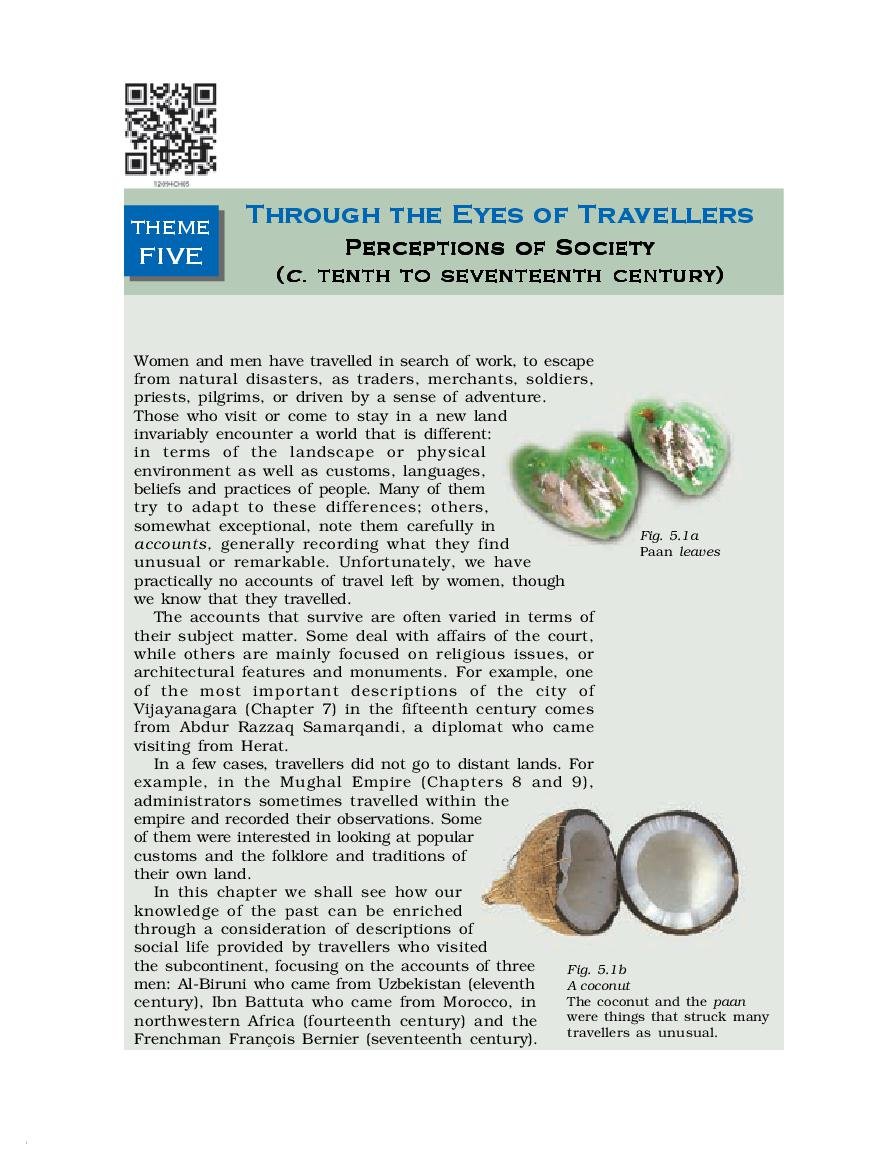
Fig. 5.1a
accounts, generally recording what they find Paan leaves
unusual or remarkable. Unfortunately, we have
practically no accounts of travel left by women, though
we know that they travelled.
The accounts that survive are often varied in terms of
their subject matter. Some deal with affairs of the court,
while others are mainly focused on religious issues, or
architectural features and monuments. For example, one
of the most important descriptions of the city of
Vijayanagara (Chapter 7) in the fifteenth century comes
from Abdur Razzaq Samarqandi, a diplomat who came
visiting from Herat.
In a few cases, travellers did not go to distant lands. For
example, in the Mughal Empire (Chapters 8 and 9),
administrators sometimes travelled within the
empire and recorded their observations. Some
of them were interested in looking at popular
customs and the folklore and traditions of
their own land.
In this chapter we shall see how our
knowledge of the past can be enriched
through a consideration of descriptions of
social life provided by travellers who visited
the subcontinent, focusing on the accounts of three Fig. 5.1b
men: Al-Biruni who came from Uzbekistan (eleventh A coconut
century), Ibn Battuta who came from Morocco, in The coconut and the paan
northwestern Africa (fourteenth century) and the were things that struck many
travellers as unusual.
Frenchman François Bernier (seventeenth century).
Showing the first page only. Download the PDF above for the complete document.
Document Details
| Board / Org | NCERT |
| Exam | Class 12 |
| Type | Books |
| Pages | 25 |
| Updated | 29 Aug 2026 |