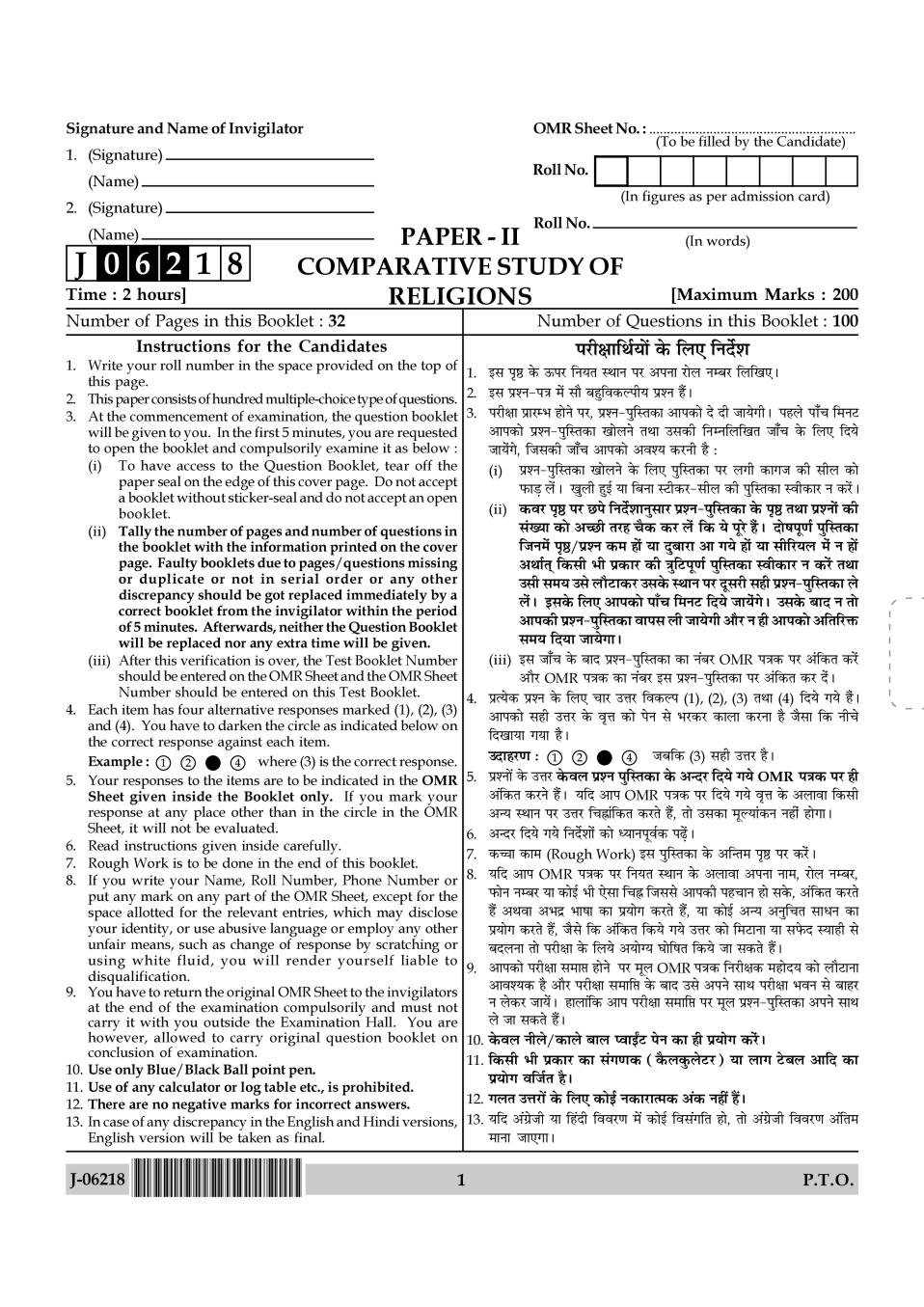
UGC NET Comparative Study of Religions Question Paper 2018
Finished viewing? Save it for later —
Download UGC NET Comparative Study of Religions Question Paper 2018 (PDF · 32 pages)About UGC NET Comparative Study of Religions Question Paper 2018
UGC NET Comparative Study of Religions Question Paper 2018 is available here for free download. Published by NTA for UGC National Eligibility Test, this question paper can be viewed online or downloaded as a PDF (32 pages). Candidates preparing for UGC National Eligibility Test can use UGC NET Comparative Study of Religions Question Paper 2018 to understand the exam pattern, the type of questions asked, and the overall difficulty level.
Frequently Asked Questions
How can I download UGC NET Comparative Study of Religions Question Paper 2018?
Open this page and click the Download button to save UGC NET Comparative Study of Religions Question Paper 2018 as a PDF. It is completely free on AglaSem Docs.
Is UGC NET Comparative Study of Religions Question Paper 2018 free to download?
Yes. UGC NET Comparative Study of Religions Question Paper 2018 can be viewed online and downloaded as a PDF free of cost on AglaSem Docs.
How many pages does UGC NET Comparative Study of Religions Question Paper 2018 have?
UGC NET Comparative Study of Religions Question Paper 2018 contains 32 pages, which you can read online or download together as a single PDF.
Where can I find more UGC National Eligibility Test study material?
You can find more UGC National Eligibility Test question papers, sample papers, syllabus, and answer keys on AglaSem Docs.
UGC NET Comparative Study of Religions Question Paper 2018 – Text
Read the full text of this question paper below — useful to quickly search, copy and reference the content online without downloading the PDF.
📄 View text version (32 pages)
Page 1
(To be filled by the Candidate)
1. (Signature)
Roll No.
(Name)
(In figures as per admission card)
2. (Signature)
Roll No.
(Name) PAPER - II (In words)
J 0 6 2 1 8 COMPARATIVE STUDY OF
Time : 2 hours] RELIGIONS [Maximum Marks : 200
Number of Pages in this Booklet : 32 Number of Questions in this Booklet : 100
Instructions for the Candidates ¬⁄UˡÊÊÁÕ¸ÿÙ¢ ∑§ Á‹∞ ÁŸŒ¸‡Ê
1. Write your roll number in the space provided on the top of
1. ß‚ ¬ÎDU ∑§ ™§¬⁄U ÁŸÿà SÕÊŸ ¬⁄U •¬ŸÊ ⁄UÙ‹U Ÿê’⁄U Á‹Áπ∞–
this page.
2. This paper consists of hundred multiple-choice type of questions. 2. ß‚ ¬˝‡Ÿ-¬òÊ ◊¢ ‚ÊÒ ’„ÈÁfl∑§À¬Ëÿ ¬˝‡Ÿ „Ò¥–
3. At the commencement of examination, the question booklet 3. ¬⁄UˡÊÊ ¬˝Ê⁄êU÷ „ÙŸ ¬⁄U, ¬˝‡Ÿ-¬ÈÁSÃ∑§Ê •Ê¬∑§Ù Œ ŒË ¡ÊÿªË– ¬„‹U ¬UÊ°ø Á◊Ÿ≈U
will be given to you. In the first 5 minutes, you are requested •Ê¬∑§Ù ¬˝‡Ÿ-¬ÈÁSÃ∑§Ê πÙ‹Ÿ ÃÕÊ ©‚∑§Ë ÁŸêŸÁ‹Áπà ¡Ê°ø ∑§ Á‹∞ ÁŒÿ
to open the booklet and compulsorily examine it as below : ¡Êÿ¢ª, Á¡‚∑§Ë ¡Ê°ø •Ê¬∑§Ù •fl‡ÿ ∑§⁄UŸË „Ò —
(i) To have access to the Question Booklet, tear off the (i) ¬˝‡Ÿ-¬ÈÁSÃ∑§Ê πÙ‹Ÿ ∑§ Á‹∞ ¬ÈÁSÃ∑§Ê ¬⁄U ‹ªË ∑§Êª¡ ∑§Ë ‚Ë‹ ∑§Ê
paper seal on the edge of this cover page. Do not accept
a booklet without sticker-seal and do not accept an open
»§Ê«∏ ‹¢U– πÈ‹Ë „È߸ ÿÊ Á’ŸÊ S≈UË∑§⁄U-‚Ë‹U ∑§Ë ¬ÈÁSÃ∑§Ê SflË∑§Ê⁄U Ÿ ∑§⁄¢U–
booklet. (ii) ∑§fl⁄U ¬ÎDU ¬⁄U ¿U¬ ÁŸŒ¸‡ÊÊŸÈ‚Ê⁄U ¬˝‡Ÿ-¬ÈÁSÃ∑§Ê ∑§ ¬ÎDU ÃÕÊ ¬˝‡ŸÙ¢ ∑§Ë
(ii) Tally the number of pages and number of questions in ‚¢ÅÿÊ ∑§Ù •ë¿UË Ã⁄U„ øÒ∑§ ∑§⁄U ‹¢U Á∑§ ÿ ¬Í⁄U „Ò¢U– ŒÙ·¬Íáʸ ¬ÈÁSÃ∑§Ê
the booklet with the information printed on the cover Á¡Ÿ◊¢ ¬ÎDU/¬˝‡Ÿ ∑§◊ „Ù¢ ÿÊ ŒÈ’Ê⁄UÊ •Ê ªÿ „Ù¢ ÿÊ ‚ËÁ⁄Uÿ‹U ◊¢ Ÿ „Ù¢
page. Faulty booklets due to pages/questions missing •ÕʸØ Á∑§‚Ë ÷Ë ¬˝∑§Ê⁄U ∑§Ë òÊÈÁ≈U¬Íáʸ ¬ÈÁSÃ∑§Ê SflË∑§Ê⁄U Ÿ ∑§⁄¢U ÃÕÊ
or duplicate or not in serial order or any other ©‚Ë ‚◊ÿ ©‚ ‹Uı≈UÊ∑§⁄U ©‚∑§ SÕÊŸ ¬⁄U ŒÍ‚⁄UË ‚„Ë ¬˝‡Ÿ-¬ÈÁSÃ∑§Ê ‹
discrepancy should be got replaced immediately by a
‹¢– U ß‚∑§ Á‹∞ •Ê¬∑§Ù ¬Ê°ø Á◊Ÿ≈U ÁŒÿ ¡Êÿ¢ª– ©‚∑§ ’ÊŒ Ÿ ÃÙ
correct booklet from the invigilator within the period
of 5 minutes. Afterwards, neither the Question Booklet •Ê¬∑§Ë ¬˝‡Ÿ-¬ÈÁSÃ∑§Ê flʬ‚ ‹Ë ¡ÊÿªË •ı⁄U Ÿ „Ë •Ê¬∑§Ù •ÁÃÁ⁄UQ§
will be replaced nor any extra time will be given. ‚◊ÿ ÁŒÿÊ ¡ÊÿªÊ–
(iii) After this verification is over, the Test Booklet Number (iii) ß‚ ¡Ê°ø ∑§ ’ÊŒ ¬˝‡Ÿ-¬ÈÁSÃ∑§Ê ∑§Ê Ÿ¥’⁄U OMR ¬òÊ∑§ ¬⁄U •¢Á∑§Ã ∑§⁄¢U
should be entered on the OMR Sheet and the OMR Sheet •Uı⁄U OMR ¬òÊ∑§ ∑§Ê Ÿ¥’⁄U ß‚ ¬˝‡Ÿ-¬ÈÁSÃ∑§Ê ¬⁄U •¢Á∑§Ã ∑§⁄U Œ¢–
Number should be entered on this Test Booklet. 4. ¬˝àÿ∑§ ¬˝‡Ÿ ∑§ Á‹∞ øÊ⁄U ©ûÊ⁄U Áfl∑§À¬ (1), (2), (3) ÃÕÊ (4) ÁŒÿ ªÿ „Ò¢–
4. Each item has four alternative responses marked (1), (2), (3)
and (4). You have to darken the circle as indicated below on
•Ê¬∑§Ù ‚„Ë ©ûÊ⁄U ∑§ flÎûÊ ∑§Ù ¬Ÿ ‚ ÷⁄U∑§⁄U ∑§Ê‹Ê ∑§⁄UŸÊ „Ò ¡Ò‚Ê Á∑§ ŸËø
the correct response against each item. ÁŒπÊÿÊ ªÿÊ „Ò–
Example : where (3) is the correct response. ©ŒÊ„⁄UáÊ — ¡’Á∑§ (3) ‚„Ë ©ûÊ⁄U „Ò–
5. Your responses to the items are to be indicated in the OMR 5. ¬˝ ‡ ŸÊ¥ ∑§ ©ûÊ⁄U ∑ §fl‹ ¬˝‡Ÿ ¬ÈÁSÃ∑§Ê ∑§ •ãŒ⁄U ÁŒÿ ªÿ OMRU ¬òÊ∑§ ¬⁄U „Ë
Sheet given inside the Booklet only. If you mark your •¥ Á∑§Ã ∑§⁄UŸ „Ò¥– ÿÁŒ •Ê¬ OMR U ¬òÊ∑§ ¬⁄U ÁŒÿ ªÿ flÎûÊ ∑§ •‹ÊflÊ Á∑§‚Ë
response at any place other than in the circle in the OMR •ãÿ SÕÊŸ ¬⁄U ©ûÊ⁄U ÁøqÊ¢Á∑§Ã ∑§⁄Uà „Ò¥, ÃÙ ©‚∑§Ê ◊ÍÀUÿÊ¢∑§Ÿ Ÿ„Ë¢ „٪ʖ
Sheet, it will not be evaluated. 6. •ãŒ⁄U ÁŒÿ ªÿ ÁŸŒ¸‡ÊÙ¢ ∑§Ù äÿÊŸ¬Ífl¸∑§ ¬…∏¢U–
6. Read instructions given inside carefully.
7. ∑§ìÊÊ ∑§Ê◊ (Rough Work) ß‚ ¬ÈÁSÃ∑§Ê ∑§ •ÁãÃ◊ ¬ÎDU ¬⁄U ∑§⁄¢U–
7. Rough Work is to be done in the end of this booklet.
8. If you write your Name, Roll Number, Phone Number or 8. ÿÁŒ •Ê¬ OMR ¬òÊ∑§ ¬⁄U ÁŸÿà SÕÊŸ ∑§ •‹ÊflÊ •¬ŸÊ ŸÊ◊, ⁄UÊ‹ Ÿê’⁄U,
put any mark on any part of the OMR Sheet, except for the »§ÊŸ Ÿê’⁄U ÿÊ ∑§Ê߸ ÷Ë ∞‚Ê Áøq Á¡‚‚ •Ê¬∑§Ë ¬„øÊŸ „Ê ‚∑§, •¥Á∑§Ã ∑§⁄UÃ
space allotted for the relevant entries, which may disclose „Ò¥ •ÕflÊ •÷Œ˝ ÷Ê·Ê ∑§Ê ¬˝ÿʪ ∑§⁄Uà „Ò¥, ÿÊ ∑§Ê߸ •ãÿ •ŸÈÁøà ‚ÊœŸ ∑§Ê
your identity, or use abusive language or employ any other ¬˝ÿʪ ∑§⁄Uà „Ò¥, ¡Ò‚ Á∑§ •¥Á∑§Ã Á∑§ÿ ªÿ ©ûÊ⁄U ∑§Ê Á◊≈UÊŸÊ ÿÊ ‚»§Œ SÿÊ„Ë ‚
unfair means, such as change of response by scratching or ’Œ‹ŸÊ ÃÊ ¬⁄UˡÊÊ ∑§ Á‹ÿ •ÿÊÇÿ ÉÊÊÁ·Ã Á∑§ÿ ¡Ê ‚∑§Ã „Ò¥–
using white fluid, you will render yourself liable to
9. •Ê¬∑§Ù ¬⁄UˡÊÊ ‚◊Ê# „ÙŸ §¬⁄U ◊Í‹ OMR ¬òÊ∑§ ÁŸ⁄UˡÊ∑§ ◊„ÙŒÿ ∑§Ù ‹Uı≈UÊŸÊ
disqualification.
9. You have to return the original OMR Sheet to the invigilators •Êfl‡ÿ∑§ „Ò •ı⁄U ¬⁄UˡÊÊ ‚◊ÊÁ# ∑§ ’ÊŒ ©‚ •¬Ÿ ‚ÊÕ ¬⁄UˡÊÊ ÷flŸ ‚ ’Ê„⁄U
at the end of the examination compulsorily and must not Ÿ ‹∑§⁄U ¡Êÿ¢– „Ê‹Ê¥Á∑§ •Ê¬ ¬⁄UˡÊÊ ‚◊ÊÁ# ¬⁄U ◊Í‹ ¬˝‡Ÿ-¬ÈÁSÃ∑§Ê •¬Ÿ ‚ÊÕ
carry it with you outside the Examination Hall. You are ‹ ¡Ê ‚∑§Ã „Ò¥–
however, allowed to carry original question booklet on 10. ∑§fl‹ ŸË‹/∑§Ê‹ ’Ê‹U åflÊßZ≈U ¬Ÿ ∑§Ê „Ë ¬˝ÿʪ ∑§⁄¢U–
conclusion of examination.
11. Á∑§‚Ë ÷Ë ¬˝∑§Ê⁄U ∑§Ê ‚¢ªáÊ∑§ (∑Ò§‹∑ȧ‹≈U⁄U) UÿÊ ‹Êª ≈U’‹ •ÊÁŒ ∑§Ê
10. Use only Blue/Black Ball point pen.
11. Use of any calculator or log table etc., is prohibited.
¬˝ÿÙª flÁ¡¸Ã „Ò–
12. There are no negative marks for incorrect answers. 12. ª‹Ã ©ûÊ⁄UÊ¥ ∑§ Á‹∞ ∑§Ê߸ Ÿ∑§Ê⁄UÊà◊∑§ •¥∑§ Ÿ„Ë¥ „Ò¥–
13. In case of any discrepancy in the English and Hindi versions, 13. ÿÁŒ •¥ª˝¡Ë ÿÊ Á„¥ŒË Áflfl⁄UáÊ ◊¥ ∑§Ê߸ Áfl‚¥ªÁà „Ê, ÃÊ •¥ª˝¡Ë Áflfl⁄UáÊ •¥ÁÃ◊
English version will be taken as final. ◊ÊŸÊ ¡Ê∞ªÊ–
J-06218 !J-06218-PAPER-II! 1 P.T.O.
Page 2
PAPER - II
Note : This paper contains hundred (100) objective type questions of two (2) marks each. All
questions are compulsory.
1. The literal meaning of word ‘Religion’ is :
(1) Service of mankind (2) Entry into Heaven
(3) Worship of ancestors (4) To re-connect
2. Animism is a belief in :
(1) Oneness of God (2) Spirit in every object
(3) Black magic (4) Evil spirits
3. Who expounded the idea of Totemism ?
(1) William James (2) James Frazer
(3) Edward Tylor (4) Sigmund Freud
4. The book ‘‘Idea of the Holy’’ is authored by :
(1) Max Weber (2) William James (3) Joachim Wach (4) Rudolf Otto
5. Tick out the wrong statement :
(1) Devotion is an essential feature of Religion.
(2) Religion is based only upon Reason.
(3) Religion deals with good and evil.
(4) Religion comprises Sacraments.
6. Who among the followers is considered the founder of comparative study of religion ?
(1) John Hick (2) Max Weber (3) Max Muller (4) St. Augustine
J-06218 !J-06218-PAPER-II! 2 Paper-II
Page 3
¬˝‡Ÿ-¬òÊ - II
ÁŸŒ¸‡Ê — ß‚ ¬˝‡Ÿ-¬òÊ ◊¥ ‚ÊÒ (100) ’„È-Áfl∑§À¬UËÿ ¬˝‡Ÿ „Ò¥– ¬˝àÿ∑§ ¬˝‡Ÿ ∑§ ŒÙ (2) •¢∑§ „Ò¥– ‚÷Ë ¬˝‡Ÿ •ÁŸflÊÿ¸ „Ò¥–
1. “Á⁄U‹Ë¡Ÿ” ‡ÊéŒ ∑§Ê ‡ÊÊÁéŒ∑§ •Õ¸ „Ò —
(1) ◊ÊŸfl ¡ÊÁà ∑§Ë ‚flÊ (2) Sflª¸ ◊¥ ¬˝fl‡Ê
(3) Á¬ÃÎ¬Í¡Ê (4) ¬ÈŸ—¡È«∏ŸÊ
2. ¡ËflÊà◊Ê ∑§Ê Áfl‡flÊ‚ „Ò, ß‚◊¥ —
(1) ߸‡fl⁄U ∑§Ê ∞Äÿ (2) „⁄U flSÃÈ ◊¥ •Êà◊Ê
(3) ∑§Ê‹Ê ¡ÊŒÍ (4) ŒÈc≈U •Êà◊Êÿ¥
3. ≈UÊ≈UÁ◊í◊ ∑§ Á‚hÊãà ∑§Ê √ÿÊÅÿÊ∑§Ê⁄U ∑§ÊÒŸ „Ò?
(1) ÁflÁ‹ÿ◊ ¡ê‚ (2) ¡ê‚ »˝§¡⁄U
(3) ∞«Ufl«¸U ≈U‹⁄U (4) Á‚ª◊¥«U »˝§Êÿ«U
4. “•ÊßÁ«UÿÊ •ÊÚ»§ Œ „Ê‹Ë” ¬ÈSÃ∑§ ∑§Ê ‹π∑§ „Ò —
(1) ◊ÒÄ‚ fl’⁄U (2) ÁflÁ‹ÿ◊ ¡ê‚ (3) íÿÊ∑§◊ flÊ∑§ (4) L§«UÊÀ»§ •Ê≈UÊ
5. ª‹Ã ∑§ÕŸ ∑§Ê ÁøÁã„à ∑§ËÁ¡∞ —
(1) üÊhÊ œ◊¸ ∑§Ê •Êfl‡ÿ∑§ ‹ˇÊáÊ „Ò–
(2) œ◊¸ ∑§fl‹ Ã∑¸§ ¬⁄U •ÊœÊÁ⁄Uà „Ò–
(3) œ◊¸ •ë¿UÊ߸ •ÊÒ⁄U ’È⁄UÊ߸ ‚ ‚¥’¥ÁœÃ „Ò–
(4) œ◊¸ ◊¥ ‚¥S∑§Ê⁄U ‚Áê◊Á‹Ã „Ò–
6. ÁŸêŸÁ‹Áπà ◊¥ ‚ ∑§ÊÒŸ œ◊¸ ∑§ ÃÈ‹ŸÊà◊∑§ •äÿÿŸ ∑§ ‚¥SÕʬ∑§ ∑§ M§¬ ◊¥ ¡ÊŸÊ ¡ÊÃÊ „Ò?
(1) ¡ÊÚŸ Á„∑§ (2) ◊ÒÄ‚ fl’⁄U (3) ◊ÒÄ‚ ◊Í‹⁄U (4) ‚¥≈U •ÊªS≈UÊߟ
J-06218 !J-06218-PAPER-II! 3 Paper-II
Page 4
List - A List - B
(a) E.B. Tylor (i) The varieties of Religious Experience
(b) William James (ii) The clash between civilizations
(c) Samuel Huntington (iii) Towards a Theology of World Religions
(d) W. Cantwell Smith (iv) Primitive Culture
Code :
(a) (b) (c) (d)
(1) (iv) (ii) (i) (iii)
(2) (i) (iii) (iv) (ii)
(3) (ii) (i) (iii) (iv)
(4) (iv) (i) (ii) (iii)
8. Match the List - A with List - B and identify the correct code :
List - A List - B
(a) Judaism (i) Spenta Mainyu
(b) Zoroasteriamism (ii) Sabath
(c) Islam (iii) Messiah
(d) Christianity (iv) Sawm
Code :
(a) (b) (c) (d)
(1) (iv) (iii) (i) (ii)
(2) (i) (iii) (ii) (iv)
(3) (ii) (i) (iv) (iii)
(4) (iii) (iv) (i) (ii)
9. Identify the incorrect statement from the following :
(1) Indology is concerned with the studies on Indian Tradition.
(2) Indology deals with the studies on ancient Indian Literature.
(3) Indology conducts studies on Indian Culture.
(4) Indology deals with the preaching of Indian Religions.
J-06218 !J-06218-PAPER-II! 4 Paper-II
Page 5
‚ÍøË - A ‚ÍøË - B
(a) ߸.’Ë. ≈U‹⁄U (i) Œ flÒ⁄UÊÿ≈UË¡ •ÊÚ»§ Á⁄U‹ËÁ¡ÿ‚ ∞Ä‚¬ËÁ⁄Uÿã‚
(b) ÁflÁ‹ÿ◊ ¡ê‚ (ii) Œ Ä‹Ò‡Ê Á’≈UflËŸ Á‚Áfl‹Êß¡‡Êã‚
(c) ‚Ò◊È•‹ „¥Á≈¥UÇ≈UŸ (iii) ≈ÍUflÊ«˜¸U‚ ∞ ÁÕÿÊ‹ÊÚ¡Ë •ÊÚ»§ flÀ«¸U Á⁄U‹Ë¡ã‚
(d) «UéÀÿÍ. ∑§Êã≈Ufl‹ ÁS◊Õ (iv) Á¬˝Á◊Á≈Ufl ∑§Àø⁄U
∑ͧ≈U —
(a) (b) (c) (d)
(1) (iv) (ii) (i) (iii)
(2) (i) (iii) (iv) (ii)
(3) (ii) (i) (iii) (iv)
(4) (iv) (i) (ii) (iii)
8. ‚ÍøË - A ∑§Ê ‚ÍøË - B ∑§ ‚ÊÕ ‚È◊Á‹Ã ∑§⁄¥U •ÊÒ⁄U ‚„Ë ∑ͧ≈U ∑§Ê ÁøÁã„à ∑§⁄¥U —
‚ÍøË - A ‚ÍøË - B
(a) ÿ„ÍŒË ◊à (i) S¬ã≈UÊ ◊ãÿÍ
(b) ¬Ê⁄U‚Ë ◊à (ii) ‚’Õ
(c) ßS‹Ê◊ (iii) ◊‚Ë„Ê
(d) ߸‚Ê߸ ◊à (iv) ‚ÊÒ◊
∑ͧ≈U —
(a) (b) (c) (d)
(1) (iv) (iii) (i) (ii)
(2) (i) (iii) (ii) (iv)
(3) (ii) (i) (iv) (iii)
(4) (iii) (iv) (i) (ii)
9. ÁŸêŸÁ‹Áπà ◊¥ ‚ •‚àÿ ∑§ÕŸ ∑§Ê ÁøÁã„à ∑§ËÁ¡∞ —
(1) ÷Ê⁄UÃËÿ ¬˝Êëÿ ÁfllÊ (ßá«UÊ‹ÊÚ¡Ë) ÷Ê⁄UÃËÿ ¬⁄¥U¬⁄UÊ ∑§ •äÿÿŸ ‚ ‚¥’¥ÁœÃ „Ò–
(2) ÷Ê⁄UÃËÿ ¬˝Êëÿ ÁfllÊ (ßá«UÊ‹ÊÚ¡Ë) ¬˝ÊøËŸ ÷Ê⁄UÃËÿ ‚ÊÁ„àÿ ∑§ •äÿÿŸ ‚ ‚¥’¥ÁœÃ „Ò–
(3) ÷Ê⁄UÃËÿ ¬˝Êëÿ ÁfllÊ (ßá«UÊ‹ÊÚ¡Ë) ÷Ê⁄UÃËÿ ‚¥S∑ΧÁà ¬⁄U •äÿÿŸ ∑§⁄UÃË „Ò–
(4) ÷Ê⁄UÃËÿ ¬˝Êëÿ ÁfllÊ ÷Ê⁄UÃËÿ œ◊¸ ∑§ ¬˝øÊ⁄U ‚ ‚¥’¥ÁœÃ „Ò–
J-06218 !J-06218-PAPER-II! 5 Paper-II
Page 6
List - A List - B
(a) Animism (i) Belief in one God
(b) Henotheism (ii) Belief in multiple gods
(c) Polytheism (iii) Belief in spirit in all objects
(d) Monotheism (iv) Worship of one God with the other gods
Code :
(a) (b) (c) (d)
(1) (ii) (i) (iv) (iii)
(2) (iv) (iii) (i) (ii)
(3) (iii) (ii) (iv) (i)
(4) (i) (iv) (iii) (ii)
11. This is the first and most ancient scripture among the Ved-Sahitas :
(1) SÂmaVeda (2) AtharvaVeda (3) YajurVeda (4) RigVeda
12. The Vedas were revealed in hearts of :
(1) Munis (2) Àcharyas (3) Rishis (4) Angels
13. ‘‘Vasudhaiva Kutumbakam’’ is the declaration of :
(1) Muslim culture (2) Vedic culture (3) Bahai culture (4) Communism
14. Shatpath Brahman is the main source Scripture of :
(1) Mathematics (2) Sociology (3) Ethics (4) Rituals
15. Following scripture is the main part of Vedanga literature :
(1) Grammar (2) Àranyaka (3) Upanishad (4) Manu-smriti
16. The proper motto of Government of India-‘‘Satyameva Jayate’’ is quoted in :
(1) Upanishad - literature (2) Smriti - literature
(3) Purana - literature (4) Vedanga - literature
J-06218 !J-06218-PAPER-II! 6 Paper-II
Page 7
‚ÍøË - A ‚ÍøË - B
(a) ¡ËflÊà◊ÊflÊŒ (∞ŸË◊Ëí◊) (i) ∞∑§ ߸‡fl⁄U ◊¥ Áfl‡flÊ‚
(b) ∞∑Ò§∑§ÊÁœŒflflÊŒ („ÒŸÊÕËí◊) (ii) •Ÿ∑§ ŒflÊ¥ ◊¥ Áfl‡flÊ‚
(c) ’„ÈŒflflÊŒ (¬Ê‹ËÕËí◊) (iii) „⁄U flSÃÈ ◊¥ •Êà◊Ê ∑§Ê Áfl‡flÊ‚
(d) ∞∑§‡fl⁄UflÊŒ (◊ÊŸÊÕËí◊) (iv) ∞∑§ ߸‡fl⁄U ∑§ ‚ÊÕ •ãÿ ߸‡fl⁄UÊ¥ ∑§Ë ¬Í¡Ê
∑ͧ≈U —
(a) (b) (c) (d)
(1) (ii) (i) (iv) (iii)
(2) (iv) (iii) (i) (ii)
(3) (iii) (ii) (iv) (i)
(4) (i) (iv) (iii) (ii)
11. flŒ ‚¥Á„ÃÊ•Ê¥ ◊¥ ÿ„ ¬˝Õ◊ ∞fl¥ ¬˝ÊøËŸÃ◊ ª˝ãÕ „Ò —
(1) ‚Ê◊flŒ (2) •Õfl¸flŒ (3) ÿ¡Èfl¸Œ (4) ´§ÇflŒ
12. flŒ ߟ∑§ NŒÿÊ¥ ◊¥ •ÊÁfl÷͸à „È∞ —
(1) ◊ÈÁŸÿÊ¥ (2) •ÊøÊÿÊZ (3) ´§Á·ÿÊ¥ (4) ŒflŒÍÃÊ¥
13. ““fl‚ÈœÒfl ∑ȧ≈ÈUê’∑§◊˜”” ß‚∑§Ê ©Œ˜ÉÊÊ· „Ò —
(1) ◊ÈÁS‹◊ ‚¥S∑ΧÁà (2) flÒÁŒ∑§ ‚¥S∑ΧÁà (3) ’„Ê߸ ‚¥S∑ΧÁà (4) ‚ÊêÿflÊŒ
14. ‡ÊÃ¬Õ ’˝ÊrÊáÊ ß‚ ‡ÊÊSòÊ ∑§Ê ¬˝◊Èπ dÊà ª˝ãÕ „Ò —
(1) ªÁáÊà ‡ÊÊSòÊ (2) ‚◊Ê¡ ‡ÊÊSòÊ (3) •ÊøÊ⁄U ‡ÊÊSòÊ (4) ∑§◊¸∑§Êá«U ‡ÊÊSòÊ
15. •œÊÁ‹Áπà ª˝ãÕ flŒÊX ‚ÊÁ„àÿ ∑§Ê ¬˝◊Èπ •X „Ò —
(1) √ÿÊ∑§⁄UáÊ (2) •Ê⁄áÿ∑§ (3) ©¬ÁŸ·Œ˜ (4) ◊ŸÈS◊ÎÁÃ
16. ÷Ê⁄Uà ‚⁄U∑§Ê⁄U ∑§Ê äÿÿ flÊÄÿ ““‚àÿ◊fl ¡ÿÔ” ß‚ flÊ昧◊ÿ ‚ ©Œ˜œÎà „Ò —
(1) ©¬ÁŸ·Œ˜ flÊ昧◊ÿ (2) S◊ÎÁà flÊ昧◊ÿ
(3) ¬È⁄UÊáÊ flÊ昧◊ÿ (4) flŒÊX flÊ昧◊ÿ
J-06218 !J-06218-PAPER-II! 7 Paper-II
Page 8
(1) Moral teachings (2) Spiritualism
(3) Communism (4) Shaivism
18. The propounder of yoga-philosophy is :
(1) Kapila (2) Kanada (3) Patanjali (4) Panini
19. According to SÂnkhya-philosophy the pramanas are :
(1) Three (2) Four (3) Six (4) Eight
20. The Author of Manu-smriti is :
(1) Manavadeva (2) Manavendra (3) Maharshi Manu (4) Mandhata
21. Following is known as ‘‘Àdi Kavi’’ in Sanskrit language :
(1) Dandi (2) Harsha (3) VÂlmiki (4) KalidÂs
22. MÂ NishÂda Pratishtham Tvamagamah Shashwati Samah.
Yatkrouncha Mithunadekamavadhih KÂmamohitam.
was uttered firstly by following Author :
(1) KabirdÂs (2) SuradÂs (3) Valmiki (4) Bharavi
23. The number of Puranas is :
(1) Fifteen (2) Seventeen (3) Eighteen (4) Twenty
24. ‘‘Karmanyevadhikaraste Maa Phaleshu Kadachana,’’ this famous concept of Bhagavat gita,
indicates the message of :
(1) Right to consume (2) Right to get education
(3) Right to work (4) Right to get justice
25. The Movement of Raja Ram Mohan Rai was :
(1) Eradication of Polygamy (2) Propagation of Durga puja
(3) Eradication of Sati custom (4) Propagation of Gurukul education
J-06218 !J-06218-PAPER-II! 8 Paper-II
Page 9
(1) ŸÒÁÃ∑§ Á‡ÊˇÊÊ (2) •ÊäÿÊà◊
(3) ‚ÊêÿflÊŒ (4) ‡ÊÒfl
18. ÿʪ Œ‡Ê¸Ÿ ∑§ ¬˝áÊÃÊ „Ò¥ —
(1) ∑§Á¬‹ (2) ∑§áÊÊŒ (3) ¬ÃÜ¡Á‹ (4) ¬ÊÁáÊÁŸ
19. ‚Ê¥Åÿ-Œ‡Ê¸Ÿ ∑§ •ŸÈ‚Ê⁄U ¬˝◊ÊáÊ „¥Ò —
(1) ÃËŸ (2) øÊ⁄U (3) ¿ÒU (4) •Ê∆U
20. ◊ŸÈS◊ÎÁà ∑§ ¬˝áÊÃÊ „Ò¥ —
(1) ◊ÊŸflŒfl (2) ◊ÊŸflãŒ˝ (3) ◊„Á·¸ ◊ŸÈ (4) ◊ÊãœÊÃÊ
21. ÁŸêŸÊŒ˜œÎà ‚¥S∑Χà ÷Ê·Ê ∑§ ““•ÊÁŒ ∑§Áfl”” ∑§ M§¬ ◊¥ ¬˝Á‚h „Ò —
(1) Œá«UË (2) „·¸ (3) flÊÀ◊ËÁ∑§ (4) ∑§ÊÁ‹ŒÊ‚
22. ◊Ê ÁŸ·ÊŒ ¬˝ÁÃc∆UÊ¥ àfl◊ª◊— ‡ÊʇflÃË ‚◊Ê—–
ÿà∑˝§ÊÒÜø Á◊ÕÈŸÊŒ∑§◊flœË— ∑§Ê◊◊ÊÁ„Ã◊˜––
∞‚Ê ¬˝Õ◊ ’Ê⁄U ÁŸêŸÊÁVà ¬˝áÊÃÊ ∑§ mÊ⁄UÊ Á∑§ÿÊ ªÿÊ ÕÊ —
(1) ∑§’Ë⁄UŒÊ‚ (2) ‚Í⁄UŒÊ‚ (3) flÊÀ◊ËÁ∑§ (4) ÷Ê⁄UÁfl
23. ¬È⁄UÊáÊÊ¥ ∑§Ë ‚¥ÅÿÊ „Ò —
(1) ¬ãŒ˝„ (2) ‚òÊ„ (3) •≈˜U∆UÊ⁄U„ (4) ’Ë‚
24. ““∑§◊¸áÿflÊÁœ∑§Ê⁄USà ◊Ê »§‹·È ∑§ŒÊøŸ”” ÷ªflŒ˜ªËÃÊ ∑§Ë ÿ„ ¬˝Á‚h •flœÊ⁄UáÊÊ ß‚ ‚ãŒ‡Ê ∑§Ë •Ê⁄U ߥÁªÃ ∑§⁄UÃË „Ò —
(1) ©¬÷ʪ ∑§Ê •Áœ∑§Ê⁄U (2) Á‡ÊˇÊÊ ¬˝ÊÁåà ∑§Ê •Áœ∑§Ê⁄U
(3) ∑§◊¸ ∑§⁄UŸ ◊¥ •Áœ∑§Ê⁄U (4) ãÿÊÿ ¬˝ÊÁåà ∑§Ê •Áœ∑§Ê⁄U
25. ⁄UÊ¡Ê ⁄UÊ◊◊Ê„Ÿ ⁄UÊÿ ∑§Ê •ÊãŒÊ‹Ÿ ÕÊ —
(1) ’„ÈÁflflÊ„ ©ã◊Í‹Ÿ (2) ŒÈªÊ¸¬Í¡Ê ∑§Ê ¬˝øÊ⁄U
(3) ‚ÃË ¬˝ÕÊ ∑§Ê ©ã◊Í‹Ÿ (4) ªÈL§∑ȧ‹ Á‡ÊˇÊÊ ∑§Ê ¬˝øÊ⁄U
J-06218 !J-06218-PAPER-II! 9 Paper-II
Page 10
(1) RÂjakumÂra PÂrïva (2) Prince Bharata
(3) RÂjakumÂra VardhamÂna (4) Prince Ariîtanemi
27. Lord MahÂvÍra obtained salvation at :
(1) Champapur i (2) Pavapuri (3) Vaishali (4) Nalanda
28. The TattvÂrthasötra was written by :
(1) UmÂswÂtÍ (2) Samantabhadra (3) PöjyapÂda (4) Haribhadrasöri
29. The ÀcÂrÂßgasötra mainly deals with :
(1) The concept of substance (2) Spiritual saying about fundamentals
(3) Vows of Householders (4) Ten types of Jain religion
30. According to ìramana tradition the last council of Jaina canons was held at Vallabhi in :
(1) Fifth century A.D. (2) Third century A.D.
(3) First century B.C. (4) Seventh century A.D.
31. ÀcÂrya NÂneïa was great Jaina monk of the sect :
(1) TerÂpantha ìwetÂmbara (2) Digambara
(3) SÂdhömÂrgi SthÂnakavÂsi (4) Mörtipöjaka ìwetÂmbara
32. ÀcÂrya Haribhadrasöri belongs to this period :
(1) 9th century A.D. (2) 4th century A.D.
(3) 8th century A.D. (4) 6th century A.D.
33. Jainism believes in :
(1) Assimilation in God (2) No life after death
(3) Resurrection of dead (4) Rebirth
34. According to Jainism ‘RÂtribhojana - Viramana’ vow is closely related to :
(1) AparigrahÂàuvrata (2) SatyÂàuvrata
(3) AcauryÂàuvrata (4) AhiØisÂàuvrata
J-06218 !J-06218-PAPER-II! 10 Paper-II
Page 11
(1) ⁄UÊ¡∑ȧ◊Ê⁄U ¬Ê‡fl¸ (2) ⁄UÊ¡∑ȧ◊Ê⁄U ÷⁄UÃ
(3) ⁄UÊ¡∑ȧ◊Ê⁄U flœ¸◊ÊŸ (4) ⁄UÊ¡∑ȧ◊Ê⁄U •Á⁄Uc≈UŸ◊Ë
27. ÷ªflÊŸ ◊„ÊflË⁄U Ÿ ÿ„Ê° ¬⁄U ◊ÊˇÊ ¬˝Êåà Á∑§ÿÊ ÕÊ —
(1) øê¬Ê¬È⁄UË (2) ¬ÊflʬÈ⁄UË (3) flÒ‡ÊÊ‹Ë (4) ŸÊ‹ãŒÊ
28. “ÃàflÊÕ¸‚ÍòÊ” ߟ∑§ mÊ⁄UÊ Á‹Áπà „Ò —
(1) ©◊ÊSflÊÁà (2) ‚◊ãÃ÷Œ˝ (3) ¬Ííÿ¬ÊŒ (4) „Á⁄÷Œ˝‚ÍÁ⁄U
29. “•ÊøÊ⁄UÊ¥ª‚ÍòÊ” ∑§Ê ¬˝◊Èπ Áfl·ÿ „Ò —
(1) Œ˝√ÿ ∑§Ë •flœÊ⁄UáÊÊ (2) ¬ŒÊÕÊZ ∑§ ‚ê’㜠◊¥ •äÿÊÁà◊∑§ ∑§ÕŸ
(3) ªÎ„SÕÊ¥ ∑§ fl˝Ã (4) ¡ÒŸ œ◊¸ ∑§ Œ‡Ê ¬˝∑§Ê⁄U
30. üÊ◊áÊ ¬⁄Uê¬⁄UÊ ∑§ •ŸÈ‚Ê⁄U ¡ÒŸ •Êª◊Ê¥ ∑§Ë •¥ÁÃ◊ flÀ‹÷Ë flÊøŸÊ ß‚ ‚◊ÿ ◊¥ „È߸ ÕË —
(1) ¬Ê°øflË ‚ŒË ߸‚flË (2) ÃÎÃËÿ ‚ŒË ߸‚flË
(3) ¬˝Õ◊ ‚ŒË ߸.¬Í. (4) ‚ÊÃflË¥ ‚ŒË ߸‚flË
31. •ÊøÊÿ¸ ŸÊŸ‡Ê ß‚ ‚ê¬˝ŒÊÿ ∑§ ◊„ÊŸ ¡ÒŸ ‚ãÃ Õ —
(1) Ã⁄UʬãÕ ‡flÃÊê’⁄U (2) ÁŒªê’⁄U
(3) ‚ÊœÍ◊ʪ˸ SÕÊŸ∑§flÊ‚Ë (4) ◊ÍÁø¬Í¡∑§ ‡flÃÊê’⁄U
32. •ÊøÊÿ¸ „Á⁄U÷Œ˝‚ÍÁ⁄U ß‚ ‚◊ÿ ∑§ ÁflmÊŸ Õ —
(1) ŸflË¥ ‚ŒË ߸‚flË (2) øÃÈÕ¸ ‚ŒË ߸‚flË
(3) •Ê∆UflË¥ ‚ŒË ߸‚flË (4) ¿U∆UË ‚ŒË ߸‚flË
33. ¡ÒŸœ◊¸ ß‚ ¬⁄U Áfl‡flÊ‚ ∑§⁄UÃÊ „Ò —
(1) ߸‡fl⁄U ◊¥ Á◊‹ ¡ÊŸÊ (2) ◊ÎàÿÈ ∑§ ’ÊŒ ¡ËflŸ Ÿ„Ë¥
(3) ◊ÎàÿÈ √ÿÁÄà ∑§Ê ¬ÈŸL§àÕÊŸ (4) ¬ÈŸ¡¸ã◊
34. ¡ÒŸœ◊¸ ∑§ •ŸÈ‚Ê⁄U “⁄UÊÁòÊ÷Ê¡Ÿ-Áfl⁄U◊áÊ” fl˝Ã ß‚ ‚ •Áœ∑§ ‚ê’ÁãœÃ „Ò —
(1) •¬Á⁄Uª˝„ÊáÊÈfl˝Ã (2) ‚àÿÊáÊÈfl˝Ã
(3) •øÊÒÿ¸ÊáÊÈfl˝Ã (4) •Á„¥‚ÊáÊÈfl˝Ã
J-06218 !J-06218-PAPER-II! 11 Paper-II
Page 12
(1) Matter (2) Medium of rest (3) Immorality (4) Medium of motion
36. Identify the correct combination :
(1) Digambar sect - Mool Saßgha
(2) Bhagawati ÀrÂdhan - Haribhadrasöri
(3) Ellora - Museum of Jaina manuscripts
(4) Tattwarthasötra - Prakrit Text
37. Main principle of Jainism - ‘Ratnatraya’ includes :
(1) Charity, worship and study
(2) Diamond, Pearl and Gold
(3) Prayer, dedication and action
(4) Right Philosophy, Right knowledge and Right conduct
38. Assertion (A) : All Tirthaßkaras of Jainism were human beings.
Reason (R) : As according to Jainism the supreme knowledge can be achieved in human
birth only.
Select the correct answer from the following Code :
(1) (A) is false and (R) is correct (2) Both (A) and (R) are false
(3) Both (A) and (R) are correct (4) (A) is correct and (R) is false
39. It is included in four kinds of charity as prescribed in Jainism :
(1) Giving clothes (2) Giving Abhaya
(3) Bathing in river (4) Visiting T irthas
40. The great function of MahÂmastakÂbhiîeka of Jaina Tradition has been performed in February
2018 at :
(1) Girnar (2) Shravanabelagola
(3) Varanasi (4) Shrimahaveerji
41. Gautama Buddha attained Bodhi at the age of :
(1) 40 years (2) 35 years (3) 30 years (4) 33 years
J-06218 !J-06218-PAPER-II! 12 Paper-II
Page 13
(1) •¡Ëfl ¬ŒÊÕ¸ (2) ∆U„⁄UŸ ∑§Ê ‚ÊœŸ (3) •ŸÒÁÃ∑§ÃÊ (4) ªÁà ∑§Ê ‚ÊœŸ
36. ‚„Ë ‚È◊Á‹Ã ∑§Ê ¬„øÊŸ —
(1) ÁŒªê’⁄U ‚ê¬˝ŒÊÿ - ◊Í‹ ‚¥ÉÊ
(2) ÷ªflÃË •Ê⁄UÊœŸÊ - „Á⁄U÷Œ˝Ê‚Í⁄UË
(3) ∞‹Ê⁄UÊ - ¡ÒŸ ¬Êá«ÈUÁ‹Á¬ÿÊ¥ ∑§Ê ‚¥ª˝„Ê‹ÿ
(4) ÃûflÊÕ¸‚ÍòÊ - ¬˝Ê∑Χà ª˝ãÕ
37. ¡ÒŸœ◊¸ ∑§ ¬˝◊Èπ Á‚hÊãà “⁄UàŸòÊÿ” ◊¥ ‚Áê◊Á‹Ã „Ò —
(1) ŒÊŸ, ¬Í¡Ê •ÊÒ⁄U •äÿÿŸ
(2) „Ë⁄UÊ, ◊ÊÃË ∞fl¥ Sfláʸ
(3) ¬˝ÊÕ¸ŸÊ, ‚◊¬¸áÊ •ÊÒ⁄U ∑§◊¸
(4) ‚êÿ∑˜§Œ‡Ê¸Ÿ, ‚êÿ∑˜§ ôÊÊŸ ∞fl¥ ‚êÿ∑˜§ øÁ⁄UòÊ
38. ∑§ÕŸ (A) : ¡ÒŸœ◊¸ ∑§ ‚÷Ë ÃËÕZ∑§⁄UU ◊ÊŸfl Õ–
∑§Ê⁄UáÊ (R) : ÄÿÊ¥Á∑§ ¡ÒŸœ◊¸ ∑§ •ŸÈ‚Ê⁄U ∑§flÀÿ ôÊÊŸ ◊ÊŸfl-¡ã◊ ◊¥ „Ë ¬˝Êåà Á∑§ÿÊ ¡Ê ‚∑§ÃÊ „Ò–
ÁŸêŸÊ¥Á∑§Ã ∑ͧ≈UÊ¥ ◊¥ ‚ ‚„Ë ©ûÊ⁄U ∑§Ê øÿŸ ∑§ËÁ¡∞ —
(1) (A) ª‹Ã „Ò •ÊÒ⁄U (R) ‚„Ë „Ò– (2) ŒÊŸÊ¥ (A) •ÊÒ⁄U (R) ª‹Ã „Ò¥–
(3) ŒÊŸÊ¥ (A) •ÊÒ⁄U (R) ‚„Ë „Ò¥– (4) (A) ‚„Ë „Ò •ÊÒ⁄U (R) ª‹Ã „Ò–
39. ¡ÒŸœ◊¸ ◊¥ SflË∑Χà øÊ⁄U ¬˝∑§Ê⁄U ∑§ ŒÊŸÊ¥ ◊¥ ‚Áê◊Á‹Ã „Ò —
(1) flSòÊ ŒÊŸ (2) •÷ÿ ŒÊŸ
(3) ŸŒË ◊¥ SŸÊŸ (4) ÃËÕ¸-Œ‡Ê¸Ÿ
40. ¡ÒŸ ¬⁄Uê¬⁄UÊ ∑§Ê ◊„Ê◊SÃ∑§ÊÁ÷·∑§ ’«∏Ê ◊„Êà‚fl »§⁄fl⁄UË 2018 ◊¥ ÿ„Ê° ¬⁄U ‚ê¬ãŸ Á∑§ÿÊ ªÿÊ „Ò —
(1) Áª⁄UŸÊ⁄U (2) üÊfláÊ’‹ªÊ‹Ê
(3) flÊ⁄UÊáÊ‚Ë (4) üÊË◊„ÊflË⁄U¡Ë
41. ªÊÒÃ◊ ’Èh Ÿ ß‚ •ÊÿÈ ◊¥ ’ÊÁœ ¬˝Êåà ∑§Ë ÕË —
(1) 40 fl·¸ (2) 35 fl·¸ (3) 30 fl·¸ (4) 33 fl·¸
J-06218 !J-06218-PAPER-II! 13 Paper-II
Page 14
(1) Nigaàtha NÂta Putta (2) KumÂrila
(3) Kundakunda (4) PatÂnjali
43. Gautama Buddha (SiddhÂrtha) was born at :
(1) VesÂli (2) Kapilavatthu (3) Savatth i (4) Lumbin i
44. The one is recognised as the first Buddha in Buddhist tradition :
(1) DÍpaßkara (2) Sobhita (3) AnomadassÍ (4) NÂrÂda
45. Buddhism was divided into two sects after the Buddhist council known as :
(1) Vattagamin i Abhaya Sang iti (2) VaishÂli Sang iti
ɺɺ
(3) PÂòaliputra Sang iti (4) RÂjgrah Sang iti
46. ‘VibhajjavÂda’ is related to the Buddhist sect known as :
(1) VijáÂnavÂda (2) SarvÂstivÂda (3) TheravÂda (4) ìönyavÂda
47. The language used in the MahÂyÂna sötra literature is :
(1) Sanskrit (2) Pali
(3) Prakrit (4) Buddist Hybrid Sanskrit
48. The fifth constituent of the Aîtaßgika Marga is :
(1) Samm SamÂdhi (2) Samm Aj ivo
(3) Samm Sati (4) Samm Saßkappo
49. The second NidÂna (Aßga) of the PaticcasamuppÂda (Prat ityasamutpada) is :
(1) VijáÂna (2) SaØskÂra (3) Avidy (4) NÂmaröpa
50. The Jetavana Vihara was located at :
(1) Vaishali (2) Koshambi (3) Rajgrah (4) Shravasti
51. Dr. B.R. Ambedkar embraced Buddhism on the date :
(1) Kartika AmÂvasy (2) Vijaya Dasham i
(3) Chaitra ìukl TriyodaïÍ (4) VaiïÂkha PöràimÂ
J-06218 !J-06218-PAPER-II! 14 Paper-II
Page 15
(1) ÁŸª¥∆U ŸÊìÈûÊ (2) ∑ȧ◊ÊÁ⁄U‹
(3) ∑ȧãŒ∑ȧ㌠(4) ¬Ã¥¡Á‹
43. ªÊÒÃ◊ ’Èh (Á‚hÊÕ¸) ∑§Ê ¡ã◊ ß‚ SÕÊŸ ¬⁄U „È•Ê ÕÊ —
(1) fl‚Ê‹Ë (2) ∑§Á¬‹flàÕÈ (3) ‚ÊflàÕË (4) ‹ÈÁê’ŸË
44. ’ÊÒh ¬⁄Uê¬⁄UÊ ◊¥ ß‚ ¬˝Õ◊ ’Èh SflË∑§Ê⁄U Á∑§ÿÊ ¡ÊÃÊ „Ò —
(1) ŒË¬¥∑§⁄U (2) ‚ÊÁ÷à (3) •ŸÊ◊ŒS‚Ë (4) ŸÊ⁄UŒ
45. ß‚ ’ÊÒh ‚¥ªËÁà ∑§ ’ÊŒ ’ÊÒh œ◊¸ ŒÊ ‚ê¬˝ŒÊÿÊ¥ ◊¥ Áfl÷Äà „Ê ªÿÊ ÕÊ —
(1) fl^ªÁ◊ŸË •÷ÿ ‚¥ªËÁà (2) flÒ‡ÊÊ‹Ë ‚¥ªËÁÃ
(3) ¬Ê≈UÁ‹¬ÈòÊ ‚¥ªËÁà (4) ⁄UÊ¡ªÎ„ ‚¥ªËÁÃ
46. “Áfl÷í¡flÊŒ” ß‚ ’ÊÒh ‚ê¬˝ŒÊÿ ‚ ‚ê’¥ÁœÃ ◊ÊŸÊ ¡ÊÃÊ „Ò —
(1) ÁflôÊÊŸflÊŒ (2) ‚flʸÁSÃflÊŒ (3) Õ⁄UflÊŒ (4) ‡ÊÈãÿflÊŒ
47. ◊„ÊÿÊŸ ‚ÍòÊ ‚ÊÁ„àÿ ∑§Ë ÷Ê·Ê ÿ„ „Ò —
(1) ‚¥S∑Χà (2) ¬ÊÁ‹
(3) ¬˝Ê∑Χà (4) ’ÊÒh ‚¥∑§⁄U ‚¥S∑ΧÃ
48. “•c_¥Áª∑§ ◊ʪ¸” ∑§Ê ¬Ê°øflÊ¥ •¥ª „Ò —
(1) ‚ê◊Ê ‚◊ÊÁœ (2) ‚ê◊Ê •Ê¡ËflÊ
(3) ‚ê◊Ê ‚Áà (4) ‚ê◊Ê ‚¥∑§å¬Ê
49. ¬Á≈ëøÊ‚◊Èå¬ÊŒ (¬˝ÃËàÿÊ‚◊Èà¬ÊŒ) ∑§Ê ŒÍ‚⁄UÊ ÁŸŒÊŸ (•¥ª) „Ò —
(1) ÁflôÊÊŸ (2) ‚¥S∑§Ê⁄U (3) •ÁfllÊ (4) ŸÊ◊M§¬
50. “¡ÃflŸ” Áfl„Ê⁄U ß‚ SÕÊŸ ¬⁄U ÁSÕà ÕÊ —
(1) flÒ‡ÊÊ‹Ë (2) ∑§Ê‡ÊÊê’Ë (3) ⁄UÊ¡ªÎ„ (4) üÊÊflSÃË
51. «UÊÚ. ’Ë.•Ê⁄U. •ê’«U∑§⁄U Ÿ ’ÊÒh œ◊¸ ß‚ ÁÃÁÕ ∑§Ê SflË∑§Ê⁄U Á∑§ÿÊ ÕÊ —
(1) ∑§ÊÁø∑§ •◊ÊflSÿÊ (2) Áfl¡ÿ Œ‡Ê◊Ë
(3) øÒòÊ ‡ÊÈÄ‹Ê ÁòÊÿÊŒ‡ÊË (4) flÒ‡ÊÊπ ¬ÍÁáʸ◊Ê
J-06218 !J-06218-PAPER-II! 15 Paper-II
Page 16
(1) Myanmar (2) China (3) Thailand (4) Bharat
53. The present biggest Buddhist Stöpa called as ‘Dikkh Bhömi Stöpa’ is located at :
(1) Mumbai (2) Nagpur
(3) Chandra Pur (4) Ambedkar Nagar (MAHUE)
54. The ancient Buddhist centre of learning in Nalanda (Bihar) was known as :
(1) NÂland Vidyapeetha (2) NÂland MahÂvihÂra
(3) Nava NÂland MahÂvihÂra (4) NÂland Viívavidyalaya
55. The ‘Mahabodhi Society of India’ was established in India by :
(1) Mahasthavira KrpÂsarana (2) AnagÂrika DharmapÂla
(3) Dalailama (4) B.R. Ambedkar
56. The famous book ‘‘City of God’’ was authored by :
(1) St. Thomas Aquinas (2) St. Augustine
(3) St. Thomas the Apostle (4) Martin Luther
57. Anglocanism represents the form of protestantism that initially flourished specifically in :
(1) Germany (2) England (3) France (4) Spain
58. The foster father of Jesus was :
(1) John the Baptist (2) Joseph (3) Peter (4) Paul
59. The word meaning of ‘‘Bible’’ is :
(1) Sacred (2) Collection of books
(3) Idol (4) Festival
60. Identify the one which belongs to Semitic religion :
(1) Buddhism (2) Hinduism (3) Christianity (4) Taoism
61. Who was Moses ?
(1) First pope (2) An Evangelist
(3) A Prophet of Old Testament (4) Disciple of Christ
J-06218 !J-06218-PAPER-II! 16 Paper-II
Page 17
(1) êÿÊ¥◊Ê⁄U (2) øËŸ (3) ÕÊ߸‹á«U (4) ÷Ê⁄UÃ
53. •ÊœÈÁŸ∑§ ‚’‚ ’«∏Ê ’ÊÒh SÃͬ Á¡‚ “ÁŒÄπÊ ÷ÍÁ◊ SÃͬ” ∑§„Ê ¡ÊÃÊ „Ò, fl„ ÁSÕà „Ò ß‚ SÕÊŸ ¬⁄U —
(1) ◊Èê’߸ (2) ŸÊª¬È⁄U
(3) øãŒ˝ ¬È⁄U (4) •ê’«U∑§⁄U Ÿª⁄U (◊„Í)
54. ŸÊ‹ãŒÊ (Á’„Ê⁄U) ◊¥ ÁSÕà ¬˝ÊøËŸ ’ÊÒh Áfl‡flÁfllÊ‹ÿ ∑§Ê ŸÊ◊ ÕÊ —
(1) ŸÊ‹ãŒÊ ÁfllʬË∆U (2) ŸÊ‹ãŒÊ ◊„ÊÁfl„Ê⁄U
(3) Ÿfl ŸÊ‹ãŒÊ ◊„ÊÁfl„Ê⁄U (4) ŸÊ‹ãŒÊ Áfl‡flÁfllÊ‹ÿ
55. ÷Ê⁄Uà ◊¥ “◊„Ê’ÊÁœ ‚Ê‚Êß≈UË •ÊÚ»§ ߥÁ«UÿÊ” ∑§Ë SÕʬŸÊ ߟ∑§ mÊ⁄UÊ „È߸ ÕË —
(1) ◊„ÊSÕÁfl⁄U ∑Χ¬Ê‚⁄UáÊ (2) •ŸªÊÁ⁄U∑§ œ◊¸¬Ê‹
(3) Œ‹Ê߸‹Ê◊Ê (4) ’Ë.•Ê⁄U. •ê’«U∑§⁄U
56. ¬˝Á‚h ¬ÈSÃ∑§ “Á‚≈UË •ÊÚ»§ ªÊÚ«U” ߟ∑§ mÊ⁄UÊ Á‹πË ªß¸ —
(1) ‚¥≈U ÕÊÚ◊‚ ∞ÄflËŸ‚ (2) ‚¥≈U •ÊªS≈UÊߟ
(3) ‚¥≈U ÕÊ◊‚ •¬Ê‚‹ (4) ◊ÊÁ≈¸UŸ ‹ÍÕ⁄U
57. •Ê¥Ç‹-øø¸flÊŒ ¬˝ÊÚÁ≈U‚˜≈¥U≈U œ◊¸ ∑§ Á¡‚ ¬˝∑§Ê⁄U ∑§Ê ¬˝SÃÈà ∑§⁄UÃÊ „Ò, ¡Ê •Ê⁄¥U÷ ◊¥ Áfl‡Ê· M§¬ ‚ ÿ„Ê° »§‹Ê-»Í§‹Ê —
(1) ¡◊¸ŸË (2) ߥNjÒá«U (3) »˝§Ê¥‚ (4) S¬Ÿ
58. ߸‚Ê ◊‚Ë„ ∑§ ¬Ê‹∑§ Á¬ÃÊ Õ —
(1) ¡ÊÚŸ ’Ò¬Á≈US≈U (2) ¡Ê‚»§ (3) ¬Ë≈U⁄U (4) ¬ÊÚ‹
59. “’Êß’‹” ∑§Ê ‡ÊéŒÊÕ¸ „Ò —
(1) ¬ÁflòÊ (2) ¬ÈSÃ∑§Ê¥ ∑§Ê ‚¥∑§‹Ÿ
(3) ◊ÍÁø (4) àÿÊ„Ê⁄U
60. ¡Ê ‚Á◊Á≈U∑§ œ◊¸ ‚ ‚¥’¥ÁœÃ „Ò ©‚ ÁøÁã„à ∑§ËÁ¡∞ —
(1) ’ÊÒh œ◊¸ (2) Á„ãŒÍ œ◊¸ (3) ߸‚Ê߸ œ◊¸ (4) ÃÊ•ÊflÊŒ
61. ◊Í‚Ê ∑§ÊÒŸ ÕÊ?
(1) ¬„‹Ê ¬Ê¬ (2) ßflÊ¥¡Á‹S≈U
(3) ¬Ífl¸ ÁflœÊŸ ∑§ ¬Òªê’⁄U (4) ߸‚Ê ◊‚Ë„ ∑§ Á‡Êcÿ
J-06218 !J-06218-PAPER-II! 17 Paper-II
Page 18
(1) St. Peter (2) St. Mathew (3) St. John (4) St. Thomas
63. Who summoned in 325 A.D, the council of Nichea, the first of the ecumenical councils ?
(1) Emperor Constantine (2) Pope Gregory
(3) St. Peter (4) Emperor Theodosius - I
64. ‘‘The Book of Psalms’’ is considered to be authored by :
(1) Moses (2) King David (3) St. John (4) St. Paul
65. Identify the correct group according to the chronological order of the Biblical persons :
(1) Abraham, Isaac, Jacob, Jesus Christ
(2) Jesus Christ, Abraham, Isaac, Jacob
(3) Isaac, Jacob, Jesus Christ, Abraham
(4) Jacob, Jesus Christ, Isaac, Abraham
66. Martin Luther is considered to be :
(1) Official beginner of Protestant Reformation
(2) A Saint of Catholic Church
(3) A Prophet of Old Testament
(4) A Prophet of New Testament
67. Which place among the following is not related to the life and works of Jesus Christ ?
(1) Galilee (2) Samaria (3) Judea (4) Greece
68. Who among the following recognize the books of the Old Testament as the official texts of their
belief ?
(1) The jews and Hindus (2) Jews and Christians
(3) Christians and Jains (4) Christians and Zoroastrians
J-06218 !J-06218-PAPER-II! 18 Paper-II
Page 19
(1) ‚¥≈U ¬Ë≈U⁄U (2) ‚¥≈U ◊ÒâÿÍ (3) ‚¥≈U ¡ÊÚŸ (4) ‚¥≈U ÕÊÚ◊‚
63. 325 ߸‚flË ◊¥ ÁŸ∑§„Ê Áfl‡fl œ◊¸ ¬Á⁄U·Œ ∑§ ∑§ÊÒŸ •äÿˇÊ Õ, ¡Ê Áfl‡fl ∑§Ë ¬˝Õ◊ œ◊¸ ¬Á⁄U·Œ ÕË —
(1) ‚◊˝Ê≈U ∑§ÊSÃÈŸÁß (2) ¬Ê¬ Áª˝ªÊ⁄UË
(3) ‚¥≈U ¬Ë≈U⁄U (4) ‚◊˝Ê≈U ÁÕÿÊ«UÊÁ‚‚ - I
64. ““Œ ’È∑§ •ÊÚ»§ ‚Êê‚ (œ◊¸ ªËà ∑§Ë ¬ÈSÃ∑§)”” ߟ∑§ mÊ⁄UÊ Á‹πË ◊ÊŸË ¡ÊÃË „Ò —
(1) ◊Í‚Ê (2) Á∑¥§ª «UÁfl«U (3) ‚¥≈U ¡ÊÚŸ (4) ‚¥≈U ¬ÊÚ‹
65. ’Êß’‹ ‚¥’¥œË ‹ÊªÊ¥ ∑§ ∑§Ê‹∑˝§◊ÊŸÈ‚Ê⁄U ‚„Ë ‚◊Í„ ∑§Ê ÁøÁã„à ∑§ËÁ¡∞ —
(1) •’˝Ê„◊, ß‚Ê∑§, ¡Ò∑§’, ߸‚Ê ◊‚Ë„
(2) ߸‚Ê ◊‚Ë„, •’˝Ê„◊, ß‚Ê∑§, ¡Ò∑§’
(3) ß‚Ê∑§, ¡Ò∑§’, ߸‚Ê ◊‚Ë„, •’˝Ê„◊
(4) ¡Ò∑§’, ߸‚Ê ◊‚Ë„, ß‚Ê∑§, •’˝Ê„◊
66. ◊ÊÁ≈¸UŸ ‹ÍÕ⁄U ◊ÊŸÊ ¡ÊÃÊ „Ò —
(1) ¬˝ÊÒ≈US≈ãU≈U ‚ÈœÊ⁄U ∑§Ê •ÊÁœ∑§ÊÁ⁄U∑§ •Ê⁄¥U÷∑§Ê⁄U
(2) ∑Ò§ÕÁ‹∑§ øø¸ ∑§Ê ‚¥≈U
(3) ¬Ífl¸ ÁflœÊŸ ∑§ ¬Òªê’⁄U
(4) Ÿfl ÁflœÊŸ ∑§ ¬Òªê’⁄U
67. ÁŸêŸÁ‹Áπà ◊¥ ‚ ∑§ÊÒŸ-‚Ê SÕÊŸ ߸‚Ê ◊‚Ë„ ∑§ ¡ËflŸ •ÊÒ⁄U ∑§ÊÿÊZ ‚ ‚¥’¥ÁœÃ Ÿ„Ë¥ „Ò?
(1) ªÒ‹Ë‹Ë (2) ‚◊Á⁄UÿÊ (3) ¡ÈŒ˜ÿÊ (4) ª˝Ë‚
68. ÁŸêŸÁ‹Áπà ◊¥ ‚ ∑§ÊÒŸ ¬Ífl¸ ÁflœÊŸ ∑§Ë ¬ÈSÃ∑§Ê¥ ∑§Ê ©Ÿ∑§ Áfl‡flÊ‚ ∑§ •ÊÁœ∑§ÊÁ⁄U∑§ ¬Ê∆U ∑§ M§¬ ◊¥ ◊ÊŸÃ „Ò¥?
(1) ÿ„ÍŒË •ÊÒ⁄U Á„ãŒÍ (2) ÿ„ÍŒË •ÊÒ⁄U ߸‚Ê߸
(3) ߸‚Ê߸ •ÊÒ⁄U ¡ÒŸ (4) ߸‚Ê߸ •ÊÒ⁄U ¡⁄UÕ˝ÈSòÊ
J-06218 !J-06218-PAPER-II! 19 Paper-II
Page 20
(a) Arrival of Thomas of Cana to India
(b) Arrival of Apostle Thomas to India
(c) Arrival of Vasco-da-Gama to India
(d) Arrival of Francis Xavier to India
Code :
(1) (b), (a), (c), (d) (2) (a), (b), (c), (d)
(3) (c), (b), (a), (d) (4) (d), (c), (b), (a)
70. ‘Trinity’ according to Christian means :
(1) Three Gods in one person (2) One God in three persons
(3) One God in one person (4) One God in two persons
71. What constitutes the profession of Kalma-e-ShahÂdah in Islam ?
(1) Belief in the Revealed Books (2) Belief in Paradise and Hell
(3) Belief in Life hereafter (4) Belief in one God and Prophethood
72. Muhammad the founder of the religion of Islam belonged to :
(1) The Quraysh (2) Hashimite Tribe (3) Banu Abbas (4) Banu Taglib
73. The title of ‘Al-Sadiq’ and ‘Al-amin’ was given to :
(1) Abu Bakr (2) Umar
(3) The Prophet Mohammad (4) Usman
74. The first revelation received by the Noble Prophet is in the Quranie chapter :
(1) Al-M‘ida (2) Al-Alaq (3) Al-Baqara (4) Al-Nisa
75. The party which supported the cause of Ali’s Caliphate was known as :
(1) The MuhÂjirs (2) The Ansars (3) The Legitimists (4) Aristocrates
76. The Pahlawi version of Panchatantra was rendered into Arabic by :
(1) Ibn al - Qötiyah (2) Al - Biruni
(3) Ibn al - Muqaffa (4) Hunayn Ibn Ishaq
J-06218 !J-06218-PAPER-II! 20 Paper-II
Page 21
(a) ∑§ŸÊ ∑§ ÕÊ◊‚ ∑§Ê ÷Ê⁄Uà •Êª◊Ÿ
(b) •¬Ê‚‹ ÕÊ◊‚ ∑§Ê ÷Ê⁄Uà •Êª◊Ÿ
(c) flÊS∑§Ê-«UÊ-ªÊ◊Ê ∑§Ê ÷Ê⁄Uà •Êª◊Ÿ
(d) »˝§Ê¥Á‚‚ ¡Áflÿ⁄U ∑§Ê ÷Ê⁄Uà •Êª◊Ÿ
∑ͧ≈U —
(1) (b), (a), (c), (d) (2) (a), (b), (c), (d)
(3) (c), (b), (a), (d) (4) (d), (c), (b), (a)
70. ߸‚Ê߸ Á‚hÊãà ∑§ •ŸÈ‚Ê⁄U “ÁòÊàfl” ∑§Ê •Ê‡Êÿ „Ò —
(1) ∞∑§ √ÿÁÄà ◊¥ ÃËŸ ߸‡fl⁄U (2) ÃËŸ √ÿÁÄÃÿÊ¥ ◊¥ ∞∑§ ߸‡fl⁄U
(3) ∞∑§ √ÿÁÄà ◊¥ ∞∑§ ߸‡fl⁄U (4) ŒÊ √ÿÁÄÃÿÊ¥ ◊¥ ∞∑§ ߸‡fl⁄U
71. ßS‹Ê◊ ∑§ •ŸÈ‚Ê⁄U “∑§À◊Ê-∞ ‡Ê„ʌÔ ◊¥ ߟ◊¥ ‚ ÄÿÊ ‚Áê◊Á‹Ã „Ò?
(1) ¬˝∑§ÊÁ‡Êà ¬ÈSÃ∑§Ê¥ ◊¥ Áfl‡flÊ‚ (2) Sflª¸ •ÊÒ⁄U Ÿ⁄U∑§ ◊¥ Áfl‡flÊ‚
(3) ◊⁄UáÊʬ⁄Uʥà ¡ËflŸ ◊¥ Áfl‡flÊ‚ (4) ∞∑§ ߸‡fl⁄U •ÊÒ⁄U ◊Ê„ê◊Œ ∑§Ë Ÿ’Í•Ã ◊¥ Áfl‡flÊ‚
72. ßS‹Ê◊ œ◊¸ ∑§ ‚¥SÕʬ∑§ ◊Ê„ê◊Œ Á∑§‚ ‚ ‚¥’¥ÁœÃ Õ —
(1) ∑ȧ⁄UÒ‡Ê (2) „ÊÁ‡Ê◊Ë ∑§’Ë‹Ê (3) ’ŸÍ •é’Ê‚ (4) ’ŸÍ êÁ‹’
73. “•‹-‚ÊÁŒ∑§” •ÊÒ⁄U “•‹-•◊ËŸ” ∑§Ë ©¬ÊÁœ ŒË ªß¸ ÕË —
(1) •’Í ’∑˝§ (2) ©◊⁄U
(3) ¬Òªê’⁄U ◊È„ê◊Œ (4) ©S◊ÊŸ
74. ◊„ÊŸ ¬Òªê’⁄U ¬⁄U ¡Ê ¬„‹Ê ß‹„Ê◊ •ÊÿÊ, fl„ Á∑§‚ ∑ȧ⁄UÊŸË •äÿÊÿ ◊¥ „Ò —
(1) •‹-◊Ê∞ŒÊ (2) •‹-•‹$∑§ (3) •‹-’$∑§Ê⁄UÊ (4) •‹-ÁŸ‚Ê
75. „¡⁄Uà •‹Ë ∑§Ë Áπ‹Ê»§Ã ∑§Ê ‚◊Õ¸Ÿ ŒŸ flÊ‹Ê ‚◊Í„ Á∑§‚ ŸÊ◊ ‚ ¡ÊŸÊ ¡ÊÃÊ ÕÊ?
(1) ◊È„ÊÁ¡⁄U (2) •ã‚Ê⁄U (3) „∑§ŒÊ⁄U (4) ∑ȧ‹ËŸ
76. “¬¥øÃ¥òÊ” ∑§Ê ¬„‹flË ‚¥S∑§⁄UáÊ •⁄U’Ë ◊¥ Á∑§‚∑§ mÊ⁄UÊ •ŸÍÁŒÃ „È•Ê ÕÊ?
(1) ßéŸÈ‹ $∑ͧÁÃÿÊ„ (2) •‹ Á’M§ŸË
(3) ßéŸÈ‹ ◊È$∑§$$ç$»§Ê (4) „ÈŸÒŸ ßéŸ ß¸‡„Ê$∑§
J-06218 !J-06218-PAPER-II! 21 Paper-II
Page 22
Unit - I Unit - II
(a) Ali al - Tabari (i) The concept of ‘Ideal City State’
(b) Al - Farabi (ii) Founder of an observatory at NaysÂbur
(c) Umar al - KhayyÂm (iii) A Historian
(d) Ibn Qutaybah (iv) Most notable medical author
Code :
(a) (b) (c) (d)
(1) (i) (iii) (iv) (ii)
(2) (iv) (iii) (ii) (i)
(3) (iii) (i) (ii) (iv)
(4) (iv) (i) (ii) (iii)
78. Bait al - Hikma (house of wisdom) established by Al - Mamun at Baghdad was for the promotion
of :
(1) Architechture (2) Translation (3) Astronomy (4) Music
79. This question consists of four statements. Indicate the correct answer from the code given
below :
(a) The title of the ‘Philosopher of the Arabs’ was given to Al - Kindi.
(b) Imam al - Ashari was the founder of the Mutazilite school of Muslim Philosophy.
(c) Al - Istakri was the famous historians of the Abbasid period.
(d) The title of the ‘second teacher’ was given to Al - FarÂbi.
Code :
(1) (d) is wrong and (a), (b) and (c) is correct
(2) (a) and (c) are correct, (b) and (d) are wrong
(3) (b) and (c) are correct, (a) and (d) are wrong
(4) (a) and (d) are correct, (b) and (c) are wrong
80. The famous traveller of 14th century A.D. who speaks at length about the Arab traders who came
and settled on the coastal towns of South-India was :
(1) Al - Istaqri (2) Ibn Battuta
(3) Sulaiman the Merchant (4) Buzerg bin Shahriyar
J-06218 !J-06218-PAPER-II! 22 Paper-II
Page 23
ß∑§Ê߸ - I ß∑§Ê߸ - II
(a) •‹Ë •‹-Ã’⁄UË (i) “•ÊßÁ«Uÿ‹ Á‚≈UË S≈U≈U” ∑§Ë ‚¥∑§À¬ŸÊ
(b) •‹-$»§Ê⁄UÊ’Ë (ii) ÁŸ‚ʬÈ⁄U ◊¥ ∞∑§ flœ‡ÊÊ‹Ê ∑§Ê ‚¥SÕʬ∑§
(c) ©◊⁄U •‹-πƒÿÊ◊ (iii) ∞∑§ ßÁÄʂ∑§Ê⁄U
(d) ßéŸ ∑ȧÃÒ’Ê (iv) ‚flʸÁœ∑§ ¬˝Á‚h ÁøÁ∑§à‚Ê ‚¥’¥œË ‹π∑§
∑ͧ≈U —
(a) (b) (c) (d)
(1) (i) (iii) (iv) (ii)
(2) (iv) (iii) (ii) (i)
(3) (iii) (i) (ii) (iv)
(4) (iv) (i) (ii) (iii)
78. •‹-◊Ê◊ÍŸ mÊ⁄UÊ ’ªŒÊŒ ◊¥ SÕÊÁ¬Ã ’ÒË
È Á„∑§◊Ê („Ê©‚ •ÊÚ»§ ÁflS«UU◊) Á∑§‚∑§Ë Ã⁄UÄ∑§Ë ∑§ Á‹∞ ’ŸÊÿÊ ªÿÊ ÕÊ —
(1) SÕʬàÿ (2) •ŸÈflÊŒ (3) πªÊ‹ ÁfllÊ (4) ‚¥ªËÃ
79. ß‚ ¬˝‡Ÿ ◊¥ øÊ⁄U ∑§ÕŸ „Ò¥– ŸËø ÁŒÿ ªÿ ∑ͧ≈UÊ¥ ◊¥ ‚ ‚„Ë ©ûÊ⁄U øÈŸ¥ —
(a) •‹-Á∑§ãŒË ∑§Ê “•⁄U’Ê¥ ∑§Ê ŒÊ‡Ê¸ÁŸ∑§” ∑§Ë ©¬ÊÁœ ŒË ªß¸ ÕË–
(b) ◊ÈÁS‹◊ Œ‡Ê¸Ÿ ∑§ ◊ÈÃÁ$¡‹Ë S∑ͧ‹ ∑§Ê ‚¥SÕʬ∑§ ß◊Ê◊ •‹-•‡Ê⁄UË ÕÊ–
(c) •‹-ßSÃπ⁄UË •é’Ê‚Ë ‡ÊÊ‚Ÿ ∑§Ê‹ ∑§Ê ¬˝Á‚h ßÁÄʂ∑§Ê⁄U ÕÊ–
(d) •‹-$»§⁄UÊ’Ë ∑§Ê “ÁmÃËÿ Á‡ÊˇÊ∑§” (‚∑¥§«U ≈UËø⁄U) ∑§Ë ©¬ÊÁœ ŒË ªß¸ ÕË–
∑ͧ≈U —
(1) (d) ª‹Ã „Ò, •ÊÒ⁄U (a), (b) •ÊÒ⁄U (c) ‚„Ë „Ò¥–
(2) (a) •ÊÒ⁄U (c) ‚„Ë „Ò¥, (b) •ÊÒ⁄U (d) ª‹Ã „Ò¥–
(3) (b) •ÊÒ⁄U (c) ‚„Ë „Ò¥, (a) •ÊÒ⁄U (d) ª‹Ã „Ò¥–
(4) (a) •ÊÒ⁄U (d) ‚„Ë „Ò¥, (b) •ÊÒ⁄U (c) ª‹Ã „Ò¥–
80. øÊÒŒ„flË¥ ‚ŒË ∑§Ê ¬˝Á‚h ÿÊòÊË, Á¡‚Ÿ ŒÁˇÊáÊ-÷Ê⁄Uà ∑§ Ã≈UËÿ ‡Ê„⁄UÊ¥ ◊¥ •ÊŸ flÊ‹ •ÊÒ⁄U ’‚Ÿ flÊ‹ •⁄U’ √ÿʬÊÁ⁄UÿÊ¥ ∑§
’Ê⁄U ◊¥ ‚flʸÁœ∑§ Á‹πÊ —
(1) •‹-ßSÃ$∑§⁄UË (2) ßéŸ ’ÃÍÃÊ
(3) ‚È‹◊ÊŸ Œ ◊øZ≈U (4) ’È$¡Èª¸ Á’Ÿ ‡Ê„⁄UÿÊ⁄U
J-06218 !J-06218-PAPER-II! 23 Paper-II
Page 24
Arab traders going to India and far - east was :
(1) Jeddah (2) Uman (Masqat) (3) Al - Daybul (4) SirÂf
82. Match the following. Identify the correct answer and mark the same in the code given below :
(a) Shah Waliullah (i) IrtifaqÂt
(b) Shaykh NizÂmuddin Awliya (ii) AsmÂr al - AsrÂr
(c) GisödirÂz (iii) Khairul MajÂlis
(d) Nasiruddin ChirÂgh Dehlawi (iv) FawÂd al - Fuad
Code :
(a) (b) (c) (d)
(1) (i) (iv) (ii) (iii)
(2) (iii) (ii) (iv) (i)
(3) (ii) (i) (iv) (iii)
(4) (iv) (ii) (iii) (i)
83. ‘Futuh al - Ghayb’ was written by :
(1) Abdul Qadir Gillani (2) Shaykh Shiab al - Din Suhrawardi
(3) Bahauddin Zakariyya (4) Abul Hasan al - Junaid
84. Who among the following was bitterly anti - British ?
(1) Jamaluddin AfghÂni (2) Shibli Numani
(3) Sir Sayyid Ahmad Khan (4) Zia Gokalp
85. The Hindu saint who offered a meeting ground between the Hindus and Muslims was :
(1) Hargobind Saheb (2) Harihara
(3) Kab ir (4) Akana
86. Which was related to Gurdwara Sudhar Lehar ?
(1) Punjabi Suba movement (2) Morcha of Jaito
(3) Operation Blue Star (4) Pagri Sambhal Jatta
J-06218 !J-06218-PAPER-II! 24 Paper-II
Page 25
flÊ‹ •⁄U’ √ÿʬÊÁ⁄UÿÊ¥ ∑§Ê ∑§ãŒ˝ ÕÊ —
(1) ¡Œ˜ŒÊ (2) ©◊ÊŸ (◊S$∑§≈U) (3) •‹-Œ’È‹ (4) Á‚⁄UÊ$»§
82. ÁŸêŸÁ‹Áπà ∑§Ê ‚È◊Á‹Ã ∑§⁄¥U– ‚„Ë ©ûÊ⁄U ∑§Ê ÁøÁã„à ∑§⁄¥U •ÊÒ⁄U ŸËø ÁŒÿ ªÿ ∑ͧ≈U ◊¥ ‚ ©‚ øÈÁŸÿ —
(a) ‡ÊÊ„ fl‹Ë©À‹Ê„ (i) ßÁø$»§Ê$∑§ÊÃ
(b) ‡Êπ ÁŸ¡Ê◊ÈŒ˜ŒËŸ •ÊÒÁ‹ÿÊ (ii) •S◊Ê⁄U •‹-•S⁄UÊ⁄U
(c) ª‚ÍŒ⁄UÊ$¡ (iii) πÒL§‹ ◊¡ÊÁ‹‚
(d) Ÿ‚ËL§Œ˜ŒËŸ Áø⁄Uʪ Œ„‹flË (iv) »§flÊŒ •‹-»È§•ÊŒ
∑ͧ≈U —
(a) (b) (c) (d)
(1) (i) (iv) (ii) (iii)
(2) (iii) (ii) (iv) (i)
(3) (ii) (i) (iv) (iii)
(4) (iv) (ii) (iii) (i)
83. “»È§ÃÍ„È‹ ªÒ’” Á∑§‚∑§ mÊ⁄UÊ Á‹πË ªß¸?
(1) •éŒÈ‹ ∑§ÊÁŒ⁄U ªË‹ÊŸË (2) ‡Êπ Á‡ÊÿÊ’-•‹-ŒËŸ ‚È„⁄UÊflŒË¸
(3) ’„Ê©Œ˜ŒËŸ $¡∑§Á⁄UÿÊ (4) •’È‹ „‚Ÿ •‹-¡ÈŸÒŒ
84. ÁŸêŸÁ‹Áπà ◊¥ ‚ ∑§ÊÒŸ ’„Èà íÿÊŒÊ •¥ª˝¡Ê¥ ∑§ ÁflL§h ÕÊ?
(1) ¡◊Ê‹ÈŒ˜ŒËŸ •$»§ªÊŸË (2) Á‡Êé‹Ë ŸÊ◊ÊŸË
(3) ‚⁄U ‚ÒƒÿŒ •„◊Œ πÊŸ (4) Á¡ÿÊ ªÊ∑§À¬
85. Á∑§‚ Á„ãŒÈ ‚ãà Ÿ Á„ãŒÈ•Ê¥ •ÊÒ⁄U ◊È‚‹◊ÊŸÊ¥ ∑§Ê ∑§⁄UË’ ‹ÊŸ ∑§Ê •ÊœÊ⁄U ¬˝ŒÊŸ Á∑§ÿÊ —
(1) „⁄UªÊÁ’㌠‚Ê„’ (2) „Á⁄U„⁄U
(3) ∑§’Ë⁄U (4) •∑§ãŸ
86. ߟ ◊¥ ‚ ªÈ⁄UŒÈ•Ê⁄UÊ ‚ÈœÊ⁄U ‹Á„⁄U ‚ ¡Ê ‚¥’¥ÁœÃ „Ò —
(1) ¬¥¡Ê’Ë ‚Í’Ê ‹„⁄U (2) ¡ÒÃÊ ∑§Ê ◊Êøʸ
(3) •ÊÚ¬⁄U‡ÊŸ ’ÀÿÍ S≈UÊ⁄U (4) ¬ª«∏Ë ‚¥÷Ê‹ ¡^Ê
J-06218 !J-06218-PAPER-II! 25 Paper-II
Page 26
(1) Bhai Santokh Singh (2) Anand Ghan
(3) Miharban (4) Bhai Kanhya
88. Identify the correct match from Item I and II :
Item - I Item - II
(a) Guru Gobind Singh (i) Sukhamani
(b) Guru Arjan Dev (ii) Bavan Akhari
(c) Kabir Bhagat (iii) Jaapu
(d) Guru Amardas (iv) Anand Sahib
Code :
(a) (b) (c) (d)
(1) (i) (ii) (iii) (iv)
(2) (iii) (i) (ii) (iv)
(3) (ii) (iii) (iv) (i)
(4) (iv) (ii) (i) (iii)
89. Author of Shabdarth Guru Granth Sahib is :
(1) Sahib Singh (2) Vir Singh (3) Harbans Singh (4) Teja Singh
90. Who founded Amritsar sacred pond (Sarovar) ?
(1) Guru Angad Dev (2) Guru Amardas
(3) Guru Ramdas (4) Guru Arjan Dev
91. Takhat Sri Harimandir is situated at :
(1) Amritsar (2) Anandpur (3) Nanded (4) Patna
92. The Year of, Martyrdom of Guru Tegh Bahadar is :
(1) 1675 CE (2) 1665 CE (3) 1708 CE (4) 1685 CE
93. Author of Gursobha is :
(1) Mani Singh (2) Santokh Singh (3) Senapati (4) Sarupdas Bhalla
J-06218 !J-06218-PAPER-II! 26 Paper-II
Page 27
(1) ÷Ê߸ ‚¥ÃÊπ Á‚¥„ (2) •Ÿ¥Œ ÉÊŸ
(3) Á◊„⁄U’ÊŸ (4) ÷Ê߸ ∑§ã„ÿÊ
88. ‚ÍøË - I ∑§Ê ‚ÍøË - II ‚ ‚È◊Á‹Ã ∑§ËÁ¡∞ •ÊÒ⁄U ŸËø ŒË ªß¸ ∑ͧ≈U ◊¥ ‚ ‚„Ë ©ûÊ⁄U ∑§Ê øÿŸ ∑§ËÁ¡∞ —
‚ÍøË - I ‚ÍøË - II
(a) ªÈL§ ªÊÁ’¥Œ Á‚¥„ (i) ‚Èπ◊ŸË
(b) ªÈL§ •¡¸Ÿ Œfl (ii) ’ÊflŸ •Äπ⁄UË
(c) ∑§’Ë⁄U ÷ªÃ (iii) ¡Ê¬È
(d) ªÈL§ •◊⁄UŒÊ‚ (iv) •Ÿ¥Œ ‚ÊÁ„’
∑ͧ≈U —
(a) (b) (c) (d)
(1) (i) (ii) (iii) (iv)
(2) (iii) (i) (ii) (iv)
(3) (ii) (iii) (iv) (i)
(4) (iv) (ii) (i) (iii)
89. ‡ÊéŒÊÕ¸ ªÈL§ ª˝¥Õ ‚ÊÁ„’ ∑§ ∑§Ãʸ „Ò¥ —
(1) ‚ÊÁ„’ Á‚¥„ (2) flË⁄U Á‚¥„ (3) „⁄U’¥‚ Á‚¥„ (4) Ã¡Ê Á‚¥„
90. •◊ÎÂ⁄U ¬ÁflòÊ ‚⁄UÊfl⁄U ∑§Ê ÁŸ◊ʸáÊ Á∑§‚ Ÿ Á∑§ÿÊ ÕÊ?
(1) ªÈL§ •¥ªŒ Œfl (2) ªÈL§ •◊⁄UŒÊ‚
(3) ªÈL§ ⁄UÊ◊ŒÊ‚ (4) ªÈL§ •¡¸Ÿ Œfl
91. “ÃπÔ Á‚⁄UË „Á⁄U◊¥ÁŒ⁄U ‚ÊÁ„’ ¡„Ê¥ ÁSÕà „Ò —
(1) •◊ÎÂ⁄U (2) •ÊŸ¥Œ¬È⁄U (3) ŸÊ¥Œ«∏ (4) ¬≈UŸÊ
92. ªÈL§ ê’„ÊŒ⁄U ∑§Ë ‡Ê„ʌà ∑§Ê ‚Ê‹ „Ò —
(1) 1675 ߸. (2) 1665 ߸. (3) 1708 ߸. (4) 1685 ߸.
93. “ªÈ⁄U‚Ê÷Ê” ∑§ ‹π∑§ „Ò —
(1) ◊ŸË Á‚¥„ (2) ‚¥ÃÊπ Á‚¥„ (3) ‚ŸÊ¬Áà (4) ‚L§¬ŒÊ‚ ÷À‹Ê
J-06218 !J-06218-PAPER-II! 27 Paper-II
Page 28
Item - I Item - II
(a) Tukhari (i) Patti
(b) Ramkali (ii) Sukhamani
(c) Gaudi (iii) Sadd
(d) Assa (iv) Barahmaha
Code :
(a) (b) (c) (d)
(1) (iv) (iii) (ii) (i)
(2) (ii) (i) (iii) (iv)
(3) (i) (iii) (ii) (iv)
(4) (i) (ii) (iv) (iii)
95. Janamsakhi tradition belongs to :
(1) Baba Farid (2) Bhagat Kabir
(3) Guru Nanak Dev (4) Bhagat Namdev
96. Identify the correct match from item I and II :
Item - I Item - II
(a) 1699 AD (i) Operation Blue Star
(b) 1675 AD (ii) Foundation of Khalsa
(c) 1984 AD (iii) Martyrdom of Guru Teg Bahadar
(d) 1708 AD (iv) Guruship to Guru Granth
Code :
(a) (b) (c) (d)
(1) (iii) (i) (ii) (iv)
(2) (iv) (iii) (i) (ii)
(3) (i) (ii) (iii) (iv)
(4) (ii) (iii) (i) (iv)
J-06218 !J-06218-PAPER-II! 28 Paper-II
Page 29
‚ÍøË - I ‚ÍøË - II
(a) ÃÈπÊ⁄UË (i) ¬^Ë
(b) ⁄UÊ◊∑§‹Ë (ii) ‚Èπ◊ŸË
(c) ª©«∏Ë (iii) ‚Œ
(d) •Ê‚Ê (iv) ’Ê⁄U„◊Ê„
∑ͧ≈U —
(a) (b) (c) (d)
(1) (iv) (iii) (ii) (i)
(2) (ii) (i) (iii) (iv)
(3) (i) (iii) (ii) (iv)
(4) (i) (ii) (iv) (iii)
95. ““¡ã◊‚ÊπË”” ¬⁄¥U¬⁄UÊ Á¡Ÿ ‚ ‚¥’¥ÁœÃ „Ò —
(1) ’Ê’Ê »§⁄UËŒ (2) ÷ªÃ ∑§’Ë⁄U
(3) ªÈL§ŸÊŸ∑§ Œfl (4) ÷ªÃ ŸÊ◊Œfl
96. ‚ÍøË -I ∑§Ê ‚ÍøË - II ‚ Á◊‹ÊŸ ∑§⁄U∑§ ‚„Ë ∑ͧ≈U øÿŸ ∑§⁄¥U —
‚ÍøË - I ‚ÍøË - II
(a) 1699 ߸. (i) •ÊÚ¬⁄U‡ÊŸ ’ÀÿÍ S≈UÊ⁄U
(b) 1675 ߸. (ii) πÊ‹‚Ê ¬¥Õ ∑§Ë SÕʬŸÊ
(c) 1984 ߸. (iii) ªÈL§ ê’„ÊŒ⁄U ∑§Ë ‡Ê„ÊŒÃ
(d) 1708 ߸. (iv) ªÈL§ ª˝¥Õ ∑§Ê ªÈÁ⁄UÿÊ߸
∑ͧ≈U —
(a) (b) (c) (d)
(1) (iii) (i) (ii) (iv)
(2) (iv) (iii) (i) (ii)
(3) (i) (ii) (iii) (iv)
(4) (ii) (iii) (i) (iv)
J-06218 !J-06218-PAPER-II! 29 Paper-II
Page 30
(1) Guru Gobind Singh (2) Al Bairuni
(3) Bhai Nand Lal (4) Qazi Noor Mohammad
98. Country denied entry of Kamagatamaru ship was :
(1) Andaman (2) England (3) America (4) Canada
99. Guruship to Guru Granth was given by :
(1) Guru Arjan Dev (2) Bhai Gurdas
(3) Guru Gobind Singh (4) Khalsa Panth
100. First defence minister in the Canadian cabinet :
(1) Yogi Harbhajan Singh (2) Didar Singh Bains
(3) Harjit Singh Sajjan (4) Ganga Singh Dhillon
-oOo-
J-06218 !J-06218-PAPER-II! 30 Paper-II
Page 31
(1) ªÈL§ ªÊÁ’¥Œ Á‚¥„ (2) •‹ ’ÒM§ŸË
(3) ÷Ê߸ Ÿ¥Œ ‹Ê‹ (4) ∑§Ê$¡Ë ŸÍ⁄U ◊Ê„ê◊Œ
98. Á¡‚ Œ‡Ê Ÿ ∑§Ê◊ʪÊ≈UÊ◊ÊM§ ¡„Ê$¡ ∑§Ê ŒÊÁπ‹ Ÿ„Ë¥ „ÊŸ ÁŒÿÊ —
(1) •¥«◊ÊŸ (2) ߥª‹Ò¥«U (3) •◊Á⁄U∑§Ê (4) ∑§ŸÊ«UÊ
99. ªÈL§ ª˝¥Õ ∑§Ê Á¡‚Ÿ ªÈÁ⁄UÿÊ߸ ¬˝ŒÊŸ ∑§Ë —
(1) ªÈL§ •¡¸ŸŒfl (2) ÷Ê߸ ªÈ⁄UŒÊ‚
(3) ªÈL§ ªÊÁ’¥Œ Á‚¥„ (4) πÊ‹‚Ê ¬¥Õ
100. ∑Ò§ŸÁ«UÿŸ ◊¥òÊË◊¥«U‹ ◊¥ ¬„‹ ⁄UˇÊÊ ◊¥òÊË —
(1) ÿÊªË „⁄U÷¡Ÿ Á‚¥„ (2) ŒËŒÊ⁄U Á‚¥„ ’Ò¥‚
(3) „⁄U¡Ëà Á‚¥„ ‚í¡Ÿ (4) ª¥ªÊ Á‚¥„ Á…UÀ‹Ê¥
-oOo-
J-06218 !J-06218-PAPER-II! 31 Paper-II
Page 32
J-06218 !J-06218-PAPER-II! 32 Paper-II
Document Details
| Board / Org | NTA |
| Exam | UGC National Eligibility Test |
| Type | Question Paper |
| Pages | 32 |
| Updated | 30 Apr 2026 |