DUET Question Paper 2019 for M.Sc Geology
Finished viewing? Save it for later —
Download DUET Question Paper 2019 for M.Sc Geology (PDF · 20 pages)About DUET Question Paper 2019 for M.Sc Geology
DUET Question Paper 2019 for M.Sc Geology is available here for free download. Published by NTA for DUET, this question paper can be viewed online or downloaded as a PDF (20 pages). Candidates preparing for DUET can use DUET Question Paper 2019 for M.Sc Geology to understand the exam pattern, the type of questions asked, and the overall difficulty level.
Frequently Asked Questions
How can I download DUET Question Paper 2019 for M.Sc Geology?
Open this page and click the Download button to save DUET Question Paper 2019 for M.Sc Geology as a PDF. It is completely free on AglaSem Docs.
Is DUET Question Paper 2019 for M.Sc Geology free to download?
Yes. DUET Question Paper 2019 for M.Sc Geology can be viewed online and downloaded as a PDF free of cost on AglaSem Docs.
How many pages does DUET Question Paper 2019 for M.Sc Geology have?
DUET Question Paper 2019 for M.Sc Geology contains 20 pages, which you can read online or download together as a single PDF.
Where can I find more DUET study material?
You can find more DUET question papers, sample papers, syllabus, and answer keys on AglaSem Docs.
DUET Question Paper 2019 for M.Sc Geology – Text
Read the full text of this question paper below — useful to quickly search, copy and reference the content online without downloading the PDF.
📄 View text version (20 pages)
Page 1
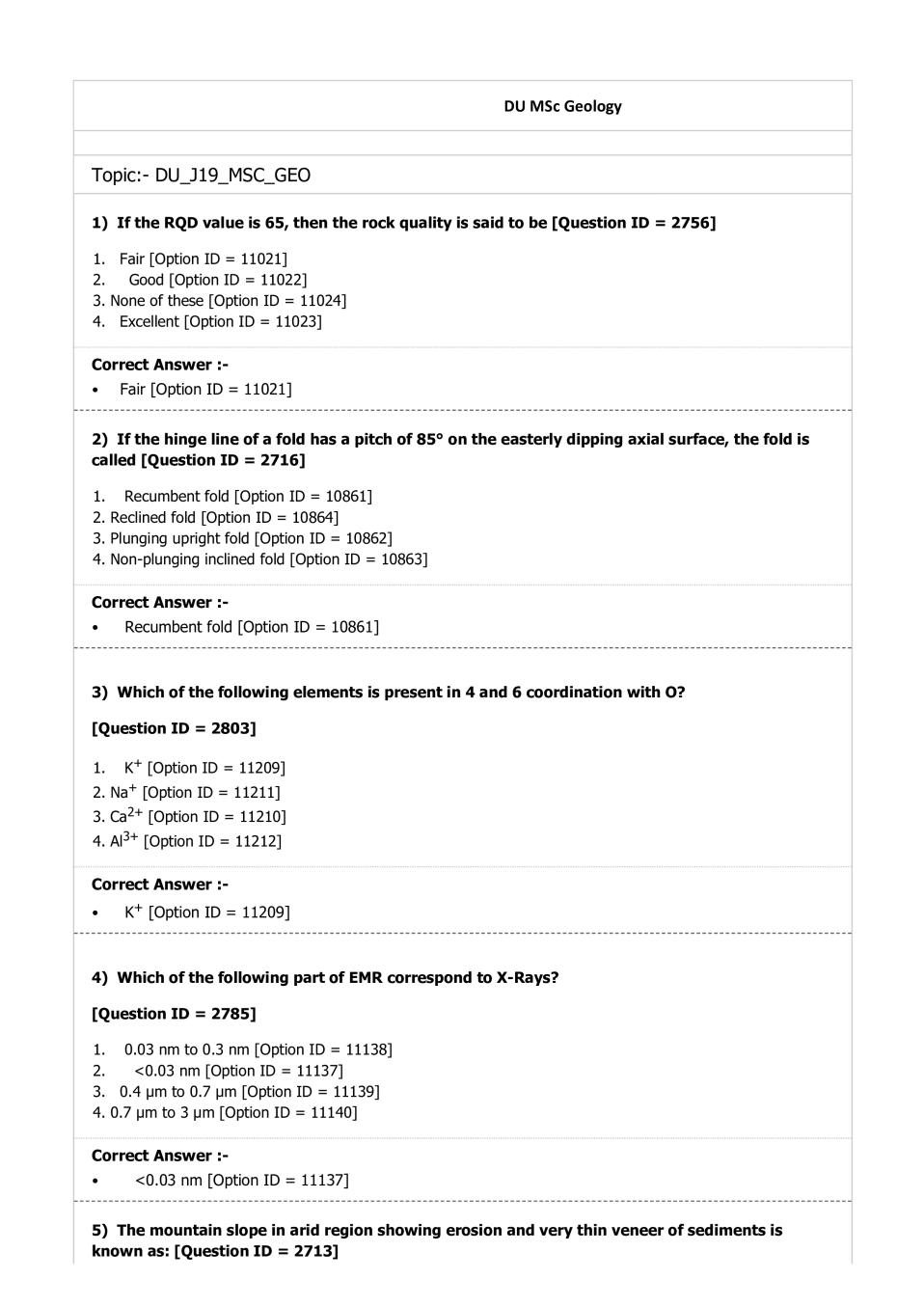
Topic:- DU_J19_MSC_GEO
1) If the RQD value is 65, then the rock quality is said to be [Question ID = 2756]
1. Fair [Option ID = 11021]
2. Good [Option ID = 11022]
3. None of these [Option ID = 11024]
4. Excellent [Option ID = 11023]
Fair [Option ID = 11021]
2) If the hinge line of a fold has a pitch of 85° on the easterly dipping axial surface, the fold is
called [Question ID = 2716]
1. Recumbent fold [Option ID = 10861]
2. Reclined fold [Option ID = 10864]
3. Plunging upright fold [Option ID = 10862]
4. Non-plunging inclined fold [Option ID = 10863]
Recumbent fold [Option ID = 10861]
3) Which of the following elements is present in 4 and 6 coordination with O?
[Question ID = 2803]
1. K+ [Option ID = 11209]
2. Na+ [Option ID = 11211]
3. Ca2+ [Option ID = 11210]
4. Al3+ [Option ID = 11212]
K+ [Option ID = 11209]
4) Which of the following part of EMR correspond to X-Rays?
[Question ID = 2785]
1. 0.03 nm to 0.3 nm [Option ID = 11138]
2. <0.03 nm [Option ID = 11137]
3. 0.4 µm to 0.7 µm [Option ID = 11139]
4. 0.7 µm to 3 µm [Option ID = 11140]
<0.03 nm [Option ID = 11137]
5) The mountain slope in arid region showing erosion and very thin veneer of sediments is
known as: [Question ID = 2713]
Page 2
2. Pediment [Option ID = 10851]
3. Playa [Option ID = 10849]
4. Piedmont [Option ID = 10850]
Playa [Option ID = 10849]
6) A greisen deposit exposes the _____________ part of a granitic body. [Question ID = 2736]
1. Uppermost [Option ID = 10942]
2. Middle [Option ID = 10943]
3. Lower [Option ID = 10941]
4. Basal [Option ID = 10944]
Lower [Option ID = 10941]
7) The mineralogical abundance of the Earth’s crust shows that …………………..is the most
abundant mineral. [Question ID = 2767]
1. Olivine [Option ID = 11068]
2. Feldspar [Option ID = 11065]
3. Quartz [Option ID = 11066]
4. Pyroxene [Option ID = 11067]
Feldspar [Option ID = 11065]
8) Serpentine is a [Question ID = 2740]
1. Tectosilicate [Option ID = 10958]
2. Inosilicate [Option ID = 10957]
3. Nesosilicate [Option ID = 10960]
4. Phyllosilicate [Option ID = 10959]
Inosilicate [Option ID = 10957]
9) A sedimentologist interprets a matrix-supported conglomerate with sharp, non-erosional
base and with a(p)a(i) imbrication of clast as product of [Question ID = 2722]
1. Unconformity [Option ID = 10885]
2. Grain flow [Option ID = 10887]
3. Channel lag [Option ID = 10886]
4. Debris flow [Option ID = 10888]
Unconformity [Option ID = 10885]
10) Bhakra dam is made up of [Question ID = 2755]
1. Earth fill [Option ID = 11017]
2. A combination of all [Option ID = 11020]
3. Concrete [Option ID = 11019]
4. Rock fill [Option ID = 11018]
Page 3
11) Sea water is saline because [Question ID = 2729]
1. Na+2 has higher residency time compared to Ca+2 [Option ID = 10916]
2. Na+ and Cl- are most abundant cation and anion in seawater. [Option ID = 10913]
3. Ca+2 is les abundant in sea water than Na+2 [Option ID = 10915]
4. Na+2 is abundant but Cl- is less abundant. [Option ID = 10914]
Na+ and Cl- are most abundant cation and anion in seawater. [Option ID = 10913]
12) Texturally super mature sandstone is defined by [Question ID = 2772]
1. Lots of clay, well-sorting, Subrounded grains [Option ID = 11086]
2. Lots of clay, poor sorting, subangular grains [Option ID = 11085]
3. Little or no clay, poor-soring, angular grains [Option ID = 11088]
4. No clay, well-soring, well rounded grains [Option ID = 11087]
Lots of clay, poor sorting, subangular grains [Option ID = 11085]
13) In a ‘Similar fold’, the dip isogons drawn on the two limbs of the folded layer in a profile
section
[Question ID = 2717]
1. diverge strongly towards the core [Option ID = 10867]
2. remain parallel to the axial trace [Option ID = 10866]
3. converge strongly towards the core [Option ID = 10865]
4. converge weakly towards the core. [Option ID = 10868]
converge strongly towards the core [Option ID = 10865]
14) Early stages of diagenesis in carbonate rocks show [Question ID = 2774]
1. Blocky cement [Option ID = 11094]
2. Rim cement [Option ID = 11095]
3. Drusy cement [Option ID = 11093]
4. Pressure solution [Option ID = 11096]
Drusy cement [Option ID = 11093]
15) The metamorphic facies not present in the low-P series metamorphism is [Question ID =
2741]
1. Amphibolite facies [Option ID = 10962]
2. Epidote-amphibolite facies [Option ID = 10961]
3. Pyroxene Hornfels facies [Option ID = 10963]
4. Sanidinite facies [Option ID = 10964]
Page 4
16) Hydraulic conductivity is a function of: [Question ID = 2705]
1. Medium alone [Option ID = 10817]
2. Both fluid and medium [Option ID = 10819]
3. None of the above [Option ID = 10820]
4. Fluid alone [Option ID = 10818]
Medium alone [Option ID = 10817]
17) The most fundamental unit of lithostratigraphy is: [Question ID = 2787]
1. Group [Option ID = 11145]
2. Super Group [Option ID = 11146]
3. Member [Option ID = 11148]
4. Formation [Option ID = 11147]
Group [Option ID = 11145]
18) Which part of the Earth is marked by extensive weathering and formation of thick Fe and Al
hydroxides and oxides? [Question ID = 2768]
1. Steppe [Option ID = 11070]
2. Tropical [Option ID = 11072]
3. Desert [Option ID = 11071]
4. Savana [Option ID = 11069]
Savana [Option ID = 11069]
19) The principal section of a uniaxial mineral contains [Question ID = 2760]
1. Optic axis and one vertical symmetry axis. [Option ID = 11040]
2. Optic axis and one horizontal symmetry axis [Option ID = 11039]
3. Optic axis and extraordinary ray [Option ID = 11038]
4. Optic axis and ordinary ray [Option ID = 11037]
Optic axis and ordinary ray [Option ID = 11037]
20) Resistivity sounding in groundwater exploration estimates : [Question ID = 2710]
1. Variation of resistivity with depth [Option ID = 10837]
2. None of the above [Option ID = 10840]
3. Horizontal variation in resistivity [Option ID = 10838]
4. Both Variation of resistivity with depth and Horizontal variation in resistivity [Option ID = 10839]
Variation of resistivity with depth [Option ID = 10837]
21) In the earth atmosphere, the atmospheric pressure [Question ID = 2734]
Page 5
2. remains constant with height [Option ID = 10935]
3. first increases and then decreases with height [Option ID = 10936]
4. decreases with height [Option ID = 10934]
increases with height [Option ID = 10933]
22) This assemblage is characteristic of low to medium grade low-P series metamorphism of
pelites [Question ID = 2739]
1. Kyanite+garnet+biotite+muscovite+quartz [Option ID = 10956]
2. Garnet+sillimanite+Kfeldspar+biotite+quartz [Option ID = 10954]
3. Cordierite+sillimanite+Kfeldspar+quartz [Option ID = 10953]
4. Cordierite+biotite+muscovite+quartz [Option ID = 10955]
Cordierite+sillimanite+Kfeldspar+quartz [Option ID = 10953]
23) A glide plane involves [Question ID = 2761]
1. Inversion + rotation [Option ID = 11044]
2. Translation + inversion [Option ID = 11043]
3. Reflection + translation [Option ID = 11042]
4. Rotation + reflection [Option ID = 11041]
Rotation + reflection [Option ID = 11041]
24) The seismic discontinuity within Earth at a depth of about 2,900 km is known as: [Question
ID = 2786]
1. Gutenberg Discontinuity [Option ID = 11142]
2. Mohorovicic Discontinuity [Option ID = 11141]
3. Lehmann Discontinuity [Option ID = 11143]
4. Conard Discontinuity [Option ID = 11144]
Mohorovicic Discontinuity [Option ID = 11141]
25) The spinifex texture with long spines of olivine is associated with: [Question ID = 2801]
1. Komatiite [Option ID = 11203]
2. Kimberlite [Option ID = 11204]
3. Gabbro [Option ID = 11202]
4. Basalt [Option ID = 11201]
Basalt [Option ID = 11201]
26) The Ganga Brahmaputra groundwater province includes [Question ID = 2712]
1. The Aravallis [Option ID = 10847]
2. The Deccan basalts [Option ID = 10846]
3. The Vindhyans [Option ID = 10845]
4. Bhabar and Tarai belts [Option ID = 10848]
Page 6
27) The composition of the Brachiopod evolved from ------ to -----. [Question ID = 2779]
1. Calcareous to siliceous [Option ID = 11116]
2. Siliceous to phosphatic [Option ID = 11113]
3. Chitin-phosphate to siliceous [Option ID = 11115]
4. Chitin-phosphate to calcareous [Option ID = 11114]
Siliceous to phosphatic [Option ID = 11113]
28) Glossopteris became less diverse in [Question ID = 2744]
1. Permian [Option ID = 10973]
2. Triassic [Option ID = 10975]
3. Cretaceous [Option ID = 10974]
4. Jurassic [Option ID = 10976]
Permian [Option ID = 10973]
29) The physics of how organisms move is known as [Question ID = 2753]
1. Biomechanics [Option ID = 11010]
2. Biotechnology [Option ID = 11009]
3. biostratinomy [Option ID = 11012]
4. bioimmuration [Option ID = 11011]
Biotechnology [Option ID = 11009]
30) Deepest Trench occurs in [Question ID = 2732]
1. Atlantic Ocean [Option ID = 10927]
2. Indian Ocean [Option ID = 10928]
3. Pacific Ocean [Option ID = 10926]
4. Arctic Ocean [Option ID = 10925]
Arctic Ocean [Option ID = 10925]
31) In pericline law of twining in plagioclase, the rhombic section is parallel to [Question ID =
2762]
1. (101) [Option ID = 11047]
2. (001) [Option ID = 11046]
3. (011) [Option ID = 11048]
4. (010) [Option ID = 11045]
(010) [Option ID = 11045]
32)
Page 7
1. KAlSi2O8 [Option ID = 11059]
2. KAlSi2O6 [Option ID = 11060]
3. KAlSi3O8 [Option ID = 11057]
4. KAl2Si3O8 [Option ID = 11058]
KAlSi3O8 [Option ID = 11057]
33) A fold with a sharp hinge and slightly bent (wavy) limbs in a profile section is called:
[Question ID = 2715]
1. Arrowhead fold [Option ID = 10859]
2. Box fold [Option ID = 10860]
3. Polyclinal fold [Option ID = 10858]
4. Chevron fold [Option ID = 10857]
Chevron fold [Option ID = 10857]
34) AFM diagrams for metamorphic rocks can be called as
[Question ID = 2743]
1. Compatibility diagrams [Option ID = 10971]
2. Pseudocomponent diagrams [Option ID = 10970]
3. Phase diagrams [Option ID = 10969]
4. All of the above [Option ID = 10972]
Phase diagrams [Option ID = 10969]
35) The monsoon has well developed cycle in [Question ID = 2733]
1. East United State [Option ID = 10932]
2. Africa [Option ID = 10931]
3. Indian and South East Asia [Option ID = 10929]
4. North Australia [Option ID = 10930]
Indian and South East Asia [Option ID = 10929]
36) The drainage pattern over a gently sloping, uniformly resistant terrain will be [Question ID
= 2776]
1. Parallel [Option ID = 11103]
2. Trellis [Option ID = 11102]
3. Dendritic [Option ID = 11104]
4. Rectangular [Option ID = 11101]
Rectangular [Option ID = 11101]
37) The triple point for the kyanite, sillimanite and andalusite occurs at: [Question ID = 2799]
Page 8
2. 6 kbar, 610 °C [Option ID = 11193]
3. 8 kbar, 310 °C [Option ID = 11196]
4. 5 kbar, 710 °C [Option ID = 11194]
6 kbar, 610 °C [Option ID = 11193]
38) The last appearance of Hipparion defines the: [Question ID = 2789]
1. Paleocene/Eocene boundary [Option ID = 11153]
2. Miocene/Pliocene boundary [Option ID = 11156]
3. Oligocene/Miocene boundary [Option ID = 11155]
4. Pliocene/Pleistocene boundary [Option ID = 11154]
Paleocene/Eocene boundary [Option ID = 11153]
39) The bedforms of the lower flow regime migrate: [Question ID = 2769]
1. Downstream [Option ID = 11074]
2. Do not migrate [Option ID = 11076]
3. Upstream [Option ID = 11073]
4. Transverse to flow [Option ID = 11075]
Upstream [Option ID = 11073]
40) Calcium in garnet is in [Question ID = 2764]
1. 3 fold coordination [Option ID = 11053]
2. 8 fold coordination [Option ID = 11056]
3. 6 fold coordination [Option ID = 11055]
4. 4 fold coordination [Option ID = 11054]
3 fold coordination [Option ID = 11053]
41) The cephalopod with both saddle and lobes denticulated is: [Question ID = 2782]
1. Goniatite [Option ID = 11125]
2. Ammonite [Option ID = 11127]
3. None of the above [Option ID = 11128]
4. Ceratitie [Option ID = 11126]
Goniatite [Option ID = 11125]
42) The marine to continental transition in the Himalayan foreland is marked by: [Question ID =
2792]
1. Upper Dharamshala to Lower Siwaliks [Option ID = 11168]
2. Lower to Middle Upper Siwalik [Option ID = 11165]
3. Subathu to Dagshai Formation [Option ID = 11167]
4. Dagshai to Kasouli Formation [Option ID = 11166]
Page 9
43) Cambrian explosion marks the beginning of ——————- [Question ID = 2749]
1. extinction of trilobites [Option ID = 10996]
2. Skeletalisation [Option ID = 10993]
3. Diversification of corals [Option ID = 10994]
4. Trilobite expansion [Option ID = 10995]
Skeletalisation [Option ID = 10993]
44) In order to analyze paleo-environment/s of a sedimentary basin in geological rock record,
we mainly depend on [Question ID = 2721]
1. Paleo-current analyses [Option ID = 10882]
2. Facies association analyses [Option ID = 10883]
3. Facies analyses [Option ID = 10881]
4. Lithological description [Option ID = 10884]
Facies analyses [Option ID = 10881]
45) Bone coal refers to [Question ID = 2720]
1. Very pure coal containing low ash content [Option ID = 10878]
2. Dense coal with more than 90% carbon [Option ID = 10880]
3. Very impure coal containing high ash content [Option ID = 10877]
4. Dull, black coal that breaks with conchoidal fracture [Option ID = 10879]
Very impure coal containing high ash content [Option ID = 10877]
46) Plutonic equivalent of Trachyte is: [Question ID = 2802]
1. Syenite [Option ID = 11207]
2. Granite [Option ID = 11205]
3. Diorite [Option ID = 11208]
4. Granodiorite [Option ID = 11206]
Granite [Option ID = 11205]
47) Humans dispersed out from —————— centre of origin [Question ID = 2745]
1. African [Option ID = 10977]
2. European [Option ID = 10979]
3. New World [Option ID = 10980]
4. Asian [Option ID = 10978]
African [Option ID = 10977]
48) Cyclic twinning is associated with: [Question ID = 2800]
Page 10
2. Pyrite [Option ID = 11197]
3. Orthoclase [Option ID = 11200]
4. Aragonite [Option ID = 11198]
Pyrite [Option ID = 11197]
49) Pigeonite is a clinopyroxene that contains [Question ID = 2759]
1. Less Ca than Augite [Option ID = 11036]
2. More Ca than Augite [Option ID = 11035]
3. Less Na than Augite [Option ID = 11034]
4. More Na than Augite [Option ID = 11033]
More Na than Augite [Option ID = 11033]
50) The Ganges-Brahmputra delta is characterized by [Question ID = 2777]
1. Tide dominated marshy island, bars and mangroves [Option ID = 11107]
2. Fluvial dominated long streams with natural levees [Option ID = 11105]
3. Braid plains and bars [Option ID = 11108]
4. Wave dominated beaches and barriers [Option ID = 11106]
Fluvial dominated long streams with natural levees [Option ID = 11105]
51) The mantle plume related to Deccan Trap is known as: [Question ID = 2791]
1. Kergulean [Option ID = 11161]
2. Jan Mayen [Option ID = 11164]
3. Marion [Option ID = 11163]
4. Reunian [Option ID = 11162]
Kergulean [Option ID = 11161]
52) Assertion (A):Tetrapods are vertebrates but some vertebrates are not tetrapods
Reasoning ( R): Vertebrae appeared first followed by tetrapod limb in the evolutionary history of
chordates [Question ID = 2751]
1. R explains A [Option ID = 11003]
2. A & R are false [Option ID = 11002]
3. A is false [Option ID = 11001]
4. R does not explain A [Option ID = 11004]
A is false [Option ID = 11001]
53) The plagioclase with ab50 to ab70 is known as [Question ID = 2796]
1. Albite [Option ID = 11181]
2. Anorthite [Option ID = 11184]
3. Andesine [Option ID = 11183]
4. Oligoclase [Option ID = 11182]
Page 11
54) In prograde metamorphism of mafic rocks from greenschist to amphibolite facies which
is/are the characteristic change/s [Question ID = 2735]
1. Change of anorthite content of plagioclase from oligoclase to andesine [Option ID = 10937]
2. First appearance of orthopyroxene [Option ID = 10940]
3. Both Change of anorthite content of plagioclase from oligoclase to andesine and Change of amphibole
composition from actinolite to common hornblende [Option ID = 10939]
4. Change of amphibole composition from actinolite to common hornblende [Option ID = 10938]
Change of anorthite content of plagioclase from oligoclase to andesine [Option ID = 10937]
55) Speciation by geographic isolation is known as
[Question ID = 2748]
1. Allopatric [Option ID = 10989]
2. Sympatric [Option ID = 10990]
3. None of these [Option ID = 10992]
4. Anagenesis [Option ID = 10991]
Allopatric [Option ID = 10989]
56) Kyanite=> Sillimanite [Question ID = 2742]
1. A continuous reaction [Option ID = 10966]
2. A discontinuous reaction [Option ID = 10965]
3. A oxidation reaction [Option ID = 10968]
4. An Ion-Exchange reaction [Option ID = 10967]
A discontinuous reaction [Option ID = 10965]
57) Total number of lattice points in a 3-d primitive cell is
[Question ID = 13542]
1. 1 [Option ID = 24165]
2. 4 [Option ID = 24167]
3. 2 [Option ID = 24166]
4. 8 [Option ID = 24168]
1 [Option ID = 24165]
58) Reversal of paleocurrent, cross bedding and mud drapes commonly occur in: [Question ID =
2724]
1. None of the above [Option ID = 10896]
2. Tide dominated delta [Option ID = 10895]
3. Wave dominated delta [Option ID = 10894]
Page 12
Fluvial dominated delta [Option ID = 10893]
59) Which of the following Brachiopod is still living? [Question ID = 2780]
1. Athyris [Option ID = 11118]
2. Orthis [Option ID = 11117]
3. Lingula [Option ID = 11120]
4. Atryrapa [Option ID = 11119]
Orthis [Option ID = 11117]
60) Which of the following silica minerals is a characteristic of high pressure in excess of 20
Kbar? [Question ID = 2794]
1. Cristobalite [Option ID = 11176]
2. Opal [Option ID = 11173]
3. Tridymite [Option ID = 11174]
4. Coesite [Option ID = 11175]
Opal [Option ID = 11173]
61) Which of the following minerals is a cyclosilicate? [Question ID = 2793]
1. Olivine [Option ID = 11169]
2. Anthophyllite [Option ID = 11172]
3. Enstatite [Option ID = 11170]
4. Beryl [Option ID = 11171]
Olivine [Option ID = 11169]
62) Which of the followings rocks is the most abundant sedimentary rock in geological record of
the Earth? [Question ID = 2766]
1. Mud rocks [Option ID = 11061]
2. Limestones [Option ID = 11063]
3. Sandstones [Option ID = 11062]
4. Conglomerates [Option ID = 11064]
Mud rocks [Option ID = 11061]
63) Highstand of Sea level favours [Question ID = 2723]
1. Calcitic ooids due to higher CO2 and lower Mg/Ca ratio [Option ID = 10889]
2. Aragonite ooids due to lower CO2 and higher Mg/Ca ratio [Option ID = 10891]
3. Calcite ooids due to lower CO2 and lower Mg/Ca ratio [Option ID = 10892]
4. Calcitic ooids due to higher CO2 and higher Mg/Ca ratio [Option ID = 10890]
Page 13
64) Ediacaran Metazoan appeared at: [Question ID = 2790]
1. Hadean [Option ID = 11159]
2. Archean [Option ID = 11160]
3. paleo Proterozoic [Option ID = 11157]
4. Neoproterozoic [Option ID = 11158]
paleo Proterozoic [Option ID = 11157]
65) Coral reefs are generally found in [Question ID = 2726]
1. Tropical regions [Option ID = 10902]
2. Subtropical regions [Option ID = 10904]
3. Mid latitude region [Option ID = 10903]
4. Polar regions [Option ID = 10901]
Polar regions [Option ID = 10901]
66)
[Question ID = 2718]
1. none of the above [Option ID = 10872]
2. material a [Option ID = 10869]
3. material b [Option ID = 10870]
4. material c [Option ID = 10871]
material a [Option ID = 10869]
67) PT stability curve of Muscovite intersects Granite melt at about [Question ID = 2798]
1. 1.5 kbar, 700°C [Option ID = 11190]
2. 3 kbar, 1000°C [Option ID = 11191]
3. 1 kbar, 1500°C [Option ID = 11189]
4. 4 kbar, 900°C [Option ID = 11192]
1 kbar, 1500°C [Option ID = 11189]
68) The main driving force behind horse evolution is [Question ID = 2746]
Page 14
2. Orogeny [Option ID = 10983]
3. Climate [Option ID = 10982]
4. marine transgression [Option ID = 10984]
Tectonics [Option ID = 10981]
69) The Zawar deposit in Udaipur district is an important source of _________ in India.
[Question ID = 2737]
1. Lead – Zinc [Option ID = 10946]
2. Gold – Silver [Option ID = 10948]
3. Tin – Tungsten [Option ID = 10947]
4. Copper [Option ID = 10945]
Copper [Option ID = 10945]
70) The hydrographs of the streams are useful to asses: [Question ID = 2707]
1. River response [Option ID = 10827]
2. Base flow [Option ID = 10825]
3. Storm flow [Option ID = 10826]
4. All of the above [Option ID = 10828]
Base flow [Option ID = 10825]
71) Imperceptible/very slow downslope movement of soil/rock is known as: [Question ID =
2754]
1. Creep [Option ID = 11015]
2. Topple [Option ID = 11014]
3. Avalanche [Option ID = 11013]
4. Debris flow [Option ID = 11016]
Avalanche [Option ID = 11013]
72) Which of the following type of volcanic activity is marked by fissure and basaltic flows?
[Question ID = 2778]
1. Plinian [Option ID = 11110]
2. Icelandic [Option ID = 11111]
3. Pelean [Option ID = 11112]
4. Vesuvian [Option ID = 11109]
Vesuvian [Option ID = 11109]
73) Which of the following is marked by loop shaped brachial skeleton? [Question ID = 2781]
1. Terebratula [Option ID = 11123]
2. Spirifer [Option ID = 11122]
3. Productus [Option ID = 11124]
Page 15
Rhynchonella [Option ID = 11121]
74) Which of the following trace fossil indicates the deep marine conditions? [Question ID =
2771]
1. Zoophycos [Option ID = 11083]
2. Nereites [Option ID = 11084]
3. Skolithos [Option ID = 11082]
4. Cruziana [Option ID = 11081]
Cruziana [Option ID = 11081]
75) Which of the following is a Li bearing pyroxene? [Question ID = 2797]
1. Spodumene [Option ID = 11187]
2. Jadeite [Option ID = 11186]
3. Diopside [Option ID = 11188]
4. Enstatite [Option ID = 11185]
Enstatite [Option ID = 11185]
76) Which of the following plant fossil is not found in Lower Gondwana? [Question ID = 2784]
1. Glossopteris [Option ID = 11133]
2. Vertebraria [Option ID = 11136]
3. Nilssonia [Option ID = 11135]
4. Schizoneura [Option ID = 11134]
Glossopteris [Option ID = 11133]
77) Which of the following is not a sulfide ore mineral? [Question ID = 2738]
1. Molybdenite [Option ID = 10949]
2. Bornite [Option ID = 10950]
3. Marcasite [Option ID = 10952]
4. Cuprite [Option ID = 10951]
Molybdenite [Option ID = 10949]
78) Which of the following map can give direction of groundwater flow: [Question ID = 2709]
1. Water level fluctuation map [Option ID = 10834]
2. None of the above [Option ID = 10836]
3. Depth to water level map [Option ID = 10833]
4. Water table contour map [Option ID = 10835]
Depth to water level map [Option ID = 10833]
Page 16
2773]
1. Bituminous coal [Option ID = 11092]
2. Peat [Option ID = 11089]
3. Lignite [Option ID = 11090]
4. Anthracite [Option ID = 11091]
Peat [Option ID = 11089]
80) Which of the following primary producer with calcareous skeletal framework evolved during
the Mesozoic marine revolution [Question ID = 2750]
1. diatoms [Option ID = 10998]
2. coccolithophorids [Option ID = 10999]
3. radiolarians [Option ID = 10997]
4. sponges [Option ID = 11000]
radiolarians [Option ID = 10997]
81) Which of the following methods is best suited to date the marine carbonates uptothe last
30,000 yr BP [Question ID = 2725]
1. 210Pb dating [Option ID = 10899]
2. Thermoluminescence dating [Option ID = 10897]
3. U/Th dating [Option ID = 10900]
4. Radiocarbon dating [Option ID = 10898]
Thermoluminescence dating [Option ID = 10897]
82) In an isotropic aquifer [Question ID = 2708]
1. None of the above [Option ID = 10832]
2. Aquifer parameters vary in space and direction both [Option ID = 10831]
3. Aquifer parameters are same in all directions [Option ID = 10829]
4. Aquifer parameters does not vary spatially [Option ID = 10830]
Aquifer parameters are same in all directions [Option ID = 10829]
83) An unconformity where the lower (underlying the unconformity surface) unit is essentially
of plutonic rocks, is known as: [Question ID = 2719]
1. An angular unconformity [Option ID = 10875]
2. A non-conformity [Option ID = 10876]
3. A disconformity [Option ID = 10873]
4. A para-conformity [Option ID = 10874]
A disconformity [Option ID = 10873]
84) A confined aquifer behaves as an unconfined aquifer when: [Question ID = 2714]
Page 17
2. None of the above [Option ID = 10856]
3. The piezometric head falls below the top of the lower confining layer [Option ID = 10855]
4. The piezometric head falls below the bottom of the upper confining layer [Option ID = 10853]
The piezometric head falls below the bottom of the upper confining layer [Option ID = 10853]
85) The oldest seafloor on Earth is not more than [Question ID = 2730]
1. 2 million years old. [Option ID = 10920]
2. 200 million years old. [Option ID = 10917]
3. 20 million years old. [Option ID = 10919]
4. 2 billion years old. [Option ID = 10918]
200 million years old. [Option ID = 10917]
86) In unconfined aquifer Storativity is approximately equal to: [Question ID = 2706]
1. Intrinsic permeability [Option ID = 10822]
2. Conductivity [Option ID = 10821]
3. None of the above [Option ID = 10824]
4. Specific retention [Option ID = 10823]
Conductivity [Option ID = 10821]
87) The optic axial plane of Epidote is [Question ID = 2758]
1. (110) [Option ID = 11032]
2. (001) [Option ID = 11031]
3. (100) [Option ID = 11029]
4. (010) [Option ID = 11030]
(100) [Option ID = 11029]
88) In biostratigraphy, graphic correlation method uses [Question ID = 2752]
1. Ranges of all species [Option ID = 11006]
2. Abundance zones [Option ID = 11007]
3. Concurrent range zones [Option ID = 11008]
4. Assemblage zones [Option ID = 11005]
Assemblage zones [Option ID = 11005]
89) The high temperature monoclinic variety of alkali feldspar is known as [Question ID = 2795]
1. Albite [Option ID = 11177]
2. Microcline [Option ID = 11180]
3. Sanidine [Option ID = 11179]
4. Anorthoclase [Option ID = 11178]
Page 18
90) The Ninety East Ridge is present in which ocean [Question ID = 2731]
1. Arctic [Option ID = 10924]
2. Atlantic [Option ID = 10921]
3. Pacific [Option ID = 10923]
4. Indian [Option ID = 10922]
Atlantic [Option ID = 10921]
91) Sodium Adsorption Ratio in groundwater quality is used for studying [Question ID = 2711]
1. Hydrochemical facies of water samples [Option ID = 10841]
2. Suitability of groundwater for irrigation uses [Option ID = 10843]
3. Portability of water [Option ID = 10844]
4. Metamorphic facies of rock samples [Option ID = 10842]
Hydrochemical facies of water samples [Option ID = 10841]
92) The Greenland ice sheet is defined by
[Question ID = 2775]
1. Wet base [Option ID = 11097]
2. Dry base [Option ID = 11098]
3. Dry-wet transition [Option ID = 11099]
4. None of the above [Option ID = 11100]
Wet base [Option ID = 11097]
93) The Hadean Eon corresponds to evolution of Earth during;
[Question ID = 2788]
1. 2500 Ma to 542 Ma [Option ID = 11150]
2. 4560 Ma to 3850 Ma [Option ID = 11149]
3. < 542 Ma [Option ID = 11152]
4. 3850 Ma to 2500 Ma [Option ID = 11151]
4560 Ma to 3850 Ma [Option ID = 11149]
94) The type specimen used while describing a new species is known as
[Question ID = 2747]
1. Syntype [Option ID = 10986]
2. Holotype [Option ID = 10987]
3. Paratype [Option ID = 10985]
4. None of the above [Option ID = 10988]
Page 19
95) The Agnostus trilobite from Cambrian and Ordovician is marked by
[Question ID = 2783]
1. Very large pygidium but very small cephalon [Option ID = 11129]
2. Small pygidium but no cephalon [Option ID = 11132]
3. Very small pygidium but very large cephalon [Option ID = 11130]
4. Pygidium and cephalon are almost similar in size [Option ID = 11131]
Very large pygidium but very small cephalon [Option ID = 11129]
96) The transition from lower to upper flow regime occurs when Froude No is
[Question ID = 2770]
1. Fr= <0.1 [Option ID = 11080]
2. Fr= >0.1 [Option ID = 11077]
3. Fr= ~1 [Option ID = 11079]
4. Fr= <1 [Option ID = 11078]
Fr= >0.1 [Option ID = 11077]
97) The wind system in the equatorial areas is known as: [Question ID = 2728]
1. Monsoon [Option ID = 10912]
2. Doldrums [Option ID = 10911]
3. Westerlies [Option ID = 10909]
4. Trades [Option ID = 10910]
Westerlies [Option ID = 10909]
98) The cosmic ray intensity is minimum at the magnetic [Question ID = 2727]
1. Equator [Option ID = 10905]
2. North pole [Option ID = 10906]
3. South pole [Option ID = 10907]
4. Tropic of cancer [Option ID = 10908]
Equator [Option ID = 10905]
99) Anorthoclase is [Question ID = 2763]
1. Intermediate between Microcline and Albite [Option ID = 11050]
2. Intermediate between sanidine and Albite [Option ID = 11051]
3. Intermediate between orthoclase and Anorthite [Option ID = 11049]
4. Intermediate between sanidine and Anorthite. [Option ID = 11052]
Page 20
100) An imaginary horizontal reference line located at the maximum horizontal dimension or
diameter of a tunnel is called [Question ID = 2757]
1. Tunnel Line [Option ID = 11025]
2. Stress Line [Option ID = 11028]
3. Spring Line [Option ID = 11027]
4. Pressure Line [Option ID = 11026]
Tunnel Line [Option ID = 11025]
Document Details
| Board / Org | NTA |
| Exam | DUET |
| Type | Question Paper |
| Pages | 20 |
| Updated | 30 Apr 2026 |