JNUEE 2021 Question Paper Ph.D Social Exclusion N Inclusive Policy
Finished viewing? Save it for later —
Download JNUEE 2021 Question Paper Ph.D Social Exclusion N Inclusive Policy (PDF · 13 pages)About JNUEE 2021 Question Paper Ph.D Social Exclusion N Inclusive Policy
JNUEE 2021 Question Paper Ph.D Social Exclusion N Inclusive Policy is available here for free download. Published by NTA for JNUEE, this question paper can be viewed online or downloaded as a PDF (13 pages). Candidates preparing for JNUEE can use JNUEE 2021 Question Paper Ph.D Social Exclusion N Inclusive Policy to understand the exam pattern, the type of questions asked, and the overall difficulty level.
Frequently Asked Questions
How can I download JNUEE 2021 Question Paper Ph.D Social Exclusion N Inclusive Policy?
Open this page and click the Download button to save JNUEE 2021 Question Paper Ph.D Social Exclusion N Inclusive Policy as a PDF. It is completely free on AglaSem Docs.
Is JNUEE 2021 Question Paper Ph.D Social Exclusion N Inclusive Policy free to download?
Yes. JNUEE 2021 Question Paper Ph.D Social Exclusion N Inclusive Policy can be viewed online and downloaded as a PDF free of cost on AglaSem Docs.
How many pages does JNUEE 2021 Question Paper Ph.D Social Exclusion N Inclusive Policy have?
JNUEE 2021 Question Paper Ph.D Social Exclusion N Inclusive Policy contains 13 pages, which you can read online or download together as a single PDF.
Where can I find more JNUEE study material?
You can find more JNUEE question papers, sample papers, syllabus, and answer keys on AglaSem Docs.
JNUEE 2021 Question Paper Ph.D Social Exclusion N Inclusive Policy – Text
Read the full text of this question paper below — useful to quickly search, copy and reference the content online without downloading the PDF.
📄 View text version (12 pages)
Page 1
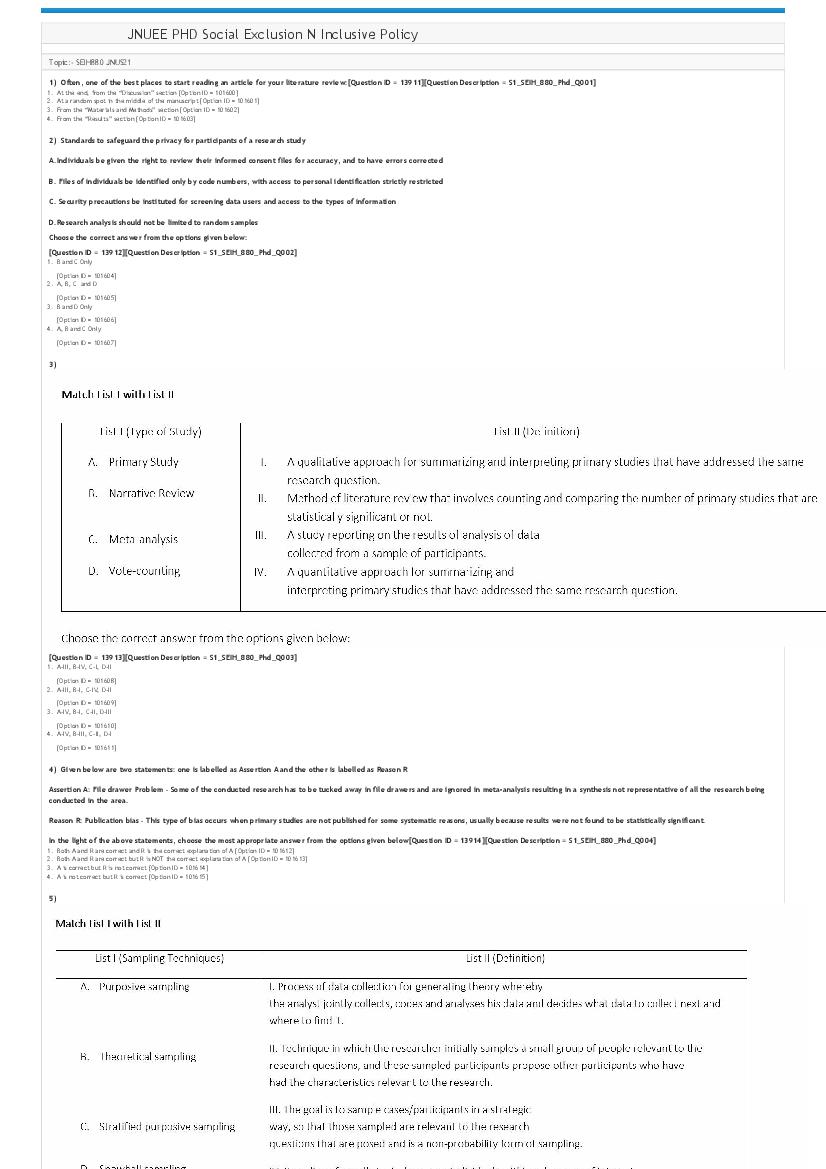
Topic:‐ SEIH880 JNUS21
1) Often, one of the best places to start reading an article for your literature review:[Question ID = 13911][Question Description = S1_SEIH_880_Phd_Q001]
1. At the end, from the “Discussion” section [Option ID = 101600]
2. At a random spot in the middle of the manuscript [Option ID = 101601]
3. From the “Materials and Methods” section [Option ID = 101602]
4. From the “Results” section [Option ID = 101603]
2) Standards to safeguard the privacy for participants of a research study
A.Individuals be given the right to review their informed consent files for accuracy, and to have errors corrected
B. Files of individuals be identified only by code numbers, with access to personal identification strictly restricted
C. Security precautions be instituted for screening data users and access to the types of information
D.Research analysis should not be limited to random samples
[Question ID = 13912][Question Description = S1_SEIH_880_Phd_Q002]
1. B and C Only
[Option ID = 101604]
2. A, B, C and D
[Option ID = 101605]
3. B and D Only
[Option ID = 101606]
4. A, B and C Only
[Option ID = 101607]
3)
[Question ID = 13913][Question Description = S1_SEIH_880_Phd_Q003]
1. A‐III, B‐IV, C‐I, D‐II
[Option ID = 101608]
2. A‐III, B‐I, C‐IV, D‐II
[Option ID = 101609]
3. A‐IV, B‐I, C‐II, D‐III
[Option ID = 101610]
4. A‐IV, B‐III, C‐II, D‐I
[Option ID = 101611]
4) Given below are two statements: one is labelled as Assertion A and the other is labelled as Reason R
Assertion A: File drawer Problem – Some of the conducted research has to be tucked away in file drawers and are ignored in meta‐analysis resulting in a synthesis not representative of all the research being
conducted in the area.
Reason R: Publication bias – This type of bias occurs when primary studies are not published for some systematic reasons, usually because results were not found to be statistically significant.
In the light of the above statements, choose the most appropriate answer from the options given below[Question ID = 13914][Question Description = S1_SEIH_880_Phd_Q004]
1. Both A and R are correct and R is the correct explanation of A [Option ID = 101612]
2. Both A and R are correct but R is NOT the correct explanation of A [Option ID = 101613]
3. A is correct but R is not correct [Option ID = 101614]
4. A is not correct but R is correct [Option ID = 101615]
5)
Page 2
1. A‐III, B‐IV, C‐I, D‐II
[Option ID = 101616]
2. A‐I, B‐IV, C‐II, D‐III
[Option ID = 101617]
3. A‐III, B‐I, C‐IV, D‐II
[Option ID = 101618]
4. A‐IV, B‐III, C‐II, D‐I
[Option ID = 101619]
6) Given below are two statements: one is labelled as Assertion A and the other is labelled as Reason R
Assertion A: A long bibliography containing more references implies that the author has been comprehensive in his or her search of literature.
Reason R: Bibliography should include everything that has ever been written about a subject.
In the light of the above statements, choose the correct answer from the options given below[Question ID = 13916][Question Description = S1_SEIH_880_Phd_Q006]
1. Both A and R are true and R is the correct explanation of A [Option ID = 101620]
2. Both A and R are true but R is NOT the correct explanation of A [Option ID = 101621]
3. A is true but R is false [Option ID = 101622]
4. A is false but R is true [Option ID = 101623]
7) Linear model of the research process:
A. Validation
B. Theory
C. Operationalization
D. Collection
E. Hypothesis
Choose the correct answer from the options given below:[Question ID = 13917][Question Description = S1_SEIH_880_Phd_Q007]
1. A, C, D, B, E [Option ID = 101624]
2. B, E, C, D, A [Option ID = 101625]
3. B, D, E, C, A [Option ID = 101626]
4. C, D, B, E, A [Option ID = 101627]
8) Given below are two statements:
Statement I: Most issues of research can be addressed by more than one research question. It is important, when you start your research, to decide which one you will focus on.
Statement II: Research questions once conceptualized cannot be refined or reformulated during the research project.
In the light of the above statements, choose the most appropriate answer from the options given below[Question ID = 13918][Question Description = S1_SEIH_880_Phd_Q008]
1. Both Statement I and Statement II are correct [Option ID = 101628]
2. Both Statement I and Statement II are incorrect [Option ID = 101629]
3. Statement I is correct but Statement II is incorrect [Option ID = 101630]
4. Statement I is incorrect but Statement II is correct [Option ID = 101631]
9) Given below are two statements:
Statement I: Visual data methods provide new ways of analyzing the visual side of social settings and practices and of making these a part of research.
Statement II: Visual data are selective in their focus and provide a specific perspective on the issues that are studied with them.
In the light of the above statements, choose the correct answer from the options given below[Question ID = 13919][Question Description = S1_SEIH_880_Phd_Q009]
1. Both Statement I and Statement II are true [Option ID = 101632]
2. Both Statement I and Statement II are false [Option ID = 101633]
3. Statement I is correct but Statement II is false [Option ID = 101634]
4. Statement I is incorrect but Statement II is true [Option ID = 101635]
10)
[Question ID = 13920][Question Description = S1_SEIH_880_Phd_Q010]
1. A‐III, B‐I, C‐II, D‐IV
[Option ID = 101636]
2. A‐II, B‐III, C‐IV, D‐I
[Option ID = 101637]
3. A‐III, B‐IV, C‐I, D‐II
[Option ID = 101638]
4. A‐II, B‐III, C‐I, D‐IV
[Option ID = 101639]
11) What is ethnography or ethnographic research?
A. A research strategy combining different methods, but based on participation, observation, and writing about a field under study.
B. Theoretical approach interested in analyzing the methods people use in their everyday lives to make communications and routine work.
C. Tools for dealing with a complex issue leading to first solutions and stimulating further analysis.
D. A strong emphasis on exploring the nature of a particular social phenomenon, rather than setting out to test hypothesis about them.
E. A tendency to work primarily with “unstructured data” that is data that have not been coded at the point of data collection.
[Question ID = 13921][Question Description = S1_SEIH_880_Phd_Q011]
1. B, C and E Only
[Option ID = 101640]
2. B, D and E Only
[Option ID = 101641]
3. A, C and E Only
[Option ID = 101642]
4. A, D and E Only
[Option ID = 101643]
12) Which of the following methods are used to summarize the frequency distribution or compare the frequencies?
A. Central tendency including mean, median
B. Dispersion such as standard deviation, coefficient of variation
C. Probability
D. Ratio
E. Proportion or percentages
Choose the most appropriate answer from the options given below:
Page 3
1. A, B, and E only
[Option ID = 101644]
2. A, B, D and E only
[Option ID = 101645]
3. B, C and E only
[Option ID = 101646]
4. A, B, C, D and E
[Option ID = 101647]
13)
[Question ID = 10360][Question Description = S1_SEIH_880_Phd_Q013]
1. A‐III, B‐I, C‐II, D‐IV
[Option ID = 101992]
2. A‐I, B‐IV, C‐II, D‐III
[Option ID = 101993]
3. A‐III, B‐I, C‐IV, D‐II
[Option ID = 101994]
4. A‐II, B‐III, C‐I, D‐IV
[Option ID = 101995]
14) Given below are two statements:
Statement I: In peer review, publishers seek the advice of expert readers, or referees, before considering a manuscript for publication
Statement II: The process of peer review ensures that the scientific paper is correct
In the light of the above statements, choose the correct answer from the options given below[Question ID = 13923][Question Description = S1_SEIH_880_Phd_Q014]
1. Both Statement I and Statement II are true [Option ID = 101648]
2. Both Statement I and Statement II are false [Option ID = 101649]
3. Statement I is correct but Statement II is false [Option ID = 101650]
4. Statement I is incorrect but Statement II is true [Option ID = 101651]
15) What is the importance of a research plan:
A. It helps the researcher to organize the ideas in a form whereby it will be possible for him to look for flaws and inadequacies, if any
B. It provides an inventory of what must be done and which materials have to be collected as a preliminary step
C. It is a document that cannot be given to others for comments
D. It is a document that can be given to others for comments
[Question ID = 13924][Question Description = S1_SEIH_880_Phd_Q015]
1. A, B and C Only
[Option ID = 101652]
2. A, B, C and D
[Option ID = 101653]
3. B and D Only
[Option ID = 101654]
4. A, B and D only
[Option ID = 101655]
16) What are the steps undertaken in selecting the sample design?
[Question ID = 13925][Question Description = S1_SEIH_880_Phd_Q016]
1. Type of universe > source list > sampling procedure > size of sample > parameters of interest>sampling unit
[Option ID = 101656]
2. Type of universe > sampling unit > source list > size of sample > parameters of interest > budgetary constraint > sampling procedure
[Option ID = 101657]
3. Type of universe > source list > size of sample > sampling unit > budgetary constraint > sampling procedure
[Option ID = 101658]
4. Type of universe > sampling unit > budgetary constraint > size of sample > parameters of interest > sampling procedure
[Option ID = 101659]
17)
[Question ID = 10361][Question Description = S1_SEIH_880_Phd_Q017]
1. A‐III, B‐IV, C‐I, D‐II
[Option ID = 101996]
2. A‐I, B‐IV, C‐II, D‐III
[Option ID = 101997]
3. A‐III, B‐I, C‐IV, D‐II
[Option ID = 101998]
4. A‐IV, B‐III, C‐II, D‐I
[Option ID = 101999]
18) What are the CORRECT differences between Questionnaires and Schedules?
A. Non‐response is usually high in case of questionnaire leading to bias, whereas in schedules non‐response is low but the danger of interviewer bias is high.
Page 4
C. The questionnaire method is likely to be very fast, but in case of schedules, the information is collected very slowly.
D. Questionnaire method can be used only when the respondents are literate and cooperative, but in case of schedules, the information can be gathered even when the respondents happen to be illiterate.
E. To collect data through questionnaire is relatively costly compared to schedules.
Choose the most appropriate answer from the options given below:
[Question ID = 13926][Question Description = S1_SEIH_880_Phd_Q018]
1. A, D and E only
[Option ID = 101660]
2. A and D only
[Option ID = 101661]
3. A, B, C and E only
[Option ID = 101662]
4. A, B, C, D and E
[Option ID = 101663]
19) What is Leptokurtic curve?[Question ID = 13927][Question Description = S1_SEIH_880_Phd_Q019]
1. A bell shaped curve or a normal curve [Option ID = 101664]
2. A curve is more flat than the normal curve [Option ID = 101665]
3. A curve which is relatively more peaked than the normal curve [Option ID = 101666]
4. Curve which is perfectly symmetrical [Option ID = 101667]
20) What is Type I error?
[Question ID = 10319][Question Description = S1_SEIH_880_Phd_Q020]
1. Null Hypothesis H0 (True) → Reject Null Hypothesis → Alpha (α) error
[Option ID = 101668]
2. Null Hypothesis H0 (True) → Reject Null Hypothesis → Beta (β) error
[Option ID = 101669]
3. Null Hypothesis H0 (False) → Reject Null Hypothesis → Alpha (α) error
[Option ID = 101670]
4. Null Hypothesis H0 (False) → Accept Null Hypothesis → Alpha (α) error
[Option ID = 101671]
21) What is the common abbreviation used in report writing when two or more successive footnotes refer to the same work, and it is not necessary to repeat complete reference for the second
footnote:[Question ID = 10320][Question Description = S1_SEIH_880_Phd_Q021]
1. Itsp. [Option ID = 101672]
2. Isip. [Option ID = 101673]
3. Ibid. [Option ID = 101674]
4. Itsd. [Option ID = 101675]
22) Find the binary equivalent of 45[Question ID = 10321][Question Description = S1_SEIH_880_Phd_Q022]
1. 110101 [Option ID = 101676]
2. 101101 [Option ID = 101677]
3. 101011 [Option ID = 101678]
4. 101110 [Option ID = 101679]
23)
[Question ID = 10322][Question Description = S1_SEIH_880_Phd_Q023]
1. Percentage Bar diagram [Option ID = 101680]
2. Sub‐divided Bar diagram [Option ID = 101681]
3. Component Bar Diagram [Option ID = 101682]
4. Deviation Bar diagram [Option ID = 101683]
24) The numbers 3.2, 5.8, 7.9, and 4.5, having frequencies x, (x + 2), (x ‐ 3) and (x + 6) respectively. If the arithmetic mean is 4.876, find the value of x?[Question ID = 10323][Question Description =
S1_SEIH_880_Phd_Q024]
1. 2 [Option ID = 101684]
2. 3 [Option ID = 101685]
3. 4.5 [Option ID = 101686]
4. 5 [Option ID = 101687]
25) In each of the following cases, which description applies to median value?
A. Can be calculated from a frequency distribution with open end classes.
B. The values of all items are taken into consideration in the calculation.
C. The values of extreme do not influence the average.
D. In a distribution with a single peak and moderate skewness to the right, it is closer to the concentration of the distribution.
E. It is suitable for further mathematical treatment.
[Question ID = 10324][Question Description = S1_SEIH_880_Phd_Q025]
1. B, C and E Only
[Option ID = 101688]
2. B, D and E Only
[Option ID = 101689]
3. A, C and D Only
[Option ID = 101690]
4. A, D and E Only
[Option ID = 101691]
26) Full form of OPAC:
[Question ID = 10325][Question Description = S1_SEIH_880_Phd_Q026]
1. Open Public Access Catalogue
[Option ID = 101692]
2. Online Public Authorized Catalogue
[Option ID = 101693]
3. Online Public Access Catalogue
[Option ID = 101694]
4. Online Public Access Corpus
[Option ID = 101695]
27) Which of the following is NOT a precaution in the use of Secondary Data?[Question ID = 10326][Question Description = S1_SEIH_880_Phd_Q027]
1. Reliability of the data [Option ID = 101696]
2. Data is available to a wider population [Option ID = 101697]
3. Suitability of the data [Option ID = 101698]
4. Adequacy of the data [Option ID = 101699]
Page 5
[Question ID = 10327][Question Description = S1_SEIH_880_Phd_Q028]
1. Glaser and Strauss
[Option ID = 101700]
2. Charmaz
[Option ID = 101701]
3. Strauss and Corbin
[Option ID = 101702]
4. Corbin and Charmaz
[Option ID = 101703]
29) As per the Grounded Theory, the size of a sample is determined by the ______________ of categories[Question ID = 10328][Question Description = S1_SEIH_880_Phd_Q029]
1. Theoretical saturation [Option ID = 101704]
2. Demographic representativeness [Option ID = 101705]
3. Lack of additional information [Option ID = 101706]
4. Analytical representativeness [Option ID = 101707]
30) What do you understand by the term Research?
[Question ID = 10329][Question Description = S1_SEIH_880_Phd_Q030]
1. It is a plan that specifies the sources and types of information relevant to the research problem.
[Option ID = 101708]
2. It is a design which concerns with the question of how many items are to be observed and how
the information and data gathered are to be analyzed.
[Option ID = 101709]
3. Systematic method consisting of enunciating the problem, formulating a hypothesis, collecting
the facts or data, analyzing the facts and reaching certain conclusions either in the form of
solutions towards the concerned problem or in certain generalisations for some theoretical formulation
[Option ID = 101710]
4. It includes the time and cost budgets since most studies are done under these two constraints
[Option ID = 101711]
31)
[Question ID = 10330][Question Description = S1_SEIH_880_Phd_Q031]
1. A‐III, B‐IV, C‐I, D‐II
[Option ID = 101712]
2. A‐I, B‐IV, C‐II, D‐III
[Option ID = 101713]
3. A‐III, B‐I, C‐IV, D‐II
[Option ID = 101714]
4. A‐IV, B‐III, C‐II, D‐I
[Option ID = 101715]
32) The numerical information in a statistical table is called the _______________ of the table.[Question ID = 10331][Question Description = S1_SEIH_880_Phd_Q032]
1. Stubs [Option ID = 101716]
2. Captions [Option ID = 101717]
3. Body [Option ID = 101718]
4. Rows and column [Option ID = 101719]
33)
[Question ID = 10332][Question Description = S1_SEIH_880_Phd_Q033]
1. Mean: 14; Median: 14
[Option ID = 101720]
2. Mean: 14.8; Median: 14
[Option ID = 101721]
3. Mean: 14.4; Median: 14
[Option ID = 101722]
4. Mean: 14.4; Median: 14.5
[Option ID = 101723]
34) “The manipulation of things, concepts or symbols for the purpose of generalizing to extend, correct or verify knowledge, whether that knowledge aids in construction of theory or in practice of an
article.”
This is a definition of: [Question ID = 10333][Question Description = S1_SEIH_880_Phd_Q034]
1. Researcher [Option ID = 101724]
2. Data collection [Option ID = 101725]
3. Research [Option ID = 101726]
4. Data manipulation [Option ID = 101727]
35) Among the definitions given below, what all applies to plagiarism:
A. The action or practice of plagiarizing; the wrongful appropriation or purloining, and publication as one’s own, of the ideas, or the expression of ideas (literary, artistic, musical, mechanical, etc.) of another.
B. A purloined idea, design, passage or work.
C. To make away with, misappropriate, or take dishonestly; to steal especially under circumstances which involve a breach of trust; to pilfer, filtch.
D. An honest, exhaustive, intelligent searching for facts and their meanings or implications with reference to a given problem.
E. An endeavor / attempt to discover, develop and verify knowledge.
[Question ID = 10334][Question Description = S1_SEIH_880_Phd_Q035]
1. B, C and E Only
[Option ID = 101728]
2. A, B and D only
[Option ID = 101729]
3. A, B and C only
[Option ID = 101730]
4. A, B and E only
[Option ID = 101731]
36) From the below given options, which of these is NOT the plagiarized from of the original text given as “But Hertzog recognized the danger and stood up for the rights of the Afrikaner. Only the National
Party offered a Christian solution to South Africa's racial problems. The politics of the nationalists, were in the view of Het Westen, unquestionably Christian. The Afrikaner People were a Christian people,
therefore their politics must of necessity be Christian. (Source: Irving Hexham, The Irony of Apartheid, Lewiston: Edwin Mellen, 1981, p. 185).”
[Question ID = 10335][Question Description = S1_SEIH_880_Phd_Q036]
1. But General Hertzog recognized the danger and fought for the rights of the Afrikaner. Only the National Party offered a Christian solution to South Africa's racial problems. The politics of the Nationalists, were in the view of the newspaper Het Westen,
thoroughly Christian. The Afrikaner People were a Christian people, therefore their politics must of necessity be Christian.
[Option ID = 101732]
2. Professor Hexham brilliantly observes that Hertzog recognized the danger and stood up for the rights of the Afrikaner. Only the National Party offered a Christian solution to South Africa's racial problems. The politics of the nationalists, were in the
view of Het Westen, unquestionably Christian. The Afrikaner People were a Christian people, therefore their politics must of necessity be Christian.
Page 6
3. Hexham writes "But General Hertzog recognized the danger and stood up for the rights of the
Afrikaner. Only the National Party offered a Christian solution to South Africa's racial problems.
The politics of the nationalists, were in the view of Het Westen, unquestionably Christian. The Afrikaner People were a Christian people, therefore their politics must of necessity be Christian."1
(1) Irving Hexham, The Irony of Apartheid (Lewiston: Edwin Mellen, 1981), p. 185
[Option ID = 101734]
4. In his insightful book The Irony of Apartheid Dr. Hexham observes that Dr. Hertzog recognized the
danger and stood up against the British for the rights of the Afrikaner. Only the Nationale Partie
offered a real solution to South Africa's racial problems. The politics of Afrikaner Nationalists, were in the view of Het Westen, entirely Christian. The Afrikaner Volk were a Christian people, therefore their politics must of necessity be Christian.1
(1) Irving Hexham, The Irony of Apartheid, chapter 7
[Option ID = 101735]
37) Given below are two statements: one is labeled as Assertion A and the other is labeled as Reason R.
Assertion A: Research rejects assumptions and dogma as methods of established knowledge. It accepts only what is verified by experimentation.
Reason R: A research is an empirical process and involves data collection.
In the light of the above statements, choose the most appropriate answer from the options given below
[Question ID = 10336][Question Description = S1_SEIH_880_Phd_Q037]
1. Both A and R are correct and R is the correct explanation of A
[Option ID = 101736]
2. Both A and R are correct but R is NOT the correct explanation of A
[Option ID = 101737]
3. A is correct but R is not correct
[Option ID = 101738]
4. A is not correct but R is correct
[Option ID = 101739]
38) Among the characteristics given below, what are the objectives of research?
A. Understanding a business problem
B. Identifying the cause and effect relationship
C. To innovate new ideas
D. To improve quality
E. To earn fame
[Question ID = 13965][Question Description = S1_SEIH_880_Phd_Q038]
1. A, B, C and E Only
[Option ID = 101740]
2. A, D and E only
[Option ID = 101741]
3. A, B, C and D only
[Option ID = 101742]
4. A, B and E only
[Option ID = 101743]
39)
[Question ID = 13966][Question Description = S1_SEIH_880_Phd_Q039]
1. A‐III, B‐IV, C‐I, D‐II
[Option ID = 101744]
2. A‐I, B‐IV, C‐II, D‐III
[Option ID = 101745]
3. A‐III, B‐I, C‐IV, D‐II
[Option ID = 101746]
4. A‐IV, B‐III, C‐II, D‐I
[Option ID = 101747]
40) Given below are two statements:
Statement I: The research procedure used should be described in sufficient detail to permit another researcher to repeat the research for further advancement, keeping the continuity of what has already
been attained.
Statement II: An important requirement of good research design is that it should provide adequate information so that the research problem can be analyzed on a very narrow perspective.
In the light of the above statements, choose the most appropriate answer from the options given below
[Question ID = 13967][Question Description = S1_SEIH_880_Phd_Q040]
1. Both Statement I and Statement II are correct [Option ID = 101748]
2. Both Statement I and Statement II are incorrect [Option ID = 101749]
3. Statement I is correct but Statement II is incorrect [Option ID = 101750]
4. Statement I is incorrect but Statement II is correct [Option ID = 101751]
41) Among the following, which is NOT a criteria of good problem statement?[Question ID = 13968][Question Description = S1_SEIH_880_Phd_Q041]
1. A problem should be concerned with relation between two or more variables. [Option ID = 101752]
2. It should be stated ‘clearly and unambiguously in question form’. [Option ID = 101753]
3. It should be a short statement. [Option ID = 101754]
4. It should be amenable to empirical testing. [Option ID = 101755]
42) What is a variable:[Question ID = 13969][Question Description = S1_SEIH_880_Phd_Q042]
1. Self‐administered questionnaire [Option ID = 101756]
2. A attribute in terms of which cases vary [Option ID = 101757]
3. A cross‐sectional design in relation to collected data [Option ID = 101758]
4. Analysis of a single variable [Option ID = 101759]
43) Primary data are generally collected using following methods:
A. Direct personal observations
B. Data through schedules
C. Consumer panels
D. Personal interviews
E. Government websites or official pharmaceutical industry websites
[Question ID = 13970][Question Description = S1_SEIH_880_Phd_Q043]
1. A, B, C and D Only
[Option ID = 101760]
2. A, B, C, D and E
[Option ID = 101761]
3. A, B, D and E Only
[Option ID = 101762]
4. A, B and E Only
Page 7
44) Which of these is NOT a source of data collection for a Historical research:[Question ID = 13971][Question Description = S1_SEIH_880_Phd_Q044]
1. Documents or records [Option ID = 101764]
2. Remains or relics [Option ID = 101765]
3. Oral testimony [Option ID = 101766]
4. Clinical trial [Option ID = 101767]
45) Which of these is a purpose of an Informed consent:
A. To inform the participants about ‘why the information is sought’
B. To inform the participants about ‘what purpose it will be put to’
C. To inform the participants about ‘how they are expected to participate in the study’
D. To inform the participants about ‘how the study will directly or indirectly affect them’
E. To inform the participants that the study is purely on a voluntary basis
[Question ID = 13972][Question Description = S1_SEIH_880_Phd_Q045]
1. A, B, C, D and E
[Option ID = 101768]
2. A, B, D and E only
[Option ID = 101769]
3. A, B, C and D only
[Option ID = 101770]
4. A, B and E only
[Option ID = 101771]
46) At which stage of qualitative research process, these steps are undertaken?
Statement of the problem in general way > understanding the nature of the problem > surveying the available literature > developing the ideas through discussions > rephrasing
[Question ID = 13973][Question Description = S1_SEIH_880_Phd_Q046]
1. Defining the research problem
[Option ID = 101772]
2. Sampling designing
[Option ID = 101773]
3. Processing and analysis of data
[Option ID = 101774]
4. Testing the hypothesis
[Option ID = 101775]
47)
[Question ID = 13974][Question Description = S1_SEIH_880_Phd_Q047]
1. A‐III, B‐IV, C‐I, D‐II
[Option ID = 101776]
2. A‐I, B‐IV, C‐II, D‐III
[Option ID = 101777]
3. A‐III, B‐I, C‐IV, D‐II
[Option ID = 101778]
4. A‐IV, B‐III, C‐II, D‐I
[Option ID = 101779]
48) Which of the below listed design is NOT a Formal experimental designs:[Question ID = 13975][Question Description = S1_SEIH_880_Phd_Q048]
1. Completely randomized design [Option ID = 101780]
2. Randomized block design [Option ID = 101781]
3. Latin square design [Option ID = 101782]
4. After‐only with control design [Option ID = 101783]
49) In a sampling technique, the total population is divided, depending on the problem under study, into some recognizable sub‐divisions, a simple random sample from these sub‐divisions are taken and then
each and every unit of that subset is studied or interviewed. Which type of sampling technique is this?[Question ID = 13976][Question Description = S1_SEIH_880_Phd_Q049]
1. Simple random sampling [Option ID = 101784]
2. Quota sampling [Option ID = 101785]
3. Systematic random sampling [Option ID = 101786]
4. Cluster sampling [Option ID = 101787]
50) In which of the below listed cases, sample enumeration is preferred compared to complete enumeration?[Question ID = 13977][Question Description = S1_SEIH_880_Phd_Q050]
1. A population survey [Option ID = 101788]
2. A census survey [Option ID = 101789]
3. To estimate the average life of the bulbs in a consignment [Option ID = 101790]
4. When the total population size under study is very small [Option ID = 101791]
51) A principal category used for dealing with people of other Jati is known as: [Question ID = 13978][Question Description = S1_SEIH_880_Phd_Q051]
1. Clan [Option ID = 101792]
2. Class [Option ID = 101793]
3. Jati‐ cluster [Option ID = 101794]
4. Tribals [Option ID = 101795]
52)
[Question ID = 13979][Question Description = S1_SEIH_880_Phd_Q052]
1. A‐ I, B‐II, C‐III, D‐IV
[Option ID = 101796]
2. A‐ III, B‐ IV, C‐II, D‐I
[Option ID = 101797]
3. A‐II, B‐ I, C‐ IV, D‐III
[Option ID = 101798]
4. A‐ II, B‐III, C‐I, D‐ IV
[Option ID = 101799]
Page 8
A. Refers to the total way of life of any society, not simply to those parts of this way which the society regards as higher or more desirable.
B. The person who judges other cultures solely in terms of his or her own culture.
C. The anthropological attitude that a society’s customs and ideas should be described objectively and understood in the context of that society’s problems and opportunities.
D. The commonly shared customs of a group within a society, which are a central concern of sociology.
Choose the most appropriate answer from the options given below:
[Question ID = 13980][Question Description = S1_SEIH_880_Phd_Q053]
1. C only
[Option ID = 101800]
2. A and B only
[Option ID = 101801]
3. A and C only
[Option ID = 101802]
4. D only
[Option ID = 101803]
54) Which of the following are correct?
A. Male hegemony or hegemonic masculinity refers to the widespread domination of women in the social, economic and cultural spheres.
B. ‘Inversion’ and ‘invert’ are popular 19th century terms to describe opposite‐ sex behaviors and individuals who engage in opposite‐ sex sexual activities.
C. Sexuality is a set of social processes which produce and organize the structure and expression of desire.
D. Gender is the culturally variable elaboration of sex, as a hierarchical pair.
[Question ID = 13981][Question Description = S1_SEIH_880_Phd_Q054]
1. A and B only
[Option ID = 101804]
2. A and C only
[Option ID = 101805]
3. B and D only
[Option ID = 101806]
4. C and D only
[Option ID = 101807]
55) Given below are two statements:
Statement I: Gender, Work, and Space contributes to debates about the geography of labor market segmentation, to our understanding of sex‐based occupational segregation, and, in the close attention given
to the construction of social, geographic, economic, and symbolic boundaries in ordinary lives, provides a counterbalance to the focus on mobility within contemporary feminist theory
Statement II: Gender, Work, and Space explore how boundaries get constructed between women and men and among women living in different neighbourhoods.
In the light of the above statements, choose the most appropriate answer from the options given below
[Question ID = 13982][Question Description = S1_SEIH_880_Phd_Q055]
1. Both Statement I and Statement II are correct
[Option ID = 101808]
2. Both Statement I and Statement II are incorrect
[Option ID = 101809]
3. Statement I is correct but Statement II is incorrect
[Option ID = 101810]
4. Statement I is incorrect but Statement II is correct
[Option ID = 101811]
56) The terms ‘Mechanical Inclusion’ and ‘Organic Inclusion’ were introduced by,
[Question ID = 13983][Question Description = S1_SEIH_880_Phd_Q056]
1. Dorthy Dinnerstein
[Option ID = 101812]
2. Jessica Benjamin
[Option ID = 101813]
3. Emile Durkheim
[Option ID = 101814]
4. Herbert Spencer
[Option ID = 101815]
57) The Constitution of India uses the term ‘minority/ minorities’ in four articles,[Question ID = 13984][Question Description = S1_SEIH_880_Phd_Q057]
1. Article 19, 20, 243‐D, 243‐F [Option ID = 101816]
2. Article 29, 30, 350‐A, 350‐B (1)(2) [Option ID = 101817]
3. Article 22, 27, 333, 336 [Option ID = 101818]
4. Article 21, 32, 335, 342 [Option ID = 101819]
58) The first formal census enumeration was taken up in which year?[Question ID = 10337][Question Description = S1_SEIH_880_Phd_Q058]
1. 1991 [Option ID = 101820]
2. 1891 [Option ID = 101821]
3. 1981 [Option ID = 101822]
4. 1881 [Option ID = 101823]
59)
[Question ID = 10338][Question Description = S1_SEIH_880_Phd_Q059]
1. A‐ II, B‐ I, C‐IV, D‐ III [Option ID = 101824]
2. A‐I, B‐ II, C‐III, D‐IV [Option ID = 101825]
3. A‐ IV, B‐I, C‐ III, D‐ II [Option ID = 101826]
4. A‐ III, B‐ IV, C‐ II, D‐ I [Option ID = 101827]
60) Who made the statement, “for want of education intellect deteriorated; for want of wealth Shudras perished and all these sprang from illiteracy”.
[Question ID = 10339][Question Description = S1_SEIH_880_Phd_Q060]
1. Mahatma Gandhi
[Option ID = 101828]
2. Jyotirao Phule
[Option ID = 101829]
3. B.R. Ambedkar
[Option ID = 101830]
4. Narayan Guru
[Option ID = 101831]
61) Given below are two statements:
Statement I: The Khasi are a matrilocal and matrilineal people. They trace descent from female ancestresses who are often depicted in folk‐tales as princesses of tribal legends.
Statement II: The patrilocal Tharu are dominated by their wives who are said to be experts in sorcery witchcraft.
Page 9
1. Both Statement I and Statement II are correct [Option ID = 101832]
2. Both Statement I and Statement II are incorrect [Option ID = 101833]
3. Statement I is correct but Statement II is incorrect [Option ID = 101834]
4. Statement I is incorrect but Statement II is correct [Option ID = 101835]
62) Thinkers and nation builders such as Jyotiba Phule and B.R. Ambedkar rightly linked the connection between caste and gender inequalities. This practice of analysis with deep roots in India gives an
effective feminist methodology, which is also known as:[Question ID = 10341][Question Description = S1_SEIH_880_Phd_Q062]
1. Ethnomethodological approach [Option ID = 101836]
2. Interactionist approach [Option ID = 101837]
3. Intersectionality approach [Option ID = 101838]
4. Structural functionalist approach [Option ID = 101839]
63) Gender indoctrination is:
[Question ID = 10342][Question Description = S1_SEIH_880_Phd_Q063]
1. The specific process of socialization, which teaches children their gender roles.
[Option ID = 101840]
2. The process through which children imbibe the meaning of masculine and feminine and internalize them unconsciously.
[Option ID = 101841]
3. The institution that has the greatest impact on gender socialization.
[Option ID = 101842]
4. An environment where conscious socialization is happening.
[Option ID = 101843]
64) Who was the first feminist scholar to use the concept Gender?[Question ID = 10343][Question Description = S1_SEIH_880_Phd_Q064]
1. Kamala Bhasin [Option ID = 101844]
2. Ann Oakely [Option ID = 101845]
3. Amy S. Whartson [Option ID = 101846]
4. Kimberle Crenshaw [Option ID = 101847]
65) The term 'Intersectionality' was first used by,
[Question ID = 10344][Question Description = S1_SEIH_880_Phd_Q065]
1. Emmeline Pankhurst
[Option ID = 101848]
2. Kimberle Crenshaw
[Option ID = 101849]
3. Simone de Beauvoir’s
[Option ID = 101850]
4. Virginia Woolf
[Option ID = 101851]
66)
[Question ID = 10345][Question Description = S1_SEIH_880_Phd_Q066]
1. A‐ I, B‐IV, C‐II, D‐III [Option ID = 101852]
2. A‐I, B‐ II, C‐III, D‐ IV [Option ID = 101853]
3. A‐ II, B‐ III, C‐I, D‐ IV [Option ID = 101854]
4. A‐ III, B‐ I, C‐ II, D‐IV [Option ID = 101855]
67) Given below are two statements:
Statement I: The term unorganized worker is frequently used to refer to workers on the basis of the nature of their work arrangements which are formal and not dangerous. Their employment is permanent, it
may often be regular, and employer‐ employee relationships are clearly marked, the workers in this sector are able to reap the benefits of the laws and social security.
Statement II:The term unorganized worker is frequently used to refer to workers on the basis of the nature of their work arrangements which are informal and often precarious. Their employment is not
permanent, it may often be contractual, and employer‐ employee relationships are not clearly marked, the workers in this sector are unable to reap the benefits of the laws and social security.
In the light of the above statements, choose the correct answer from the options given below[Question ID = 10346][Question Description = S1_SEIH_880_Phd_Q067]
1. Both Statement I and Statement II are true [Option ID = 101856]
2. Both Statement I and Statement II are false [Option ID = 101857]
3. Statement I is correct but Statement II is false [Option ID = 101858]
4. Statement I is incorrect but Statement II is true [Option ID = 101859]
68) According to Ruth Hartley, socialization takes place through four processes
A. Manipulation and Canalisation
B. Gender relations and Power Relations
C. Verbal appellation and Activity Exposure
D. Symbolic positioning and Structural Adjustment
Choose the most appropriate answer from the options given below:
[Question ID = 10347][Question Description = S1_SEIH_880_Phd_Q068]
1. A and C Only
[Option ID = 101860]
2. B and D Only
[Option ID = 101861]
3. A and D Only
[Option ID = 101862]
4. C and B Only
[Option ID = 101863]
69)
[Question ID = 10348][Question Description = S1_SEIH_880_Phd_Q069]
1. A‐ I, B‐II, C‐III, D‐ IV [Option ID = 101864]
2. A‐III, B‐II, C‐IV, D‐I [Option ID = 101865]
3. A‐ II, B‐ IV, C‐III, D‐I [Option ID = 101866]
4. A‐ III, B‐ I, C‐ II, D‐ IV [Option ID = 101867]
Page 10
[Question ID = 10349][Question Description = S1_SEIH_880_Phd_Q070]
1. A‐ III, B‐II, C‐IV, D‐I
[Option ID = 101868]
2. A‐ IV, B‐ I, C‐III, D‐ II
[Option ID = 101869]
3. A‐ I, B‐II, C‐ III, D‐ IV
[Option ID = 101870]
4. A‐ II, B‐III, C‐ I, D‐ IV
[Option ID = 101871]
71)
[Question ID = 10350][Question Description = S1_SEIH_880_Phd_Q071]
1. A‐ I, B‐IV, C‐III, D‐II
[Option ID = 101872]
2. A‐IV,B‐ II, C‐ III, D‐ I
[Option ID = 101873]
3. A‐IV, B‐III, C –I, D‐II
[Option ID = 101874]
4. A‐I, B‐II, C‐III, D‐ IV
[Option ID = 101875]
72) Class Situation / Market situation refers to
A. A number of people never consists in the mere existence or occupancy of differential positions.
B. A number of people have in common a specific causal component of their life chances.
C. The component is represented exclusively by economic interests in the possession of goods and opportunities for income.
D. This is represented under the conditions of the commodity or labor markets.
E. Class based on the division of society, command, means of production and holds legal ownership.
[Question ID = 10351][Question Description = S1_SEIH_880_Phd_Q072]
1. A only
[Option ID = 101876]
2. D and E only
[Option ID = 101877]
3. B, C and D only
[Option ID = 101878]
4. A and E only
[Option ID = 101879]
73) Measurement of Poverty according to Amartya Sen is:[Question ID = 10352][Question Description = S1_SEIH_880_Phd_Q073]
1. Descriptive and Policy forms of measurement [Option ID = 101880]
2. Development and Freedom forms of measurement [Option ID = 101881]
3. Identification of poor and Aggregation of Statistics forms of measurement [Option ID = 101882]
4. A ranked scale or inequality and differential social ordering forms of measurement [Option ID = 101883]
74) Given below are two statements:
Statement I: Louis Dumont’s work Homo Hirarchicus is, speaking opposite of Homo Acqualis.
Statement II: India is characterized by hierarchy and France (Europe) is seen by equality.
In the light of the above statements, choose the most appropriate answer from the options given below[Question ID = 10353][Question Description = S1_SEIH_880_Phd_Q074]
1. Both Statement I and Statement II are correct [Option ID = 101884]
2. Both Statement I and Statement II are incorrect [Option ID = 101885]
3. Statement I is correct but Statement II is incorrect [Option ID = 101886]
4. Statement I is incorrect but Statement II is correct [Option ID = 101887]
75) Given below are two statements:
Statement I: The government has launched Pradhan Mantri Jan Dhan Yojana to promote financial inclusion.
Statement II: The system of direct benefit transfer is detrimental to financial inclusion.
In the light of the above statements, choose the most appropriate answer from the options given below[Question ID = 10354][Question Description = S1_SEIH_880_Phd_Q075]
1. Both Statement I and Statement II are correct [Option ID = 101888]
2. Both Statement I and Statement II are incorrect [Option ID = 101889]
3. Statement I is correct but Statement II is incorrect [Option ID = 101890]
4. Statement I is incorrect but Statement II is correct [Option ID = 101891]
76)
[Question ID = 14194][Question Description = S1_SEIH_880_Phd_Q076]
1. A‐II, B‐I, C‐III, D‐IV
[Option ID = 101892]
2. A‐I, B‐II,C‐IV, D‐III
[Option ID = 101893]
3. A‐II, B‐IV, C‐ III, D‐ I
[Option ID = 101894]
4. A‐ III, B‐I, C‐II, D‐ IV
[Option ID = 101895]
77) Which continent started International Migration for the first time?[Question ID = 14195][Question Description = S1_SEIH_880_Phd_Q077]
1. Africa [Option ID = 101896]
2. Europe [Option ID = 101897]
3. Asia [Option ID = 101898]
4. North America [Option ID = 101899]
78) Which historian coined the term “The Commerce of Migration”?[Question ID = 14196][Question Description = S1_SEIH_880_Phd_Q078]
Page 11
2. Robert Harney [Option ID = 101901]
3. Ram Saran Sharma [Option ID = 101902]
4. Sumit Majumdar [Option ID = 101903]
79) The association of South East Asian Nations (ASEAN) was founded in,[Question ID = 14197][Question Description = S1_SEIH_880_Phd_Q079]
1. 1995 [Option ID = 101904]
2. 1967 [Option ID = 101905]
3. 1993 [Option ID = 101906]
4. 1991 [Option ID = 101907]
80) According to Indian Constitution which set of Articles recognizes certain group rights that is “cultural and educational rights of minorities”?[Question ID = 14198][Question Description =
S1_SEIH_880_Phd_Q080]
1. Article 14‐15 [Option ID = 101908]
2. Article 16‐18 [Option ID = 101909]
3. Article 20‐21 [Option ID = 101910]
4. Article 29‐30 [Option ID = 101911]
81) Given below are two statements: one is labelled as Assertion A and the other is labelled as Reason R
Assertion A: Parliament passed the Maternity Benefit (Amendment) Act in 2017.
Reason R: Female labor force participation rate is very low in India.
In the light of the above statements, choose the most appropriate answer from the options given below
[Question ID = 14199][Question Description = S1_SEIH_880_Phd_Q081]
1. Both A and R are correct and R is the correct explanation of A
[Option ID = 101912]
2. Both A and R are correct but R is NOT the correct explanation of A
[Option ID = 101913]
3. A is correct but R is not correct
[Option ID = 101914]
4. A is not correct but R is correct
[Option ID = 101915]
82) Cultural and structural definitions of caste given by F. G. Bailey
A. Rigidity type
B. Analytic type
C. Cultural type
D. Structural type
E. Axiomatic type
Choose the most appropriate answer from the options given below:
[Question ID = 14200][Question Description = S1_SEIH_880_Phd_Q082]
1. A, C and D only
[Option ID = 101916]
2. B, D and E only
[Option ID = 101917]
3. A, D and E only
[Option ID = 101918]
4. B and C only
[Option ID = 101919]
83) Given below are two statements:
Statement I: The Constitution of India has made provision for the reservation of not more than 33 percent seats for women at Panchayats.
Statement II: Many states in India have increased the reserved seats for women in Panchayats to 50 percent.
In the light of the above statements, choose the correct answer from the options given below[Question ID = 14201][Question Description = S1_SEIH_880_Phd_Q083]
1. Both Statement I and Statement II are true [Option ID = 101920]
2. Both Statement I and Statement II are false [Option ID = 101921]
3. Statement I is correct but Statement II is false [Option ID = 101922]
4. Statement I is incorrect but Statement II is true [Option ID = 101923]
84) Who is the first American Anthropologist to conduct fieldwork in India in 1937?[Question ID = 14202][Question Description = S1_SEIH_880_Phd_Q084]
1. M. N Srinivas [Option ID = 101924]
2. Margret Mead [Option ID = 101925]
3. D G Mandelbaum [Option ID = 101926]
4. D N Majumdar [Option ID = 101927]
85) According to Indian Constitution which article guarantees equality before the law and equal protection of the law to all person?[Question ID = 14203][Question Description = S1_SEIH_880_Phd_Q085]
1. Article 14 [Option ID = 101928]
2. Article 16 [Option ID = 101929]
3. Article 20 [Option ID = 101930]
4. Article 22 [Option ID = 101931]
86) Given below are two statements:
Statement I:
One of the key objectives of Swachh Bharat Mission was to make India Open Defecation Free.
Statement II:
Swachh Bharat Mission includes carrying out behavior change campaigns to change the attitude of people regarding healthy sanitation practices.
In the light of the above statements, choose the most appropriate answer from the options given below[Question ID = 14204][Question Description = S1_SEIH_880_Phd_Q086]
1. Both Statement I and Statement II are correct [Option ID = 101932]
2. Both Statement I and Statement II are incorrect [Option ID = 101933]
3. Statement I is correct but Statement II is incorrect [Option ID = 101934]
4. Statement I is incorrect but Statement II is correct [Option ID = 101935]
87) “A State that takes prime responsibility for the social welfare of its citizens, discharged through a range of social security, health, education and other services is________”.
A. Competitive State
B. Welfare State
C. Failed State
D. Communist State
Choose the most appropriate answer from the options given below:
[Question ID = 14205][Question Description = S1_SEIH_880_Phd_Q087]
1. A and C only
[Option ID = 101936]
2. C and D only
[Option ID = 101937]
3. B only
[Option ID = 101938]
4. D only
[Option ID = 101939]
88) The Indian Civil Liberties Union (ICLU) was established in:[Question ID = 14206][Question Description = S1_SEIH_880_Phd_Q088]
1. 1934 [Option ID = 101940]
2. 1935 [Option ID = 101941]
3. 1936 [Option ID = 101942]
4. 1927 [Option ID = 101943]
89) The substantive roles of NGO have been performed in the past by local organizations or voluntary organizations registered under the Societies Registration Act ‐‐‐‐‐‐‐‐‐‐‐‐‐‐‐‐?[Question ID = 14207]
[Question Description = S1_SEIH_880_Phd_Q089]
1. Act 1857 [Option ID = 101944]
2. Act 1860 [Option ID = 101945]
3. Act 1917 [Option ID = 101946]
4. Act 1919 [Option ID = 101947]
90) Labour Market Exclusion is
Page 12
B. The freedom to participate in labour markets has a basic role in social living
C. The rejection of the freedom to participate in the labour market
D. It can have both constitutive relevance and instrumental importance
E. Expanding access to credit on the part of people
[Question ID = 14208][Question Description = S1_SEIH_880_Phd_Q090]
1. A, C and D only
[Option ID = 101948]
2. B and D only
[Option ID = 101949]
3. B, D and E only
[Option ID = 101950]
4. A and C only
[Option ID = 101951]
91) What is the objective of the Nayi Udaan scheme of the Ministry of Minority Affairs?
[Question ID = 14209][Question Description = S1_SEIH_880_Phd_Q091]
1. Special assistance for students clearing prelims of the civil services exams.
[Option ID = 101952]
2. Skill development for economic empowerment.
[Option ID = 101953]
3. Free Coaching for technical courses.
[Option ID = 101954]
4. Financial assistance for students studying abroad.
[Option ID = 101955]
92) When was the regulation made which debarred the Depressed Classes from entry into the Military Service?
[Question ID = 14210][Question Description = S1_SEIH_880_Phd_Q092]
1. 1857
[Option ID = 101956]
2. 1892
[Option ID = 101957]
3. 1899
[Option ID = 101958]
4. 1858
[Option ID = 101959]
93) Which of the following act marked the real beginning of Western Education in India, which not only allowed the missionaries to travel to India, but also provided allocation of funds. [Question ID = 14211]
[Question Description = S1_SEIH_880_Phd_Q093]
1. Queen’s proclamation of 1858 [Option ID = 101960]
2. The Charter Act of 1813 [Option ID = 101961]
3. Indian Education Commission, 1882 [Option ID = 101962]
4. The Charter Act of 1793 [Option ID = 101963]
94) The term ‘Symbolic Interaction’ also called the ‘Interaction perspective’, was coined by:
[Question ID = 14212][Question Description = S1_SEIH_880_Phd_Q094]
1. Herbert Blumer
[Option ID = 101964]
2. Erving Goffman
[Option ID = 101965]
3. Judith Lober
[Option ID = 101966]
4. Sigmund Freud
[Option ID = 101967]
95) Which Act instructed the Government of India to abolish slavery?[Question ID = 14213][Question Description = S1_SEIH_880_Phd_Q095]
1. The Charter Act of 1833 [Option ID = 101968]
2. The Charter Act of 1813 [Option ID = 101969]
3. The Charter Act of 1793 [Option ID = 101970]
4. Government of India Act, 1935 [Option ID = 101971]
96) Who presented a design of political safeguards for the protection of the Depressed Classes at the first Round Table Conference?[Question ID = 10355][Question Description = S1_SEIH_880_Phd_Q096]
1. Mahatma Gandhi and Balagangadhar Tilak [Option ID = 101972]
2. Narayan Guru and B.R. Ambedkar [Option ID = 101973]
3. Mahatma Gandhi and Sahu Maharaj [Option ID = 101974]
4. B.R. Ambedkar and R. Srinivasan [Option ID = 101975]
97) Who used the concept ‘graded inequality’ in analysing the caste system in India?[Question ID = 10356][Question Description = S1_SEIH_880_Phd_Q097]
1. S.V. Ketkar [Option ID = 101976]
2. B.R. Tomlinson [Option ID = 101977]
3. B.R. Ambedkar [Option ID = 101978]
4. John Dreze [Option ID = 101979]
98) On the request of ____________ in 1943, Ambedkar wrote a paper on the problems and solutions of the Scheduled Castes.[Question ID = 10357][Question Description = S1_SEIH_880_Phd_Q098]
1. London School of Economics [Option ID = 101980]
2. Columbia University [Option ID = 101981]
3. Ministry of Social Welfare [Option ID = 101982]
4. Institute of Pacific Studies [Option ID = 101983]
99) Given below are two statements:
Statement I: Financial inclusion is the process of ensuring access to financial services, and timely and adequate credit disbursement to vulnerable groups such as weaker sections and low income groups at an
affordable cost.
Statement II: Financial inclusion is the process of ensuring access to appropriate financial products and services needed by vulnerable groups such as weaker sections and low income groups at an affordable
cost in a fair and transparent manner by mainstream institutional players.
In the light of the above statements, choose the most appropriate answer from the options given below[Question ID = 10358][Question Description = S1_SEIH_880_Phd_Q099]
1. Both Statement I and Statement II are correct [Option ID = 101984]
2. Both Statement I and Statement II are incorrect [Option ID = 101985]
3. Statement I is correct but Statement II is incorrect [Option ID = 101986]
4. Statement I is incorrect but Statement II is correct [Option ID = 101987]
100) Which of the following were made official languages of the Union Territory of Jammu and Kashmir through a parliamentary act in September 2020.
A. Kashmiri
B. Pahadi
C. Dogri
D. Punjabi
E. Hindi
[Question ID = 10359][Question Description = S1_SEIH_880_Phd_Q100]
1. B, C and D only
[Option ID = 101988]
2. A and C only
[Option ID = 101989]
3. A, B, C and D only
[Option ID = 101990]
4. A, C and E only
[Option ID = 101991]