JEST 2027 Sample Paper Physics
Finished viewing? Save it for later —
Download JEST 2027 Sample Paper Physics (PDF · 7 pages)About JEST 2027 Sample Paper Physics
JEST 2027 Sample Paper Physics is available here for free download. Published by Default for JEST, this sample paper can be viewed online or downloaded as a PDF (7 pages). Candidates preparing for JEST can use JEST 2027 Sample Paper Physics to understand the exam pattern, the type of questions asked, and the overall difficulty level.
Frequently Asked Questions
How can I download JEST 2027 Sample Paper Physics?
Open this page and click the Download button to save JEST 2027 Sample Paper Physics as a PDF. It is completely free on AglaSem Docs.
Is JEST 2027 Sample Paper Physics free to download?
Yes. JEST 2027 Sample Paper Physics can be viewed online and downloaded as a PDF free of cost on AglaSem Docs.
How many pages does JEST 2027 Sample Paper Physics have?
JEST 2027 Sample Paper Physics contains 7 pages, which you can read online or download together as a single PDF.
Where can I find more JEST study material?
You can find more JEST question papers, sample papers, syllabus, and answer keys on AglaSem Docs.
JEST 2027 Sample Paper Physics – Text
Read the full text of this sample paper below — useful to quickly search, copy and reference the content online without downloading the PDF.
📄 View text version (7 pages)
Page 1
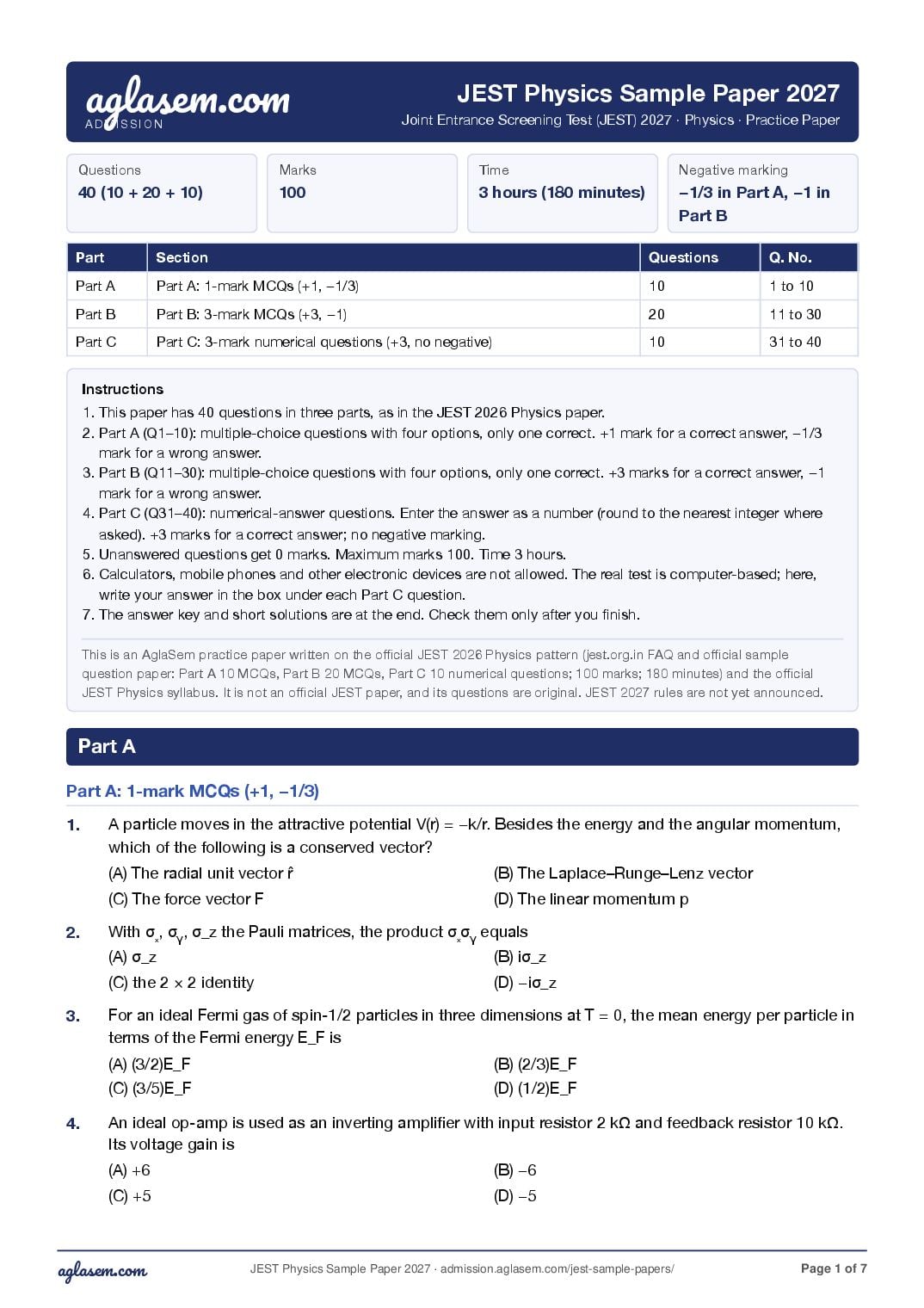
JEST Physics Sample Paper 2027
Joint Entrance Screening Test (JEST) 2027 · Physics · Practice Paper
Questions Marks Time Negative marking
40 (10 + 20 + 10) 100 3 hours (180 minutes) −1/3 in Part A, −1 in
Part B
Part Section Questions Q. No.
Part A Part A: 1-mark MCQs (+1, −1/3) 10 1 to 10
Part B Part B: 3-mark MCQs (+3, −1) 20 11 to 30
Part C Part C: 3-mark numerical questions (+3, no negative) 10 31 to 40
Instructions
1. This paper has 40 questions in three parts, as in the JEST 2026 Physics paper.
2. Part A (Q1–10): multiple-choice questions with four options, only one correct. +1 mark for a correct answer, −1/3
mark for a wrong answer.
3. Part B (Q11–30): multiple-choice questions with four options, only one correct. +3 marks for a correct answer, −1
mark for a wrong answer.
4. Part C (Q31–40): numerical-answer questions. Enter the answer as a number (round to the nearest integer where
asked). +3 marks for a correct answer; no negative marking.
5. Unanswered questions get 0 marks. Maximum marks 100. Time 3 hours.
6. Calculators, mobile phones and other electronic devices are not allowed. The real test is computer-based; here,
write your answer in the box under each Part C question.
7. The answer key and short solutions are at the end. Check them only after you finish.
This is an AglaSem practice paper written on the official JEST 2026 Physics pattern (jest.org.in FAQ and official sample
question paper: Part A 10 MCQs, Part B 20 MCQs, Part C 10 numerical questions; 100 marks; 180 minutes) and the official
JEST Physics syllabus. It is not an official JEST paper, and its questions are original. JEST 2027 rules are not yet announced.
Part A
Part A: 1-mark MCQs (+1, −1/3)
1. A particle moves in the attractive potential V(r) = −k/r. Besides the energy and the angular momentum,
which of the following is a conserved vector?
(A) The radial unit vector r̂ (B) The Laplace–Runge–Lenz vector
(C) The force vector F (D) The linear momentum p
2. With σₓ, σᵧ, σ_z the Pauli matrices, the product σₓσᵧ equals
(A) σ_z (B) iσ_z
(C) the 2 × 2 identity (D) −iσ_z
3. For an ideal Fermi gas of spin-1/2 particles in three dimensions at T = 0, the mean energy per particle in
terms of the Fermi energy E_F is
(A) (3/2)E_F (B) (2/3)E_F
(C) (3/5)E_F (D) (1/2)E_F
4. An ideal op-amp is used as an inverting amplifier with input resistor 2 kΩ and feedback resistor 10 kΩ.
Its voltage gain is
(A) +6 (B) −6
(C) +5 (D) −5
JEST Physics Sample Paper 2027 · admission./jest-sample-papers/ Page 1 of 7
Page 2
(A) A + B (B) A
(C) AB (D) Ā + B
6. If H is a Hermitian matrix, then the matrix U = exp(iH) is always
(A) unitary (B) real and symmetric
(C) Hermitian (D) nilpotent
7. Unpolarised light falls from air on a flat glass surface of refractive index √3. The reflected light is
completely plane polarised when the angle of incidence is
(A) 54.7° (B) 30°
(C) 60° (D) 45°
8. Black-body radiation in thermal equilibrium inside a two-dimensional cavity (photons confined to a
plane) has an energy per unit area proportional to
(A) T^(5/2) (B) T²
(C) T⁴ (D) T³
9. In the non-relativistic hydrogen atom, including the electron spin, the number of distinct states with
principal quantum number n = 3 is
(A) 9 (B) 12
(C) 18 (D) 6
10. The number of conjugacy classes of the symmetric group S₃ (the permutation group of three objects) is
(A) 6 (B) 2
(C) 3 (D) 4
Part B
Part B: 3-mark MCQs (+3, −1)
11. A particle of mass m moves in one dimension in the potential V(x) = V₀(x²/a² − 1)², with V₀ > 0. The
angular frequency of small oscillations about either minimum is
(A) √(4V₀/(ma²)) (B) √(16V₀/(ma²))
(C) √(2V₀/(ma²)) (D) √(8V₀/(ma²))
12. A planet moves in an elliptical orbit of eccentricity 1/2 about the Sun. The ratio of its maximum speed to
its minimum speed is
(A) 2 (B) √3
(C) 9 (D) 3
13. A particle of rest mass m moving with speed 0.6c collides with an identical particle at rest, and the two
stick together. The rest mass of the composite particle is
(A) 2m (B) (3/√2)m
(C) √5 m (D) (9/4)m
14. Two identical masses m on a frictionless horizontal line are each joined to a fixed wall by a spring of
constant k (one wall on each side) and to each other by a spring of the same constant k. The normal-
mode angular frequencies are
(A) √(k/m) and √(3k/m) (B) √(2k/m) and √(3k/m)
(C) √(k/2m) and √(3k/m) (D) √(k/m) and √(2k/m)
JEST Physics Sample Paper 2027 · admission./jest-sample-papers/ Page 2 of 7
Page 3
> R). The magnitude of the force on the charge is
(A) q²R² / [4πε₀(d² − R²)²] (B) q² / [16πε₀(d − R)²]
(C) q²Rd / [4πε₀(d² − R²)²] (D) q²R / [4πε₀ d(d − R)²]
16. Charges +q at (a, 0, 0), +q at (−a, 0, 0) and −2q at the origin form a static distribution. At a distance r ≫
a, the electrostatic potential falls off as
(A) 1/r² (B) 1/r³
(C) 1/r⁴ (D) 1/r
17. A steady current I flows in a square loop of side a. The magnitude of the magnetic field at the centre of
the square is
(A) √2 μ₀I/(πa) (B) 2√2 μ₀I/(πa)
(C) μ₀I/(2a) (D) 2μ₀I/(πa)
18. A parallel-plate capacitor with circular plates of radius R is being charged by a steady current I.
Neglecting edge effects, the magnitude of the magnetic field between the plates at a distance r < R
from the axis is
(A) μ₀Ir²/(2πR³) (B) zero
(C) μ₀I/(2πr) (D) μ₀Ir/(2πR²)
19. A particle is in the ground state of an infinite square well with walls at x = 0 and x = L. The wall at x = L
is suddenly moved to x = 2L. The probability that the particle is found in the ground state of the new
well is
(A) 8/(3π²) (B) 16/(9π²)
(C) 1/2 (D) 32/(9π²)
20. A spin-1/2 particle is in the eigenstate of S_z with eigenvalue +ħ/2. The spin component is measured
along a unit vector in the x–z plane making an angle of 60° with the z-axis. The probability of obtaining
+ħ/2 is
(A) 3/4 (B) 1/4
(C) 1/2 (D) √3/2
21. Two spin-1 particles are in the state |m₁ = 1⟩|m₂ = −1⟩. The probability that a measurement of the total
spin gives S = 0 is
(A) 1/3 (B) 2/3
(C) 1/6 (D) 1/2
22. A one-dimensional harmonic oscillator (mass m, angular frequency ω) is perturbed by H′ = λx. The
second-order correction to the ground-state energy is
(A) −λ²/(2mω²) (B) −λ²/(mω²)
(C) 0 (D) +λ²/(2mω²)
23. The trial wave function ψ(x) = e^(−α|x|) (α > 0) is used in the variational method for a one-dimensional
harmonic oscillator of frequency ω. The best upper bound obtained for the ground-state energy is
(A) ħω/√2 (B) 3ħω/4
(C) ħω/2 (D) ħω
24. N non-interacting spin-1/2 particles, each with magnetic moment μ, are in a magnetic field B at
temperature T. The mean magnetisation (moment along B) is
(A) Nμ coth(μB/kT) (B) Nμ²B/(3kT)
(C) Nμ tanh(μB/kT) (D) Nμ[coth(μB/kT) − kT/(μB)]
JEST Physics Sample Paper 2027 · admission./jest-sample-papers/ Page 3 of 7
Page 4
(A) nRT/(V − nb) (B) an²/V²
(C) 0 (D) −an²/V²
26. Black-body radiation in a cavity is expanded reversibly and adiabatically until its volume becomes 8
times the initial volume. If the initial temperature is T, the final temperature is
(A) T/4 (B) T/2
(C) T/8 (D) T/(2√2)
27. A series LCR circuit has R = 10 Ω, L = 10 mH and C = 1 μF. Its resonant angular frequency ω₀ and
quality factor Q are
(A) ω₀ = 10⁴ rad/s, Q = 100 (B) ω₀ = 10³ rad/s, Q = 10
(C) ω₀ = 10⁵ rad/s, Q = 1 (D) ω₀ = 10⁴ rad/s, Q = 10
28. In 8-bit two's complement representation, the number −45 is written as
(A) 10101101 (B) 11010011
(C) 01010011 (D) 11010010
29. The value of the integral ∫₋∞^∞ dx/(x² + 1)² is
(A) π/4 (B) π
(C) π/2 (D) 2π
30. The eigenvalues of the matrix [[2, 1, 0], [1, 2, 1], [0, 1, 2]] are
(A) 2 and 2 ± √2 (B) 1, 2 and 3
(C) 0 and 2 ± √3 (D) 2 and 2 ± √3
Part C
Part C: 3-mark numerical questions (+3, no negative)
31. A sample of hydrogen atoms is excited so that all of them are in the n = 6 level. As they return to the
ground state by all possible routes, how many distinct spectral lines can be emitted?
32. A ball is dropped from a height of 30 m onto a hard floor. The coefficient of restitution is 1/2. Neglecting
air resistance, find the total distance (in m) travelled by the ball before it comes to rest.
33. A particle has rest energy 3 GeV and total energy 5 GeV. What is its momentum in GeV/c?
34. A Carnot refrigerator keeps its cold chamber at −23 °C while rejecting heat to a room at 27 °C. What is
its coefficient of performance?
35. Evaluate (1/(πi)) ∮_C (z² + 1)/(z(z − 1)) dz, where C is the circle |z| = 2 traversed anticlockwise.
JEST Physics Sample Paper 2027 · admission./jest-sample-papers/ Page 4 of 7
Page 5
37. For a three-dimensional isotropic harmonic oscillator of angular frequency ω, find the degeneracy of the
energy level E = (9/2)ħω.
38. Five non-interacting electrons (spin 1/2) are placed in a one-dimensional infinite square well. If E₁ is the
lowest single-particle energy, find the ground-state energy of the system in units of E₁.
39. An ideal op-amp summing amplifier (inverting) has a feedback resistor of 20 kΩ. Input V₁ = 1 V is
applied through 10 kΩ and input V₂ = 0.5 V through 5 kΩ. Find the output voltage in volts.
40. Light of wavelength 600 nm falls normally on a diffraction grating with 5000 lines per cm. What is the
highest order of the principal maximum that can be observed?
JEST Physics Sample Paper 2027 · admission./jest-sample-papers/ Page 5 of 7
Page 6
1 B 2 B 3 C 4 D 5 A 6 A 7 C 8 D 9 C 10 C
11 D 12 D 13 B 14 A 15 C 16 B 17 B 18 D 19 D 20 A
21 A 22 A 23 A 24 C 25 B 26 B 27 D 28 B 29 C 30 A
31 15 32 50 33 4 34 5 35 2 36 112 37 10 38 19 39 −4 40 3
Solutions
Part A: 1-mark MCQs (+1, −1/3)
1. (B) For the Kepler (1/r) potential the Laplace–Runge–Lenz vector A = p × L − mk r̂ is conserved; it points along the
major axis and is why bound orbits are closed. Linear momentum is not conserved because there is a force.
ₖ ₖ ₖₗ ₗ
2. (B) σₓσᵧ = [[0, 1], [1, 0]][[0, −i], [i, 0]] = [[i, 0], [0, −i]] = iσ_z (generally σⱼσ = δⱼ I + iεⱼ σ ).
3. (C) The density of states in 3D is g(E) ∝ √E, so ⟨E⟩ = ∫₀^(E_F) E^(3/2) dE / ∫₀^(E_F) E^(1/2) dE = (2/5)E_F^(5/2) /
((2/3)E_F^(3/2)) = (3/5)E_F.
4. (D) For an inverting amplifier, A = −R_f/R_in = −10/2 = −5. (+6 would be the gain of the non-inverting configuration, 1
+ R_f/R_in.)
5. (A) A + ĀB = (A + Ā)(A + B) = A + B, using the distributive law X + YZ = (X + Y)(X + Z).
6. (A) U† = exp(−iH†) = exp(−iH), and since H commutes with itself, U†U = exp(−iH)exp(iH) = I. So U is unitary (its
eigenvalues e^(iλ) lie on the unit circle).
7. (C) At Brewster's angle tan θ_B = n₂/n₁ = √3, so θ_B = 60°. At this angle the reflected and refracted rays are
perpendicular.
8. (D) In d dimensions the density of photon modes per unit frequency goes as ω^(d−1), so the energy density is ∫
ω^(d−1) · ħω/(e^(ħω/kT) − 1) dω ∝ T^(d+1). For d = 2 this is T³ (and T⁴ for d = 3).
9. (C) For given n, l = 0, …, n − 1 and m = −l, …, l give n² = 9 orbital states; the two spin states double this to 2n² = 18.
ₙ
10. (C) Conjugacy classes in S correspond to cycle types. For S₃: the identity, the three transpositions, and the two 3-
cycles, so 3 classes (matching three irreducible representations).
Part B: 3-mark MCQs (+3, −1)
11. (D) The minima are at x = ±a. V′(x) = (4V₀x/a²)(x²/a² − 1), so V″(x) = (4V₀/a²)(x²/a² − 1) + 8V₀x²/a⁴, and V″(a) = 0 +
8V₀/a² = 8V₀/a². Then ω = √(V″(a)/m) = √(8V₀/(ma²)).
12. (D) Angular momentum conservation gives r_p v_p = r_a v_a, so v_max/v_min = r_a/r_p = a(1 + e)/(a(1 − e)) =
(1.5)/(0.5) = 3.
13. (B) γ = 1.25. Total energy E = (1.25 + 1)mc² = 2.25mc², momentum p = 1.25 × 0.6 mc = 0.75mc. M²c⁴ = E² − p²c² =
(5.0625 − 0.5625)m²c⁴ = 4.5 m²c⁴, so M = √4.5 m = (3/√2)m ≈ 2.12m (more than 2m because kinetic energy becomes
rest energy).
14. (A) Equations: m ẍ₁ = −kx₁ − k(x₁ − x₂), m ẍ₂ = −kx₂ − k(x₂ − x₁). The in-phase mode (x₁ = x₂) does not stretch the
middle spring: ω² = k/m. The out-of-phase mode (x₁ = −x₂) has ω² = (k + 2k)/m = 3k/m.
15. (C) The image charge is q′ = −qR/d at distance R²/d from the centre. The separation is d − R²/d = (d² − R²)/d, so F
= q · qR/d / [4πε₀((d² − R²)/d)²] = q²Rd/[4πε₀(d² − R²)²], attractive.
16. (B) The total charge is 0 (no monopole term) and the dipole moment Σqᵢrᵢ = qa x̂ − qa x̂ + 0 = 0. The first non-zero
term is the quadrupole term, which goes as 1/r³.
17. (B) Each side is at distance a/2 from the centre and subtends ±45°: B_side = [μ₀I/(4π(a/2))](sin 45° + sin 45°) = √2
μ₀I/(2πa). Four sides add: B = 4 × √2 μ₀I/(2πa) = 2√2 μ₀I/(πa).
18. (D) The displacement current I_d = I is spread uniformly over the plate area, so the current enclosed by a circle of
radius r is I r²/R². Ampère–Maxwell: B · 2πr = μ₀ I r²/R², giving B = μ₀Ir/(2πR²).
JEST Physics Sample Paper 2027 · admission./jest-sample-papers/ Page 6 of 7
Page 7
= (√2/L) × 4L/(3π) = 4√2/(3π). Probability |c|² = 32/(9π²) ≈ 0.36.
20. (A) The +ħ/2 eigenstate along n̂ (θ, φ = 0) is cos(θ/2)|↑⟩ + sin(θ/2)|↓⟩. The probability is |⟨n̂ +|↑⟩|² = cos²(θ/2) = cos²30°
= 3/4.
21. (A) The singlet is |0, 0⟩ = (1/√3)(|1, −1⟩ − |0, 0⟩ + |−1, 1⟩), so the Clebsch–Gordan coefficient ⟨1, 1; 1, −1|0, 0⟩ = 1/√3
and the probability is 1/3.
22. (A) Only ⟨1|x|0⟩ = √(ħ/2mω) is non-zero, so E⁽²⁾ = −λ²(ħ/2mω)/(ħω) = −λ²/(2mω²). This is exact: completing the
square, V = (1/2)mω²(x + λ/mω²)² − λ²/(2mω²). The first-order shift is zero.
23. (A) With the normalised state, ⟨T⟩ = ħ²α²/(2m) and ⟨x²⟩ = 1/(2α²), so E(α) = ħ²α²/(2m) + mω²/(4α²). Minimising (AM–
GM): E_min = 2√(ħ²ω²/8) = ħω/√2 ≈ 0.707ħω, above the exact ħω/2 as it must be.
24. (C) Each moment has energies ∓μB, so Z₁ = 2cosh(μB/kT) and ⟨μ_z⟩ = μ(e^(x) − e^(−x))/(e^(x) + e^(−x)) = μ tanh x
with x = μB/kT. The Langevin form (last option) is for classical dipoles.
25. (B) Using the Maxwell relation (∂S/∂V)_T = (∂P/∂T)_V: (∂U/∂V)_T = T(∂P/∂T)_V − P = nRT/(V − nb) − P = an²/V². (It is
0 for an ideal gas.)
26. (B) The entropy of a photon gas is S = (4/3)aVT³, so an adiabatic process keeps VT³ constant. With V → 8V, T³ →
T³/8, i.e. T → T/2.
27. (D) ω₀ = 1/√(LC) = 1/√(10⁻² × 10⁻⁶) = 10⁴ rad/s. Q = ω₀L/R = (10⁴ × 10⁻²)/10 = 10. The bandwidth is R/L = 10³ rad/s =
ω₀/Q.
28. (B) +45 = 00101101. Invert the bits: 11010010, then add 1: 11010011. (10101101 is the sign-magnitude form and
11010010 the one's complement.)
29. (C) Close in the upper half plane; the double pole at z = i has residue d/dz[(z + i)⁻²] at z = i = −2/(2i)³ = 1/(4i). So the
integral is 2πi × 1/(4i) = π/2.
30. (A) Write the matrix as 2I + T with T = [[0, 1, 0], [1, 0, 1], [0, 1, 0]]. T has characteristic polynomial −λ³ + 2λ, so its
eigenvalues are 0, ±√2. Hence the eigenvalues are 2 and 2 ± √2 (trace check: 6).
Part C: 3-mark numerical questions (+3, no negative)
31. (15) Answer: 15. Any pair of levels among n = 1, …, 6 gives a line, so the number is ⁶C₂ = 6 × 5/2 = 15.
32. (50) Answer: 50. After each bounce the speed is multiplied by e, so the rebound height is multiplied by e² = 1/4.
Distance = h + 2h(e² + e⁴ + …) = h(1 + e²)/(1 − e²) = 30 × 1.25/0.75 = 50 m.
33. (4) Answer: 4. E² = p²c² + m²c⁴, so pc = √(25 − 9) = 4 GeV, i.e. p = 4 GeV/c (and v = pc²/E = 0.8c).
34. (5) Answer: 5. COP = T_c/(T_h − T_c) = 250/(300 − 250) = 5.
35. (2) Answer: 2. Both poles z = 0 and z = 1 lie inside C. Res(z = 0) = (0 + 1)/(0 − 1) = −1, Res(z = 1) = (1 + 1)/1 = 2. The
contour integral is 2πi(−1 + 2) = 2πi, and dividing by πi gives 2.
36. (112) Answer: 112. J has rank 1 with eigenvalues 5 (eigenvector (1, …, 1)) and 0 (four times). So J + 2I has
eigenvalues 7, 2, 2, 2, 2 and determinant 7 × 2⁴ = 112.
37. (10) Answer: 10. E = (nₓ + n_y + n_z + 3/2)ħω, so nₓ + n_y + n_z = 3. The number of non-negative integer solutions
is (N + 1)(N + 2)/2 with N = 3, i.e. 10.
38. (19) Answer: 19. Single-particle energies are n²E₁. By the Pauli principle each level holds two electrons (spin up and
down): 2 × 1 + 2 × 4 + 1 × 9 = 19, so E = 19E₁.
39. (−4) Answer: −4. V_out = −R_f(V₁/R₁ + V₂/R₂) = −20 kΩ × (1/10 kΩ + 0.5/5 kΩ) = −(2 + 2) = −4 V.
40. (3) Answer: 3. The grating spacing is d = 1 cm/5000 = 2 μm. The condition d sin θ = nλ with sin θ ≤ 1 gives n ≤ d/λ
= 2/0.6 = 3.33, so the highest order is 3.
JEST Physics Sample Paper 2027 · admission./jest-sample-papers/ Page 7 of 7
Document Details
| Board / Org | Default |
| Exam | JEST |
| Type | Sample Paper |
| Pages | 7 |
| Language | english |
| Updated | 27 Oct 2026 |