DUET Question Paper 2019 for M.Sc Resource Management & Design Application
Finished viewing? Save it for later —
Download DUET Question Paper 2019 for M.Sc Resource Management & Design Application (PDF · 27 pages)About DUET Question Paper 2019 for M.Sc Resource Management & Design Application
DUET Question Paper 2019 for M.Sc Resource Management & Design Application is available here for free download. Published by NTA for DUET, this question paper can be viewed online or downloaded as a PDF (27 pages). Candidates preparing for DUET can use DUET Question Paper 2019 for M.Sc Resource Management & Design Application to understand the exam pattern, the type of questions asked, and the overall difficulty level.
Frequently Asked Questions
How can I download DUET Question Paper 2019 for M.Sc Resource Management & Design Application?
Open this page and click the Download button to save DUET Question Paper 2019 for M.Sc Resource Management & Design Application as a PDF. It is completely free on AglaSem Docs.
Is DUET Question Paper 2019 for M.Sc Resource Management & Design Application free to download?
Yes. DUET Question Paper 2019 for M.Sc Resource Management & Design Application can be viewed online and downloaded as a PDF free of cost on AglaSem Docs.
How many pages does DUET Question Paper 2019 for M.Sc Resource Management & Design Application have?
DUET Question Paper 2019 for M.Sc Resource Management & Design Application contains 27 pages, which you can read online or download together as a single PDF.
Where can I find more DUET study material?
You can find more DUET question papers, sample papers, syllabus, and answer keys on AglaSem Docs.
DUET Question Paper 2019 for M.Sc Resource Management & Design Application – Text
Read the full text of this question paper below — useful to quickly search, copy and reference the content online without downloading the PDF.
📄 View text version (27 pages)
Page 1
Application
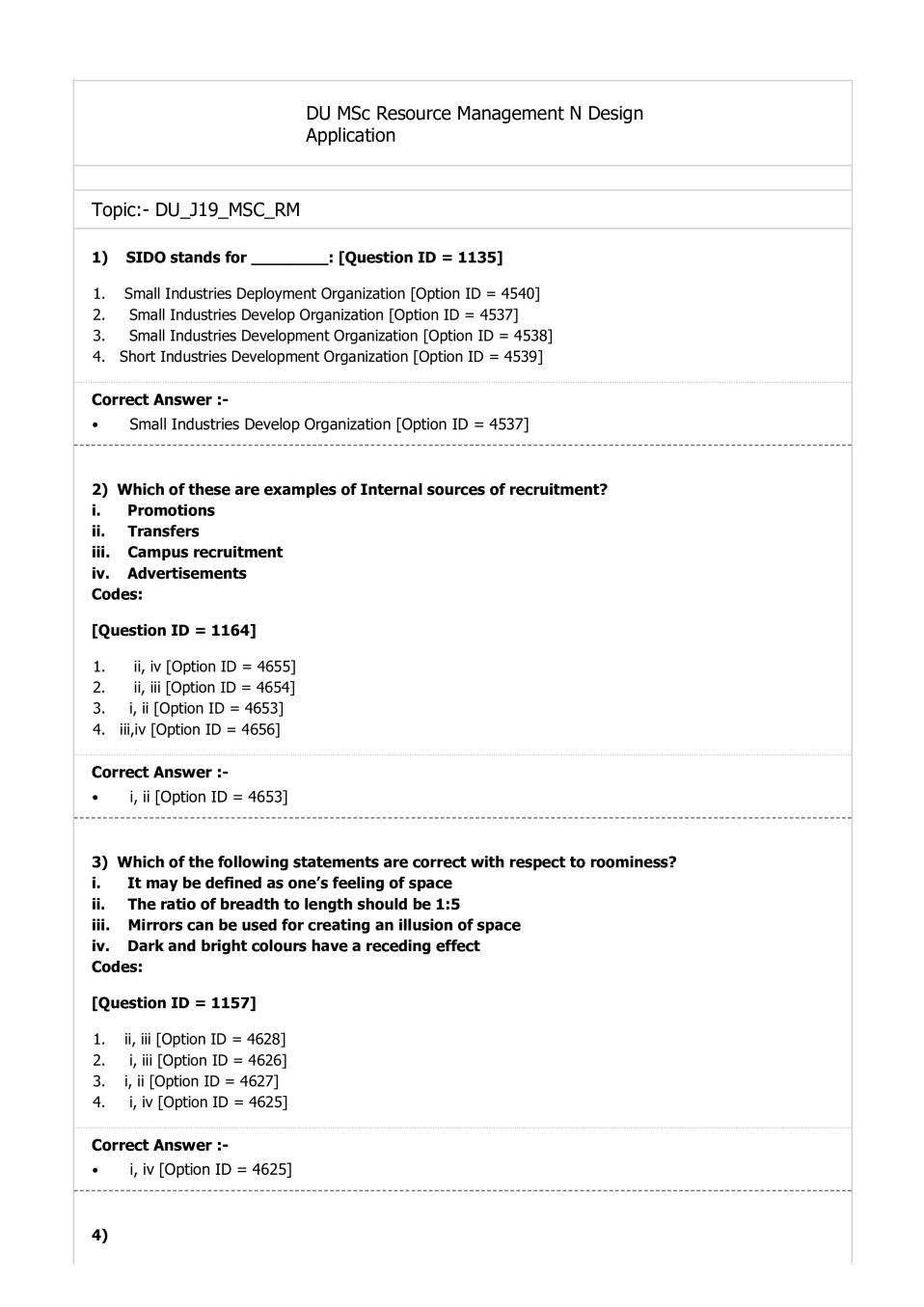
Topic:- DU_J19_MSC_RM
1) SIDO stands for ________: [Question ID = 1135]
1. Small Industries Deployment Organization [Option ID = 4540]
2. Small Industries Develop Organization [Option ID = 4537]
3. Small Industries Development Organization [Option ID = 4538]
4. Short Industries Development Organization [Option ID = 4539]
Small Industries Develop Organization [Option ID = 4537]
2) Which of these are examples of Internal sources of recruitment?
i. Promotions
ii. Transfers
iii. Campus recruitment
iv. Advertisements
[Question ID = 1164]
1. ii, iv [Option ID = 4655]
2. ii, iii [Option ID = 4654]
3. i, ii [Option ID = 4653]
4. iii,iv [Option ID = 4656]
i, ii [Option ID = 4653]
3) Which of the following statements are correct with respect to roominess?
i. It may be defined as one’s feeling of space
ii. The ratio of breadth to length should be 1:5
iii. Mirrors can be used for creating an illusion of space
iv. Dark and bright colours have a receding effect
[Question ID = 1157]
1. ii, iii [Option ID = 4628]
2. i, iii [Option ID = 4626]
3. i, ii [Option ID = 4627]
4. i, iv [Option ID = 4625]
i, iv [Option ID = 4625]
4)
Page 2
i. It is a step-by-step description of a worker performing a task
ii. Movement from one place to another is indicated by an inverted triangle
iii. It shows the flow of movement in a task
iv. A set of standard symbols are used for charting an activity using a process chart
[Question ID = 1178]
1. ii, iii, iv [Option ID = 4710]
2. i, ii, iv [Option ID = 4712]
3. i, iii, iv [Option ID = 4711]
4. i, ii, iii [Option ID = 4709]
i, ii, iii [Option ID = 4709]
5) Which of the following statements hold TRUE for Static Contractions?
i. It is a kind of muscle action
ii. It represents muscle tension which is insufficient to move a body part against a given
resistance
iii. The length of the muscle keeps on changing
iv. An example of static contraction is attempting to lift an immovable object
[Question ID = 1163]
1. i, ii, iv [Option ID = 4651]
2. i, iii, iv [Option ID = 4649]
3. i, ii, iii [Option ID = 4652]
4. ii, iii, iv [Option ID = 4650]
i, iii, iv [Option ID = 4649]
6) Which of the following are external forces that impact Human Resource Planning?
i. Economic
ii. Technological
iii. Strategy, task and leadership
iv. Organizational culture & conflict
[Question ID = 1166]
1. ii, iii [Option ID = 4664]
2. i, iii, iv [Option ID = 4662]
3. i, ii [Option ID = 4663]
4. i, ii, iii [Option ID = 4661]
i, ii, iii [Option ID = 4661]
7) Which of the following is NOT a ratio of proportion according to the Greek golden section?
[Question ID = 1125]
Page 3
2. 2:3 [Option ID = 4497]
3. 3:5 [Option ID = 4498]
4. 8:13 [Option ID = 4500]
2:3 [Option ID = 4497]
8) Which of the following criteria are important considerations for designing seats
ergonomically?
i. Seat height
ii. Arm rest and backrest
iii. Seat depth & seat width
iv. Color of seat
[Question ID = 1162]
1. ii, iii, iv [Option ID = 4646]
2. i, iii, iv [Option ID = 4648]
3. i, ii, iii [Option ID = 4645]
4. i, ii, iv [Option ID = 4647]
i, ii, iii [Option ID = 4645]
9) Which of the following methods are used for obtaining secondary data?
i. Observation
ii. Questionnaire
iii. Books
iv. Journals
[Question ID = 1182]
1. ii, iii [Option ID = 4726]
2. i, ii [Option ID = 4727]
3. i, iii [Option ID = 4725]
4. iii, iv [Option ID = 4728]
i, iii [Option ID = 4725]
10) Which of the following are modern methods of performance appraisal?
i. Critical Incident
ii. MBO
iii. 360 degree appraisal
iv. Psychological appraisal
[Question ID = 1165]
1. i, ii, iii [Option ID = 4657]
2. i, iii, iv [Option ID = 4658]
3. i, ii, iv [Option ID = 4659]
Page 4
i, ii, iii [Option ID = 4657]
11) Which of the following scales are used for drafting floor plans?
i. Erasing Shields
ii. Architect’s Scale
iii. Metric Scale
iv. Template
[Question ID = 1156]
1. ii, iii [Option ID = 4622]
2. iii, iv [Option ID = 4623]
3. i, iii [Option ID = 4621]
4. ii, iv [Option ID = 4624]
i, iii [Option ID = 4621]
12) Which of the following is an effective way of arranging furniture?
[Question ID = 1130]
1. Place all the furniture in the sun [Option ID = 4517]
2. Place furniture close to the walls [Option ID = 4519]
3. Place furniture in places where there is no focal point [Option ID = 4518]
4. Place furniture in the middle of the room [Option ID = 4520]
Place all the furniture in the sun [Option ID = 4517]
13) Job specification does NOT include:
[Question ID = 1122]
1. Job duties [Option ID = 4487]
2. Skills, knowledge and abilities [Option ID = 4488]
3. Work experience [Option ID = 4486]
4. Education [Option ID = 4485]
Education [Option ID = 4485]
14) SDGs stand for:
[Question ID = 1123]
1. Sustainable Development Guidelines [Option ID = 4492]
2. Sustainable Development Goals [Option ID = 4491]
3. Sustainability Deforestation Guidelines [Option ID = 4490]
4. Sustainability Decarbonizing Goals [Option ID = 4489]
Page 5
15) Which colour scheme represents tints and shades of a single colour?
[Question ID = 1124]
1. Complimentary colour scheme [Option ID = 4493]
2. Analogous colour scheme [Option ID = 4496]
3. Split-complimentary colour scheme [Option ID = 4495]
4. Monochromatic colour scheme [Option ID = 4494]
Complimentary colour scheme [Option ID = 4493]
16) Following are the methods of calculating National Income:
i. Product method
ii. Direct Tax method
iii. Income method
iv. Expenditure method
[Question ID = 1167]
1. i, ii, iii [Option ID = 4665]
2. i, iii, iv [Option ID = 4668]
3. i, ii, iv [Option ID = 4667]
4. ii, iii, iv [Option ID = 4666]
i, ii, iii [Option ID = 4665]
17) Which of the following are shown in the floor plan of a house?
i. Wall painting
ii. Furniture
iii. Flooring material
iv. Indoor plants
[Question ID = 1158]
1. i, ii, iv [Option ID = 4630]
2. i, iii, iv [Option ID = 4629]
3. i, ii, iii [Option ID = 4631]
4. ii, iii, iv [Option ID = 4632]
i, iii, iv [Option ID = 4629]
18) Which of the following statements are INCORRECT with respect to Goals?
i. They are more easily defined and understood than values
ii. They are only long-term
iii. They might change over a period of time
Page 6
[Question ID = 1177]
1. ii, iv [Option ID = 4706]
2. i, ii [Option ID = 4705]
3. i, iv [Option ID = 4708]
4. iii, iv [Option ID = 4707]
i, ii [Option ID = 4705]
19) Which of the following statements hold TRUE for budgeting?
i. It is a financial plan made for a specific time period
ii. It helps in determining wasteful expenditure
iii. It helps in allocating and prioritizing income
iv. It requires little time and attention
[Question ID = 1175]
1. i, iii, iv [Option ID = 4699]
2. i, ii, iv [Option ID = 4700]
3. ii, iii, iv [Option ID = 4698]
4. i, ii, iii [Option ID = 4697]
i, ii, iii [Option ID = 4697]
20) Which of the following are requirements of a good decorative design?
i. Moderate use
ii. Express individuality
iii. Create emphasis
iv. Simplicity
[Question ID = 1160]
1. i, ii, iii [Option ID = 4640]
2. i, iii, iv [Option ID = 4637]
3. i, ii, iv [Option ID = 4639]
4. ii, iii, iv [Option ID = 4638]
i, iii, iv [Option ID = 4637]
21) Which of the following does NOT come under 5C’s of event management?
[Question ID = 1119]
1. Customization [Option ID = 4473]
2. Costing [Option ID = 4474]
3. Canvassing [Option ID = 4476]
4. Contingency [Option ID = 4475]
Page 7
22) Which of the following is NOT a stage of skill acquisition as given by Seymour?
[Question ID = 1117]
1. Diminishing conscious attention [Option ID = 4467]
2. Structuring sensory motor patterns [Option ID = 4465]
3. Developing work curve [Option ID = 4466]
4. Learning the sequence of activity [Option ID = 4468]
Structuring sensory motor patterns [Option ID = 4465]
23) Which of these is NOT a type of environmental barrier for entrepreneurship?
[Question ID = 1131]
1. Economic [Option ID = 4522]
2. Political [Option ID = 4524]
3. Motivational [Option ID = 4521]
4. Social [Option ID = 4523]
Motivational [Option ID = 4521]
24) Which of these is NOT a feature of a partnership firm?
[Question ID = 1133]
1. It must be formed via a legal agreement between all partners [Option ID = 4532]
2. Minors can enter into a partnership contract [Option ID = 4531]
3. There is an agreement between the partners to share the profits or losses of the business [Option ID =
4530]
4. It involves two or more people [Option ID = 4529]
It involves two or more people [Option ID = 4529]
25) In the context of income tax department, PAN stands for:
[Question ID = 1150]
1. Permanent Activated Number [Option ID = 4600]
2. Preliminary Account Number [Option ID = 4597]
3. Preliminary Activated Number [Option ID = 4599]
4. Permanent Account Number [Option ID = 4598]
Preliminary Account Number [Option ID = 4597]
26) MKS system of measurement is?
Page 8
1. Mile, Kilolitre, Second [Option ID = 4512]
2. Mile, Kilogram, Second [Option ID = 4510]
3. Metre, Kilogram, Second [Option ID = 4509]
4. Metre, Kilolitre, Second [Option ID = 4511]
Metre, Kilogram, Second [Option ID = 4509]
27) Triple Bottom Line for Sustainable Development consists of:
i. Environmental Sustainability
ii. Economic Sustainability
iii. Welfare Sustainability
iv. Social Sustainability
[Question ID = 1155]
1. ii, iii, iv [Option ID = 4617]
2. i, ii, iii [Option ID = 4619]
3. i, ii, iv [Option ID = 4618]
4. i, iii, iv [Option ID = 4620]
ii, iii, iv [Option ID = 4617]
28) ________________ means the special right given by the producer of a product (brand) to
another firm to sell his product in a particular locality:
[Question ID = 1140]
1. Franchise [Option ID = 4558]
2. Franchiser [Option ID = 4559]
3. Outsourcing [Option ID = 4560]
4. Franchisee [Option ID = 4557]
Franchisee [Option ID = 4557]
29) ______________ is a word, mark, symbol, device or a combination thereof used to identify
a product or service.
[Question ID = 1149]
1. Trademark [Option ID = 4594]
2. Packaging [Option ID = 4595]
3. Labeling [Option ID = 4596]
4. Brand [Option ID = 4593]
Brand [Option ID = 4593]
30)
Page 9
i. Energy efficiency
ii. Water efficiency
iii. Indoor environmental quality enhancement
iv. Waste maximization
[Question ID = 1154]
1. i, iii, iv [Option ID = 4614]
2. i, ii, iii [Option ID = 4613]
3. i, ii, iv [Option ID = 4616]
4. ii, iii, iv [Option ID = 4615]
i, ii, iii [Option ID = 4613]
31) Following are the consumer problems related to services:
i. Incourteous staff
ii. Fly by night operators
iii. Sharing personal information with other marketers
iv. Incorrect weights and measures
[Question ID = 1169]
1. i, ii, iii [Option ID = 4674]
2. i, ii, iv [Option ID = 4675]
3. i, iii, iv [Option ID = 4676]
4. ii, iii, iv [Option ID = 4673]
ii, iii, iv [Option ID = 4673]
32) Following are some basic considerations in setting up a new business enterprise:
i. Form of ownership
ii. Location of the business
iii. Size of the business
iv. Tax evasion
[Question ID = 1161]
1. i, ii, iv [Option ID = 4644]
2. i, iii, iv [Option ID = 4643]
3. ii, iii, iv [Option ID = 4642]
4. i, ii, iii [Option ID = 4641]
i, ii, iii [Option ID = 4641]
33) Purchasing power in rupees and paisa that goes into the family treasury in a given period
of time is called:
[Question ID = 1148]
Page 10
2. Psychic income [Option ID = 4591]
3. Community income [Option ID = 4592]
4. Money income [Option ID = 4589]
Money income [Option ID = 4589]
34) Management can be considered as universal in the following ways:
i. It is an inevitable function in all organisations
ii. Managerial skills are transferable from one type of organisation to another
iii. Government establishments do not require management for their functioning
iv. Management does not permeate through all organisations
[Question ID = 1174]
1. i, iv [Option ID = 4696]
2. i, ii [Option ID = 4693]
3. ii, iii [Option ID = 4694]
4. iii, iv [Option ID = 4695]
i, ii [Option ID = 4693]
35) WAWE stands for ___________:
[Question ID = 1136]
1. Wide Association of Women Entrepreneurship [Option ID = 4544]
2. World Association of Women Entrepreneurs [Option ID = 4542]
3. Wide Association of Women Enterprises [Option ID = 4541]
4. World Assembly of Women Entrepreneurship [Option ID = 4543]
Wide Association of Women Enterprises [Option ID = 4541]
36) Rear set back is:
[Question ID = 1129]
1. Closed area at the back of building [Option ID = 4516]
2. Closed area at the side of building [Option ID = 4513]
3. Open area at the side of building [Option ID = 4514]
4. Open area at the back of building [Option ID = 4515]
Closed area at the side of building [Option ID = 4513]
37) Following activities can be considered as training:
i. Classroom training
ii. Workshops and seminars
iii. Personal interview
Page 11
[Question ID = 1180]
1. i, ii, iv [Option ID = 4718]
2. i, iii, iv [Option ID = 4720]
3. i, ii, iii [Option ID = 4717]
4. ii, iii, iv [Option ID = 4719]
i, ii, iii [Option ID = 4717]
38) Following are the various methods of maintaining household records:
i. Envelope method
ii. Share method
iii. Sheet method
iv. Notebook method
[Question ID = 1173]
1. i, ii, iv [Option ID = 4691]
2. i, iii, iv [Option ID = 4690]
3. i, ii, iii [Option ID = 4692]
4. ii, iii, iv [Option ID = 4689]
ii, iii, iv [Option ID = 4689]
39) Following are the forms of direct marketing:
i. Face-to-face selling
ii. Print advertisement
iii. Telemarketing
iv. Marketing through SMS
[Question ID = 1172]
1. i, iii, iv [Option ID = 4687]
2. i, ii, iii [Option ID = 4685]
3. i, ii, iv [Option ID = 4688]
4. ii, iii, iv [Option ID = 4686]
i, ii, iii [Option ID = 4685]
40) Following are some of the sales promotion schemes offered by companies in the market
place:
i. Discounts
ii. Free gifts
iii. Lucky draws
iv. Pamphlets
[Question ID = 1171]
Page 12
2. i, iii, iv [Option ID = 4683]
3. i, ii, iii [Option ID = 4681]
4. i, ii, iv [Option ID = 4684]
i, ii, iii [Option ID = 4681]
41) Following are some of the features of management:
i. It is purposeful
ii. It is a social process
iii. It is tangible
iv. It is a dynamic discipline
[Question ID = 1179]
1. ii, iii, iv [Option ID = 4714]
2. i, ii, iii [Option ID = 4713]
3. i, ii, iv [Option ID = 4716]
4. i, iii, iv [Option ID = 4715]
i, ii, iii [Option ID = 4713]
42) Following are the advantages of lecture method as a method of training:
i. It is useful if number of trainees is large and teaching resources are scarce
ii. It facilitates active participation of trainees
iii. It is useful when basic theoretical knowledge has to be built up
iv. It accomplishes attitudinal changes by placing trainees in specified roles
[Question ID = 1181]
1. i, iv [Option ID = 4721]
2. i, iii [Option ID = 4724]
3. ii, iii [Option ID = 4723]
4. i, ii [Option ID = 4722]
i, iv [Option ID = 4721]
43) Following are the ways in which one can include rest periods between tasks:
i. Lying down
ii. Running on a treadmill
iii. Alternating light and heavy tasks
iv. Switching to a relaxing activity
[Question ID = 1176]
1. i, iii, iv [Option ID = 4703]
2. ii, iii, iv [Option ID = 4702]
3. i, ii, iv [Option ID = 4704]
4. i, ii, iii [Option ID = 4701]
Page 13
44) Product mix does not include:
[Question ID = 1132]
1. Brand [Option ID = 4525]
2. Color [Option ID = 4526]
3. Package [Option ID = 4527]
4. Publicity [Option ID = 4528]
Brand [Option ID = 4525]
45) COPRA stands for: [Question ID = 1146]
1. Consumer Prevention Act [Option ID = 4581]
2. Consumer Prevention Action [Option ID = 4584]
3. Consumer Protection Act [Option ID = 4583]
4. Consumer Protection Action [Option ID = 4582]
Consumer Prevention Act [Option ID = 4581]
46) Identify all the personal factors affecting consumer behaviour:
i. Reference groups
ii. Income
iii. Lifestyle
iv. Occupation
[Question ID = 1168]
1. ii, iii, iv [Option ID = 4670]
2. i, iv [Option ID = 4672]
3. i, ii, iii [Option ID = 4671]
4. ii, iii [Option ID = 4669]
ii, iii [Option ID = 4669]
47) According to Gross and Crandall, family income consists of:
i. Money income
ii. Real income
iii. Psychic income
iv. Community income
[Question ID = 1170]
1. i, iii, iv [Option ID = 4680]
2. i, ii, iii [Option ID = 4678]
3. i, ii, iv [Option ID = 4677]
4. ii, iii, iv [Option ID = 4679]
Page 14
48) ____________ is obtained by screening the main entrance by means of a porch or by
plantation.
[Question ID = 1126]
1. Aspect [Option ID = 4503]
2. Prospect [Option ID = 4502]
3. Internal Privacy [Option ID = 4504]
4. External privacy [Option ID = 4501]
External privacy [Option ID = 4501]
49) In context of Training Evaluation Method, CIRO stands for:
[Question ID = 1152]
1. Context, Input, Reaction & Outstanding [Option ID = 4606]
2. Content, Input, Resistance & Output [Option ID = 4608]
3. Context, Input, Reaction & Outcome [Option ID = 4607]
4. Content, Input, Reaction & Outcome [Option ID = 4605]
Content, Input, Reaction & Outcome [Option ID = 4605]
50) When sample is selected by dividing the population into different sub-groups or strata, it is
called: [Question ID = 1139]
1. Systematic Sampling [Option ID = 4555]
2. Simple random sampling [Option ID = 4556]
3. Multi-stage sampling [Option ID = 4553]
4. Stratified random sampling [Option ID = 4554]
Multi-stage sampling [Option ID = 4553]
51) Time and motion study technique dealing with the movement of right and left hand of the
worker is known as: [Question ID = 1144]
1. Process chart [Option ID = 4573]
2. Pathway chart [Option ID = 4574]
3. Micro-motion film analysis [Option ID = 4576]
4. Operation chart [Option ID = 4575]
Process chart [Option ID = 4573]
52) Which of the following is NOT related to invention? [Question ID = 1134]
1. It involves conceiving new ideas [Option ID = 4533]
2. It means conversion of an idea into real life application [Option ID = 4536]
3. It leads to discovery of new products, materials and methods [Option ID = 4535]
Page 15
It involves conceiving new ideas [Option ID = 4533]
53) Which of the following skills are NOT required by managers at different levels in a corporate
setting? [Question ID = 1153]
1. Technical skill [Option ID = 4609]
2. Human skill [Option ID = 4610]
3. Conceptual skill [Option ID = 4611]
4. Culinary skill [Option ID = 4612]
Technical skill [Option ID = 4609]
54) Which of the following is the most suitable wall finish/material for sink areas in the kitchen?
[Question ID = 1142]
1. Tiles [Option ID = 4568]
2. Paint [Option ID = 4567]
3. Wallpaper [Option ID = 4565]
4. Wood panels [Option ID = 4566]
Wallpaper [Option ID = 4565]
55) Which of the following is an intermediate slab constructed between two floors for storage
purposes, normally cast at lintel level, open on one or both sides for access? [Question ID =
1141]
1. Setback [Option ID = 4562]
2. Tread [Option ID = 4563]
3. Barsati [Option ID = 4561]
4. Loft [Option ID = 4564]
Barsati [Option ID = 4561]
56) In Company ABC, middle & low level managers are also given the authority to be a part of
the decision making process. It is called: [Question ID = 1116]
1. Centralization [Option ID = 4461]
2. Decentralization [Option ID = 4462]
3. Span of control [Option ID = 4463]
4. Downsizing [Option ID = 4464]
Centralization [Option ID = 4461]
57) Semi-detached houses have:
i. One common wall
ii. Only two sides open
iii. Cost is higher than row houses
Page 16
[Question ID = 1159]
1. i, ii, iv [Option ID = 4636]
2. i, iii, iv [Option ID = 4635]
3. ii, iii, iv [Option ID = 4634]
4. i, ii, iii [Option ID = 4633]
i, ii, iii [Option ID = 4633]
58) Resources may be defined as: [Question ID = 1118]
1. Family objectives [Option ID = 4469]
2. Rhythm in movement [Option ID = 4472]
3. Tools of energy management [Option ID = 4471]
4. Means to achieve goals [Option ID = 4470]
Family objectives [Option ID = 4469]
59) CSR stands for: [Question ID = 1138]
1. Cooperation Social Responsibility [Option ID = 4549]
2. Corporate Social Responsibility [Option ID = 4552]
3. Cooperative Social Responsibility [Option ID = 4550]
4. Corporation Social Responsibility [Option ID = 4551]
Cooperation Social Responsibility [Option ID = 4549]
60) According to Abraham Maslow, _________ are the lowest level needs in the hierarchy of
needs: [Question ID = 1120]
1. Self-esteem needs [Option ID = 4478]
2. Safety & security needs [Option ID = 4480]
3. Social needs [Option ID = 4477]
4. Physiological needs [Option ID = 4479]
Social needs [Option ID = 4477]
61) Which of the following is a part of the cognitive component of worker input? [Question ID =
1143]
1. Knowledge [Option ID = 4572]
2. Feelings [Option ID = 4569]
3. Time management [Option ID = 4570]
4. Health [Option ID = 4571]
Feelings [Option ID = 4569]
62)
Page 17
List I List II
a. Digital display i. Pedometer
b. Analogous display ii. Wrist watch with dial
c. Qualitative display iii. Stop, Caution & Go signals of a traffic light
d. Representational display iv. Railway signal boxes
[Question ID = 1214]
1. a. ii, b. i, c. iv, d. iii [Option ID = 4853]
2. a. ii, b. i, c. iii, d. iv [Option ID = 4854]
3. a. i, b. ii, c. iv, d. iii [Option ID = 4855]
4. a. i, b. ii, c. iii, d. iv [Option ID = 4856]
a. ii, b. i, c. iv, d. iii [Option ID = 4853]
63) Match the items in List I with items in List II:
List I List II
a. Task lighting i. Spot light
b. General lighting ii. Cove lighting
c. Ambient lighting iii. Tube light
d. Accent lighting iv. Study lamp
[Question ID = 1213]
1. a. iii, b. iv, c. ii, d. i [Option ID = 4851]
2. a. iii, b. iv, c. i, d. ii [Option ID = 4849]
3. a. iv, b. i, c. ii, d. iii [Option ID = 4852]
4. a. iv, b. iii, c. ii, d. i [Option ID = 4850]
a. iii, b. iv, c. i, d. ii [Option ID = 4849]
64) Match the items in List I with items in List II:
List I List II
a. Class I changes i. Trip-frequency chart
b. Psychic income ii. Evaluating a time plan
c. Psychological fatigue iii. Changes in bodily activities of worker
d. Pathway chart iv. Satisfaction derived from use of real income
e. Gantt chart v. Boredom & frustration
[Question ID = 1204]
1. a. iii, b. iv, c. v, d. ii, e. i [Option ID = 4815]
2. a. iii, b. iv, c. v, d. i, e. ii [Option ID = 4816]
3. a. iii, b. v, c. iv, d. ii, e. i [Option ID = 4813]
4. a. ii, b. v, c. iv, d. iii, e. i [Option ID = 4814]
a. iii, b. v, c. iv, d. ii, e. i [Option ID = 4813]
Page 18
List I List II
a. Butter/Ghee i. Metanil yellow
b. Asafoetida ii. Castor oil
c. Sweets iii. Mashed potato
d. Edible oil iv. Non-edible resin/gum
[Question ID = 1209]
1. a. iii, b. iv, c. i, d. ii [Option ID = 4833]
2. a. iv, b. i, c. ii, d. iii [Option ID = 4836]
3. a. iv, b. ii, c. iii, d. i [Option ID = 4835]
4. a. ii, b. iii, c. i, d. iv [Option ID = 4834]
a. iii, b. iv, c. i, d. ii [Option ID = 4833]
66) Match the items in List I with items in List II:
List I List II
a. Flip chart i. Video Cassette recorder (VCR)
b. Over head projector (OHP) ii. Board covered with felt cloth
c. Tele-visual Aid iii. Sheets of paper clamped to an easel or whiteboard
d. Flannel board iv. Acetate transparencies prepared with pens
[Question ID = 1215]
1. a. iii, b. iv, c. ii, d. i [Option ID = 4858]
2. a. iii, b. iv, c. i, d. ii [Option ID = 4860]
3. a. ii, b. iv, c. iii, d. i [Option ID = 4859]
4. a. ii, b. iii, c. i, d. iv [Option ID = 4857]
a. ii, b. iii, c. i, d. iv [Option ID = 4857]
67) Match the items in List I with items in List II:
List I List II
a. Preparation stage i. Careful and deliberate search
b. Idea germination ii. Recognition of technical feasibility
c. Illumination iii. Initial stage of a new idea
d. Incubation iv. Testing the value of the idea
e. Verification v. Gathering of information
[Question ID = 1211]
1. a. i, b. iv, c. iii, d. ii, e. v [Option ID = 4844]
2. a. iii, b. iv, c. v, d. i, e. ii [Option ID = 4842]
3. a. iii, b. iv, c. ii, d. i, e. v [Option ID = 4843]
4. a. i, b. iii, c. ii, d. v, e. iv [Option ID = 4841]
a. i, b. iii, c. ii, d. v, e. iv [Option ID = 4841]
Page 19
List I List II
a. Informative advertising i. Aims to create liking, preference, conviction and purchase
of a new product or service
b. Persuasive advertising ii. Aims to convince current purchasers that they have made
the right choice
c. Reinforcement advertising iii. Aims to stimulate repeat purchase of products and services
d. Reminder advertising iv. Aims to create brand awareness and knowledge of new
products or new features of existing products.
[Question ID = 1210]
1. a. iii, b. i, c. iv, d. ii [Option ID = 4837]
2. a. iv, b. i, c. ii, d. iii [Option ID = 4840]
3. a. iv, b. ii, c. iii, d. i [Option ID = 4839]
4. a. ii, b. iii, c. i, d. iv [Option ID = 4838]
a. iii, b. i, c. iv, d. ii [Option ID = 4837]
69) Match the items in List I with items in List II:
List I List II
a. Values i. Conventional & Non-conventional
b. Standards ii. Realizing one’s potential for continued self-development
c. Theory X iii. Motivating forces in human behaviour that provide basis for judgment
d. Self-actualization iv. Work shirkers
[Question ID = 1207]
1. a. iii, b. i, c. iv, d. ii [Option ID = 4825]
2. a. iii, b. iv, c. i, d. ii [Option ID = 4827]
3. a. iv, b. i, c. ii, d. iii [Option ID = 4828]
4. a. ii, b. i, c. iv, d. iii [Option ID = 4826]
a. iii, b. i, c. iv, d. ii [Option ID = 4825]
70) Match the items in List I with items in List II:
List I List II
a. Character i. Ability to pay
b. Capital ii. Desire to pay
c. Capacity iii. Money & securities owned
d. Collateral iv. Assets pledged for a loan or credit
[Question ID = 1208]
1. a. iv, b. i, c. ii, d. iii [Option ID = 4832]
2. a. iv, b. ii, c. iii, d. i [Option ID = 4831]
3. a. ii, b. iii, c. i, d. iv [Option ID = 4829]
4. a. ii, b. iii, c. iv, d. i [Option ID = 4830]
Page 20
71) Match the items in List I with items in List II:
List I List II
a. Emphasis i. Symmetry
b. Rhythm ii. Impression of unity
c. Balance iii. Focal point
d. Harmony iv. Repetition
[Question ID = 1212]
1. a. iii, b. iv, c. ii, d. i [Option ID = 4845]
2. a. iii, b. iv, c. i, d. ii [Option ID = 4847]
3. a. ii, b. i, c. iv, d. iii [Option ID = 4848]
4. a. i, b. ii, c. iii, d. iv [Option ID = 4846]
a. iii, b. iv, c. ii, d. i [Option ID = 4845]
72) Match the items in List I with items in List II:
List I List II
a. Charanka Park, Gujarat i. Solar energy
b. Biomass ii. Hydropower
c. The Jaisalmer Park, Rajasthan iii. Wind energy
d. Tehri Dam, Uttarakhand iv. Agricultural waste
[Question ID = 1202]
1. a. ii, b. iii, c. i, d. iv [Option ID = 4806]
2. a. ii, b. iv, c. i, d. iii [Option ID = 4808]
3. a. i, b. iv, c. iii, d. ii [Option ID = 4807]
4. a. i, b. ii, c. iii, d. iv [Option ID = 4805]
a. i, b. ii, c. iii, d. iv [Option ID = 4805]
73) Match the items in List I with items in List II:
List I List II
a. Centre of gravity i. Product of weight of a body and the velocity with which it is
moving
b. Rhythm ii. Minimized effect of a weight while carrying it through proper use
of levers
c. Momentum iii. Succession of movements at the same tempo
d. Leverage iv. Point at which mass of a body is thought to be concentrated
[Question ID = 1206]
1. a. iv, b. i, c. ii, d. iii [Option ID = 4821]
2. a. iv, b. iii, c. i, d. ii [Option ID = 4823]
3. a. i, b. ii, c. iii, d. iv [Option ID = 4822]
4. a. iv b., iii, c. ii, d. i [Option ID = 4824]
Page 21
74) Match the items in List I with items in List II:
List I List II
a. Planning i. Dividing and combining activities
b. Organizing ii. Monitoring
c. Supervision iii. Checking performance
d. Controlling iv. Creation and maintenance of a plan
[Question ID = 1205]
1. a. iv, b. i, c. ii, d. iii [Option ID = 4817]
2. a. iv, b. ii, c. iii, d. i [Option ID = 4819]
3. a. iv, b. iii, c. ii, d. i [Option ID = 4820]
4. a. i, b. ii, c. iii, d. iv [Option ID = 4818]
a. iv, b. i, c. ii, d. iii [Option ID = 4817]
75) Match the items in List I with items in List II:
List I List II
a. Plot area i. Constructed areas covered by the roof
b. Covered area ii. Floor area of rooms excluding area covered by the walls
c. Plinth area iii. Land area available for construction
d. Carpet area iv.Raised area above the foundation
[Question ID = 1203]
1. a. iii, b. i, c. iv, d. ii [Option ID = 4812]
2. a. iii, b. iv, c. i, d. ii [Option ID = 4811]
3. a. iii, b. ii, c. iv, d. i [Option ID = 4810]
4. a. i, b. iii, c. ii, d. iv [Option ID = 4809]
a. i, b. iii, c. ii, d. iv [Option ID = 4809]
76) Assertion (A): Frustration fatigue occurs when a person faces a conflicting situation.
Reason (R): Frustration fatigue can be successfully overcome by eating.
[Question ID = 1183]
1. Both (A) and (R) are correct [Option ID = 4731]
2. (A) is wrong but (R) is correct [Option ID = 4730]
3. (A) is correct but (R) is wrong [Option ID = 4729]
4. Both (A) and (R) are wrong [Option ID = 4732]
(A) is correct but (R) is wrong [Option ID = 4729]
77)
Page 22
Reason (R): Innovation is followed by creativity.
[Question ID = 1195]
1. Both (A) and (R) are wrong [Option ID = 4780]
2. Both (A) and (R) are correct [Option ID = 4779]
3. (A) is wrong, but (R) is correct [Option ID = 4778]
4. (A) is correct, but (R) is wrong [Option ID = 4777]
(A) is correct, but (R) is wrong [Option ID = 4777]
78) Assertion (A): There should be direct access from the main entrance of the house to the
bedroom.
Reason (R): Dining room should be located next to the bathroom.
[Question ID = 1198]
1. Both (A) and (R) are correct [Option ID = 4791]
2. (A) is wrong, but (R) is correct [Option ID = 4790]
3. Both (A) and (R) are wrong [Option ID = 4792]
4. (A) is correct, but (R) is wrong [Option ID = 4789]
(A) is correct, but (R) is wrong [Option ID = 4789]
79) Assertion (A): Entrepreneurship is an economic activity.
Reasoning (R): Entrepreneurship involves the creation and operation of an enterprise.
[Question ID = 1193]
1. Both (A) and (R) are wrong [Option ID = 4772]
2. Both (A) and (R) are correct [Option ID = 4771]
3. (A) is wrong, but (R) is correct [Option ID = 4770]
4. (A) is correct, but (R) is wrong [Option ID = 4769]
(A) is correct, but (R) is wrong [Option ID = 4769]
80) Assertion (A): Engel’s law states that with an increase in income, the percentage of income
spent on necessities will decrease.
Reason (R): As a family’s income increases, it spends more and more on comforts and luxuries.
[Question ID = 1187]
1. (A) is correct, but (R) is wrong [Option ID = 4745]
2. Both (A) and (R) are wrong [Option ID = 4748]
3. Both (A) and (R) are correct [Option ID = 4747]
4. (A) is wrong, but (R) is correct [Option ID = 4746]
Page 23
81) Assertion (A): System’s Approach studies the interrelated and interdependent parts of an
organization as they interact with their environments.
Reason (R): System’s Approach offers problem-solving mechanism with the help of mathematical
tools and techniques.
[Question ID = 1186]
1. Both (A) and (R) are correct [Option ID = 4743]
2. Both (A) and (R) are wrong [Option ID = 4744]
3. (A) is wrong but (R) is correct [Option ID = 4742]
4. (A) is correct but (R) is wrong [Option ID = 4741]
(A) is correct but (R) is wrong [Option ID = 4741]
82) Assertion (A): World Consumer Rights Day has its origins in former US President Abraham
Lincoln’s declaration of four basic consumer rights.
Reason (R): World Consumer Rights Day is celebrated on March 10.
[Question ID = 1190]
1. (A) is wrong, but (R) is correct [Option ID = 4758]
2. Both (A) and (R) are wrong [Option ID = 4760]
3. Both (A) and (R) are correct [Option ID = 4759]
4. (A) is correct, but (R) is wrong [Option ID = 4757]
(A) is correct, but (R) is wrong [Option ID = 4757]
83) Assertion (A): Warm-up periods do not contribute to the overall productivity of the task.
Reason (R): Output increases if the task is continued till the point of exhaustion.
[Question ID = 1184]
1. Both (A) and (R) are correct [Option ID = 4735]
2. (A) is wrong but (R) is correct [Option ID = 4734]
3. Both (A) and (R) are wrong [Option ID = 4736]
4. (A) is correct but (R) is wrong [Option ID = 4733]
(A) is correct but (R) is wrong [Option ID = 4733]
84) Assertion (A): Too many curved lines in a room can produce a restless effect.
Reason (R): The infinite variety of curved lines makes them ineffective in expressing moods.
[Question ID = 1196]
1. Both (A) and (R) are wrong [Option ID = 4784]
2. (A) is wrong, but (R) is correct [Option ID = 4782]
Page 24
4. Both (A) and (R) are correct [Option ID = 4783]
(A) is correct, but (R) is wrong [Option ID = 4781]
85) Assertion (A): Energy conservation refers to reducing energy use.
Reason (R): Energy conservation leads to decreased financial security.
[Question ID = 1200]
1. Both (A) and (R) are wrong [Option ID = 4800]
2. (A) is wrong but (R) is correct [Option ID = 4798]
3. Both (A) and (R) are correct [Option ID = 4799]
4. (A) is correct but (R) is wrong [Option ID = 4797]
(A) is correct but (R) is wrong [Option ID = 4797]
86) Assertion (A): A family passes through various stages of the family life cycle.
Reason (R): The resource requirement of a family during different stages remains the same.
[Question ID = 1185]
1. Both (A) and (R) are wrong [Option ID = 4740]
2. Both (A) and (R) are correct [Option ID = 4739]
3. (A) is wrong but (R) is correct [Option ID = 4738]
4. (A) is correct but (R) is wrong [Option ID = 4737]
(A) is correct but (R) is wrong [Option ID = 4737]
87) Assertion (A): The term ‘Intrapreneur’ was coined by Gilford Poncho.
Reason(R): Intrapreneurs do not work within the framework of an organization.
[Question ID = 1194]
1. Both (A) and (R) are wrong [Option ID = 4776]
2. Both (A) and (R) are correct [Option ID = 4775]
3. (A) is wrong, but (R) is correct [Option ID = 4774]
4. (A) is correct, but (R) is wrong [Option ID = 4773]
(A) is correct, but (R) is wrong [Option ID = 4773]
88) Assertion (A): False ceiling is used for structural purpose.
Reason (R): False ceiling does not conceal light and ducting wires.
[Question ID = 1197]
1. Both (A) and (R) are correct [Option ID = 4787]
Page 25
3. (A) is correct, but (R) is wrong [Option ID = 4785]
4. Both (A) and (R) are wrong [Option ID = 4788]
(A) is correct, but (R) is wrong [Option ID = 4785]
89) Assertion (A): Consumer wants have always stayed within the limits of resource availability.
Reason (R): Dissatisfaction of human wants is the goal of all economic efforts.
[Question ID = 1188]
1. Both (A) and (R) are wrong [Option ID = 4752]
2. Both (A) and (R) are correct [Option ID = 4751]
3. (A) is wrong but (R) is correct [Option ID = 4750]
4. (A) is correct but (R) is wrong [Option ID = 4749]
(A) is correct but (R) is wrong [Option ID = 4749]
90) Assertion (A): Consumption of renewable sources of energy leads to sustainable
development.
Reason (R): Renewable sources of energy are coal and petroleum.
[Question ID = 1201]
1. (A) is correct but (R) is wrong [Option ID = 4801]
2. Both (A) and (R) are wrong [Option ID = 4804]
3. Both (A) and (R) are correct [Option ID = 4803]
4. (A) is wrong but (R) is correct [Option ID = 4802]
(A) is correct but (R) is wrong [Option ID = 4801]
91) Assertion (A): Marketers should follow healthy and ethical advertising practices.
Reason (R): Advertising is a personal form of communication between manufacturers and
retailers.
[Question ID = 1189]
1. Both (A) and (R) are correct [Option ID = 4755]
2. (A) is wrong, but (R) is correct [Option ID = 4754]
3. (A) is correct, but (R) is wrong [Option ID = 4753]
4. Both (A) and (R) are wrong [Option ID = 4756]
(A) is correct, but (R) is wrong [Option ID = 4753]
92) Assertion (A): Selection is the process of rewarding applicants in a job interview.
Reason (R): Selection involves picking incompetent individuals to fill positions of an
Page 26
[Question ID = 1191]
1. Both (A) and (R) are wrong [Option ID = 4764]
2. (A) is wrong but (R) is correct [Option ID = 4762]
3. Both (A) and (R) are correct [Option ID = 4763]
4. (A) is correct but (R) is wrong [Option ID = 4761]
(A) is correct but (R) is wrong [Option ID = 4761]
93) Assertion (A): Height of kitchen wall should not be more than 1m.
Reason (R): Every room to be used as a kitchen should have a television.
[Question ID = 1199]
1. (A) is wrong, but (R) is correct [Option ID = 4794]
2. (A) is correct, but (R) is wrong [Option ID = 4793]
3. Both (A) and (R) are wrong [Option ID = 4796]
4. Both (A) and (R) are correct [Option ID = 4795]
(A) is correct, but (R) is wrong [Option ID = 4793]
94) Assertion(A): The flexor and extensor muscles of the limbs, neck and trunk occur in
opposing pairs and are called sympathetic muscles.
Reason (R): When flexors contract, they pull limbs towards the ground.
[Question ID = 1192]
1. Both (A) and (R) are wrong [Option ID = 4768]
2. Both (A) and (R) are correct [Option ID = 4767]
3. (A) is wrong but (R) is correct [Option ID = 4766]
4. (A) is correct but (R) is wrong [Option ID = 4765]
(A) is correct but (R) is wrong [Option ID = 4765]
95) _________________involves simulation of a series of decisions a trainee might have to
make in real life: [Question ID = 1151]
1. Out-basket exercise [Option ID = 4602]
2. Under-basket exercise [Option ID = 4603]
3. In-basket exercise [Option ID = 4601]
4. Over-basket exercise [Option ID = 4604]
In-basket exercise [Option ID = 4601]
96) _________________ refer to the moral principles that govern business activities:
[Question ID = 1137]
Page 27
2. Business ethics [Option ID = 4547]
3. Legal obligation [Option ID = 4546]
4. Compliance of law [Option ID = 4548]
Social responsiveness [Option ID = 4545]
97) The BIS launched the eco-labeling scheme known as Ecomark for easy identification of:
[Question ID = 1145]
1. Fruit Products [Option ID = 4580]
2. Silk Products [Option ID = 4577]
3. Economic Products [Option ID = 4579]
4. Eco-friendly Products [Option ID = 4578]
Silk Products [Option ID = 4577]
98) The vertical distance between two successive treads is known as:
[Question ID = 1127]
1. Stairs [Option ID = 4508]
2. Ramp [Option ID = 4506]
3. Verandah [Option ID = 4505]
4. Rise [Option ID = 4507]
Verandah [Option ID = 4505]
99) If milk turns blue on the addition of iodine, it indicates presence of:
[Question ID = 1147]
1. Starch [Option ID = 4585]
2. Sugar [Option ID = 4588]
3. Water [Option ID = 4586]
4. Fat [Option ID = 4587]
Starch [Option ID = 4585]
100) Theory of Bureaucratic management is given by: [Question ID = 1121]
1. Max Weber [Option ID = 4484]
2. Henri Fayol [Option ID = 4482]
3. Frederick Taylor [Option ID = 4481]
4. Edgar Henry Schein [Option ID = 4483]
Frederick Taylor [Option ID = 4481]
Document Details
| Board / Org | NTA |
| Exam | DUET |
| Type | Question Paper |
| Pages | 27 |
| Updated | 30 Apr 2026 |