Karnataka PGCET 2017 Question Paper Textile Technology
Finished viewing? Save it for later —
Download Karnataka PGCET 2017 Question Paper Textile Technology (PDF · 15 pages)About Karnataka PGCET 2017 Question Paper Textile Technology
Karnataka PGCET 2017 Question Paper Textile Technology is available here for free download. Published by KEA for Karnataka Post Graduate Common Entrance Test, this question paper can be viewed online or downloaded as a PDF (15 pages). Candidates preparing for Karnataka Post Graduate Common Entrance Test can use Karnataka PGCET 2017 Question Paper Textile Technology to understand the exam pattern, the type of questions asked, and the overall difficulty level.
Frequently Asked Questions
How can I download Karnataka PGCET 2017 Question Paper Textile Technology?
Open this page and click the Download button to save Karnataka PGCET 2017 Question Paper Textile Technology as a PDF. It is completely free on AglaSem Docs.
Is Karnataka PGCET 2017 Question Paper Textile Technology free to download?
Yes. Karnataka PGCET 2017 Question Paper Textile Technology can be viewed online and downloaded as a PDF free of cost on AglaSem Docs.
How many pages does Karnataka PGCET 2017 Question Paper Textile Technology have?
Karnataka PGCET 2017 Question Paper Textile Technology contains 15 pages, which you can read online or download together as a single PDF.
Where can I find more Karnataka Post Graduate Common Entrance Test study material?
You can find more Karnataka Post Graduate Common Entrance Test question papers, sample papers, syllabus, and answer keys on AglaSem Docs.
Karnataka PGCET 2017 Question Paper Textile Technology – Text
Read the full text of this question paper below — useful to quickly search, copy and reference the content online without downloading the PDF.
📄 View text version (15 pages)
Page 1
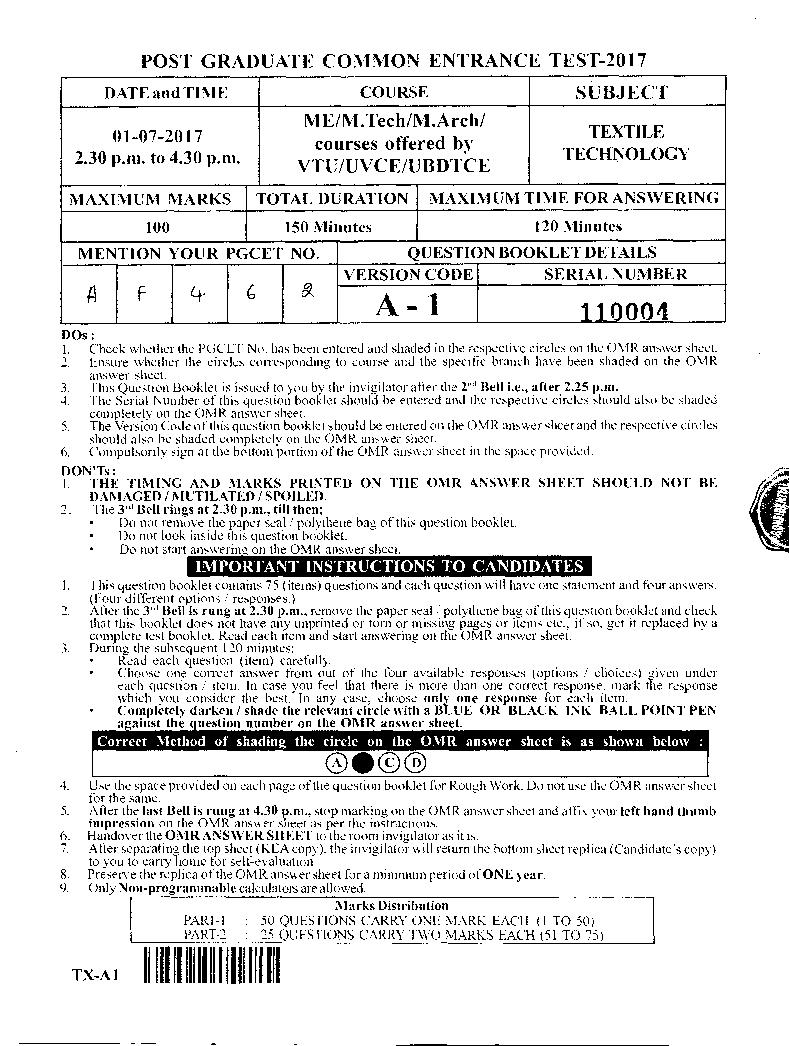
DATE and TI NI E COURSE SUBJECT
M E/M.Tech/M.Arch/
01 -07-2017 TEXTILE
courses offered by
2.30 p.m. to 4.30 p.m. TECHNOLOGY
VTU/UVCE/UBDTCE
MAXIMUM MARKS TOTAL DURATION MAXIMUM TIME FOR ANSWERING
100 150 Minutes 120 Minutes
MENTION YOUR PGCET NO. QUESTION BOOKLET DETAILS
VERSION CODE SERIAL NUMBER
A-1
A F 4+ 6 (R
110004
DOs :
I. Check whether the POCET No. has been entered and shaded in the respective circles on the OMR answer sheet.
Ensure whether the circles corresponding to course and the specific branch have been shaded on the OMR
answer sheet.
3. This Question Booklet is issued to you by the invigilator after the 2'' Bell i.e., after 2.25 p.m.
4. The Serial Number of this question booklet should be entered and the respective circles should also be shaded
completely on the OMR answer sheet.
5. The Version Code of this question booklet should be entered on the OMR answer sheet and the respective circles
should also be shaded completely on the OMR answer sheet.
6. Compulsorily sign at the bottom portion of the OMR answer sheet in the space provided.
DON'Ts :
I. THE TIMING AND MARKS PRINTED ON THE OMR ANSWER SHEET SHOULD NOT BE
DAMAGED / MUTILATED / SPOILED.
The 3r" Bell rings at 2.30 p.m., till then;
• Do not remove the paper seal polythene hag of this question booklet.
• Do not look inside this question booklet.
• Do not start answering on the OMR answer sheet.
IMPORTANT INSTRUCTIONS TO CANDIDATES
1. This question booklet contains 75 (items) questions and each question will have one statement and four answers.
(Four different options responses.)
2. After the 3"' Bell is rung at 2.30 p.m., remove the paper seal / polythene bag of this question booklet and check
that this booklet does not have any unprinted or torn or missing pages or items etc., if so, get it replaced by a
complete test booklet. Read each item and start answering on the OMR answer sheet.
3. During the subsequent 120 minutes:
• Read each question (item) carefully.
• Choose one correct answer from out of the four available responses (options / choices) given under
each question / item. In case you feel that there is more than one correct response. mark the response
which you consider the best. In any case, choose only one response for each item.
• Completely darken / shade the relevant circle with a BLUE OR BLACK INK BALI. POINT PEN
against the uestion number on the OMR answer sheet.
Correct Method of shading the circle on the OMR answer sheet is as shown below :
4. Use the space provided on each page of the question booklet for Rough Work. Do not use the OMR answer sheet
for the same.
5. After the last Bell is rung at 4.30 p.m.. stop marking on the OMR answer sheet and affix your left hand thumb
impression on the OMR answer sheet as per the instructions.
6. Handover the OMR ANSWER SH EET to the room invigilator as it is.
7. After separating the top sheet (K EA copy), the invigilator will return the bottom sheet replica (Candidate's copy)
to you to carry home for self-evaluation.
8. Preserve the replica of the OMR answer sheet for a minimum period of ONE year.
9. Only Non-programmable calculators are allowed.
Marks Distribution
PARf-1 : 50 QUESTIONS CARRY ONE MARK EACH (1 TO 50)
PART-2 : 25 QUESTIONS CARRY TWO MARKS EACH (51 TO 75)
Tx-A, 11111111111111111111
Page 2
PART — 1
(Each question carries one mark) (50 x 1 = 50)
1. Which of the following fibre is used to 4. Which of the following is the coarsest
make parachute fabric ? variety cotton ?
(A) Cotton (A) MCL-l5
(B) Kevlar (B) CIS Raw Cotton
(C) Glass (C) J-34 Cotton
(D) Nylon (D) Desi Cotton
Density of cotton fibre is 5. Lignin present in
(A) 0.9 gms/c.c (A) Viscose
(B) 1.54 g,ms/c.c (B) Silk
(C) Cotton
(C) 1.34 gms/c.c
(D) Nylon
(D) 2 gms/c.c
6. Material which is used to be blend
3. Moisture regain of polyester is
with polyester staple fibre is
(A) 4%
(A) Cotton Staple Fibre
(B) 8.5%
(B) Cotton Card Sliver
(C) 4.5%
(C) Cotton Draw Frame Sliver
(D) 0.4%
(D) Cotton Combed Sliver
TX 3 A-1
Page 3
the specific volume of the fibre is and flats is
(A) 0.70 c.c/g (A) Back to Point
(B) 0.66 c.c/g
(B) Point to Point
(C) 0.80 c.c/g
(C) Point to Back
(D) 0.85 c.c/g
(D) Back to Back
8. Lap rejection percentage in Blow
room is 11. Feeding material to comber is
(A) less than 5% (A) Wider Lap
(B) less than 10% (B) Thick Sliver
(C) less than 2%
(C) Thin Sliver
(D) less than 20%
(D) Narrow Lap
9. Feeding speed of card is 2 mts/min
and delivery speed is 200 mts/min, 12. Index wheel of comber is graduated
then the actual draft of card is from
(A) 50 (A) 0 — 40
(B) 25 (B) 0-50
(C) 100
(C) 0 — 60
(D) 75
(D) 0— 100
A-1 4 TX
Page 4
present day draw frame is process of Nylon 6 is
(A) 200 mts/ min (A) Magnesium Acetate
(B) 500 mts/min (B) Cobalt Acetate
(C) 1000 mts/min (C) Acetic Acid
(D) 1500 nets/min (D) Water
14. The coil angle preferred for trouble 17. Nylon 6 and Nylon 66 filaments can
free unwinding is he distinguished by
(A) 81° — 68° (A) Melting point test
(B) 30° — 20° (B) Bursting test
(C) 40° — 60° (C) Optical microscopy test
(D) 20° — 10° (D) Density measurement
15. Number of projectiles on Sulzer 18. Maximum penalty points allotted in 4
projectile looms depends on point fabric inspection system is
(A) Weight of projectile (A) 6
(B) Width of loom (B) 4
(C) Speed of loom (C) 8
(D) Picking force (D) 10
TX 5 A-1
Page 5
frame is BOD means
(A) 1008 (A) Bio Oxidative Degradation
(B) 1200 (B) Bio Oxygen Distress
(C) Biological Oxygen Demand
(C) 1400
(D) Bacteria Observed on Disc
(D) 1408
23, Dyed wool fabric standards are used
20. Technology used for producing sms
for the evaluation of
fabric is
(A) Wash fastness
(A) Spunlace
(B) Perspiration fastness
(B) Spunlace and melt blown
(C) Sublimation fastness
(C) Needle punch
(D) Light fastness
(D) Spun bond and melt blown
24. The property that Kawabata
21. Jigger cannot be used for Evaluation System (KES) does not
measure is
(A) Printing
(A) Shear rigidity
(B) Dyeing
(B) Bending rigidity
(C) Washing
(C) Compressional resilience
(D) Scouring
(D) Tensile strength
A-1 6 TX
Page 6
yarn ? expressed in
(A) lOsNe ( A) m ts/min
(B) 10Tex (B) yardsimin
(C) 100sNe (C) RPM
(D) 100Tex (D) NPM
26. Opening roller speed in rotor spinning 29. If the count of roving is 1.8 Ne, then
machine is its value in Tex is
(A) 20,000 rpm (A) 300 Tex
(B) 10,000 rpm
(B) 328 Tex
(C) 25,000 rpm
(C) 338 Tex
(D) 30,000 rpm
(D) 348 Tex
27. Non-Separable nature of Twisting and
30. Normal lift of Ring frame is
Winding is found in
(A) 300 mm
(A) Speed frame
(B) 175 mm
(B) Rotor frame
(C) 250 mm
(C) Ring frame
(D) 275 mm
(D) Airjet machine
TX 7 A-1
Page 7
solid polymer and its homogenization
(A) Card
takes place in
(A) Manifold (B) Draw frame
(B) Extruder (C) Speed frame
(C) Metering pump (D) Comber
(D) Quench duct
35. Gas singeing machine is operated at a
32. Which of the following is named as speed of
Aerodynamic beater ?
(A) 50 — 70 nn/min
(A) Disc beater
(B) 125 200 m/min
(B) Two bladed heater
(C) 10 — 40 m/min
(C) Mono cylinder
(D) Kirschner beater (D) 80 — 120 mimin
33. Common blend of polyester and cotton 36. Nylon is drawing
is in the ratio of
(A) At Tg, Temp
(A) 50 : 50
(B) At Softening Temp
( B) 67 : 33
(C) 65 : 35 (C) At Room Temp
(D) 58 : 42 (D) At 100% RH Condition
A-1 8 TX
Page 8
producing polyester staple fibres,
(A) Aid dyes
before drawing is about
3000 (B) Direct dyes
(A)
(B) 30000 (C) Vat dyes
(C) 50000 (D) Disperse dyes
(D) 10000
41. Lyocell is a
38. Roller and cleaner card is used for
(A) Polyamide fibre
carding of
(B) Protein fibre
(A) Cotton
(C) Cellulosic fibre
(B) Wool fibres
(D) Polyester fibre
(C) Cotton waste
(D) Man made fibres
42. The purpose of using auto leveller is to
improve
39. Sizing gives to the yarn
(A) yarn evenness
(A) Higher Breaking Strength
(B) fibre orientation in yarn
(B) Increase lustre
(C) Increased moisture absorption (C) yarn count cv%
(D) Better uniformity - (D) yarn strength
TX 9 A-1
Page 9
more pieces of fabric weaving- system can offer maximum
width ?
(A) Quilting
(A) Air Jet
(B) Seam
( B) Projectile loom
(C) Stitches
(C) Water l et
(D) Interlocking
(D) Rapier loom
44. Among the following which software
assists for pattern development and 46. A enzyme used for Bio-polishing of
marker making ? cotton is
(A) CAD (A) Pectinase
(B) CIF (B) Cellulase
(C) CMT (C) Lipase
(D) CIM (D) Amylase
A-1 10 TX
Page 10
for viscose as compared to cotton multiples of
fibres is
(A) 2
(A) Lower
(B) 4
(B) Higher
(C) 5
(C) Same
(D) 6
(D) Moderate
50. Stone wash finish is more commonly
48. Rate of ring rail traverse in given to
unconventional ring frame is
(A) Denim
(A) 1 :2
(B) Poplin
(B) 2:1
(C) Cambric
(C) 1 :3
(D) Shirtings
(D) 3:1
TX 11 A-1
Page 11
(Each question carries two marks) (25 x 2 = 50)
51. In a cotton comber, noil extraction 54. In ?IA crossing winding drum the no.
increases of crossing are
(A) with decrease in detachment (A) 6
setting.
(B) 5
(B) with increase in pre-combing
draft. (C) 10
(C) with an increase in short fibres.
(D) If majority of hooks are
presented in leading direction.
55. The maximum rotor speed of a modern
rotor frame is
52. The blending technique that gives
(A) 50,000 rpm
most homogeneous mixing of fibre is
(A) Lap blending (B) 25,000 rpm
(B) Sliver blending (C) 1 lakh rpm
(C) Rover blending (D) 10,000 rpm
(D) Tuft blending
56. The most preferred for processing man
53. On absorption of moisture, the thermal made fibres is
insulation of cotton fabric will
(A) Shirley opener
(A) remain same
(B) Krishner beater
(B) decrease
(C) Creighton beater
(C) increase
(D) first increase & then decreases (D) Three bladed beater
A-1 12 TX
Page 12
cotton yarn in sizing is assess the efficiency of
(A) 10% (A) Bleaching
(B) Singeing
(B) 8%
(C) Desizing
(C) less than 2% (D) Mercerisation
(D) 7%
61. The air pressure required in the nozzle
of Air Jet loom is
58. Continuous scouring can be carried
(A) 4 — 5 bar
out in
(B) 10 bar
(A) Winch (C) 1 bar
(B) Jigger (D) 9 bar
(C) Kier
62. Marker efficiency indicates in garment
(D) J-box
(A) Fabric utilization percentage
(B) Product efficiency
59. H70, is called universal bleaching (C) Pattern alteration
agent because (D) Cutting efficiency
(A) it is cheap
63. Water Jet looms are suitable to weave
(B) used for bleaching all textile
(A) Polyester fabric
materials.
(B) Silk fabrics
(C) process is quick.
(C) Cotton fabrics
(D) more stable in all conditions.
(D) Viscose fabrics
TX 13 A-1
Page 13
in yarn is the most by its
(A) 100 km (A) Bending rigidity
(B) 90 km (B) Tensile strength
(C) 360 km (C) Elongation at break
(D) 180 km (D) Bulling strength
65. The RKM of a yarn is equal to 68. Lister classimatc is for classifying
(A) g/tex (A) Yarn faults
(B) ufden (B) Yarn imperfections
(C) Breaking length in km (C) Yarn irregularities
(D) CSP (D) Yarn hairyness
66. The fibre parameter that cannot be 69. The weft density at selvedge is
obtained from bear sorter diagram is doubled in the case of
(A) Mean length (A) Tuck in selvedge
(B) Effective length (B) Leno selvedge
(C) Span length (C) Melt selvedges
(D) Modal length (D) Conventional selvedges
A-1 14 TX
Page 14
cm. The length of overhanging strip of to measure
the fabric specimen when the tip of it,
(A) Convolutions/unit length
viewed in the mirror, cuts both index
lines of fabric bending length tester is (B) Maturity
(A) 10 cm (C) Strength
(B) 5 cm (D) Elongation
(C) 2.5 cm
74. In Bombyx mori silk 80 — 85% of
(D) 7.5 cm
fibroin is composed of the following
amino acids :
71. The fibre that contains Nitrogen and (A) Glycine, Trysoine & Asparitic
Sulphur is acid
(A) Polyester (B) Serine, Tyrosine & Asparitic
acid
(B) Tenacity
(C) Glycine, Alamine & Serine
(C) Tension modulus
(D) Tyrosine, Asparitic acid &
(D) Elongation at break Serine
72. The DP of viscose fibre is 75. Which one of the following is most
approximately resistant to attack by micro
organisms ?
(A) 25000
(A) Cotton
(B) 2500
(B) Acrylic
(C) 25
(C) Wool
(D) 250
(D) Jute
'Space For Rough Work
TX 15 A-1
Page 15
Document Details
| Board / Org | KEA |
| Exam | Karnataka Post Graduate Common Entrance Test |
| Type | Question Paper |
| Pages | 15 |
| Updated | 22 Jul 2026 |