Bihar Board Class 12th Model Paper 2023 Philosophy
Finished viewing? Save it for later —
Download Bihar Board Class 12th Model Paper 2023 Philosophy (PDF · 39 pages)About Bihar Board Class 12th Model Paper 2023 Philosophy
Bihar Board Class 12th Model Paper 2023 Philosophy is available here for free download. Published by Bihar Board for Class 12, this sample paper can be viewed online or downloaded as a PDF (39 pages). Candidates preparing for Class 12 can use Bihar Board Class 12th Model Paper 2023 Philosophy to understand the exam pattern, the type of questions asked, and the overall difficulty level.
Frequently Asked Questions
How can I download Bihar Board Class 12th Model Paper 2023 Philosophy?
Open this page and click the Download button to save Bihar Board Class 12th Model Paper 2023 Philosophy as a PDF. It is completely free on AglaSem Docs.
Is Bihar Board Class 12th Model Paper 2023 Philosophy free to download?
Yes. Bihar Board Class 12th Model Paper 2023 Philosophy can be viewed online and downloaded as a PDF free of cost on AglaSem Docs.
How many pages does Bihar Board Class 12th Model Paper 2023 Philosophy have?
Bihar Board Class 12th Model Paper 2023 Philosophy contains 39 pages, which you can read online or download together as a single PDF.
Where can I find more Class 12 study material?
You can find more Class 12 question papers, sample papers, syllabus, and answer keys on AglaSem Docs.
Bihar Board Class 12th Model Paper 2023 Philosophy – Text
Read the full text of this sample paper below — useful to quickly search, copy and reference the content online without downloading the PDF.
📄 View text version (39 pages)
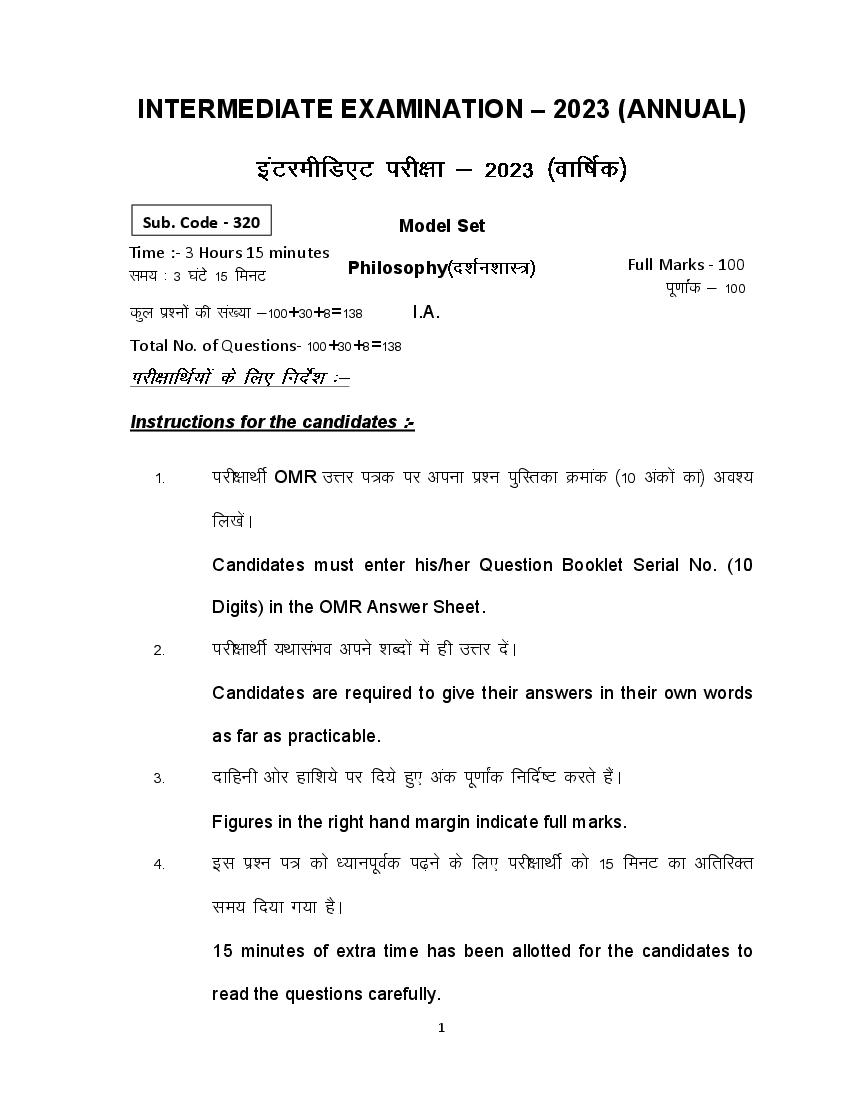
Page 1
Sub. Code - 320 Model Set
Time :- 3 Hours 15 minutes
Philosophy Full Marks - 100
le; % 3 ?kaVs 15 feuV
iw.kkZad & 100
dqy iz’uksa dh la[;k &100+30+8=138 I.A.
Total No. of Questions- 100+30+8=138
Instructions for the candidates :-
1- ijh{kkFkhZ OMR mÙkj i=d ij viuk iz'u iqfLrdk Øekad ¼10 vadksa dk½ vo';
fy[ksaA
Candidates must enter his/her Question Booklet Serial No. (10
Digits) in the OMR Answer Sheet.
2- ijh{kkFkhZ ;FkklaHko vius 'kCnksa esa gh mÙkj nsaA
Candidates are required to give their answers in their own words
as far as practicable.
3- nkfguh vksj gkf’k;s ij fn;s gq, vad iw.kkZad fufnZ"V djrs gSaA
Figures in the right hand margin indicate full marks.
4- bl iz’u i= dks /;kuiwoZd i<+us ds fy, ijh{kkFkhZ dks 15 feuV dk vfrfjDr
le; fn;k x;k gSA
15 minutes of extra time has been allotted for the candidates to
read the questions carefully.
1
Page 2
This question paper is divided into two sections : Section-A and
Section-B.
6- [k.M&v esa 100 oLrqfu"B iz’u gSa] ftuesa ls fdUgha 50 iz’uksa dk mÙkj nsuk
vfuok;Z gSA 50 iz’uksa ls vf/kd ds mÙkj nsus ij izFke 50 dk gh ewY;kadu
gksxkA izR;sd iz’u ds fy, 1 vad fu/kkZfjr gSA budk mÙkj nsus ds fy, miyC/k
djk;s x;s OMR-Sheet ¼mÙkj&i=d½ esa fn;s x;s o`Ùk esa dkys@uhys ckWy isu
ls izxk<+ djsaA fdlh Hkh izdkj ds OgkbVuj@rjy inkFkZ@CysM@uk[kwu vkfn
dk OMR mÙkj&i=d esa iz;ksx djuk euk gS] vU;Fkk ijh{kk ifj.kke vekU;
gksxkA
In Section-A, there are 100 objective type questions, out of which
any 50 questions are to be answered. If more than 50 questions
are answered only the first 50 will be evaluated. Each question
carries 1 mark. For answering these darken the circle with
black/blue ball pen against the correct option on OMR Answer
Sheet provided to you. Do not use Whitener/Liquid/Blade/Nail etc
on OMR Answer Sheet, otherwise the result will be treated as
invalid.
7- [k.M&c esa 30 y?kqmÙkjh; iz’u gSaA izR;sd ds fy, 2 vad fu/kkZfjr gS] ftuesa ls
fdUgha 15 iz’uksa dk mÙkj nsuk vfuok;Z gSA blds vfrfjDr esa 08 nh?kZ
2
Page 3
fdUgha 4 iz’uksa dk mÙkj nsuk vfuok;Z gSA
In Section-B, there are 30 Short Answer Type Questions, each
carrying 2 marks. Out of which any 15 questions are to be
answered. Apart from this, there are 8 Long answer type
questions, each carrying 5 marks, Out of which any 4 questions
are to be answered.
8- fdlh izdkj ds bysDVªkWfud midj.k dk iz;ksx iw.kZr;k oftZr gSA
Use of any electronic appliances is strictly prohibited.
Section-A
Objective Type Questions
iz'u la[;k 1 ls 100 rd ds izR;sd iz’u ds fy, pkj fodYi fn, x, gSa] ftuesa ls ,d
lgh gSA vkidks 100 iz’uksa esa ls fdUgh 50 iz’uksa dk gh mÙkj nsuk gSA vius }kjk pqus x,
lgh fodYi dks OMR&’khV ij fpfUgr djsaA 50x1=50
Question No.- 1 to 100 have four options, out of which only one is correct.
Out of 100 questions any 50 questions are to be answered. You have to
mark, your selected option, on the OMR Sheet. 50x1=50
1- egkohj dk laca/k fuEufyf[kr esa ls fdl LFkku ls gS \
(A) cks/k x;k ls (B) lkjukFk ls
(C) ikokiqjh ls (D) dfiyoLrq ls
3
Page 4
(A) Bodh Gaya (B) Sarnath
(C) Pawapuri (D) Kapilvastu
2- fdlus dgk Fkk fd lalkj nq%[kksa ls Hkjk gS \
(A) dfiy (B) egkohj
(C) Jh d`".k (D) cq)
Who had said that the world is full of sorrow ?
(A) Kapil (B) Mahavira
(C) Sri Krishna (D) Buddha
3- lka[; n’kZu izd`fr ds Lo:Ik ds laca/k esa D;k ekurk gS \
(A) f=xq.kkRed (B) xq.kjfgr
(C) psru (D) mijksDr lHkh
What does Sankhya accept regarding the nature of Prakriti ?
(A) Consists of three gunas (B) Devoid of gunas
(C) Consciousness (D) All of the above
4- v}Sr osnkUr n’kZu ds izoZrd dkSu gSa \
(A) 'kadj (B) dfiy
(C) d.kkn (D) iratfy
Who is the propounder of the Advaita Vedanta Philosophy ?
(A) Shankara (B) Kapil
(C) Kanad (D) Patanjali
4
Page 5
(A) 'kadj (B) egkohj
(C) vjLrw (D) d.kkn
Which of the following is not an Indian Philosopher ?
(A) Shankara (B) Mahavira
(C) Aristotle (D) Kanad
6- ckS) ds yxHkx ledkyhu dkSu nk’kZfud Fks \
(A) 'kadj (B) egkohj
(C) iratfy (D) d.kkn
Which of the following Philosopher is almost contemporary to Buddha?
(A) Shankara (B) Mahavira
(C) Patanjali (D) Kanad
7- Hkkjrh; n’kZu esa tSu n’kZu dks fdl nk’kZfud oxZ esa j[krs gSa \
(A) ukfLrd (B) vkfLrd
(C) (A) vkSj (B) nksuksa (D) buesa ls dksbZ ugha
In which Philosophical school Jainism is placed in Indian Philosophy ?
(A) Heterodox (B) Orthodox
(C) Both (A) and (B) (D) None of these
8- fdl n’kZu esa psru lÙkk dks tho dgrs gSa \
(A) lka[; (B) ckS)
(C) tSu (D) buesa ls dksbZ ugha
5
Page 6
(A) Sankhya (B) Buddhism
(C) Jainism (D) None of these
9- Hkkjrh; n’kZu esa }Srokn dk Li"V mnkgj.k dkSu n’kZu gS \
(A) ckS) (B) lka[;
(C) osnkUr (D) oS’ksf"kd
Which Philosophy is the clear example of Dualism in Indian
Philosophy?
(A) Buddhism (B) Sankhya
(C) Vedanta (D) Vaisesika
10- fuEufyf[kr esa ls fdl in dk laca/k ckS) n’kZu ls gS \
(A) vgZr (B) fo’ks"k
(C) dSoY; (D) rhFkZadj
Which of the following term is related to Buddhism ?
(A) Arhat (B) Visesha
(C) Kaivalya (D) Tirthankara
11- ^izrhR;leqRiknokn* ckS) n’kZu ds fdl nk’kZfud fl)kar ds ewy esa gS \
(A) dkj.krk fl)kar (B) e/;eekxhZ fl)kar
(C) (A) vkSj (B) nksuksa (D) buesa ls dksbZ ugha
In the root of which philosophical principle of Buddhism
Pratityasamutpadvada belongs ?
6
Page 7
(C) Both (A) and (B) (D) None of these
12- tSu n’kZu ds rÙoehekalh; fl)kUr dks D;k dgrs gSa \
(A) vusdkUrokn (B) L;knokn
(C) lE;d~ pfj= (D) mijksDr lHkh
What is called the Ontological theory of Jainism ?
(A) Anekantvada (B) Syadvada
(C) Samyak Chritra (D) All of the above
13- fuEufyf[kr esa ls fdl fopkj dk laca/k Hkxon~ xhrk ls gS \
(A) vusdkUrokn (B) f=jRu
(C) L;knokn (D) yksdlaxzg
Which of the following concept is related to Bhagavad Gita ?
(A) Anekantvada (B) Three Gems
(C) Syadvada (D) Lok Sangraha
14- Hkkjrh; n’kZu esa iq:"kkFkZ ds vkn’kZ dk pje mRd"kZ D;k gS \
(A) dke (B) eks{k
(C) /keZ (D) vFkZ
What is the highest elevation of the goal of Purusartha in Indian
Philosophy ?
(A) Kama (B) Moksha
(C) Dharma (D) Artha
7
Page 8
(A) lE;d~ n’kZu (B) lE;d~ Kku
(C) lE;d~ pfj= (D) mijksDr lHkh
What is the dimension of the concept of Triratna according to Jainism ?
(A) Samyak Darshan (B) Samyak Jnana
(C) Samyak Charitra (D) All of the above
16- tSu n’kZu ds vuqlkj ^ftu* 'kCn dk D;k vFkZ gksrk gS \
(A) e/;e (B) ek;k
(C) fotsrk (D) lalkj
What is the meaning of the word ‘Jina’ according to Jaina Philosophy?
(A) Middle (B) Maya
(C) Conqueror (D) World
17- Hkkjrh; n’kZu ds fdl xzaFk esa bZ’oj dks ^iq:"kksÙke* dgk x;k gS \
(A) Hkxon~ xhrk (B) czã lw=
(C) ;ksx lw= (D) buesa ls dksbZ Hkh ugha
In which scripture of Indian Philosophy God is called ‘Purushottam’ ?
(A) Bhagvad Gita (B) Brahma Sutra
(C) Yoga Sutra (D) None of the above
18- fuEufyf[kr esa ls dkSu lk fodYi Hkkjrh; n’kZu ds lanHkZ esa lgh gS \
(A) dsoy fo’ys"k.kkRed Kku (B) dsoy ckSf)d Kku
(C) dsoy vuqHkotU; Kku (D) iw.kZ n`f"V
8
Page 9
Philosophy ?
(A) Only analytical knowledge (B) Only rational knowledge
(C) Only empirical knowledge (D) Perfect vision
19- Hkkjrh; n’kZu ds fdl lEiznk; esa rdZ’kkL=h; foospu dks egÙo fn;k x;k gS \
(A) U;k; n’kZu (B) v}Sr osnkUr n’kZu
(C) ;ksx n’kZu (D) lka[; n’kZu
Which school of Indian Philosphy has given importance to the Logical
discussion ?
(A) Nyaya Philosophy (B) Advaita Vedanta Philosophy
(C) Yoga Philosophy (D) Sankhya Philosophy
20- ;ksx n’kZu dk ikjekfFkZd mís’; D;k gS \
(A) LoLFk 'kjhj (B) LoLFk eu
(C) thokRek dk bZ’oj ls feyu (D) buesa ls dksbZ ugha
What is the ultimate goal of Yoga Philosophy ?
(A) Healthy body
(B) Healthy mind
(C) Union of the individual soul with God
(D) None of these
21- ^fQykWlQh* 'kCn dk D;k vFkZ gS \
(A) deZ dh [kkst (B) vkRek dh [kkst
9
Page 10
What is the meaning of the Word ‘Philosophy’ ?
(A) Search for action (B) Search for spirit
(C) Love for Wisdom (D) Love for the World
22- Hkkjrh; n’kZu ds vuqlkj nq%[k fdl izdkj ds gSa \‘
(A) vk/;kfRed (B) vf/knSfod
(C) vf/kHkkSfrd (D) mijksDr lHkh
What is the kind of suffering according to Indian Philosophy ?
(A) Spiritual (B) Divine
(C) Physical (D) All of the above
23- ;ksx n’kZu fdl Hkkjrh; n’kZu dk O;kogkfjd i{k gS \
(A) U;k; n’kZu dk (B) lka[; n’kZu dk
(C) ehekalk n’kZu dk (D) tSu n’kZu dk
The applied aspect of which Indian Philosophy the Yoga Philosophy
belongs ?
(A) Nyaya Philosophy (B) Sankhya Philosophy
(C) Mimansa Philosophy (D) Jaina Philosophy
24- v/;kReokn ds vuqlkj fo’o ds ewy rRo dk Lo:Ik D;k gS \
(A) psru (B) tM+
(C) rVLFk (D) buesa ls dksbZ ugha
10
Page 11
spiritualism ?
(A) Conscious (B) Matter
(C) Neutral (D) None of these
25- cdZys us oLrqvksa dks D;k ekuk gS \
(A) izR;;ksa dk vk/kkj (B) izR;;kRed
(C) HkkSfrd (D) buesa ls dksbZ ugha
What has Berkeley regarded the objects as ?
(A) Substratum of ideas (B) Ideal
(C) Physical (D) None of these
26- }Srokn ds vuqlkj ewy rRo dh la[;k fdruh gS \
(A) vusd (B) ,d
(C) nks (D) mijksDr lHkh
What is number of ultimate reality according to dualism ?
(A) Many (B) One
(C) Two (D) All of the above
27- euq"; esa fdl izdkj dh izo`fÙk;k¡ ikbZ tkrh gaS \
(A) lkfRod (B) jktfld
(C) rkefld (D) mijksDr lHkh
What kind of tendencies are found in human-beings ?
(A) Satavik (B) Rajasik
11
Page 12
28- ckS) n’kZu ds vuqlkj dkSu lk fl)kUr fo’o dks dkj.krk dh J`a[kyk esa j[krk gS \
(A) izrhR;leqRiknokn (B) vukReokn
(C) L;kn~okn (D) vusdkarokn
Which principle does keep the world in the series of causality
according to Buddhism ?
(A) Pratityasamutpadavad (B) Anatmavada
(C) Syadvada (D) Anekantvada
29- 'kadj ds vuqlkj lr~&fpÙk&vkuan dh fLFkfr esa dkSu jgrk gS \
(A) thokRek (B) bZ’oj
(C) ek;k (D) czã
Who remains in the state of Sat-Chit-Ananda according to Shankara ?
(A) Individual soul (B) God
(C) Maya (D) Brahman
30- ml ckS) fl)kUr dks D;k dgrs gSa tks lkalkfjd oLrqvksa dks {kf.kd ekurk gS \
(A) vukReokn (B) {kf.kdokn
(C) /keZpØ izorZu (D) L;kn~okn
What is called to the Buddhist doctrine which regards worldly entities
as momentary ?
(A) Anatmavada (B) Momentariness
(C) Dharmachakra Pravartan (D) Syadvada
12
Page 13
(A) la’k;okn (B) vKs;okn
(C) Kku dk lkis{koknh fl)kUr (D) buesa ls dksbZ Hkh ugha
What is the theory of Syadvada ?
(A) Scepticism
(B) Agnosticism
(C) Theory of the relativity of knowledge
(D) None of the above
32- ^la?ke~ 'kj.ke~ xPNkfe* fdldh f’k{kk ls lacaf/kr gS \
(A) cq) ls (B) egkohj ls
(C) 'kadj ls (D) iratfy ls
To whose teaching is ‘I Take Refuge in Sangha’ related ?
(A) Buddha (B) Mahavira
(C) Shankara (D) Patanjali
33- fu"dke deZ djus dh izsj.kk gesa dgk¡ feyrh gS \
(A) ehekalk esa (B) ckS) n’kZu esa
(C) Hkxon~ xhrk esa (D) U;k; n’kZu esa
From where do we get inspiration to follow Nishkama Karma ?
(A) Mimansa (B) Buddhism
(C) Bhagavad Gita (D) Nyaya Philosophy
34- v"Vkax ekxZ dk laca/k cq) ds fdl vk;ZlR; ls gS \
13
Page 14
(C) rhljk (D) pkSFkk
To which Noble Truth of Buddha the Eightfold Path is related ?
(A) First (B) Second
(C) Third (D) Fourth
35- vius fdl ekSfyd fl)kUr dks cq) us /keZ dgk Fkk \
(A) {kf.kdokn (B) vukReokn
(C) izrhR;leqRiknokn (D) deZ fl)kUr
Which of the basis doctrine of Buddha has been called dharma by
him?
(A) Momentariness (B) Anatmvada
(C) Pratityasamutpadvada (D) Theory of Karma
36- cq) us nq%[k ds ckjg dkj.kksa dh J`a[kyk ds ewy esa fdls ekuk gS \
(A) laLdkj (B) vfo|k
(C) r`".kk (D) osnuk
What has been regarded as the root of the chain of twelve causes of
suffering by Buddha ?
(A) Samskara (B) Avidya
(C) Trasana (D) Vedana
37- Kku izkfIr ds mijkUr cq) us viuk igyk mins’k dgk¡ fn;k Fkk \
(A) cks/k x;k esa (B) dq’khuxj esa
14
Page 15
Where has Buddha delivered his first sermon after the attainment of
Knowledge ?
(A) at Bodh Gaya (B) at Kushinagar
(C) at Rajgrih (D) at Sarnath
38- fdl n’kZu esa xq.k dks ,d Lora= inkFkZ ekuk x;k gS \
(A) lka[; (B) oS’ksf"kd
(C) tSu (D) buesa ls dksbZ ugha
In which Philosophy quality is regarded as an independent Padarth ?
(A) Sankhya (B) Vaisesika
(C) Jainism (D) None of these
39- tSu n’kZu fdrus rhFkZadj dks ekurk gS \
(A) 24 (B) 18
(C) 12 (D) 6
How many Tirthankaras are accepted in Jainism ?
(A) 24 (B) 18
(C) 12 (D) 6
40- xkSre _f"k }kjk fyf[kr iqLrd dk D;k uke gS \
(A) jkek;.k (B) egkHkkjr
(C) Hkxon~ xhrk (D) U;k; lw=
What is the name of the book written by Gautam Rishi ?
15
Page 16
(C) Bhagavad Gita (D) Nyaya Sutra
41- U;k; n’kZu ds vuqlkj Kku izkIr djus okys dks D;k dgrs gSa \
(A) izek.k (B) vizek
(C) izek (D) izekrk
What is called to the subject who acquires knowledge according to
Nyaya Philosophy ?
(A) Praman (B) Aprama
(C) Prama (D) Pramata
42- U;k; n’kZu ds vuqlkj lkekU; ds Kku dk L=ksr D;k gS \
(A) ykSfdd izR;{k (B) vykSfdd izR;{k
(C) vuqeku (D) 'kCn
What is the source of knowledge of universal according to Nyaya
Philosophy ?
(A) Ordinary Perception (B) Extra-ordinary perception
(C) Inference (D) Verbal testimony
43- U;k; n’kZu ds vuqlkj Kku dk lk/ku D;k gS \
(A) izR;{k (B) vuqeku
(C) 'kCn (D) mijksDr lHkh
What is the source of Knowledge according to Nyaya Philosophy ?
(A) Perception (B) Inference
16
Page 17
44- iapko;o vuqeku ds fdrus vo;o gskrs gSa \
(A) nks (B) pkj
(C) ik¡p (D) lkr
How many constituents are in Panchvayava Anuman ?
(A) Two (B) Four
(C) Five (D) Seven
45- 'kCn izek.k opu gS &
(A) vkIr iq:"k dk (B) fo’ks"k iq:"k dk
(C) vije iq:"k dk (D) iq:"k dk
Verbal testimony is a statement of -
(A) Trustworthy Person (B) Particular Person
(C) Aparam Purush (D) Purush
46- fuEufyf[kr esa ls dkSu Hkkjrh; n’kZu dk izeq[k fo"k;&oLrq gS \
(A) ca/ku (B) eks{k
(C) eks{k&ekxZ (D) mijksDr lHkh
Which of the following is the main subject matter of Indian Philosophy?
(A) Bondage (B) Liberation
(C) Ways to Liberation (D) All of the above
47- tSu n’kZu ds 23osa rhFkZadj dkSu gSa \
17
Page 18
(C) egkohj (D) _"kHknso
Who is the 23rd Tirthankar of Jainism ?
(A) Ganinath (B) Parshvanath
(C) Mahavira (D) Rishabhadeva
48- lka[; n’kZu ds vuqlkj izd`fr dk dkSu lk vo;o vfLFkjrk dks c<+krk gS \
(A) jtl (B) rel~
(C) lRo (D) buesa ls dksbZ ugha
Which element of Prakriti increases the restlessness according to
Sankhya Philosophy ?
(A) Rajas (B) Tamas
(C) Sattava (D) None of these
49- fuEufyf[kr esa ls dkSu egkdkO; egkHkkjr dk Hkkx gS \
(A) jkek;.k (B) okYehfd jkek;.k
(C) rqylh jkek;.k (D) Hkxon~ xhrk
Which of the following is the part of the great epic Mahabharat ?
(A) Ramayan (B) Valmiki Ramayan
(C) Tulsi Ramayan (D) Bhagavad Gita
50- ;ksx n’kZu ds vuqlkj fuEufyf[kr esa ls dkSu cfgjax lk/ku ds vk;ke gSa \
(A) /kkj.kk (B) vklu
(C) /;ku (D) lekf/k
18
Page 19
according to Yoga Philosophy ?
(A) Dharana (B) Asana
(C) Dhyan (D) Samadhi
51- ;ksx lk/kuk i)fr esa iz.kk;ke dh D;k eq[; Hkwfedk gS \
(A) 'okl izfØ;k dk fu;a=.k (B) /;ku
(C) psruk dk fu;a=.k (D) buesa ls dksbZ ugha
What is the prime role of Pranayam in the method of yogic Sadhana ?
(A) Regulation of breathing process
(B) Concentration (Dhyan)
(C) Regulation of consciousness
(D) None of these
52- ^fpÙko`fr fujks/k* dk fopkj fdl n’kZu ls lacaf/kr gS \
(A) v}Sr osnkUr ls (B) ckS) ls
(C) ;ksx ls (D) tSu ls
To which philosophy is the concept of ‘chittavrittinirodha’ related ?
(A) Advaita Vedanta (B) Buddhism
(C) Yoga (D) Jainism
53- oS’ksf"kd n’kZu ds vuqlkj fuEufyf[kr esa ls dkSu inkFkZ gS \
(A) nzO; (B) lkekU;
(C) deZ (D) mijksDr lHkh
19
Page 20
(A) Dravya (B) Samanya
(C) Karma (D) All of the above
54- oS’ksf"kd n’kZu ds vuqlkj nzO; dh la[;k fdruh gS \
(A) ik¡p (B) lkr
(C) ukS (D) X;kjg
What is the number of substance according to Vaisesiska Philosophy?
(A) Five (B) Seven
(C) Nine (D) Eleven
55- Hkxon~ xhrk fdlds mins’k dk izfrQy gS \
(A) Jhd`".k (B) 'kadj
(C) d.kkn (D) dfiy
Whose teaching has resulted in Bhagavad Gita ?
(A) Sri Krishna (B) Shankara
(C) Kanad (D) Kapil
56- dfiy fdl n’kZu ds izorZd gS \
(A) lka[; (B) U;k;
(C) oS’ksf"kd (D) ;ksx
Which Philosophy has been propounded by Kapil ?
(A) Sankhya (B) Nyaya
(C) Vaisesika (D) Yoga
20
Page 21
(A) lka[; (B) U;k;
(C) oS’ksf"kd (D) ;ksx
Which Philosophy has been propounded by Kanad ?
(A) Sankhya (B) Nyaya
(C) Vaisesika (D) Yoga
58- vHkko dks inkFkZ fdl n’kZu us ekuk gS \
(A) U;k; (B) oS’ksf"kd
(C) lka[; (D) buesa ls dksbZ ugha
Which Philosophy has accepted Non-Existence as a Padartha ?
(A) Nyaya (B) Vaisesika
(C) Sankhya (D) None of these
59- v}Sr osnkUr ds vuqlkj czã fdl izdkj dh lÙkk gS \
(A) ikjekfFkZd (B) izkfrHkkfld
(C) O;kogkfjd (D) mijksDr lHkh
What kind of reality is Brahaman according to Advaita Vedanta ?
(A) Paramarthika (B) Pratibhasika
(C) Vyavaharika (D) All of the above
60- v}Sr osnkUr fdl n`f"Vdks.k ls txr dks lR; ekurk gS \
(A) ikjekfFkZd (B) izkfrHkkfld
(C) O;kogkfjd (D) mijksDr lHkh
21
Page 22
Advaita Vedanta ?
(A) Paramarthika (B) Pratibhasika
(C) Vyavaharika (D) All of the above
61- v}Sr osnkUr esa lxq.k czã fdls ekuk x;k gS \
(A) bZ’oj dks (A) txr dks
(C) thokRek dks (D) ek;k dks
Whom is regarded as Saguna Brahman in Advaita Vedanta ?
(A) God (B) World
(C) Individual Soul (D) Maya
62- v}Sr osnkUr esa lcls loZJs"B lÙkk fdls ekuk x;k gS \
(A) ijczã dks (B) vijczã dks
(C) (A) vkSj (B) nksuksa dks (D) buesa ls dksbZ ugha
What is regarded as the Supreme Reality in Adavaita Vedanta ?
(A) Parabrahman (B) Aparabrahman
(C) Both (A) and (B) (D) None of these
63- ijczã ds fy, fuEufyf[kr esa ls dkSu fodYi lgh gS \
(A) lxq.k czã (B) fuxqZ.k czã
(C) bZ’oj (D) txr
Which of the following alternative is correct for Parabrahman ?
22
Page 23
(C) God (D) World
64- 'kadj ds vuqlkj ijerÙo dh la[;k fdruh gS \
(A) nks (B) vusd
(C) ,d (D) buesa ls dksbZ ugha
What is the number of ultimate reality according to Shankara ?
(A) Two (B) Many
(C) One (D) None of these
65- 'kadj ds vuqlkj ijerÙo czã dh 'kfDr D;k gS \
(A) ek;k (B) thokRek
(C) txr (D) buesa ls dksbZ ugha
What is the power of ultimate reality Brahman according to Shankara?
(A) Maya (B) Individual Soul
(C) World (D) None of these
66- cqf)okn ds vuqlkj Kku dk Lo:Ik D;k gS \
(A) lkoZHkkSe (B) fuf’pr
(C) vlafnX/k (D) mijksDr lHkh
What is the nature of knowledge according to rationalism ?
(A) Universal (B) Certain
(C) Indubitable (D) All of the above
67- fdldk ekuuk gS fd vkjEHk esa Kku tUetkr izR;; ds :Ik esa jgrk gS \
23
Page 24
(C) cqf)okn dk (D) mijksDr lHkh dk
Who has regarded that in the beginning the knowledge remains in the
form of innate idea ?
(A) Empiricism (B) Scepticism
(C) Rationalism (D) All of the above
68- dk.V ds Kku fl)kUr dks D;k dgrs gSa \
(A) leh{kkokn (B) cqf)okn
(C) vuqHkookn (D) la’k;okn
What is called the epistemological theoy of Kant ?
(A) Criticism (B) Rationalism
(C) Empiricism (D) Scepticism
69- dk.V ds vuqlkj Kku dk vkjEHk fdlls gksrk gS \
(A) cqf) ls (B) vuqHko ls
(C) tUetkr izR;; ls (D) mijksDr lHkh ls
From which knowledge begins according to Kant ?
(A) reason (B) experience
(C) innate ideas (D) All of the above
70- vius Kku fl)kUr esa laLdkj vkSj izR;; dk fopkj fdlus izfrikfnr fd;k gS \
(A) ykWd (B) áwe
(C) cdZys (D) nsdkrZ
24
Page 25
of Knowledge ?
(A) Locke (B) Hume
(C) Berkeley (D) Descartes
71- nsdkrZ dkSu Fks \
(A) cqf)oknh (B) cqf)okn ds izcy leFkZd
(C) vk/kqfud ik’pkR; n’kZu ds tud (D) mijksDr lHkh
Who was Descrates ?
(A) Rationalist
(B) Strong supporter of rationalism
(C) Father of Modern Western Philosophy
(D) All of the above
72- fdl fl)kUr dh ;g ekU;rk gS fd oLrq Kkrk ls Lora= gS \
(A) izR;;okn (B) oLrqokn
(C) rVLFkokn (D) }Srokn
Which doctrine has held that object is independent of Knower ?
(A) Idealism (B) Realism
(C) Neutralism (D) Dualism
73- áwe ds vuqHkookn dk D;k egRo gS \
(A) vKs;okn (B) la’k;okn
25
Page 26
What is the importance of Hume’s Empiricism ?
(A) Agnosticism (B) Scepticism
(C) Method of doubt (D) None of these
74- lgt Kku vkSj fuxeu dks Kku dk lk/ku fdlus ekuk gS \
(A) ykWd (B) cdZys
(C) nsdkrZ (D) áwe
Who has regarded intuition and deduction as the source of
knowledge?
(A) Locke (B) Berkeley
(C) Descartes (D) Hume
75- nsdkrZ ds n’kZu esa lansg dk D;k LFkku gS \
(A) vkjEHk fcUnq gS (B) var gS
(C) (A) vkSj (B) nksuksa (D) buesa ls dksbZ Hkh ugha
What is the place of doubt in Descarte’s Philosophy ?
(A) Starting point (B) End
(C) Both (A) and (B) (D) None of the above
76- fdlus dgk gS fd ^eSa lksprk gw¡ blfy, eSa gw¡* \
(A) fLiukstk (B) ykbcfut
(C) nsdkrZ (D) ykWd
Who has said that ‘I think, therefore, I am’ ?
26
Page 27
(C) Descartes (D) Locke
77- tM+ rRo dh vfuok;Z fo’ks"krk D;k gS \
(A) psruk (B) foLrkj
(C) (A) vkSj (B) nksuksa (D) buesa ls dksbZ Hkh ugha
What is the essential characteristics of Physical reality ?
(A) Consciousness (B) Extension
(C) Both (A) and (B) (D) None of these
78- nsdkrZ ds vuqlkj rkfRod n`f"V ls bZ’oj D;k gS \
(A) fujis{k nzO; (B) lkis{k nzO;
(C) dkj.k :Ik (D) (A) vkSj (B) nksuksa
What is God from the ontological point of view according to Descartes?
(A) Absolute Substance (B) Relative Substance
(C) Causa Sui (D) Both (A) and (B)
79- bZ’oj dh lÙkk ds lanHkZ esa fLiukstk ds n’kZu dh D;k ekU;rk gS \
(A) vuh’ojokn (B) losZ’ojokn
(C) vKs;okn (D) la’k;okn
What does Spinoza’s Philosophy regard in the context of the reality of
God ?
(A) Atheism (B) Pantheism
(C) Agnosticism (D) Scepticism
27
Page 28
(A) ykWd (B) cdZys
(C) fLiukstk (D) áwe
Who has given maximum importance to the Geometrical Method ?
(A) Locke (B) Berkeley
(C) Spinoza (D) Hume
81- fLiukstk us nzO; ds lanHkZ esa fdl fopkj dks vLohdkj fd;k gS \
(A) lkis{k nzO; ds fopkj dks (B) fujis{k nzO; ds fopkj dks
(C) Lora= nzO; ds fopkj dks (D) buesa ls dksbZ Hkh ugha
Which concept has been denied by Spinoza regarding substance ?
(A) Relative Substance (B) Absolute Substance
(C) Independent Substance (D) None of these
82- txr ds lanHkZ esa bZ’oj dks ^dkj.k izd`fr* vkSj ^dk;Z izd`fr* fdlus dgk gS \
(A) nsdkrZ (B) ykbcfut
(C) fLiukstk (D) buesa ls dksbZ Hkh ugha
Who has regarded God as ‘Natura Naturans’ and ‘Natura Naturata’ in
the context of World ?
(A) Descartes (B) Leibniz
(C) Spinoza (D) None of them
83- fdlus xq.kksa dks nzO; dk lkj ekuk gS \
28
Page 29
(C) ykbcfut (D) buesa ls dksbZ Hkh ugha
Who has regarded attributes as the essence of substance ?
(A) Spinoza (B) Descartes
(C) Leibniz (D) None of them
84- ykbcfut ds nzO; fl)kUr dks D;k dgrs gSa \
(A) HkkSfrdokn (B) ,dokn
(C) }Srokn (D) fpn~.kqokn
What is called the theory of substance of Leibniz ?
(A) Materialism (B) Monism
(C) Dualism (D) Monadology
85- fdlus dgk gS fd fpn~.kq xok{kghu gksrs gSa \
(A) fLiukstk (B) ykbcfut
(C) nsdkrZ (D) buesa ls dksbZ Hkh ugha
Who has said that Monads are Windowless ?
(A) Spinoza (B) Leibniz
(C) Descartes (D) None of them
86- lekukUrjokn ds fl)kUr dks fdlus Lohdkj fd;k gS \
(A) fLiukstk (B) ykbcfut
(C) nsdkrZ (D) buesa ls dksbZ Hkh ugha
Who has accepted the theory of Parallelism ?
29
Page 30
(C) Descartes (D) None of them
87- fdl vuqHkooknh nk’kZfud us ljy vkSj tfVy izR;; esa Hksn fd;k gS \
(A) ykWd (B) cdZys
(C) áwe (D) dk.V
Which empiricist thinker has made a distinction between Simple and
Complex ideas ?
(A) Locke (B) Berkeley
(C) Hume (D) Kant
88- nzO; dks vKs; fdl vuqHkooknh fpard us ekuk gS \
(A) áwe (B) ykWd
(C) cdZys (D) dk.V
Which empiricist thinker has regarded substance as unknowable ?
(A) Hume (B) Locke
(C) Berkeley (D) Kant
89- Kku dks dsoy izR;; rd fdlus lhfer fd;k gS \
(A) dk.V (B) cdZys
(C) áwe (D) ykWd
Who has limited knowledge to only idea ?
(A) Kant (B) Berkeley
(C) Hume (D) Locke
30
Page 31
(A) dk.V (B) áwe
(C) cdZys (D) ykWd
Which empiricist philosopher has denied the Physical World ?
(A) Kant (B) Hume
(C) Berkeley (D) Locke
91- cqf)okn vkSj vuqHkookn ds lanHkZ esa fdlus dgk gS fd ftu ckrksa dks os Lohdkj djrs
gSa] os lR; gSa vkSj ftu ckrkssa dk os fu"ks/k djrs gSa] os vlR; gSa \
(A) áwe (B) dk.V
(C) ykWd (D) cdZys
Who has said in the context of rationalism and empiricism that ‘they
are justified in what they affirm, but wrong in what they deny ?
(A) Hume (B) Kant
(C) Locke (D) Berkeley
92- fdl vuqHkooknh fopkjd us dgk gS fd dkj.k&dk;Z lEHkkO; gS \
(A) ykWd (B) cdZys
(C) áwe (D) dk.V
Which empiricist thinker has said that cause-effect is probable ?
(A) Locke (B) Berkeley
(C) Hume (D) Kant
93- fdl nk’kZfud us dgk gS fd ns’k vkSj dky vuqHko&iwoZ izR;{k gS \
31
Page 32
(C) áwe (D) dk.V
Which Philosopher has said that space and time are apriori percept ?
(A) Locke (B) Berkeley
(C) Hume (D) Kant
94- uhfr’kkL= ds Lo:Ik ds lanHkZ esa fuEufyf[kr esa ls dkSu lk dFku lgh gS \
(A) uhfr’kkL= ,d 'kq) foKku gS (B) uhfr’kL= ,d dyk gS
(C) uhfr’kkL= ,d vkn’kZewyd foKku gS (D) buesa ls dksbZ ugha
Which of the following statement is correct regarding the nature of
Ethics ?
(A) Ethics is a pure science (B) Ethics is an art
(C) Ethics is a normative science (D) None of these
95- uhfr’kkL= dk fo"k; oLrq fuEufyf[kr esa ls dkSu gS \
(A) ekuo dk ,sfPNd deZ (B) lgt fØ;k
(C) vuSfPNd deZ (D) mijksDr lHkh
Which of the following is the subject matter of Ethics ?
(A) Voluntary action of a man (B) Instinctive action
(C) Non-voluntary action (D) All of the above
96- uhfr’kkL= esa lEeksgu dh voLFkk esa fd;s x;s deZ dks D;k ekurs gSa \
(A) uSfrd deZ (B) uSfrd ,oa uhfr’kwU; deZ nksuksa
(C) uhfr’kwU; deZ (D) mijksDr lHkh
32
Page 33
(A) Moral action
(B) Both Moral and non-moral action
(C) Non-moral action
(D) All of the above
97- dkj.k&dk;Z laca/k ds lanHkZ esa fuEufyf[kr esa ls dkSu lk fodYi lgh gS \
(A) dkj.k iwoZorhZ gS (B) dkj.k vuqorhZ gS
(C) dk;Z iwoZorhZ gS (D) dk;Z vuqorhZ gS
Which of the following alternative is correct regarding the cause-effect
relationship ?
(A) Cause is an antecedent (B) Cause is consequent
(C) Effect is antecedent (D) Effect is consequent
98- ekSfyd uSfrd izR;; D;k gS \
(A) mfpr (B) vuqfpr
(C) 'kqHk (D) mijksDr lHkh
What is fundamental ethical concept ?
(A) Right (B) Wrong
(C) Good (D) All of the above
99- loksZPp 'kqHk D;k gS \
(A) mPpre y{; (B) tks vU; y{; dk lk/ku gS
(C) tks vU; y{; dh iwfrZ esa mi;ksxh gS (D) buesa ls dksbZ ugha
33
Page 34
(A) Highest Goal
(B) Which is means to other goals
(C) Which is useful in the attainment of other goals
(D) None of these
100- O;kogkfjd uhfr’kkL= dk D;k mi;ksx gS \
(A) uSfrd izR;;ksa dk fo’ys"k.k
(B) uSfrd ekin.M dk fo’ys"k.k
(C) uhfr’kkL= dks orZeku ds O;kogkfjd leL;kvksa ij ykxw djuk
(D) buesa ls dksbZ Hkh ugha
What is the use of Practical ethics ?
(A) Analysis of ethical concepts
(B) Analysis of ethical standards
(C) Application of ethics on the present practical problems
(D) None of these
Section-B
Short Answer Type Questions
iz’u la[;k 1 ls 30 rd y?kq mÙkjh; gSaA buesa ls fdUgha 15 iz’uksa ds mÙkj nsaA izR;sd iz’u
ds fy, 2 vad fu/kkZfjr gSA vf/kdre 50 'kCnksa esa mÙkj nsaA (15x2=30)
34
Page 35
question carries 2 marks. Answer in not more than 50 words. (15x2=30)
1- Kku fl)kUr esa cqf)okn 'kCn dk iz;ksx fdl vFkZ esa gksrk gS \ 2
In which sense the term rationalism is used in the theory of
Knowledge?
2- ;ksx n’kZu ds vuqlkj /;ku dh D;k mi;ksfxrk gS \ 2
What is the use of Dhyana according to Yoga Philosophy ?
3- Hkkjrh; n’kZu dh D;k fo’ks"krk gS \ la{ksi esa o.kZu djsaA 2
What is the characteristics of Indian Philosophy ? Describe briefly.
4- lka[; ds vuqlkj izd`fr ds reks xq.k vkSj jtks xq.k esa ewy varj D;k gS \ 2
What is the basic difference between the Tamo Guna and Rajo Guna
of Prakriti according to Sankhya ?
5- vuqeku fdl Kku ij vk/kkfjr gS \ 2
On which knowledge is Inference based ?
6- D;k fu"dke deZ deksZa dk fu"ks/k djrk gS \ 2
Does Niskama Karma negate actions ?
7- Hkkjrh; n’kZu dk ekuoh; thou ds laca/k esa ekSfyd fopkj D;k gS \ 2
What is the basic concept of Indian Philosophy regarding the
human life ?
8- ^Hkkjrh; n’kZu* 'kCn esa n’kZu dk D;k vFkZ gS \ 2
What is the meaning of Darshan in the term ‘Bhartiya Darshan’ ?
35
Page 36
What do you mean by Artha-Purusartha ?
10- U;k; n’kZu ds vuqlkj izR;{k izek.k dk oxhZdj.k djsaA 2
Make a classification of the Pratyaksha Pramana according to Nyaya
Philosophy ?
11- fuokZ.k vkSj ifjfuokZ.k esa D;k varj gS \
What is the difference between Nirvana and Parinirvana ?
12- nsdkrZ us xf.kr dks vkn’kZ ekurs gq, bldk iz;ksx n’kZu esa D;ksa fd;k \ 2
Why did Descartes regarded mathematics as a model and used it in
Philosophy ?
13- vjLrw ds vuqlkj miknku dkj.k dk o.kZu djsaA 2
Describe the material cause according to Aristotle.
14- O;kogkfjd uhfr’kkL= ds egRo ij izdk’k MkysaA 2
Throw light on the significance of practical ethics.
15- tSu n’kZu ds egRoiw.kZ rhFkZadj dkSu&dkSu Fks \ 2
Who were the important Tirthankars of Jainism ?
16- tSu n’kZu dks ,d ukfLrd n’kZu D;ksa ekuk tkrk gS \ 2
Why is Jainism regarded as a heterodox Philosophy ?
17- uSfrd izR;; ^’kqHk* dk o.kZu djsaA 2
Describe the ethical concept ‘Good’ ?
18- uhfr’kkL= dk izeq[k fo"k; oLrq D;k gS \ 2
36
Page 37
19- uhfr’kwU; deZ dk mnkgj.k lfgr o.kZu djsaA 2
Discuss non-moral action with examples.
20- fu;frokn vkSj ladYi&LokrU«; ds laca/k dk o.kZu djsaA 2
Describe the relation of determinism and freedom of will.
21- 'kadj ds n’kZu dks v}Srokn D;ksa dgrs gSa \ 2
Why is Shankara’s Philosophy called Non-dualism ?
22- lxq.k bZ’oj dk D;k fopkj gS \ 2
What is the concept of Saguna God ?
23- 'kadj ds vuqlkj txr lr~ gS ;k vlr~ \ 2
Is world real or unreal according to Shankara ?
24- iq:"k dh la[;k vkSj Lo:Ik ds laca/k esa lka[; n’kZu dk D;k fopkj gS \ 2
What is the concept of Sankhya Philosophy reagarding the number
and nature of Purusa ?
25- izd`fr ds xq.kksa esa fo:Ik ifjorZu fdl fLFkfr esa gksrk gS \ 2
In which state heterogeneous changes take place in the gunas of
Prakriti ?
26- bZ’oj ds vfLrRo ds i{k esa fn;s tkus okys izek.kksa esa ls fdlh ,d dk o.kZu djsaA 2
Describe any one argument of the various arguments given in favour of
God.
27- ;ksxt izR;{k dh D;k fo’ks"krk gS \ 2
37
Page 38
28- nsdkrZ lansg fof/k ds vk/kkj ij fdl Kku dks izkIr djrs gSa \ 2
Which knowledge is acquired by Descartes on the basis of the method
of doubt ?
29- vuqHkookn dk vk/kkj D;k gS \ 2
What is the foundation of empiricism ?
30- i;kZoj.k ds fy, uSfrdrk dk egÙo gSA o.kZu djsaA 2
There is a significance of morality for environment. Describe.
Long Answer Type Questions
iz’u la[;k 31 ls 38 nh?kZ mÙkjh; izdkj gSaA fdUgha 4 iz’uksa ds mÙkj nsaA izR;sd iz’u ds
fy, 5 vad fu/kkZfjr gSaA vf/kdre 100 'kCnksa esa mÙkj nsaA (4x5=20)
Question no. 31 to 38 are Long Answer Type. Answer any 4 questions. Each
question carries 5 marks. Answer each in not more than 100 words.(4x5=20)
31- iq#"kkFkZ ds fopkj ds lanHkZ esa vFkZ vkSj /keZ dk o.kZu djsaA 5
Describe Artha and Dharma in the context of the concept of
Purusartha.
32- oS’ksf"kd ds nzO; fopkj dk o.kZu djsaA 5
Describe the concept of Substance according to Vaisesika.
33- Hkxon~ xhrk ds ekSfyd fparu vkids vuqlkj D;k gS \ 5
What is the basic thoughts of Bhagavad Gita in your view ?
38
Page 39
Is Yoga means or end ? Discuss.
35- O;kolkf;d uhfr’kkL= dk egRo cryk;saA 5
Describe the significance of Professional ethics.
36- fpfdRlk ds {ks= esa O;kogkfjd uhfr n’kZu dh lEHkkfor Hkwfedk;sa D;k gks ldrh gSa \
What are the possible roles of applied ethics in the field of Medical
Science ?
37- uhfr’kkL= dk euq"; ds deksZ ij D;k izHkko iM+rk gS \ 5
What is the impact of ethics on human conduct ?
38- vkids vuqlkj Kku&izkfIr dk lk/ku cqf) gS ;k vuqHko \ 5
What, according to you, is the source of Knowledge, Reason or
Experience ?
39
Document Details
| Board / Org | Bihar Board |
| Exam | Class 12 |
| Type | Sample Paper |
| Pages | 39 |
| Updated | 22 Jul 2026 |