GATE 2024 Syllabus for Production & Industrial Engineering
Finished viewing? Save it for later —
Download GATE 2024 Syllabus for Production & Industrial Engineering (PDF · 4 pages)About GATE 2024 Syllabus for Production & Industrial Engineering
GATE 2024 Syllabus for Production & Industrial Engineering is available here for free download. Published by IIT for Graduate Aptitude Test in Engineering, this syllabus can be viewed online or downloaded as a PDF (4 pages). Candidates preparing for Graduate Aptitude Test in Engineering can use GATE 2024 Syllabus for Production & Industrial Engineering to understand the exam pattern, the type of questions asked, and the overall difficulty level.
Frequently Asked Questions
How can I download GATE 2024 Syllabus for Production & Industrial Engineering?
Open this page and click the Download button to save GATE 2024 Syllabus for Production & Industrial Engineering as a PDF. It is completely free on AglaSem Docs.
Is GATE 2024 Syllabus for Production & Industrial Engineering free to download?
Yes. GATE 2024 Syllabus for Production & Industrial Engineering can be viewed online and downloaded as a PDF free of cost on AglaSem Docs.
How many pages does GATE 2024 Syllabus for Production & Industrial Engineering have?
GATE 2024 Syllabus for Production & Industrial Engineering contains 4 pages, which you can read online or download together as a single PDF.
Where can I find more Graduate Aptitude Test in Engineering study material?
You can find more Graduate Aptitude Test in Engineering question papers, sample papers, syllabus, and answer keys on AglaSem Docs.
GATE 2024 Syllabus for Production & Industrial Engineering – Text
Read the full text of this syllabus below — useful to quickly search, copy and reference the content online without downloading the PDF.
📄 View text version (4 pages)
Page 1
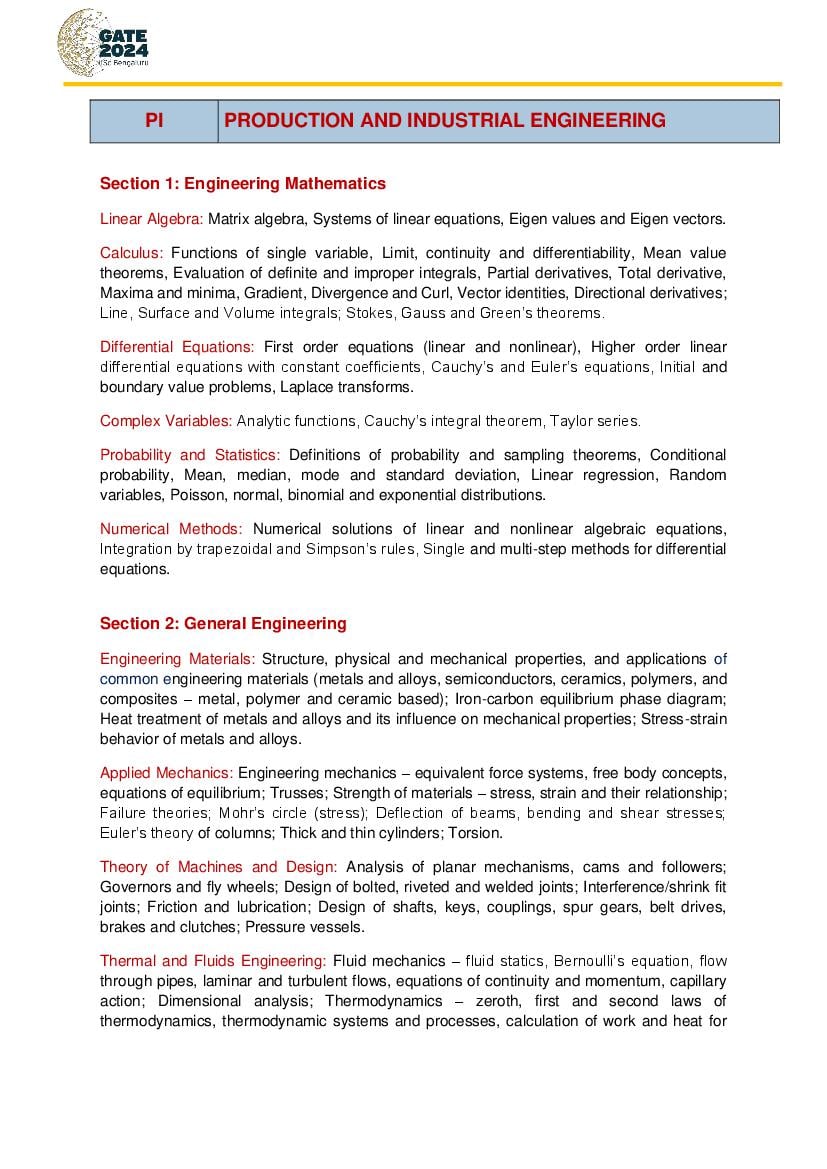
Section 1: Engineering Mathematics
Linear Algebra: Matrix algebra, Systems of linear equations, Eigen values and Eigen vectors.
Calculus: Functions of single variable, Limit, continuity and differentiability, Mean value
theorems, Evaluation of definite and improper integrals, Partial derivatives, Total derivative,
Maxima and minima, Gradient, Divergence and Curl, Vector identities, Directional derivatives;
Line, Surface and Volume integrals; Stokes, Gauss and Green’s theorems.
Differential Equations: First order equations (linear and nonlinear), Higher order linear
differential equations with constant coefficients, Cauchy’s and Euler’s equations, Initial and
boundary value problems, Laplace transforms.
Complex Variables: Analytic functions, Cauchy’s integral theorem, Taylor series.
Probability and Statistics: Definitions of probability and sampling theorems, Conditional
probability, Mean, median, mode and standard deviation, Linear regression, Random
variables, Poisson, normal, binomial and exponential distributions.
Numerical Methods: Numerical solutions of linear and nonlinear algebraic equations,
Integration by trapezoidal and Simpson’s rules, Single and multi-step methods for differential
equations.
Section 2: General Engineering
Engineering Materials: Structure, physical and mechanical properties, and applications of
common engineering materials (metals and alloys, semiconductors, ceramics, polymers, and
composites – metal, polymer and ceramic based); Iron-carbon equilibrium phase diagram;
Heat treatment of metals and alloys and its influence on mechanical properties; Stress-strain
behavior of metals and alloys.
Applied Mechanics: Engineering mechanics – equivalent force systems, free body concepts,
equations of equilibrium; Trusses; Strength of materials – stress, strain and their relationship;
Failure theories; Mohr’s circle (stress); Deflection of beams, bending and shear stresses;
Euler’s theory of columns; Thick and thin cylinders; Torsion.
Theory of Machines and Design: Analysis of planar mechanisms, cams and followers;
Governors and fly wheels; Design of bolted, riveted and welded joints; Interference/shrink fit
joints; Friction and lubrication; Design of shafts, keys, couplings, spur gears, belt drives,
brakes and clutches; Pressure vessels.
Thermal and Fluids Engineering: Fluid mechanics – fluid statics, Bernoulli’s equation, flow
through pipes, laminar and turbulent flows, equations of continuity and momentum, capillary
action; Dimensional analysis; Thermodynamics – zeroth, first and second laws of
thermodynamics, thermodynamic systems and processes, calculation of work and heat for
Page 2
conduction, convection and radiation.
Section 3: Manufacturing Processes I
Casting: Types of casting processes and applications; Sand casting: patterns – types,
materials and allowances; molds and cores–materials, making, and testing; design of gating
system and riser; casting techniques of cast iron, steels, and nonferrous metals and alloys;
analysis of solidification and microstructure development; Other casting techniques: Pressure
die casting, Centrifugal casting, Investment casting, Shell mold casting; Casting defects and
their inspection by non-destructive testing.
Metal Forming: Stress-strain relations in elastic and plastic deformation; von Mises and Tresca
yield criteria, Concept of flow stress; Hot, warm and cold working; Bulk forming processes –
forging, rolling, extrusion and wire drawing; Sheet metal working processes – blanking,
punching, bending, stretch forming, spinning and deep drawing; Ideal work and slab analysis;
Defects in metal working and their causes.
Joining of Materials: Classification of joining processes; Principles of fusion welding processes
using different heat sources (flame, arc, resistance, laser, electron beam), Heat transfer and
associated losses; Arc welding processes - SMAW, GMAW, GTAW, plasma arc, submerged
arc welding processes; Principles of solid state welding processes - friction welding, friction
stir welding, ultrasonic welding; Welding defects - causes and inspection; Principles of
adhesive joining, brazing and soldering processes.
Powder Processing: Production of metal/ceramic powders, compaction and sintering of metals
and ceramic powders, Cold and hot isostatic pressing.
Polymers and Composites: Polymer processing – injection, compression and blow molding,
extrusion, calendaring and thermoforming; Molding of composites.
Section 4: Manufacturing Processes II
Machining: Orthogonal and oblique machining, Single point cutting tool and tool signature,
Chip formation, cutting forces, Merchant’s analysis, Specific cutting energy and power;
Machining parameters and material removal rate; tool materials, Tool wear and tool life;
Thermal aspects of machining, cutting fluids, machinability; Economics of machining;
Machining processes - turning, taper turning, thread cutting, drilling, boring, milling, gear
cutting, thread production; Finishing processes – grinding, honing, lapping and super-finishing.
Machine Tools: Lathe, milling, drilling and shaping machines – construction and kinematics;
Jigs and fixtures – principles, applications, and design.
Advanced Manufacturing: Principles and applications of USM, AJM, WJM, AWJM, EDM and
Wire EDM, LBM, EBM, PAM, CHM, ECM; Effect of process parameters on material removal
rate, surface roughness and power consumption; Additive manufacturing techniques.
Computer Integrated Manufacturing: Basic concepts of CAD and CAM, Geometric modeling,
CNC; Automation in Manufacturing; Industrial Robots – configurations, drives and controls;
Cellular manufacturing and FMS - Group Technology, CAPP.
Page 3
Metrology and Inspection: Accuracy and precision; Types of errors; Limits, fits and tolerances;
Gauge design, Interchangeability, Selective assembly; Linear, angular, and form
measurements (straightness, flatness, roundness, runout and cylindricity) by mechanical and
optical methods; Inspection of screw threads and gears; Surface roughness measurement by
contact and non-contact methods.
Quality Management: Quality – concept and costs; Statistical quality control – process
capability analysis, control charts for variables and attributes and acceptance sampling; Six
sigma; Total quality management; Quality assurance and certification - ISO 9000, ISO14000.
Reliability and Maintenance: Reliability, availability and maintainability; Distribution of failure
and repair times; Determination of MTBF and MTTR, Reliability models; Determination of
system reliability; Preventive and predictive maintenance and replacement, Total productive
maintenance.
Section 6: Industrial Engineering
Product Design and Development: Principles of product design, tolerance design; Quality and
cost considerations; Product life cycle; Standardization, simplification, diversification; Value
engineering and analysis; Concurrent engineering; Design for “X”.
Work System Design: Taylor’s scientific management, Gilbreths’s contributions; Productivity
– concepts and measurements; Method study, Micro-motion study, Principles of motion
economy; Work measurement – time study, Work sampling, Standard data, PMTS;
Ergonomics; Job evaluation and merit rating.
Facility Design: Facility location factors and evaluation of alternate locations; Types of plant
layout and their evaluation; Computer aided layout design techniques; Assembly line
balancing; Materials handling systems.
Section 7: Operations research and Operations management
Operation Research: Linear programming – problem formulation, simplex method, duality and
sensitivity analysis; Transportation and assignment models; Integer programming;
Constrained and unconstrained nonlinear optimization; Markovian queuing models;
Simulation – manufacturing applications.
Engineering Economy and Costing: Elementary cost accounting and methods of depreciation;
Break-even analysis; Techniques for evaluation of capital investments; Financial statements;
Activity based costing.
Production control: Forecasting techniques – causal and time series models, moving average,
exponential smoothing, trend and seasonality; Aggregate production planning; Master
production scheduling; MRP, MRP-II and ERP; Routing, scheduling and priority dispatching;
Push and pull production systems, concepts of Lean and JIT manufacturing systems;
Page 4
classifications, deterministic inventory models, quantity discount; Perpetual and periodic
inventory control systems.
Project management: Scheduling techniques – Gantt chart, CPM, PERT and GERT.
Document Details
| Board / Org | IIT |
| Exam | Graduate Aptitude Test in Engineering |
| Type | Syllabus |
| Pages | 4 |
| Updated | 22 Jul 2026 |