CBSE Class 11 Syllabus 2022-23 English Core
Finished viewing? Save it for later —
Download CBSE Class 11 Syllabus 2022-23 English Core (PDF · 15 pages)About CBSE Class 11 Syllabus 2022-23 English Core
CBSE Class 11 Syllabus 2022-23 English Core is available here for free download. Published by CBSE for Class 11, this syllabus can be viewed online or downloaded as a PDF (15 pages). Candidates preparing for Class 11 can use CBSE Class 11 Syllabus 2022-23 English Core to understand the exam pattern, the type of questions asked, and the overall difficulty level.
Frequently Asked Questions
How can I download CBSE Class 11 Syllabus 2022-23 English Core?
Open this page and click the Download button to save CBSE Class 11 Syllabus 2022-23 English Core as a PDF. It is completely free on AglaSem Docs.
Is CBSE Class 11 Syllabus 2022-23 English Core free to download?
Yes. CBSE Class 11 Syllabus 2022-23 English Core can be viewed online and downloaded as a PDF free of cost on AglaSem Docs.
How many pages does CBSE Class 11 Syllabus 2022-23 English Core have?
CBSE Class 11 Syllabus 2022-23 English Core contains 15 pages, which you can read online or download together as a single PDF.
Where can I find more Class 11 study material?
You can find more Class 11 question papers, sample papers, syllabus, and answer keys on AglaSem Docs.
CBSE Class 11 Syllabus 2022-23 English Core – Text
Read the full text of this syllabus below — useful to quickly search, copy and reference the content online without downloading the PDF.
📄 View text version (15 pages)
Page 1
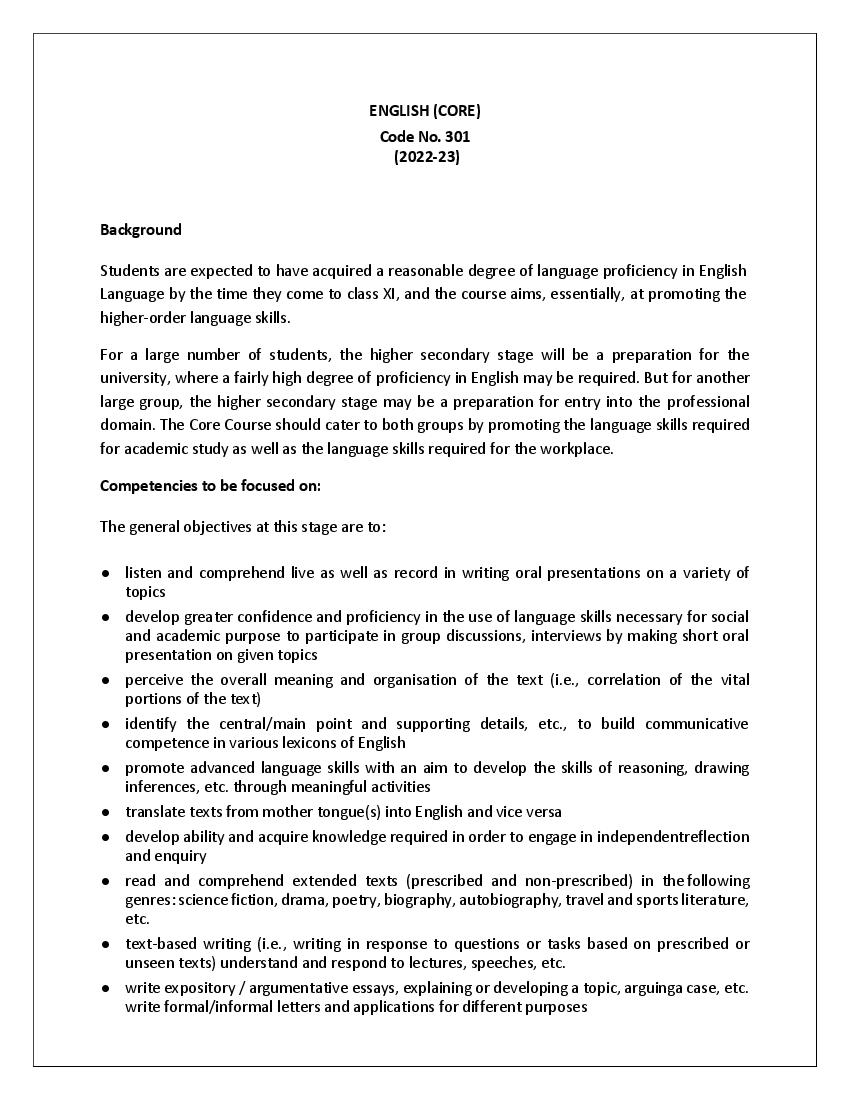
Code No. 301
(2022-23)
Background
Students are expected to have acquired a reasonable degree of language proficiency in English
Language by the time they come to class XI, and the course aims, essentially, at promoting the
higher-order language skills.
For a large number of students, the higher secondary stage will be a preparation for the
university, where a fairly high degree of proficiency in English may be required. But for another
large group, the higher secondary stage may be a preparation for entry into the professional
domain. The Core Course should cater to both groups by promoting the language skills required
for academic study as well as the language skills required for the workplace.
Competencies to be focused on:
The general objectives at this stage are to:
● listen and comprehend live as well as record in writing oral presentations on a variety of
topics
● develop greater confidence and proficiency in the use of language skills necessary for social
and academic purpose to participate in group discussions, interviews by making short oral
presentation on given topics
● perceive the overall meaning and organisation of the text (i.e., correlation of the vital
portions of the text)
● identify the central/main point and supporting details, etc., to build communicative
competence in various lexicons of English
● promote advanced language skills with an aim to develop the skills of reasoning, drawing
inferences, etc. through meaningful activities
● translate texts from mother tongue(s) into English and vice versa
● develop ability and acquire knowledge required in order to engage in independentreflection
and enquiry
● read and comprehend extended texts (prescribed and non-prescribed) in the following
genres: science fiction, drama, poetry, biography, autobiography, travel and sports literature,
etc.
● text-based writing (i.e., writing in response to questions or tasks based on prescribed or
unseen texts) understand and respond to lectures, speeches, etc.
● write expository / argumentative essays, explaining or developing a topic, arguinga case, etc.
write formal/informal letters and applications for different purposes
Page 2
● select, compile and collate information for an oral presentation
● produce unified paragraphs with adequate details and support
● use grammatical structures accurately and appropriately
● write items related to the workplace (minutes, memoranda, notices, summaries,reports etc.
● filling up of forms, preparing CV, e-mail messages., making notes from referencematerials,
recorded talks etc.
The core course should draw upon the language items suggested for class IX-X and delve deeper
into their usage and functions. Particular attention may, however, be givento the following areas
of grammar:
• The use of passive forms in scientific and innovative writings.
• Convert one kind of sentence/clause into a different kind of structure as well as other
items to exemplify stylistic variations in different discourses modal auxiliaries- uses based
on semantic considerations.
A. Specific Objectives of Reading
Students are expected to develop the following study skills:
• skim for main ideas and scan for details
• refer to dictionaries, encyclopedia, thesaurus and academic reference material in
any format
• select and extract relevant information, using reading skills of skimming and scanning
• understand the writer's purpose and tone
• comprehend the difference between the literal and the figurative
• differentiate between claims and realities, facts and opinions, form business opinions
onthe basis of latest trends available
• comprehend technical language as required in computer related fields, arrive at
personal conclusion and logically comment on a given text.
• Specifically develop the ability to be original and creative in interpreting opinion,
develop the ability to be logically persuasive in defending one's opinion and making
notes based on a text.
Develop literary skills as enumerated below:
• respond to literary texts
• appreciate and analyse special features of languages that differentiate literary texts
from non-literary ones, explore and evaluate features of character, plot, setting, etc.
• understand and appreciate the oral, mobile and visual elements of drama.
Identify the elements of style such as humour, pathos, satire and irony, etc.
• make notes from various resources for the purpose of developing the extracted ideas
into sustained pieces of writing
Page 3
Speaking needs a very strong emphasis and is an important objective leading toprofessional
competence. Hence, testing of oral skills must be made an important component of the overall
testing pattern. To this end, speaking and listening skills are overtly built into the material to
guide the teachers in actualization of the skills.
Specific Objectives of Listening & Speaking
Students are expected to develop the ability to:
• take organized notes on lectures, talks and listening passages
• listen to news bulletins and to develop the ability to discuss informally a wideranging
issues like current national and international affairs, sports, business, etc.
• respond in interviews and to participate in formal group discussions.
• make enquiries meaningfully and adequately and to respond to enquiries for thepurpose
of travelling within the country and abroad.
• listen to business news and to be able to extract relevant important information.
• to develop public speaking skills.
C. Specific Objectives of Writing
The students will be able to:
• write letters to friends, relatives, etc. to write business and official letters.
• open accounts in post offices and banks. To fill in railway/airline reservation forms.
• draft notices, advertisements and design posters effectively and appropriately
• write on various issues to institutions seeking relevant information, lodge complaints,
express gratitude or render apology.
• write applications, fill in application forms, prepare a personal bio-data for admissioninto
colleges, universities, entrance tests and jobs.
• write informal reports as part of personal letters on functions, programmes and
activities held in school (morning assembly, annual day, sports day, etc.)
• write formal reports for school magazines/events/processes/ or in local newspapers
about events or occasions.
• express opinions, facts, arguments in the form of speech or debates, using a varietyof
accurate sentence structures
• draft papers to be presented in symposia.
• take down notes from talks and lectures.
• write examination answers according to the requirement of various subjects.
• summarise a text.
Page 4
Inculcating good reading habits in children has always been a concern for all stakeholders in
education. The purpose is to create independent thinking individualswith the ability to not only
create their own knowledge but also critically interpret, analyse and evaluate it with objectivity
and fairness. This will also help students in learning and acquiring better language skills.
Creating learners for the 21st century involves making them independent learners whocan learn,
unlearn and relearn. If our children are in the habit of reading, they will learn to reinvent
themselves and deal with the many challenges that lie ahead of them.
Reading is not merely decoding information or pronouncing words correctly. It is an interactive
dialogue between the author and the reader in which the reader and the author share their
experiences and knowledge with each other. Good readers are critical readers with an ability to
arrive at a deeper understanding of not only the worldpresented in the book but also of the real
world around them.
Consequently, they become independent thinkers capable of taking their own decisions in life
rationally. Hence, a few activities are suggested below which teachers may use asa part of the
reading project.
• Short review / dramatization of the story
• Commentary on the characters
• Critical evaluation of the plot, storyline and characters
• Comparing and contrasting the characters within the story, with other characters in
stories by the same author or by different authors
• Extrapolating about the story read or life of characters after the story ends defending
characters actions in the story
• Making an audio story out of the novel/text to be read aloud.
• Interacting with the author
• Holding a literature fest where students role-play as various characters to interact with
each other
• Role playing as authors/poets/dramatists, to defend their works and characters
• Symposiums and seminars for introducing a book, an author, or a theme
• Creating graphic novels out of novel or short stories they read
• Dramatizing incidents from a novel or a story
• Creating their own stories
• Books of one genre to be read by the whole class.
Teachers may select books and e-books suitable to the age and level of the learners.Care
ought to be taken to choose books that are appropriate in terms of language, theme and
content and which do not hurt the sensibilities of a child.
Page 5
extended activity. The Project should lead to independent learning/reading skills and hence the
chosen book should not be taught in class, but may be introduced through activities and be left
for the students to read at their own pace. Teachers may, however, choose to assess a student's
progress or success in reading the book by asking for verbal or written progress reports, looking
at their diary entries, engaging in a discussion about the book, giving a short quiz or a work sheet
about the book/short story. A befitting mode of assessment may be chosen by the teacher.
Methods and Techniques
The techniques used for teaching should promote habits of self-learning and reduce dependence
on the teacher. In general, we recommend a multi-skill, learner-centred, activity based approach,
of which there can be many variations. The core classroom activity is likely to be that of silent
reading of prescribed/selected texts for comprehension, which can lead to other forms of
language learning activities such as role-play, dramatization, group discussion, writing, etc.,
although many such activities could be carried out without the preliminary use of textual
material. It is important that students be trained to read independently and intelligently,
interacting actively withtexts, with the use of reference materials (dictionary, thesaurus, etc.)
where necessary. Some pre-reading activity will generally be required, and the course books
should suggest suitable activities, leaving teachers free to devise other activities when desired.
So also, the reading of texts should be followed by post reading activities. It is important to
remember that students should be encouraged to interpret texts in different ways.
Group and pair activities can be resorted to when desired, although many useful language
activities can be carried out individually. In general, teachers should encourage students to
interact actively with texts and with each other. Oral activity (group discussion, etc.) should be
encouraged.
Page 6
CODE NO. 301
CLASS – XI (2022-23)
Section A
Reading Skills
Reading Comprehension through Unseen Passage 18 Marks
I. One unseen passage to assess comprehension, interpretation inference and vocabulary. The
passage may be factual, descriptive or literary.
II. One unseen case-based passage with verbal/visual inputs like statistical data, charts etc.
Note: The combined word limit for both the passages will be 600-750.
Multiple Choice Questions / Objective Type Questions will be asked. (10+8 = 18 Marks)
III. Note Making and Summarization based on a passage of approximately 200-250 words.
i. Note Making: 5 Marks
○ Title: 1
○ Numbering and indenting: 1
○ Key/glossary: 1
○ Notes: 2
ii. Summary (up to 50 words): 3 Marks
○ Content: 2
○ Expression: 1
Section B
IV. Grammar 7 Marks
i. Questions on Gap filling (Tenses, Clauses)
ii. Questions on re-ordering/transformation of sentences
(Total seven questions to be done out of the eight given).
V. Creative Writing Skills 16 Marks
i. Short writing task – Classified Advertisements up to 50 words. One out of the two given
questions to be answered (3 Marks: Format : 1 / Content : 1 / Expression : 1)
Page 7
answered.(3marks:Format : 1 / Content : 1 / Expression : 1)
iii. Writing a Speech in 120-150 words based on verbal / visual cues related to some contemporary
/ age-appropriate topic.
iv. Writing a Debate based on visual/verbal inputs in 120-150 words. The theme should be
contemporary topical issues. One out of the two given questions to be answered. (5 Marks:
Format: 1 / Content: 2 / Expression: 2)
Section C
This section will have variety of assessment items including Multiple Choice Questions, Objective Type
Questions, Short Answer Type Questions and Long Answer Type Questions to assess comprehension,
analysis, interpretation and extrapolation beyond the text.
VI. Reference to the Context
i. One Poetry extract out of two from the book Hornbill to assess comprehension,
interpretation, analysis and appreciation. (3x1=3 Marks)
ii. One Prose extract out of two from the book Hornbill to assess comprehension,
interpretation, analysis and appreciation. (3x1=3 Marks)
iii. One prose extract out of two from the book Snapshots to assess comprehension,
interpretation and analysis. (4x1=4 Marks)
VII. Two Short answer type question (one from Prose and one from Poetry from the book Hornbill), out
of four, to be answered in 40-50 words. Questions should elicit inferential responses through critical
thinking. (3x2=6 Marks)
VIII. One Short answer type question, from the book Snapshots, to be answered I n 40- 50 words.
Questions should elicit inferential responses through critical thinking. Any 1 out of 2 questions to
be done. (3x1=3 Marks)
IX. One Long answer type question, from Prose/Poetry Hornbill, to be answered in 120-150 words.
Questions can be based on incident / theme / passage / extract / event as reference points to
assess extrapolation beyond and across the text. The question will elicit analytical and evaluative
response from student. Any 1 out of 2 questions to be done. (1x6=6 Marks)
X. One Long answer type question, based on the chapters from the book Snapshots to be answered
in 120-150 words to assess global comprehension and extrapolation beyond the text. Questions to
provide evaluative and analytical responses using incidents, events, themes as reference points.
Any 1 out of 2 questions to be done. (1x6=6 Marks)
Page 8
1. Hornbill: English Reader published by National Council of Education Research andTraining,
New Delhi
• The Portrait of a Lady (Prose)
• A Photograph (Poem)
• “We’re Not Afraid to Die… if we can be together
• Discovering Tut: the Saga Continues
• The Laburnum Top (Poem)
• The Voice of the Rain (Poem)
• Childhood (Poem)
• The Adventure
• Silk Road (Prose)
• Father to Son
2. Snapshots: Supplementary Reader published by National Council of EducationResearch
and Training, New Delhi
• The Summer of the Beautiful White Horse (Prose)
• The Address (Prose)
• Mother’s Day (Play)
• Birth ( Prose)
• The Tale of Melon City
INTERNAL ASSESSMENT
Assessment of Listening Skills - 05 marks.
Assessment of Speaking Skills – 05 Marks
Project Work - 10 Marks
Page 9
CORE XI (Code No. 301)
Section Competencies Total marks
Reading Skills Conceptual understanding, decoding, Analyzing,
inferring, interpreting, appreciating, literary,
conventions and vocabulary, summarizing and 26
usingappropriate format/s.
Creative Writing Sills Conceptual Understanding, application of rules,
Analysis, Reasoning, appropriacy of style and
tone, using appropriate format and fluency, 23
inference, analysis, evaluation and creativity.
Literature Text Books and Recalling, reasoning, appreciating literary
Supplementary Reading convention, inference, analysis, creativity with
Texts fluency, Critical Thinking. 31
80
TOTAL
Assessment ofListening andSpeaking Skills
10
Internal Assessment
• Listening
• Speaking 5
5
• Project Work
10
GRAND TOTAL 100
Page 10
Guidelines for Internal Assessment
Classes XI-XII
ALS must be seen as an integrated component of all four language skills rather than a compartment of two. Suggested
activities, therefore, take into consideration an integration of the four language skills but during assessment, emphasis will
be given to speaking and listening, since reading and writing are already being assessed in the written exam.
Classes XI-XII Total Marks: 20
Assessment of Listening and Speaking Skills: (5+5=10 Marks)
i. Activities:
● Subject teachers must refer to books prescribed in the syllabus.
● In addition to the above, teachers may plan their own activities and create their own material for assessing
the listening and speaking skills.
ii. Parameters for Assessment: The listening and speaking skills are to be assessed on the following parameters:
a. Interactive competence (Initiation & turn taking, relevance to the topic)
b. Fluency (cohesion, coherence and speed of delivery)
c. Pronunciation
d. Language (grammar and vocabulary)
A suggestive rubric is given below:
1. 2. 3. 4. 5.
Interaction
• Contributions are • Contributions • Develops • Interaction is • Can initiate &
mainly unrelated are often interaction adequately logically develop
to those of other unrelated to adequately, initiated simple
speakers those of the makes and develop conversation on
• Shows hardly any other speaker however • Can take turn familiar topics
initiative in the • Generally minimal effort but needs • Can take turns
development of passive in the to initiate little appropriately
conversation development of conversation prompting
• Very limited conversation • Needs
interaction constant
prompting to
take turns
• Insufficient • Frequently • Largely correct • Mostly correct • Can pronounce
Pronunciation accuracy in unintelligible pronunciation & pronunciation correctly &
pronunciation; articulation clear & clear articulate clearly
many • Frequent articulation articulation • Is always
grammatical phonological except • Can be clearly comprehensible
errors errors occasional understood ; uses
• Communication • Major errors most of the appropriate
is severely communication • Some time; very few intonation
affected problems expressions phonological
cause stress errors
without
compromising
with
understanding
of spoken
discourse.
Page 11
Fluency &
Coherence • Noticeably/ long • Usually fluent; • Is willing to • Speaks without • Speaks fluently
pauses; rate of produces simple speak at noticeable almost with no
Speech is slow speech fluently, length, effort, with a repetition &
• Frequent but loses however little repetition minimal
repetition and/or coherence in repetition is • Demonstrates hesitation
self- correction complex noticeable hesitation to • Develops topic
• Links only basic communication • Hesitates find words or fully &
sentences; • Often hesitates and/or self use correct coherently
breakdown of and/or resorts to corrects; grammatical
coherence slow speech occasionally structures
evident • Topics partly loses and/or self-
developed; not coherence correction
always • Topics mainly • Topics not fully
concluded developed, but developed to
logically usually not merit
logically
concluded
Vocabulary & • Demonstrates • Communicates • Communicate • Can express • Can express
almost no with limited s with limited with some with some
Grammar flexibility, and flexibility and flexibility flexibility and flexibility and
mostly struggles appropriacy on and appropriacy on appropriacy on a
for appropriate some of the appropriacy most of the variety of topics
words topics on most of the topics such as family,
• Uses very basic • Complex forms topics • Demonstrates hobbies, work,
vocabulary to and sentence • Sometimes ability to use travel and current
express view- structures are uses complex complex forms events
points. rare; exhibits forms and and sentence • Frequently uses
limited sentence structures most complex forms
vocabulary to structures; has of the time; and sentence
express new limited expresses with structures; has
ideas vocabulary to adequate enough
describe/ vocabulary vocabulary to
express new express himself/
points herself
iii. Schedule:
• The practice of listening and speaking skills should be done throughout the academic year.
• The final assessment of the skills is to be done as per the convenience and schedule of the school.
Project Work + Viva: 10 Marks
Out of ten marks, 5 marks will be allotted for the project report/script /essay etc. and 5 marks for the viva.
I. Schedule:
● Schools may refer to the suggestive timeline given in these guidelines for the planning, preparation and viva-voce
of ALS based projects.
● The final assessment of the skills may be done on the basis of parameters suggested by the Board. Language
teachers, however, have the option to adopt/ modify these parameters according to their school specific
requirements.
II. Suggestions for Project Work:
• The Project can be inter-disciplinary in theme. The ideas/issues highlighted in the chapters/ poems/ drama given
the prescribed books can also be developed in the form of a project. Students can also take up any relevant and
age-appropriate theme.
• Such topics may be taken up that provide students with opportunities for listening and speaking.
Some suggestions are as follows:
a. Interview-Based research:
Example:
Page 12
Evolving food tastes in my neighbourhood” or “Corona pandemic and the fallout on families.” Read the available
literature.
• The student then conducts interviews with a few neighbours on the topic. For an interview, with the help of the
teacher, student will frame questions based on the preliminary research/background.
• The student will then write an essay/ write up / report etc. up to 1000 words on his/her research and submit it. He
/ She will then take a viva on the research project. The project can be done in individually or in pairs/ groups
b. Listen to podcasts/ interviews/radio or TV documentary on a topic and prepare a report countering or agreeing with
the speakers. Write an 800 - 1000 words report and submit. Take a viva on the report.
c. Students create their own video/ Audio, after writing a script. Before they decide a format, the following elements can
be taken into consideration:
● Theme/topic of the audio / video. Would the child like to pick a current issue or something artistic like theatre?
● What are the elements that need to be part of the script?
● Will the video/audio have an interview with one or more guests?
● Would they prefer to improvise while chatting with guests, or work from a script?
● What would be the duration?
● How would they present the script/report to the teacher, e.g. Can it be in the form of a narrative?
d. Write, direct and present a theatrical production, /One act play
This will be a project which will be done as a team. It will involve planning, preparation and presentation. In short,
various language skills will be utilised. There will be researching, discussion, writing the script, auditioning and
ultimately producing the play. The project will end with a presentation and subsequently a viva. Teachers will be able
to assess the core language skills of the students and help them grow as 21 st century critical thinkers.
III. Instructions for the Teachers:-
1. Properly orient students about the Project work, as per the present Guidelines.
2. Facilitate the students in the selection of theme and topic.
3. Create a rubric for assessment and share with the students before they start so that they know the parameters of
assessment:
• Teachers need to familiarize themselves with the method of assessing students with the rubric-- a table
with different criteria and a grading scale.
• Choose the criteria on which you will grade students and list them along the left side of the page.
• Create an even number of columns along the top of the page. These columns will represent potential skill
levels of the students.
• Assessing students on four/five criteria is an easy way to begin. For each criterion, define the ability that
a student would exhibit at each of the levels.
● The more detailed you make your criteria, the easier it will be to evaluate each student and define the level at
which the student is presenting.
{Sample Rubric is attached at the end for reference}
IV. Parameters for Overall Assessment:-
1. Pronunciation:
• When evaluating the pronunciation of the students, teachers must listen for clearly articulated words, pronunciation
of unusual spellings and intonation.
• Assess the students for the pronunciation skills and determine at which level the student needs improvement.
2. Vocabulary:
• After noting their pronunciation levels, evaluate the students on the use of extensive and appropriate vocabulary
during the viva. Check if students are using vocabulary appropriate to the context about which they are speaking.
3. Accuracy:
• Grammar has always been an important component of language skills. As students speak/ answer the questions
during the viva, listen to their grammatical structures. Are they competent enough to use multiple tenses? Is
their word order correct in a given sentence? An effective speaker will automatically use the correct grammatical
structures of his language.
Page 13
• Assessing the communication skills of the students means looking at more than language. Look at how
creatively students use the language to make their points understood. Students with a low level of vocabulary and
grammar may still have good communication skills if they are able to make the teacher understand their point of
view.
5. Interaction:
• During the viva teachers need to ask the students some questions. Questions need to be based on the projects
that have been suggested or chosen by the students.
• It is imperative for a teacher to read the essays/project reports before they can be ready to ask questions.
• Teachers need to observe how students answer the questions that are posed to them: Are they able to understand
and answer questions independently or can they answer only when the questions are translated into simpler words
or repeated? Are they able to give appropriate responses in a conversation?
• These elements of interaction are necessary for clear and effective communication. A student with effective
interaction skills will be able to answer questions with relative ease and follow the flow of conversation.
6. Fluency:
• Fluency may be the easiest quality to judge in the students’ speech: How comfortable are they as they speak and
express themselves? How easily do the words come out? Are there inappropriate pauses and gaps in the way a
student speaks?
• Fluency is a judgement of this communication and is an important criterion when evaluating speaking skills. These
criteria: pronunciation, vocabulary, accuracy, interaction and fluency are all the hallmarks of a student's overall
speaking abilities.
• Teachers must also remember that some students may excel in one area and struggle in another. Helping the
students understand these issues will enable them to become effective speakers in future. Let your students know
that you will be assessing them in these various areas when you evaluate their progress and encourage them to
work and improve in these areas.
• Finally, teachers must remember that a proper evaluation of the students will take into consideration more than
just one oral interview on the final ASL project. Teachers must take note of a student’s progress throughout
the academic year.
V. Project-Portfolio/ Project Report
The Project-Portfolio/Project Report is a compilation of the work that the students produce during the process of working
on their ALS Project.
The Project-Portfolio may include the following:
● Cover page, with title of project, school details/details of students.
● Statement of purpose/objectives/goals
● Certificate of completion under the guidance of the teacher.
● Action plan for the completion of assigned tasks.
● Materials such as scripts for the theatre/role play, questionnaires for interview, written assignments, essays,
survey-reports and other material evidence of learning progress and academic accomplishment.
● The 800-1000 words essay/Script/Report.
● Student/group reflections.
● If possible, Photographs that capture the positive learning experiences of the student(s).
● List of resources/bibliography.
The following points must be kept for consideration while assessing the project portfolios:
● Quality of content of the project
● Accuracy of information
● Adherence to the specified timeline
● Content in respect of (spellings, grammar ,punctuation)
● Clarity of thoughts and ideas
● Creativity
● Contributions by group members
● Knowledge and experience gained
Page 14
The FIVE Steps in Project Plan
PROJECT-INITIATION
PROJECT-PLANNING
EXECUTION IMPLEMENTATION CLOSURE
Month Objectives
Planning and Research ● Teachers plan a day to orient students about the ALS projects, details are shared
for the Project Work with all stakeholders.
● Students choose a project, select team members and develop project- plan.
Preferably till ● Group meets (preferably online) and reports to the team leader about the
November-December progress: shortfalls and successes are detailed.
● Team leader apprises teacher-mentor.
● Students working individually or in pairs also update the teachers.
● A logical, deliverable and practical plan is drafted by the team/ pair/individual.
Goals/objectives are clearly defined for all.
● Work is delegated to team members by the team leader. Students wishing to work
alone develop their own plan of Action.
● Detailed project schedules are shared with the teacher.
December- ● Suggestions and improvements are shared by the teacher, wherever necessary.
January ● Group members coordinate and keep communication channels open for
interaction.
● Gaps ( if any) are filled with the right skill sets by the Team Leader/ individual
student.
● The final draft of the project portfolio/ report is prepared and submitted for
evaluation.
January-February ● Students are assessed on their group/pair/individual presentations on allotted
days. Final Viva is conducted by the External/Internal examiner.
February-March ● Marks are uploaded on the CBSE website.
or
as per the timelines
given by the Board
Page 15
(For Theatre/Role Play/Oral presentation/Interview/Podcast)
CATEGORY 1 2 3 4 5
TIME LIMIT Presentation is Presentation Presentation Presentation Student/ group
less than or more exceeded or less exceeded or less exceeded or less adhered to the
than 5 minutes than specified than specified than specified given time limit
long time limit by 4 to 5 time limit by 3 to 4 time limit by 2 to 3
minutes minutes minutes
CONTENT/SCRIPT/ Script is not Well written script/ Well written script/ Well written script/ Well written
QUESTIONNAIRE related to topic or content shows content shows content shows a script/ content
issue little good good shows full
understanding of understanding of understanding of understanding of
parts of topic parts of topic subject topic subject topic
CREATIVITY No Some work done, Well organized Logical use of Suitable props /
props/costumes/ average stage presentation, props ,reasonable honest effort
stage set- up and could have work done, seen/
presentation lack- costumes improved creative considerable
lustre work done/
creative and
relevant
costumes
PREPAREDNESS Student /group Some Somewhat Good Complete
seems to be preparedness prepared, preparedness ,but preparedness/
unprepared visible, but rehearsal is need better rehearsed
rehearsal is lacking rehearsal presentation
lacking
CLARITY OF Lack of clarity in Speaks clearly, Speaks clearly Speaks clearly Speaks clearly
SPEECH presentation some words are 90% of the time/ a and distinctly 95% distinctly 95% of
many words mispronounced few of time/ few time/ fluency in
mispronounced mispronounced mispronounced pronunciation
words words
USE OF PROPS Only 1/no relevant 1 to 2 relevant 2 to 3 relevant 3 to 4 relevant 4 to 5 relevant
( Theatre/Role Play) props used props used props used props used props used
EXPRESSION/ Very little use of Little Use of facial Facial Facial expression Facial expression
BODY LANGUAGE facial expressions and expressions and and body and body
expressions/ body body language body language language language
language, does are used to try to sometimes generate strong
not generate generate some generate strong enthusiasm with
much interest enthusiasm enthusiasm with the topic
the topic
PORTFOLIO- Inadequate & Somewhat Adequate & Interesting, Brilliant, creative
PRESENTATION unimpressive suitable & relevant enjoyable & & exceptional
convincing relevant
Document Details
| Board / Org | CBSE |
| Exam | Class 11 |
| Type | Syllabus |
| Pages | 15 |
| Language | english |
| Updated | 22 Jul 2026 |