NCERT Book Class 12 History Chapter 7 An Imperial Captial Vijayanagara
Finished viewing? Save it for later —
Download NCERT Book Class 12 History Chapter 7 An Imperial Captial Vijayanagara (PDF · 26 pages)About NCERT Book Class 12 History Chapter 7 An Imperial Captial Vijayanagara
NCERT Book Class 12 History Chapter 7 An Imperial Captial Vijayanagara is available here for free download. Published by NCERT for Class 12, this books can be viewed online or downloaded as a PDF (26 pages). Candidates preparing for Class 12 can use NCERT Book Class 12 History Chapter 7 An Imperial Captial Vijayanagara to understand the exam pattern, the type of questions asked, and the overall difficulty level.
Frequently Asked Questions
How can I download NCERT Book Class 12 History Chapter 7 An Imperial Captial Vijayanagara?
Open this page and click the Download button to save NCERT Book Class 12 History Chapter 7 An Imperial Captial Vijayanagara as a PDF. It is completely free on AglaSem Docs.
Is NCERT Book Class 12 History Chapter 7 An Imperial Captial Vijayanagara free to download?
Yes. NCERT Book Class 12 History Chapter 7 An Imperial Captial Vijayanagara can be viewed online and downloaded as a PDF free of cost on AglaSem Docs.
How many pages does NCERT Book Class 12 History Chapter 7 An Imperial Captial Vijayanagara have?
NCERT Book Class 12 History Chapter 7 An Imperial Captial Vijayanagara contains 26 pages, which you can read online or download together as a single PDF.
Where can I find more Class 12 study material?
You can find more Class 12 question papers, sample papers, syllabus, and answer keys on AglaSem Docs.
NCERT Book Class 12 History Chapter 7 An Imperial Captial Vijayanagara – Text
Read the full text of this books below — useful to quickly search, copy and reference the content online without downloading the PDF.
📄 View text version (1 page)
Page 1
THEME An Imperial Capital
SEVEN Vijayanagara
( c . fourteenth to sixteenth century)
Vijayanagara or “city of victory” was the name of
both a city and an empire. The empire was founded
in the fourteenth century. In its heyday it stretched
from the river Krishna in the north to the extreme
south of the peninsula. In 1565 the city was sacked
and subsequently deserted. Although it fell into
ruin in the seventeenth-eighteenth centuries, it
lived on in the memories of people living in the
Krishna-Tungabhadra doab. They remembered it
as Hampi, a name derived from that of the local
mother goddess, Pampadevi. These oral traditions
combined with archaeological finds, monuments
and inscriptions and other records helped scholars
to rediscover the Vijayanagara Empire.
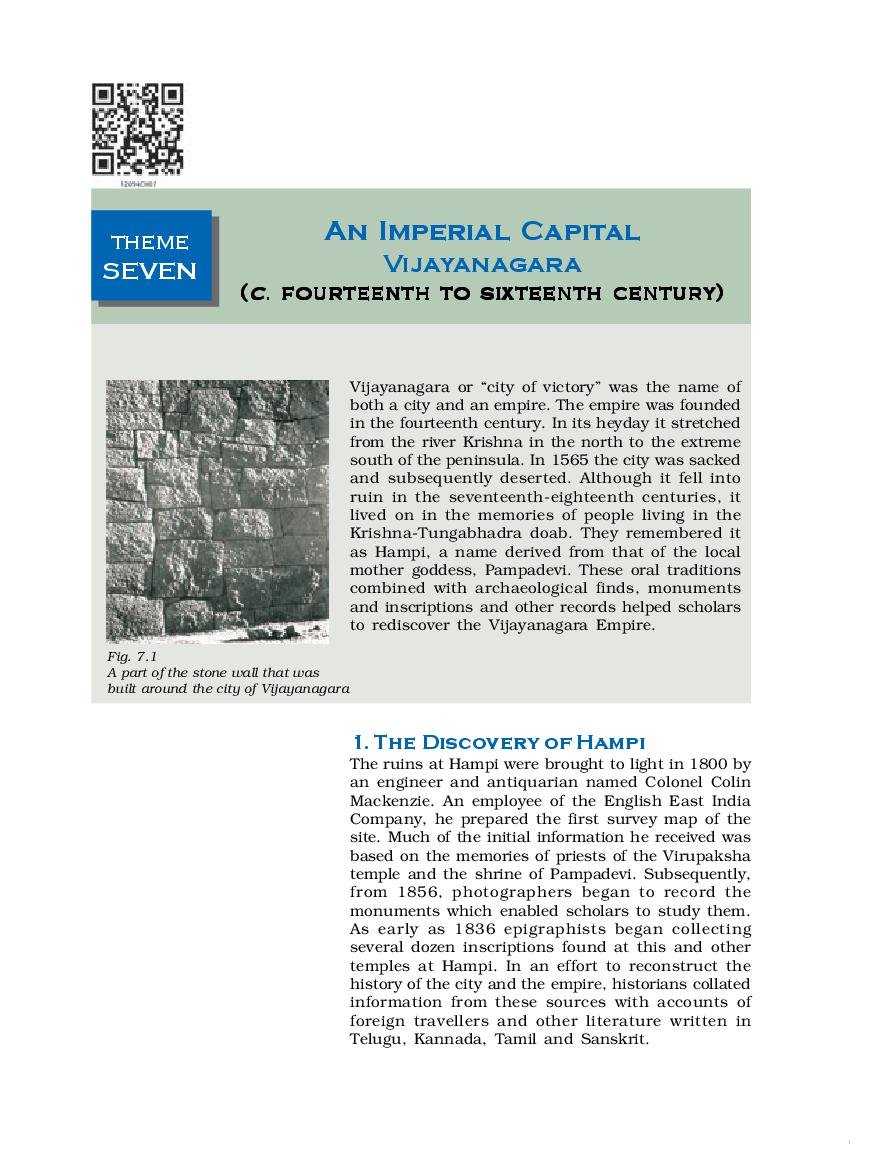
Fig. 7.1
A part of the stone wall that was
built around the city of Vijayanagara
1. The Discovery of Hampi
The ruins at Hampi were brought to light in 1800 by
an engineer and antiquarian named Colonel Colin
Mackenzie. An employee of the English East India
Company, he prepared the first survey map of the
site. Much of the initial information he received was
based on the memories of priests of the Virupaksha
temple and the shrine of Pampadevi. Subsequently,
from 1856, photographers began to record the
monuments which enabled scholars to study them.
As early as 1836 epigraphists began collecting
several dozen inscriptions found at this and other
temples at Hampi. In an effort to reconstruct the
history of the city and the empire, historians collated
information from these sources with accounts of
foreign travellers and other literature written in
Telugu, Kannada, Tamil and Sanskrit.
Showing the first page only. Download the PDF above for the complete document.
Document Details
| Board / Org | NCERT |
| Exam | Class 12 |
| Type | Books |
| Pages | 26 |
| Updated | 29 Aug 2026 |