Finished viewing? Save it for later —
Download CBSE Class 11 Syllabus 2022-23 English Elective (PDF · 6 pages)About CBSE Class 11 Syllabus 2022-23 English Elective
CBSE Class 11 Syllabus 2022-23 English Elective is available here for free download. Published by CBSE for Class 11, this syllabus can be viewed online or downloaded as a PDF (6 pages). Candidates preparing for Class 11 can use CBSE Class 11 Syllabus 2022-23 English Elective to understand the exam pattern, the type of questions asked, and the overall difficulty level.
Frequently Asked Questions
How can I download CBSE Class 11 Syllabus 2022-23 English Elective?
Open this page and click the Download button to save CBSE Class 11 Syllabus 2022-23 English Elective as a PDF. It is completely free on AglaSem Docs.
Is CBSE Class 11 Syllabus 2022-23 English Elective free to download?
Yes. CBSE Class 11 Syllabus 2022-23 English Elective can be viewed online and downloaded as a PDF free of cost on AglaSem Docs.
How many pages does CBSE Class 11 Syllabus 2022-23 English Elective have?
CBSE Class 11 Syllabus 2022-23 English Elective contains 6 pages, which you can read online or download together as a single PDF.
Where can I find more Class 11 study material?
You can find more Class 11 question papers, sample papers, syllabus, and answer keys on AglaSem Docs.
CBSE Class 11 Syllabus 2022-23 English Elective – Text
Read the full text of this syllabus below — useful to quickly search, copy and reference the content online without downloading the PDF.
📄 View text version (6 pages)
Page 1
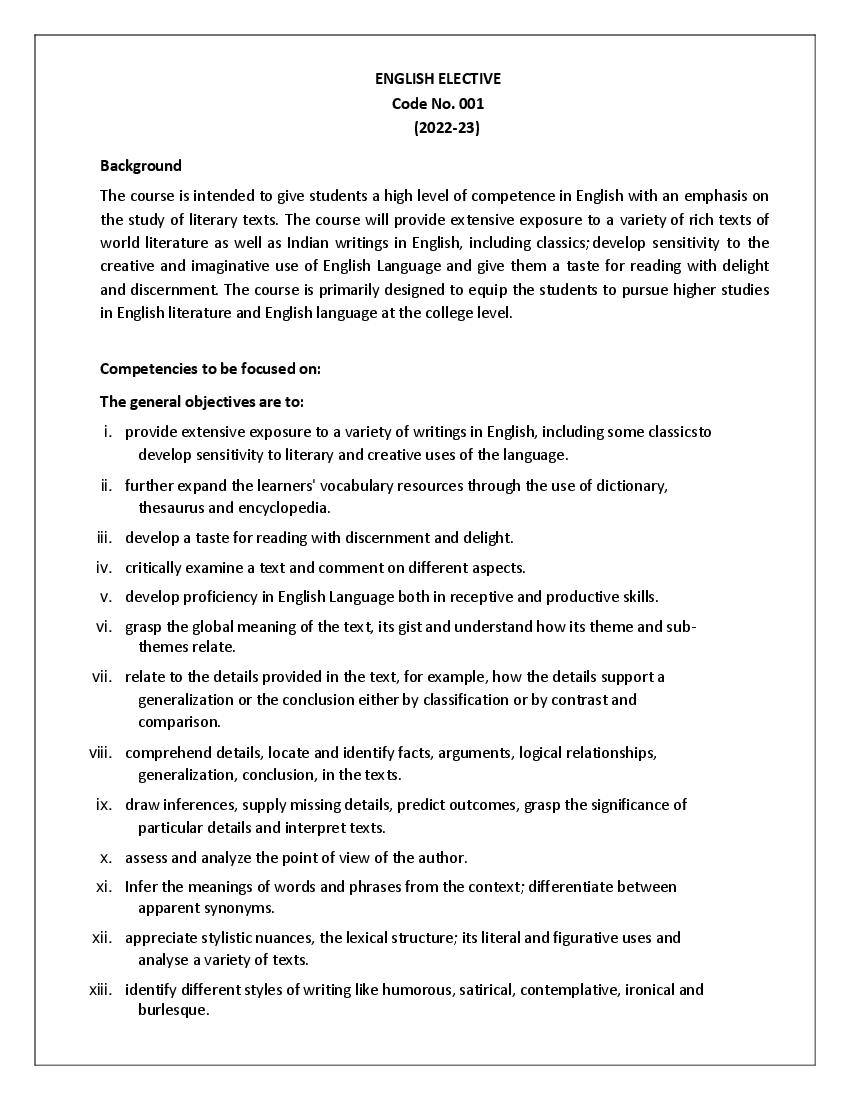
Code No. 001
(2022-23)
Background
The course is intended to give students a high level of competence in English with an emphasis on
the study of literary texts. The course will provide extensive exposure to a variety of rich texts of
world literature as well as Indian writings in English, including classics; develop sensitivity to the
creative and imaginative use of English Language and give them a taste for reading with delight
and discernment. The course is primarily designed to equip the students to pursue higher studies
in English literature and English language at the college level.
Competencies to be focused on:
The general objectives are to:
i. provide extensive exposure to a variety of writings in English, including some classics to
develop sensitivity to literary and creative uses of the language.
ii. further expand the learners' vocabulary resources through the use of dictionary,
thesaurus and encyclopedia.
iii. develop a taste for reading with discernment and delight.
iv. critically examine a text and comment on different aspects.
v. develop proficiency in English Language both in receptive and productive skills.
vi. grasp the global meaning of the text, its gist and understand how its theme and sub-
themes relate.
vii. relate to the details provided in the text, for example, how the details support a
generalization or the conclusion either by classification or by contrast and
comparison.
viii. comprehend details, locate and identify facts, arguments, logical relationships,
generalization, conclusion, in the texts.
ix. draw inferences, supply missing details, predict outcomes, grasp the significance of
particular details and interpret texts.
x. assess and analyze the point of view of the author.
xi. Infer the meanings of words and phrases from the context; differentiate between
apparent synonyms.
xii. appreciate stylistic nuances, the lexical structure; its literal and figurative uses and
analyse a variety of texts.
xiii. identify different styles of writing like humorous, satirical, contemplative, ironical and
burlesque.
Page 2
prescribed as well as 'unseen' texts)
xv. develop the advanced skills of reasoning, inferring, analysing, evaluating and creating.
xvi. develop familiarity with the poetic uses of language including features of the language
through which artistic effect is achieved.
Methods and Techniques
The techniques used for teaching should promote habits of self-learning and reduce dependence
on the teacher. The multi-skill, learner-centric, activity-based approach already recommended for
the previous stages of education, is still in place, though it will be used in such a way that silent
reading of prescribed selected texts for comprehension will receive greater focus as one of the
activities. Learners will be trained to read independently and intelligently, interacting actively with
texts and other reference materials (dictionary, thesaurus, encyclopedia, etc.) where necessary.
Some pre-reading activity will generally be required, as suggested in the course books. The reading
of texts should be followed by post reading activities. It is important to remember that every text
can generate different reading strategies. Students should be encouraged to interpret texts in
different ways, understand the views of others and present their views on a literary text. Some
projects may be assignedto students from time to time, for instance, students may be asked to put
together a few literary pieces on a given theme, so as to create a meaningful singular hold.
Page 3
(Code No. 001)
CLASS – XI
Section A
Reading
Two unseen passages and a poem 20 Periods
1. 12 out of 15 questions from a literary or discursive passage of about 950-1000words.
(1x12=12 marks)
2. 8 questions to test interpretation and appreciation of a poem of about 10-12 lines.
(1x8=8 marks)
3. 5 out of 7 questions from a case-based passage (with visual input- statistical data,
chart etc.) of 100-120 words to test interpretation. (1x5=5 marks)
Section B
Creative Writing Skills 20 Periods
4. An Essay on an argumentative/discursive/reflective/descriptive topic, leading tocreative
rendering, forming and defending of opinions, to be answered in 120-150 words. (5 marks)
5. Article on one out of two topics to be answered in 120-150 words. Contemporary topical
issues to be a part of Article writing. (5 marks)
6. Speech on one out of two topics to be answered in 120-150 words.Contemporary topical
issues to be a part of Speech writing. (5 marks)
Section C
This section will have variety of assessment items including Multiple Choice Questions, Objective
Type Questions, Short Answer Type Questions and Long Answer Type Questions to assess
comprehension, analysis, interpretation and extrapolation beyond the text.
Book: Woven Words 60 Periods
7. Reference to the Context
i. One Prose extract out of two to assess comprehension, Literary, appreciation and inference.
ii. One Poetry extract out of two to assess comprehension, Literary, appreciation and inference.
(5+5=10 Marks)
8. Two Short Answer Question out of three to be answered in 30-40 words to assess
understanding, analysis and critical appreciation. Questions should elicit inferential
responses through critical thinking. (2x2=4 marks)
9. Two Short Answer Question out of three to be answered in 50-60 words to assess
understanding, analysis and critical appreciation. Questions should elicit inferential
responses through critical thinking. (3x2=6marks)
Page 4
10. Two Long Answer Questions out of three to be answered in 80-100 words to appreciate
characters, events and episodes. Questions to provide analytical responses using
incidents, events, themes as reference points. (5x2=10 marks)
Fiction 20 Periods
11. One Short Answer Question out of two to be answered in 30-40 words to critically
appreciate characters, events, episodes and interpersonal relationships and to form their
opinions with reference to content, events and episode. (2 marks)
12. One Short Answer Question out of two to be answered in 50-60 words to assess
understanding, analysis and critical appreciation. Questions should elicit inferential
responses through critical thinking. (3 marks)
13. One Long Answer Question out of two to be answered in 120-150 words to test literary
appreciation and to draw inferences. Questions should elicit creative responses and
develop ability to form opinions. (5 marks)
Seminar (20 marks)
Presentation - book review /a play /a short story/a novel/novella (tale, table, and
parable) to be followed by a question-answer session.
Poetry reading to be followed by interpretative tasks based on close reading and
literary analysis of the text.
Critical review of a film/ documentary or a play.
Conducting a theatre workshop to be followed by a discussion
Note: Teachers may develop their own rubrics to assess the performance of studentsobjectively
The parameters for assessing Speaking skills as given in the curriculum for English Core may be
referred to.
Prescribed Books:
1. Text book: Woven Words published by NCERT
2. Fiction: The Old Man and the Sea (Novel unabridged) by Ernest Hemingway
3. Drama: Arms and the Man by George Bernard Shaw
Page 5
The Lament
A Pair of Mustachios
The Rocking-horse Winner
The Adventure of the Three Garridebs
Pappachi’s Moth
The Third and Final Continent
Book-Woven Words-Poetry
The Peacock
Let me Not to the Marriage of True Minds
Coming
Telephone Conversation
The World is too Much With Us
Mother Tongue
Hawk Roosting
Ode to a Nightingale
Book-Woven Words-Essays
My Watch
My Three Passions
Patterns of Creativity
Tribal Verse
What is a Good Book?
The Story
Bridges
Page 6
English Elective Class XI
MARKS 80+20=100
Section Competencies Total marks %
Weightage
Comprehension Conceptual understanding, decoding,
analyzing, inferring, interpreting, 25 31.25%
appreciating, literary, conventions and
vocabulary
Creative Writing Reasoning, appropriacy of style and
tone, use of appropriate format and 15 18.75%
fluency
Literature Texts Recalling, reasoning, appreciating
literary conventions illustrating with
relevant quotations from the texts, 20 25%
giving opinions and justifying with
fluency
Drama Recalling, reasoning, appreciating
literary conventions, illustrating with
relevant quotations from the texts, 10 12.50%
giving opinions and justifying with
fluency
Fiction Recalling, reasoning, appreciating
literary conventions, illustrating with
relevant quotations from the texts,
giving opinions and justifying with 10 12.50%
fluency
TOTAL 80 100%
Seminar Seeking information and clarifying,
illustrating with relevant quotations
from the texts, reasoning, diction,
articulation clarity of pronunciation,
using appropriate language
conventions 20 -
Addressing participants using appropriate
titles or nomenclatures andoverall fluency
Grand Total 100
Document Details
| Board / Org | CBSE |
| Exam | Class 11 |
| Type | Syllabus |
| Pages | 6 |
| Language | english |
| Updated | 15 Jul 2026 |