JNUEE 2021 Question Paper Ph.D Theatre and Performance Studies
Finished viewing? Save it for later —
Download JNUEE 2021 Question Paper Ph.D Theatre and Performance Studies (PDF · 25 pages)About JNUEE 2021 Question Paper Ph.D Theatre and Performance Studies
JNUEE 2021 Question Paper Ph.D Theatre and Performance Studies is available here for free download. Published by NTA for JNUEE, this question paper can be viewed online or downloaded as a PDF (25 pages). Candidates preparing for JNUEE can use JNUEE 2021 Question Paper Ph.D Theatre and Performance Studies to understand the exam pattern, the type of questions asked, and the overall difficulty level.
Frequently Asked Questions
How can I download JNUEE 2021 Question Paper Ph.D Theatre and Performance Studies?
Open this page and click the Download button to save JNUEE 2021 Question Paper Ph.D Theatre and Performance Studies as a PDF. It is completely free on AglaSem Docs.
Is JNUEE 2021 Question Paper Ph.D Theatre and Performance Studies free to download?
Yes. JNUEE 2021 Question Paper Ph.D Theatre and Performance Studies can be viewed online and downloaded as a PDF free of cost on AglaSem Docs.
How many pages does JNUEE 2021 Question Paper Ph.D Theatre and Performance Studies have?
JNUEE 2021 Question Paper Ph.D Theatre and Performance Studies contains 25 pages, which you can read online or download together as a single PDF.
Where can I find more JNUEE study material?
You can find more JNUEE question papers, sample papers, syllabus, and answer keys on AglaSem Docs.
JNUEE 2021 Question Paper Ph.D Theatre and Performance Studies – Text
Read the full text of this question paper below — useful to quickly search, copy and reference the content online without downloading the PDF.
📄 View text version (25 pages)
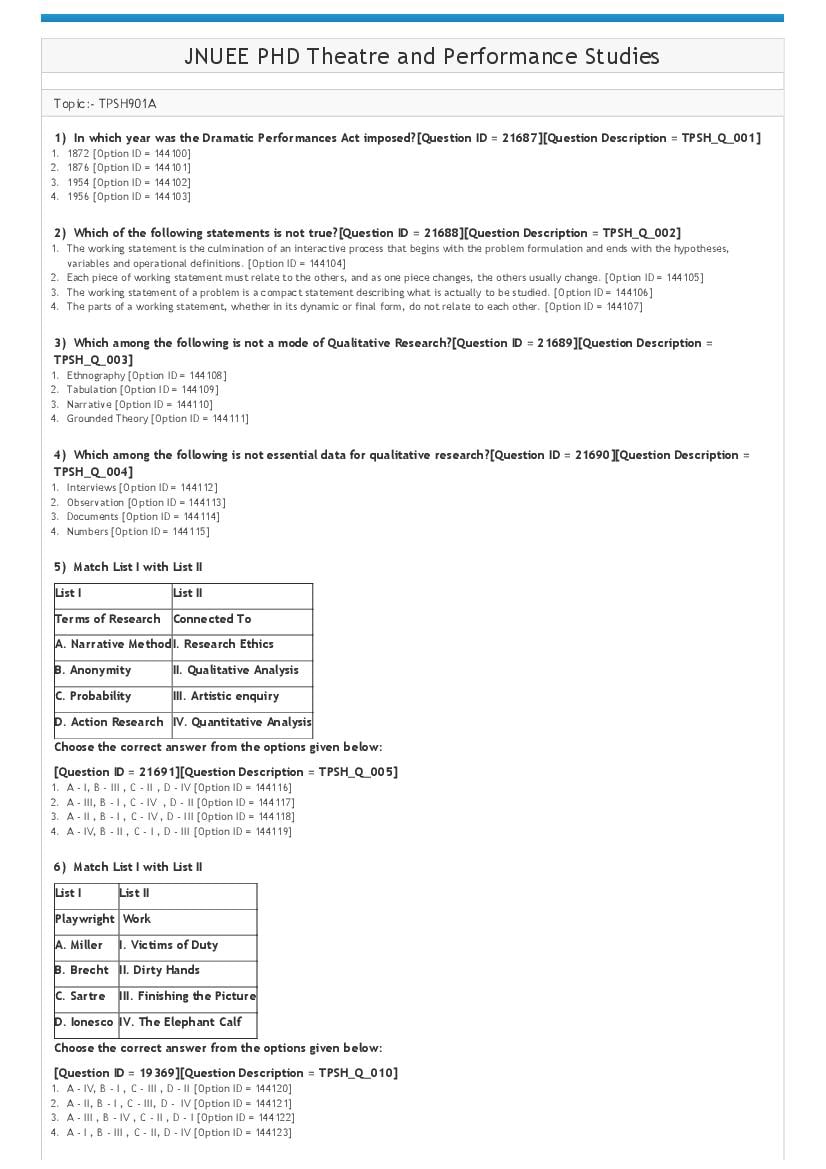
Page 1
Topic:‐ TPSH901A
1) In which year was the Dramatic Performances Act imposed?[Question ID = 21687][Question Description = TPSH_Q_001]
1. 1872 [Option ID = 144100]
2. 1876 [Option ID = 144101]
3. 1954 [Option ID = 144102]
4. 1956 [Option ID = 144103]
2) Which of the following statements is not true?[Question ID = 21688][Question Description = TPSH_Q_002]
1. The working statement is the culmination of an interactive process that begins with the problem formulation and ends with the hypotheses,
variables and operational definitions. [Option ID = 144104]
2. Each piece of working statement must relate to the others, and as one piece changes, the others usually change. [Option ID = 144105]
3. The working statement of a problem is a compact statement describing what is actually to be studied. [Option ID = 144106]
4. The parts of a working statement, whether in its dynamic or final form, do not relate to each other. [Option ID = 144107]
3) Which among the following is not a mode of Qualitative Research?[Question ID = 21689][Question Description =
TPSH_Q_003]
1. Ethnography [Option ID = 144108]
2. Tabulation [Option ID = 144109]
3. Narrative [Option ID = 144110]
4. Grounded Theory [Option ID = 144111]
4) Which among the following is not essential data for qualitative research?[Question ID = 21690][Question Description =
TPSH_Q_004]
1. Interviews [Option ID = 144112]
2. Observation [Option ID = 144113]
3. Documents [Option ID = 144114]
4. Numbers [Option ID = 144115]
5) Match List I with List II
List I List II
Terms of Research Connected To
A. Narrative MethodI. Research Ethics
B. Anonymity II. Qualitative Analysis
C. Probability III. Artistic enquiry
D. Action Research IV. Quantitative Analysis
Choose the correct answer from the options given below:
[Question ID = 21691][Question Description = TPSH_Q_005]
1. A ‐ I, B ‐ III , C ‐ II , D ‐ IV [Option ID = 144116]
2. A ‐ III, B ‐ I , C ‐ IV , D ‐ II [Option ID = 144117]
3. A ‐ II , B ‐ I , C ‐ IV , D ‐ III [Option ID = 144118]
4. A ‐ IV, B ‐ II , C ‐ I , D ‐ III [Option ID = 144119]
6) Match List I with List II
List I List II
Playwright Work
A. Miller I. Victims of Duty
B. Brecht II. Dirty Hands
C. Sartre III. Finishing the Picture
D. Ionesco IV. The Elephant Calf
Choose the correct answer from the options given below:
[Question ID = 19369][Question Description = TPSH_Q_010]
1. A ‐ IV, B ‐ I , C ‐ III , D ‐ II [Option ID = 144120]
2. A ‐ II, B ‐ I , C ‐ III, D ‐ IV [Option ID = 144121]
3. A ‐ III , B ‐ IV , C ‐ II , D ‐ I [Option ID = 144122]
4. A ‐ I , B ‐ III , C ‐ II, D ‐ IV [Option ID = 144123]
Page 2
A. Robert Wilson
B. Antonin Artaud
C. Heiner Muller
D. Ernest Toller
Choose the correct answer from the options given below:
[Question ID = 19370][Question Description = TPSH_Q_011]
1. A and B only
[Option ID = 144124]
2. B and C only
[Option ID = 144125]
3. A and C only
[Option ID = 144126]
4. C and D only
[Option ID = 144127]
8) Among the following, who was awarded the Nobel Prize in Literature for his plays but declined it thereafter?[Question ID
= 19371][Question Description = TPSH_Q_012]
1. George Bernard Shaw [Option ID = 144128]
2. Boris Pesternak [Option ID = 144129]
3. Maurice Maeterlinck [Option ID = 144130]
4. Jean‐Paul Sartre [Option ID = 144131]
9) Which two personalities, among the following, were associated with the play Ghasiram Kotwal?
A. Jabbar Patel
B. Girish Karnad
C. Vijay Tendulkar
D. Manoj Mitra
Choose the correct answer from the options given below:
[Question ID = 19372][Question Description = TPSH_Q_013]
1. A and B only
[Option ID = 144132]
2. C and D only
[Option ID = 144133]
3. A and C only
[Option ID = 144134]
4. B and D only
[Option ID = 144135]
10) Which production dealt with the Naxalite movement and was written and directed by Gurcharan Singh Channi?
[Question ID = 19373][Question Description = TPSH_Q_014]
1. Dukka Dumbi Billa [Option ID = 144136]
2. Disturbed Area [Option ID = 144137]
3. Andhre ke Khilaaf [Option ID = 144138]
4. Daant‐te‐Raho [Option ID = 144139]
11) Among the following personalities, which two were associated with the play A Month in the Country?
A. Nikolai Gogol
B. Ivan Turgenev
C. Anton Chekhov
D. Konstantin Stanislavski
Choose the correct answer from the options given below:
[Question ID = 19374][Question Description = TPSH_Q_015]
1. A and B only
[Option ID = 144140]
2. B and C only
[Option ID = 144141]
3. A and C only
Page 3
4. B and D only
[Option ID = 144143]
12) Which of the following are not true about e‐journals?
A. They are distributed through digital methods
B. They also have editors and editorial boards
C. They are published in print in serialized form
D. They are always free of cost
Choose the correct answer from the options given below:
[Question ID = 19375][Question Description = TPSH_Q_016]
1. A and B only
[Option ID = 144144]
2. B and C only
[Option ID = 144145]
3. C and D only
[Option ID = 144146]
4. B and D only
[Option ID = 144147]
13) Which of the following are not graphic representations?
A. Pie chart
B. Rows
C. Table
D. Histogram
Choose the correct answer from the options given below:
[Question ID = 19376][Question Description = TPSH_Q_017]
1. A and B only
[Option ID = 144148]
2. B and C only
[Option ID = 144149]
3. C and D only
[Option ID = 144150]
4. A and D only
[Option ID = 144151]
14) Among the following, which two belong to narrative analysis?
A. Life‐history research
B. Inter‐subjective analysis
C. Meta‐analysis
D. Structural analysis
Choose the correct answer from the options given below:
[Question ID = 19377][Question Description = TPSH_Q_018]
1. A and B only
[Option ID = 144152]
2. B and C only
[Option ID = 144153]
3. C and D only
[Option ID = 144154]
4. A and D only
[Option ID = 144155]
15) Given below are two statements, one is labelled as Assertion A and the other is labelled as Reason R
Assertion A: The structure of the source text must be preserved and yet recreated in the second language so that the
resulting work has an identifiable shape and order.
Page 4
work must be 'from' and yet be 'at' home on a foreign stage.
In light of the above statements, choose the most appropriate answer from the options given below
[Question ID = 19378][Question Description = TPSH_Q_019]
1. Both A and R are correct and R is the correct explanation of A
[Option ID = 144156]
2. Both A and R are correct but R is NOT the correct explanation of A
[Option ID = 144157]
3. A is correct but R is not correct
[Option ID = 144158]
4. A is not correct but R is correct
[Option ID = 144159]
16) Match List I with List II
List I List II
Types of Research Meaning
I. providing an answer to the research
A. Exploratory
topic and has a proper design in the methodology
II. the theories, their explanation and it does not provide
B. Fundamental
any conclusion for the research topic
III. action research where only one domain is considered
C. Applied
and mostly the facts are generalized
IV. the basic or pure research done to find out an
D. Conclusive
element or a theory that has not been in the world yet
Choose the correct answer from the options given below:
[Question ID = 19379][Question Description = TPSH_Q_020]
1. A ‐ III , B ‐ IV , C ‐ I , D ‐ II [Option ID = 144160]
2. A ‐ II , B ‐ I , C ‐ IV , D ‐ III [Option ID = 144161]
3. A ‐ IV , B ‐ II , C ‐ III , D ‐ I [Option ID = 144162]
4. A ‐ II, B ‐ IV , C ‐ III , D ‐ I [Option ID = 144163]
17) Match List I with List II
List I List II
Terms in Research Connected to
A. Research design I. Research bias
B. Key concept of research II. Meta‐analysis
C. Sampling III. Behavioural
D. Quantitative research IV. Random
Choose the correct answer from the options given below:
[Question ID = 19380][Question Description = TPSH_Q_021]
1. A ‐ III , B ‐ I , C ‐ IV , D ‐ II [Option ID = 144164]
2. A ‐ I , B ‐ III , C ‐ II , D ‐ IV [Option ID = 144165]
3. A ‐ II , B ‐ III , C ‐ I , D ‐ IV [Option ID = 144166]
4. A ‐ III , B ‐ II , C ‐ I , D ‐ IV [Option ID = 144167]
18) Match List I with List II
List I List II
Terms in Research Connected to
A. Reflexivity I. Way to optimize the performance of a database
B. Participant ObservationII. Native format information
III. Entering a group of people with shared identity
C. Indexing
to gain an understanding of their community
Page 5
D. Unstructured data
and practices during research
Choose the correct answer from the options given below:
[Question ID = 19381][Question Description = TPSH_Q_022]
1. A ‐ III , B ‐ II , C ‐ IV, D ‐ I [Option ID = 144168]
2. A ‐ I , B ‐ IV , C ‐ II , D ‐ III [Option ID = 144169]
3. A ‐ III , B ‐ II , C ‐ I , D ‐ IV [Option ID = 144170]
4. A ‐ IV , B ‐ III , C ‐ I , D ‐ II [Option ID = 144171]
19) Match List I with List II
List I List II
Terms in research Connected to
A. Planning researchI. Archive
B. Literature search II. Analysed information
C. Structured data III. Chicago
D. Citation IV. Hypothesis
Choose the correct answer from the options given below:
[Question ID = 19382][Question Description = TPSH_Q_023]
1. A ‐ I , B ‐ IV , C ‐ II , D ‐ III [Option ID = 144172]
2. A ‐ IV , B ‐ I , C ‐ II , D ‐ III [Option ID = 144173]
3. A ‐ II , B ‐ IV , C ‐ I , D ‐ III [Option ID = 144174]
4. A ‐ III , B ‐ II , C ‐ I , D ‐ IV [Option ID = 144175]
20) Which is the correct sequence for library research?
A. Use catalogues, databases, internet resources etc
B. Find background information in reference sources
C. Evaluate findings and review progress
D. Understand the assignment and selecting topic
Choose the correct answer from the options given below
[Question ID = 19383][Question Description = TPSH_Q_024]
1. A, B, C, D
[Option ID = 144176]
2. D, B, A, C
[Option ID = 144177]
3. B, D, A, C
[Option ID = 144178]
4. B, A, D, C
[Option ID = 144179]
21) Which is the correct sequence of research methodology from the following?
A. Construct new procedures
B. Investigate existing situations or problems
C. Synthesize existing knowledge
D. Generate new knowledge
Choose the correct answer from the options given below
[Question ID = 19384][Question Description = TPSH_Q_025]
1. A, B, C, D
[Option ID = 144180]
2. B, C, A, D
[Option ID = 144181]
3. C, B, A, D
[Option ID = 144182]
4. A, C, B, D
[Option ID = 144183]
22) Given below are two statements, one is labelled as Assertion A and the other is labelled as Reason R
Page 6
audio technology gave rise to electronically sounds, when many composers agreed that all sounds, even noise, can be
considered forms of music.
Reason R : The development of audio recording technology, along with the ability to quickly and cheaply distribute
recordings and scores, were central to the revolutions of modern music.
In light of the above statements, choose the correct answer from the options given below
[Question ID = 19385][Question Description = TPSH_Q_026]
1. Both A and R are true and R is the correct explanation of A
[Option ID = 144184]
2. Both A and R are true but R is NOT the correct explanation of A
[Option ID = 144185]
3. A is true but R is false
[Option ID = 144186]
4. A is false but R is true
[Option ID = 144187]
23) Given below are two statements
Statement I: Applied theatre continues to derive its aesthetic from forms of theatre and performance that challenge or
subvert political and social hegemonies.
Statement II: Central to these theatrical movements has been the development of new sets of relationships between actor
and the audience.
In light of the above statements, choose the most appropriate answer from the options given below
[Question ID = 19386][Question Description = TPSH_Q_027]
1. Both Statement I and Statement II are correct [Option ID = 144188]
2. Both Statement I and Statement II are incorrect [Option ID = 144189]
3. Statement I is correct but Statement II is incorrect [Option ID = 144190]
4. Statement I is incorrect but Statement II is correct [Option ID = 144191]
24) Given below are two statements
Statement I: A scale refers to any series of items that are arranged randomly according to value or magnitude, into which an
item can be placed according to its quantification.
Statement II: It is traditional to classify scales of measurement on the basis of the mathematical comparisons that are
allowable with these scales.
In light of the above statements, choose the correct answer from the options given below
[Question ID = 22168][Question Description = TPSH_Q_028]
1. Both Statement I and Statement II are true [Option ID = 144192]
2. Both Statement I and Statement II are false [Option ID = 144193]
3. Statement I is true but Statement II is false [Option ID = 144194]
4. Statement I is false but Statement II is true [Option ID = 144195]
25) Given below are two statements
Statement I: In probability sampling, every element in the population has a known nonzero probability of selection.
Statement II:The simple random is the best known probability sample, in which each member of the population has an equal
probability of being selected.
In light of the above statements, choose the most appropriate answer from the options given below
[Question ID = 22169][Question Description = TPSH_Q_029]
1. Both Statement I and Statement II are correct [Option ID = 144196]
2. Both Statement I and Statement II are incorrect [Option ID = 144197]
3. Statement I is correct but Statement II is incorrect [Option ID = 144198]
4. Statement I is incorrect but Statement II is correct [Option ID = 144199]
26) Given below are two statements, one is labelled as Assertion A and the other is labelled as Reason R
Assertion A : A hypothesis is a conjecture about reality.
Reason R : Hypothesis is a statement that one has reason to believe is true but for which adequate evidence is lacking.
In light of the above statements, choose the correct answer from the options given below
[Question ID = 22170][Question Description = TPSH_Q_030]
1. Both A and R are true and R is the correct explanation of A
[Option ID = 144200]
2. Both A and R are true but R is NOT the correct explanation of A
Page 7
3. A is true but R is false
[Option ID = 144202]
4. A is false but R is true
[Option ID = 144203]
27) In which city is the famous Bolshoi theatre situated?[Question ID = 22171][Question Description = TPSH_Q_031]
1. St. Petersburg [Option ID = 144204]
2. Moscow [Option ID = 144205]
3. Paris [Option ID = 144206]
4. Berlin [Option ID = 144207]
28) Which among the following is not a Primary source for research?[Question ID = 22172][Question Description =
TPSH_Q_032]
1. Interview [Option ID = 144208]
2. Dictionary [Option ID = 144209]
3. Letters [Option ID = 144210]
4. Diaries [Option ID = 144211]
29) Which among the following is not related to Feminism?[Question ID = 22173][Question Description = TPSH_Q_033]
1. Radical [Option ID = 144212]
2. Liberal [Option ID = 144213]
3. Socialist [Option ID = 144214]
4. Dishonour [Option ID = 144215]
30) Which two productions, on Tagore’s writings among these were choreographed by Udayshankar?
A. Samanya Kshati
B. Tomari Matir Konya
C. Prakriti O Ananda
D. Horikhela
Choose the correct answer from the options given below:
[Question ID = 22174][Question Description = TPSH_Q_034]
1. A and D only
[Option ID = 144216]
2. A and B only
[Option ID = 144217]
3. A and C only
[Option ID = 144218]
4. B and C only
[Option ID = 144219]
31) What is a list of questions, which is handed over to the respondent (who reads it and records the answers himself),
known as?[Question ID = 22175][Question Description = TPSH_Q_035]
1. Interview Schedule [Option ID = 144220]
2. Questionnaire [Option ID = 144221]
3. Interview Guide [Option ID = 144222]
4. Question Session [Option ID = 144223]
32) What is Scopus?[Question ID = 22176][Question Description = TPSH_Q_036]
1. E‐Journal [Option ID = 144224]
2. Citation [Option ID = 144225]
3. Database [Option ID = 144226]
4. Digital Method [Option ID = 144227]
33) Which statement is true for Null Hypothesis?[Question ID = 22177][Question Description = TPSH_Q_037]
1. There is no relationship between variables. [Option ID = 144228]
2. There is a relationship between variables. [Option ID = 144229]
3. One variable causes change to other variables. [Option ID = 144230]
4. Contains only one variable. [Option ID = 144231]
34) Among the following personalities, which two were the directors of Rangayana?
A. Sri Chidambara Rao Jambe
B. Chandrasekhar Kambara
C. Lingadevaru Halemane
Page 8
Choose the correct answer from the options given below:
[Question ID = 22178][Question Description = TPSH_Q_038]
1. A and B only
[Option ID = 144232]
2. A and C only
[Option ID = 144233]
3. A and D only
[Option ID = 144234]
4. B and C only
[Option ID = 144235]
35) Among the following institutions, which two offer Masters Degree in Drama/Theatre Arts?
A. Bangalore University
B. Rabindra Bharati University
C. Sidho‐Kanho Birsha University
D. Cotton University
Choose the correct answer from the options given below:
[Question ID = 22179][Question Description = TPSH_Q_039]
1. A and B only
[Option ID = 144236]
2. B and C only
[Option ID = 144237]
3. C and D only
[Option ID = 144238]
4. A and D only
[Option ID = 144239]
36) Which among the following are propagators of Kathak dance?
A. Raja Chakradhar Singh
B. Nawab Wajid Ali Shah
C. Raja Chandrakirti
D. Raja Kapilendradeva
Choose the correct answer from the options given below:
[Question ID = 22180][Question Description = TPSH_Q_040]
1. A and B only
[Option ID = 144240]
2. A and C only
[Option ID = 144241]
3. B and C only
[Option ID = 144242]
4. B and D only
[Option ID = 144243]
37) Which among the following folk dances belong to North India?
A. Rauf
B. Giddha
C. Karagattam
D. Cheraw
Choose the correct answer from the options given below:
[Question ID = 22181][Question Description = TPSH_Q_041]
1. A and C only
[Option ID = 144244]
2. B and D only
[Option ID = 144245]
3. A and B only
Page 9
4. A and D only
[Option ID = 144247]
38) Which is the next step in the research process after identifying the important variables and establishing the logical
reasoning in theoretical framework?[Question ID = 22182][Question Description = TPSH_Q_042]
1. To conduct surveys [Option ID = 144248]
2. To generate the hypothesis [Option ID = 144249]
3. To focus group discussions [Option ID = 144250]
4. To use experiments in an investigation [Option ID = 144251]
39) What is the full form of APA style in citation?[Question ID = 22183][Question Description = TPSH_Q_043]
1. American Psychological Association [Option ID = 144252]
2. Asian Performing Arts [Option ID = 144253]
3. American Perfect Action [Option ID = 144254]
4. All Paper Aspects [Option ID = 144255]
40) Which among the following are parts of research proposal?
A. Literature Review
B. Methodology of Research
C. Conclusion of Research
D. Questionnaire of Research
Choose the correct answer from the options given below:
[Question ID = 22184][Question Description = TPSH_Q_044]
1. A and D only
[Option ID = 144256]
2. B and D only
[Option ID = 144257]
3. B and C only
[Option ID = 144258]
4. A and B only
[Option ID = 144259]
41) Which among the following are Abstract properties?
A. Universal
B. Fundamental
C. Particular
D. Intuition
Choose the correct answer from the options given below:
[Question ID = 22185][Question Description = TPSH_Q_045]
1. A and B only
[Option ID = 144260]
2. B and C only
[Option ID = 144261]
3. C and D only
[Option ID = 144262]
4. A and D only
[Option ID = 144263]
42) Which of the following statements is incorrect?[Question ID = 22186][Question Description = TPSH_Q_046]
1. A research proposal is a document that plans how and in which manner a research will be conducted. [Option ID = 144264]
2. Research proposals contain extensive literature reviews. [Option ID = 144265]
3. Proposals must offer convincing support for your research topic. [Option ID = 144266]
4. Proposals need not detail the methodology of research and tools to be used. [Option ID = 144267]
43) Match List I with List II
List I List II
Raga in Indian Music The Thaat they are connected to
A. Vasant I. Ashavari
B. Malkaus II. Kafi
Page 10
D. Bageshri IV. Bhairavi
Choose the correct answer from the options given below:
[Question ID = 22187][Question Description = TPSH_Q_047]
1. A ‐I , B ‐ II , C ‐ III , D ‐ IV [Option ID = 144268]
2. A ‐ III, B ‐ IV , C ‐I , D ‐II [Option ID = 144269]
3. A ‐ II, B ‐ III , C ‐ IV, D ‐ I [Option ID = 144270]
4. A ‐ IV , B ‐ I , C ‐ II , D ‐ III [Option ID = 144271]
44) Match List I with List II
List I List II
Name of the play Playwright
A. Surendra Binodini I. Anant Waman Varve
B. Barricade II. Sunkara Satyanarayana, Vaasireddy Bhaskar Rao
C. Lokmat Vijay III. Utpal Dutt
D. Maa Bhoomi IV. Upendranath Das
Choose the correct answer from the options given below:
[Question ID = 19387][Question Description = TPSH_Q_048]
1. A ‐ I , B ‐ II , C ‐ III, D ‐ IV
[Option ID = 144272]
2. A ‐ II , B ‐ III , C ‐ IV , D ‐ I
[Option ID = 144273]
3. A ‐ III, B ‐ IV, C ‐ I , D ‐ II
[Option ID = 144274]
4. A ‐ IV , B ‐ III, C ‐ I , D ‐ II
[Option ID = 144275]
45) Match List I with List II
List I List II
Name of Play Playwright
A. Shervani I. Agha Hashar Kashmiri
B. Rustom‐O‐ SohrabII. Atamjit Singh
C. Sinam III. Subodh Pattanaik
D. Ho Bhagate IV. Premnath Pardesi
Choose the correct answer from the options given below:
[Question ID = 19388][Question Description = TPSH_Q_049]
1. A ‐ I, B ‐ II , C ‐ III , D ‐ IV [Option ID = 144276]
2. A ‐ II , B ‐ III , C ‐ I , D ‐ IV [Option ID = 144277]
3. A ‐ IV, B ‐ I, C ‐ II, D ‐ III [Option ID = 144278]
4. A ‐ IV, B ‐ III , C ‐ II , D ‐ I [Option ID = 144279]
46) Match List I with List II
List I List II
Choreograpers Productions
A. Anita Ratnam I. Daughters of the Ocean
B. Uttara Asha CoorlawalaII. Amrit
C. Akram Khan III. Kaash
D. Shobhana Jeyasingh IV.Configurations
Choose the correct answer from the options given below:
[Question ID = 19389][Question Description = TPSH_Q_050]
1. A ‐ I, B ‐ II , C ‐ III, D ‐ IV
[Option ID = 144280]
2. A ‐ II, B ‐ III , C ‐ IV , D ‐ I
[Option ID = 144281]
Page 11
[Option ID = 144282]
4. A ‐ IV, B ‐ III , C ‐ II , D ‐ I
[Option ID = 144283]
47) Match List I with List II
List I List II
Costume parts Used in Classical dance forms
A. Potloi‐PoshwanI. Odissi
B. Bengapatia II. Kathak
C. Angrakha III. Satriya
D. Paguri IV. Manipuri
Choose the correct answer from the options given below:
[Question ID = 19390][Question Description = TPSH_Q_051]
1. A ‐ I , B ‐ II , C ‐ III , D ‐ IV [Option ID = 144284]
2. A ‐ II , B ‐ III , C ‐IV , D ‐ I [Option ID = 144285]
3. A ‐ III , B ‐ IV , C ‐ II, D ‐ I [Option ID = 144286]
4. A ‐ IV, B ‐ I, C ‐ II, D ‐ III [Option ID = 144287]
48) Match List I with List II
List I List II
Scales of Measurement Meaning
A. Nominal I. If a>b and b>c then a>c
B. Ordinal II. The zero point is arbitrary
C. Interval III. Provision of absolute zero
D. Ratio IV. No arithmetic origin
Choose the correct answer from the options given below:
[Question ID = 19391][Question Description = TPSH_Q_052]
1. A ‐ III , B ‐ IV , C ‐ II , D ‐ I [Option ID = 144288]
2. A ‐ IV , B ‐ I , C ‐ II, D ‐ III [Option ID = 144289]
3. A ‐ I, B ‐ II, C ‐ III , D ‐ IV [Option ID = 144290]
4. A ‐ II , B ‐ III , C ‐ IV, D ‐ I [Option ID = 144291]
49) Match List I with List II
List I List II
Variables Meanings
A. Independent VariableI. Two or more variables combined to make a more complex variable.
B. Intervening Variable II. Singular Characteristic that other variables cannot change
C. Control Variables III. Mediator
D. Composite Variable IV. Constant and do not change during study
Choose the correct answer from the options given below:
[Question ID = 19392][Question Description = TPSH_Q_053]
1. A ‐ IV, B ‐ III , C ‐ II, D ‐ I [Option ID = 144292]
2. A ‐ III , B ‐ IV , C ‐ I, D ‐ II [Option ID = 144293]
3. A ‐ II , B ‐ III , C ‐IV , D ‐ I [Option ID = 144294]
4. A ‐ I, B ‐ II , C ‐ III, D ‐ IV [Option ID = 144295]
50) What goes first in a citation?[Question ID = 19393][Question Description = TPSH_Q_054]
1. Book Title [Option ID = 144296]
2. Author [Option ID = 144297]
3. Date of publication [Option ID = 144298]
4. Volume of the book [Option ID = 144299]
51) Which one is a characteristic of Descriptive Hypothesis?[Question ID = 19394][Question Description = TPSH_Q_055]
1. Univariate [Option ID = 144300]
2. Corelation [Option ID = 144301]
3. Non‐directional [Option ID = 144302]
4. Dependent [Option ID = 144303]
Page 12
population?[Question ID = 19395][Question Description = TPSH_Q_056]
1. Stratified Sampling [Option ID = 144304]
2. Random Sampling [Option ID = 144305]
3. Non‐probability Sampling [Option ID = 144306]
4. Systematic Sampling [Option ID = 144307]
53) Which is the correct ascending order sequence according to the number of beats of the tala‐s?
A. Tevra
B. Dadra
C. Dhamar
D. Kaharwa
Choose the correct answer from the options given below
[Question ID = 19396][Question Description = TPSH_Q_057]
1. A, B, C, D
[Option ID = 144308]
2. B, A, D, C
[Option ID = 144309]
3. C, D, B, A
[Option ID = 144310]
4. D, C, B, A
[Option ID = 144311]
54) From the following, which is the correct sequence that indicates the different stages of experiment?
A. Locate appropriate subjects or cases.
B. Examine data collected and make comparisons between different groups.
C. Make a hypothesis that is appropriate for experimental research
D. Debrief the subjects by informing them of the true purpose and reasons for the experiment.
Choose the correct answer from the options given below
[Question ID = 19397][Question Description = TPSH_Q_058]
1. A, B, C, D
[Option ID = 144312]
2. B, A, D, C
[Option ID = 144313]
3. B, C, D, A
[Option ID = 144314]
4. C, A, D, B
[Option ID = 144315]
55) Which is the correct sequence of the following while writing a research paper?
A. Abstract
B. Key words
C. Introduction
D. Body of text
E. Bibliography
Choose the correct answer from the options given below
[Question ID = 19398][Question Description = TPSH_Q_059]
1. A, B, C, D, E
[Option ID = 144316]
2. B, C, A, D, E
[Option ID = 144317]
3. C, B, D, A, E
[Option ID = 144318]
4. C, A, B, D, E
[Option ID = 144319]
Page 13
A. Merce Cunningham
B. Isadora Duncan
C. Bill. T. Jones
D. Martha Graham
Choose the correct answer from the options given below
[Question ID = 19399][Question Description = TPSH_Q_060]
1. A, B, C, D
[Option ID = 144320]
2. B, C, D, A
[Option ID = 144321]
3. B, D, A, C
[Option ID = 144322]
4. C, A, D, B
[Option ID = 144323]
57) Who introduced the Impact Factor?[Question ID = 19400][Question Description = TPSH_Q_061]
1. Eugenio Barba [Option ID = 144324]
2. Eugene Garfield [Option ID = 144325]
3. Carl Manson [Option ID = 144326]
4. Baz Kershaw [Option ID = 144327]
58) What is Axim in research?[Question ID = 19401][Question Description = TPSH_Q_062]
1. A graphic way of illustrating differences among the groups. [Option ID = 144328]
2. A frequency distribution statistics. [Option ID = 144329]
3. A statement widely accepted as truth. [Option ID = 144330]
4. The relationship between cause and effect. [Option ID = 144331]
59) What is Action Research?[Question ID = 19402][Question Description = TPSH_Q_063]
1. The detailed reconstruction of individual stories. [Option ID = 144332]
2. A form of research that pursuits change and research at the same time. [Option ID = 144333]
3. Any influence that distorts the results of a research study. [Option ID = 144334]
4. A negative feature of research. [Option ID = 144335]
60) Who popularized the term 'Practice‐based research'?[Question ID = 19403][Question Description = TPSH_Q_064]
1. Linda Candy [Option ID = 144336]
2. Herbert Spencer [Option ID = 144337]
3. Frederic Le Play [Option ID = 144338]
4. JP Spradley [Option ID = 144339]
61) What is a tool in research?[Question ID = 19404][Question Description = TPSH_Q_065]
1. A specific mechanism [Option ID = 144340]
2. Episode [Option ID = 144341]
3. Key Word [Option ID = 144342]
4. Strategy [Option ID = 144343]
62) Where does Phenomenology have its roots?[Question ID = 22207][Question Description = TPSH_Q_066]
1. Philosophy [Option ID = 144344]
2. Public account. [Option ID = 144345]
3. Non‐controversial [Option ID = 144346]
4. Trust [Option ID = 144347]
63) Given below are two statements, one is labelled as Assertion A and the other is labelled as Reason R
Assertion A: According to Grinnell "Research is a structured enquiry that utilizes an acceptable scientific methodology to
solve problems and create new knowledge that is generally not applicable".
Reason R: Research is a systematic investigation to find answers to a problem.
In light of the above statements, choose the most appropriate answer from the options given below
[Question ID = 22208][Question Description = TPSH_Q_067]
1. Both A and R are correct and R is the correct explanation of A
[Option ID = 144348]
2. Both A and R are correct but R is NOT the correct explanation of A
[Option ID = 144349]
3. A is correct but R is not correct
Page 14
4. A is not correct but R is correct
[Option ID = 144351]
64) Given below are two statements
Statement I: Subjectivity is an integral part of way of thinking that is 'conditioned' by researcher educational background,
discipline, philosophy, expereince and skills.
Statement II: Subjectivity is not deliberate, it is the way the researcher understand or interpret something.
In light of the above statements, choose the most appropriate answer from the options given below
[Question ID = 22209][Question Description = TPSH_Q_068]
1. Both Statement I and Statement II are correct
[Option ID = 144352]
2. Both Statement I and Statement II are incorrect
[Option ID = 144353]
3. Statement I is correct but Statement II is incorrect
[Option ID = 144354]
4. Statement I is incorrect but Statement II is correct
[Option ID = 144355]
65) Find the correct sequence of the plot structure in ascending order according to Gustav Freytag's graph.
A. Exposition
B. Rising Action
C. Climax
D. Falling Action
E. Catastrophe
Choose the correct answer from the options given below
[Question ID = 22210][Question Description = TPSH_Q_069]
1. A, B, C, D, E
[Option ID = 144356]
2. A, B, D, E, C
[Option ID = 144357]
3. E, D, C, B, A
[Option ID = 144358]
4. B, C, D, E, A
[Option ID = 144359]
66) Indicated the correct geographical locations of the following theatre institutions from North to South.
A. NINASAM
B. MP School of Drama.
C. Trissur School of Drama
D. National School of Drama.
Choose the correct answer from the options given below
[Question ID = 22211][Question Description = TPSH_Q_070]
1. A, B, C, D
[Option ID = 144360]
2. B, C, D, A
[Option ID = 144361]
3. D, B, A, C
[Option ID = 144362]
4. C, D, A, B
[Option ID = 144363]
67) Indicate the correct sequence of the following directors of the National School of Drama from latest to oldest.
A. Dinesh Khanna
B. Suresh Sharma
C. Waman Kendre
Page 15
E. Devendra Raj Ankur
Choose the correct answer from the options given below
[Question ID = 22212][Question Description = TPSH_Q_071]
1. A, B, C, D, E
[Option ID = 144364]
2. A, B, C, E ,D
[Option ID = 144365]
3. B, C, D, E, A
[Option ID = 144366]
4. C, D, A, B, E
[Option ID = 144367]
68) Who labeled the word 'Transfiguration of common Place'?[Question ID = 22213][Question Description = TPSH_Q_072]
1. Arthur C. Danto [Option ID = 144368]
2. Alison Oddey [Option ID = 144369]
3. Arnold Van Gennep [Option ID = 144370]
4. Paul Walsh [Option ID = 144371]
69) Among the following who said, "Work in theatre is largely a matter of self‐education"?[Question ID = 22214][Question
Description = TPSH_Q_073]
1. Ebrahim Alkaji [Option ID = 144372]
2. Utpal Dutt [Option ID = 144373]
3. Habib Tanveer [Option ID = 144374]
4. Badal Sircar [Option ID = 144375]
70) Match List I with List II
List I List II
(Book/Theory proposed/Characteristic, etc.) (Author/Thinker/Name of Theory, etc.)
A. Frame Analysis I. Erving Goffman
B. Semiotics of Theatrical Performance. II. Umberto Eco
C. Reception Theory III. Hans Robert Jauss
D. Bodies Spaces IV. Staton Garner Jr.
Choose the correct answer from the options given below:
[Question ID = 22215][Question Description = TPSH_Q_074]
1. A ‐I, B ‐II , C ‐III , D ‐IV [Option ID = 144376]
2. A ‐II , B ‐III , C ‐IV , D ‐I [Option ID = 144377]
3. A ‐III , B ‐IV , C ‐I , D ‐II [Option ID = 144378]
4. A ‐IV , B ‐III , C ‐II , D ‐I [Option ID = 144379]
71) Match List I with List II
List I List II
(Book/Theory proposed/Characteristic, etc.) (Author/Thinker/Name of Theory, etc.)
A. Performative Speech Acts I. JL. Austin
B. Performance Principle II. Allan Kaprow
C. Dramastic Pental III. Herbert Marcuse
D. Happening IV. Kennet Burke
Choose the correct answer from the options given below:
[Question ID = 22216][Question Description = TPSH_Q_075]
1. A ‐ I, B ‐II , C ‐III , D ‐IV [Option ID = 144380]
2. A ‐I , B ‐III , C ‐IV , D ‐II [Option ID = 144381]
3. A ‐II , B ‐III , C ‐IV , D ‐I [Option ID = 144382]
4. A ‐III , B ‐IV , C ‐II , D ‐I [Option ID = 144383]
72) What is dangerous fieldwork?
A. Described as a craft skill.
B. The recording activities and experiences are usually in written format within specific episodes of time.
C. Which threatens the health of the field worker.
Page 16
Choose the correct answer from the options given below:
[Question ID = 22217][Question Description = TPSH_Q_076]
1. A, B and D only
[Option ID = 144384]
2. B and C only
[Option ID = 144385]
3. C and D only
[Option ID = 144386]
4. A and D only
[Option ID = 144387]
73) What are the three types of case studies distinguished by R.E Stake?
A. Intrinsic Extrinsic
B. Instrumental
C. Collective
D. Manipulated data
Choose the correct answer from the options given below:
[Question ID = 22218][Question Description = TPSH_Q_077]
1. A, B and D only
[Option ID = 144388]
2. B, C and D only
[Option ID = 144389]
3. A , B, and C only
[Option ID = 144390]
4. A, C and D only
[Option ID = 144391]
74) Given below are two statements
Statement I: According to Meyerhold "The actor embodies in himself both the organizer and that which is organized (i.e.
the artist and his material).
Statement II: The formula for acting may be expressed as follows: N=A1+A2 (Where N=the actor, A1= the artists who
conceive the idea and issues the instructions necessary for its execution: A2= The executant who executes the conception
of A1).
In light of the above statements, choose the most appropriate answer from the options given below
[Question ID = 22222][Question Description = TPSH_Q_083]
1. Both Statement I and Statement II are correct
[Option ID = 144404]
2. Both Statement I and Statement II are incorrect
[Option ID = 144405]
3. Statement I is correct but Statement II is incorrect
[Option ID = 144406]
4. Statement I is incorrect but Statement II is correct
[Option ID = 144407]
75) Given below are two statements
Statement I:: The arguments for the establishment of both ritual and theatre studies were similar in kind.
Statement II: Both cases advocated the reversal of hierarchical positions: from myth to ritual and from literary text to the
theatre performance.
In light of the above statements, choose the Statement II: answer from the options given below
[Question ID = 22223][Question Description = TPSH_Q_084]
1. Both Statement I and Statement II are correct
[Option ID = 144408]
2. Both Statement I and Statement II are incorrect
[Option ID = 144409]
3. Statement I is correct but Statement II is incorrect
[Option ID = 144410]
Page 17
[Option ID = 144411]
76) Given below are two statements
Statement I:: Observation is one of the methods of collecting secondary data.
Statement II: The observation method is dominantly used in qualitative research, it is also used in quantitative research.
In light of the above statements, choose the most appropriate answer from the options given below
[Question ID = 22224][Question Description = TPSH_Q_085]
1. Both Statement I and Statement II are correct
[Option ID = 144412]
2. Both Statement I and Statement II are incorrect
[Option ID = 144413]
3. Statement I is correct but Statement II is incorrect
[Option ID = 144414]
4. Statement I is incorrect but Statement II is correct
[Option ID = 144415]
77) Which one is not the correct pair?[Question ID = 22225][Question Description = TPSH_Q_086]
1. Khandita ‐ One dressed up for union [Option ID = 144416]
2. Virahotkanthita ‐ One distressed by separation [Option ID = 144417]
3. Kalahantarita ‐ One separated from her lover by a quarrel [Option ID = 144418]
4. Abhisarika ‐ One going to meet her lover [Option ID = 144419]
78) What is the subject of Bhama Kalapam?[Question ID = 22226][Question Description = TPSH_Q_087]
1. Bringing Parijaat plant for Rukmini [Option ID = 144420]
2. Bringing Parijaat plant for Satyabhama [Option ID = 144421]
3. Bringing Parijaat plant for Radha [Option ID = 144422]
4. Bringing Parijaat plant for Kalindi [Option ID = 144423]
79) Which style of music is followed in Kathakali performance?[Question ID = 19405][Question Description = TPSH_Q_088]
1. Hindustani [Option ID = 144424]
2. Carnatic [Option ID = 144425]
3. Combination of both Hindustani and Carnatic [Option ID = 144426]
4. Sopanam [Option ID = 144427]
80) Arrange the following in the chronological order of research designs.
A. Exploration
B. Experimentation
C. Diagnosis
D. Description
[Question ID = 19406][Question Description = TPSH_Q_089]
1. A, B, D, C
[Option ID = 144428]
2. A, C, B, D
[Option ID = 144429]
3. A, B, C, D
[Option ID = 144430]
4. B, C, D, A
[Option ID = 144431]
81) Which one is a famous commentary on Nātyashastra?[Question ID = 19407][Question Description = TPSH_Q_090]
1. Nataka Lakshan Ratana Kosh [Option ID = 144432]
2. Natya Manjari Saurabh [Option ID = 144433]
3. Abhinav Bharati [Option ID = 144434]
4. Ashtadhyayi [Option ID = 144435]
82) Which of the following plays are NOT written by Bhasa?
A. Mricchkatika
B. Swapanvasavadatta
C. Malavikagnimitra
D. Urubhanga
Page 18
[Question ID = 19408][Question Description = TPSH_Q_091]
1. A and B only
[Option ID = 144436]
2. A and C only
[Option ID = 144437]
3. A and D only
[Option ID = 144438]
4. C and D only
[Option ID = 144439]
83) What is not included in Nritta?
A.Vyabhichari Bhava
B.Abhinaya
C.Tala
D.Laya
Choose the correct answer from the options given below:
[Question ID = 19409][Question Description = TPSH_Q_092]
1. A and B only
[Option ID = 144440]
2. B and C only
[Option ID = 144441]
3. C and D only
[Option ID = 144442]
4. B and D only
[Option ID = 144443]
84) Which artists are not from the field of Bharatanatyam?
A.Bala Saraswati
B.Gauri Amma
C.Maya Rao
D. Shobha Naidu
Choose the correct answer from the options given below:
[Question ID = 19410][Question Description = TPSH_Q_093]
1. A and B only
[Option ID = 144444]
2. C and D only
[Option ID = 144445]
3. A and C only
[Option ID = 144446]
4. B and D only
[Option ID = 144447]
85) Match List I with List II
Book Author
A. Bhavaprakash I. Parshvadeva
B. Manasollasa II. Sharadatanaya
C. Shringara Prakash III. Bhoja
D. Sangita SamayasaraIV. Someshvara
Choose the correct answer from the options given below:
[Question ID = 19411][Question Description = TPSH_Q_094]
1. A ‐ I, B ‐ II, C ‐ III, D ‐ IV
[Option ID = 144448]
2. A‐II, B ‐ IV, C ‐III, D ‐ I
[Option ID = 144449]
3. A‐I, B ‐III, C‐II, D‐IV
Page 19
4. A‐IV, B ‐II , C ‐I, D ‐III
[Option ID = 144451]
86) Match List I with List II
Vritti Meaning
A. Arabhati I. Yajur
B. Satvati II. Rig
C. Bharati III. Atharva
D. Kaishiki IV. Sam
Choose the correct answer from the options given below:
[Question ID = 19412][Question Description = TPSH_Q_095]
1. A ‐I, B ‐II, C ‐IV, D ‐III
[Option ID = 144452]
2. A‐II, B ‐III, C ‐I, D ‐IV
[Option ID = 144453]
3. A ‐III, B ‐I, C ‐II, D ‐IV
[Option ID = 144454]
4. A ‐IV, B ‐I, C ‐III, D ‐II
[Option ID = 144455]
87) Given below are two statements, one is labelled as Assertion A and the other is labelled as Reason R
Assertion A : The Natyashastra has an entire section on Music.
Reason R : The music was used according to the requirement of the theatre production.
In light of the above statements, choose the correct answer from the options given below
[Question ID = 19413][Question Description = TPSH_Q_096]
1. Both A and R are false
[Option ID = 144456]
2. A is false but R is true
[Option ID = 144457]
3. A is true but R is false
[Option ID = 144458]
4. Both A and R are true
[Option ID = 144459]
88) Given below are two statements, one is labelled as Assertion A and the other is labelled as Reason R
Assertion A : Mohiniattam literally interpreted as the dance of ‘Mohini’, the celestial enchantress of the Hindu mythology
Reason R : The rigorous body movements and subtle facial expressions are more feminine in nature and therefore are ideally
suited for performance by women.
In light of the above statements, choose the correct answer from the options given below
[Question ID = 19414][Question Description = TPSH_Q_097]
1. A is true but R is false
[Option ID = 144460]
2. Both A and R are true
[Option ID = 144461]
3. A is false but R is true
[Option ID = 144462]
4. Both A and R are false
[Option ID = 144463]
89) Identify the correct sequence of the chapters of Natyashastra
A.Puja to the Gods of stage
B.Origin of Drama
C.The Preliminaries of a play
D.Description of Play House
Page 20
[Question ID = 19415][Question Description = TPSH_Q_098]
1. B, A, C, D
[Option ID = 144464]
2. B, D, A, C
[Option ID = 144465]
3. B, C, A, D
[Option ID = 144466]
4. B, D, C, A
[Option ID = 144467]
90) Identify the correct sequence of 'drishti bheda' from Abhinayadarpanam.
A.Sama
B.Avalokita
C.Aalokita
D.Nimilita
Choose the correct answer from the options given below
[Question ID = 19416][Question Description = TPSH_Q_099]
1. A, B, C, D
[Option ID = 144468]
2. A, C, D, B
[Option ID = 144469]
3. A, D, C, B
[Option ID = 144470]
4. A, C, B, D
[Option ID = 144471]
91) Identify the correct chronological sequence of traditional art forms of Kerala
A. Kudiyattam
B. Krishnattam
C. Ramanattam
D. Kathakalisss
Choose the correct answer from the options given below
[Question ID = 19417][Question Description = TPSH_Q_100]
1. A, B, C, D
[Option ID = 144472]
2. A, C, D, B
[Option ID = 144473]
3. A, D, C, B
[Option ID = 144474]
4. A, C, B, D
[Option ID = 144475]
Topic:‐ TPSH901B
1) Read the passage and answer the questions that follow:
Ionesco protested against the imputation that he was a deliberate antirealist, that he maintained the impossibility of
communication by language. ‘The very fact of writing and presenting plays is surely incompatible with such a view. I simply
hold that it is difficult to make oneself understood, not absolutely impossible.’ After a dig at Sartre (as the author of political
melodramas), Osborne, Miller, Brecht, et al., as auteurs du boulevard‐ representatives of a Left Wing conform‐ism which is
just as lamentable as the Right Wing sort’, Ionesco stated his conviction that society itself formed one of the barriers
between human beings, that the authentic community of man is wider than society. ‘No society has been able to abolish
human sadness, no political system can deliver us from the pain of living, from our fear of death, our thirst for the absolute;
it is the human condition that directs the social condition, not vice versa/ Hence the need to break down the language of
society, which ‘is nothing but clichés, empty formulas and slogans’. That is why the ideologies with their fossilized language
must be continually reexamined and ‘their congealed language … relentlessly split apart in order to find the living sap
beneath’.
Page 21
Assertion A : Sartre is a right‐wing playwright of the absurdist tradition
Reason R : Sartre writes about the lack of meaning in life through his characters using melodrama.
In light of the above statements, choose the correct answer from the options given below
[Question ID = 19418][Question Description = TPSH_Q_006]
1. Both A and R are true and R is the correct explanation of A
[Option ID = 144476]
2. Both A and R are true but R is NOT the correct explanation of A
[Option ID = 144477]
3. A is true but R is false
[Option ID = 144478]
4. A is false but R is true
[Option ID = 144479]
2) Read the passage and answer the questions that follow:
Ionesco protested against the imputation that he was a deliberate antirealist, that he maintained the impossibility of
communication by language. ‘The very fact of writing and presenting plays is surely incompatible with such a view. I simply
hold that it is difficult to make oneself understood, not absolutely impossible.’ After a dig at Sartre (as the author of political
melodramas), Osborne, Miller, Brecht, et al., as auteurs du boulevard‐ representatives of a Left Wing conform‐ism which is
just as lamentable as the Right Wing sort’, Ionesco stated his conviction that society itself formed one of the barriers
between human beings, that the authentic community of man is wider than society. ‘No society has been able to abolish
human sadness, no political system can deliver us from the pain of living, from our fear of death, our thirst for the absolute;
it is the human condition that directs the social condition, not vice versa/ Hence the need to break down the language of
society, which ‘is nothing but clichés, empty formulas and slogans’. That is why the ideologies with their fossilized language
must be continually reexamined and ‘their congealed language … relentlessly split apart in order to find the living sap
beneath’.
Given below are two statements, one is labelled as Assertion A and the other is labelled as Reason R
Assertion A: For Ionesco, the breakdown of the existing modes of communication is absolutely necessary.
Reason R: Ionesco believes that the fossilized languages are vast and boundless and hence unable to reveal the essential
truth that underlies humanity.
In light of the above statements, choose the most appropriate answer from the options given below
[Question ID = 19419][Question Description = TPSH_Q_007]
1. Both A and R are correct and R is the correct explanation of A
[Option ID = 144480]
2. Both A and R are correct but R is NOT the correct explanation of A
[Option ID = 144481]
3. A is correct but R is not correct
[Option ID = 144482]
4. A is not correct but R is correct
[Option ID = 144483]
3) Read the passage and answer the questions that follow:
Ionesco protested against the imputation that he was a deliberate antirealist, that he maintained the impossibility of
communication by language. ‘The very fact of writing and presenting plays is surely incompatible with such a view. I simply
hold that it is difficult to make oneself understood, not absolutely impossible.’ After a dig at Sartre (as the author of political
melodramas), Osborne, Miller, Brecht, et al., as auteurs du boulevard‐ representatives of a Left Wing conform‐ism which is
just as lamentable as the Right Wing sort’, Ionesco stated his conviction that society itself formed one of the barriers
between human beings, that the authentic community of man is wider than society. ‘No society has been able to abolish
human sadness, no political system can deliver us from the pain of living, from our fear of death, our thirst for the absolute;
it is the human condition that directs the social condition, not vice versa/ Hence the need to break down the language of
society, which ‘is nothing but clichés, empty formulas and slogans’. That is why the ideologies with their fossilized language
must be continually reexamined and ‘their congealed language … relentlessly split apart in order to find the living sap
beneath’.
Page 22
Statement I: Ionesco believes that ideology has no place in art
Statement II: To free art from ideology, Ionesco extends the language of theatre to the exterior.
In light of the above statements, choose the correct answer from the options given below
[Question ID = 19420][Question Description = TPSH_Q_008]
1. Both Statement I and Statement II are true
[Option ID = 144484]
2. Both Statement I and Statement II are false
[Option ID = 144485]
3. Statement I is true but Statement II is false
[Option ID = 144486]
4. Statement I is false but Statement II is true
[Option ID = 144487]
4) Read the passage and answer the questions that follow:
Ionesco protested against the imputation that he was a deliberate antirealist, that he maintained the impossibility of
communication by language. ‘The very fact of writing and presenting plays is surely incompatible with such a view. I simply
hold that it is difficult to make oneself understood, not absolutely impossible.’ After a dig at Sartre (as the author of political
melodramas), Osborne, Miller, Brecht, et al., as auteurs du boulevard‐ representatives of a Left Wing conform‐ism which is
just as lamentable as the Right Wing sort’, Ionesco stated his conviction that society itself formed one of the barriers
between human beings, that the authentic community of man is wider than society. ‘No society has been able to abolish
human sadness, no political system can deliver us from the pain of living, from our fear of death, our thirst for the absolute;
it is the human condition that directs the social condition, not vice versa/ Hence the need to break down the language of
society, which ‘is nothing but clichés, empty formulas and slogans’. That is why the ideologies with their fossilized language
must be continually reexamined and ‘their congealed language … relentlessly split apart in order to find the living sap
beneath’.
Given below are two statements
Statement I: Despite his criticism on Brecht, Ionesco is appreciative of the idea behind Epic Theatre.
Statement II: Ionesco believes that theatre should have the flexibility to teach values that are characteristic of a society
and not the dominant ideology of the time.
In light of the above statements, choose the most appropriate answer from the options given below
[Question ID = 19421][Question Description = TPSH_Q_009]
1. Both Statement I and Statement II are correct
[Option ID = 144488]
2. Both Statement I and Statement II are incorrect
[Option ID = 144489]
3. Statement I is correct but Statement II is incorrect
[Option ID = 144490]
4. Statement I is incorrect but Statement II is correct
[Option ID = 144491]
Topic:‐ TPSH901C
1) Read the passage given below and answer the question that follows:
Greek Tragedy
Greek tragedy in its oldest form dealt only with the sufferings of Dionysus [. . .] all the celebrated characters of the Greek
stage – Prometheus, Oedipus and so on – are merely masks of that original hero [. . .] this hero is the suffering Dionysus of
the mysteries, the god who himself experiences the suffering of individuation [. . .] This suggests that dismemberment, the
true Dionysiac suffering, amounts to a transformation into air, water, earth and fire, and that we should therefore see the
condition of individuation as the source and origin of all suffering and hence as something reprehensible. (Nietzsche 1995:
51–2)
Page 23
sacrificial ritual, the ritual of dismemberment. Such an idea was unacceptable to his contemporaries. It not only equated
Greek culture with ‘primitive’ culture, and negated the value of the individual, moreover, it also completely disregarded
the role and significance of the great texts handed down to us. In nineteenth century Germany, theatre was predominantly
defined by its capacity to convey or mediate literary works of art. A theatrical performance was only awarded the status as
a work of art if it fulfilled this function. Otherwise it simply served to entertain the audience. The idea was raised, albeit
sporadically, that a theatrical performance as such might be seen as an autonomous work of art as, for example, Goethe
suggested of opera in On the Truth and Plausibility of Works of Art (1798), an idea which Richard Wagner took up and
developed even further when defining the performance of a musical drama as the only conceivable and valuable artwork of
the future (The Artwork of the Future, 1848). (Besides, it was Richard Wagner’s music theatre, which Nietzsche hailed and
celebrated as the resurrection of the temporarily dismembered, tragic theatre in Birth of Tragedy.) The majority of
Goethe’s and Wagner’s contemporaries, however, believed that only the performed dramatic text could secure the status
of a work of art for a theatrical performance. Even as late as 1918, the critic Alfred Klaar wrote: ‘Theatre will only succeed
in maintaining a position of great importance when dramatic poetry adds its substance.’
According to the passage, Nietzsche traced back the origin of Greek tragic theatre as which of the following?
[Question ID = 19422][Question Description = TPSH_Q_078]
1. Ritual
[Option ID = 144492]
2. Opera
[Option ID = 144493]
3. Musical Drama
[Option ID = 144494]
4. Dramatic Text
[Option ID = 144495]
2) Read the passage given below and answer the question that follows:
Greek Tragedy
Greek tragedy in its oldest form dealt only with the sufferings of Dionysus [. . .] all the celebrated characters of the Greek
stage – Prometheus, Oedipus and so on – are merely masks of that original hero [. . .] this hero is the suffering Dionysus of
the mysteries, the god who himself experiences the suffering of individuation [. . .] This suggests that dismemberment, the
true Dionysiac suffering, amounts to a transformation into air, water, earth and fire, and that we should therefore see the
condition of individuation as the source and origin of all suffering and hence as something reprehensible. (Nietzsche 1995:
51–2)
That is to say, Nietzsche traced back the origin of Greek tragic theatre to a ritual, a very particular ritual, in fact: a
sacrificial ritual, the ritual of dismemberment. Such an idea was unacceptable to his contemporaries. It not only equated
Greek culture with ‘primitive’ culture, and negated the value of the individual, moreover, it also completely disregarded
the role and significance of the great texts handed down to us. In nineteenth century Germany, theatre was predominantly
defined by its capacity to convey or mediate literary works of art. A theatrical performance was only awarded the status as
a work of art if it fulfilled this function. Otherwise it simply served to entertain the audience. The idea was raised, albeit
sporadically, that a theatrical performance as such might be seen as an autonomous work of art as, for example, Goethe
suggested of opera in On the Truth and Plausibility of Works of Art (1798), an idea which Richard Wagner took up and
developed even further when defining the performance of a musical drama as the only conceivable and valuable artwork of
the future (The Artwork of the Future, 1848). (Besides, it was Richard Wagner’s music theatre, which Nietzsche hailed and
celebrated as the resurrection of the temporarily dismembered, tragic theatre in Birth of Tragedy.) The majority of
Goethe’s and Wagner’s contemporaries, however, believed that only the performed dramatic text could secure the status
of a work of art for a theatrical performance. Even as late as 1918, the critic Alfred Klaar wrote: ‘Theatre will only succeed
in maintaining a position of great importance when dramatic poetry adds its substance.’
Greek Tragedy deals with which of the following?
[Question ID = 21652][Question Description = TPSH_Q_079]
1. Prometheus
[Option ID = 144496]
2. Oedipus
[Option ID = 144497]
3. Sufferings of Dionysus
[Option ID = 144498]
4. Comedy
[Option ID = 144499]
3) Greek Tragedy
Greek tragedy in its oldest form dealt only with the sufferings of Dionysus [. . .] all the celebrated characters of the Greek
stage – Prometheus, Oedipus and so on – are merely masks of that original hero [. . .] this hero is the suffering Dionysus of
the mysteries, the god who himself experiences the suffering of individuation [. . .] This suggests that dismemberment, the
Page 24
condition of individuation as the source and origin of all suffering and hence as something reprehensible. (Nietzsche 1995:
51–2)
That is to say, Nietzsche traced back the origin of Greek tragic theatre to a ritual, a very particular ritual, in fact: a
sacrificial ritual, the ritual of dismemberment. Such an idea was unacceptable to his contemporaries. It not only equated
Greek culture with ‘primitive’ culture, and negated the value of the individual, moreover, it also completely disregarded
the role and significance of the great texts handed down to us. In nineteenth century Germany, theatre was predominantly
defined by its capacity to convey or mediate literary works of art. A theatrical performance was only awarded the status as
a work of art if it fulfilled this function. Otherwise it simply served to entertain the audience. The idea was raised, albeit
sporadically, that a theatrical performance as such might be seen as an autonomous work of art as, for example, Goethe
suggested of opera in On the Truth and Plausibility of Works of Art (1798), an idea which Richard Wagner took up and
developed even further when defining the performance of a musical drama as the only conceivable and valuable artwork of
the future (The Artwork of the Future, 1848). (Besides, it was Richard Wagner’s music theatre, which Nietzsche hailed and
celebrated as the resurrection of the temporarily dismembered, tragic theatre in Birth of Tragedy.) The majority of
Goethe’s and Wagner’s contemporaries, however, believed that only the performed dramatic text could secure the status
of a work of art for a theatrical performance. Even as late as 1918, the critic Alfred Klaar wrote: ‘Theatre will only succeed
in maintaining a position of great importance when dramatic poetry adds its substance.
Given below are two statements Statement I: In nineteenth Century German theatre, the theatre was predominantly
defined by its capacity to convey or mediate literary works of art. In nineteenth‐century German theatre, the theatre was
predominantly defined by its capacity to convey or mediate literary works of art.
Statement II: A theatrical performance was only awarded the status as a work of art if it is fulfilled this function In light of
the above statements, choose the most appropriate answer from the options given below [Question ID = 21651][Question
Description = New_TPSH_Q080]
1. Both Statement I and Statement II are correct [Option ID = 149433]
2. Both Statement I and Statement II are incorrect [Option ID = 149434]
3. Statement I is correct but Statement II is incorrect [Option ID = 149435]
4. Statement I is incorrect but Statement II is correct [Option ID = 149436]
4) Greek Tragedy
Greek tragedy in its oldest form dealt only with the sufferings of Dionysus [. . .] all the celebrated characters of the Greek
stage – Prometheus, Oedipus and so on – are merely masks of that original hero [. . .] this hero is the suffering Dionysus of
the mysteries, the god who himself experiences the suffering of individuation [. . .] This suggests that dismemberment, the
true Dionysiac suffering, amounts to a transformation into air, water, earth and fire, and that we should therefore see the
condition of individuation as the source and origin of all suffering and hence as something reprehensible. (Nietzsche 1995:
51–2)
That is to say, Nietzsche traced back the origin of Greek tragic theatre to a ritual, a very particular ritual, in fact: a
sacrificial ritual, the ritual of dismemberment. Such an idea was unacceptable to his contemporaries. It not only equated
Greek culture with ‘primitive’ culture, and negated the value of the individual, moreover, it also completely disregarded
the role and significance of the great texts handed down to us. In nineteenth century Germany, theatre was predominantly
defined by its capacity to convey or mediate literary works of art. A theatrical performance was only awarded the status as
a work of art if it fulfilled this function. Otherwise it simply served to entertain the audience. The idea was raised, albeit
sporadically, that a theatrical performance as such might be seen as an autonomous work of art as, for example, Goethe
suggested of opera in On the Truth and Plausibility of Works of Art (1798), an idea which Richard Wagner took up and
developed even further when defining the performance of a musical drama as the only conceivable and valuable artwork of
the future (The Artwork of the Future, 1848). (Besides, it was Richard Wagner’s music theatre, which Nietzsche hailed and
celebrated as the resurrection of the temporarily dismembered, tragic theatre in Birth of Tragedy.) The majority of
Goethe’s and Wagner’s contemporaries, however, believed that only the performed dramatic text could secure the status
of a work of art for a theatrical performance. Even as late as 1918, the critic Alfred Klaar wrote: ‘Theatre will only succeed
in maintaining a position of great importance when dramatic poetry adds its substance.
Who wrote the book 'The Truth and Plausibility of Works of Art'?[Question ID = 22266][Question Description =
New_TPSH_Q081]
1. Richard Wagner [Option ID = 149437]
2. Nietzsche [Option ID = 149438]
3. Alfred Klaar [Option ID = 149439]
4. Goethe [Option ID = 149440]
5) Greek Tragedy
Greek tragedy in its oldest form dealt only with the sufferings of Dionysus [. . .] all the celebrated characters of the Greek
stage – Prometheus, Oedipus and so on – are merely masks of that original hero [. . .] this hero is the suffering Dionysus of
the mysteries, the god who himself experiences the suffering of individuation [. . .] This suggests that dismemberment, the
true Dionysiac suffering, amounts to a transformation into air, water, earth and fire, and that we should therefore see the
condition of individuation as the source and origin of all suffering and hence as something reprehensible. (Nietzsche 1995:
51–2)
That is to say, Nietzsche traced back the origin of Greek tragic theatre to a ritual, a very particular ritual, in fact: a
sacrificial ritual, the ritual of dismemberment. Such an idea was unacceptable to his contemporaries. It not only equated
Greek culture with ‘primitive’ culture, and negated the value of the individual, moreover, it also completely disregarded
the role and significance of the great texts handed down to us. In nineteenth century Germany, theatre was predominantly
defined by its capacity to convey or mediate literary works of art. A theatrical performance was only awarded the status as
a work of art if it fulfilled this function. Otherwise it simply served to entertain the audience. The idea was raised, albeit
Page 25
suggested of opera in On the Truth and Plausibility of Works of Art (1798), an idea which Richard Wagner took up and
developed even further when defining the performance of a musical drama as the only conceivable and valuable artwork of
the future (The Artwork of the Future, 1848). (Besides, it was Richard Wagner’s music theatre, which Nietzsche hailed and
celebrated as the resurrection of the temporarily dismembered, tragic theatre in Birth of Tragedy.) The majority of
Goethe’s and Wagner’s contemporaries, however, believed that only the performed dramatic text could secure the status
of a work of art for a theatrical performance. Even as late as 1918, the critic Alfred Klaar wrote: ‘Theatre will only succeed
in maintaining a position of great importance when dramatic poetry adds its substance.
According to the passage Greek Culture equated with
A. Primitive culture
B. Negated the value of individual
C. Mediate literary works of art.
D. Autonomous work of Art
Choose the correct answer from the options given below: [Question ID = 22267][Question Description = New_TPSH_Q082]
1. A, B and D only [Option ID = 149441]
2. A and B only [Option ID = 149442]
3. B and C only [Option ID = 149443]
4. A and D only [Option ID = 149444]