NCERT Book Class 12 History Chapter 8 Peasants, Zamindars and the State
Finished viewing? Save it for later —
Download NCERT Book Class 12 History Chapter 8 Peasants, Zamindars and the State (PDF · 31 pages)About NCERT Book Class 12 History Chapter 8 Peasants, Zamindars and the State
NCERT Book Class 12 History Chapter 8 Peasants, Zamindars and the State is available here for free download. Published by NCERT for Class 12, this books can be viewed online or downloaded as a PDF (31 pages). Candidates preparing for Class 12 can use NCERT Book Class 12 History Chapter 8 Peasants, Zamindars and the State to understand the exam pattern, the type of questions asked, and the overall difficulty level.
Frequently Asked Questions
How can I download NCERT Book Class 12 History Chapter 8 Peasants, Zamindars and the State?
Open this page and click the Download button to save NCERT Book Class 12 History Chapter 8 Peasants, Zamindars and the State as a PDF. It is completely free on AglaSem Docs.
Is NCERT Book Class 12 History Chapter 8 Peasants, Zamindars and the State free to download?
Yes. NCERT Book Class 12 History Chapter 8 Peasants, Zamindars and the State can be viewed online and downloaded as a PDF free of cost on AglaSem Docs.
How many pages does NCERT Book Class 12 History Chapter 8 Peasants, Zamindars and the State have?
NCERT Book Class 12 History Chapter 8 Peasants, Zamindars and the State contains 31 pages, which you can read online or download together as a single PDF.
Where can I find more Class 12 study material?
You can find more Class 12 question papers, sample papers, syllabus, and answer keys on AglaSem Docs.
NCERT Book Class 12 History Chapter 8 Peasants, Zamindars and the State – Text
Read the full text of this books below — useful to quickly search, copy and reference the content online without downloading the PDF.
📄 View text version (1 page)
Page 1
Peasants, Zamindars
THEME
and the State
EIGHT
Ag r ar ian Socie
arian ty and t
Society he Mughal Em
the pir
Empir
piree
( c . sixteent
sixteenthh - seventeenth centuries)
During the sixteenth and seventeenth centuries
about 85 per cent of the population of India lived in
its villages. Both peasants and landed elites were
involved in agricultural production and claimed
rights to a share of the produce. This created
relationships of cooperation, competition and
conflict among them. The sum of these agrarian
relationships made up rural society.
At the same time agencies from outside also
entered into the rural world. Most important among
these was the Mughal state, which derived the
bulk of its income from agricultural production.
Agents of the state – revenue assessors, collectors,
record keepers – sought to control rural society so
as to ensure that cultivation took place and the
state got its regular share of taxes from the
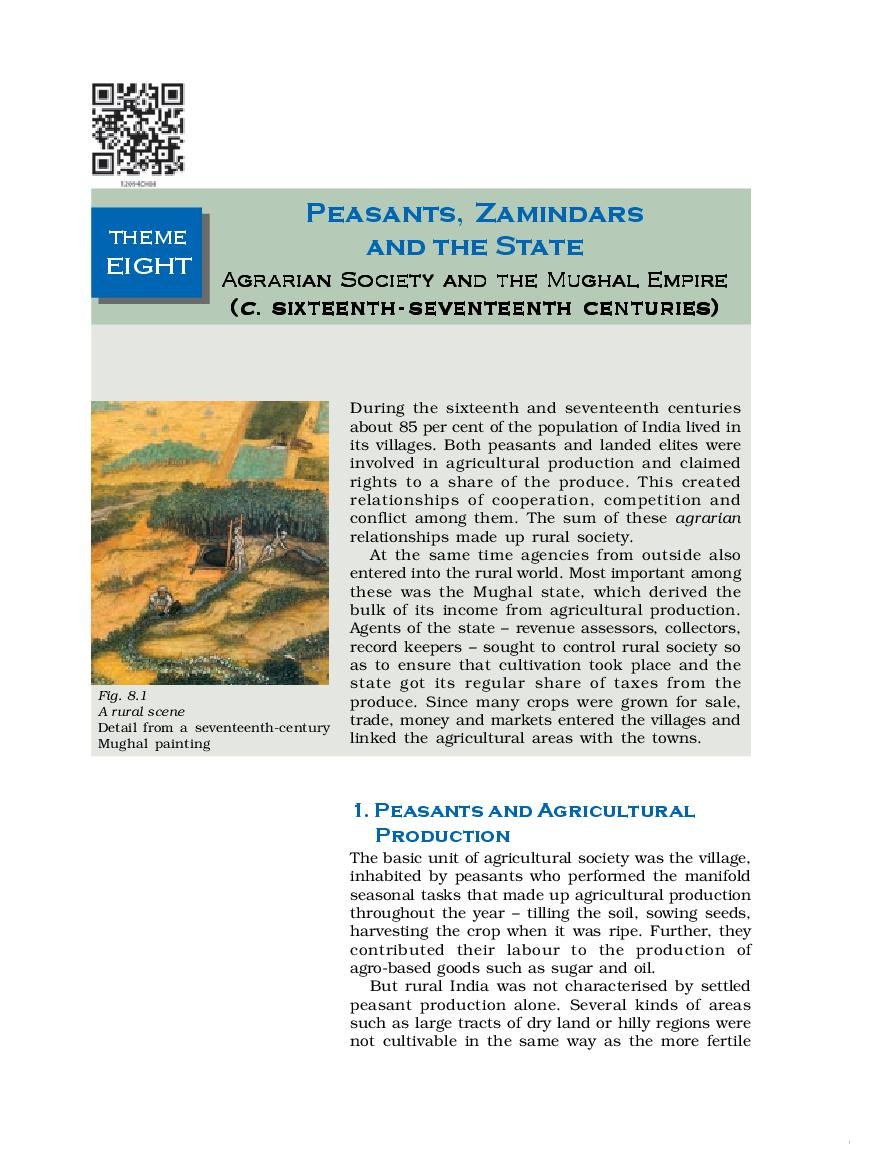
Fig. 8.1
produce. Since many crops were grown for sale,
A rural scene
Detail from a seventeenth-century
trade, money and markets entered the villages and
Mughal painting linked the agricultural areas with the towns.
1. Peasants and Agricultural
Production
The basic unit of agricultural society was the village,
inhabited by peasants who performed the manifold
seasonal tasks that made up agricultural production
throughout the year – tilling the soil, sowing seeds,
harvesting the crop when it was ripe. Further, they
contributed their labour to the production of
agro-based goods such as sugar and oil.
But rural India was not characterised by settled
peasant production alone. Several kinds of areas
such as large tracts of dry land or hilly regions were
not cultivable in the same way as the more fertile
Showing the first page only. Download the PDF above for the complete document.
Document Details
| Board / Org | NCERT |
| Exam | Class 12 |
| Type | Books |
| Pages | 31 |
| Updated | 29 Aug 2026 |