JNUEE 2021 Question Paper Ph.D Visual Studies
Finished viewing? Save it for later —
Download JNUEE 2021 Question Paper Ph.D Visual Studies (PDF · 23 pages)About JNUEE 2021 Question Paper Ph.D Visual Studies
JNUEE 2021 Question Paper Ph.D Visual Studies is available here for free download. Published by NTA for JNUEE, this question paper can be viewed online or downloaded as a PDF (23 pages). Candidates preparing for JNUEE can use JNUEE 2021 Question Paper Ph.D Visual Studies to understand the exam pattern, the type of questions asked, and the overall difficulty level.
Frequently Asked Questions
How can I download JNUEE 2021 Question Paper Ph.D Visual Studies?
Open this page and click the Download button to save JNUEE 2021 Question Paper Ph.D Visual Studies as a PDF. It is completely free on AglaSem Docs.
Is JNUEE 2021 Question Paper Ph.D Visual Studies free to download?
Yes. JNUEE 2021 Question Paper Ph.D Visual Studies can be viewed online and downloaded as a PDF free of cost on AglaSem Docs.
How many pages does JNUEE 2021 Question Paper Ph.D Visual Studies have?
JNUEE 2021 Question Paper Ph.D Visual Studies contains 23 pages, which you can read online or download together as a single PDF.
Where can I find more JNUEE study material?
You can find more JNUEE question papers, sample papers, syllabus, and answer keys on AglaSem Docs.
JNUEE 2021 Question Paper Ph.D Visual Studies – Text
Read the full text of this question paper below — useful to quickly search, copy and reference the content online without downloading the PDF.
📄 View text version (23 pages)
Page 1
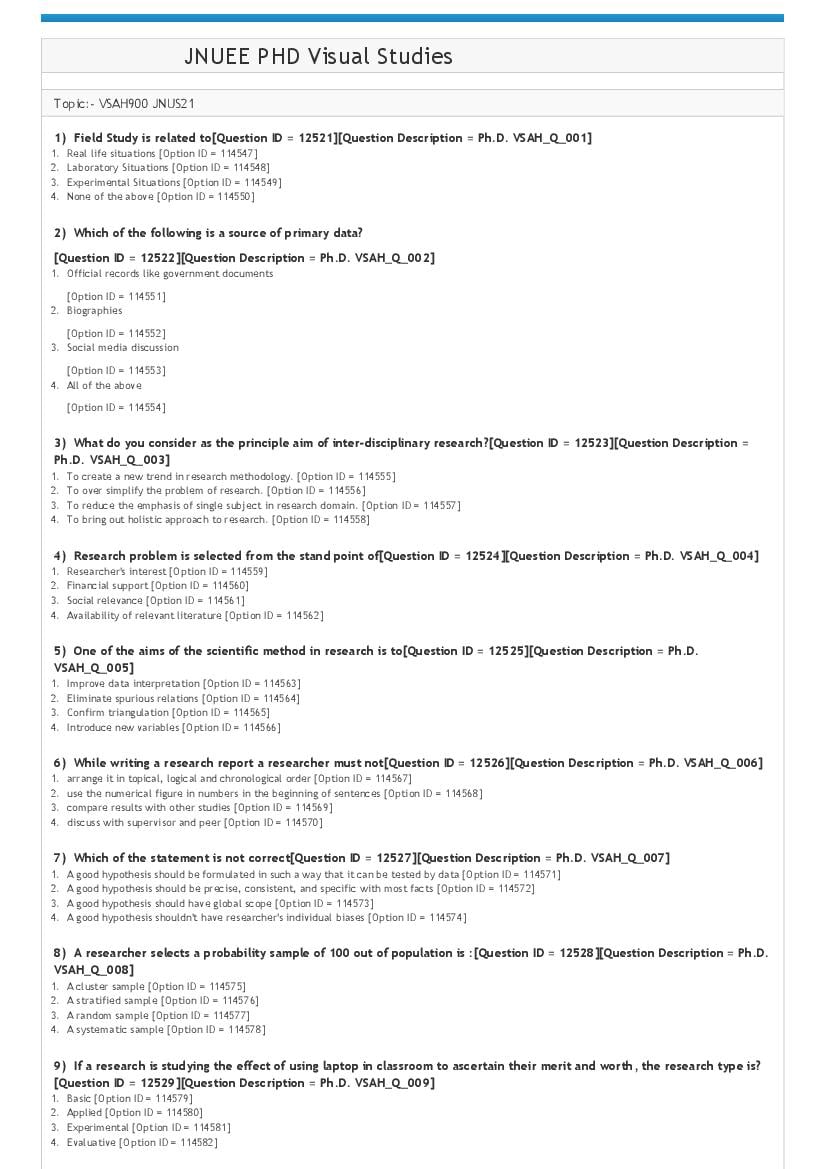
Topic:‐ VSAH900 JNUS21
1) Field Study is related to[Question ID = 12521][Question Description = Ph.D. VSAH_Q_001]
1. Real life situations [Option ID = 114547]
2. Laboratory Situations [Option ID = 114548]
3. Experimental Situations [Option ID = 114549]
4. None of the above [Option ID = 114550]
2) Which of the following is a source of primary data?
[Question ID = 12522][Question Description = Ph.D. VSAH_Q_002]
1. Official records like government documents
[Option ID = 114551]
2. Biographies
[Option ID = 114552]
3. Social media discussion
[Option ID = 114553]
4. All of the above
[Option ID = 114554]
3) What do you consider as the principle aim of inter‐disciplinary research?[Question ID = 12523][Question Description =
Ph.D. VSAH_Q_003]
1. To create a new trend in research methodology. [Option ID = 114555]
2. To over simplify the problem of research. [Option ID = 114556]
3. To reduce the emphasis of single subject in research domain. [Option ID = 114557]
4. To bring out holistic approach to research. [Option ID = 114558]
4) Research problem is selected from the stand point of[Question ID = 12524][Question Description = Ph.D. VSAH_Q_004]
1. Researcher's interest [Option ID = 114559]
2. Financial support [Option ID = 114560]
3. Social relevance [Option ID = 114561]
4. Availability of relevant literature [Option ID = 114562]
5) One of the aims of the scientific method in research is to[Question ID = 12525][Question Description = Ph.D.
VSAH_Q_005]
1. Improve data interpretation [Option ID = 114563]
2. Eliminate spurious relations [Option ID = 114564]
3. Confirm triangulation [Option ID = 114565]
4. Introduce new variables [Option ID = 114566]
6) While writing a research report a researcher must not[Question ID = 12526][Question Description = Ph.D. VSAH_Q_006]
1. arrange it in topical, logical and chronological order [Option ID = 114567]
2. use the numerical figure in numbers in the beginning of sentences [Option ID = 114568]
3. compare results with other studies [Option ID = 114569]
4. discuss with supervisor and peer [Option ID = 114570]
7) Which of the statement is not correct[Question ID = 12527][Question Description = Ph.D. VSAH_Q_007]
1. A good hypothesis should be formulated in such a way that it can be tested by data [Option ID = 114571]
2. A good hypothesis should be precise, consistent, and specific with most facts [Option ID = 114572]
3. A good hypothesis should have global scope [Option ID = 114573]
4. A good hypothesis shouldn't have researcher's individual biases [Option ID = 114574]
8) A researcher selects a probability sample of 100 out of population is :[Question ID = 12528][Question Description = Ph.D.
VSAH_Q_008]
1. A cluster sample [Option ID = 114575]
2. A stratified sample [Option ID = 114576]
3. A random sample [Option ID = 114577]
4. A systematic sample [Option ID = 114578]
9) If a research is studying the effect of using laptop in classroom to ascertain their merit and worth, the research type is?
[Question ID = 12529][Question Description = Ph.D. VSAH_Q_009]
1. Basic [Option ID = 114579]
2. Applied [Option ID = 114580]
3. Experimental [Option ID = 114581]
4. Evaluative [Option ID = 114582]
Page 2
1. general to particular [Option ID = 114583]
2. particular to general [Option ID = 114584]
3. one general conclusion to another general conclusion [Option ID = 114585]
4. one particular conclusion to another particular conclusion [Option ID = 114586]
11) Which of the following is a non probability sample ?[Question ID = 12531][Question Description = Ph.D. VSAH_Q_011]
1. Quota sample [Option ID = 114587]
2. Normative [Option ID = 114588]
3. Simple random sample [Option ID = 114589]
4. Quick sample [Option ID = 114590]
12)
[Question ID = 12532][Question Description = Ph.D. VSAH_Q_012]
1. A ‐ IV , B ‐ III , C ‐ II , D ‐ I [Option ID = 114591]
2. A ‐ I , B ‐ IV , C ‐ III , D ‐ II [Option ID = 114592]
3. A ‐ IV , B ‐ II , C ‐ I , D ‐ III [Option ID = 114593]
4. A ‐ I , B ‐ II , C ‐ III , D ‐ IV [Option ID = 114594]
13) Bibliography given in a research report[Question ID = 12533][Question Description = Ph.D. VSAH_Q_013]
1. shows vast knowledge of the researcher [Option ID = 114595]
2. helps those interested in further research [Option ID = 114596]
3. has no relevance to research [Option ID = 114597]
4. has specific value [Option ID = 114598]
14) Research in the field of visual art can not be[Question ID = 12534][Question Description = Ph.D. VSAH_Q_014]
1. exploratory research [Option ID = 114599]
2. co‐relational research [Option ID = 114600]
3. fundamental research [Option ID = 114601]
4. numeric research [Option ID = 114602]
15) A researcher divides the population in certain groups and fixes the size of the sample from each group is called
[Question ID = 12535][Question Description = Ph.D. VSAH_Q_015]
1. stratified sample [Option ID = 114603]
2. random sample [Option ID = 114604]
3. cluster Sample [Option ID = 114605]
4. quota Sample [Option ID = 114606]
16) Seeing a very big turnout it was reported that the leader named JD will win the elections. The conclusion was based
on
[Question ID = 12536][Question Description = Ph.D. VSAH_Q_016]
1. random sampling
[Option ID = 114607]
2. purposive sampling
[Option ID = 114608]
3. stratified sampling
[Option ID = 114609]
4. cluster sampling
[Option ID = 114610]
17) Read the following passage and answer the question:
ECHOING THE MOTHER DISCIPLINE of history, which studies change over time, art history concentrates on changes of style, or the
distinct manner of an artist, a school, or a period. The bedrock of mainstream arthistorical analysis has been the morphology of styles
in terms of line, color, texture, composition, motif, and other formal elements. Developments since the advent of modernity have
radically disrupted the entire concept of style, yet it remains—however much we might protest—the principal analytic tool for studying
the evolution of artistic traditions. Two aspects of style have dominated art history: first, style as a canon; second, stylistic influence
as “engine” of change, because without change there can be no history. From both perspectives, style is an instrument of authority.
And Western art history, with its cultural baggage of a universalist canon and a linear trajectory that ranks world art according to a
powerful teleology, has provided the model for global art history. Let me illustrate this with an example from Indian art, which is my
field of study. Colonial art historians, almost without exception, were disturbed by the rich polychrome surface decoration of South
Page 3
nonclassical art: Similar charges were leveled against Baroque and Rococo art. Johann Joachim Winckelmann’s famous dictum about
artistic perfection—“noble simplicity and quiet grandeur”—goes back to Giorgio Vasari, who codified classical taste and thereby
created an instrument for imposing authority. In the nineteenth century, Hegel’s classical bias led him to declare that Indian
civilization displayed a staggering contrast between the gross materiality of sacred eroticism and the highest abstraction of Indian
philosophy, a remark based on his perception of Hindu sculpture. (Partha Mitter for Art Forum, Sept 2010)
What has disrupted the entire concept of style since the advent of modernity?
[Question ID = 12537][Question Description = Ph.D. VSAH_Q_017]
1. Development
[Option ID = 114611]
2. Politics
[Option ID = 114612]
3. Economics
[Option ID = 114613]
4. Television
[Option ID = 114614]
18) Read the following passage and answer the question:
ECHOING THE MOTHER DISCIPLINE of history, which studies change over time, art history concentrates on
changes of style, or the distinct manner of an artist, a school, or a period. The bedrock of mainstream art
historical analysis has been the morphology of styles in terms of line, color, texture, composition, motif, and
other formal elements. Developments since the advent of modernity have radically disrupted the entire
concept of style, yet it remains—however much we might protest—the principal analytic tool for studying the
evolution of artistic traditions. Two aspects of style have dominated art history: first, style as a canon;
second, stylistic influence as “engine” of change, because without change there can be no history. From both
perspectives, style is an instrument of authority. And Western art history, with its cultural baggage of a
universalist canon and a linear trajectory that ranks world art according to a powerful teleology, has
provided the model for global art history. Let me illustrate this with an example from Indian art, which is my
field of study. Colonial art historians, almost without exception, were disturbed by the rich polychrome
surface decoration of South Indian temples, which they described as tasteless, overripe, and decadent. Such
responses stem from Neoclassical criticisms of nonclassical art: Similar charges were leveled against
Baroque and Rococo art. Johann Joachim Winckelmann’s famous dictum about artistic perfection—“noble
simplicity and quiet grandeur”—goes back to Giorgio Vasari, who codified classical taste and thereby created
an instrument for imposing authority. In the nineteenth century, Hegel’s classical bias led him to declare that
Indian civilization displayed a staggering contrast between the gross materiality of sacred eroticism and the
highest abstraction of Indian philosophy, a remark based on his perception of Hindu sculpture. (Partha Mitter
for Art Forum, Sept 2010)
Two aspects of style have dominated art history. First, style as a canon; second, stylistic influence as “engine” of change
A. Because without change there can be no history
B. From both perspectives, style is an instrument of authority
C. Cultural baggage of a universalist canon in eastern art history has provided the model for global art history
D. A linear trajectory that ranks world art according to a powerful teleology has never provided the model for global art
history
E. Hegel’s classical reading has led him to declare that Indian civilization displayed the highest form of aesthetic sensibilities
Choose the
correct answer from the options given below:
[Question ID = 12538][Question Description = Ph.D. VSAH_Q_018]
1. A, B and D only
[Option ID = 114615]
2. B, C and E only
[Option ID = 114616]
3. A, B and C only
[Option ID = 114617]
4. B, C and D only
[Option ID = 114618]
19) Read the following passage and answer the question:
ECHOING THE MOTHER DISCIPLINE of history, which studies change over time, art history concentrates on
Page 4
historical analysis has been the morphology of styles in terms of line, color, texture, composition, motif, and
other formal elements. Developments since the advent of modernity have radically disrupted the entire
concept of style, yet it remains—however much we might protest—the principal analytic tool for studying the
evolution of artistic traditions. Two aspects of style have dominated art history: first, style as a canon;
second, stylistic influence as “engine” of change, because without change there can be no history. From both
perspectives, style is an instrument of authority. And Western art history, with its cultural baggage of a
universalist canon and a linear trajectory that ranks world art according to a powerful teleology, has
provided the model for global art history. Let me illustrate this with an example from Indian art, which is my
field of study. Colonial art historians, almost without exception, were disturbed by the rich polychrome
surface decoration of South Indian temples, which they described as tasteless, overripe, and decadent. Such
responses stem from Neoclassical criticisms of nonclassical art: Similar charges were leveled against
Baroque and Rococo art. Johann Joachim Winckelmann’s famous dictum about artistic perfection—“noble
simplicity and quiet grandeur”—goes back to Giorgio Vasari, who codified classical taste and thereby created
an instrument for imposing authority. In the nineteenth century, Hegel’s classical bias led him to declare that
Indian civilization displayed a staggering contrast between the gross materiality of sacred eroticism and the
highest abstraction of Indian philosophy, a remark based on his perception of Hindu sculpture. (Partha Mitter
for Art Forum, Sept 2010)
Given below are two statements, one is labelled as Assertion A and the other is labelled as Reason R
Assertion A: The principal analytic tool for studying the evolution of artistic traditions is development.
Reason R: Developments since the advent of modernity have radically disrupted the entire concept of style.
In light of the above statements, choose the most appropriate answer from the options given below
[Question ID = 12539][Question Description = Ph.D. VSAH_Q_019]
1. Both A and R are correct and R is the correct explanation of A
[Option ID = 114619]
2. Both A and R are correct but R is NOT the correct explanation of A
[Option ID = 114620]
3. A is correct but R is not correct
[Option ID = 114621]
4. A is not correct but R is correct
[Option ID = 114622]
20) Read the following passage and answer the question:
ECHOING THE MOTHER DISCIPLINE of history, which studies change over time, art history concentrates on
changes of style, or the distinct manner of an artist, a school, or a period. The bedrock of mainstream art
historical analysis has been the morphology of styles in terms of line, color, texture, composition, motif, and
other formal elements. Developments since the advent of modernity have radically disrupted the entire
concept of style, yet it remains—however much we might protest—the principal analytic tool for studying the
evolution of artistic traditions. Two aspects of style have dominated art history: first, style as a canon;
second, stylistic influence as “engine” of change, because without change there can be no history. From both
perspectives, style is an instrument of authority. And Western art history, with its cultural baggage of a
universalist canon and a linear trajectory that ranks world art according to a powerful teleology, has
provided the model for global art history. Let me illustrate this with an example from Indian art, which is my
field of study. Colonial art historians, almost without exception, were disturbed by the rich polychrome
surface decoration of South Indian temples, which they described as tasteless, overripe, and decadent. Such
responses stem from Neoclassical criticisms of nonclassical art: Similar charges were leveled against
Baroque and Rococo art. Johann Joachim Winckelmann’s famous dictum about artistic perfection—“noble
simplicity and quiet grandeur”—goes back to Giorgio Vasari, who codified classical taste and thereby created
an instrument for imposing authority. In the nineteenth century, Hegel’s classical bias led him to declare that
Indian civilization displayed a staggering contrast between the gross materiality of sacred eroticism and the
highest abstraction of Indian philosophy, a remark based on his perception of Hindu sculpture. (Partha Mitter
for Art Forum, Sept 2010)
Arrange the following in the correct chronological order
A. Rococo
B. Baroque
C. Renaissance
D. Neoclassicism
Page 5
[Question ID = 12540][Question Description = Ph.D. VSAH_Q_020]
1. A, B, C, D
[Option ID = 114623]
2. C, B, A, D
[Option ID = 114624]
3. D, C, B, A
[Option ID = 114625]
4. D, A, C, B
[Option ID = 114626]
21)
[Question ID = 12570][Question Description = Ph.D. VSAH_Q_021]
1. A ‐ I, B ‐ II, C ‐ III, D ‐ IV [Option ID = 114903]
2. A ‐ II, B ‐ I, C ‐ III, D ‐ IV [Option ID = 114904]
3. A ‐ III, B ‐ II, C ‐ I, D ‐ IV [Option ID = 114905]
4. A ‐ II, B ‐ III, C ‐ I, D ‐ IV [Option ID = 114906]
22) Given below are two statements, one is labelled as Assertion A and the other is labelled as Reason R
Assertion A: Dadaists both embraced and critiqued modernity.
Reason R: They have used references of technologies, newspapers, films, and advertisements that increasingly defined
contemporary life.
In light of the above statements, choose the most appropriate answer from the options given below
[Question ID = 12541][Question Description = Ph.D. VSAH_Q_022]
1. Both A and R are correct and R is the correct explanation of A
[Option ID = 114627]
2. Both A and R are correct but R is NOT the correct explanation of A
[Option ID = 114628]
3. A is correct but R is not correct
[Option ID = 114629]
4. A is not correct but R is correct
[Option ID = 114630]
23) Given below are two statements, one is labelled as Assertion A and the other is labelled as Reason R
Assertion A: Subaltern studies analyzes the “binary relationship” of the subaltern and ruling classes.
Reason R: Hence it is the studies of the interplay of dominance and subordination in Mughal India.
In light of the above statements, choose the most appropriate answer from the options given below
[Question ID = 12542][Question Description = Ph.D. VSAH_Q_023]
1. Both A and R are correct and R is the correct explanation of A
[Option ID = 114631]
2. Both A and R are correct but R is NOT the correct explanation of A
[Option ID = 114632]
3. A is correct but R is not correct
[Option ID = 114633]
4. A is not correct but R is correct
[Option ID = 114634]
24) Given below are two statements, one is labelled as Assertion A and the other is labelled as Reason R
Assertion A : Indian philosophers have relied heavily on the concept of aesthetic flavour, or rasa.
Page 6
of embodied forms.
In light of the above statements, choose the correct answer from the options given below
[Question ID = 12543][Question Description = Ph.D. VSAH_Q_024]
1. Both A and R are true and R is the correct explanation of A
[Option ID = 114635]
2. Both A and R are true but R is NOT the correct explanation of A
[Option ID = 114636]
3. A is true but R is false
[Option ID = 114637]
4. A is false but R is true
[Option ID = 114638]
25) Given below are two statements, one is labelled as Assertion A and the other is labelled as Reason R
Assertion A: The Chola Dynasty was a prominent Tamil Dynasty that ruled primarily in the south of India until the 17th
century.
Reason R: Among the rulers, Narasimha Chola was the most famous among the early Chola kings.
In light of the above statements, choose the most appropriate answer from the options given below
[Question ID = 12544][Question Description = Ph.D. VSAH_Q_025]
1. Both A and R are correct and R is the correct explanation of A
[Option ID = 114639]
2. Both A and R are correct but R is NOT the correct explanation of A
[Option ID = 114640]
3. Both A and R are not correct
[Option ID = 114641]
4. A is not correct but R is correct
[Option ID = 114642]
26) Given below are two statements, one is labelled as Assertion A and the other is labelled as Reason R
Assertion A : Nandalal Bose was known as the father of modern indian art.
Reason R : Nandalal Bose had painted the Shiva Drinking Poison.
In light of the above statements, choose the correct answer from the options given below
[Question ID = 12545][Question Description = Ph.D. VSAH_Q_026]
1. Both A and R are true and R is the correct explanation of A
[Option ID = 114643]
2. Both A and R are true but R is NOT the correct explanation of A
[Option ID = 114644]
3. A is true but R is false
[Option ID = 114645]
4. A is false but R is true
[Option ID = 114646]
27)
[Question ID = 12571][Question Description = Ph.D. VSAH_Q_027]
1. A ‐ IV , B ‐ II , C ‐ I , D ‐ III [Option ID = 114907]
2. A ‐ I , B ‐ III , C ‐ IV , D ‐ II [Option ID = 114908]
3. A ‐ IV , B ‐ II , C ‐ III , D ‐ I [Option ID = 114909]
Page 7
28)
[Question ID = 12572][Question Description = Ph.D. VSAH_Q_028]
1. A ‐ I , B ‐ II , C ‐ III , D ‐ IV [Option ID = 114911]
2. A ‐ IV , B ‐ III , C ‐ II , D ‐ I [Option ID = 114912]
3. A ‐ III , B ‐ IV , C ‐ II , D ‐ I [Option ID = 114913]
4. A ‐ I , B ‐ II , C ‐ IV , D ‐ III [Option ID = 114914]
29)
[Question ID = 12573][Question Description = Ph.D. VSAH_Q_029]
1. A ‐ I , B ‐ III, C ‐ II , D ‐ IV
[Option ID = 114915]
2. A ‐ II , B ‐ III , C ‐ I , D ‐ IV
[Option ID = 114916]
3. A ‐ III , B ‐ I , C ‐ IV, D ‐ II
[Option ID = 114917]
4. A ‐ IV , B ‐ III , C ‐ II , D ‐ I
[Option ID = 114918]
30) Chronologically arrange the following name of the renaissance artists.
A. Michelangelo
B. Leonardo Da Vinci
C. Raphael
D. Donatello
Choose the correct answer from the options given below
[Question ID = 12546][Question Description = Ph.D. VSAH_Q_030]
1. A, B, C, D
[Option ID = 114647]
2. D, B, A, C
[Option ID = 114648]
3. D, C, B, A
[Option ID = 114649]
4. A, C, B, D
[Option ID = 114650]
31) Arrange the following artist groups as their dates of inception‐
A. Bombay Progressive Artists' Group
B. Baroda Group
C. Cholamandal Artists' Village
D. Calcutta Group
Page 8
[Question ID = 12547][Question Description = Ph.D. VSAH_Q_031]
1. A, B, C, D
[Option ID = 114651]
2. B, C, A, D
[Option ID = 114652]
3. D, A, B , C
[Option ID = 114653]
4. D, C, B, A
[Option ID = 114654]
32) Arrange the following Art institutions according to their dates of inception‐
A. Governement College of Fine Arts, Madras
B. Government College of Art & Craft, Calcutta
C. J.J School of Arts
D. Kalabhavana, Santiniketan
Choose the correct answer from the options given below
[Question ID = 12548][Question Description = Ph.D. VSAH_Q_032]
1. A, B, C, D
[Option ID = 114655]
2. D, C, B, A
[Option ID = 114656]
3. D, B, A, C
[Option ID = 114657]
4. A, C, B, D
[Option ID = 114658]
33) Pick the correct statements only
A. Notions of tradition are complicated when discussed in relation to non‐Western modernisms, such as that of India.
B. Traditions resisting change have either been reinvented and modernised without consent, or abandoned in favour of
those that are applicable to a modern world.
C. KG Subramanyan is one artist who has moved to assimilate the traditional and the modern in a twentieth century Indian
context.
D. His work appropriates elements of Indian cinema tradition and reinterprets them through modernist forms and
techniques.
E. Subramanyam was born in Vadodara.
Choose the correct answer from the options given below:
[Question ID = 17481][Question Description = Ph.D. VSAH_Q_033]
1. A, B and D only
[Option ID = 114659]
2. A, B and C only
[Option ID = 114660]
3. B, D and E only
[Option ID = 114661]
4. A, B and E only
[Option ID = 114662]
34) Select the correct statements only
A. Jean Arp encapsulates the Dadaists’ frustrations with the state of affairs at the time.
B. Henri Rodin, credited as the founder of Dada, coined the name: ‘Dada is ‘yes yes’ in Rumanian.
C. Francis Picabia opposed the ideals of ‘the institution’with his 1920 showcase of a stuffed monkey surrounded by the
words ‘Portrait of Cézanne, Portrait of Renoir, Portrait of Rembrandt.
D. Paul Gaunguin, one of the most prolific figures in Dada, produced collages ‘from fragments of recognisable imagery' to
produce disturbing counter‐realities.
Page 9
produce disturbing counter‐realities.
Choose the correct answer from the options given below:
[Question ID = 17482][Question Description = Ph.D. VSAH_Q_034]
1. A, B, D only
[Option ID = 114663]
2. B, C, D only
[Option ID = 114664]
3. A, C, E only
[Option ID = 114665]
4. C, D, E only
[Option ID = 114666]
35) The Great Wave off Kanagawa also known as The Great Wave or simply The Wave, is a woodblock print by the Japanese
artist Hokusai and belongs to which period of Japanese history? [Question ID = 17483][Question Description = Ph.D.
VSAH_Q_035]
1. Muromachi Period (1338‐1573) [Option ID = 114667]
2. Azuchi‐Momoyama Period (1573‐1603) [Option ID = 114668]
3. Edo Period (1603‐1868) [Option ID = 114669]
4. Meiji Period (1868‐1912) [Option ID = 114670]
36) The art movement founded by Filippo Tommaso Marinetti in 1909 as an Italian development in abstract art and
literature, aiming to capture the dynamism, speed and energy of the modern mechanical world was known as [Question ID =
17484][Question Description = Ph.D. VSAH_Q_036]
1. Surrealism [Option ID = 114671]
2. Futurism [Option ID = 114672]
3. Neo‐Impressionism [Option ID = 114673]
4. Constructivism [Option ID = 114674]
37) The 10th century Lakshmana temple built in the Nagara style by Yashovarman lies in[Question ID = 17485][Question
Description = Ph.D. VSAH_Q_037]
1. Ayodhya [Option ID = 114675]
2. Khajuraho [Option ID = 114676]
3. Madurai [Option ID = 114677]
4. Varanasi [Option ID = 114678]
38) Quota sampling can be defined as a sampling method of gathering representative data from a group. Application of
quota sampling ensures that sample group represents certain characteristics of the population chosen by the researcher.
Quota sampling can be of two kinds
[Question ID = 17486][Question Description = Ph.D. VSAH_Q_038]
1. Controlled quota sampling and Uncontrolled quota sampling.
[Option ID = 114679]
2. Primary quota sampling and Secondary quota sampling.
[Option ID = 114680]
3. Major quota sampling and Minor quota sampling.
[Option ID = 114681]
4. Physical quota sampling and Digital quota sampling.
[Option ID = 114682]
39) The terms “Ephemeralization", "Synergetics", "Tensegrity" & “Dymaxion” were associated with which of the following
[Question ID = 17487][Question Description = Ph.D. VSAH_Q_039]
1. Mies Van der Rohe [Option ID = 114683]
2. Frank Lloyd Wright [Option ID = 114684]
3. Ieoh Ming Pei [Option ID = 114685]
4. Buckminster Fuller [Option ID = 114686]
40) Which of the following Types of reasoning is not associated with qualitative research methods ?[Question ID = 17488]
[Question Description = Ph.D. VSAH_Q_040]
1. Induction [Option ID = 114687]
2. Subjectivity [Option ID = 114688]
3. Meaning [Option ID = 114689]
4. Objectivity [Option ID = 114690]
41) This research approach involves the search for pattern from observation and the development of explanations –
theories – for those patterns through series of hypotheses[Question ID = 17489][Question Description = Ph.D. VSAH_Q_041]
1. Inductive Research [Option ID = 114691]
Page 10
3. Intuitive Research [Option ID = 114693]
4. Pattern Research [Option ID = 114694]
42) Why are data analysis and data reduction interconnected ?[Question ID = 17490][Question Description = Ph.D.
VSAH_Q_042]
1. Because data collection exceeds requirement [Option ID = 114695]
2. Because we need to make sense of the data [Option ID = 114696]
3. Because of the repetitions in answers to questionnaires [Option ID = 114697]
4. Because the sample size has been exceeded [Option ID = 114698]
43) According to the Shannon‐Weaver Theory of Communication (1949), Level B‐ The Semantic Problem is concerned with
[Question ID = 17491][Question Description = Ph.D. VSAH_Q_043]
1. The extent to which the received meaning affects the conduct of the receiver in the way desired. [Option ID = 114699]
2. Accuracy of transference of symbols of communication from the sender to receiver. [Option ID = 114700]
3. Approximation of the intended meaning of the sender and the interpretation of meaning by the receiver. [Option ID = 114701]
4. Disconnect between the intended meaning of the sender and the non‐interpretation of meaning by the receiver. [Option ID = 114702]
44) The Brihat Samhita, an encyclopaedic work on ancient Indian art, architecture, astronomy, & mathematics among many
other topics was created in the 6th century AD by [Question ID = 17492][Question Description = Ph.D. VSAH_Q_044]
1. Varahamihira [Option ID = 114703]
2. Kautilya [Option ID = 114704]
3. Aryabhatta [Option ID = 114705]
4. Brahmagupta [Option ID = 114706]
45) A catch‐all term for the artificial production, manipulation, and modification of data and media through the use of
artificial intelligence algorithms and automation, for the purpose of misleading people or changing an original meaning
through human image/speech synthesis and more.
[Question ID = 17493][Question Description = Ph.D. VSAH_Q_045]
1. Fake Media
[Option ID = 114707]
2. Post Truth Media
[Option ID = 114708]
3. Synthetic Media
[Option ID = 114709]
4. Artificial Media
[Option ID = 114710]
46) A French term which refers to the incorporation of either iconography or concepts of Japanese art into European art
and design through its deep influence on most of the Impressionist and Neo‐Impressionist artists. [Question ID = 17494]
[Question Description = Ph.D. VSAH_Q_046]
1. Nipponisme [Option ID = 114711]
2. Japonisme [Option ID = 114712]
3. Orientalisme [Option ID = 114713]
4. Art Nihon [Option ID = 114714]
47) Developed by Ivan Sutherland in 1963 and widely held as the first graphical computer‐aided design program. [Question
ID = 17495][Question Description = Ph.D. VSAH_Q_047]
1. Windows [Option ID = 114715]
2. Linux [Option ID = 114716]
3. Sketchpad [Option ID = 114717]
4. Mac OS [Option ID = 114718]
48) The Art of Social Media is written by Peg Fitzpatrick and[Question ID = 17496][Question Description = Ph.D.
VSAH_Q_048]
1. David Ogilvy [Option ID = 114719]
2. Leo Burnett [Option ID = 114720]
3. Prasoon Joshi [Option ID = 114721]
4. Guy Kawasaki [Option ID = 114722]
49) Artwork different from conventional visual arts (i.e. architecture, painting, sculpture, etc.) created with alternative
media/emerging technologies, including digital art, computer graphics & animation, virtual reality, Internet art, interactive
art, video games, computer robotics, 3D printing, and art as biotechnology are part of a genre known as [Question ID =
17497][Question Description = Ph.D. VSAH_Q_049]
1. User Experience (UX) Art [Option ID = 114723]
2. Future Art [Option ID = 114724]
3. Avant‐Garde art [Option ID = 114725]
4. New Media Art [Option ID = 114726]
50) Given below are two statements, one is labelled as Assertion A and the other is labelled as Reason R
Page 11
Colours in Visual Art composition & Design have vital and variable effects on our Psyche.
Reason R:
Due to this the perception and preference of individual colours are shaped by society/culture and influences individual
preferences.
In the light of the above statements, choose the correct answer from the options given below
[Question ID = 17498][Question Description = Ph.D. VSAH_Q_050]
1. Both A and R are true and R is the correct explanation of A
[Option ID = 114727]
2. Both A and R are true but R is NOT the correct explanation of A
[Option ID = 114728]
3. A is true but R is false
[Option ID = 114729]
4. A is false but R is ture
[Option ID = 114730]
51) Given below are two statements, one is labelled as Assertion A and the other is labelled as
Reason R
Assertion A :
Cubism is an early‐19th‐century avant‐garde art movement that was pioneered by Pablo Picasso
and Georges Braque. It revolutionized western art and its expression, inspiring related
movements in music, literature and architecture till today.
Reason R :
In Cubist artwork, objects are conceptually analysed, fragmented and reassembled —instead of
representing a single viewpoint, the artist depicts the subject from multiple viewpoints,
expanding its level of visual abstraction to better represent the idea of the subject and its
experience.
In light of the above statements, choose the correct answer from the options given below
[Question ID = 17499][Question Description = Ph.D. VSAH_Q_051]
1. Both A and R are true and R is the correct explanation of A
[Option ID = 114731]
2. Both A and R are true but R is NOT the correct explanation of A
[Option ID = 114732]
3. A is true but R is false
[Option ID = 114733]
4. A is false but R is true
[Option ID = 114734]
52) Given below are two statements, one is labelled as Assertion A and the other is labelled as
Reason R
Assertion A :
Digital Tools & Emerging technologies like Artificial Intelligence and Rapid Prototyping are
transforming the content and practice of Visual Arts and Design.
Reason R :
Since technology has made fabrication easier and cheaper ,these have reduced the importance of
design thought, ideation and the ability to manually craft as part of the Art/design process and
experience.
In light of the above statements, choose the correct answer from the options given below
[Question ID = 17500][Question Description = Ph.D. VSAH_Q_052]
1. Both A and R are true and R is the correct explanation of A
Page 12
2. Both A and R are true but R is NOT the correct explanation of A
[Option ID = 114736]
3. A is true but R is false
[Option ID = 114737]
4. A is false but R is true
[Option ID = 114738]
53) Select the correct chronological sequence of artists who worked on geometrical forms in their
paintings.
A. Gustav Klimt
B. Wassily Kandinsky
C. Piet Mondrian
D. Paul Klee
E. Victor Vasarely
Choose the correct answer from the options given below
[Question ID = 12549][Question Description = Ph.D. VSAH_Q_053]
1. A, B, C, D, E [Option ID = 114739]
2. B, C, A, D, E [Option ID = 114740]
3. D, E, B, C, A [Option ID = 114741]
4. A, B, D, E, C [Option ID = 114742]
54) Select the correct historical sequence of ancient Indian empires that patronized Indian art,
sculpture and architecture
A. Gupta
B. Chalukya
C. Maurya
D. Chola
E. Rashtrakuta
Choose the correct answer from the options given below
[Question ID = 12550][Question Description = Ph.D. VSAH_Q_054]
1. A, B, C, D, E [Option ID = 114743]
2. B, C, A, D, E [Option ID = 114744]
3. C, A, B, D, E [Option ID = 114745]
4. C, A, B, E, D [Option ID = 114746]
55) Select the following Operating Systems in order of development based on year of release.
A. Android
B. Windows 1
C. Linux
D. IBM System/360
E. Macintosh System 1
Choose the correct answer from the options given below
[Question ID = 12551][Question Description = Ph.D. VSAH_Q_055]
1. D, E, B, C, A [Option ID = 114747]
2. A, B, C, D, E [Option ID = 114748]
3. B, D, E, C, A [Option ID = 114749]
4. D, B, E, C, A [Option ID = 114750]
56) Select the correct sequence of philosophers in reverse chronological order.
A. Friedrich Nietzsche
B. Søren Kierkegaard
C. Sigmund Freud
D. Immanuel Kant
E. Baruch Spinoza
Page 13
[Question ID = 12552][Question Description = Ph.D. VSAH_Q_056]
1. A, B, C, D, E [Option ID = 114751]
2. C, A, B, D, E [Option ID = 114752]
3. C, A, B, E, D [Option ID = 114753]
4. B, C, A, D, E [Option ID = 114754]
57)
[Question ID = 12574][Question Description = Ph.D. VSAH_Q_057]
1. A ‐ II, B ‐ IV, C ‐ III, D ‐ I, E ‐ V [Option ID = 114919]
2. A ‐ IV, B ‐ III, C ‐ I, D ‐ V, E ‐ II [Option ID = 114920]
3. A ‐ III, B ‐ IV, C ‐ I, D ‐ II, E ‐ V [Option ID = 114921]
4. A ‐ V, B ‐ II, C ‐ IV, D ‐ III, E ‐ I [Option ID = 114922]
58)
[Question ID = 12575][Question Description = Ph.D. VSAH_Q_058]
1. A ‐ II, B ‐ III, C ‐ IV, D ‐ I [Option ID = 114923]
2. A ‐ II, B ‐ I, C ‐ III, D ‐ IV [Option ID = 114924]
3. A ‐ III, B ‐ II, C ‐ I, D ‐ IV [Option ID = 114925]
4. A ‐ I, B ‐ II, C ‐ III, D ‐ IV [Option ID = 114926]
59)
[Question ID = 12576][Question Description = Ph.D. VSAH_Q_059]
1. A ‐ I, B ‐ III, C ‐ V, D ‐ IV, E ‐ II [Option ID = 114927]
2. A ‐ IV, B ‐ III, C ‐ II, D ‐ V, E ‐ I [Option ID = 114928]
3. A ‐ II, B ‐ I, C ‐ III, D ‐ IV, E ‐ V [Option ID = 114929]
4. A ‐ I, B ‐ III, C ‐ II, D ‐ IV, E ‐ V [Option ID = 114930]
60) Given below are two statements
Statement I:
The Value' (also called lightness or luminosity) of a color is a measure of how light or dark a
color is while its hue is held constant.
Page 14
According to subtractive color theory, a color's value is changed by adding white or black to the
hue. Adding black to the hue lowers the value and creates a tint of the color while adding white
to the hue increases the value and creates a shade of the color.
In light of the above statements, choose the most appropriate answer from the options given
below
[Question ID = 12553][Question Description = Ph.D. VSAH_Q_060]
1. Both Statement I and Statement II are correct
[Option ID = 114755]
2. Both Statement I and Statement II are incorrect
[Option ID = 114756]
3. Statement I is correct but Statement II is incorrect
[Option ID = 114757]
4. Statement I is incorrect but Statement II is correct
[Option ID = 114758]
61) Given below are two statements
Statement I:
The Internet and emerging technologies have increased engagement in the Visual Arts and
design by providing a global platform through which a diverse audience can participate in the
creative process.
Statement II:
The Internet has shifted the focus of many artists and arts organizations from artistic
contemplation, creation and curation to promotion and marketing.
In light of the above statements, choose the correct answer from the options given below
[Question ID = 12554][Question Description = Ph.D. VSAH_Q_061]
1. Both Statement I and Statement II are true
[Option ID = 114759]
2. Both Statement I and Statement II are false
[Option ID = 114760]
3. Statement I is true but Statement II is false
[Option ID = 114761]
4. Statement I is false but Statement II is true
[Option ID = 114762]
62) Given below are two statements
Statement I:
Figure–ground organization is a fixed / non‐interchangeable type of perceptual grouping that is a
vital necessity for recognizing objects through vision.
Statement II:
Figure–ground perception precedes all other visual perceptual skills and is one of the first to
develop in a young baby.
In light of the above statements, choose the most appropriate answer from the options given
below
[Question ID = 12555][Question Description = Ph.D. VSAH_Q_062]
1. Both Statement I and Statement II are correct
[Option ID = 114763]
2. Both Statement I and Statement II are incorrect
[Option ID = 114764]
3. Statement I is correct but Statement II is incorrect
Page 15
4. Statement I is incorrect but Statement II is correct
[Option ID = 114766]
63) The Bengal School of Art commonly referred as Bengal School, was an art movement and a
style of Indian painting that originated in Bengal, primarily Kolkata and Santiniketan, and
flourished throughout the Indian subcontinent, during the British Raj in the early 20th century.
Who among the following were some of the members of this illustrious school?
A. Sughra Rababi, Sunayani Devi
B. Subho Tagore, Nirode Mazumdar, Rathin Moitra
C. M.A.R Chughtai, Sudhir Khastgir
D. Prankrishna Pal, Gopal Ghosh
E. Mukul Dey, Kalipada Ghoshal, Asit Kumar Haldar
Choose the correct answer from the options given below:
[Question ID = 12556][Question Description = Ph.D. VSAH_Q_063]
1. A, B and D only
[Option ID = 114767]
2. A, C and E only
[Option ID = 114768]
3. B, D and E only
[Option ID = 114769]
4. B, C and E only
[Option ID = 114770]
64) The development of Indo‐Saracenic or Indo‐Islamic architecture after 12th century AD came
about as a result of contact, intermixing and assimilation of the artistic and cultural traditions of
India and the Islamic world. Constant interventions of acceptance, rejection or modification of
architectural elements gave rise to an expressive vibrant style seen most prominently in
A. Malwa, Jaunpur, Bijapur
B. Gujarat, Bengal
C. Golconda, Bijapur, Vijaynagar,
D. During and after the Delhi sultanate period.
E. During and after the Mughal period.
Choose the correct answer from the options given below:
[Question ID = 12557][Question Description = Ph.D. VSAH_Q_064]
1. A, B and D only [Option ID = 114771]
2. A, B and E only [Option ID = 114772]
3. B, C and D only [Option ID = 114773]
4. B, C and E only [Option ID = 114774]
65) Gestalt psychology, is a school of psychology that emerged in the early twentieth century in
Europe and emphasized that "the whole is more than the sum of its parts."Gestalt principles,
determine how humans perceive visuals in connection with different objects and environments.
Which of the following groupings are all Gestalt Principles ?
A. Line, Colour, Shape
B. Figure‐Ground ,Proximity
C. Imagination, Awareness, Creativity
D. Similarity, Continuity
E. Closure, and Connection
Choose the correct answer from the options given below:
[Question ID = 12558][Question Description = Ph.D. VSAH_Q_065]
1. A, B and D only [Option ID = 114775]
Page 16
3. B, D and E only [Option ID = 114777]
4. C, D and E only [Option ID = 114778]
66) Given below are two statements
Statement I:
Visual Semiotics is an investigation into how visual meaning is created and communicated.
Semiotics includes the study of signs and sign processes, indication, designation, likeness,
analogy, allegory, metonymy, metaphor, symbolism, signification, and communication.
Statement II:
Computational semiotics: attempts to engineer the process of semiosis, in the study of and des
for human‐computer interaction or to mimic aspects of human cognition through artificial
intelligence and knowledge representation.
In light of the above statements, choose the correct answer from the options given below
[Question ID = 12559][Question Description = Ph.D. VSAH_Q_066]
1. Both Statement I and Statement II are true [Option ID = 114779]
2. Both Statement I and Statement II are false [Option ID = 114780]
3. Statement I is true but Statement II is false [Option ID = 114781]
4. Statement I is false but Statement II is true [Option ID = 114782]
67) Given below are two statements
Statement I:
Triangulation also has been viewed as a qualitative research strategy to test validity through the
convergence of information from different sources
Statement II:
Denzin (1978) and Patton (1999) identified four types of triangulation: (a)
exploratory triangulation, (b) conceptual triangulation, (c) qualitative triangulation, and (d) data
source triangulation.
In light of the above statements, choose the correct answer from the options given below
[Question ID = 12560][Question Description = Ph.D. VSAH_Q_067]
1. Both Statement I and Statement II are true [Option ID = 114783]
2. Both Statement I and Statement II are false [Option ID = 114784]
3. Statement I is true but Statement II is false [Option ID = 114785]
4. Statement I is false but Statement II is true [Option ID = 114786]
68) Mughal miniature is a well‐known form of Indian Miniature Painting. Which of the following painting style did not get
influenced by the Mughal miniatures? [Question ID = 12561][Question Description = Ph.D. VSAH_Q_068]
1. Pahari [Option ID = 114787]
2. Kangra [Option ID = 114788]
3. Rajasthani [Option ID = 114789]
4. Kalighat [Option ID = 114790]
69) Which of the following is well known as the floor art of Tamil Nadu?[Question ID = 12562][Question Description = Ph.D.
VSAH_Q_069]
1. Mandana [Option ID = 114791]
2. Rangoli [Option ID = 114792]
3. Kolam [Option ID = 114793]
4. Jhoti [Option ID = 114794]
70) Rajasthan’s blue pottery finds its origins from: [Question ID = 12563][Question Description = Ph.D. VSAH_Q_070]
1. Kashmir [Option ID = 114795]
2. Eurasia [Option ID = 114796]
3. Afganistan [Option ID = 114797]
4. Sindh [Option ID = 114798]
71) The subject of Ajanta Cave Paintings is based on:[Question ID = 12564][Question Description = Ph.D. VSAH_Q_071]
1. Buddhism [Option ID = 114799]
2. Jainism [Option ID = 114800]
3. Vaishnavism [Option ID = 114801]
4. Shaivism [Option ID = 114802]
72) The Architectural wonder “Sun Temple of Konark” is in:[Question ID = 12565][Question Description = Ph.D.
Page 17
1. Assam [Option ID = 114803]
2. Odisha [Option ID = 114804]
3. Karnataka [Option ID = 114805]
4. Kolkata [Option ID = 114806]
73) The Kailash temple of Ellora, carved in stone was built by ruler of which dynasty?
[Question ID = 12566][Question Description = Ph.D. VSAH_Q_073]
1. Chola
[Option ID = 114807]
2. Chalukya
[Option ID = 114808]
3. Rashtrakuta
[Option ID = 114809]
4. Pallava
[Option ID = 114810]
74) The vehicle for literature, science, and philosophy is:[Question ID = 17501][Question Description = Ph.D. VSAH_Q_074]
1. Fine arts [Option ID = 114811]
2. Craft [Option ID = 114812]
3. Mathematics [Option ID = 114813]
4. Language [Option ID = 114814]
75) Education in art heightens :‐[Question ID = 17502][Question Description = Ph.D. VSAH_Q_075]
1. Man’s Knowledge [Option ID = 114815]
2. Man’s knowledge and efficiency [Option ID = 114816]
3. Man’s aesthetic experience [Option ID = 114817]
4. Man’s knowledge and aesthetic experience [Option ID = 114818]
76) Mixing the colors blue and red in equal proportion will produce which of the following hues?[Question ID = 17503]
[Question Description = Ph.D. VSAH_Q_076]
1. Burgundy [Option ID = 114819]
2. Violet [Option ID = 114820]
3. Viridian [Option ID = 114821]
4. Cerulean [Option ID = 114822]
77) Baroque Painter Caravaggio introduced which style of painting by using strong contrast of dark and light: [Question ID =
17504][Question Description = Ph.D. VSAH_Q_077]
1. Impasto [Option ID = 114823]
2. Sfumato [Option ID = 114824]
3. Tenebrism [Option ID = 114825]
4. Sgraffito [Option ID = 114826]
78) Italian Baroque art developed primarily for which of the following purposes?[Question ID = 17505][Question Description
= Ph.D. VSAH_Q_078]
1. Celebrating the architectural styles of classical antiquity [Option ID = 114827]
2. Communicating the need for social justice [Option ID = 114828]
3. Entertaining wealthy merchants [Option ID = 114829]
4. Stimulating interest in the church [Option ID = 114830]
79) Which of the following components of Gothic cathedrals would be useful to study in an architecture class due to its
design to function as wall support? [Question ID = 17506][Question Description = Ph.D. VSAH_Q_079]
1. Flying buttress [Option ID = 114831]
2. Portal [Option ID = 114832]
3. Stained glass window [Option ID = 114833]
4. Clerestory [Option ID = 114834]
80) Father figure of Indian Modern Art, Raja Ravi Varma’s Oleographs are considered as:
[Question ID = 17507][Question Description = Ph.D. VSAH_Q_080]
1. Expressionistic style
[Option ID = 114835]
2. Bazar Style
[Option ID = 114836]
3. European style
[Option ID = 114837]
4. Impressionist style
[Option ID = 114838]
Page 18
1. Planography and Serigraphy [Option ID = 114839]
2. Lithography and Wood cut [Option ID = 114840]
3. Aquatint and Dry point [Option ID = 114841]
4. Lithography, Dry point and Wood cut [Option ID = 114842]
82) Name the Author of the book entitled, “The Non‐Objective World”.
[Question ID = 17509][Question Description = Ph.D. VSAH_Q_082]
1. Paul Klee [Option ID = 114843]
2. Moholy Nagy [Option ID = 114844]
3. Robert Motherwell [Option ID = 114845]
4. Kazimir Malevich [Option ID = 114846]
83)
[Question ID = 12577][Question Description = Ph.D. VSAH_Q_083]
1. A ‐ II, B ‐ III, C ‐ IV, D ‐ I [Option ID = 114931]
2. A ‐ III, B ‐ II, C ‐ I, D ‐ IV [Option ID = 114932]
3. A ‐ II, B ‐ I, C ‐ IV, D ‐ III [Option ID = 114933]
4. A ‐ II, B ‐ IV, C ‐ I, D ‐ III [Option ID = 114934]
84)
[Question ID = 12578][Question Description = Ph.D. VSAH_Q_084]
1. A ‐ III , B ‐ I , C ‐ IV , D ‐ II [Option ID = 114935]
2. A ‐ II , B ‐ III , C ‐ IV , D ‐ I [Option ID = 114936]
3. A ‐ IV , B ‐ II , C ‐ I , D ‐ III [Option ID = 114937]
4. A ‐ III , B ‐ II , C ‐ I , D ‐ IV [Option ID = 114938]
85)
[Question ID = 12579][Question Description = Ph.D. VSAH_Q_085]
1. A ‐ II , B ‐ IV , C ‐ III , D ‐ I [Option ID = 114939]
2. A ‐ IV , B ‐ III , C ‐ II , D ‐ I [Option ID = 114940]
3. A ‐ III , B ‐ IV , C ‐ II , D ‐ I [Option ID = 114941]
4. A ‐ I , B ‐ III , C ‐ IV , D ‐ II [Option ID = 114942]
86)
Page 19
1. A ‐ IV , B ‐ II , C ‐ I , D ‐ III [Option ID = 114943]
2. A ‐ III , B ‐ I , C ‐ IV , D ‐ II [Option ID = 114944]
3. A ‐ II , B ‐ III , C ‐ IV , D ‐ I [Option ID = 114945]
4. A ‐ III , B ‐ I , C ‐ III , D ‐ IV [Option ID = 114946]
87) Select the correct timeline of the Printers
A. All‐in‐one printer
B. Xerox
C. Ink‐jet Printer
D. Wireless Printer
E. 3‐D printer
Choose the correct answer from the options given below
[Question ID = 17510][Question Description = Ph.D. VSAH_Q_087]
1. C, B, A, D, E [Option ID = 114847]
2. B, C, E, A, D [Option ID = 114848]
3. C, B, A, E, D [Option ID = 114849]
4. A, B, C, E, D [Option ID = 114850]
88) Choose the correct chronological order of the Dynasty from the following:
A. Sunga
B. Chandela
C. Maurya
D. Gupta
E. Chola
Choose the correct answer from the options given below
[Question ID = 17511][Question Description = Ph.D. VSAH_Q_088]
1. C, B, A, D, E [Option ID = 114851]
2. A, C, D, E, B, [Option ID = 114852]
3. C, A, D, B, E [Option ID = 114853]
4. B, C, D, E, A [Option ID = 114854]
89) Select correct chronological order of Vincent van Gogh’s Paintings from the following:
A. The Courtesan
B. The Potato Eaters
C. Self‐Portrait with Bandaged Ear
D. Café Terrace at Night
E. Starry Night
Choose the correct answer from the options given below
[Question ID = 17512][Question Description = Ph.D. VSAH_Q_089]
1. B, A, D, C, E [Option ID = 114855]
2. A, D, B, E, C [Option ID = 114856]
3. A, E, B, C, D [Option ID = 114857]
4. C, B, A, D, E [Option ID = 114858]
90) Given below are two statements, one is labelled as Assertion A and the other is labelled as
Reason R
Assertion A: Ellora Temple “Kailashnatha” is a megalith, completely carved out of single
Igneous Rock.
Reason R: The temple was carved from top then excavated downwards and this traditional
practice was prevalent during 8th Century C. E. to build the temple quickly.
In light of the above statements, choose the most appropriate answer from the options given
below
Page 20
1. Both A and R are correct and R is the correct explanation of A
[Option ID = 114859]
2. Both A and R are correct but R is NOT the correct explanation of A
[Option ID = 114860]
3. A is correct but R is not correct
[Option ID = 114861]
4. A is not correct but R is correct
[Option ID = 114862]
91) Given below are two statements, one is labelled as Assertion A and the other is labelled as
Reason R
Assertion A: Advertisement must cope up with cultural environment and value system of the
society. The advertisements with false claims are subject to ethical issue
Reason R: Advertisements provide knowledge to society about the products and services.
In light of the above statements, choose the most appropriate answer from the options given
below
[Question ID = 17514][Question Description = Ph.D. VSAH_Q_091]
1. Both A and R are correct and R is the correct explanation of A
[Option ID = 114863]
2. Both A and R are correct but R is NOT the correct explanation of A
[Option ID = 114864]
3. A is correct but R is not correct
[Option ID = 114865]
4. A is not correct but R is correct
[Option ID = 114866]
92) Given below are two statements, one is labelled as Assertion A and the other is labelled as
Reason R
Assertion A : Litho‐ offset is still an extremely popular medium of expression in Visual Art.
Reason R : Litho‐offset printing is an indirect printing process. Its functioning is based on the
fact that water and grease (i.e., inks) are mutually repellent.
In light of the above statements, choose the correct answer from the options given below
[Question ID = 17515][Question Description = Ph.D. VSAH_Q_092]
1. Both A and R are true and R is the correct explanation of A
[Option ID = 114867]
2. Both A and R are true but R is NOT the correct explanation of A
[Option ID = 114868]
3. A is true but R is false
[Option ID = 114869]
4. A is false but R is true
[Option ID = 114870]
93) Given below are two statements, one is labelled as Assertion A and the other is labelled as
Reason R
Assertion A : “Fountain” is a retinal art sculpture by Marcel Duchamp, signed as "R. Mutt" and
was submitted for an exhibition of the Society of Independent Artists. Duchamp's expression was
that the work was “Suppressed”.
Reason R : The selection committee wrote, "may be a very useful object in its place, but its place
is not an art exhibition, and it is by no definition, a work of art.
Page 21
[Question ID = 17516][Question Description = Ph.D. VSAH_Q_093]
1. Both A and R are true and R is the correct explanation of A
[Option ID = 114871]
2. Both A and R are true but R is NOT the correct explanation of A
[Option ID = 114872]
3. A is true but R is false
[Option ID = 114873]
4. A is false but R is true
[Option ID = 114874]
94) Fauvism was inspired by post‐ impressionist artists
A. Paul Cezzane
B. Paul Gauguin
C. Vincent van Gogh
D. Franz Marc
E. Paul Klee
Choose the correct answer from the options given below:
[Question ID = 17517][Question Description = Ph.D. VSAH_Q_094]
1. A, B and C only [Option ID = 114875]
2. A, D and E only [Option ID = 114876]
3. B, D and E only [Option ID = 114877]
4. C, D and E only [Option ID = 114878]
95) The artists who put print‐making on the map.
A. Rembrandt
B. Constantin Brancusi
C. Picasso
D. Paul Gauguin
E. Frida Kahlo
Choose the correct answer from the options given below:
[Question ID = 17518][Question Description = Ph.D. VSAH_Q_095]
1. A, B and D only [Option ID = 114879]
2. A, C and D only [Option ID = 114880]
3. B, D and E only [Option ID = 114881]
4. C, D and E only [Option ID = 114882]
96) Qualities of a good researcher
A. Emphasis on teaching
B. Prudence
C. Competitive
D. Integration
E. Collaboration
Choose the correct answer from the options given below:
[Question ID = 17519][Question Description = Ph.D. VSAH_Q_096]
1. A, B and D only [Option ID = 114883]
2. B, C and E only [Option ID = 114884]
3. B, D and E only [Option ID = 114885]
4. A, C and E only [Option ID = 114886]
97) Between which years Picasso worked for his blue period?
A. 1998‐ 1999
B. 1999‐ 1900
C. 1901‐ 1902
D. 1902‐ 1903
E. 1903‐ 1904
Page 22
[Question ID = 17520][Question Description = Ph.D. VSAH_Q_097]
1. A, B and C only [Option ID = 114887]
2. B, C and D only [Option ID = 114888]
3. C, D and E only [Option ID = 114889]
4. A, B and E only [Option ID = 114890]
98) Given below are two statements:
Statement I:
Abstract art is an art that does not attempt to represent an accurate depiction of a visual reality
but instead uses shapes, colours, forms and gestural marks to achieve its effect.
Statement II:
Abstract art conceives drawing, painting, sculpture, photography and installation as an
arrangement of forms and colours capable of representing dream and spirituality.
In light of the above statements, choose the most appropriate answer from the options given
below
[Question ID = 12567][Question Description = Ph.D. VSAH_Q_098]
1. Both Statement I and Statement II are correct
[Option ID = 114891]
2. Both Statement I and Statement II are incorrect
[Option ID = 114892]
3. Statement I is correct but Statement II is incorrect
[Option ID = 114893]
4. Statement I is incorrect but Statement II is correct
[Option ID = 114894]
99) Given below are two statements
Statement I:
Without the support of Artificial Intelligence and computers, Designers fail to engage in design
thinking process.
Statement II:
21st century Designers always use digital interfaces and computers, with the advent of Industrial
revolution 4.0, practically the AI and computers now perform almost every aspect of design
activity.
In light of the above statements, choose the most appropriate answer from the options given
below
[Question ID = 12568][Question Description = Ph.D. VSAH_Q_099]
1. Both Statement I and Statement II are correct [Option ID = 114895]
2. Both Statement I and Statement II are incorrect [Option ID = 114896]
3. Statement I is correct but Statement II is incorrect [Option ID = 114897]
4. Statement I is incorrect but Statement II is correct [Option ID = 114898]
100) Given below are two statements
Statement I:
Our reactions to colour are culturally specific. The color has been one of the most commonly
used among many cultures for communicating information and creating emotions.
Statement II:
Van Gogh called yellow “a colour capable of charming god”. Russians used the colloquial
expression “yellow house” for insane asylum.
In light of the above statements, choose the correct answer from the options given below
[Question ID = 12569][Question Description = Ph.D. VSAH_Q_100]
1. Both Statement I and Statement II are true
Page 23
2. Both Statement I and Statement II are false
[Option ID = 114900]
3. Statement I is true but Statement II is false
[Option ID = 114901]
4. Statement I is false but Statement II is true
[Option ID = 114902]