NCERT Book Class 12 History Chapter 9 Colonialism and the Countryside
Finished viewing? Save it for later —
Download NCERT Book Class 12 History Chapter 9 Colonialism and the Countryside (PDF · 31 pages)About NCERT Book Class 12 History Chapter 9 Colonialism and the Countryside
NCERT Book Class 12 History Chapter 9 Colonialism and the Countryside is available here for free download. Published by NCERT for Class 12, this books can be viewed online or downloaded as a PDF (31 pages). Candidates preparing for Class 12 can use NCERT Book Class 12 History Chapter 9 Colonialism and the Countryside to understand the exam pattern, the type of questions asked, and the overall difficulty level.
Frequently Asked Questions
How can I download NCERT Book Class 12 History Chapter 9 Colonialism and the Countryside?
Open this page and click the Download button to save NCERT Book Class 12 History Chapter 9 Colonialism and the Countryside as a PDF. It is completely free on AglaSem Docs.
Is NCERT Book Class 12 History Chapter 9 Colonialism and the Countryside free to download?
Yes. NCERT Book Class 12 History Chapter 9 Colonialism and the Countryside can be viewed online and downloaded as a PDF free of cost on AglaSem Docs.
How many pages does NCERT Book Class 12 History Chapter 9 Colonialism and the Countryside have?
NCERT Book Class 12 History Chapter 9 Colonialism and the Countryside contains 31 pages, which you can read online or download together as a single PDF.
Where can I find more Class 12 study material?
You can find more Class 12 question papers, sample papers, syllabus, and answer keys on AglaSem Docs.
NCERT Book Class 12 History Chapter 9 Colonialism and the Countryside – Text
Read the full text of this books below — useful to quickly search, copy and reference the content online without downloading the PDF.
📄 View text version (1 page)
Page 1
Colonialism and the
THEME Countryside
NINE Explor ing Of
Exploring Offf icial Ar
Arcchiv es
hives
In this chapter you will see what
colonial rule meant to those who lived
in the countryside. You will meet the
zamindars of Bengal, travel to the
Rajmahal hills where the Paharias
and the Santhals lived, and then move
west to the Deccan. You will look at
the way the English East India
Company (E.I.C.) established its raj in
the countryside, implemented its
revenue policies, what these policies
meant to different sections of people,
and how they changed everyday lives.
Laws introduced by the state
have consequences for people: they
determine to an extent who grows
richer and who poorer, who acquires
new land and who loses the land they
have lived on, where peasants go
when they need money. As you will see,
however, people were not only subject
to the working of laws, they also
resisted the law by acting according to
what they believed to be just. In doing
so people defined the way in which
laws operated, thereby modifying their
consequences.
You will also come to know about
the sources that tell us about these
histories, and the problems historians
face in interpreting them. You will read
about revenue records and surveys,
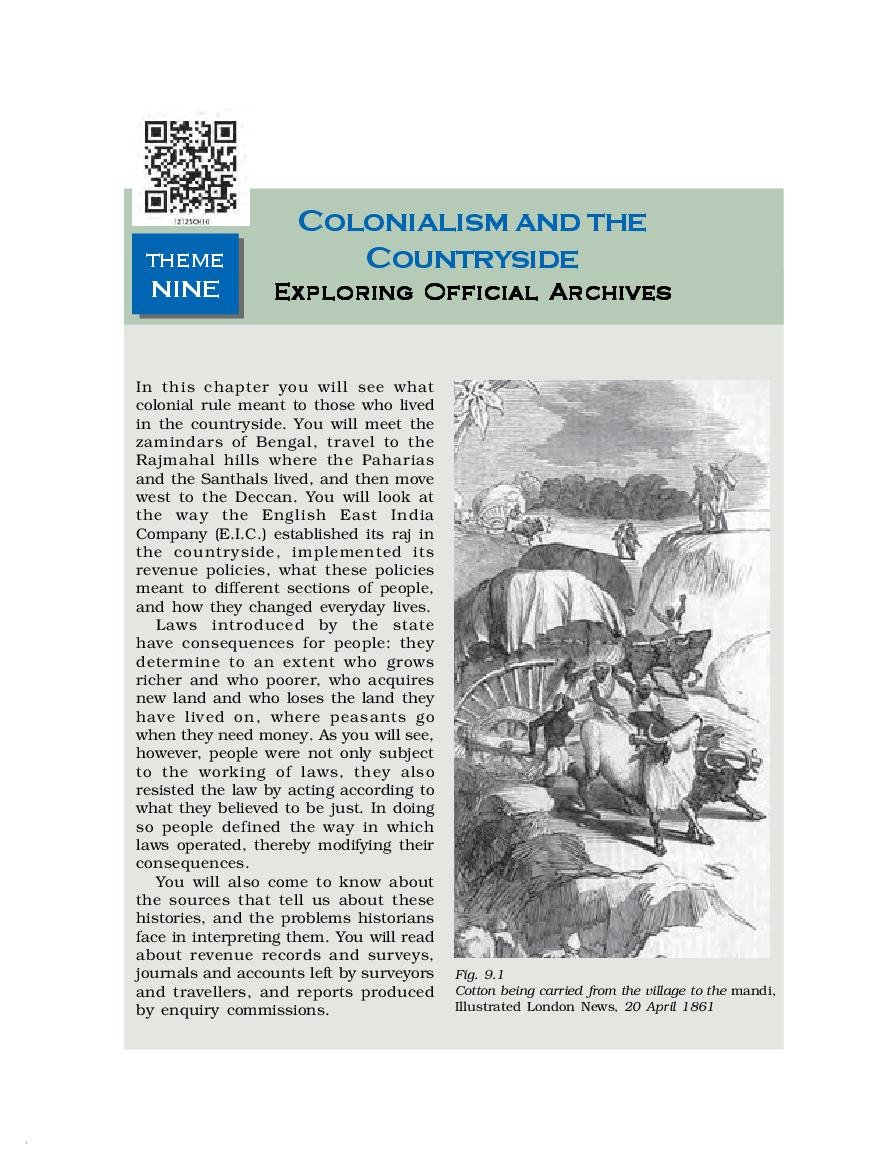
journals and accounts left by surveyors Fig. 9.1
and travellers, and reports produced Cotton being carried from the village to the mandi,
by enquiry commissions. Illustrated London News, 20 April 1861
Showing the first page only. Download the PDF above for the complete document.
Document Details
| Board / Org | NCERT |
| Exam | Class 12 |
| Type | Books |
| Pages | 31 |
| Updated | 29 Aug 2026 |