GSEB HSC Model Question Paper for Chemistry - Set 5
Finished viewing? Save it for later —
Download GSEB HSC Model Question Paper for Chemistry - Set 5 (PDF · 20 pages)About GSEB HSC Model Question Paper for Chemistry - Set 5
GSEB HSC Model Question Paper for Chemistry - Set 5 is available here for free download. Published by Gujarat Board for Class 12, this sample paper can be viewed online or downloaded as a PDF (20 pages). Candidates preparing for Class 12 can use GSEB HSC Model Question Paper for Chemistry - Set 5 to understand the exam pattern, the type of questions asked, and the overall difficulty level.
Frequently Asked Questions
How can I download GSEB HSC Model Question Paper for Chemistry - Set 5?
Open this page and click the Download button to save GSEB HSC Model Question Paper for Chemistry - Set 5 as a PDF. It is completely free on AglaSem Docs.
Is GSEB HSC Model Question Paper for Chemistry - Set 5 free to download?
Yes. GSEB HSC Model Question Paper for Chemistry - Set 5 can be viewed online and downloaded as a PDF free of cost on AglaSem Docs.
How many pages does GSEB HSC Model Question Paper for Chemistry - Set 5 have?
GSEB HSC Model Question Paper for Chemistry - Set 5 contains 20 pages, which you can read online or download together as a single PDF.
Where can I find more Class 12 study material?
You can find more Class 12 question papers, sample papers, syllabus, and answer keys on AglaSem Docs.
GSEB HSC Model Question Paper for Chemistry - Set 5 – Text
Read the full text of this sample paper below — useful to quickly search, copy and reference the content online without downloading the PDF.
📄 View text version (20 pages)
Page 1
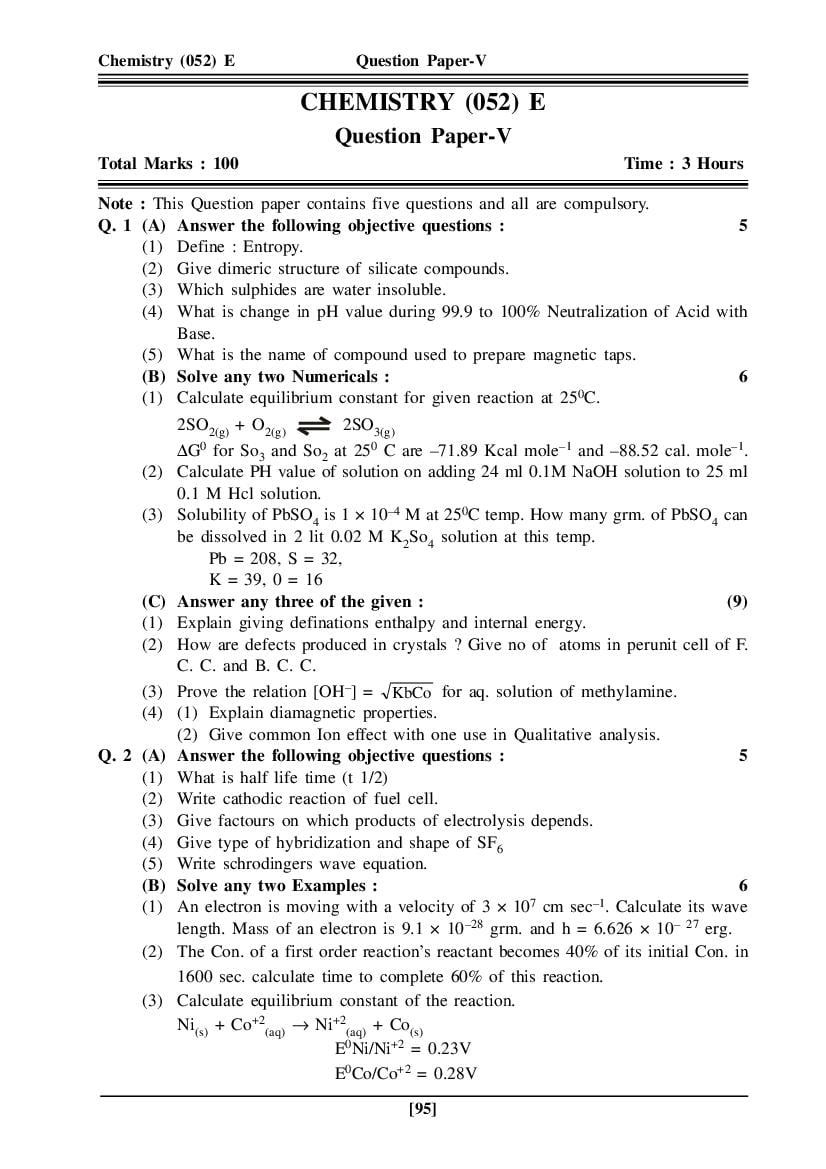
CHEMISTRY (052) E
Question Paper-V
Total Marks : 100 Time : 3 Hours
Note : This Question paper contains five questions and all are compulsory.
Q. 1 (A) Answer the following objective questions : 5
(1) Define : Entropy.
(2) Give dimeric structure of silicate compounds.
(3) Which sulphides are water insoluble.
(4) What is change in pH value during 99.9 to 100% Neutralization of Acid with
Base.
(5) What is the name of compound used to prepare magnetic taps.
(B) Solve any two Numericals : 6
0
(1) Calculate equilibrium constant for given reaction at 25 C.
2SO2(g) + O2(g) 2SO3(g)
∆G0 for So3 and So2 at 250 C are –71.89 Kcal mole–1 and –88.52 cal. mole–1.
(2) Calculate PH value of solution on adding 24 ml 0.1M NaOH solution to 25 ml
0.1 M Hcl solution.
(3) Solubility of PbSO4 is 1 × 10⁻⁴ M at 25 0C temp. How many grm. of PbSO4 can
be dissolved in 2 lit 0.02 M K2So 4 solution at this temp.
Pb = 208, S = 32,
K = 39, 0 = 16
(C) Answer any three of the given : (9)
(1) Explain giving definations enthalpy and internal energy.
(2) How are defects produced in crystals ? Give no of atoms in perunit cell of F.
C. C. and B. C. C.
(3) Prove the relation [OH –] = KbCo for aq. solution of methylamine.
(4) (1) Explain diamagnetic properties.
(2) Give common Ion effect with one use in Qualitative analysis.
Q. 2 (A) Answer the following objective questions : 5
(1) What is half life time (t 1/2)
(2) Write cathodic reaction of fuel cell.
(3) Give factours on which products of electrolysis depends.
(4) Give type of hybridization and shape of SF6
(5) Write schrodingers wave equation.
(B) Solve any two Examples : 6
7 –1
(1) An electron is moving with a velocity of 3 × 10 cm sec . Calculate its wave
length. Mass of an electron is 9.1 × 10 –28 grm. and h = 6.626 × 10– 27 erg.
(2) The Con. of a first order reaction’s reactant becomes 40% of its initial Con. in
1600 sec. calculate time to complete 60% of this reaction.
(3) Calculate equilibrium constant of the reaction.
Ni(s) + Co+2(aq) → Ni+2(aq) + Co(s)
E0Ni/Ni+2 = 0.23V
E0Co/Co+2 = 0.28V
[95]
Page 2
(C) Answer any three question from the following : 9
(1) Explain chemistry of Rusting of Iron. How it can be stop ?
(2) Describe the construction. Working and uses of standard hydrogen electrode.
(3) Derive the equation for rate constant of a first order reaction. Using Integrated
rate law method.
(4) Explain Heisenberg’s principle.
Q. 3. (A) Answer the following objective questions : 5
0
(1) Write the reaction when Ethyl Benzene is healted at 630 c with Zinc Oxide.
(2) Give structure of Anthracene, p–cresol.
(3) Give formula of Lithium Carbide. Perchloric Acid.
(4) Give the name of scientist who first isolated Na and K.
(5) Give Equation of the reaction when toluene reactwith Cl2 at 1110C in presnece
of sunlight.
(B) Write the chemical Equation for any three of to following conversions (two
steps) 6
(1) Benzyl Alcohol from toluene.
(2) 1 phenyl–1 Ethanol from Benzene.
(3) Acetanilide from chloro Benzene.
(4) Phenetol from phenol.
(C) Answer any three question from the following : 9
(1) Explain the following reactions with equations.
(a) Sulphonation of Benzene
(b) Acetylation of Benzene
(2) Write short note on : (1) Lucas test (2) Wurtz reaction
(3) Give the properties in which Li differ’s from the other elements of it’s group.
(4) Explain : (1) Benzene does not oxidize
(2) Classify in Ortho and meta directing groups
–OH, –SO3H, –NO2
Q. 4. (A) Answer the following objective questions : 5
(1) Give IUPAC name C6H5NHCH 3, C2H5CN
(2) What is Hyperglycemia and Hypoglycemia
(3) Give Chemical name and structure of Asprin.
(4) Give name and structureof yellow azodye.
(5) Give the reaction when Benzoic Acid is heated with thionyl chloride.
(B) Write the chemical Equation for any three conversions (two steps) 6
(1) Aniline from Benzoyl chloride
(2) Lactic Acid from Acetaldehyde
(3) Phenol from Aniline
(4) Triethyl amine from ethy amine.
(C) Answer the three questions from the following : 9
(1) Give classification of polymers on the bases of structure.
(2) Give short note on : (1) Wolff kishnes reduction (2) Carbyl amine test
[96]
Page 3
(3) Write preparation and uses of : Nitrolim, PVC
(4) What is diazotization ? Write the reaction to prepare. Iodobenzene from diazoniam
salt.
Q. 5. (A) Answer the following objective questions : 5
(1) How is Red phosphorous prepared.
(2) Define Co–ordination site of ligand.
(3) Give name of complex compound.
[Cr(en) 2Co3]NO3
(4) What are vanadates ?
(5) How much vitamin B12 is required perday to a person.
(B) Answer the following questions : 6
(1) Why Inert gas do not forms compounds.
(2) Explain most stable oxidation state of Ti is 4 but Ti4 Ion does not exist.
(3) Give the physical properties of transition elements.
(C)Answer any three questions from the following : 9
(1) Explain importance of complex occuring in nature
(2) Discuss the shape and magnetic properties of complex [NiCl4]2–
(3) Give the structure of : (1) Pyrophosphoric Acid (2) hypophosphoroous Acid
(4) “Transition metal Ions have high tendency to form complex compounds” Explain.
*–*–*
[97]
Page 4
: ANSWER :
Q. 1. (A) Anser in short (5)
(1) The measure of randoness in a system is called entropy
(2)
. .
(3) Sulphides of alkali metals and alkaline earth metals
(4) From 4.30 to 7.00
(5) CrO2
(B) Solve any two numericals (6)
(1) ∆G0 = Σ ∆G0f(products) – Σ∆G0f (reactants)
= [2∆G0fSO3] – [2∆G0fSO2 + ∆ G0fO2]
= [2(–88.52)] – [2(–71.79) + 0]
= – 177.04 + 143.58]
∆G = –33.46 Kcal
0
Now
∆G0 = – 2.303 RT log Kp
–33.46 = –2.303 × 1.987 × 10 –3 × 298 × log Kp
33. 46
∴ log Kp =
2. 303 × 1. 987 × 10 −3 × 298
33. 46
=
1363. 7
log Kp = 24.53
∴ Kp = Antilog (24.53)
Kp = 3.44 × 1024
(2) 1000 ml HCl → 0.1 mole HCl
25 ml HCl → (?)
∴ moles of HCl = 0.0025
0. 1 × 24
Similarly, moles of NaOH = = 0.0024 mole
1000
NaOH + HCl = NaCl + H2O
Thus, 0.0024 mole NaOH will neutralize 0.0024 moles of HCl
∴ Unneutralized moles of HCl = 0.0025 – 0.0024
= 0.0001 mole
Now, total volume = 24 + 25 = 49 ml
1 × 10 −4 × 1000
∴ Molarity of HCl =
49
[HCl] = 2.04 × 10⁻³ M
Now, HCl is strong acid, ionizes completely
HCl + H2O → Cl– + H 3+O
[98]
Page 5
∴ [H3+O] = 2.04 × 10⁻³ M
∴ pH = – log [H3+O] = –log 2.04 × 10 –3
= 3 – 0.3096
pH = 2.6904
(3) PbSO4(s) Pb 2+(aq) + SO32–(aq)
K2SO4(aq) → 2K+(aq) + SO42–(aq)
2(0.02)M 0.02 M
∴ In solution, [Pb ] = S = ?
2+
[SO 42–] = (S + 0.02)
≅ 0.02 M [∴ S < < < 0.02)
Now,
∴ Ksp = [Pb2+] [SO42–]
1 × 10–4 = (S) (0.02)
S = 5 × 10 –3 mole/litre
Now, Molecular weight of PbSO4 = 208 + 32 + 64
= 304 gm/mole
So lub ility in gm 1000
Molar solubility = ×
Molecular weight Volume in ml
W 1000
5 × 10–3 = ×
304 2000
w = 5 × 10–3 × 608
w = 3.04 gm
(C) Answer any three : (9)
(1) Internal energy :
Each substance is a huge store of energy. The energy stored in any substance is
known as internal energy.
This energy is stored as potential energy and kinetic energy.
The absolute energy of internal energy can not be calculated. It is a state func-
tion and extensive properties.
Enthalpy :
Usually chemical reactions are carried out in an open container under constant
pressure. Thus, a new state function called enthalpy (H) is defined.
H = E + PV
If the state of a system changes, the enthalpy change ∆ H is as below :
∆H = ∆E + ∆(PV)
= ∆E + P∆V + V∆P
but at constant pressure, ∆P = 0
∴ ∆H = ∆E + P∆V
Now, according to first law of thermodynamics. ∆E = q + w and under constant
pressure q = q(p) and w = – P∆V
∆H = (q(p) – P∆V) + P∆V
∴ ∆H = q(p)
[99]
Page 6
(2) (i) At a temperature higher than absolute zero, the ions or atoms vibrate and the
arrangement becomes slightly random. Due to this, the displacement of cations
and anious from their proper positions causes defects in the crystal.
(ii) Moreover, the introduction of some impurities in the crystal also produces
defects.
F 1 I+ F6 × 1 I
Number of atoms in FCC = 8 × H 8K H 2K
=1+3
= 4 atoms
F 1 I+ (1)
Number of atms in BCC = 8 × H 8K
=1+1
= 2 atoms
(3) CH3–NH2 + H2O CH3NH 3+ + OH
CH 3 − NH3+ OH
∴ Ke = CH − NH H O
3 2 2
When methyl amine dissolves in water, the decrease in concentration of
water is negligible compare to concentration to pure water. So the concentration
of water is accepted as constant. This constant [H2O] is combined with Ke and
new constant Kb is written.
CH 3 − NH +3 OH
∴ Ke × [H 2O] = Kb =
CH 3 − NH 2
→ Now CH3NH2 is weak base. Thus, if ionizes only slightly. Moreover, CH3NH3+
and OH– ions are produce in equal mole ratio.
∴ [CH3NH +3 ] = [OH–] and [CH 3NH2] = Co
OH
∴ Kb =
CH 3NH 3
Kb [CH3NH 2] = [OH–]2
∴ Kb.Co = [OH–]2
∴ [OH–] = Kb ⋅ Co ...(1)
(4) (1) Diamagnetic Substances :
→ The substance which are repelled by an external magnetic field are called dia-
magnetic substances.
→ When such substances are place in external magnetic field, they tend to move
away from the stronger part to the weaker part of the applied magnetic field e.g.
TiO 2
[100]
Page 7
→ Diamagnetic property is due to the substances having atoms with closed shells
of electrons or with all electrons paired.
→ The magnetic susceptibility of such substances is negative.
→ Larmor circulation : Under the influence of an external magnetic field, the
electrons in the closed shells of every substance experience a force. This force
sets them into motion about the direction of applied magnetic field as the axis
and as a result another magnetic field is induced with its direction opposite to
that of the applied field. The induced field acts against the applied field. So the
substances are repelled. This kind of motion of electrons is Known as “Larmor
Circulation”
(2) In III–A group of qualitative analysis, NH4Cl is added before NH4OH to the
given solution.
e.g.NH 4OH(aq) NH4+(aq) + OH–(aq)
NH4Cl(aq) → NH4+(aq) + Cl–(aq)
common ion
→ Here, NH4Cl being strong electrolyte, ionizes completly and produces large
connections of NH4+ ions. So the concentration of NH4+ ions increases. So the
equilibrium of NH4OH shifts in the reverse direction. As a result, ionization of
NH4OH decreases. Here the concen. of OH – ions decrease to a large extent.
∴ [OH]– remains very low.
→ Now, the solubilities of hydroxides of group III–A ions Al 3+, Fe 3+, Cr3+ and Fe2+
are very low compared to the hydroxides of later groups i.e. III–B, IV and Mg2+.
So under low concentration of OH– ion, only Al3+, Fe3+, Cr 3+ and Fe2+ ions are
precipitated as hydroxides.
→ While the solubility of hydroxides of group III–B, IV and Mg2+ are compara-
tively high. So under low concen. of OH– ions these groups ions do not precipi-
tate as hydroxides.
Q. 2. (A) Answer the following objectives ...(5)
(1) The time taken by the reaction to consume half (50%) of initial concentration
of reactant is known as half– life time of reaction
–
(2) O2 + 2H2O + 4e– → 4OH
(3) Factors : (i) Nature of electrodes
(ii) Concentration of electrolytes
(4) SF6 : Hybridization → sp3d2
shape → Octahedral
d2ψ d ψ
2
d2ψ 8 π2 m
(5) = = = (E – V) Ψ = 0
dx2 dy2 dz 2 h2
(B) Solve any two examples : (6)
−27
h 6. 626 × 10
(1) λ = = = 24.25A0
mv 9. 1 × 10 −28 × 3 × 10 7
[101]
Page 8
2 .303 a
(2) K = × log
t a−b
2 .303 100
t40% = × log
K 60
2 .303 × 0 . 2219
∴ t40% =
K
Now,
2 .303 100
t 60% = × log
K 40
2 .303 × 0 .3980
=
K
Now,
t 60% 2 .303 × 0 .3980 K
t 40% = K
×
2 .303 × 0 . 2219
t 60% 0. 3980
=
1600 0. 2219
∴ t60% = 2871 seconds
(3) Equilibrium constant
Ni(s) + CO2+(aq) NI2+(aq) + Co(s)
∆E0 = E0Ni/Ni 2+ – E0ColCo2+
= 0.23 – 0.28
∆E = – 0.05 volt
0
Now, At equilibrium ∆E = 0.000, Kc = ?
0. 0592 Ni 2 +
∆E = ∆E – 0
× log Co2 +
n
0 . 0592
0.00 = –0.05 – × log Kc
2
0. 05
∴ log Kc =
0. 0296
∴ = –1.690
∴ Kc = Antilog (–1.690)
= Antilog (2.310)
Kc = 2.042 × 10 –2
Q. 2. (C) Explain following (any three) 9
(1) Corrosion of metal :
→ The formation of the rust on the surface of some metals by a chemical rreaction
between oxygen of air and atoms of metals lying in contact with air is known
as corrosion.
→ e.g. Rusting or ison, formation green salts of utensils of copper and brass,
tarnishing of shing silver etc. are examples of corrosion.
→ Anodic Oxidation : The arrangement of atoms in an iron rod or a container can
never be perfect. Whenever even a slight bent in a rod exists, the microscopic
[102]
Page 9
imperfection is created in the crystalinc structure. Moreover, the crystal struc-
ture of metal is never perfect. In addition, impurity of Cu metal is also present
in minute proportion in iron. So the surface of microstal is very reactive. Due
to this, the atoms present in this surface can lose the electrons easily and get
converted into positive (+ve) ions. Thus, metal at bent acts as an anode. Water
molecules needed in this reaction are available from moisture of air.
Anode : (At bent) : Fe(s) → Fe2+ (aq) + 2e –
Cathodic Reduction : The electrons set free by anode are conducted by the rod
and reach to a such point where they can reduce O2 of air in presence of H+ ions.
This point on the surface acts as a cathode.
Cathode : O2(g) + 4H +(aq) + 4e– → 2H 2O(l)
→ H+ ions required in this reaction are produced by the dissociation of H2CO3.
This H2CO3 is formed on the surface of the rod by dissolution of CO2 gas in the
moisture present on the surface of the rod.
→ If H+ ions are not available on cathode, O2 dissolved in moisture gets reduced
to OH–(aq).
O2(g) + 4H+(aq) + 4e– → 2H2O(l)
→ Fe2+(aq) formed by the oxidation are further oxidized to Fe3+ by atmospheric
oxygen. These Fe3+ ions migrate towards cathode and eventually fron Fe2O3.xH2O.
→ Corrosion of Fe can be prevented : (i) by avoiding the contact of metal surface
with moisture. (ii) For this purpose the surface of iron is coated with thin layer
of Zn metal, (iii) by attaching iron plates with metals like Mg or Zn. Thus, Fe
becomes cathod and Mg or Zn acts as an anode. Because E0Mg/Mg 2+ > E0 Fe/Fe2+
(2) Standard Hydrogen Electrode. (SHE)
→ Construction : 1 M aqueous solution of HCl Cu wire
(H3O+ ) is filled in a container. A platinum
plate coated with platinum black is dipped
in 1 M HCl(aq) solution. Hg
H2(g)
→ This platinum plate is connected with a small glass tube
piece of platinum wire and it is sealed in a
glass–tube. The another end of this Pt wire
is in contact with a small quantity of mercury Pt
A thin copper wire which is also in contact plate
with mercury is used to connect external 1M HCl
circuit. This half cell is known as standard
hydrogen electrode. H2(g) is bubbled over
platinum plate at 250 C and 1 atm pressure.
→ Working : This electrode is connected with another half–cell to form a complete
cell. It acts either as an anode or a cathode. When it acts as an anode H2 gas gets
oxidized into H+ ions. When it acts as a cathode 2H+ ions gets reduced to H2
gas on the plate.
[103]
Page 10
1
Anode : H (g.1 atm) → H+(aq.1M) + e–
2 2
1
Cathode : H+(aq,1M) + e– → H
2 2 (g,1atm)
→ Thus, this electrode has a tendency either to accept electrons or to release elec-
trons. However, the intensity of this tendency is assigned arbitarily a value of
0.00 volt. So the relative tendency of other electrodes to release or gain the
electrons can be determined easily.
→ Use : This electrode is used to determine the standard potential of another
electrodes. The electrode of which potential is to be determined is connected
with a standard hydrogen half cell. Then using a salt bridge an electrochemical
cell is completed. And ∆E0 of the cell is measured by potentiometer and using
following formula potential of another electrode can be calculated.
∆E0cell = E 0ox(anode) – E0ox (cathode)
(3) Integrated rate law.
Following reaction occurs in forward direction and it isfirst order.
1
N2O5(g) → 2NO 2(g) + O
2 2(g)
d[ N 2 O5 ]
− = K [N2O5]
dt
if [N 2O5] = C mole/litre
dc
=K.C
dt
dc
∴ − = K . dt
c
Now, integrating this equation between following limits.
Initial concentration c = co when t = to and concentration c = c when t = t.
zdcc = K zdt
c t
−
co 0
−[ln c ] CCo = K[ t ] t0
C
–ln =K.t
Co
Co
2.303 log =K.t
C
2 .303 Co
∴ K = log
t C
→ The unit of K forfirst order is time–1 i. e. second–1, minute–1 etc.
(4) State the explain Heisenberg’s Uncertainty Principle.
Ans. The speed and the position of a plane flying in sky can be determine accurately
at any moment.
→ But “it is not possible to determine simultaneously the position and the speed
[104]
Page 11
of moving microscopic particles like electron, proton, neutron in a space with
high accuracy.” It is known as a Heisenberg’s uncertainty principle.
→ If a radiation having λ wavelength is used to locate a microscopic particle in
space, the minimum uncertainly in the measured value sould be ±λ. Therefore
to minimize the value ofuncertainty in the measured value of position of the
partcile, the wavelength of radiation used in the experiment should be very small
h
as far as possible. Since the momentum (p) of a photon is given by P = , the
λ
momentum of a photon of radiation having very small wavelength is very large.
→ When such photon hits a microscopic particle, some unknown faction of its
energy is transferred to the particle. As a result, the velocity of the particle
increases suddenly to a high value. Thus, if the momentum of a particle is to be
determined simultaneously with the determination of position of the particle, the
measured value of the momentum would be highly uncertain.
→ It is possible to show that “the product of uncertainties in values of position and
momentum determined simultaneously is atleast equal to h/4π or more”.
h
→ ∴ ∆χ × ∆p ≥ Where h = Planck’s constant
4π
∆p = uncertainty in its momentum.
∆χ = uncertainty in the position of a particle.
→ Above equation indicates that if, any attempt is made to reduce uncertainty of
one kind then there increases the uncertainty of another kind. Thus, it is under-
stood that the path of a particle going from one point to another point cannot be
predicted with a very high accuracy.
Q. 3 (A) Answer in short : (5)
CH2CH3 CH = CH 2
ZnO
(1) →
Ethyl benzene 6300C, –H2 Styrene
CH3
(2)
Anthracene OH
P–Cresol
(3) Li2C2 and HClO4
(4) Humphrey Davy
CH3 CH2Cl
Cl2/hv
(5) →
1110C, –HCl
Toluene Benzyl Chloride
[105]
Page 12
(B) Any three conversions : (6)
CH3 [O], ∆ COOH 2H2 CH2OH
(1) → →
Toluene KMnO4 / KOH Benzoic acid LiAlH4 –H2O Benzyl alcohol
COCH 3
CH3–Co–Cl H2
(2) → → CH–CH3
Anhy. [AlCl3] LiAlH4
Benzene Aceto OH
0
–HCl, 80 C Phenone 1–Phenyl,
1–Ethanol
Cl NH 2 NH–COCH3
[Cu2O] ∆ CH3CoCl
(3) + 2NH3 → →
2000C –HCl
Chloro Aniline Acetanilide
benzene 60 atm.
–NH4Cl
OH ONa OCH 2CH3
Aq. NaOH CH3CH3Cl
(4) → →
–H2O –NaCl
Phenol Sodium Phenetole
Phenoxide
Q. 3. (C) Answer in the following (three) 9
(1) Sulphonation of benzene
H2SO4 + H2SO 4 SO3H+ + HSO–4 + H2O
SO3H SO3H
conc. H2SO4 + SO3 conc. H2SO4 + SO3 SO3H
→ →
-H 2O, 800C -H2O
Benzene Benzene 2000C BDS
Sulphonic Fusion
acid NaOH(s)
Fusion ↓
NaOH(2)
↓ OH OH
OH
phenol Resorcinol
[106]
Page 13
→ When benzene is heated with conc. H2SO4 and SO3 at 800C, it gives benzene
sulphonic acid. If more H2SO 4 is taken and temperature is increased to 2000C
for long time then it gives benzene m-disulphonic aid.
→ Here, -SO3H group is m-directing, so second incoming -SO3H goes to m-posi-
tion giving BDS.
→ When these products are fused with solid NaOH, give phenol and resorcinol.
→ In sulphonation, SO3H+ is attracted by π-electron cloud of benzene and it dis-
places aromatic substitution reaction.
Acylation of toluene :
CH3 CH3
CH3Co-Cl (-HCl)
→
(CH3Co)2O (-Ch3COOH)
CO CH3
Toluene 1110C. Anhy. [AlC;3] p=methyl
acetophenone
Where toluene is heated with acetyl chloride or acetic anhydride at 111 0C, in pres-
ence of anhy. AlCl3 it gives p-methyl acetophenone. Here CH 3 grp is o+p directing.
So-CoCH3 grp is attached to p-position.
(2) (1) Explain : Lucas Test : (Imp.)
anhy. [ZnCl2]
R–OH + conc. HCl → R–Cl + H2O
alcohol hydrochloric acid ∆ alkyl chloride
→ When alcohol is heated with conc. HCl in presence of anhydrous ZnCl2, it gives
alkyl chloride. This reaction is fast with tertiary alcohol, Slow with secondary
alcohol and difficult with primary alcohol. Thus, Primary, Secondary and ter-
tiary alcohol can be distinguished by this reaction. This test is called Lucas test.
→ Test and Observations :
→ In this test, a given sample of alcohol is mixed with conc HCl and anhydrous
ZnCl2 and shaken well and the mix. is kept for observation.
(i) If in few minutes, oily drops are appeared on the upper layer of the mixture,
it must be a tertiary alcohol. (3 0)
(ii) If it takes about five minutes for the solution to become milky, it must be
a secondary (20) alcohol.
(iii) And if mixture remains clear i.e. no reaction occur.
It must be a primary (1 0) alcohol.
(2) Wurtz reaction : anhy.
2CH3I + 2Na → CH3–CH3 + 2NaI
Methyl Powder ether Ethane Sodium Ionide
Iodide
[107]
Page 14
anhy.
2CH3–CH–Cl + 2Na → CH3–CH2–CH2–CH3 + 2NaCl
Ethyl chloride Sodium ether n–Butane
→ When alkyl halide is reacted with powdered sodium metal taken in anhydrous
ether, it gives an alkane. This alkane contains double number of C–atoms com-
pared to initial alkyl halide. This reaction is known as Wurtz reaction. By this
reaction methyl iodide give ethan and Ethyl chloride gives butane.
(3) Explain how Li differs from other alkali metals. (Specific)
Ans. (1) The under lying closed shell in Li contains only 2 electrons (2S2) while the
underlying closed shell of other alkali metals contains 8 electrons of ns2np6 type.
(2) Li directly combines with nitrogen giving lithium nitride while other alkali
∆
metals do not form nitrides. 6Li + N2 → 2Li3N (Lithium nitride)
(3) Only Li can combine with carbon and silicon to from a carbide and a silicide
respectively while other alkali metals do not form carbides and silicides.
2Li + 2C → Li2C2 (Lithium Carbide)
2Li + 2Si → Li2Si2 (Lithium Silicide)
(4) The nitrate of Li when heated gives nitrogen dioxide and oxygen while other
alkali metal nitrate heating give on nitrites.
∆ ∆
4LiNo3 → 2Li2O + 4NO 2 + O2, 2NaNO 3 → 2NaNO 2 + O2
nitrogen dioxide sodium nitrite
(4) (1) Give reasion : Benzene resists oxidation.
→ Due to a resonance in benzene its energy state (potential energy) decreases by
36.0 K.cal/mole. The lower resonance energy of benzene indicates its specific
type of higher stability and somewhat less chemical reactivity.
→ Thus, inspite of having three double bonds in benzene, it is more stable and
much less reactive compared to alkene. Hence, it behaves like stable alkanes. So
benzene resists oxidation with strong oxidizing agent like KMnO4 at room tem-
perature.
(2) –OH → O and p–directing group
(3) –SO3H, –NO2 → m–directing group
Q. 4. (A) Answer following in shrot : (5)
(1) IUPAC name : C6H5–NH–CH3 → N–methyl amino benzene
C2H5–CN → cyano ethane
(2) If in 100 ml the amount of glucose is more than 130 miligram it is called
hyperglycemia or diabetes and amount of glucose is less than 65 miligram it is
called hypoglycemia.
COOH
OCOCH 3,
(3) chemical name : acetyle solicylic acid
[108]
Page 15
CH3
(4) N=N N
CH3
P–dimethyl amino azobenzene
COOH Co–Cl
SoCl2
(5) →
∆, –SO2
Benzoic acid –HCl Benzoly Chloride
(B) Give conversions (three) : (6)
(1) Aniline from benzoly chloride
Co–Cl CoNH2 NH2
2NH 3 ∆ Br2 + 4NaOH
→ →
–NH 4Cl –2H2O, –2NaBr
Benzoly Benzamide –Na2CO3 Aniline
Chloride
(2) Lactic acid from acetaldehyde
Aq. H2SO2
CH3–CHO + HCN → CH3–CH–CN → CH3–CH– COOH
OH +2H2O OH
Acetaldehyde Acetaldehyde –NH 3 Lactic acid
Cyanohydrin
(3) Phenol from qniline
NH2 N=N·Cl OH
NaNO2 + 2HCl H 2O, ∆
→ →
0–50C –N2↑
–NaCl, –2H2O BDAC Salt –HCl Phenol
✈
✔✉ Tri ethyl amine from ethyl amine
CH3CH2–Cl CH3CH2–Cl CH2–CH3
CH3CH2–NH2 → CH3CH2–NH–CH2CH3 → CH3–CH2–NH
Ethyl amine –HCl Diethyl amine –HCl triethyl amine CH2–CH3
(C) Answer the following (three) (9)
(1) Classification of polymers :
(i) Linear plymers : If monomers are jointed to each other in a continuous long
chain, it gives linear polymers.
→ Natural fibers like cotton, wool, silk, etc. are also linear polymers. Linear poly-
mers are thermoplastic polymers. eq. Nylon, terylene etc.
–A–A–A–A–A–A–A–A–
–A–B–A–B–A–B–A–B–
linear plymers
[109]
Page 16
(ii) Branched polymers :
→ When a long chain is formed from monomers contain branching, we get branched
polymers. Branched polymers can be called Thermosetting polymers. eg. PVC
polystyrenes aer branched polymers.
–A–A–A–A–A–A–
A–A–A–A–A–A–
A–A–A–A–A–A–
branched polymer
(iii) Cross – Linked Polymers :
→ If several linear long chains of monomer units are chemically joined to each
other at several points by mixed bonding, we get Cross–linked polymers.
→ These polymers can be called thermo setting polymers. e.g. Bakelite melamine
etc. They are solid, hard and resistant to wear and tear.
–A–A–A–A–A–A–A–A–
–A–A–A–A–A–A–A–A–
–A–A–A–A–A–A–A–A–
cross–linked polymers
(2) (1) Wolf–Kishner Reduction : When aldehydes and ketones are reduced by hydra-
zine and potassium hydroxide givs hydrocarbons. In this reaction carbonyl group
C = O is directly reduced in methylene – CH2 – group. This reaction is known
as wolf–kishner reduction. e.g. Acetaldehyde gives ethane and acetone gives
propane by this reduction.
NH2.NH2
CH3CHO → CH3CH 3 + H 2O + N2
Acetaldehyde KOH Ethane
NH2.NH2
CH3COCH3 → CH3CH2CH 3 + H 2O + N2
Acetone KOH Propane
(2) Explain : Carbyl Amine Test. Short note :
Ans. Primary amines (10) can be detected in laboratory by carbyl amine test. In this
test, ethyl amine is heated with alcoholic KOH and chloroform. It forms ethyl
isocyanide or carbyl amine. This product is very toxic and foul smelling.
∆
CH3–CH2NH2 + CHCl 3 + 3KOH → CH3 – CH2 – N+ ≡ C + 2KCl + 3H2O
Ethylamine (i) Chloroform Potassium Ethyl iso cyanide
hydroxide
→ While secondary and tertiary amines do not give this test. So 10 amine can be
distinguished from 20 and 30 amines.
[110]
Page 17
NH2 N+ ≡ C
+ CHCl3 + 3KOH → + 3KCl + 3H2O
Chloroform ∆
Aniline (10) potassium Phenyl
hydroxide iso cyanide
→ Similarly when aniline is heated with alcoholic KOH and chloroform, it gives
very foul smelling toxic compound phenyl isocyanide or carbil amine.
(3) Nitrolim : (Nitrogeneous Fertilizer)
Ans. When a mixture of calcium oxide (quick lime) and carbon is heated in an elec-
tric furnace at 20000C, it gives calcium carbide.
→ This is then finely powdered and placed in electric furnace having porous walls.
At 12000C, nitrogen is passed into the furnace which gives calcium cyanamide.
→ Fine powder of this mixture (nitrogen + lime) is used as nitrolim fertilizer. In
the soil containing moisture, nitrolim hydrolyze giving CaCO3 and ammonia.
20000C
CaO + 3C → CaC2 + CO
calcium oxide carbon Calcium Carbon monoxide
carbide
12000C
CaC2 + N2 → CaCN2 + C
Calcium carbide nitrogen Calcium Carbon
cyanamide
hydrolysis
CaCN 2 + 3H2O → CaCO3 + 2NH3
calcium ammonia
carbonate
Uses : It supplies Nitrogen to plants.
(4) Diazotiazation of Aniline :
Ans. The reaction of primary aromatic amine with HNO2 at low temperature (O – 50C)
gives diazonium chloride salt. This reaction is known as Diazotiation.
NH2 N=N–Cl
NaNO2 + 2HCl
→
0–50C, –NaCl –2H2O
Aniline Benzene diazonium salt
N=N–Cl I
KI, ∆
→
–KCl, –N2↑
iodobenzene
When BDAC salt is heated with KI, it gives iodobenzene.
[111]
Page 18
Q. 5. (A) Answer the following objectives : (5)
0
(1) When yellow phosphorous is heated at 250 C in presence of sunlight and I2 as
catalyst and in inert atmosphere of N2 or CO, it gives red phosphorous
nP4 250, hv (P4)n
→
Yellow [I2], N 2 or Co red (polymolecular)
(2) The electron pair donar atom of the ligand is called coordination site of ligand.
•• •• •• ••
eq. N –atom in N H3, N O and CH3 N H2 molecule is co–ordination site.
(3) IUPAC name : Carbonato bis (ethylene diamine) chromium (III) nitrate.
(4) The highest oxidation state of vanadium is +5. The compounds in +5 state are
called vanadates eq. V2O5.
(5) 1.5 microgram of vitamin B12.
(B) Answer the following : (6)
(1) The inert gases other than helium possess an electron octet in their valence
shells. This closed shell configuration is very stable. Owing to very high ionization
energies, inert gases possess a negligible tendency of exchanging electrons and
so they do not form ionic compounds. All the electrons being paired in these
elements, they are unavailable for sharing. Moreover the expansion of the valence
shells of these elements being not possible, even covalent compounds cannot be
formed.
(2) The most stable oxidation state of Ti is +4. Which is more stable than Ti3+ and
Ti3+
Ti + energy → Ti4+ + 4e–
(Large)
Thus Ti is expected to be stable due to 3d 0 but the removal of four electrons
4+
from Ti atom requires very large energy, the Ti4+ ion does not exist but this
oxidation state is found in compounds containing covalent bonds. Therefore,
TiCl4 contains covalent bonds.
(3) Physical Properties : (any four)
(1) They are all metallic elements. They easily form positive ions losing the
electrons from the outermost valence shells and combine with non–metals.
(2) These metals possess high melting points and boiling points.
(3) They are good conductors of heat and electricity.
(4) They combine with oxygen forming oxides. They form alloys with other metals.
(5) They react with acids giving ionic compounds.
(6) These elements can be drawn into wires and beaten into sheets and they
have a shining surface.
(C) (1) Importants of complex :
(1) Chlorophyl, a magnesium complex present in green plants is important for
photosynthesis.
(2) Hemoglobin, an iron complex present in animal blood, serves to carry oxygen
to the muscles and to remove Co2 from the blood.
[112]
Page 19
(3) The complexes present in minerals are useful as catalysts in the metallurgical
industries and as analytical reagents in the laboratory.
(2) Geometry and Magnetic property of [NiCl4]2– OR K2[NiCl4], (Tetra chloro nickelate
(II) ion).
Ans. This complex contains Ni2+ which is co–ordinated with four weak Cl– ligands.
The relatively weak Cl– ligands are attracted weakly by Ni2+ ion. So they cannot
approach very close to it. As a result, the rearrangement of the 3d electrons of
the Ni2+ ion does not become necessary.
→ The electron configuration of Ni2+ ion = [Ar] 3d 84s 00
→ If complex involvex Sp3 hybridization then the one 4s and the three 4p orbitals
hybridize and produces four equienergic Sp3 hybrid orbitals. These four vacant
sp3 hybrid orbitals acomodate four electron – pairs donated by four Cl– ions
which are shown as xx.
→ These four Sp3 hybrid orbitals are directed toward the four corners of a tetrahedron.
So the geometry of [NiCl4]2– is tetrahedral.
Ni2+(z=28) = [Ar] 3d84s 0 3d 4s 4p
ABABAB AA
[Ni(Cl)4]2– = ABABAB AA xx xx xx xx
tetrahedral n=2 sp3 hybridization
[Ni(Cl4]2– = ABABABABxx xx xx xx
square planar n=0 dsp 2 hybridization
→ Magnetic property : This complex has two unpaired
electrons in 3d orbitals; the complex is paramagnetic.
2– Its µ expt. = 2.80 BM which is near to its µ theor =
2.83 BM for n = 2 electrons. This suggests sp 3
hybridization and tetrahedral shape
µexpt = 2.90 BM
µtheor = 2.83 BM, for n = 2
→ If complex has dsp2 hybridization then its µ = 0.00
BM for n = 0. But these is not in agreement with
TETRAHEDRAL value µ = 2.83 BM. This proves that complex ion
contains. sp 3 hybridization and not dsp2 hybridization.
(3) pyrophosphoric acid →
O O
↑ ↑
HO – P – O – P – OH
OH OH
[113]
Page 20
hypo phosphorous acid → O
↑
H – P – OH
H
meta phosphoric acid → +
O = P – OH
O
–
The transition Metal Ions have a greater tendency to form complexes than other
elements. Explain giving reason.s
Ans. (1) Transition metal cations are small in size compared to cations of other
elements.
(2) The nuclear and ionic charges of transitional metal ions are relatively large.
(3) The electronic configurations of these cations are suitable for complex
formation. The 3d orbitals of the ions are either vacant or can become
vacant, which can accomodate the incoming electron – pairs.
(4) There are very small energy separations between 3d, 4s, 4p and 4d orbitals
of these ions. This make the possible various types of hybridization of
these orbitals.
e.g. sp3, dsp2, d2sp3, sp 3d2 etc.
(5) Due to different types of hybridizations and the directional character of
co–ordinate bonds, complexes with different geometries can be formed.
e.g. (i) Tetrahedral K 2[NiCl4] (i) Square planar K2[Ni(CN)4]
(iii) Octahedral [Co(NH 3)6]Cl 3
(6) These metal ions being capable of existing in several oxidation states,
different types of complexes are formed.
e.g. The oxidation states of Fe = +2, +3 and Mn = +2, +3, +4, +5, +6, +7
*–*–*
[114]
Document Details
| Board / Org | Gujarat Board |
| Exam | Class 12 |
| Type | Sample Paper |
| Pages | 20 |
| Updated | 22 Jul 2026 |