GSEB HSC Model Question Paper for Chemistry - Set 4
Finished viewing? Save it for later —
Download GSEB HSC Model Question Paper for Chemistry - Set 4 (PDF · 17 pages)About GSEB HSC Model Question Paper for Chemistry - Set 4
GSEB HSC Model Question Paper for Chemistry - Set 4 is available here for free download. Published by Gujarat Board for Class 12, this sample paper can be viewed online or downloaded as a PDF (17 pages). Candidates preparing for Class 12 can use GSEB HSC Model Question Paper for Chemistry - Set 4 to understand the exam pattern, the type of questions asked, and the overall difficulty level.
Frequently Asked Questions
How can I download GSEB HSC Model Question Paper for Chemistry - Set 4?
Open this page and click the Download button to save GSEB HSC Model Question Paper for Chemistry - Set 4 as a PDF. It is completely free on AglaSem Docs.
Is GSEB HSC Model Question Paper for Chemistry - Set 4 free to download?
Yes. GSEB HSC Model Question Paper for Chemistry - Set 4 can be viewed online and downloaded as a PDF free of cost on AglaSem Docs.
How many pages does GSEB HSC Model Question Paper for Chemistry - Set 4 have?
GSEB HSC Model Question Paper for Chemistry - Set 4 contains 17 pages, which you can read online or download together as a single PDF.
Where can I find more Class 12 study material?
You can find more Class 12 question papers, sample papers, syllabus, and answer keys on AglaSem Docs.
GSEB HSC Model Question Paper for Chemistry - Set 4 – Text
Read the full text of this sample paper below — useful to quickly search, copy and reference the content online without downloading the PDF.
📄 View text version (17 pages)
Page 1
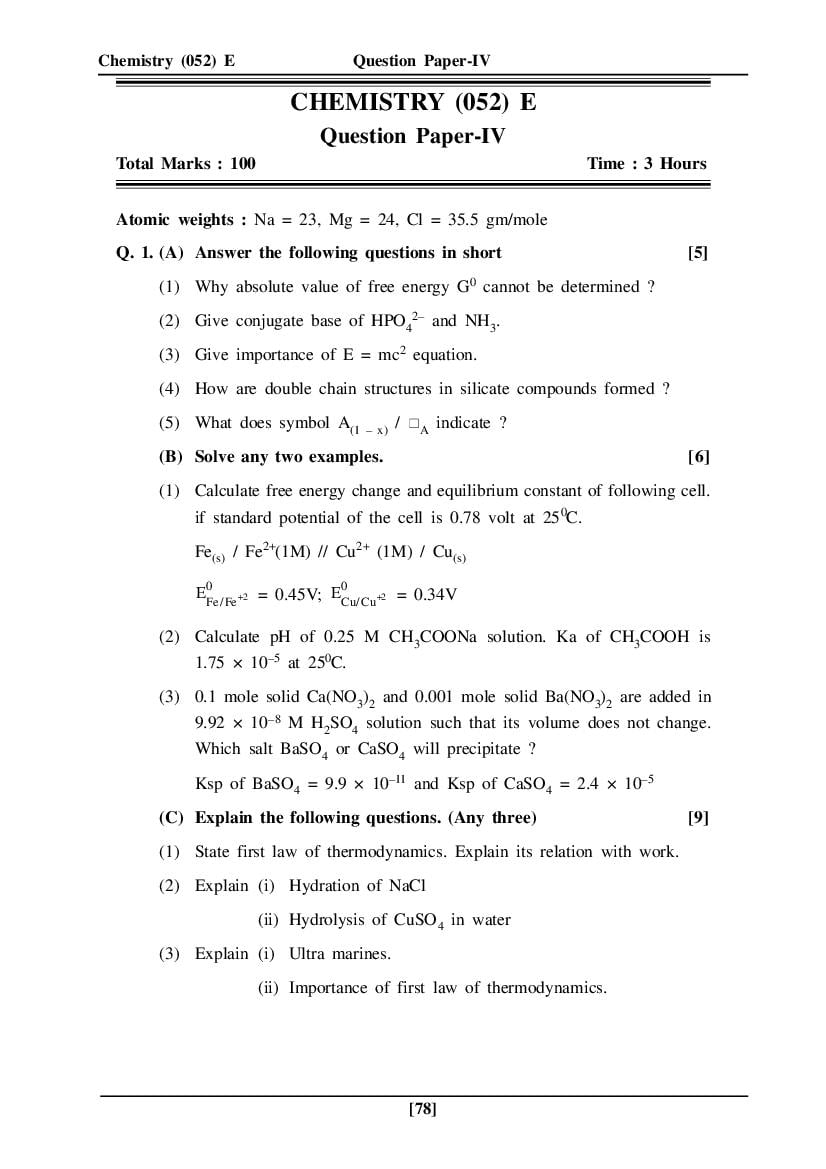
CHEMISTRY (052) E
Question Paper-IV
Total Marks : 100 Time : 3 Hours
Atomic weights : Na = 23, Mg = 24, Cl = 35.5 gm/mole
Q. 1. (A) Answer the following questions in short [5]
(1) Why absolute value of free energy G0 cannot be determined ?
(2) Give conjugate base of HPO42– and NH3.
(3) Give importance of E = mc 2 equation.
(4) How are double chain structures in silicate compounds formed ?
(5) What does symbol A(1 – x) / *A indicate ?
(B) Solve any two examples. [6]
(1) Calculate free energy change and equilibrium constant of following cell.
if standard potential of the cell is 0.78 volt at 250C.
Fe(s) / Fe2+(1M) // Cu 2+ (1M) / Cu(s)
E0Fe / Fe +2 = 0.45V; E0Cu / Cu +2 = 0.34V
(2) Calculate pH of 0.25 M CH 3COONa solution. Ka of CH3COOH is
1.75 × 10⁻⁵ at 250C.
(3) 0.1 mole solid Ca(NO 3)2 and 0.001 mole solid Ba(NO3)2 are added in
9.92 × 10 –8 M H2SO4 solution such that its volume does not change.
Which salt BaSO4 or CaSO4 will precipitate ?
Ksp of BaSO4 = 9.9 × 10⁻¹¹ and Ksp of CaSO 4 = 2.4 × 10⁻⁵
(C) Explain the following questions. (Any three) [9]
(1) State first law of thermodynamics. Explain its relation with work.
(2) Explain (i) Hydration of NaCl
(ii) Hydrolysis of CuSO 4 in water
(3) Explain (i) Ultra marines.
(ii) Importance of first law of thermodynamics.
[78]
Page 2
(4) Explain (i) Amorphous solids
(ii) Crystal structure of ZnS (figs. not required)
Q. 2. (A) Answer the following questions in short. [5]
(1) What is called one faraday ?
(2) What is known as electrolytic cell ?
(3) Define : specific rate constant of reaction.
(4) What is called nodal plane ? Which type of molecular orbitals possess
nodal plane ?
(5) Why SF6 is stable through it is formed from excited state ?
(B) Solve any two examples. [6]
(1) Fused MgCl2 and NaCl are connected in series and same current is
passed through them. During this period, 142 gm. of Cl 2 gas is evolved.
How much Mg and Na would be produced during this period ?
(2) In a first order reaction, the concentration of reactant decreases from 0.8
M to 0.6 M in 2700 seconds. Calculate half–life of the reaction.
(3) Calculate wavelength of particle weighing 500 milligram and moving
with a velocity of 3600 km/second (h = 6.626 × 10⁻²⁷ erg.)
(C) Explain any three of following. [9]
(1) Explain : ‘‘Fuel cell’’.
(2) Derive integrated rate law equation for first order reaction.
(3) Explain (i) Energy barrier
(ii) Difference between BMO and ABMO
(4) Give molecular orbital diagram of O2 molecule. Calculate its bond order
and predict its magnetic property.
Q. 3. (A) Answer the following objectives. [5]
(1) Why the temperature for the bromination of benzene is maintained higher ?
(2) Give structural formula of glycerol and DDT.
(3) Give the equation of reaction when ethanol is reacted with PI3.
(4) What is half–life of francium ? Why does it not occure free in nature ?
(5) Which of the following reaction is possible ? Why ?
(i) Cl2 + 2KF → 2KCl + F2
(ii) F2 + 2KCl → 2KF + Cl2
[79]
Page 3
(B) Give equations of following conversions (any three). Mention name,
structures of organic compounds and necessary conditions. (only in
two steps) [6]
(1) Benzene into TNT.
(2) Toluene into Benzoyl chloride
(3) Di ethyl ether into n–butane.
(4) Chlorobenzene into sodium phenoxide
(C) Explain any three of following. [9]
(1) Explain (1) Ozonolysis of benzene and its importance
(2) Toluene has one isoner while xylene has three isomers.
(2) Explain (1) B–elimination reaction
(2) Classification alkyl halides
(3) Explain (i) Crystal structures of alkali metal elements.
(ii) Density of alkali metals.
(4) Explain : Preparation of halogen acids.
Q. 4. (A) Answer the following objectives [5]
(1) Give structural formula of diethyl ketone and acetone cyanohydrine.
(2) What is called formaline ? Give its use.
(3) Give equation of bromination of aniline.
(4) What are called optical brightners ?
(5) Give two different names of iso cyanide compounds.
(B) Give equations of any three conversions. Mention names, structures
of organic compounds. Also state necessary reaction conditions. (only
in two steps) [6]
(1) Acetophenone into Ethyl benzoate
(2) Acetic acid into ethene.
(3) Nitro benzene into acetanilide
(4) Benzene diazonium chloride into phenyl acetate.
(C) Explain the following questions (any three) [9]
(1) Explain (i) Condensation of ethanal
(ii) Wolf–kishner reduction
[80]
Page 4
(2) Explain preparation of amide. Give its two different chemical properties
with equations.
(3) Explain (i) Degree of polymerisation
(ii) preparation of polystyrene and its uses.
(4) Explain (i) Hormones and its importance
(ii) CNS and CND drugs.
Q. 5. (A) Answer the following objectives. [5]
(1) Give two characteristics of black arsenic.
(2) Give the compound of manganese in highest oxidation state. What is its
characteristic ?
(3) Give IUPAC name.
(i) K3 [Co(OX)2 (CN)2]
(ii) [Mn(en)2 Br2] NO3
(4) Give the molecular formula of calcium phosphide and stibine
(5) Give electron configuration of Bi (Z = 83) Br (z = 35) elements.
(B) Answer the following questions. [6]
(1) Explain allotropes of phosphorous
(2) Explain properties of interstitial compounds.
(3) Give only importance of chlorophyl and hamoglobin
(C) Explain the following questions. (any three) [9]
(1) Explai : bi dentate and hexadentate ligands with illustrations.
(2) Explain coloured ions of transition elements.
(3) Explain Wenner’s theory.
(4) Explain nature of bonding of V–A group elements.
*–*–*
[81]
Page 5
Marking Scheme
Q. 1. (A) Answer the following objectives (5)
(1) According to equation G = H–TS, the value of G depends on enthalpy
and absolute value of enthalpy cannot be determine. ∴ G cannot be
determine
3−
4 → H2 PO4
(2) Conjugate base : HPO2−
NH3 → NH2–
(3) Importance of E = mc 2 equation.
(i) mass is itself is one form of energy
(ii) Thus, if mass is converted into heat energy, extremely large amount
of heat can be produced
(4) When half the Si atoms in chain silicates shares with more O–atoms,
then bent or double chain silicates are formed
(5) This symbol indicates that atom A occupies (1–x)th part of its normal
lattice site and remaining site being vacant
(B) Solve any two examples (Each of 3 marks) (6)
(1) Here, n = 2 mole and ∆E0 = 0.78 V
∴ ∆G 0 = –nF∆E0 (total mark 1 1/2)
= –2 × 96500 × 0.78 volt. quolomb
= – 88140 joules
But 4.183 j → 1 cal
– 88140 j → (?)
∴ ∆G0 = –21071 cal
Now ∆G0 = –2.303 RT log Kc
–21.071 = –2.303 × 1.987 × 10–3 × 298 × log Kc
21. 70
∴ Kc =
2. 303 × 1. 987 × 10 −3 × 298
21. 70
=
1363. 7 × 10 −3
= 15.4513
∴ Kc = Anti (15.4513)
Kc = 2.8 × 10¹⁵
[82]
Page 6
(2) Here, total volume V = 1 litre = 1000 ml
1000 1000
∴ Molar solubility of Ca(NO3)2 = 0.1 × = 0.1 ×
Vml 1000
0. 001 × 1000
Similarly, molarity of Ba(NO3)2 = = 0.0001 M
1000
Now,
Ca(NO3)2(aq) → Ca2+(aq) + 2 NO3– (aq)
0.1M 0.1 M 0.2 M
Ba(NO3)2(aq) → Ba2+(aq) + 2NO3– (aq)
0.001 M 0.001 M 0.002 M
H2SO4(aq) → 2H+(aq) + SO42–(aq)
9.92 × 10⁻⁸ M 9.92 × 10⁻⁸ M
Now : IP of CaSO4 :
CaSO4(s) Ca2+(aq) + SO4–2(aq)
Ip = [Ca2+] [SO42–]
= (0.1) (9.92 × 10⁻⁸)
IP = 9.92 × 10⁻⁹
But Ksp = 2.4 × 10⁻⁵ ∴ IP < Ksp
∴ CaSO4 will not precipitate
Similarly, IP of BaSO4 :
BaSO4(s) Ba2+(aq) + SO42–(aq)
Ip = [Ba2+] [SP42–] = (0.001) × (9.92 × 10–8) = 9.92 10–11
∴ Ip > Ksp ∴ BaSO4 will precipitate
(2) CH3COONa is a salt of NaOH and CH3COOH Thus, it undergoes hydrolysis
CH3COONa(aq) → CH3COO–(aq) + Na+ (aq)
CH3COO– + H2O(l) CH3COOH(aq) + OH– (aq)
Kw [ OH ]2 Kw ⋅ Co 1 × 10 −14 × 0. 25
∴ = ∴ [OH–] = =
Ka Co Ka 1. 75 × 10 −5
∴ [OH–] = 1.2 × 10⁻⁵ M
[83]
Page 7
∴ pOH = –log [OH–] = –log [1.2 × 10 5] = –[5 – 0.0969]
pOH = 4.9031 c ∴ pH + pOH = 14.00
∴ pH = 14 – 4.9031 = 9.0969
Q. 1. (C) Answer any three (Each of 3 marks) (9)
(1) First law :
(i) Energy is neither created nor destroyed
(ii) Total energy in the world is constant
Work : If a force acts on a body and the point on which the force acts is
displaced in any direction, we say that the work is done.
There are two types of work in chemistry
(i) Electrical work and (ii) Mechanical work
→ Electrical work is importance in reactions involving ions. While me-
chanical work is important in reactions involving gase.
→ In gaseous process, the volume of the system changes under constant
external pressure Thus, if volume increases, work is done by the system
and if volume decreases, work is done on the system.
∴ work done W = P(V 2 – V 1) = P∆V
Now : If only P.V type work is done, then, at constant pressure q = q(v)
and W = –P∆V. ∴ According to ∆E = q + w, ∆E = q(v) – P.∆V.
But if volume does not change then P∆V = 0. ∴ ∆E = qv
This indicates that “internal energy change of reaction at constant vol-
ume is equal to the heat lost or gain by the system.
(2) Hydration of NaCl
(1) → When a salt dissolves in water, some definite no. of water molecules
attaches to the ions of salt.This is known as hydration. e.g. NaCl in
water.
12H 2O(l)
NaCl(s) → [Na(H2O) 6]+(aq) + [Cl(H2O)6]–(aq)
This, Na+ is Lewis acid and H2O is Lewis base.
Similarly Cl– is Lewis base and H2O is Lewis acid.
(2) Hydrolysis of CuSO4 : CuSO4 is a salt of base Cu(OH)2 and acid
H2SO4. It hydrolysis as follows :
[84]
Page 8
H2O(l) H+(aq) + OH –(aq)
CuSO4(aq) → Cu2+(aq) + SO 42–
Cu 2+(aq) + 2H2O Cu(OH)2 + 2H3O+
Explanation : According to text book.
(3) Explain :
(1) Ultramarines
They are known as for their attractive colours
Blue → S22–, Green : S22–, S32– and Red : S 22–, S32– and S42– ions.
(2) Importance of first law of thermodynamics.
(i) Bond energy (ii) Heat of formation of compounds (iii) heat of com-
bustion (iv) Enthaly charge and internal energy changes can be deter-
mined.
(4) Explain : (1) Amorphorus solids :
→ Solids which do not have ordered arrangement or definite pattern of
symmetry of their constituent particles like atoms, ions or molecules are
called amorphous solids.
Explain : acc. to text book page no.
(2) Crystal structure of Zns :
There are two forms of Zns. (i) Zinc bend (ii) Wrutzite.
→ As C–atoms are arranged in tetrahedral shape, Zn2+ and S2– ions are
also arranged in tetrahedral shape.
→ In Wurtzite, Zn+2 ions ... hexagonal str.
Zinc blene, S2– ions ... Face centered cubic str.
– –
→ In Zns, Zn shares its two Valence es and s shares its six Valence es
making total 8 es. for four covalent bond.
∴ Each ions has co–ordination number → 4
Q. 2. (A) (1) The quantity of electricity carried by 1 mole electrons is called one
Faraday. 1 F = 96500 C = 6.023 × 10²³ electrons
(2) The device in which redox reaction is carried out by passing current
through fused or aqueous solutions of electrolytes is called electrolytic
cell.
[85]
Page 9
(3) When concentration of each of the reactant in a reaction is 1M i.e. unity,
then rate of reaction becomes equal to the rate constant. Such rate con-
stant is called specific rate constant.
(4) The surface or plane having zero probability of electron is called nodal
plane.
π and π* molecular orbital possess nodal planes.
(5) Because energy released during formation of more no. of bonds in SF6
is greater than energy absorbed in unpairing of electrons.
(B) Solve any two examples (Each of three marks) (6)
(1) Molecular weight of Cl 2 = 71 gm/mole
142
∴ mole of Cl2 = = 2.0
71
Anode : 2Cl–(l) → Cl2(g) + 2e– 1 mole cb → 2F
1 mole 2F 2 mole → ?
∴ Faraday = 4.0 = 4 × 96500 coulombs
Now Cathode : Mg2+(l) + 2e– → Mg(s)
2F 1 mole
2 F → 1 mole Mg
4 F → ? ∴ moles of Mg = 2.0 ∴ wt. of Mg = 2 × 24 = 48 gms
Similarly : Cathode : Na+(l) + e– → Na(s)
1 mole 1 mole
(1F)
Thus, 1F → 1 mole Na
4F → (?)∴ moles of Na = 4 ∴ weight of Na = 4 × 23 = 92 gm.
2. 303 C
(2) K = t × log C K = 383.4 second–1
o
0. 693 0. 693
=
2. 303
× log
0. 8 Now : t 12 = =
2700 .6 K 3834
2. 303 t1 = 6504 seconds
= × (9.9031 – 1 .778) 2
2700
2. 303
= × 0.1253
2700
[86]
Page 10
(3) Velocity V = 3600 km/second = 3600 × 105 cm/second
h 6. 626 × 10 −27 6. 626 × 10−27 6. 626 × 10−27
λ= = = =
mv 500 × 10 −3 × 3600 × 10 5 1800000 × 10 2 1. 8 × 10⁸
λ = 3.68 × 10⁻⁵ cm = 3.68 × 10⁻²⁷ A0
→ Such extremely small λ cannot be determined by experiment.
∴ wave nature concept cannot be applied to such particle.
(C) Answer any three : (Each of 3 marks) (9)
(1) Fuel cell : fig. and construction of cell
Equations at electrodes
→ importance of the cell
(2) Integrated rate law :
1 d[ N2O5 ]
N2O5(g) → 2NO2(g) + O2(g) ∴ − = K.[N 2O5]
2 dt
dc dc
∴ But [N2O5] = C ∴ − = K.C ∴ − = K.dt
dt c
→ Now : Integrating this equation
– z =K z
c
dc t
1 C c
dt ∴ − ln C = K[ t ] t0 ∴ –ln = Kt
c
co 0 Co Co
w 2. 303 Co
∴ 2.303 × log = Kt ∴ K = × log time–1
c t C
(3) Explain : (1) Energy barrier
→ There is a presence of energy barries between molecules of reactant and
product during reaction.
→ The height of energy barier is an important factor determining rate of
reaction.
→ If height is more, rate is less and height is less, rate is more.
→ Energy barrier decreases in presence of catalyst. ∴ rate of reaction
increases.
[87]
Page 11
(2) Difference between BMO and ABMO (each point 1/2 mark)
BMO ABMO
→ lower energy → higher energy
→ indicated as → Indicated as σ*, π*
→ helps in bonding → opposes in bonding
(4) → Molecular orbital diagram with labbels and es.
→ Calculation of bond order B.O. = 1/2[10–6] = 2.0
→ Magnetic property : two unpd. es. Paramagnetic
Q. 3. (A) Answer the following questions (Each of 1 mark ) 5
(1) Because rate of bromination of benzene is very slow.
(2) CH2–CH–CH2 Cl CH Cl
OH OH OH CCl 3
(3) 3CH3CH2OH + PI3 → 3CH3CH2I + H3PO3
Ethanol Ethyl iodide
(4) Fr, t 1 = 21 minutes. It is radio active therefore does not occur in nature.
2
(5) F2 + 2KCl → 2KF + Cl2 is possible.
Because reactivity of F > Cl ∴ F can displace Cl.
(B) Conversions (any three) (Each of two mark) 6
(1) CH3 nitration CH3
CH3–Cl Fun. HNO 3 O2N NO2
→ →
Anhy [AlCl 3] Fun. [H 2SO4]
Benzene –HCl Toluene –H2O, 1110C NO2
80 0C TNT
(2) CH3 [O] COOH SOCl2, ∆ CO–Cl
KMnO4/KOH –SO 2
→ →
Toluene ∆ Benzoic acid –HCl Benzoyl chloride
[88]
Page 12
(3) ∆
CH3CH2–O–CH2CH3 + 2HI → 2CH3CH2I + H2 O
Di–Ethyl conc. Et–iodide
ether
Dry ether
2CH3CH2I + 2Na → CH3–CH2–CH2–CH3 + 2NaI
Et–iodide sodium Wurt n–butane
(4) Cl OH O–Na
Aque 300 atm Aq.NaOH
+ NaOH → →
6–8% 3600C –H2O
Chloro (Dow) Phenol Sodium Phenoxide
benzene –NaCl ...(1) ...(1)
(C) Answer the following (any three) (Each of 3 marks) (9)
Zn/3H2O CHO
(1) Explain : C6H6 + 3O3 → C6H6(O3) 3 → 3
Benzene Ozone BTO –3H2O2 CHO
Glyoxal
Importance (i) Three C–C single bonds, three C = C double bond
(ii) benzene has hexagonal cyclic structure
(2) Acc. to M.O. theory 6C and 6H atoms are indentical
CH3 CH3 CH3 CH3
CH3
CH3
Toluene o–xylene m–xylene CH3
(1:2) (1:3) p–xylene
(1:4)
→ Explain of one isomer of toluene
→ Explanation of three isomers of xylenes
[89]
Page 13
[2](1) β–elimination :
Ethanol
CH3–CH2–Cl + KOH → CH2=CH2
Et–chloride –KCl ethene
–H2O
Ethanol
CH4–CH2–CH2–Cl + KOH → CH3–CH = CH2
1–chloro propane –KCL Propene
–H2O
OR
Ethanol
CH3–CH–CH3 + KOH → CH3–CH=CH2
Cl –KCl, –H2O propene
2–chloro propane Discription
(2) Classification of alkyl halides
primary ... CH3– CH2–Cl
secondary ... CH3– CH–CH3
Cl
CH3
tertiary ... CH3– C–CH3
Cl
[3] (1) Crystal str. of alkali metals
→ 8 coordination no. and BCC–str.
→ Li at V. low temp., 12 co–ordi. no. & hcp str.
(2) Alkali metals have very large size. So they have remarkably
low density
Li → half the density of water
Na → slightly less density than water
[90]
Page 14
[4] Preparation of halogen acids (Discription is required)
(i) CaF2 + H2SO4 → CaSO4 + 2HF
∆
conc.
∆
(ii) NaCl + H2SO4 → NaHSO4 + HCl
Conc.
direct
H2 + Cl2 → 2HCl
[pt]
(iii) H2 + Br2 → 2HBr
∆
(iv) 3KI + H3PO4 → 3HI + K3PO4
Q. 4. (A) Answer following in short (Each of half–mark) (5)
(1) CH3–CH 2–C–CH 2–CH3 CH3
O CH3– C–CN
Di–Et–Ketone OH
(2) Formaldehyde is gas but its aqueous solution is known as formaline
Uses : In preservation of dead bodies of animals
(3) NH2 NH 2
Br Br
Direct
+ 3Br2 water →
bromination
Aniline –3HBr Br
2,4,6 Tri bromo aniline
(4) Some colourless organic compounds have affinity toward the fabric.
Moreover, they have fluorescent properly in presence of sunlight. Such
compounds are called optical brightness.
(5) Two difference names of isocyanides are
(i) Carbyl amine compounds and
(ii) Iso-nitriles
[91]
Page 15
(B) Any three conversions (Each of 2 marks) 6
(1) CO–CH3 COOH COO–CH2CH3
[O], ∆ Esterification
→ → + H2 O
KMNO4/KOH CH3CH2OH
Aceto– –CO2, –H 2O Benzoic conc.[H2SO4] Et.–benzoate
phenone acid ∆
(2) 2H2 [Al2O4]
CH3COOH → CH3CH2OH → CH2=CH2
LiAlH4 350–4000C
Acetic –H2O Ethanol –H2O Ethene ...(1)
acid
(4) N=N–Cl ∆ OH ∆ OCOCH 3
H2O CH3CO–Cl
→ →
–N2 ↑ –HCl
Benzene –HCl phenol Acetylation Phenyl
diazonium ...(1) acetate
chloride ...(1)
[C] Answer any three (Each of three mark) 9
(1) Explain (1) Condensation of ethanal
NH2OH
→ CH3–C–H
[H+], –H2O
N–OH
Acetaldoxime
CH3–CHO – NH2–NH2
Ethanal → CH3–C–H
[H+], –H2O
N–NH2
Acetaldehyde hydrazone
NH2–NH–C6H5
→ CH3–C–H
[H+], –H2O
N–NH–C6H5
Acetaldehyde Phenyl hydrazone ...
[92]
Page 16
N2H4 | KOH
(2) CH3–CHO → CH3–CH3 + N2 ↑ + H2O
Acetaldehyde
N2H4 | KOH
CH3–Co–CH3 → CH3–CH2–CH3 + N2 ↑ + H2O
Propane
Explanation is required acc. to text book.
[2] Preparation of amide :
CH3CO–Cl + 2NH3 → CH3CONH2 OR
CO–Cl CO–NH2
+ 2NH3 →
* Any two chemical reactions
[3] Explain :
(i) Degree of polymerisation
→ No. of repeating units is called d. p.
→ If d. p. > 25 ... heavy polymers
→ If d. p. < 25 ... light polymers
(ii) CH=CH –CH–CH2–
2
Polymerisation
n →
(Z. N. catalysts)
styrene polystyrene n
(n–molecules)
Uses : In buttons, tooth brush handes, cock of botle, pipes, In cabinates of
radio, freez, TV etc.
(4) Explain :
(1) Hormones :
→ Secretion of chemical messanger in ductless glands.
→ Inhibites circulation
(2) CNS and CND durgs :
→ some compounds like opium, morphin etc. decreases the activity
of CNS
→ Some compounds like hashish, marijuana, Ethanol increase the
activity to CNS
Q. 5. (A) Answer the following in short (Each one mark) (5)
(1) Black As : (i) Mixed properties of metal and non metals.
(ii) Non–conductor of heat adnd electric current.
(2) KMnO4, strong oxidizing property
(3) (i) Potassium dicyano bis (oxalato) cobaltate (III)
(ii) Dibromo bis (ethylene diamine) manganese (III) nitrate
[93]
Page 17
(4) Ca3P2 and SbH3
(5) Bi(Z = 83) [Xe] to 4f145d106s26p3
Br(Z = 35) . [Ar] 3d 10 4s2 4p5
[B] Answer the following : (Each of two marks) (6)
(1) Allopropes of phosphorous yellow phospherous and its characteristics
(2) Properties (any four)
(i) Bonding forces increase (ii) m.p. and b.p. increases.
(iii) Hardness increases (iv) good electrical conductors.
(v) lusture like metal
(3) Chlorophy : → essential for photosynthesis.
→ responsible for geen colour of plants.
Hemoglobin : → Provides O2 to the muxles.
→ resoponsible for red colour of blood.
Q. 5 (C) Answer the following (any three) (Each three mark) (9)
(1) Didentate : two co–ordination sites
••
eq. CH– N H2, CO 32–, SO42– etc
••
CH2– N H2
Hexadentate : Six co–ordination sites
give example of Edta with structure
(2) Coloured ions : (i) coloured property (ii) colourless property
(according to text book)
(3) Werner’s theory : Each two points 1 mark.
(according to text book)
(4) Nature of bonding : → electron configuration
(i) Covalent bonding → sharing of 3e–s ... NH3, PH3
→ sharing of 5e–s ... PCl 5, NH4+ etc.
(ii) ionic bonding : → ions in +5 state not possible
→ ions in +3 state ... Sb3+, Bi3+
→ ions in –3 state ... Li 3N, Na 3P
(Write acc. to text book)
*–*–*
[94]
Document Details
| Board / Org | Gujarat Board |
| Exam | Class 12 |
| Type | Sample Paper |
| Pages | 17 |
| Updated | 22 Jul 2026 |