ISC Class 12 Question Paper 2019 for Economics
Finished viewing? Save it for later —
Download ISC Class 12 Question Paper 2019 for Economics (PDF · 4 pages)About ISC Class 12 Question Paper 2019 for Economics
ISC Class 12 Question Paper 2019 for Economics is available here for free download. Published by CISCE for Class 12, this question paper can be viewed online or downloaded as a PDF (4 pages). Candidates preparing for Class 12 can use ISC Class 12 Question Paper 2019 for Economics to understand the exam pattern, the type of questions asked, and the overall difficulty level.
Frequently Asked Questions
How can I download ISC Class 12 Question Paper 2019 for Economics?
Open this page and click the Download button to save ISC Class 12 Question Paper 2019 for Economics as a PDF. It is completely free on AglaSem Docs.
Is ISC Class 12 Question Paper 2019 for Economics free to download?
Yes. ISC Class 12 Question Paper 2019 for Economics can be viewed online and downloaded as a PDF free of cost on AglaSem Docs.
How many pages does ISC Class 12 Question Paper 2019 for Economics have?
ISC Class 12 Question Paper 2019 for Economics contains 4 pages, which you can read online or download together as a single PDF.
Where can I find more Class 12 study material?
You can find more Class 12 question papers, sample papers, syllabus, and answer keys on AglaSem Docs.
ISC Class 12 Question Paper 2019 for Economics – Text
Read the full text of this question paper below — useful to quickly search, copy and reference the content online without downloading the PDF.
📄 View text version (4 pages)
Page 1
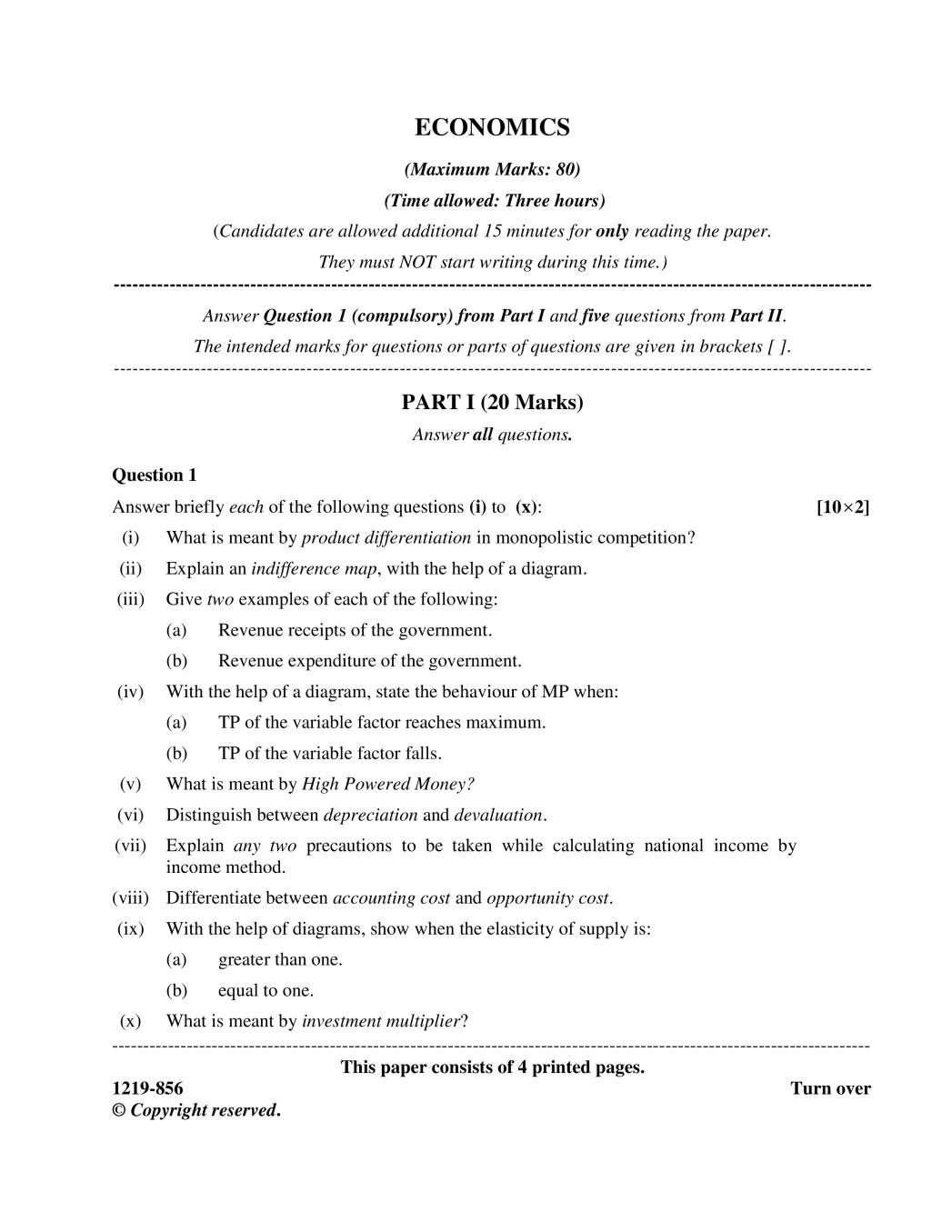
(Maximum Marks: 80)
(Time allowed: Three hours)
(Candidates are allowed additional 15 minutes for only reading the paper.
They must NOT start writing during this time.)
Answer Question 1 (compulsory) from Part I and five questions from Part II.
The intended marks for questions or parts of questions are given in brackets [ ].
PART I (20 Marks)
Answer all questions.
Question 1
Answer briefly each of the following questions (i) to (x): [10 2]
(i) What is meant by product differentiation in monopolistic competition?
(ii) Explain an indifference map, with the help of a diagram.
(iii) Give two examples of each of the following:
(a) Revenue receipts of the government.
(b) Revenue expenditure of the government.
(iv) With the help of a diagram, state the behaviour of MP when:
(a) TP of the variable factor reaches maximum.
(b) TP of the variable factor falls.
(v) What is meant by High Powered Money?
(vi) Distinguish between depreciation and devaluation.
(vii) Explain any two precautions to be taken while calculating national income by
income method.
(viii) Differentiate between accounting cost and opportunity cost.
(ix) With the help of diagrams, show when the elasticity of supply is:
(a) greater than one.
(b) equal to one.
(x) What is meant by investment multiplier?
This paper consists of 4 printed pages.
1219-856 Turn over
© Copyright reserved.
Page 2
Answer any five questions.
Question 2
(a) How does an increase in income affect the demand for the following: [3]
(i) A normal good
(ii) An inferior good
(b) Discuss any three reasons for the leftward shift of a supply curve. [3]
(c) Explain how a consumer attains equilibrium using indifference curve analysis. [6]
Question 3
(a) Discuss two differences between returns to scale and returns to a variable factor. [3]
(b) With the help of a diagram, explain the relationship between AR and MR of a firm [3]
under imperfect competition.
(c) Discuss any four features of monopoly market. [6]
Question 4
(a) Explain the various degrees of price elasticity of demand at different points on a [3]
straight line demand curve.
(b) Show with the help of a diagram, how a perfectly competitive firm earns normal [3]
profit in short run equilibrium.
(c) Explain with the help of diagrams how equilibrium price changes when there is [6]
simultaneous increase of both, demand and supply.
Question 5
(a) Discuss any two exceptions to the law of demand. [3]
(b) Study the cost function of a firm given below: [3]
Output (Units) 0 1 2 3
TC (₹) 30 90 110 120
Calculate:
(i) AFC
(ii) AC
(iii) MC
2
Page 3
of a diagram.
Question 6
(a) Explain how public expenditure can be used as an instrument of fiscal policy to [3]
solve the problem of:
(i) Income inequality
(ii) Inflation
(b) Differentiate between the revenue and capital components of the union budget. [3]
(c) Discuss briefly the various components of balance of payment. [6]
Question 7
(a) Discuss any two limitations of credit creation by commercial banks. [3]
(b) Explain two secondary functions of money. [3]
(c) Discuss any two qualitative methods and any two quantitative methods of credit [6]
control used by the Central Bank.
Question 8
(a) What is meant by average propensity to consume? Explain its relationship with [3]
average propensity to save.
(b) Discuss any two fiscal measures to correct a situation of deficient demand in an [3]
economy.
(c) Explain how equilibrium level of income can be determined with the help of saving [6]
and investment approach.
Question 9
(a) Draw a well-labelled diagram to show a circular flow of income in a two sector [3]
model. What happens to the flow of income when savings equals investment?
(b) What is meant by economic welfare? Explain how GDP is an indicator of [3]
economic welfare.
3
1219-856 Turn over
Page 4
Income method:
Item ₹ in crores
(i) Value of output 2500
(ii) Value of intermediate consumption 1300
(iii) Subsidies 40
(iv) Rent 110
(v) Employer’s contribution to social security 30
(vi) Profit 50
(vii) Wages and salaries 340
(viii) Interest 10
(ix) Mixed income of self-employed 360
(x) Indirect tax 180
(xi) NFIA (-)30
(xii) Consumption of fixed capital 160
4
Document Details
| Board / Org | CISCE |
| Exam | Class 12 |
| Type | Question Paper |
| Pages | 4 |
| Updated | 22 Jul 2026 |