Nagaland TET 2026 Syllabus
Finished viewing? Save it for later —
Download Nagaland TET 2026 Syllabus (PDF · 11 pages)About Nagaland TET 2026 Syllabus
Nagaland TET 2026 Syllabus is available here for free download. Published by Nagaland Board for Nagaland Teacher Eligibility Test (N-TET), this syllabus can be viewed online or downloaded as a PDF (11 pages). Candidates preparing for Nagaland Teacher Eligibility Test (N-TET) can use Nagaland TET 2026 Syllabus to understand the exam pattern, the type of questions asked, and the overall difficulty level.
Frequently Asked Questions
How can I download Nagaland TET 2026 Syllabus?
Open this page and click the Download button to save Nagaland TET 2026 Syllabus as a PDF. It is completely free on AglaSem Docs.
Is Nagaland TET 2026 Syllabus free to download?
Yes. Nagaland TET 2026 Syllabus can be viewed online and downloaded as a PDF free of cost on AglaSem Docs.
How many pages does Nagaland TET 2026 Syllabus have?
Nagaland TET 2026 Syllabus contains 11 pages, which you can read online or download together as a single PDF.
Where can I find more Nagaland Teacher Eligibility Test (N-TET) study material?
You can find more Nagaland Teacher Eligibility Test (N-TET) question papers, sample papers, syllabus, and answer keys on AglaSem Docs.
Nagaland TET 2026 Syllabus – Text
Read the full text of this syllabus below — useful to quickly search, copy and reference the content online without downloading the PDF.
📄 View text version (11 pages)
Page 1
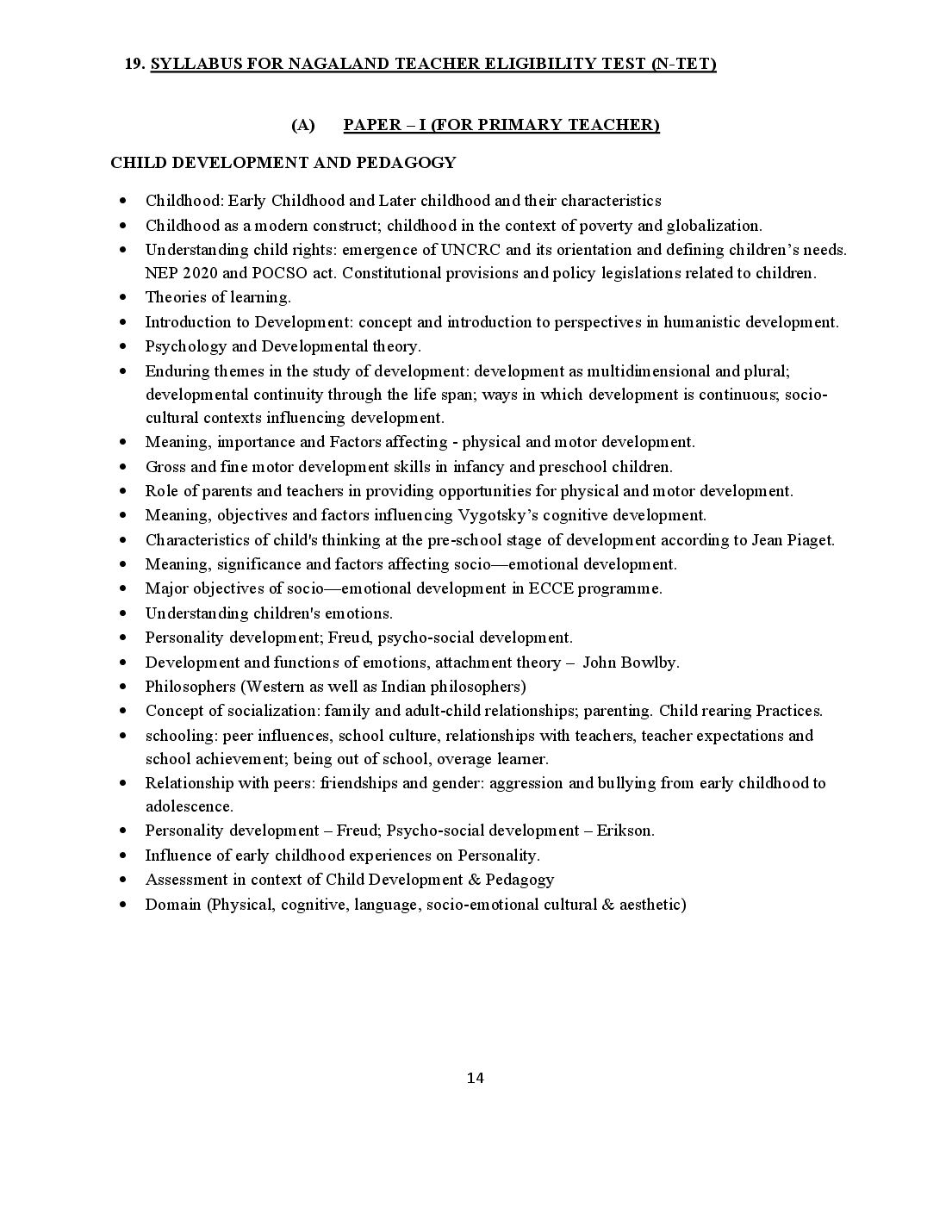
(A) PAPER – I (FOR PRIMARY TEACHER)
CHILD DEVELOPMENT AND PEDAGOGY
Childhood: Early Childhood and Later childhood and their characteristics
Childhood as a modern construct; childhood in the context of poverty and globalization.
Understanding child rights: emergence of UNCRC and its orientation and defining children’s needs.
NEP 2020 and POCSO act. Constitutional provisions and policy legislations related to children.
Theories of learning.
Introduction to Development: concept and introduction to perspectives in humanistic development.
Psychology and Developmental theory.
Enduring themes in the study of development: development as multidimensional and plural;
developmental continuity through the life span; ways in which development is continuous; socio-
cultural contexts influencing development.
Meaning, importance and Factors affecting - physical and motor development.
Gross and fine motor development skills in infancy and preschool children.
Role of parents and teachers in providing opportunities for physical and motor development.
Meaning, objectives and factors influencing Vygotsky’s cognitive development.
Characteristics of child's thinking at the pre-school stage of development according to Jean Piaget.
Meaning, significance and factors affecting socio—emotional development.
Major objectives of socio—emotional development in ECCE programme.
Understanding children's emotions.
Personality development; Freud, psycho-social development.
Development and functions of emotions, attachment theory – John Bowlby.
Philosophers (Western as well as Indian philosophers)
Concept of socialization: family and adult-child relationships; parenting. Child rearing Practices.
schooling: peer influences, school culture, relationships with teachers, teacher expectations and
school achievement; being out of school, overage learner.
Relationship with peers: friendships and gender: aggression and bullying from early childhood to
adolescence.
Personality development – Freud; Psycho-social development – Erikson.
Influence of early childhood experiences on Personality.
Assessment in context of Child Development & Pedagogy
Domain (Physical, cognitive, language, socio-emotional cultural & aesthetic)
14
Page 2
Need and Importance of Mathematics in school curriculum.
Aspects of Mathematics: Concept, Process, Symbol and Language.
Educational values of Mathematics (Utilitarian, Cultural and Disciplinary).
Understanding the learners (Stages of cognitive development – Sensory motor, Pre-operation,
Concrete Operation and Formal Operation Periods).
Understanding the learning processes during early childhood.(Manipulation of objects, placing tasks
in meaningful contexts, representation in multiple ways, developing alternative strategies, problem
solving and problem posing), Constructivist theory of learning.
Methods of mathematics learning-
Pre-number concepts, Understanding Numbers and Presentation of numbers.
Number names and numerals.
Place value of numbers (Indian system and English system).
Expanded and short form.
Natural numbers, whole numbers, even numbers and odd numbers.
Four basic fundamental operations on whole numbers.
Concept of factors and multiples.
Prime, composite, co-prime and twin prime.
Basic figures: point, line, rays, line segment, collinear points.
Angles and its types (right, acute, obtuse, straight and reflex angles).
Triangles and its types (based on sides and angles).
2D and 3D shapes.
Understanding of Patterns in Numbers (Odd, even numbers, Multiples and divides by 10s, 100s…,
square numbers, triangular numbers).
Understanding of Patterns (symmetrical shapes and patterns).
Philosophy and guiding Principles for development of Mathematics Textbooks.
Themes, structure of the unit, nature of exercises and its implications.
Academic standards and indicators of learning.
Learning resources/Various types of learning aids in mathematics.
Concept of aims and objectives. Aims of teaching mathematics at the Primary level. Types of
objectives (knowledge, understanding, application and skill). Instructional objectives in terms of
behavioural outcomes.
Teaching Readiness: Characteristics of a unit, Unit planning, concept mapping and Lesson planning.
Assessment and evaluation – Definition, need and importance, types of assessment.
Note: For the content area refer to Nagaland State Syllabus (Classes 1 to Class 8) and for the method areas
refer to D.El.ED syllabus.
15
Page 3
Introduction - Meaning, Aims and Objectives, Scope and Importance of EVS, its Evolution as a
curricular area at the primary level.
EVS as an integrated area of study that draws upon understanding from Science, Social Science and
Environmental Education.
Different Perspectives on EVS according to NCF 2005, NEP 2020.
Children’s Ideas – Preconceptions, Alternative Conceptions.
Characteristics of Children’s Ideas with respect to the development stage of Piaget.
Implications of understanding children’s ideas for classroom transaction.
Ways of conducting inquiry: Activities, Discussion, Group work, Field visits, Project, Surveys,
Experimentation etc.
Process Approach in EVS: Process Skills – simple experiments, observations, classification, probing
questions, framing hypothesis, designing experiments, recording results, data analysis, drawing
inferences, interpretation of results, giving examples.
Map – Picture differentiation, Map reading.
Considerations in concept maps and thematic web charts.
Philosophy and guiding principles for development of EVS textbooks.
Content approaches and methods of teaching EVS- Interactive and participatory methods, teacher as
facilitator.
Themes, structure of the unit, nature of exercises and its implications.
Academic standards and indicators of learning.
Learning resources for effective transaction of EVS curriculum.
Understanding Reflective Teaching and Learning.
Assessment – Definition, need and importance.
Different ways of assessment and reporting assessment for further learning,
Assessment for learning, Assessment as learning and Assessment of Learning.
Note: For the content area refer to Nagaland State Syllabus (Classes 1 to Class 8) and for the method areas
refer to D.El.Ed syllabus.
16
Page 4
Issues of learning English in a multilingual/ multicultural society: the multilingual nature of India,
English as the language of prestige & power; First, Second and Foreign Language Acquisition/
Learning.
Teaching English as a second language: developmental, socio-economic and psychological factors.
Approaches of teaching English: Behaviouristic Approach & Structural Approach; Cognitive &
Constructivist Approach – Nature and role of Learners; different kind of Learners- Young Learners.
Beginners; Teaching large Classes etc.
Methods of Teaching English; Grammar- Translation Method, Audio Lingual and Bi-Lingual
Method.
Aims, objectives and steps of Teaching prose and poetry.
Structure of language: Phonemes, Morphemes and Syntax.
Relationship between language and society: Identity, power and discrimination.
Constitutional provision on Language.
Language diversity in the context of India.
Difference between Acquisition and Learning.
Aims and Objectives of Language teaching.
Functions of language in the classroom.
Organizing the language classroom.
Role of the language teacher.
Skills of teaching and learning English-Listening, Speaking, Reading and Writing
Figures of Speech.
Parts of Speech: Noun, Pronoun, Verb, Adverb and its kinds, Adjective – Degrees of comparison,
Conjunction, Prepositions, Interjection – usage.
Determiners, Conditionals Concord.
Passive and Active voice.
Kinds of sentences - Subject and predicate, Simple, compound and complex sentences
Tenses.
Clause - Noun, Adjective, Adverbial clause.
Direct & Indirect speech.
Method of teaching Prose, Poetry and Grammar.
Phonetic transcription and stress, intonation, rhythm.
Continuous & Comprehensive Assessment.
17
Page 5
The test items in Language II will focus on the content area of language, communication comprehension
abilities and grammar.
For Language II (Nagaland Heritage Studies) a candidate may choose any one of the following
languages, recognized as one of the language subject introduced in the State and will be required to
indicate the same in the application form with code no.
Code No. List of Languages Code No. List of Languages
01. Ao 011. Nthenyi (Rengma)
02. Chang 012. Phom
03. Chokri (Chakhesang) 013. Pochury
04. Kuzhale (Chakhesang) 014. Sangtam
05. Khiamniungan 015. Sumi
06. Kuki 016. Tenyidie (Angami)
07. Konyak 017 Yimkhuing
08. Liangmai 018. Zeme
09. Lotha 019. Hindi
010. Nzonkhwe (Rengma) 020. Tükhya yu (Tikhir)
The questions in the test for Paper I will be based on the topics of the prescribed syllabus of NHS Textbooks
for Classes I to V but the difficulty standard and the linkages could be upto the elementary stage.
18
Page 6
CHILD DEVELOPMENT AND PEDAGOGY
Contribution of Indian & Western Philosophers in the field of Child Development and Pedagogy.
Learning: Meaning – Nature of Learning – Types of Learning – factors affecting learning – Theories
of Learning: Trial and Error, Thorndike’s law of learning. Classical conditioning, Gagne’s theory of
learning. Motivation and emotions.
Behaviourism: concept of Behaviourism - determinants of behaviour - methods of studying
behaviour – observation, interview and case study.
Cognition: Meaning, Theories of cognitive development - Jean Piaget, Lev Vygotsky’s Social
Constructivism - Erik Erikson’s Psychological stages
Moral Development - Lawrence Kohlberg
Meaning of Play – Characteristics, objectives, kinds and types of play.
Role of play way method in the development of – social, emotional, cognitive, language and motor
development of children.
Language: meaning, beginning of language development, stages of language development – infancy,
early childhood, later childhood and adolescence; role of Imitation in language learning.
Communication: meaning, types, language as a means of communication, effect of socio-cultural
variation in language learning – effect of multicultural classroom –
role of teacher in developing effective communication.
Social development in pre-school years and school years.
Concept of Intelligence and Multi-dimensional Intelligence.
Bilingualism, Trilingualism, Multilingualism – implication for teachers.
Self – self description , self-recognition, self concept, self esteem: social comparison, internalization
as self control.
Addressing learner’s from diverse backgrounds, including disadvantaged and deprived children.
Assessment - In context of Child Development & Pedagogy.
Basic processes of teaching - children's strategies of learning and the teacher’s role as a facilitator.
Identifying and catering to the needs of students with learning disabilities, visual/hearing
impairments and exceptional children (gifted, creative and specially abled)
Hereditary and environment.
19
Page 7
Process of Generalisation: Pattern recognition and inductive reasoning process that enable formation
of hypothesis.
Structure of Mathematics: Axioms , Postulates, Definitions and Theorems
Creative thinking in mathematics.
Methods of Teaching: Problem solving, Analytic and synthetic method, Project Method.
Techniques of Teaching:
Factors and multiples: LCM and HCF, Test of divisibility of numbers by 2,3,4,5,6,8,9 and 11.
Different sets of numbers and their operations: Integers, rational numbers and their operations.
Concepts of fraction and its representation, types of fractions and its operations. Uses of decimal
fraction in context of units of length and money.
Decimals: Reading and writing of decimals, expanded and short form, rounding off, conversion of
fraction to decimals and vice-versa. Four fundamental operations on decimals.
Algebraic expressions, variable and constant, terms of an algebraic expression, Product, factors and
coefficients, like and unlike terms.
Operation (+, -, ×, ÷) on algebraic expressions.
Algebraic identities and their uses.
Data Analysis: Measures of Central Tendency, Arithmetic mean, Median, Mode.
Percentage.
Ratio and proportion.
Interest (simple and compound).
Discount.
Profit and loss.
Pair of angles (adjacent, linear, vertically opposite, complementary, supplementary). Transversal of a
pair of lines and angles their off (corresponding, alternate angles), parallel lines and their
characteristics.
Quadrilaterals and their kinds, Circle ( Properties of quadrilateral and circle)
Congruency and similarity:
Construction of an angle equal to a given angle, bisect a given angle, line segment.
Construction of a line perpendicular to a given line from a point outside the line and a point on the
line.
Construction of a triangle when all the three sides, two sides and containing angle and two angles
and containing side are given.
Measurement of geometrical shapes (Perimeters and areas of a Triangle, Rectangle, Square,
Rhombus, Parallelogram, Trapezium and Circle).
Assessment.
Note: For the content area refer to Nagaland State Syllabus (Classes 6 to Class 10) and for the method areas
refer to D.El.Ed and B.Ed syllabus.
20
Page 8
Meaning, nature, scope of Science.
Value of Science in our everyday life.
Scientific Method.
Scientific Attitude.
Objectives of Science Education; Differences between Aims and objectives; Objective of teaching
science at Elementary Level.
Bloom’s Taxanomy.
Methods of Teaching Science: Lecture cum Demonstration Method, Heuristic Method, Problem Solving
Method, Project Method, Inductive and deductive Method, Concept Mapping.
Curriculum: Meaning, Principles of Curriculum construction, Place of Science in School Curriculum.
Science Text Book: Characteristics of a good science Text book.
Science Teacher: Qualification, Qualities and Professional growth of teachers.
Teaching Aids: Classification of teaching aids, effective use of multi-media for teaching of science,
Improvisation of teaching aids using locally available resources.
Co-curricular activities in science: concept and values of co-curricular activities, organization of science
club, science exhibition, field trips and excursions, science quiz
Models of teaching Science.
Concept and purpose of Evaluation.
Types of Evaluation: Diagnostic, Formative and Summative Evaluation.
Continuous Comprehensive Evaluation.
Tools and Techniques of Evaluation.
Continuous and Comprehensive Evaluation (CCE).
Assessment for learning, Assessment as learning and Assessment of Learning.
Constructivist and behaviourist approach.
Refer NCERT Science Text Books from Classes 6 -10 for the content area.
21
Page 9
Social Sciences: Meaning, scope and nature, Differences, Aims and Objectives of teaching Social
Sciences based on NCF 2005, National Education Policy (NEP) 2020.
History of Social Sciences, structure of History, Geography, Economics, Civics,
Different approaches to organize social sciences: discipline centered, issue-centered, integrated
social studies and interdisciplinary social science.
Understanding change and continuity, cause and effect, time perspective and chronology, socio-
spatial interaction through the following:
o Society: social structure, social stratification, community and groups.
o Civilization: history, culture.
o State: authority, nation, nation-state and citizen.
o Region: resources, space and people.
o Market: Exchange.
Role of social sciences in developing children understanding of their social context and social
realities like Awareness about their rights and duties towards their society, social evils like
corruption, unemployment, poverty, drug addiction, gender discrimination.
Cognitive development and concept formation among children in middle/upper primary classes
with reference to their age and socio-cultural context; significance of these factors for curriculum
and pedagogy;
Different types of teaching-learning materials for social sciences including community and local
sources.
Analysis of different textbooks of social sciences to understand the perspective about the subject uses
of case studies, pictures, story/narration, dialogue and discussion, experiments, comparison,
development of concepts.
Teaching methods: Heuristics/discovery method, Project method, use of Narration, Comparisons,
Observations, Dialogue and Discussion in Social Science;
Concept of data, its sources and evidence in different social science disciplines; difference between
fact and opinion, identifying bias and prejudices; use of personal/experiential knowledge for critical
thinking.
Philosophy and guiding principles for the development of Social Science textbooks.
Content, approaches and methods of teaching Social Science – Interactive and participatory methods,
teacher as facilitator.
Themes, structure of the unit, nature of exercises and its implications.
Academic standards and indicators of learning.
Learning resources for effective transaction of Social Science curriculum.
Lesson Planning: Planning of Teaching Social Science, Year plan, Unit plan and Period plan.
Assessment and Evaluation – Definition, need and importance, types of assessment.
22
Page 10
Approaches of teaching English: Behaviouristic Approach & Structural Approach; Cognitive &
Constructivist Approach – Nature and role of Learners; different kind of Learners- Young Learners.
Beginners; Teaching large Classes etc.
Methods of Teaching English; Grammar- Translation Method, Audio Lingual and Bi-Lingual
Method.
Issues of learning English in a multilingual/ multicultural society : the multilingual nature of India,
English as the language of prestige & power ; Key factors affecting second language Acquisition.
Aims and objectives, steps of Teaching prose and poetry.
Understanding the Nature of Language.
Vocabulary and usage.
Comprehension.
Idioms and Phrases.
Synonyms, Antonyms, Homonyms.
Diminutives.
Phonetic transcription and stress.
Structure of language: Phonemes, Morphemes and Syntax.
Figures of Speech.
Parts of Speech: Noun, Pronoun, Verb, Adverb and its kinds, Adjective – Degrees of comparison,
Conjunction, Prepositions, Interjection – usage.
Determiners, Conditionals Concord.
Voice.
Kinds of sentences - Subject and predicate, Simple, compound and complex sentences
Tense.
Clause – Noun, Adjective, Adverbial clause.
Direct & Indirect speech.
Method of teaching Prose, Poetry and Grammar.
Skills of teaching and learning English-Listening, Speaking, Reading and Writing.
Formative & Summative Assessment.
Assessment – Meaning, definition and types of assessment.
23
Page 11
The test items in Language II will focus on the content area of language, communication comprehension
abilities and grammar.
For Language II (Nagaland Heritage Studies) a candidate may choose any one of the following
languages, recognized as one of the language subject introduced in the State and will be required to
indicate the same in the application form with code no.
Code No. List of Languages Code No. List of Languages
01. Ao 011. Nthenyi (Rengma)
02. Chang 012. Phom
03. Chokri (Chakhesang) 013. Pochury
04. Kuzhale (Chakhesang) 014. Sangtam
05. Khiamniungan 015. Sumi
06. Kuki 016. Tenyidie (Angami)
07. Konyak 017 Yimkhuing
08. Liangmai 018. Zeme
09. Lotha 019. Hindi
010. Nzonkhwe (Rengma) 020. Tükhya yu (Tikhir)
The questions in the test for Paper II will be based on the topics of the prescribed syllabus of NHS Text
Books for Classes VI to VIII.
24
Document Details
| Board / Org | Nagaland Board |
| Exam | Nagaland Teacher Eligibility Test (N-TET) |
| Type | Syllabus |
| Pages | 11 |
| Language | english |
| Updated | 11 Aug 2026 |