WB SET 2020 Question Paper 2 Philosophy
Finished viewing? Save it for later —
Download WB SET 2020 Question Paper 2 Philosophy (PDF · 16 pages)About WB SET 2020 Question Paper 2 Philosophy
WB SET 2020 Question Paper 2 Philosophy is available here for free download. Published by Default for Govt Jobs Exams, this question paper can be viewed online or downloaded as a PDF (16 pages). Candidates preparing for Govt Jobs Exams can use WB SET 2020 Question Paper 2 Philosophy to understand the exam pattern, the type of questions asked, and the overall difficulty level.
Frequently Asked Questions
How can I download WB SET 2020 Question Paper 2 Philosophy?
Open this page and click the Download button to save WB SET 2020 Question Paper 2 Philosophy as a PDF. It is completely free on AglaSem Docs.
Is WB SET 2020 Question Paper 2 Philosophy free to download?
Yes. WB SET 2020 Question Paper 2 Philosophy can be viewed online and downloaded as a PDF free of cost on AglaSem Docs.
How many pages does WB SET 2020 Question Paper 2 Philosophy have?
WB SET 2020 Question Paper 2 Philosophy contains 16 pages, which you can read online or download together as a single PDF.
Where can I find more Govt Jobs Exams study material?
You can find more Govt Jobs Exams question papers, sample papers, syllabus, and answer keys on AglaSem Docs.
WB SET 2020 Question Paper 2 Philosophy – Text
Read the full text of this question paper below — useful to quickly search, copy and reference the content online without downloading the PDF.
📄 View text version (15 pages)
Page 1
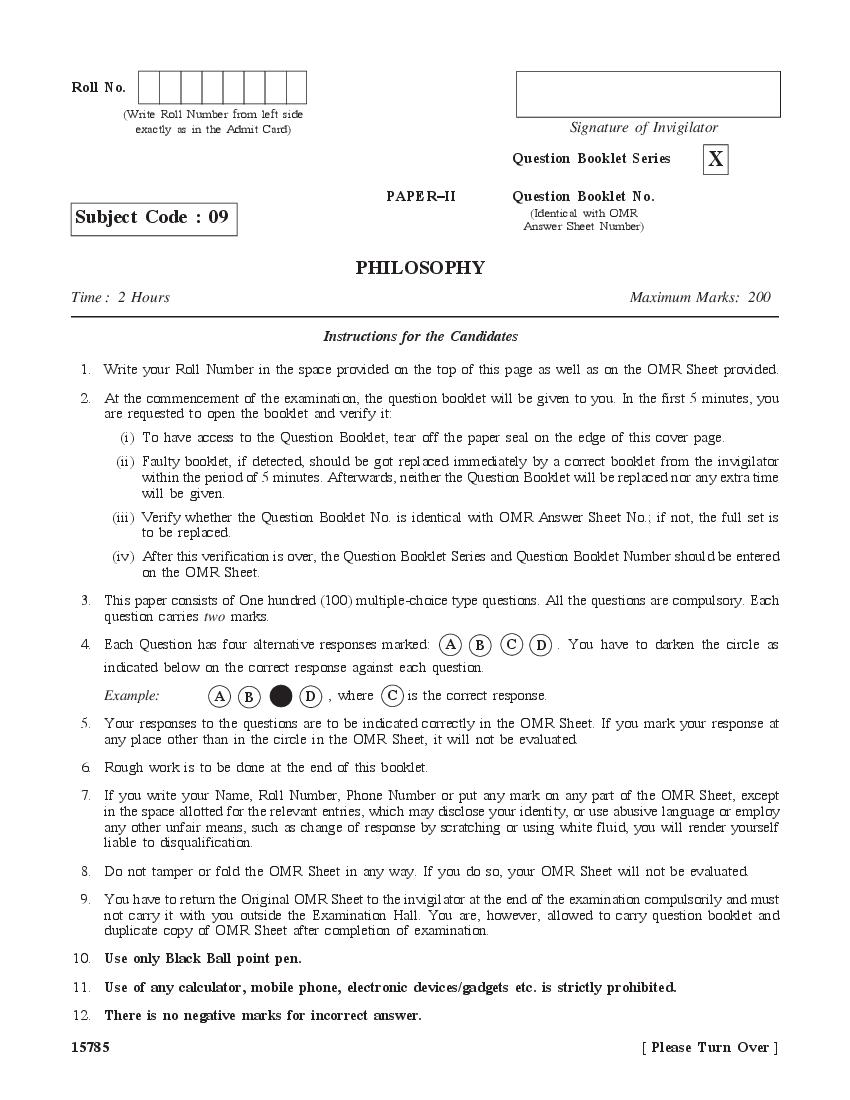
(Write Roll Number from left side
exactly as in the Admit Card) Signature of Invigilator
Question Booklet Series X
PAPER–II Question Booklet No.
Subject Code : 09 (Identical with OMR
Answer Sheet Number)
PHILOSOPHY
Time : 2 Hours Maximum Marks: 200
Instructions for the Candidates
1. Write your Roll Number in the space provided on the top of this page as well as on the OMR Sheet provided.
2. At the commencement of the examination, the question booklet will be given to you. In the first 5 minutes, you
are requested to open the booklet and verify it:
(i) To have access to the Question Booklet, tear off the paper seal on the edge of this cover page.
(ii) Faulty booklet, if detected, should be got replaced immediately by a correct booklet from the invigilator
within the period of 5 minutes. Afterwards, neither the Question Booklet will be replaced nor any extra time
will be given.
(iii) Verify whether the Question Booklet No. is identical with OMR Answer Sheet No.; if not, the full set is
to be replaced.
(iv) After this verification is over, the Question Booklet Series and Question Booklet Number should be entered
on the OMR Sheet.
3. This paper consists of One hundred (100) multiple-choice type questions. All the questions are compulsory. Each
question carries two marks.
4. Each Question has four alternative responses marked: A B C D . You have to darken the circle as
indicated below on the correct response against each question.
Example: A B C D , where C is the correct response.
5. Your responses to the questions are to be indicated correctly in the OMR Sheet. If you mark your response at
any place other than in the circle in the OMR Sheet, it will not be evaluated.
6. Rough work is to be done at the end of this booklet.
7. If you write your Name, Roll Number, Phone Number or put any mark on any part of the OMR Sheet, except
in the space allotted for the relevant entries, which may disclose your identity, or use abusive language or employ
any other unfair means, such as change of response by scratching or using white fluid, you will render yourself
liable to disqualification.
8. Do not tamper or fold the OMR Sheet in any way. If you do so, your OMR Sheet will not be evaluated.
9. You have to return the Original OMR Sheet to the invigilator at the end of the examination compulsorily and must
not carry it with you outside the Examination Hall. You are, however, allowed to carry question booklet and
duplicate copy of OMR Sheet after completion of examination.
10. Use only Black Ball point pen.
11. Use of any calculator, mobile phone, electronic devices/gadgets etc. is strictly prohibited.
12. There is no negative marks for incorrect answer.
15785 [ Please Turn Over ]
Page 3
PHILOSOPHY
PAPER II
1. Which of the following is a case of 6. According to the Vai—˜Áe—˝Áika, ëThe cow is not a
extra-ordinary perception in the NyøıËya? goatí is an example of
(A) Yogaja (A) AtyantøıËbhøıËva
(B) SøıËmøıËnyalak—˝ÁaÃ˝Èa (B) PrøıËgabhøıËva
(C) JÈÈøıËnalak—˝ÁaÃ˝Èa (C) AnyonyøıËbhøıËva
(D) All of the above (D) DhvaÀÛflsøıËbhøıËva
7. Match List-I with List-II and select the correct
answer from the codes given below:
2. Which one is the correct sequence of five kle—˜Áas,
according to Yoga-Dar—˜Áana? List-I List-II
(a) Earth (P–˝Áthiv¤ıÂ) (i) Taste (Rasa)
(A) AsmitøıË, RøıËga, Dve—˝Áa, AvidyøıË and Abhinive—˜Áa
(b) Water (Ap) (ii) Colour (R”ıËpa)
(B) AvidyøıË, RøıËga, Dve—˝Áa, AsmitøıË and Abhinive—˜Áa
(c) Fire (Agni) (iii) Touch (Spar—˜Áa)
(C) Abhinive—˜Áa, RøıËga, Dve—˝Áa, AvidyøıË and AsmitøıË (d) Air (VøıËyu) (iv) Odour (Gandha)
(D) AvidyøıË, AsmitøıË, RøıËga, Dve—˝Áa and Abhinive—˜Áa
Codes:
(a) (b) (c) (d)
(A) (i) (ii) (iii) (iv)
(B) (iv) (i) (ii) (iii)
3. ∑˝fia¬˝›øıËyatana is produced due to
(C) (ii) (iv) (iii) (i)
(A) spar—˜Áa (D) (iii) (ii) (i) (iv)
(B) nøıËmøıËr”ıËpa
(C) vedanøıË
8. Consider the Assertion (A) and Reason (R) and
(D) t–˝Á—˝ÁnøıË
select the correct answer from the codes given
below:
Assertion (A) : The CøıËrvøıËkas argue that anumøıËna
is never valid.Ë
4. Which of the following knowledge, according to Reason (R) : They believe that the invariable
Jainism, cannot be wrong? concommitance cannot be
(A) Mati and ∑Ófiruta established.
(B) ∑Ófiruta and Avadhi Codes:
(A) Both (A) and (R) are true and (R) is the
(C) ManaΔ˝ËparyøıËya and Kevala
correct explanation of (A).
(D) Mati and Avadhi (B) Both (A) and (R) are true and (R) is not the
correct explanation of (A).
(C) (A) is true and (R) is false.
(D) (A) is false and (R) is true.
5. Which among the following is anastikøıËya dravya
according to the Jaina?
9. According to Gautama Apavarga means
(A) j¤ıÂva
(A) pleasure
(B) aj¤ıÂva (B) sorrow
(C) øıËkøıË—˜Áa (C) absolute cessation from suffering
(D) køıËla (D) All of the above
[ Please Turn Over ]
Page 4
10. In VedøıËnta, §Ò‡tman associated with the waking 15. ìAn apple is sweet, because it has sweetness.îó
state of J¤ıÂva is called In the above-mentioned inference there is a fallacy.
(A) PrajÈÈøıË The name of the fallacy is:
(B) Taijasa (A) asøıËdhøıËraÃ˝Èa anaikøıËntika
(C) Vai—˜Áva (B) satpratipak—˝Áa
(D) HiraÃ˝Èyagarbha (C) VøıËdhita
(D) øıË—˜ÁrayøıËsiddhi
16. Match List-I with List-II and select correct answer
by using the codes given below:
11. AbhihitøıËnvaya-vøıËda is related to List-I List-II
(A) perception (a) MøıËdhyamika (i) ∑Ófi”ıËnyavøıËda
(B) inference (b) YogøıËcøıËra (ii) VijÈÈøıËnavøıËda
(c) SautrøıËntika (iii) VøıËhyapratyak—˝ÁavøıËda
(C) postulation
(d) VaibhøıË—˝Áka (iv) VøıËhyøıËnumeyavøıËda
(D) theory of meaning
Codes:
(a) (b) (c) (d)
(A) (i) (ii) (iii) (iv)
(B) (ii) (iii) (iv) (i)
12. Who among the following considers reality as (C) (i) (ii) (iv) (iii)
cidacid-vi—˜Ái—˝Á“˝Âa-lak—˝ÁaÃ˝Èa? (D) (iv) (i) (ii) (iii)
(A) ∑Ófiankara
(B) Madhva 17. ArthakriyøıËkøıËritva-lak—˝ÁaÃ˝Èam sató is the view
advocated by
(C) RøıËmøıËnuja
(D) VidyøıËraÃ˝Èya (A) the Buddhist
(B) the Jaina
(C) the Advaitin
(D) the M¤ıÂmøıËÀÛflsaka
13. The text VedøıËnta-paribhøıË—˝ÁøıË is authored by 18. According to the NyøıËya-Vai—˜Áe—˝Áika
(A) Annam-Bha“˝Â“˝Âa (A) consciousness is the essential quality of the
(B) Gange—˜Áa soul (øıËtman).
(C) GadøıËdhara (B) consciousness is the accidental quality of the
(D) DharmarøıËja Adhvar¤ıÂndra soul (øıËtman).
(C) soul (øıËtman) is pure consciousness.
(D) consciousness is not a quality of the soul
(øıËtman).
14. Which of the following knowledge is not valid 19. Who says ìThe VedøıËnta teaches men to have faith
according to CøıËrvøıËka? in themselves firstî?
(A) Sounds as perceived (A) Lord K–˝Á—˝ÁÃ˝Èa in the Bhagavadg¤ıÂtøıË
(B) Smelt fragrance (B) ∑ÓfiaÃÛÈkara
(C) Seen items (C) Sri Aurobindo
(D) Knowledge obtained from texts (D) Swami Vivekananda
Page 5
20. Which one of the following is not a Puru—˝ÁøıËrtha? 25. The sannikar—˝Áa required for perceiving the property
blueness of a blue cloth is
(A) Artha
(B) KøıËma (A) saÀ˝flyoga
(C) Dharma (B) samavøıËya
(D) I—˜Ávara (C) saÀ˝flyukta-samavøıËya
(D) saÀ˝flyukta-samaveta-samavøıËya
26. Who among the following advocates pure
21. By which sannikar—˝Áa abhøıËva (absence) is perceived non-dualism (∑ÓfiuddhøıËdvaita) undefiled by MøıËyøıË?
according to the NyøıËya-Vai—˜Áe—˝Áika?
(A) NimbøıËrka
(A) SamavøıËya-sannikar—˝Áa (B) VidyøıËraÃ˝Èya
(B) Vi—˜Áe—˝Áya-vi—˜Áe—˝ÁaÃ˝ÈabhøıËva-sannikar—˝Áa (C) Vallabha
(C) SaÀÛflyoga-sannikar—˝Áa (D) ∑Ófir¤ıÂhar—˝Áa
(D) SaÀÛflyukta-samavøıËya-sannikar—˝Áa
27. Space and time according to Kant are
(A) not concepts but forms of intuition.
22. The CøıËrvøıËkas do not admit øıËkøıË—˜Áa (ether) as bh”ıËta (B) both concepts and forms of intuition.
(element) because (C) neither concepts nor forms of intuition.
(A) øıËkøıË—˜Áa has sound as its quality. (D) None of the above
(B) øıËkøıË—˜Áa is not perceptible.
(C) øıËkøıË—˜Áa is one.
(D) None of the above 28. Who regards ethics as first philosophy?
(A) Kant
(B) Aristotle
(C) Spinoza
(D) Levinas
23. According to the Vai—˜Áe—˝Áikas samavøıËya means
(A) inseparable eternal relation.
(B) inseparable temporary relation.
29. Match List-I with List-II and select the correct
(C) temporal relation between two separate answer by using the codes given below:
entities. List-I List-II
(D) None of the above (a) William James (i) radical empiricism
(b) Wittgenstein (ii) language game
(c) Ayer (iii) basic statements
(d) Moore (iv) common sense
Codes:
24. God, for the NaiyøıËyikas, is
(a) (b) (c) (d)
(A) creator (A) (i) (ii) (iii) (iv)
(B) sustainer (B) (iii) (iv) (i) (ii)
(C) regulating principle of the law of karma. (C) (iv) (iii) (i) (ii)
(D) All of the above (D) (ii) (i) (iii) (iv)
[ Please Turn Over ]
Page 6
30. When can it be said, according to Ayer, that 34. ëIdeas have their own separate existence outside
ëS knows that Pí? the physical and the mental worldsí is upheld by
(A) P is true. (A) Plato
(B) S believes that P. (B) Aristotle
(C) S is justified in believing P. (C) Socrates
(D) All of the above (D) Democritus
35. The method of ëclear and distinct ideasí is outlined
in the philosophy of
31. Sartreís philosophy of Being and Nothingness
can best be identified as (A) Husserl
(B) Kant
(A) Analytics of Dasein
(C) Descartes
(B) Phenomenological ontology
(D) Hegel
(C) Hermeneutics
(D) Post-truth
36. In philosophy the method of suspending the belief
in existence to reach at the essences is subscribed by
(A) Kant
32. The structure ëego-noesis-noemaí is of (B) Hegel
(A) Pre-reflective consciousness (C) Husserl
(B) Intentional consciousness (D) Descartes
(C) Extensional consciousness
(D) None of the above 37. According to Ryle, Descartesí mind-body dualism
suffers from
(A) Contradiction
(B) Ambiguity
33. Match List-I with List-II and select the correct
(C) Category mistake
answer from the codes given below:
(D) Pictorial thinking
List-I List-II
(a) The principle of all (i) Permenides
things is water. 38. Match List-I with List-II and select the correct
(b) Air is the ultimate (ii) Anaximenes answer by using the codes given below:
staff of all things List-I List-II
(c) All things are numerable, (iii) Thales (a) Plato (i) Factitious idea
can be counted. (b) Leibniz (ii) Identity of
(d) The first principle of (iv) Pythagoras indiscernibles
things is Being, wholly (c) Descartes (iii) Knowledge concerning
unmixed with Not Being,
matters of fact
wholly excludent of
all becoming. (d) Hume (iv) Ideas are the essences
of all things.
Codes: Codes:
(a) (b) (c) (d) (a) (b) (c) (d)
(A) (i) (ii) (iii) (iv) (A) (i) (ii) (iii) (iv)
(B) (iii) (ii) (i) (iv) (B) (iv) (ii) (i) (iii)
(C) (iii) (ii) (iv) (i) (C) (iii) (ii) (iv) (i)
(D) (i) (iii) (ii) (iv) (D) (ii) (iii) (iv) (i)
Page 7
39. Match List-I with List-II and select the correct 43. Match List-I with List-II and select the correct
answer from codes given: answer from codes given:
List-I List-II List-I List-II
(a) The concept of Geist (i) Husserl (a) ~ (p.q) (~ p ~ q) (i) Exportation
(b) Categories of understanding (ii) Russell (b) [(p.q) – ] [p (q r)] (ii) Transposition
(c) Logical Atomism (iii) Kant (c) (p q) (~q ~ p) (iii) Commutation
(d) Intentionality (iv) Hegel (d) (p q) (q p) (iv) De Morganís
Codes: theorem
(a) (b) (c) (d) Codes:
(A) (i) (ii) (iii) (iv) (a) (b) (c) (d)
(B) (iv) (iii) (ii) (i) (A) (ii) (i) (iii) (iv)
(C) (i) (iv) (ii) (iii) (B) (iv) (i) (ii) (iii)
(D) (iii) (ii) (i) (iv) (C) (i) (ii) (iv) (iii)
(D) (iii) (ii) (iv) (i)
40. Following statements are either True or False. 44. Two propositions with the same subject and
Examine these and find the correct answer using the predicate will not be regarded as contradictory when
given codes:
(A) they are not true together.
(a) According to Hume, causal relation is necessary.
(B) they are not false together.
(b) According to Hume, causal relation is a constant
(C) one is true, the other is false.
conjunction between two events.
(D) both are false.
(c) Hume draws the distinction between primary
and secondary qualities.
(d) Hume aroused Kant from his ëdogmatic slumberí. 45. How is the proposition ëSome scientists are
non-philosophersí derived from the proposition ëNo
Codes:
scientists are philosophersí?
(a) (b) (c) (d)
(A) False False True False (A) Obversion, conversion, conversion
(B) True True False False (B) Conversion, obversion, conversion
(C) False True True False (C) Obversion, conversion, obversion,
(D) False True False True (D) Conversion, conversion, obversion,
46. Can there be the relations of contrary and
41. The fundamental stuff, out of which this universe sub-contrary between propositions where the subject
is made, according to Thales is terms are empty?
(A) Water (A) Yes
(B) Air (B) No
(C) Soil (C) Cannot be said
(D) Fire (D) None of the above
47. Which among the following is a case of informal
42. Which one of the following is not correct? fallacy?
(A) (x) Fx ~ (x) ~ Fx (A) Fallacy of Illicit Major
(B) ~ (x) Fx ~ (x) Fx (B) Fallacy of Undistributed Middle
(C) (x) ~ Fx ~ (x) Fx (C) Fallacy of Ignoratio elanchi
(D) ~ (x) ~ Fx (x) Fx (D) None of the above
[ Please Turn Over ]
Page 8
48. How can a proposition be obtained from the 53. Neither the term ëvalidí nor its opposite ëinvalidí
propositional function ëxí? is properly applicable to
(A) Replacing ëxí by an individual name (A) Syllogism
(B) By applying universal generalization (B) Deductive argument
(C) By applying existential generalization (C) Inductive argument
(D) All of the above (D) None of the above
49. Which of the following is a contingent statement 54. What does møıËyøıË mean for K. C. Bhattacharya?
form? (A) Illusory world
(A) (p . q) q (B) Ignorance
(B) p (q. r) (C) Both (A) and (B)
(C) p. (r s) (D) Neither (A) nor (B)
(D) All of the above
55. Which one of the following concepts of Gandhi
reflects the idea ó ìEat the ghee made in your villageî?
50. An axiomatic system of logic must have
(A) SatyøıËgraha
(A) consistency
(B) Swade—˜Á¤ıÂ
(B) completeness
(C) Sarvodaya
(C) independence
(D) SwarøıËj
(D) All of the above
56. Who, among the following philosophers,
51. When is a non-exclusive disjunction not true? conceives that reality is supremely spiritual and yet we
(A) At least one of the disjuncts is true. are to assign to give matter a place in it?
(B) At least one and at most one of the disjuncts (A) S. Radhakrishnan
is true. (B) Sri Aurobindo
(C) Both the disjuncts are true. (C) ∑Ófiankara
(D) Both the disjuncts are false. (D) Vasubandhu
52. Which one among the following demonstrates the 57. According to Iqbal, the universe is of the nature
paradox of Material Implication? of a
(A) [p p q)] and [p. (p q)] (A) free creative force
(B) [p q) p] and [(p q) ~ p] (B) mechanical force
(C) [p (q p)] and [~ p (p q)] (C) divine force
(D) None of the above (D) None of the above
Page 9
58. From which Upani—˝Áada did M. K. Gandhi derive 63. D. D. Upadhyayaís Integral Humanism rejects
his ëtrusteeshipí formula?
(A) Caturvarga puru—˝ÁøıËrtha.
(A) ChøıËndogya (B) Monarchy limited by Dharma.
(B) B–˝ÁhadøıËraÃ˝Èyaka (C) Western Values and Secular Science.
(C) ¨ÒÊ—˜Áa (D) National Unity as Dharma, not to be decided
(D) MøıËn¬˝›ukya by plebicite.
64. What does the religious text Trikural embody?
59. M. N. Royís radical humanism is a search for a (A) A collecton of couplets on ethics, political
middle-path between and economic matters and love.
(B) A collection of articles on ethics, politics and
(A) Liberalism and Communism
economics.
(B) Democracy and Dictatorship
(C) A collection of couplets on mystical
(C) Nationalism and Internationalism experiences.
(D) All of the above (D) None of the above
65. Which of the following characterizations
represents best reading of Jyotiba Phule?
60. ìIntellect and intuition are complementary to
each otherî is the view held by (A) An anti-caste social reformer
(A) Vivekananda (B) An activist in eradicating untouchability
(B) Radhakrishnan (C) An crusader for womenís education
(C) Tagore (D) All of the above
(D) Sri Aurobindo
66. Integration in the philosophy of Sri Aurobindo
means
(A) Enlargement
61. The notion of ëtheoretic grades of consciousnessí
(B) Ascent through descent
is explored in the philosophy of
(C) Expansion
(A) K. C. Bhattacharya
(D) Compassion
(B) J. Krishnamurti
(C) Sri Aurobindo
(D) S. Radhakrishnan
67. Which of the following assertions is not true of
Moulana Azad?
(A) Moulana Azad did not subscribe to Jinnahís
Two-Nation Theory.
62. According to Gandhi, satyøıËgraha is based on (B) He called for an independent India to be
committed to secularism.
(A) Distrust
(C) He was personally close to Gandhi and his
(B) Steadfast adherence to truth philosophy.
(C) Aversion (D) He, like Gandhi, was a staunch supporter of
(D) Greed religion.
[ Please Turn Over ]
Page 10
68. Consider the Assertion (A) and Reason (R) and 72. Which of the following is the ëdutyí (dharma) of
select the correct answer from the codes given below: a ∑Ófiudra?
Assertion (A) : Four VarÃ˝Èas (caturvarÃ˝Èa) are (A) Agriculture
mentioned in the vedas. (B) Teaching
Reason (R) : These VarÃ˝Èas have to perform (C) Trading
certain specific duties.
(D) Serving other three varÃ˝Èas
Codes:
(A) Both (A) and (R) are true and (R) is the
73. LokasaÀÛflgraha stands for
correct explanation of (A).
(A) welfare of the world
(B) (A) is true but (R) is false.
(B) welfare of individual
(C) Both (A) and (R) are true but (R) is not the
correct explanation of (A). (C) awareness of the world
(D) Both (A) and (R) are false. (D) welfare of ∑Ófiudras
74. Match List-I with List-II and select the correct
69. Which of the following ∂˝flÃ˝Èa is related to animal
answer from the following codes given below:
welfare?
List-I List-II
(A) ∂˝fl—˝Ái-–˝ÁÃ˝Èa
(a) A—˝Á“˝ÂøıËngika møıËrga (i) Jainism
(B) Bh”ıËta-–˝ÁÃ˝Èa
(b) AÃ˝Èubandhacatu—˝Á“˝Âaya (ii) VedøıËntasøıËra
(C) N–˝Á-–˝ÁÃ˝Èa (c) PaÈÈca-mahøıËbrata (iii) Puru—˝ÁøıËrtha
(D) None of the above (d) Mok—˝Áa (iv) Buddhism
Codes:
70. Ni—˝ÁkøıËma Karma means (a) (b) (c) (d)
(A) (i) (iii) (iv) (ii)
1. Desireless action 2. Self-less action
(B) (i) (ii) (iii) (iv)
3. Desireful action 4. Selfish action
(C) (iv) (ii) (i) (iii)
Select the correct answer using the codes given:
(D) (iii) (i) (iv) (ii)
(A) 1. and 2.
(B) 2. and 3.
75. In a question to Yudhi—˝Á“˝Âhira NøıËrada speaks of six
(C) 3. and 4. evils. They are
(D) 2. and 4.
(A) sleep, idleness, love, anger, weakness of mind
and procastination.
71. Match List-I with List-II and select the correct (B) sleep, idleness, fear, anger, weakness of mind
answer from the following codes given below: and procastination.
List-I List-II (C) sleep, idleness, fear, anger, weakness of mind
(a) Yoga-k—˝Áema (i) NyøıËya-Vai—Á̃e—˝Áika Philosophy and quick response.
(b) Samvara-nirjara (ii) The Bhagavadg¤ıÂtøıË (D) sleep, idleness, fear, anger, strength of mind
and procastination.
(c) UpøıËya-kau—˜Áala (iii) Jaina Philosophy
(d) Ad–˝Á—˝Á“˝Âa (iv) Bauddha Philosophy
Codes: 76. In which part of MahøıËbhøıËrata we find discussion
on RøıËjadharma?
(a) (b) (c) (d)
(A) (iv) (i) (iii) (ii) (A) Bh¤ı—˝Áma Parva
(B) (i) (ii) (iii) (iv) (B) Vana Parva
(C) (ii) (iv) (iii) (i) (C) ∑ÓfiøıËnti Parva
(D) (ii) (iii) (iv) (i) (D) SvargøıËrohaÃ˝Èa Parva
Page 11
77. The seven elements of state craft, according to 82. For Mill, an act is morally obligatory if
Kautilya, are
(A) it is Godís command.
(A) SvøıËmin, AmøıËtya, Janapada, DurgamatøıË, (B) it produces more pleasure and benefits to
Ko—˝Áa, DaÃ˝È¬˝›a, Mitra. most people to be affected.
(B) SvøıËmin, AmøıËtya, Janapada, Durga, Ko—˝Áa, (C) it is intuitively clear a duty.
DaÃ˝È¬˝›a and Mitra.
(D) it is a virtue.
(C) SvøıËmin, AmøıËtya, ∑˝fio¬˝›a—˜Áajanapada, Durga,
Ko—˝Áa and Mitra.
(D) SvøıËmin, AmøıËtya, Janapada, Durga, Ko—˝Áa,
83. Fill in the blanks taking words given below:
DaÃ˝È¬˝›a and ∑Ófiatru.
ì _________ deontological ethics is formalistic,
while the ethics of _________ is teleological too.î
(A) Benthamís, the G¤ıÂtøıË
78. Kautilyaís Artha—˜ÁøıËstra is often compared to (B) Mill, the Tripitakas
(A) Montesquieuís Spirit of the Law (C) Kantís, the G¤ıÂtøıË
(B) Machiavellieís Prince (D) Singer, the Manusamhita
(C) Hobbes Leviathan
(D) None of the above
84. Which of the following is not a version of
non-cognitivism?
(A) Emotivism
79. Which one of the following books is largely based (B) Prescriptivism
on Kautilyaís Artha—˜ÁøıËstra?
(C) Non-Naturalism
(A) N¤ıÂtisøıËra (D) Descriptivism
(B) Manusm–˝Áti
(C) NirÃ˝Èaya Sindhu
(D) N¤ıÂti—˜Áataka 85. Which is not a sanction of morality, according to
Mill?
(A) Natural sanction
(B) Political sanction
80. On the issue of knowing moral truth, which one of
the following pairs is not true? (C) Territorial sanction
(D) Conscience sanction
(A) Kantñ by reason
(B) Benthamñ by experience
(C) Stevensonñ by divine grace
86. Which one of the following does not reflect
(D) Mooreñ by intuition feminism?
(A) Women suffer system-induced injustice just
because of their sex, just because of being
born as girls.
81. Which of the following theories of punishment
approves capital punishment? (B) A feminist belives in the concrete equality of
women vis-a-vis men.
(A) Reformative theory
(C) In order to root out the mentality of sexism
(B) Retributive theory one should refresh patriarchy.
(C) Both Preventive theory and Retributive theory (D) Gender is a cultural category, constructed
(D) Preventive theory and determined by social, religious codes
and customs.
[ Please Turn Over ]
Page 12
87. What are the four mid-level principles of medical 91. Consider the Assertion (A) and Reason (R) and
ethics? select the correct answer from the codes given below:
(A) Patient autonomy, maleficence, beneficence Assertion (A) : Ryle gives a critique of Cartesian
and justice. dualism.
(B) Patient autonomy, non-maleficence, Reason (R) : Descartes admits the existence of
beneficence and justice. God.
(C) Patient autonomy, maleficance, Codes:
non-beneficence and justice. (A) Both (A) and (R) are true, and (R) is the
(D) Doctorís paternalism, maleficence, correct explanation of (A).
beneficence and justice. (B) Both (A) and (R) are true, and (R) is not an
explanation of (A).
(C) (A) is true but (R) is false.
88. Ecofeminism signifies all of the following except: (D) (A) is false but (R) is true.
(A) Women are closer to nature.
(B) Both ecology and feminism are dedicated to
dismantling a specific logic of domination.
(C) Women cannot but love males. 92. Dialectical materialism does not directly embody
(D) Ecofeminism finally culminates in the principle of
formulating ëa general theory of oppressioní. (A) unity and conflict of the opposites.
(B) from quantity to quality.
(C) the principle of contradiction.
89. Match List-I with List-II and select the correct
(D) the negation of negation.
answer from the following codes given below:
List-I List-II
(a) Justice as greatest utility (i) Amartya Sen
(b) Justice as capability (ii) Robert Nozick
(c) Justice as fairness (iii) J. S. Mill 93. In India the reservation policy was considered
(d) Justice as entitlement (iv) John Rauls originally on the basis of
Codes: (A) Social position
(a) (b) (c) (d) (B) Economic criterion
(A) (i) (ii) (iv) (iii) (C) Both (A) and (B)
(B) (iii) (i) (iv) (ii)
(D) Neither (A) nor (B)
(C) (iii) (ii) (i) (iv)
(D) (iv) (ii) (iii) (i)
90. Neitzscheís existentialism embodies 94. Amartya Senís capability approach takes into
considerationó
(A) the nations of Slave Morality-Master
Morality, Will to Money, Das Mawn, (A) The issue of individual disabilities in
Traditional values. converting resources into valuable
(B) the nations of Slave Morality-Master functionings.
Morality, Will to Power, the Superman, (B) The phenomenon of ëadaptive preferencesí
Transvaluation of values. in which people can internalize the harshness
(C) The notions of Divinity, Will to Politics, the of their circumstances.
Superman, Aesthetic values. (C) Both (A) and (B)
(D) None of the above (D) Neither (A) nor (B)
Page 13
95. Communitarianism was largely advanced in the 98. What does the word ëlandí in Leopoldís Land
1980ís by Ethics signify?
(A) Charles Taylor (A) Only soil
(B) Michael Sandel (B) Only soil and matters
(C) Both (A) and (B)
(C) The surface of the Earth with all its species,
(D) Neither (A) nor (B) flora and fauna
(D) None of the above
96. All of the following notions are found in A Theory
of Justice except 99. Heidegger speaks of basic existential structure of
(A) Universal utility Dasein as
(B) Original position (A) Existenz, Essence and Fallenness
(C) Veil of ignorance (B) Existenz, Facticity and Fallenness
(D) Greatest equal liberty (C) Authenticity, Facticity and Divinity
(D) Inauthenticity, Facticity and Givenness
97. Applied Phiolsophy is a larger domain than
Applied Ethics in accommodating 100. All of the following are crucial issues in Media
Ethics except
(A) Applied Epistemology
(A) Impartiality
(B) Applied Logic
(B) Objectivity
(C) Applied Aesthetics (C) Private interests
(D) All of the above (D) Gender sensitivity
Page 14
ROUGH WORK
Page 15
ROUGH WORK
Page 16
ROUGH WORK
Document Details
| Board / Org | Default |
| Exam | Govt Jobs Exams |
| Type | Question Paper |
| Pages | 16 |
| Updated | 30 Apr 2026 |