Kerala Plus Two Question Paper 2022 Maths Commerce
Finished viewing? Save it for later —
Download Kerala Plus Two Question Paper 2022 Maths Commerce (PDF · 12 pages)About Kerala Plus Two Question Paper 2022 Maths Commerce
Kerala Plus Two Question Paper 2022 Maths Commerce is available here for free download. Published by Kerala Board for Class 12, this question paper can be viewed online or downloaded as a PDF (12 pages). Candidates preparing for Class 12 can use Kerala Plus Two Question Paper 2022 Maths Commerce to understand the exam pattern, the type of questions asked, and the overall difficulty level.
Frequently Asked Questions
How can I download Kerala Plus Two Question Paper 2022 Maths Commerce?
Open this page and click the Download button to save Kerala Plus Two Question Paper 2022 Maths Commerce as a PDF. It is completely free on AglaSem Docs.
Is Kerala Plus Two Question Paper 2022 Maths Commerce free to download?
Yes. Kerala Plus Two Question Paper 2022 Maths Commerce can be viewed online and downloaded as a PDF free of cost on AglaSem Docs.
How many pages does Kerala Plus Two Question Paper 2022 Maths Commerce have?
Kerala Plus Two Question Paper 2022 Maths Commerce contains 12 pages, which you can read online or download together as a single PDF.
Where can I find more Class 12 study material?
You can find more Class 12 question papers, sample papers, syllabus, and answer keys on AglaSem Docs.
Kerala Plus Two Question Paper 2022 Maths Commerce – Text
Read the full text of this question paper below — useful to quickly search, copy and reference the content online without downloading the PDF.
📄 View text version (12 pages)
Page 1
Name : .........................................
SY-51
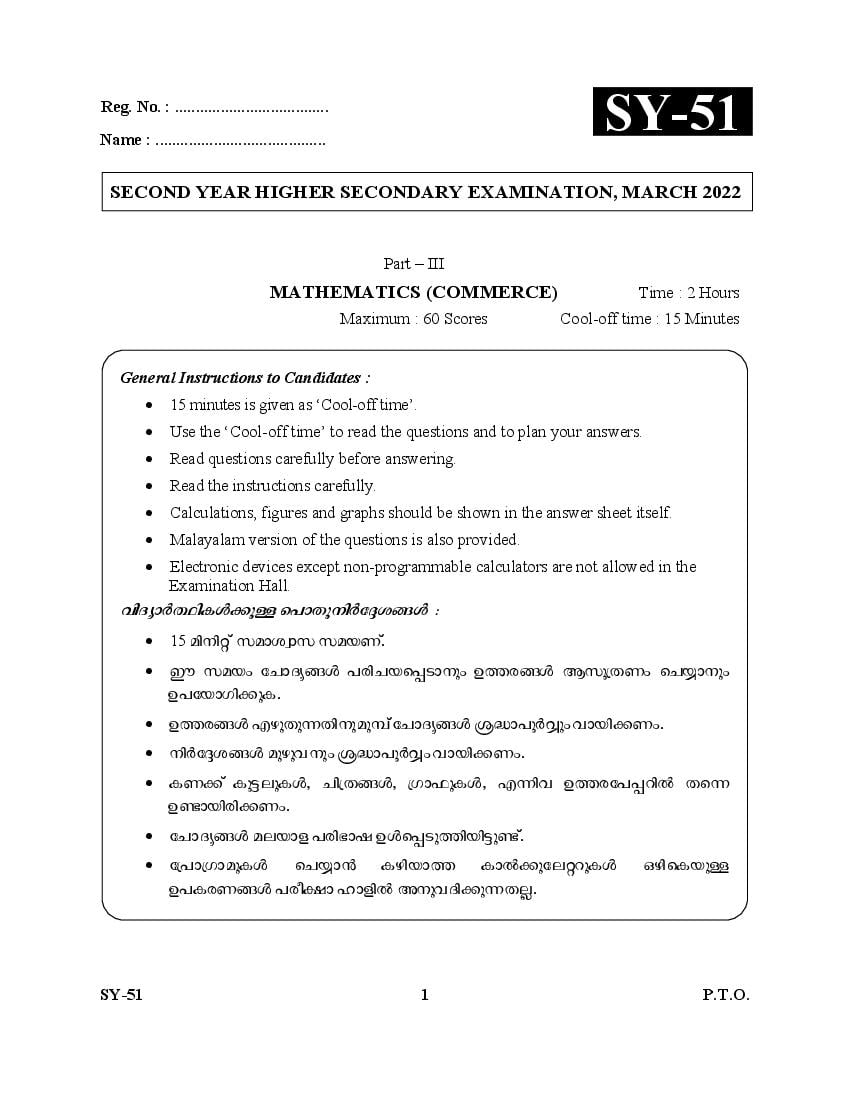
SECOND YEAR HIGHER SECONDARY EXAMINATION, MARCH 2022
Part – III
MATHEMATICS (COMMERCE) Time : 2 Hours
Maximum : 60 Scores Cool-off time : 15 Minutes
General Instructions to Candidates :
15 minutes is given as ‘Cool-off time’.
Use the ‘Cool-off time’ to read the questions and to plan your answers.
Read questions carefully before answering.
Read the instructions carefully.
Calculations, figures and graphs should be shown in the answer sheet itself.
Malayalam version of the questions is also provided.
Electronic devices except non-programmable calculators are not allowed in the
Examination Hall.
15 .
.
.
.
, , ,
.
.
.
SY-51 1 P.T.O.
Page 2
A. Answer any five questions from 1 to 9. Each carries 1 score. (5 1 = 5)
1. f : x y is onto if Range of f = _______
(a) x (b) y
(c) R (d) N
2. tan–1x + cot–1x = _______
(a) (b)
2 4
(c) 1 (d) 0
4 1
3. = _______
3 2
(a) 5 (b) 4
(c) 3 (d) 1
4. f(x) = sin x is increasing on which of the following intervals ?
(a) (0, ) (b) (0, /2)
(c) (/2, ) (d) (, 2)
5. The area of the region bounded by the curve y = cos x between x = 0 and x = /2 is
1
(a) sq. units (b) 2 sq. units
2
3
(c) 1 sq. units (d) sq. units
2
2
dy dy
6. The order of the differential equation sin 2 y 0 is
dx dx
(a) 1 (b) 2
(c) 3 (d) 4
7. If a and b are parallel then a b = _______
x5 y 4 z 6
8. Find the vector equation of the line .
3 7 2
SY-51 2
Page 3
A. 1 9 5 .
1 . (5 1 = 5)
1. f : x y f = _______
(a) x (b) y
(c) R (d) N
2. tan–1x + cot–1x = _______
(a) (b)
2 4
(c) 1 (d) 0
4 1
3. = _______
3 2
(a) 5 (b) 4
(c) 3 (d) 1
4. f(x) = sin x ?
(a) (0, ) (b) (0, /2)
(c) (/2, ) (d) (, 2)
5. x = 0, x = /2 , y = cos x
1
(a) sq. units (b) 2 sq. units
2
3
(c) 1 sq. units (d) sq. units
2
2
dy dy 2
6. sin y 0
d x
d x
(a) 1 (b) 2
(c) 3 (d) 4
7. a , b a b = _______
x5 y 4 z 6
8. .
3 7 2
SY-51 3 P.T.O.
Page 4
9. If A and B are two independent events with P(A) = , P(B) = , then P(A B) =
5 5
______.
3 3
(a) (b)
25 5
1 1
(c) (d)
5 3
B. Answer all questions from 10 to 13. Each carries 1 score. (4 1 = 4)
1
10. cos–1 = ______
2
(a) (b)
2 3
(c) (d)
4 6
11. Let A be a square matrix of order 2, then |3A| = ______
(a) 3|A| (b) 4|A|
(c) 2|A| (d) 9|A|
d
12. (log x) = _______
dx
(a) log x (b) ex
1
(c) (d) log ex
x
13. The direction cosines of the plane x + y + z = 1 is
1 1 1
(a) 1, 1, 1 (b) , ,
2 2 2
1 1 1 1 1 1
(c) , , (d) , ,
2 2 2 3 3 3
SY-51 4
Page 5
9. A, B P(A) = , P(B) =
5 5
P(A B) = ______.
3 3
(a) (b)
25 5
1 1
(c) (d)
5 3
B. 10 13 . 1 .
(4 1 = 4)
1
10. cos–1 = ______
2
(a) (b)
2 3
(c) (d)
4 6
11. A 2 |3A| = ______
(a) 3|A| (b) 4|A|
(c) 2|A| (d) 9|A|
d
12. (log x) = _______
dx
(a) log x (b) ex
1
(c) (d) log ex
x
13. x + y + z = 1
1 1 1
(a) 1, 1, 1 (b) , ,
2 2 2
1 1 1 1 1 1
(c) , , (d) , ,
2 2 2 3 3 3
SY-51 5 P.T.O.
Page 6
A. Answer any two questions from 14 to 17. Each carries 2 scores. (2 2 = 4)
4 3 y z
14. If , then find the values of x, y, z.
x 5 1 5
15. Find the equation of tangent to the curve y = x2 at (1, 2).
16. Consider the function :
f(x) = e2x
(i) find f '(x) (1)
(ii) show that f(x) is increasing on R (1)
17. Solve the differential equation :
dy 1 y 2
dx 1 x 2
B. Answer any two questions from 18 to 20. Each carries 2 scores. (2 2 = 4)
d2y
18. If y = x2 + 3x + 2 find .
dx 2
dy 2
19. Solve yx.
dx x
20. Find the distance of the point (2, 5, –3) from the plane 6x – 3y + 2z = 4.
PART – III
A. Answer any three questions from 21 to 24. Each carries 3 scores. (3 3 = 9)
21. Let f : R R defined by f(x) = 4x + 3. Show that f is one-one and onto.
8 0 2 1
22. Let A = B
3 1 3 2
(i) Find A + B (1)
(ii) Find 2A (1)
(iii) Find A' (1)
SY-51 6
Page 7
A. 14 17 2 .
2 . (2 2 = 4)
4 3 y z
14. x 5 1 5 x, y, z .
15. (1, 2) y = x2
.
16. f(x) = e2x .
(i) f '(x) . (1)
(ii) R- f(x) . (1)
dy 1 y 2
17. .
dx 1 x 2
B. 18 20 2 .
2 . (2 2 = 4)
2
d y
18. y = x2 + 3x + 2 .
dx 2
dy 2
19. yx.
dx x
20. 6x – 3y + 2z = 4 (2, 5, –3)
.
PART – III
A. 21 24 3 .
3 . (3 3 = 9)
21. f : R R f(x) = 4x + 3 . f -,
.
8 0 2 1
22. A= B
3 1 3 2
(i) A + B . (1)
(ii) 2A . (1)
(iii) A' . (1)
SY-51 7 P.T.O.
Page 8
(i) Find a . b (1)
(ii) Find the projection of a on b . (2)
24. A Random Variable X has the following probability distribution :
X 0 1 2
P(x) k 2k 3k
(i) Find the value of k (2)
(ii) Find P(x < 2) (1)
B. Answer any two questions from 25 to 27. Each carries 3 scores. (2 3 = 6)
25. Let * be a binary operation on N given by a * b = ab.
(i) Find 5 * 7 (1)
(ii) Is * commutative ? (1)
(iii) Find the identity element of * in N. (1)
1 1
26. Find the inverse of the matrix A = using elementary transformations.
2 3
27. Two balls are drawn at random without replacement (one after the other) from a box
containing 10 black and 8 red balls. Find the probability that first ball is black and
second is red.
PART – IV
A. Answer any three questions from 28 to 31. Each carries 4 scores. (3 4 = 12)
28. (i) tan–1x + tan–1y = _____. (1)
1 2 3
(ii) Show that tan–1 + tan–1 = tan–1 . (3)
2 11 4
29. Find the value of k so that :
kx 2 , if x 2
f(x) = is continuous at x = 2.
3 , if x 2
30. Find the intervals in which f(x) = 2x2 – 3x is
(i) increasing (2)
(ii) decreasing (2)
SY-51 8
Page 9
(i) a . b . (1)
(ii) a b . (2)
24. X
:
X 0 1 2
P(x) k 2k 3k
(i) k . (2)
(ii) P(x < 2) . (1)
B. 25 27 2 .
3 . (2 3 = 6)
25. * N a * b = ab .
(i) 5 * 7 . (1)
(ii) * ? (1)
(iii) N- * . (1)
1 1
26. A =
2 3
.
27. 10 8 2
( ) .
.
PART – IV
A. 28 31 3 .
4 . (3 4 = 12)
28. (i) tan–1x + tan–1y = _____. (1)
1 2 3
(ii) tan–1 + tan–1 = tan–1 . (3)
2 11 4
kx 2 , if x 2
29. f(x) =
3 , if x 2
x = 2 k .
30. f(x) = 2x2 – 3x
(i) (2)
(ii)
(2)
SY-51 9 P.T.O.
Page 10
r î ĵ λ (2 î ĵ k̂)
r 2 î ĵ k̂ μ (3 î 5ĵ 2k̂)
B. Answer any one question from 32 to 33. Each carries 4 scores. (1 4 = 4)
32. Prove that :
x y y z z x
z x y 0
1 1 1
33. A fair coin is tossed 5 times. Find the probability of
(i) Exactly 4 heads. (2)
(ii) Atleast 4 heads. (2)
PART – V
Answer any two questions from 34 to 36. Each carries 6 scores. (2 6 = 12)
34. Consider the following system of equations
x–y+z=4
2x + y – 3z = 0
x+y+z=2
(i) Express the system of equations in the form AX = B. (1)
(ii) Find A–1. (3)
(iii) Solve the system of equations using matrix method. (2)
1x
e tan
35. (i) Evaluate 1 x 2 dx . (2)
(ii) Integrate x sin x with respect to x. (2)
1
2x
(iii) Evaluate 0 x 2 1 dx . (2)
36. Solve the L.P.P. graphically
Maximise Z = 3x + 2y
Subject to x + 2y < 10
3x + y < 15
x, y > 0
___________
SY-51 10
Page 11
r 2 î ĵ k̂ μ (3 î 5ĵ 2k̂)
.
B. 32 33 .
4 . (1 4 = 4)
x y y z z x
32. z x y 0 .
1 1 1
33. 5 .
.
(i) 4 . (2)
(ii) 4 . (2)
PART – V
34 36 2 .
6 . (2 6 = 12)
34.
x–y+z=4
2x + y – 3z = 0
x+y+z=2
(i) AX = B . (1)
(ii) A–1 . (3)
(iii) . (2)
1x
e tan
35. (i) 1 x 2 dx . (2)
(ii) x sin x x . (2)
1
2x
(iii) 0 x 2 1 dx . (2)
36. L.P.P. .
Maximise Z = 3x + 2y
Subject to x + 2y < 10
3x + y < 15
x, y > 0
___________
SY-51 11 P.T.O.
Page 12
Document Details
| Board / Org | Kerala Board |
| Exam | Class 12 |
| Type | Question Paper |
| Pages | 12 |
| Updated | 22 Jul 2026 |