DU SOL M.Com Question Paper 2nd Year 2018 Sem 4 Management Of International Business Operations
Finished viewing? Save it for later —
Download DU SOL M.Com Question Paper 2nd Year 2018 Sem 4 Management Of International Business Operations (PDF · 8 pages)About DU SOL M.Com Question Paper 2nd Year 2018 Sem 4 Management Of International Business Operations
DU SOL M.Com Question Paper 2nd Year 2018 Sem 4 Management Of International Business Operations is available here for free download. Published by University of Delhi for DU SOL, this question paper can be viewed online or downloaded as a PDF (8 pages). Candidates preparing for DU SOL can use DU SOL M.Com Question Paper 2nd Year 2018 Sem 4 Management Of International Business Operations to understand the exam pattern, the type of questions asked, and the overall difficulty level.
Frequently Asked Questions
How can I download DU SOL M.Com Question Paper 2nd Year 2018 Sem 4 Management Of International Business Operations?
Open this page and click the Download button to save DU SOL M.Com Question Paper 2nd Year 2018 Sem 4 Management Of International Business Operations as a PDF. It is completely free on AglaSem Docs.
Is DU SOL M.Com Question Paper 2nd Year 2018 Sem 4 Management Of International Business Operations free to download?
Yes. DU SOL M.Com Question Paper 2nd Year 2018 Sem 4 Management Of International Business Operations can be viewed online and downloaded as a PDF free of cost on AglaSem Docs.
How many pages does DU SOL M.Com Question Paper 2nd Year 2018 Sem 4 Management Of International Business Operations have?
DU SOL M.Com Question Paper 2nd Year 2018 Sem 4 Management Of International Business Operations contains 8 pages, which you can read online or download together as a single PDF.
Where can I find more DU SOL study material?
You can find more DU SOL question papers, sample papers, syllabus, and answer keys on AglaSem Docs.
DU SOL M.Com Question Paper 2nd Year 2018 Sem 4 Management Of International Business Operations – Text
Read the full text of this question paper below — useful to quickly search, copy and reference the content online without downloading the PDF.
📄 View text version (8 pages)
Page 1
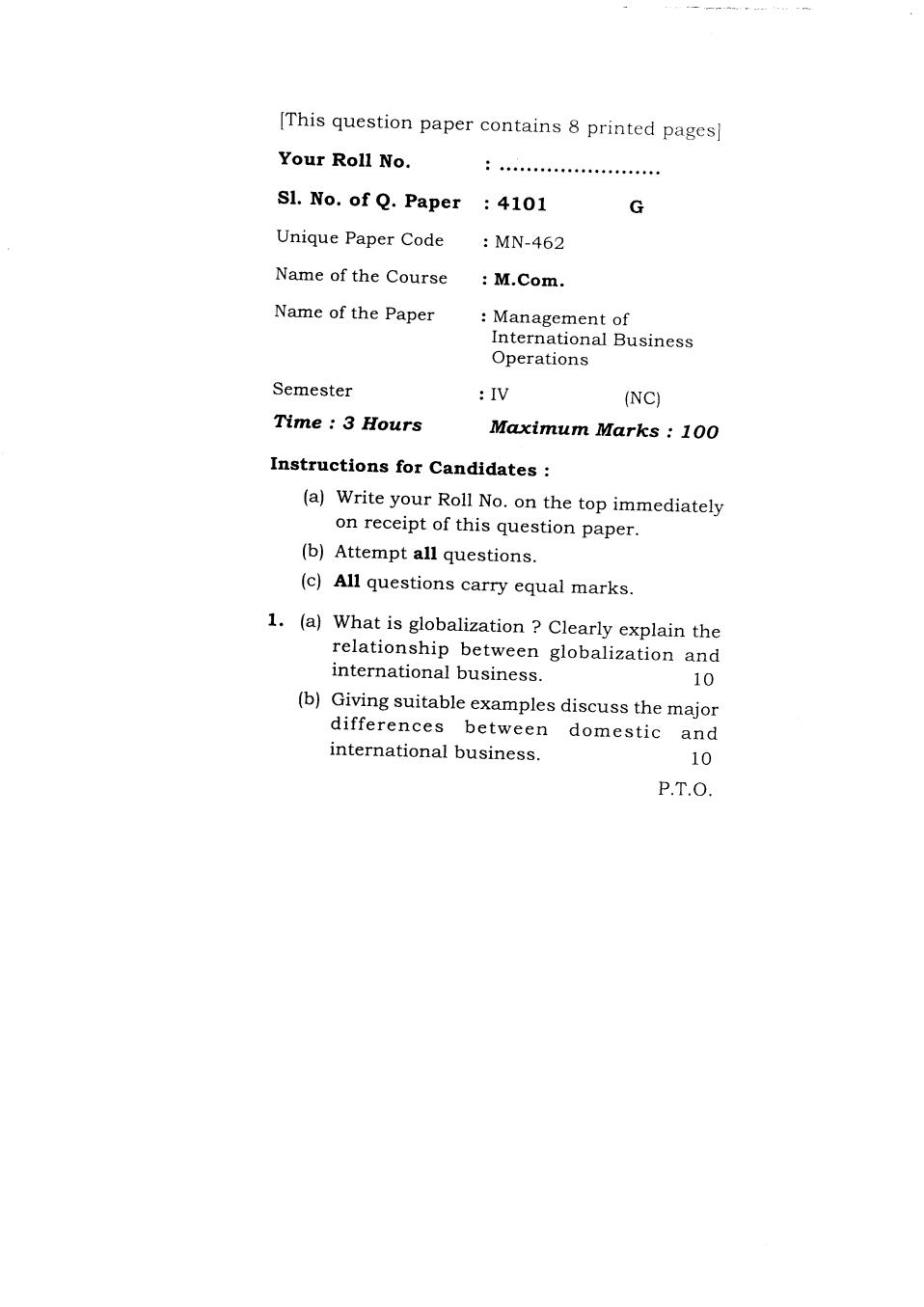
Your Roll No.
Sl. No. of e. paper 4101 c
Unique Paper Code MN-462
Name of the Course M.Com.
Name of the Paper : Management of
International Bu siness
Operations
Semester ry (NC)
Tlme : 3 Hours Maxirnum Morks : lOO
Instructions for Candidates :
(a) Write your Roll No. on the top immediately
on receipt of this question paper.
(b) Attempt all questions.
(c) All questions carry equal marks.
1. (a) What is globalization ? Clearly explain the
relationship between globalization and
international business. 10
(b) Giving suitable examples discuss the
major
differences between domestic and
international business. i0
P.T.O.
Page 2
(c) "A Company that fails to go global is in the
danger of losing its domestic business to
competitors with lower cost, greater
experience, better products and in a
nutshell, more value for the customers,,.
Discuss.
(d) The choice of an optimal production location
mu st con sider country factors,
technological factors and product factors.
Discuss.
2. (a) Explain the concept of strategy.
Differentiate between the gtoSai
standar dization, local ization and
transnational strategy given suitable
examples. 10
(b) Examine the role of Information Technolog,
and JIT Inventory for managing a global
supply chain in international business
operations. 10
OR
(c) International HRM includes the important
issues of labour unions and their
interventions. Critically evaluate the
statem ent.
(d) Discuss rn'hy and how advertising and
promotional strategies varies amonq
countries.
2
Page 3
3. (a) What is market segmentation ? Explain how
product attributes influence marketing
strategy in international business ?
10
(b) International pricing strategy is an
important component of the overall
international marketing mix' Discuss'
10
OR
(c) Identify the pros and cons of different
apProaches to staffing Policl' 1n
international busine ss'
(d) Highlight the reasons for the failure of
expatriate managers in international
business operation' How can firms reduce
exPatriate failure ?
4. (a) Transfer prices can introduce significant
distortions into the control process and
thus must be considered when setting
budgets and evaluating a subsidiary's
10
performance. Discuss'
(b) Evaluate how organt'zed labour can
influence strategic choices in international
10
business firms.
3 P.T.O.
Page 4
(c) What is IFRS ? Enumerate the factors that
have led to the evolution of international
accounting standards.
(d) Discuss major obstacles witnessed by the
International Accounting Standards Board
(IASB) in harmonisation of accounting
standards at the international level.
5. Read the following case thoroughly and answer
the questions that follow the case :
IBM's former CEO, Sam Palmisano, liked to talk
about the evolution of global strategr at one of
the world's largest computer enterprises.
According to Plamisano, when IBM first started
to expand internationally, it did so in the classic
"international" pattern of many enterprises,
undertaking most of its activities at home and
selling its products internationally through
overseas sales offices. By the time Palmisano
joined IBM in 1972, the company had already
moved away from this model and was a classic
"multinational" enterprise, with mini-IBM's in
major national markets around the world. This
structure made sense for IBM in the 1970s,
given that many markets were still segmented
from each other by high barriers to cross-border
trade and given that national difference in
business practices often required considerable
localization.
Page 5
itti"-.""ael and towards one that Plamisano
characterizes as a "globally integrated
t"tpti"e". In his words:
"t We are locating work and operations
anywhere in the world based on econo.mlcs'
ex-pertise, and the right business
.rr^.rirorr*ent. We are integrating those
op"r"tiotts horizontalty and- glob ally' We- u sed
to have separate supply chains in differenta
markets. Now *e have one supply-clqn:'for
gi"U"f one. Our R&D has been glob-al
many years' with research and software
deveiopment carried out in labs around the
*otfa. But in our professional services
businesses, where we used to think about
our human capital - our people - in terms of
countries, regions, and business"units'
"ttd
we now manage and dePloY them as one
global asset.
Thus today's IBM locates its semiconductor
R&D and manufacturing operating in uqslatg
New York and Vermont and its global
procurement center in China' Global services
ielivery is in India, while man{ of the services
that support IBM's external and internal
websites are in places like Ireland and Brazil'.
The people at each of these centers are'not
io"u""d on their national markets; they are
leading integrated global operations'
P.T.O.
Page 6
things: the globalization of the world economy;
the global nature of many of IBM's customers,
who were themselves shifting towards a global
integration strategr; and the emergence of fierce
competition from enterprises in emerging
markets such as China and India. Take India
as an example; in the 1990s a trio of Indian
outsourcing firms, Tata Consulting Services,
.Infosys, and Wipro started to take share away
IBM in its core information technolory services
business. The Indians enjoyed an advantage
!ase$ on a large supply of highly educated but
ielative inexpensive engineering and
managerial talent. IBM felt that to compete, it
had to adopt the low-cost model being
pioneered in India. So in 2OO4, it bought Daksh,
' an Indian firm that was a smaller version of
India's big three information technology
services firms. IBM has invested heavily in its
Indian unit, building it into a large global
business with leading market share that now
competes effectively on cost and quality against
its Indian rivals. While Palmisano notes that
. the original motivation for expanding in India
wqs to gain access to low-cost labour, he now
argugs that the skill base in India is just as
Page 7
important, if not more
people in Indiawho can
supply of highly "ttin"a
oner-ati-ons and move
sta-ff its globar ""*i""*
seamlessry -o''ii; th" world' It doesn't hurt
good command of the
that most r"ai"""l;;; " hT.
En gli sh r^"s*"ig'
;;"h"
ln mu(:"f :;HJ*:ttl:
faclo language of business
stresses that IBM has some way to
Palmisano a fullY integrated
go in its journ;il;;;;
global in" big thrust going forward
"rrt"rp"*'"'
ioitt u o' a""iJni"s tt'-il::";:Xti::i :til;
" - helpittg q:odlll,.r"s as global
;;;i;""ts who see themset who are able
"rrt"tpti"e
citizens'
orofessionals, ttigf"U"f the world' and do
io *orr" "no'trl"ii-arou11
wide range of national
business "n""iil"iv in
contexts'
Questions :
\- ' In the
t^f 1e7os and t:t-t"-:it?IT'"ii3:::
that IBM was ",tg:::1t what does this
multinational enterPrrse'advantages
- of this
mean ? d; *"t" itt" : "
kind of orientation ?
"t'"t"gic multinational
(b) By the. 1990" tf'" classic
no longer working
strategrc orientation was reasons for t-he
well for #il:'il;"tifv the
same'
P.T.O.
Page 8
(cl What are the strategic advantages to IBM of
its globally integrated enterprise stratery ?
What kind of organizational changes do you
think had to be made at IBM to make this
strategy a reality ?
(d) In terms of the strategic choice framework,
what strategr do you think IBM is pursuing
today ? Give reasons. 5x4=2O
8 300
Document Details
| Board / Org | University of Delhi |
| Exam | DU SOL |
| Type | Question Paper |
| Pages | 8 |
| Updated | 23 Oct 2026 |