Finished viewing? Save it for later —
Download CBSE Class 11 Syllabus 2022-23 Kokborok (PDF · 4 pages)About CBSE Class 11 Syllabus 2022-23 Kokborok
CBSE Class 11 Syllabus 2022-23 Kokborok is available here for free download. Published by CBSE for Class 11, this syllabus can be viewed online or downloaded as a PDF (4 pages). Candidates preparing for Class 11 can use CBSE Class 11 Syllabus 2022-23 Kokborok to understand the exam pattern, the type of questions asked, and the overall difficulty level.
Frequently Asked Questions
How can I download CBSE Class 11 Syllabus 2022-23 Kokborok?
Open this page and click the Download button to save CBSE Class 11 Syllabus 2022-23 Kokborok as a PDF. It is completely free on AglaSem Docs.
Is CBSE Class 11 Syllabus 2022-23 Kokborok free to download?
Yes. CBSE Class 11 Syllabus 2022-23 Kokborok can be viewed online and downloaded as a PDF free of cost on AglaSem Docs.
How many pages does CBSE Class 11 Syllabus 2022-23 Kokborok have?
CBSE Class 11 Syllabus 2022-23 Kokborok contains 4 pages, which you can read online or download together as a single PDF.
Where can I find more Class 11 study material?
You can find more Class 11 question papers, sample papers, syllabus, and answer keys on AglaSem Docs.
CBSE Class 11 Syllabus 2022-23 Kokborok – Text
Read the full text of this syllabus below — useful to quickly search, copy and reference the content online without downloading the PDF.
📄 View text version (4 pages)
Page 1
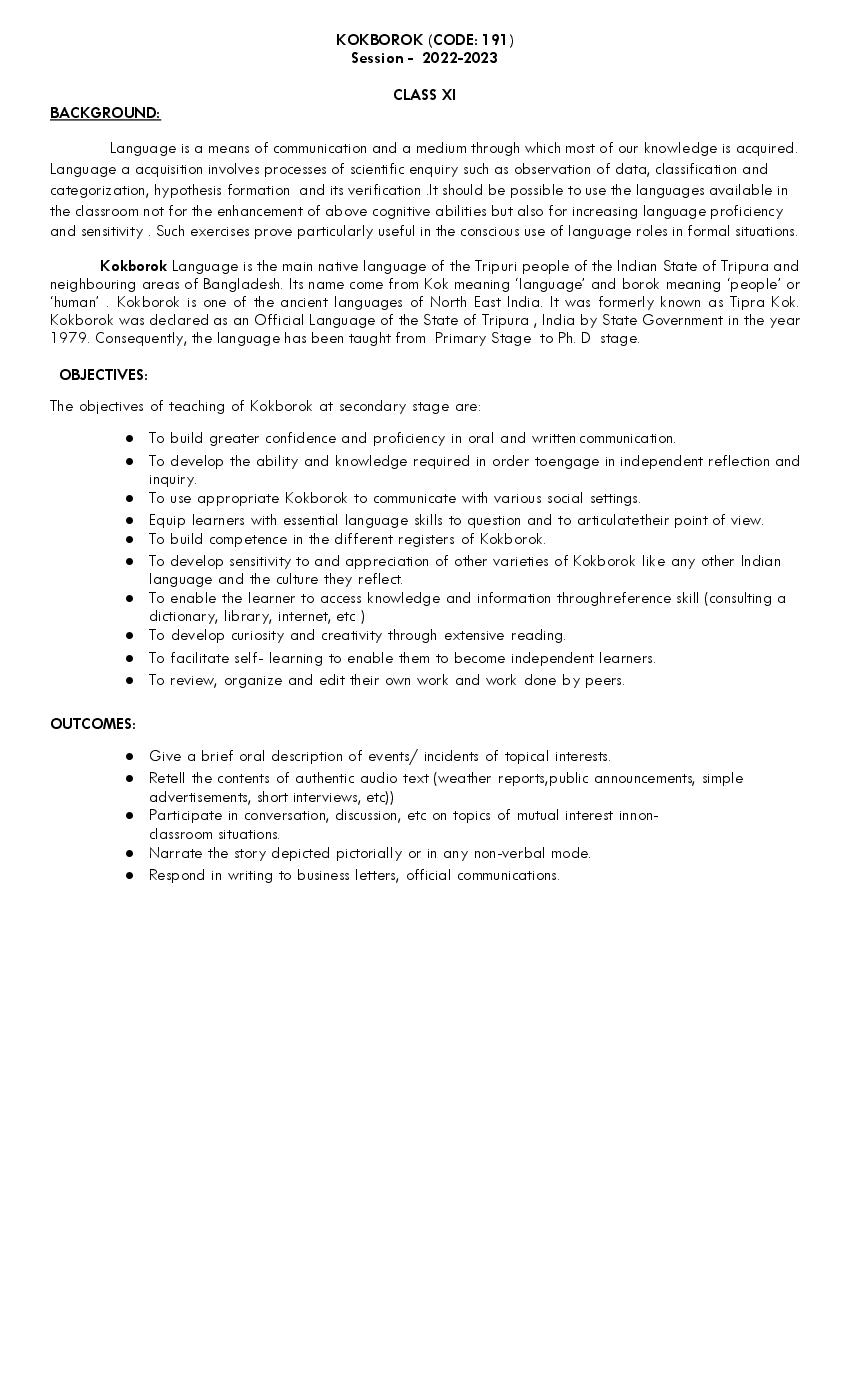
CLASS XI
BACKGROUND:
Language is a means of communication and a medium through which most of our knowledge is acquired.
Language a acquisition involves processes of scientific enquiry such as observation of data, classification and
categorization, hypothesis formation and its verification .It should be possible to use the languages available in
the classroom not for the enhancement of above cognitive abilities but also for increasing language proficiency
and sensitivity . Such exercises prove particularly useful in the conscious use of language roles in formal situations.
Kokborok Language is the main native language of the Tripuri people of the Indian State of Tripura and
neighbouring areas of Bangladesh. Its name come from Kok meaning ‘language’ and borok meaning ‘people’ or
‘human’ . Kokborok is one of the ancient languages of North East India. It was formerly known as Tipra Kok.
Kokborok was declared as an Official Language of the State of Tripura , India by State Government in the year
1979. Consequently, the language has been taught from Primary Stage to Ph. D stage.
OBJECTIVES:
The objectives of teaching of Kokborok at secondary stage are:
● To build greater confidence and proficiency in oral and written communication.
● To develop the ability and knowledge required in order to engage in independent reflection and
inquiry.
● To use appropriate Kokborok to communicate with various social settings.
● Equip learners with essential language skills to question and to articulate their point of view.
● To build competence in the different registers of Kokborok.
● To develop sensitivity to and appreciation of other varieties of Kokborok like any other Indian
language and the culture they reflect.
● To enable the learner to access knowledge and information throughreference skill (consulting a
dictionary, library, internet, etc )
● To develop curiosity and creativity through extensive reading.
● To facilitate self- learning to enable them to become independent learners.
● To review, organize and edit their own work and work done by peers.
OUTCOMES:
● Give a brief oral description of events/ incidents of topical interests.
● Retell the contents of authentic audio text (weather reports,public announcements, simple
advertisements, short interviews, etc))
● Participate in conversation, discussion, etc on topics of mutual interest in non-
classroom situations.
● Narrate the story depicted pictorially or in any non-verbal mode.
● Respond in writing to business letters, official communications.
Page 2
CLASS – XI ( 2022-2023 )
Section A Reading 10 20 Period
Section B Grammar 10 40 Period
Section C Composition and Writing 15 40 Period
Section D Literature 45 80 Period
Internal Assessment
(20) ---
Project 10 ---
Section E Speaking Skills 05 ---
Listening Skills 05 ---
TOTAL 100 180 Periods
Internal Options:
● Section A: Reading: There will be no options. All direct questions.
● Section B: Writing part will have internal options in respect to report writing, and Notice
Writing
● Section C: Grammar being a vast course, internal options should be given to all the
students.
● Section D: In the textbook part, it is desired that the students should go through the medieval
and ancient literature. Keeping this in view prose and poetry have been selected from the
prescribed textbook assigning 10 marks separately for the both part (prose and poetry).
Optional questions should be set from all the chapters for convenience of the learners.
● Section E: Internal Assesment will be done by the school concerned on students skill like project
framing, Speaking Skills & Listening Skills.
Page 3
EXAMINATION STRUCTURE
CLASS- XI
TYPE OF NO.OF WEIGHTAGE
SECTION DETAILS OF TOPICS QUESTIONS QUESTIONS (MARKS)
Comprehension : Two unseen passage of
SECTION-A 100 – 150 words each
READING Four direct (MCQ) Questions from SA 5x2= 10 (1+1+1+1+1)x2 =
10 MARKS given passage , 10 Marks
Fifth Questions (01 mark) should be
grammar based (Khorangmanju,
Juda kokmung/kokmung
thansa,Khwlai halok),
Kok Khochormung, Kok Phuarmug,
SECTION-B Kokmangrwgwi Kokbwtangni Dalberem, SA 5X2 = 10 (1+1+1+1+1)x2 =
GRAMMAR Khwlai Halok Swlaimung, 10 Marks
10 MARKS
SECTION-C 1. Kokthum Suimwng (Report Writing) :
Composition (100 -120 words ) LA 3 (5X1)X3= 15 Marks
and Writing 2. Kok Khochorwi Suimwng (Summary
15 Marks Writing) : (100-120 words)
3. Kok Phologwi Suimung (100-120 words)
Prose LA 1 (1+1+3)x1 = 05
1. HUK by Shyamlal Debbarma Marks
2. MANYAKHO by Haripada Debbarma SA 5 MCQ.1x5 = 05
SECTION- D 3. KUNAROKNI SAMO by Budhurai Marks
LITERATURE Debbarma LA 1 (2+3)X1=05 Marks
45 MARKS
SA 5 MCQ.1x5 = 05
Marks
Poetry LA 1 Explanation
1. KAMINI LAMA by Nanda Kumar (1X5)=05marks
Debbarma
2. ANG KOKBOROK by Sunil Debbarma
3. TI-I TUN by Ram Kumar Debbarma
4. KHUM BARSANI BANTA by Kamalia
Debbarma
LA 1 Questions
Supplementary Reader: ( 1+1+3)X1= 05
1. SODGOTI by Munshi PremChand Marks
2. SAL KWBANGMANI SALSA LA 1 (1+4)X1=05 Marks
by Sumen Chanda
LA 1 (1+4)X1 =0 5
Marks
SA 5 MCQ.1x5 = 05
Marks
Any one of the following Project is to be
undertaken in Class XI and another one
will be chosen in Class XII.
1. Translation : Students are to translate a
story written in English or Hindi or in any
Indian language to Kokborok within 1000
words.
2. Interview : An Interview or any
distinguished personality can be taken by
the students.
SECTION-E 3. Dramatization : Students can transform
10
Project a story written in any of the Indian
10 Marks languages into Drama within 1000 –
2000 words .
4. Survey : Students will conduct a
survey or their own School or on any
neighbouring school to reveal the facts,
History , configuration of the student’s and
teacher’s ethnic identity etc. of the school
under survey.
5. Self Composed Story : Students can
write a story on any special incident or
day they experienced in their life.
Listening 05
Page 4
TOTAL 100
Long answer (LA), short answer (SA), Very Short Answer (VSA)
Internal Assessment:
1. Assignment/ Speaking and Listening – 20 marks
QUESTION PAPER DESIGN
CLASS- XI & XII, 2022-2023
Time : 3 Hours Max. Marks : 80
Sl. Very short Short Short Long %
No Typology of Questions Answer- Answer Answer Answer Total Weighta
Objective –I –II (LA) Marks ge
type ( SA ) ( SA ) ( 5 Marks (
( VSA) (1) (1) ) approx)
( 1 Mark)
1 Remembering:
Exhibit memory of
previously learned (1X5)X3
material by recalling =15
facts, terms, basic
concepts, and answer.
2 Understanding:
Demonstrate
understanding of facts and 1X5=5
ideas by organizing ,
comparing , translating,
interpreting, giving
descriptions, and stating
main ideas.
3 Applying :
Solve problems to new (1X5)X3
situations by applying =15
acquired knowledge
,facts, techniques and rules
in defferent ways.
Analysing:
Examine and breake
Information into parts by 5X2=10
identifying motives or
causes. Make inference
and find evidence to
support generalizations.
Evaluating:
Present and defend 5X2=10
opinion by making 5X2=5
judgments about 1+4=5
information, validity of 5X1=5
ideas, or
4 qual ity of work based on
a set of criteria.
Creating :
Compile information
together in a deferent
way by combining
elements in a new 5X1=5
pattern or proposing 5X1=5
alternative solutions.
Total 80
INTERNAL ASSESSMENT:
20 Marks
Project : 10 Marks
ASL : 10 ( Listening- 05, Speaking- 05 )
Document Details
| Board / Org | CBSE |
| Exam | Class 11 |
| Type | Syllabus |
| Pages | 4 |
| Updated | 15 Jul 2026 |