JKBOSE 12th Class Model Paper 2024 Budhist Studies
Finished viewing? Save it for later —
Download JKBOSE 12th Class Model Paper 2024 Budhist Studies (PDF · 7 pages)About JKBOSE 12th Class Model Paper 2024 Budhist Studies
JKBOSE 12th Class Model Paper 2024 Budhist Studies is available here for free download. Published by JKBOSE for Class 12, this sample paper can be viewed online or downloaded as a PDF (7 pages). Candidates preparing for Class 12 can use JKBOSE 12th Class Model Paper 2024 Budhist Studies to understand the exam pattern, the type of questions asked, and the overall difficulty level.
Frequently Asked Questions
How can I download JKBOSE 12th Class Model Paper 2024 Budhist Studies?
Open this page and click the Download button to save JKBOSE 12th Class Model Paper 2024 Budhist Studies as a PDF. It is completely free on AglaSem Docs.
Is JKBOSE 12th Class Model Paper 2024 Budhist Studies free to download?
Yes. JKBOSE 12th Class Model Paper 2024 Budhist Studies can be viewed online and downloaded as a PDF free of cost on AglaSem Docs.
How many pages does JKBOSE 12th Class Model Paper 2024 Budhist Studies have?
JKBOSE 12th Class Model Paper 2024 Budhist Studies contains 7 pages, which you can read online or download together as a single PDF.
Where can I find more Class 12 study material?
You can find more Class 12 question papers, sample papers, syllabus, and answer keys on AglaSem Docs.
JKBOSE 12th Class Model Paper 2024 Budhist Studies – Text
Read the full text of this sample paper below — useful to quickly search, copy and reference the content online without downloading the PDF.
📄 View text version (7 pages)
Page 1
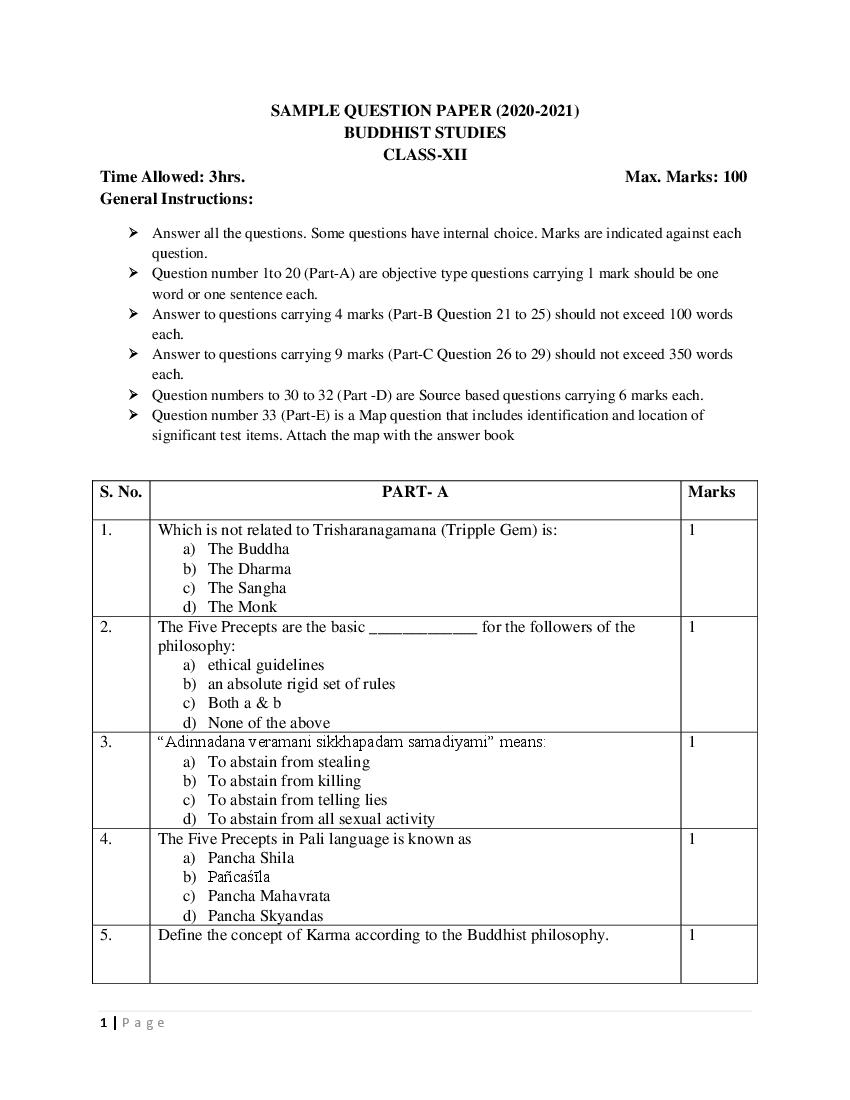
BUDDHIST STUDIES
CLASS-XII
Time Allowed: 3hrs. Max. Marks: 100
General Instructions:
Answer all the questions. Some questions have internal choice. Marks are indicated against each
question.
Question number 1to 20 (Part-A) are objective type questions carrying 1 mark should be one
word or one sentence each.
Answer to questions carrying 4 marks (Part-B Question 21 to 25) should not exceed 100 words
each.
Answer to questions carrying 9 marks (Part-C Question 26 to 29) should not exceed 350 words
each.
Question numbers to 30 to 32 (Part -D) are Source based questions carrying 6 marks each.
Question number 33 (Part-E) is a Map question that includes identification and location of
significant test items. Attach the map with the answer book
S. No. PART- A Marks
1. Which is not related to Trisharanagamana (Tripple Gem) is: 1
a) The Buddha
b) The Dharma
c) The Sangha
d) The Monk
2. The Five Precepts are the basic _____________ for the followers of the 1
philosophy:
a) ethical guidelines
b) an absolute rigid set of rules
c) Both a & b
d) None of the above
3. ―Adinnadana veramani sikkhapadam samadiyami‖ means: 1
a) To abstain from stealing
b) To abstain from killing
c) To abstain from telling lies
d) To abstain from all sexual activity
4. The Five Precepts in Pali language is known as 1
a) Pancha Shila
b) Pañcaśīla
c) Pancha Mahavrata
d) Pancha Skyandas
5. Define the concept of Karma according to the Buddhist philosophy. 1
1|Page
Page 2
a) Dependent Origination
b) Four Noble Truths
c) Eight Fold Path
d) Five Precepts
7. Who was the president of the First Buddhist Council : 1
a) Upagupta
b) Dhidhika
c) MahaKasyapa
d) Ananda
8 Who helped the women for their entry into the Sangha 1
a) MahaKasyapa
b) Ananda
c) Upagupta
d) Shvenavastra
9. Upagupta was a renowned Buddhist monk, who lived in the ____: 1
a) 6th century BCE
b) 5th century BCE
c) 3rd century CE
d) 3rd century BCE
10. Which is not related to the Buddhism: 1
a) Four Noble Truth
b) Eight Fold Path
c) Twelve Links
d) Seven Noble Truth
11. Tripitaka means: 1
a) Three baskets
b) Four baskets
c) Eight baskets
d) Ten baskets
12. Vinaya Pitaka comes under the : 1
a) Kangyur
b) Stangyur
c) Tripitaka
d) Triratana
13. Acharya Nagarjuna‘s most famous work is : 1
a) The Visuddhimagga
b) The Mulamadhyamakakarika
c) The Mahavamsa
d) The Dhamapada
14. Dharmakīrti wrote 1
a) The Vijnapti-matrata-siddhi
b) The Pramāṇa-vārttika
c) The Pramāṇa-samuccaya
d) The Hethucakra
2|Page
Page 3
enlightenment for the benefit of all sentient beings.
a) Bodhisattvas
b) Goutam Buddha
c) Bodhikatha
d) Bodhicitta
16. The Acharya Dharmakīrti wrotes: 1
1. Nyāyabindu
2. Visuddhimagga
3. Vādanyāya
4. Sambandhparikshā
a) I, II and III
b) II, III and IV
c) I, III and IV
d) II and III only
17. How many Perfection according to the Theravada tradition : 1
a) 8
b) 9
c) 11
d) 10
18. Dāna refers as: 1
a) Energy
b) Insight
c) Truthfulness
d) Generosity
19. Ambaran Buddhist site is located in : 1
a) Kashmir Region
b) Jammu Region
c) Punjab Region
d) Ladakh Region
20. Identify the following image and write its name. 1
OR
Identify the following image and write its name.
3|Page
Page 4
number 20.
Ambaran Buddhist site is located on the bank of river _________________.
OR
Ambaran Buddhist sites is _____ km far from Jammu city
PART -B
21. Define the word ―Dharma‖ according to the Buddhism. 4
22. Describe the Buddhist concept of Panchshila. 4
23. Write a short note on Re-birth according to the Buddhism. 4
24. Write a note on the contribution of MahaKasyapa. 4
OR
. Write in detail the important works of Dharamkirti
25. Write a short note on the Ten Paramitas. 4
PART-C
26. Describe in details the contribution of Acharya Nagarjuna and Vasubandhu. 9
OR
Explain the life history of Ananda and his important contribution.
27. Explain in details the classification and benefits of Parmitas. 9
OR
Define Bodhichitta and its classification in detail.
28. Describe in detail the history and different periods of Ambran Buddhist site. 9
OR
Classify and write a short note on all Buddhist sites of Kashmir
29. Explain how Buddhist plays important role for achieving World Peace. 9
OR
Write the names of Buddhist monasteries of Leh and explain any two.
4|Page
Page 5
30. The ten far-reaching attitudes, (Skt. Paramita, Pali: parami; English 2+2+2=6
perfections) are found in the Theravada, Mahayana, and Bon traditions.
Literally, they are states of mind that bring bodhisattvas to the far shore –
namely, to enlightenment. Although shravakas (listeners to Buddha‘s
teachings who aim for the liberation of an arhat) may also develop these
attitudes, they are not considered ―far-reaching‖ unless they are conjoined
with a bodhichitta aim. The Theravada version of the Previous Life
Accounts (sKyes-rab, Skt. Jataka) of Buddha when he practiced as a
bodhisattva speaks of ten far-reaching attitudes. The Sarvastivada version
has only six. Within Mahayana, both The Prajnaparamita; Sutras on Far-
Reaching Discriminating Awareness, Perfection of Wisdom Sutras) and The
Sutra of the White Lotus of the Hallowed Dharma
Skt: Saddharmapundarika-nama Mahayana Sutra; The Lotus Sutra) discuss
only six.
a) In Pali language Prefection is refers as?
b) According to Theravada there are _____ Paramitas?
c) Mahayana considers only ______ Paramitas?
31. Siddhartha Gotama was born into a royal family in Lumbini, now located in 2+2+2=6
Nepal, in 563 BC. At 29, he realized that wealth and luxury did not
guarantee happiness, so he explored the different teachings religions and
philosophies of the day, to find the key to human happiness. After six years
of study and meditation he finally found ‗the middle path‘ and was
enlightened. After enlightenment, the Buddha spent the rest of his life
teaching the principles of Buddhism — called the Dhamma, or Truth — until
his death at the age of 80. Buddhism is a religion to about 300 million people
around the world. The word comes from ‗budhi‘, ‗to awaken‘. It has its
origins about 2,500 years ago when Siddhartha Gotama, known as the
Buddha, was himself awakened (enlightened) at the age of 35.
a) The meaning of Buddha?
b) At what age Gotama Buddha achieved enlightenment?
c) Siddharatha was born at which place?
32. The Buddha taught many things, but the basic concepts in Buddhism can be 2+2+2=6
summed up by the Four Noble Truths and the Noble Eightfold Path, which is also
known as the Dhammacakkappavattana Sutta (Pali; Sanskrit:
Dharmacakrapravartana Sūtra; English: The Setting in Motion of the Wheel of the
Dharma Sutta or Promulgation of the Law Sutta) is a Buddhist text that is
considered by Buddhists to be a record of the first sermon given by Gautama
Buddha.
a) Write the Four Noble Truths?
b) Write down the Eight fold Path?
c) The First Sermon is also known as?
5|Page
Page 6
33. (33.1) On the given political outline map of India, locate and label the 3
following with appropriate symbols:
a. Sanchi Stupa
OR
Bodhgaya
b. Saranath
c. Ambaran
(33.2) On the same outline map three places have been marked as A, B, C
which are related to the Buddha‘s life. Identify them and write their correct 3
names on the lines marked near them.
Note: The following questions are for the Visually Impaired Candidates
only in lieu of Q. No.33.
(33.1) Name any three works of Dignaga. 3+3=6
OR
Name any three monasteries of Leh.
(33.2) Name any three Buddhist sites of Kashmir
6|Page
Page 7
B
C
7|Page