Kerala Plus Two Question Paper 2022 Philosophy
Finished viewing? Save it for later —
Download Kerala Plus Two Question Paper 2022 Philosophy (PDF · 8 pages)About Kerala Plus Two Question Paper 2022 Philosophy
Kerala Plus Two Question Paper 2022 Philosophy is available here for free download. Published by Kerala Board for Class 12, this question paper can be viewed online or downloaded as a PDF (8 pages). Candidates preparing for Class 12 can use Kerala Plus Two Question Paper 2022 Philosophy to understand the exam pattern, the type of questions asked, and the overall difficulty level.
Frequently Asked Questions
How can I download Kerala Plus Two Question Paper 2022 Philosophy?
Open this page and click the Download button to save Kerala Plus Two Question Paper 2022 Philosophy as a PDF. It is completely free on AglaSem Docs.
Is Kerala Plus Two Question Paper 2022 Philosophy free to download?
Yes. Kerala Plus Two Question Paper 2022 Philosophy can be viewed online and downloaded as a PDF free of cost on AglaSem Docs.
How many pages does Kerala Plus Two Question Paper 2022 Philosophy have?
Kerala Plus Two Question Paper 2022 Philosophy contains 8 pages, which you can read online or download together as a single PDF.
Where can I find more Class 12 study material?
You can find more Class 12 question papers, sample papers, syllabus, and answer keys on AglaSem Docs.
Kerala Plus Two Question Paper 2022 Philosophy – Text
Read the full text of this question paper below — useful to quickly search, copy and reference the content online without downloading the PDF.
📄 View text version (8 pages)
Page 1
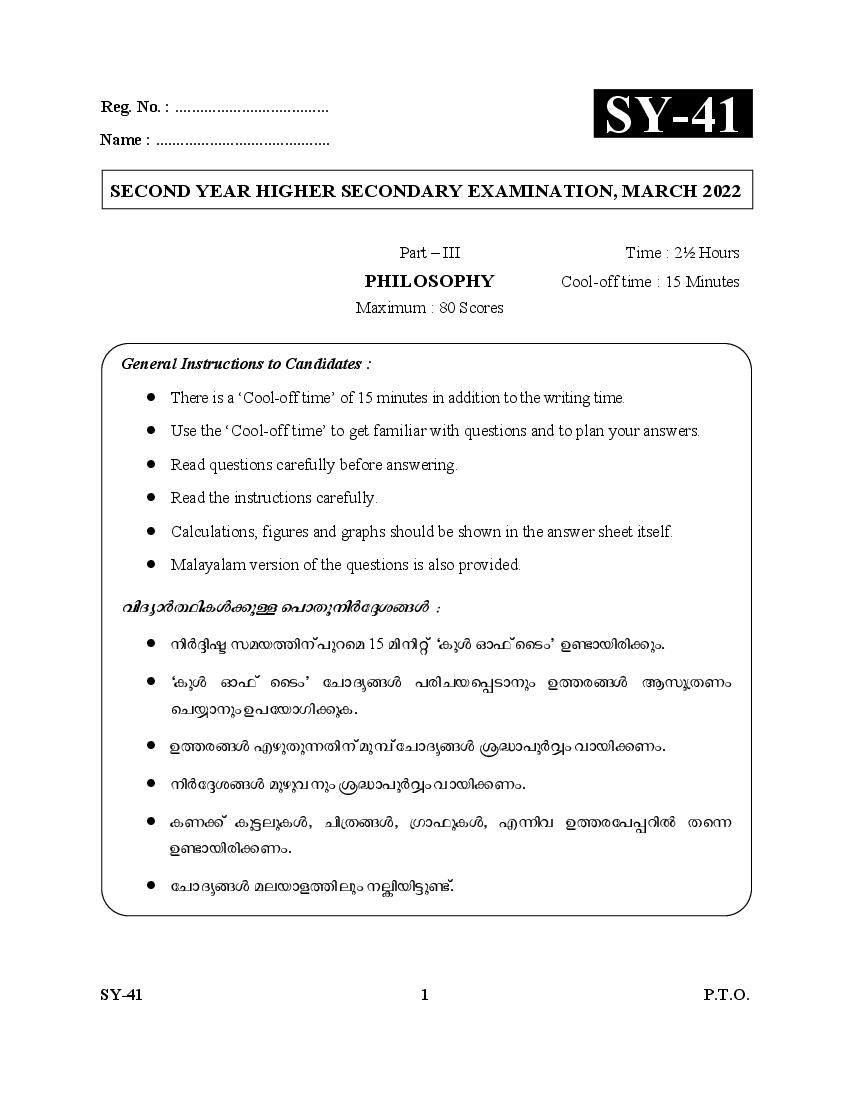
Name : ..........................................
SY-41
SECOND YEAR HIGHER SECONDARY EXAMINATION, MARCH 2022
Part – III Time : 2½ Hours
PHILOSOPHY Cool-off time : 15 Minutes
Maximum : 80 Scores
General Instructions to Candidates :
There is a ‘Cool-off time’ of 15 minutes in addition to the writing time.
Use the ‘Cool-off time’ to get familiar with questions and to plan your answers.
Read questions carefully before answering.
Read the instructions carefully.
Calculations, figures and graphs should be shown in the answer sheet itself.
Malayalam version of the questions is also provided.
15 ‘ ’ .
‘ ’
.
.
.
, , ,
.
.
SY-41 1 P.T.O.
Page 2
A. Answer any 4 questions from 1 to 6. Each carries 1 score. (4 × 1 = 4)
1. Which among the following is not a characteristics of philosophic concept ?
(a) Common (b) Central
(c) Proved hypothesis (d) Contestable
2. The word ‘Veda’ is derived from The Sanskrit root word ‘Vid’ which means
________.
3. Who is the author of ‘Nyaya Sutra’ ?
4. Who among the following philosophers declared ‘Water is the primary
substance’ ?
(a) Thales (b) Anaximander
(c) Anaximenes (d) Heraclitus
5. The word ‘religion’ is derived, from two Latin words ‘re’ and ‘ligare’ which
means _______.
6. _______ is illegal entry into a computer.
B. Answer all questions from 7 to 10 . Each carries 1 score. (4 × 1 = 4)
7. Name the pramana accepted by Charvaka.
(a) Inference (b) Verbal testimony
(c) Perception (d) Comparison
8. _________ is the last weapon of a Satyagrahi which should be used only when
other means have failed.
(a) Civil disobedience (b) Fasting
(c) Non-Co-operation (d) Direct action
9. What according to Pythagoras is the basis of everything ?
(a) air (b) fire
(c) change (d) number
10. Euthanasia is an ethical problem related to ________ ethics.
(a) Medical (b) Environmental
(c) Cyber (d) Business
SY-41 2
Page 3
A. 1 6 .
1 . (4 × 1 = 4)
1.
?
(a) (b)
(c) (d)
2. ________ ‘’
.
3. ‘ ’ ?
4. ‘ ’
?
(a) (b)
(c) (d)
5. _______ ‘re’, ‘ligare’
‘religion’ .
6.
_______ .
B. 7 10 . 1 .
(4 × 1 = 4)
7. ?
(a) (b)
(c) (d)
8. _________
.
(a) (b)
(c) (d)
9.
?
(a) (b)
(c) (d)
10. ________ .
(a) (b)
(c) (d)
SY-41 3 P.T.O.
Page 4
A. Answer any 3 questions from 11 to 15. Each carries 2 scores. (3 × 2 = 6)
11. List out four Vedas.
12. Write the meaning of the term ‘Upanisad’.
13. Differentiate orthodox schools and heterodox schools of Indian Philosophy.
14. Write any two main features of universal religion of Swami Vivekananda.
15. In what sense does Narayana Guru use the term ‘Arivu’ ?
B. Answer any 2 questions from 16 to 18. Each carries 2 scores. (2 × 2 = 4)
16. Heraclitus says, “One cannot step twice in to the same river.” What does he
mean by this statement ?
17. Differentiate Character and Conduct.
18. Define Legal ethics.
PART – III
A. Answer any 3 questions from 19 to 23. Each carries 4 scores. (3 × 4 = 12)
19. List out any four skills one needed to master philosophy.
20. Describe the two concepts, Brahman and Atman, in Upanisads.
21. Write a note on the four Noble Truths of Buddhism.
22. Write a note on the philosophy of Chattampi Swamikal.
23. Explain the famous dictum of Rene Descartes, ‘Cogito Ergo Sum’.
SY-41 4
Page 5
A. 11 15
. 2 . (3 × 2 = 6)
11. .
12. ‘’ .
13.
.
14.
.
15. ‘’ ?
B. 16 18 2 .
2 . (2 × 2 = 4)
16. , “
.” ?
17. .
18. .
PART – III
A. 19 23 3 .
4 . (3 × 4 = 12)
19. .
20. , .
21. .
22. .
23. ‘ ’
.
SY-41 5 P.T.O.
Page 6
24. Explain Plato’s cardinal virtues.
25. Define phenomenology and name the three methods of phenomenology.
PART – IV
A. Answer any 3 questions from 26 to 29. Each carries 6 scores. (3 × 6 = 18)
26. Explain the concept of Yoga in Bhagavat Gita.
27. Elucidate the educational philosophy of Mahatma Gandhi.
28. Explain Aristotle’s theory of form and matter.
29. Define environmental ethics and discuss the role of an environmental
philosopher.
B. Answer any 2 questions from 30 to 32. Each carries 6 scores. (2 × 6 = 12)
30. Elucidate the triple movement in the ‘Concept of Geist’ of Hegel.
31. Write a note on the general characteristics of existentialism.
32. Explain the three methods through which we get knowledge about God.
PART – V
Answer any 2 questions from 33 to 35. Each carries 8 scores. (2 × 8 = 16)
33. Write an essay on the norms of learning philosophy.
34. Write an essay on the eight limbs of Yoga.
35. Critically evaluate the different theories of punishment.
____________
SY-41 6
Page 7
4 . (1 × 4 = 4)
24. ‘ ’ .
25.
.
PART – IV
A. 26 29 3 .
6 . (3 × 6 = 18)
26. .
27. .
28.
.
29.
.
B. 30 32 2 .
6 . (2 × 6 = 12)
30.
.
31.
.
32.
.
PART – V
33 35 2 .
8 . (2 × 8 = 16)
33. .
34. .
35. .
___________
SY-41 7 P.T.O.
Page 8
Document Details
| Board / Org | Kerala Board |
| Exam | Class 12 |
| Type | Question Paper |
| Pages | 8 |
| Updated | 22 Jul 2026 |