Kerala Plus Two Question Paper 2022 Physics
Finished viewing? Save it for later —
Download Kerala Plus Two Question Paper 2022 Physics (PDF · 12 pages)About Kerala Plus Two Question Paper 2022 Physics
Kerala Plus Two Question Paper 2022 Physics is available here for free download. Published by Kerala Board for Class 12, this question paper can be viewed online or downloaded as a PDF (12 pages). Candidates preparing for Class 12 can use Kerala Plus Two Question Paper 2022 Physics to understand the exam pattern, the type of questions asked, and the overall difficulty level.
Frequently Asked Questions
How can I download Kerala Plus Two Question Paper 2022 Physics?
Open this page and click the Download button to save Kerala Plus Two Question Paper 2022 Physics as a PDF. It is completely free on AglaSem Docs.
Is Kerala Plus Two Question Paper 2022 Physics free to download?
Yes. Kerala Plus Two Question Paper 2022 Physics can be viewed online and downloaded as a PDF free of cost on AglaSem Docs.
How many pages does Kerala Plus Two Question Paper 2022 Physics have?
Kerala Plus Two Question Paper 2022 Physics contains 12 pages, which you can read online or download together as a single PDF.
Where can I find more Class 12 study material?
You can find more Class 12 question papers, sample papers, syllabus, and answer keys on AglaSem Docs.
Kerala Plus Two Question Paper 2022 Physics – Text
Read the full text of this question paper below — useful to quickly search, copy and reference the content online without downloading the PDF.
📄 View text version (12 pages)
Page 1
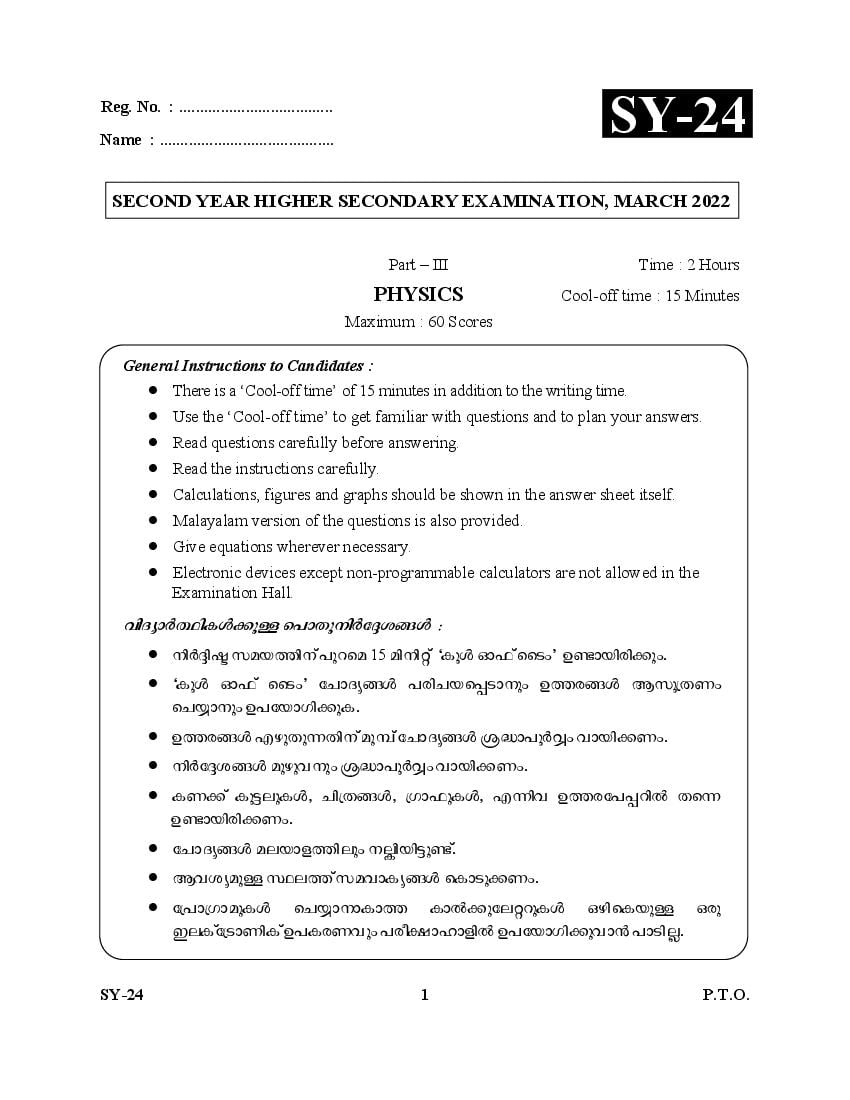
Name : ..........................................
SY-24
SECOND YEAR HIGHER SECONDARY EXAMINATION, MARCH 2022
Part – III Time : 2 Hours
PHYSICS Cool-off time : 15 Minutes
Maximum : 60 Scores
General Instructions to Candidates :
There is a ‘Cool-off time’ of 15 minutes in addition to the writing time.
Use the ‘Cool-off time’ to get familiar with questions and to plan your answers.
Read questions carefully before answering.
Read the instructions carefully.
Calculations, figures and graphs should be shown in the answer sheet itself.
Malayalam version of the questions is also provided.
Give equations wherever necessary.
Electronic devices except non-programmable calculators are not allowed in the
Examination Hall.
15 ‘ ’ .
‘ ’
.
.
.
, , ,
.
.
.
.
SY-24 1 P.T.O.
Page 2
A. Answer any 5 questions from 1 to 9. Each carries 1 score. (5 1 = 5)
1. SI unit of electric field
(a) NC–1 (b) Vm
(c) Cm (d) Nm
2. Name the force experienced by a charge q moving through a uniform magnetic field
with a velocity V.
3. Changing magnetic fields can set up current loops in nearby metal bodies. They
dissipate electrical energy as heat. Such currents are _____.
4. In purely inductive or capacitive circuit, power factor (cos ) is _____.
(a) 0
(b) 1
(c) –1
5. Relation between velocity of light (c), permeability of free space (0), permittivity of
free space (0) is _____.
1 1
(a) C= (b) C=
0 0 00
(c) C = 00 (d) C= 0 0
6. Light waves are _____ in nature.
(transverse, longitudinal)
7. Photons are electrically _____.
(a) neutral (b) positive
(c) negative (d) unpredictable
SY-24 2
Page 3
A. 1 9 5 .
1 . (5 1 = 5)
1. SI
(a) NC–1 (b) Vm
(c) Cm (d) Nm
2. V
q .
3.
.
. _____ .
4.
(cos ) = _____.
(a) 0
(b) 1
(c) –1
5. (c), (0),
(0) _____ .
1 1
(a) C= (b) C=
0 0 00
(c) C = 00 (d) C= 0 0
6. _____ .
( , )
7. _____ .
(a) (b)
(c) (d)
SY-24 3 P.T.O.
Page 4
atom is _____.
(a) + 13.6 J (b) – 13.6 J
(c) + 13.6 eV (d) – 13.6 eV
9. Complete the general equation of -decay.
A 4
Z X _____ + 2He
A–2 A–4
(a) Z – 4Y (b) Z – 2Y
A–2 A
(c) Z – 2Y (d) Z+1Y
B. Answer all questions from 10 to 13. Each carries 1 score. (4 1 = 4)
10. Electrostatic field at the surface of a charged conductor must be normal to the surface
at every point. Is the statement true or false ?
11. Magnitude of the drift velocity per unit electric field is _____.
12. The temperature at which a ferromagnetic material become paramagnetic is _____.
(a) Cut-off temperature
(b) Absolute temperature
(c) Curie temperature
13. Optical fibres make use the phenomenon of _____.
PART – II
A. Answer any 2 questions from 14 to 17. Each carries 2 scores. (2 2 = 4)
14. Draw the input and output waveform of a half-wave rectifier.
15. State Malus’ law.
16. What is angle of dip ?
17. A light bulb is rated at 100 W for a 220 V supply. Find the resistance of the bulb.
SY-24 4
Page 5
_____ .
(a) + 13.6 J (b) – 13.6 J
(c) + 13.6 eV (d) – 13.6 eV
9. .
A 4
Z X _____ + 2He
A–2 A–4
(a) Z – 4 Y (b) Z – 2Y
A–2 A
(c) Z – 2 Y (d) Z+1Y
B. 10 13 . 1 .
(4 1 = 4)
10.
.
?
11. _____.
12.
_____ .
(a) -
(b)
(c)
13. _____ .
PART – II
A. 14 17 2 .
2 . (2 2 = 4)
14. - , .
15. .
16. ?
17. 220 V 100 W .
.
SY-24 5 P.T.O.
Page 6
18. Infra-red waves are also referred to as heat waves. Why ?
19. (i) What is a solenoid ? (1)
(ii) Write down the equation for magnetic field inside a solenoid. (1)
20. Explain earthing.
PART – III
A. Answer any 3 questions from 21 to 24. Each carries 3 scores. (3 3 = 9)
21. Write down any three properties of an equipotential surfaces.
22. (i) SI unit of resistance is _____. (1)
(ii) Obtain the equivalent value of resistance when two resistors R 1 and R2 are
connected in series. (2)
23. (i) The angle between magnetic meridian and geographic meridian is _____. (1)
(ii) The declination is _____ (higher/smaller) at higher lattitudes and _____
(higher/smaller) near the equator. (2)
24. (i) If f = 0.5 m, for a glass lens, what is the power of the lens ? (1)
(ii) The radii of curvature of the faces of a double convex lens are 10 cm and 15 cm.
Its focal length is 12 cm. What is the refractive index of glass ? (2)
SY-24 6
Page 7
2 . (2 2 = 4)
18. - .
?
19. (i) ? (1)
(ii)
. (1)
20. .
PART – III
A. 21 24 3 .
3 . (3 3 = 9)
21. .
22. (i) SI _____ . (1)
(ii) R1, R2
. (2)
23. (i) ,
_____ . (1)
(ii) _____ (/)
_____ (/)
. (2)
24. (i) f = 0.5 m
? (1)
(ii) 10 cm,
15 cm . 12 cm
. (2)
SY-24 7 P.T.O.
Page 8
25. (i) Draw the energy level diagram for hydrogen atom and mark the transition
corresponding to Balmer series. (2)
(ii) Name the spectral series which lies in the ultraviolet region of the spectrum. (1)
26. (i) What is meant by the threshold frequency of a photosensitive metal ? (2)
(ii) Draw the graph showing the variation of stopping potential with frequency. (1)
27. Nuclear reactor is a device used to initiate and control a nuclear chain reaction.
Explain the major parts of a nuclear reactor.
PART – IV
A. Answer any 3 questions from 28 to 31. Each carries 4 scores. (3 4 = 12)
28. (i) SI unit of capacitance is _____. (1)
(ii) Two capacitors C1 and C2 are connected in series. Derive an expression for the
capacitance of the combination. (3)
29. (i) Which law help us to find the magnetic field on the axis of a circular current
loop ? (1)
(ii) Consider a tightly wound 100 turn coil of radius 10 cm, carrying current of 1 A.
What is the magnitude of the magnetic field at the centre of the coil ? (3)
30. (i) Which is the working principle of an a.c. generator ? (1)
(ii) With the help of a diagram explain the working of a.c. generator. (3)
31. (i) Identify the logic gate. (1)
(ii) Write down the truth table of this gate. (2)
(iii) Why this gate is also called universal gate ? (1)
SY-24 8
Page 9
3 . (2 3 = 6)
25. (i) .
. (2)
(ii) -
? (1)
26. (i)
? (2)
(ii)
. (1)
27.
.
.
PART – IV
A. 28 31 3 .
4 . (3 4 = 12)
28. (i) SI _____ . (1)
(ii) C1, C2
. (3)
29. (i)
? (1)
(ii) 10 cm 100
(coil) 1 A .
? (3)
30. (i) .. ? (1)
(ii) ..
. (3)
31. (i) . (1)
(ii) . (2)
(iii) ? (1)
SY-24 9 P.T.O.
Page 10
32. Using Huygen’s principle, explain refraction of a plane wave, with the help of a
diagram.
33. (i) State the principle of working of a transformer. (1)
(ii) Explain briefly any three energy losses in a transformer. (3)
PART – V
Answer any 2 questions from 34 to 36. Each carries 6 scores. (2 6 = 12)
34. (i) Write down the wheatstone bridge principle. (1)
(ii) A meter bridge circuit is given below.
R – unknown resistance
S – known resistance
Using this circuit, derive an expression for finding the unknown resistance. (2)
(iii) In the above circuit, the balance point is found to be at 40 cm from the end A,
when the resistance S is of 12. Determine the resistance R. (2)
(iv) Would the galvanometer show any current if the galvanometer and cell are
interchanged ? (1)
35. (i) State Gauss’s law. (2)
(ii) What is meant by a Gaussian surface ? (1)
(iii) Using Gauss’s law, find the electric field due to a uniformly charged thin
spherical shell at a point outside the shell. (3)
36. (i) State Laws of refraction. (2)
(ii) Obtain a relation for the total deviation produced for a ray incident on a prism
with the help of a ray diagram. (4)
__________
SY-24 10
Page 11
4 . (1 4 = 4)
32.
.
33. (i) . (1)
(ii) . (3)
PART – V
34 36 2 .
6 . (2 6 = 12)
34. (i) . (1)
(ii) .
R –
S –
. (2)
(iii) , 40 cm . (A
) , S = 12 . (R) . (2)
(iv)
? (1)
35. (i) . (2)
(ii) ? (1)
(iii) ,
. (3)
36. (i) . (2)
(ii)
. (4)
__________
SY-24 11 P.T.O.
Page 12
Document Details
| Board / Org | Kerala Board |
| Exam | Class 12 |
| Type | Question Paper |
| Pages | 12 |
| Updated | 22 Jul 2026 |