GATE 2018 Microbiology (XL-S) Question Paper with Answer
Finished viewing? Save it for later —
Download GATE 2018 Microbiology (XL-S) Question Paper with Answer (PDF · 9 pages)About GATE 2018 Microbiology (XL-S) Question Paper with Answer
GATE 2018 Microbiology (XL-S) Question Paper with Answer is available here for free download. Published by IIT for Graduate Aptitude Test in Engineering, this question paper can be viewed online or downloaded as a PDF (9 pages). Candidates preparing for Graduate Aptitude Test in Engineering can use GATE 2018 Microbiology (XL-S) Question Paper with Answer to understand the exam pattern, the type of questions asked, and the overall difficulty level.
Frequently Asked Questions
How can I download GATE 2018 Microbiology (XL-S) Question Paper with Answer?
Open this page and click the Download button to save GATE 2018 Microbiology (XL-S) Question Paper with Answer as a PDF. It is completely free on AglaSem Docs.
Is GATE 2018 Microbiology (XL-S) Question Paper with Answer free to download?
Yes. GATE 2018 Microbiology (XL-S) Question Paper with Answer can be viewed online and downloaded as a PDF free of cost on AglaSem Docs.
How many pages does GATE 2018 Microbiology (XL-S) Question Paper with Answer have?
GATE 2018 Microbiology (XL-S) Question Paper with Answer contains 9 pages, which you can read online or download together as a single PDF.
Where can I find more Graduate Aptitude Test in Engineering study material?
You can find more Graduate Aptitude Test in Engineering question papers, sample papers, syllabus, and answer keys on AglaSem Docs.
GATE 2018 Microbiology (XL-S) Question Paper with Answer – Text
Read the full text of this question paper below — useful to quickly search, copy and reference the content online without downloading the PDF.
📄 View text version (9 pages)
Page 1
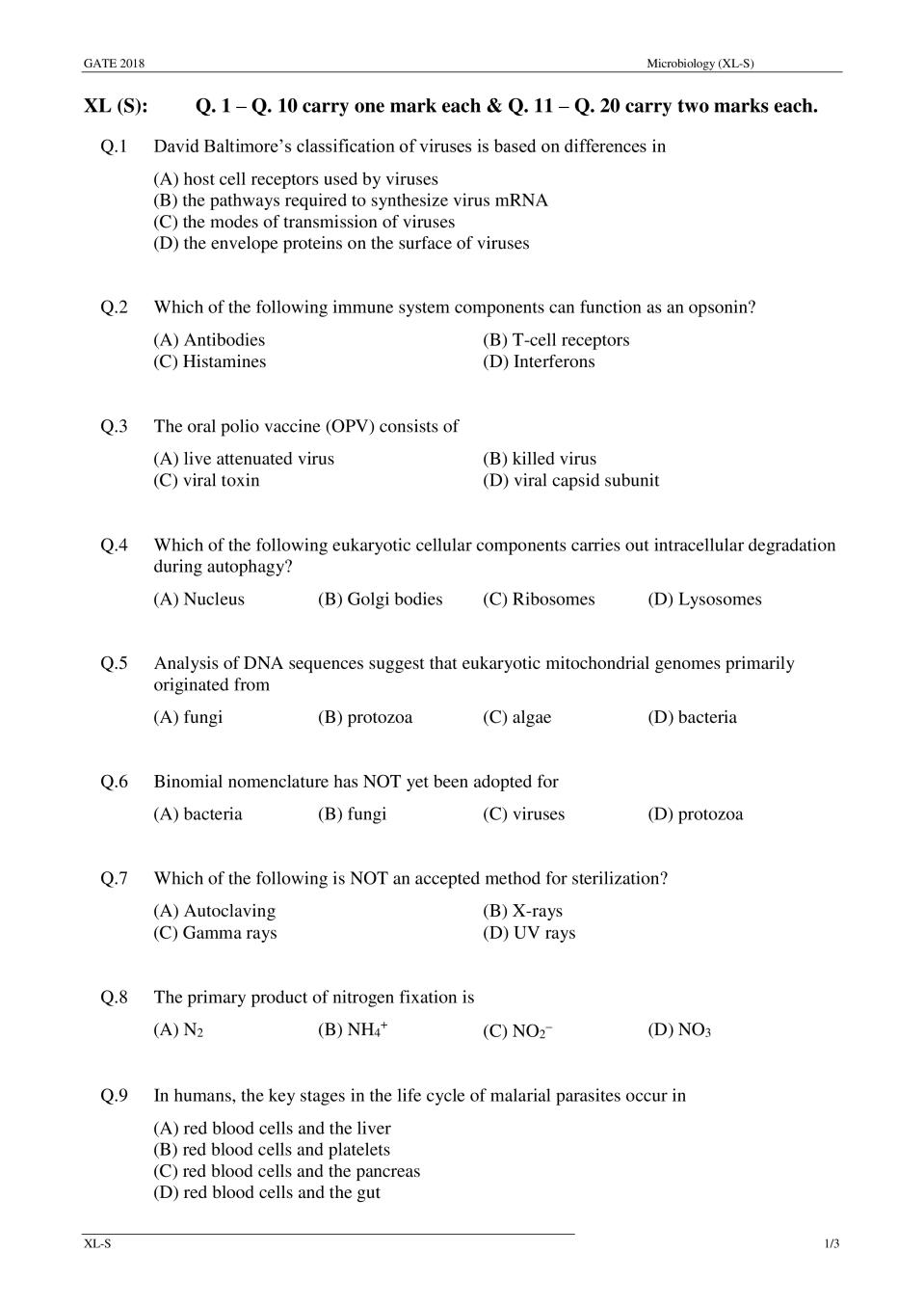
XL (S): Q. 1 – Q. 10 carry one mark each & Q. 11 – Q. 20 carry two marks each.
Q.1 David Baltimore’s classification of viruses is based on differences in
(A) host cell receptors used by viruses
(B) the pathways required to synthesize virus mRNA
(C) the modes of transmission of viruses
(D) the envelope proteins on the surface of viruses
Q.2 Which of the following immune system components can function as an opsonin?
(A) Antibodies (B) T-cell receptors
(C) Histamines (D) Interferons
Q.3 The oral polio vaccine (OPV) consists of
(A) live attenuated virus (B) killed virus
(C) viral toxin (D) viral capsid subunit
Q.4 Which of the following eukaryotic cellular components carries out intracellular degradation
during autophagy?
(A) Nucleus (B) Golgi bodies (C) Ribosomes (D) Lysosomes
Q.5 Analysis of DNA sequences suggest that eukaryotic mitochondrial genomes primarily
originated from
(A) fungi (B) protozoa (C) algae (D) bacteria
Q.6 Binomial nomenclature has NOT yet been adopted for
(A) bacteria (B) fungi (C) viruses (D) protozoa
Q.7 Which of the following is NOT an accepted method for sterilization?
(A) Autoclaving (B) X-rays
(C) Gamma rays (D) UV rays
Q.8 The primary product of nitrogen fixation is
(A) N2 (B) NH4+ (C) NO2 (D) NO3
Q.9 In humans, the key stages in the life cycle of malarial parasites occur in
(A) red blood cells and the liver
(B) red blood cells and platelets
(C) red blood cells and the pancreas
(D) red blood cells and the gut
XL-S 1/3
Page 2
Q.10 You have a 50 mg/mL stock solution of arginine. To prepare 1 liter of growth medium for
an arginine auxotroph that requires 70 µg/mL of arginine, the volume of this stock solution
that should be added is _____________ mL (up to 1 decimal point) .
Q.11 Accumulating evidence suggest that Domain Archaea is more closely related to Domain
Eukarya than to Domain Bacteria. Which of the following properties are shared between
eukaryotes and archaea ?
(i) Protein biogenesis
(ii) Presence of sterol containing membranes
(iii) Ribosomal subunit structures
(iv) Adaptation to extreme environmental conditions
(v) Fatty acids with ester linkages in the cell membrane
(A) (ii), (iii) and (v) (B) (i), (ii), (iv), and (v)
(C) (i) and (iii) (D) (iii) and (iv)
Q.12 Match the antimicrobial agents in group I with their category/mode of action in group II.
Group I Group II
(i) Fluoroquinolones (p) beta lactam antimicrobial
(ii) Amphotericin B (q) inhibition of protein synthesis
(iii) Tetracycline (r) inhibition of nucleic acid synthesis
(iv) Amoxicillin (s) antifungal agent
(A) (i)-(q), (ii)-(s), (iii)-(r), (iv)-(p) (B) (i)-(s), (ii)-(r), (iii)-(p), (iv)-(q)
(C) (i)-(r), (ii)-(s), (iii)-(q), (iv)-(p) (D) (i)-(s), (ii)-(r), (iii)-(q), (iv)-(p)
Q.13 Match the microorganisms to their predominant modes of transmission.
Microorganism Mode of Transmission
(i) Bordetella pertussis (p) Vector-borne
(ii) Dengue virus (q) Blood-borne
(iii) Entamoeba histolytica (r) Droplet infection
(iv) Hepatitis B virus (s) Contaminated food
(A) (i)-(r), (ii)-(p), (iii)-(s), (iv)-(q) (B) (i)-(s), (ii)-(q), (iii)-(p), (iv)-(r)
(C) (i)-(q), (ii)-(p), (iii)-(s), (iv)-(r) (D) (i)-(s), (ii)-(r), (iii)-(p), (iv)-(q)
Q.14 Match the precursors/intermediates with the corresponding metabolic pathways.
Precursor/Intermediates Metabolic pathway
(i) Inosine monophosphate (p) L-methionine biosynthesis
(ii) Ornithine (q) L-tryptophan biosynthesis
(iii) Chorismate (r) Purine biosynthesis
(iv) Homocysteine (s) L-arginine biosynthesis
(A) (i)-(q), (ii)-(r), (iii)-(s), (iv)-(p) (B) (i)-(p), (ii)-(r), (iii)-(s), (iv)-(q)
(C) (i)-(r), (ii)-(p), (iii)-(s), (iv)-(q) (D) (i)-(r), (ii)-(s), (iii)-(q), (iv)-(p)
XL-S 2/3
Page 3
Q.15 Match the scientists to their area of major contribution
Scientists Area of major contribution
(i) Antonie van Leeuwenhoek (p) Taxonomy
(ii) Carl Linnaeus (q) Antimicrobial agents
(iii) Sir Alexander Fleming (r) Vaccination
(iv) Louis Pasteur (s) Microscopy
(A) (i)-(s), (ii)-(q), (iii)-(p), (iv)-(r) (B) (i)-(s), (ii)-(p), (iii)-(q), (iv)-(r)
(C) (i)-(p), (ii)-(s), (iii)-(r), (iv)-(q) (D) (i)-(q), (ii)-(p), (iii)-(r), (iv)-(s)
Q.16 Which of the following combinations would improve the resolution of a microscope?
(i) Increasing the half aperture angle of the objective lens
(ii) Decreasing the wavelength of the illumination source
(iii) Decreasing the numerical aperture of the objective lens
(iv) Decreasing the refractive index of immersion medium
(A) (i) and (ii) (B) (ii) and (iii) (C) (ii) and (iv) (D) (i) and (iii)
Q.17 Active transport involves the movement of a biomolecule against a concentration gradient
across the cell membrane using metabolic energy. If the extracellular concentration of a
biomolecule is 0.005M and its intracellular concentration is 0.5M, the least amount of
energy that the cell would need to spend to transport this biomolecule from the outside to
the inside of the cell is ________ kcal/mol (up to 2 decimal points).
(Temperature T = 298K and universal gas constant R= 1.98 cal/molK)
Q.18 A continuous cell culture being carried out in a stirred tank
reactor is described in terms of its cell mass concentration X SF = 10 g/L X, S
and substrate concentration S. The concentration of the
substrate in the sterile feed stream is SF = 10 g/L and yield
coefficient Yx/s = 0.5. The flow rates of the feed stream and
the exit stream are equal (F=5 mL/min) and constant. If the
0.3 𝑆
specific growth rate (h-1) 𝜇 = (1+𝑆), the steady state V=3L
concentration of S is _____ g/L (up to 1 decimal point).
Q.19 The initial concentration of cells (N0) growing unrestricted in a culture is 1.0×10⁶
cells/mL. If the specific growth rate (µ) of the cells is 0.1 h-1, the time required for the cell
concentration to become 1.0×10⁸ cells/mL is _________ hours (up to 2 decimal points).
Q.20 The following stoichiometric equation represents the conversion of glucose to lactic acid in
a cell:
Glucose + 2Pi + 2ADP 2Lactate + 2ATP +2H2O
If the free energy of conversion of glucose to lactic acid only is ∆G0 = 47000 cal/mol, the
efficiency of energy transfer is _______ % (up to 1 decimal point).
(∆G0 for ATP hydrolysis is 7.3 kcal/mol)
END OF THE QUESTION PAPER
XL-S 3/3
Page 4
1 MCQ GA A 1
2 MCQ GA C 1
3 MCQ GA B 1
4 MCQ GA B 1
5 MCQ GA B 1
6 MCQ GA A 2
7 MCQ GA D 2
8 MCQ GA D 2
9 MCQ GA B 2
10 MCQ GA C 2
1 MCQ XL‐P A 1
2 MCQ XL‐P D 1
3 MCQ XL‐P D 1
4 NAT XL‐P 11 to 11 1
5 NAT XL‐P 4 to 4 1
6 MCQ XL‐P D 2
7 MCQ XL‐P D 2
8 MCQ XL‐P A 2
9 MCQ XL‐P D 2
10 MCQ XL‐P A 2
11 MCQ XL‐P C 2
12 MCQ XL‐P B 2
13 NAT XL‐P 1.39 to 1.43 2
Page 5
14 NAT XL‐P 7.39 to 7.54 2
15 NAT XL‐P ‐13.40 to ‐13.36 2
1 MCQ XL‐Q B 1
2 MCQ XL‐Q A 1
3 MCQ XL‐Q C 1
4 MCQ XL‐Q C 1
5 MCQ XL‐Q D 1
6 MCQ XL‐Q C 1
7 MCQ XL‐Q D 1
8 MCQ XL‐Q B 1
9 NAT XL‐Q 12 to 12 1
10 NAT XL‐Q 50 to 50 1
11 MCQ XL‐Q A 2
12 MCQ XL‐Q A 2
13 MCQ XL‐Q D 2
14 MCQ XL‐Q B 2
15 MCQ XL‐Q B 2
16 NAT XL‐Q 512 to 512 2
17 NAT XL‐Q 20 to 20 2
18 NAT XL‐Q 0.8 to 0.8 2
19 NAT XL‐Q 77 to 77 2
20 NAT XL‐Q ‐8862 to ‐8862 2
1 MCQ XL‐R A 1
Page 6
2 MCQ XL‐R B 1
3 MCQ XL‐R C 1
4 MCQ XL‐R D 1
5 MCQ XL‐R B 1
6 MCQ XL‐R C 1
7 MCQ XL‐R A 1
8 MCQ XL‐R A 1
9 MCQ XL‐R B 1
10 NAT XL‐R 28.00 to 31.00 1
11 MCQ XL‐R D 2
12 MCQ XL‐R D 2
13 MCQ XL‐R C 2
14 MCQ XL‐R B 2
15 MCQ XL‐R C 2
16 MCQ XL‐R D 2
17 MCQ XL‐R A 2
18 MCQ XL‐R B 2
19 NAT XL‐R 20.25 to 20.25 2
20 NAT XL‐R 11.00 to 12.00 2
1 MCQ XL‐S B 1
2 MCQ XL‐S A 1
3 MCQ XL‐S A 1
4 MCQ XL‐S D 1
Page 7
5 MCQ XL‐S D 1
6 MCQ XL‐S C 1
7 MCQ XL‐S D 1
8 MCQ XL‐S B 1
9 MCQ XL‐S A 1
10 NAT XL‐S 1.38 to1.42 1
11 MCQ XL‐S C 2
12 MCQ XL‐S C 2
13 MCQ XL‐S A 2
14 MCQ XL‐S D 2
15 MCQ XL‐S B 2
16 MCQ XL‐S A 2
17 NAT XL‐S 2.60 to 2.80 2
18 NAT XL‐S 0.5 to 0.5 2
19 NAT XL‐S 45.50 to 46.50 2
20 NAT XL‐S 30.5 to 31.5 2
1 MCQ XL‐T C 1
2 MCQ XL‐T B 1
3 MCQ XL‐T A 1
4 MCQ XL‐T D 1
5 MCQ XL‐T C 1
6 MCQ XL‐T D 1
7 MCQ XL‐T B 1
Page 8
8 MCQ XL‐T A 1
9 MCQ XL‐T A 1
10 MCQ XL‐T C 1
11 MCQ XL‐T B 2
12 MCQ XL‐T D 2
13 MCQ XL‐T C 2
14 MCQ XL‐T C 2
15 MCQ XL‐T B 2
16 MCQ XL‐T D 2
17 MCQ XL‐T C 2
18 MCQ XL‐T A 2
19 NAT XL‐T 5270 to 5310 2
20 NAT XL‐T 0.056 to 0.062 2
1 MCQ XL‐U B 1
2 MCQ XL‐U A 1
3 MCQ XL‐U C 1
4 MCQ XL‐U A 1
5 MCQ XL‐U D 1
6 MCQ XL‐U D 1
7 NAT XL‐U 1.55 to 1.65 1
8 NAT XL‐U 103.0 to 103.2 1
9 NAT XL‐U 54 to 56 1
10 NAT XL‐U 0 to 0 1
Page 9
11 MCQ XL‐U B 2
12 MCQ XL‐U C 2
13 MCQ XL‐U C 2
14 MCQ XL‐U A 2
15 MCQ XL‐U D 2
16 MCQ XL‐U A 2
17 MCQ XL‐U B 2
18 NAT XL‐U 9.8 to 10.2 2
19 NAT XL‐U 1.1 to 1.8 2
20 NAT XL‐U 10 to 10 2
Document Details
| Board / Org | IIT |
| Exam | Graduate Aptitude Test in Engineering |
| Type | Question Paper |
| Pages | 9 |
| Updated | 30 Apr 2026 |