MBOSE Class 11 Question Paper 2020 for Biology
Finished viewing? Save it for later —
Download MBOSE Class 11 Question Paper 2020 for Biology (PDF · 4 pages)About MBOSE Class 11 Question Paper 2020 for Biology
MBOSE Class 11 Question Paper 2020 for Biology is available here for free download. Published by Meghalaya Board for Class 11, this question paper can be viewed online or downloaded as a PDF (4 pages). Candidates preparing for Class 11 can use MBOSE Class 11 Question Paper 2020 for Biology to understand the exam pattern, the type of questions asked, and the overall difficulty level.
Frequently Asked Questions
How can I download MBOSE Class 11 Question Paper 2020 for Biology?
Open this page and click the Download button to save MBOSE Class 11 Question Paper 2020 for Biology as a PDF. It is completely free on AglaSem Docs.
Is MBOSE Class 11 Question Paper 2020 for Biology free to download?
Yes. MBOSE Class 11 Question Paper 2020 for Biology can be viewed online and downloaded as a PDF free of cost on AglaSem Docs.
How many pages does MBOSE Class 11 Question Paper 2020 for Biology have?
MBOSE Class 11 Question Paper 2020 for Biology contains 4 pages, which you can read online or download together as a single PDF.
Where can I find more Class 11 study material?
You can find more Class 11 question papers, sample papers, syllabus, and answer keys on AglaSem Docs.
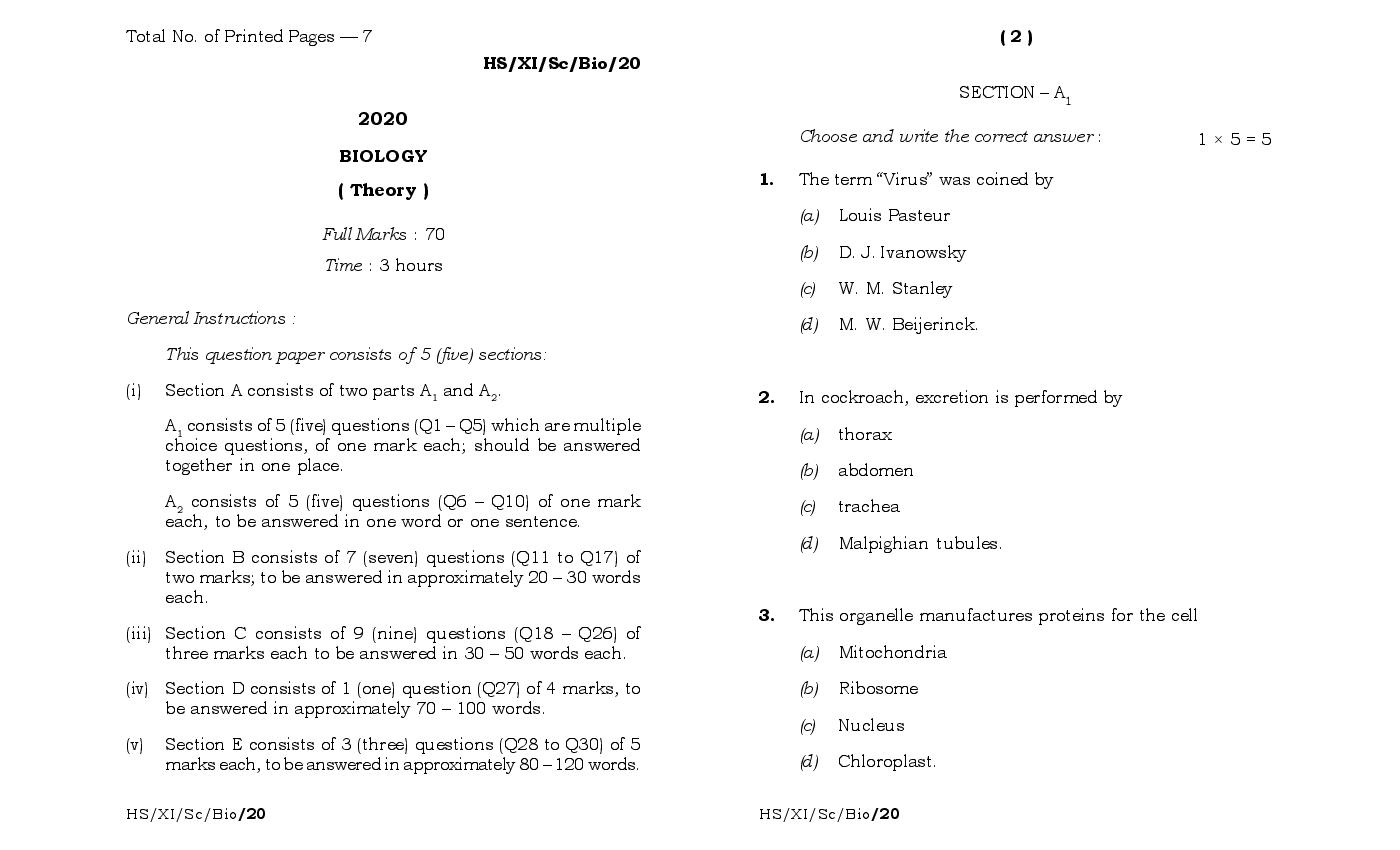
MBOSE Class 11 Question Paper 2020 for Biology – Text
Read the full text of this question paper below — useful to quickly search, copy and reference the content online without downloading the PDF.
📄 View text version (4 pages)
Page 1
SECTION – A1
2020
Choose and write the correct answer : 1 5=5
BIOLOGY
1. The term “Virus” was coined by
( Theory )
(a) Louis Pasteur
Full Marks : 70
(b) D. J. Ivanowsky
Time : 3 hours
(c) W. M. Stanley
General Instructions : (d) M. W. Beijerinck.
This question paper consists of 5 (five) sections:
(i) Section A consists of two parts A1 and A2. 2. In cockroach, excretion is performed by
A1 consists of 5 (five) questions (Q1 – Q5) which are multiple (a) thorax
choice questions, of one mark each; should be answered
together in one place. (b) abdomen
A2 consists of 5 (five) questions (Q6 – Q10) of one mark (c) trachea
each, to be answered in one word or one sentence.
(d) Malpighian tubules.
(ii) Section B consists of 7 (seven) questions (Q11 to Q17) of
two marks; to be answered in approximately 20 – 30 words
each.
3. This organelle manufactures proteins for the cell
(iii) Section C consists of 9 (nine) questions (Q18 – Q26) of
three marks each to be answered in 30 – 50 words each. (a) Mitochondria
(iv) Section D consists of 1 (one) question (Q27) of 4 marks, to (b) Ribosome
be answered in approximately 70 – 100 words.
(c) Nucleus
(v) Section E consists of 3 (three) questions (Q28 to Q30) of 5
marks each, to be answered in approximately 80 – 120 words. (d) Chloroplast.
HS/XI/Sc/Bio/20 HS/XI/Sc/Bio/20
Page 2
4. Polymorphism is the characteristic feature of phylum SECTION – B
(a) Porifera ( Short answer – I) 2 7 = 14
(b) Cnidaria
(c) Ctenophora 11. Draw a well labelled diagram of a transverse section
(d) Platyhelminthes. of a dicot leaf.
5. Water vascular system is present in animals belonging 12. Name the bonds that bind amino acids in a protein
to the Phylum and monosaccharides in carbohydrates.
(a) Porifera
(b) Arthropoda 13. Differentiate between prokaryotic and eukaryotic
(c) Echinodermata cells.
(d) Mollusca.
14. Draw a labelled diagram of human eye.
SECTION – A2
15. Which plant growth regulators would be used for
( Very short answer ) 1 5=5 1+1=2
(a) delaying leaf senescence
6. What is the scientific name of Rohu? (b) quick ripening of fruits
7. Define Parthenocarpic fruits.
16. Define Respiratory Quotient. What is its value for fats?
8. Name one respiratory disorder in man. 1+1=2
9. Differentiate between passive and active transport. 17. Differentiate between any one of the following:
10. Name the red pigment present in the members of (a) Blood and Lymph
Rhodophyceae.
(b) Actin and Myosin
HS/XI/Sc/Bio/20 HS/XI/Sc/Bio/20
Page 3
SECTION –– C 24. List the hormones secreted by the following: 1 3=3
( Short answer – II ) 3 9 = 27 (a) Pancreas
(b) Ovary
18. Write down the characteristic features of
(c) Kidney.
Deuteromycetes.
Or 25. Draw a labelled diagram of a nephron.
Give an outline of Five Kingdom classification. Who
proposed this classification? 2+ 1=3 26. Describe the different types of phyllotaxy with suitable
diagrams. 2+1=3
19. Name the factors affecting enzyme activity. Describe
any one. 1+ 2=3 SECTION – D
27. Briefly describe the different types of connective tissue. 4
20. Distinguish between Osmosis and Diffusion.
Or
RuBisCO is an enzyme that acts both as a carboxylase
21. With the help of a suitable diagram, briefly describe
and a oxygenase. Why do you think RuBisCO carries
the structure of chloroplast. 1+ 2=3
out more carboxylation in C4 plants? 4
22. Name the two types of nucleic acids. Give the
SECTION – E
differences between them. 1+ 2=3
( Long answer type ) 5 3 = 15
23. Bile juices contain no digestive enzymes, yet it is
28. Describe the mechanism of opening and closing of
important for digestion. Why?
stomata.
Or Or
Define the terms “thecodont” and “diphyodont” Mention the important characteristics of phylum
with examples. 1+1+1=3 Annelida.
HS/XI/Sc/Bio/20 HS/XI/Sc/Bio/20
Page 4
29. What are endocrine glands? How are they different
from exocrine glands? List the different hormones
produced by pituitary gland. 1+2+2=5
Or
Describe the mechanism of blood clotting.
30. Give an account of citric acid cycle with suitable a
diagram.
Or
Describe the non-cyclic photophosphorylation in
plants. Is NADPH produced during cyclic
photophosphorylation? 4+1=5
Document Details
| Board / Org | Meghalaya Board |
| Exam | Class 11 |
| Type | Question Paper |
| Pages | 4 |
| Updated | 30 Apr 2026 |