MBOSE Class 11 Question Paper 2020 for Chemistry
Finished viewing? Save it for later —
Download MBOSE Class 11 Question Paper 2020 for Chemistry (PDF · 6 pages)About MBOSE Class 11 Question Paper 2020 for Chemistry
MBOSE Class 11 Question Paper 2020 for Chemistry is available here for free download. Published by Meghalaya Board for Class 11, this question paper can be viewed online or downloaded as a PDF (6 pages). Candidates preparing for Class 11 can use MBOSE Class 11 Question Paper 2020 for Chemistry to understand the exam pattern, the type of questions asked, and the overall difficulty level.
Frequently Asked Questions
How can I download MBOSE Class 11 Question Paper 2020 for Chemistry?
Open this page and click the Download button to save MBOSE Class 11 Question Paper 2020 for Chemistry as a PDF. It is completely free on AglaSem Docs.
Is MBOSE Class 11 Question Paper 2020 for Chemistry free to download?
Yes. MBOSE Class 11 Question Paper 2020 for Chemistry can be viewed online and downloaded as a PDF free of cost on AglaSem Docs.
How many pages does MBOSE Class 11 Question Paper 2020 for Chemistry have?
MBOSE Class 11 Question Paper 2020 for Chemistry contains 6 pages, which you can read online or download together as a single PDF.
Where can I find more Class 11 study material?
You can find more Class 11 question papers, sample papers, syllabus, and answer keys on AglaSem Docs.
MBOSE Class 11 Question Paper 2020 for Chemistry – Text
Read the full text of this question paper below — useful to quickly search, copy and reference the content online without downloading the PDF.
📄 View text version (6 pages)
Page 1
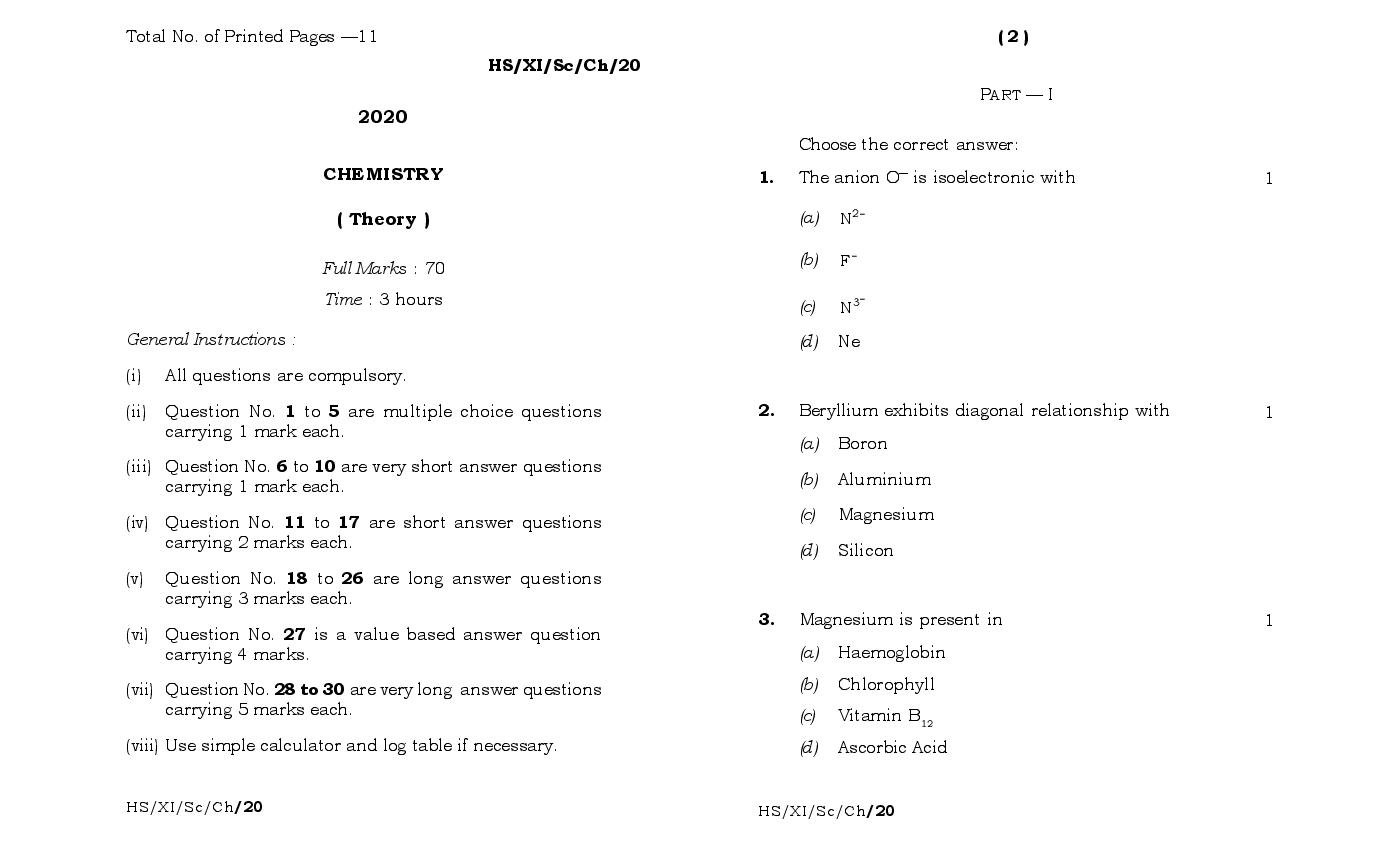
HS/XI/Sc/Ch/20
PART –– I
2020
Choose the correct answer:
CHEMISTRY 1. The anion O– is isoelectronic with 1
( Theory ) (a) N2
Full Marks : 70
(b) F
Time : 3 hours (c) N3
General Instructions : (d) Ne
(i) All questions are compulsory.
(ii) Question No. 1 to 5 are multiple choice questions 2. Beryllium exhibits diagonal relationship with 1
carrying 1 mark each.
(a) Boron
(iii) Question No. 6 to 10 are very short answer questions
carrying 1 mark each. (b) Aluminium
(iv) Question No. 11 to 17 are short answer questions (c) Magnesium
carrying 2 marks each. (d) Silicon
(v) Question No. 18 to 26 are long answer questions
carrying 3 marks each.
3. Magnesium is present in 1
(vi) Question No. 27 is a value based answer question
carrying 4 marks. (a) Haemoglobin
(vii) Question No. 28 to 30 are very long answer questions (b) Chlorophyll
carrying 5 marks each. (c) Vitamin B12
(viii) Use simple calculator and log table if necessary. (d) Ascorbic Acid
HS/XI/Sc/Ch/20 HS/XI/Sc/Ch/20
Page 2
4. Homolytic fission of a covalent bond leads to the 9. What is dry ice? 1
formation of 1
(a) Electrophile 10. What is electromeric effect? 1
(b) Nucleophile
PART –– III
(c) Free radical
(d) Carbocation
11. The molecular mass of an organic compound is 78 and
its percentage composition is 92.4% C and 7.6% H.
Determine the molecular formula of the compound. 2
5. A person living in Shimla observed that cooking food
without using pressure cooker takes more time. The
reason for this observation is that, at high altitude: 1 12. Calculate the uncertainty in the position of an electron
if the uncertainty in its velocity is 5.7 10 5 ms –1
(a) Pressure increases (h = 6.6 10 –34 Js and mass of electron is 9.1 10 –31 kg). 2
(b) Temperature decreases
13. Give the principle involved in solvay process for the
(c) Pressure decreases manufacture of sodium carbonate. 2
(d) Temperature increases Either
14. (a) Define and explain Law of Multiple Proportion
PART –– II with suitable example. 2
6. Define molality of a solution. 1 Or
7. Give the electronic configuration of Cu (Z=29) and
Cr (Z=24). 1 (b) Calculate the molarity of NaOH in the solution
prepared by dissolving its 4.0g in enough water
to form 250ml of the solution. 2
8. Define critical temperature. 1
HS/XI/Sc/Ch/20 HS/XI/Sc/Ch/20
Page 3
15. Using Markovnikov’s rule, find the product of the 1
following reactions. (ii) H2 O2 H2O, H 285 .8 kJ
2
1
(i) CH3 CH CH2 HBr 1 (iii) C2H6 O2 2CO2 3H2O, H 1560 kJ
2
CH3
19. (a) Oxygen is more electronegative than nitrogen but
(ii) CH3 C CH2 HCl 1 nitrogen has higher Ionisation Energy than
oxygen. Why? 1
16. Derive the Ideal Gas Equation. 2 (b) Explain why second ionisation energy of Mg is
less than that of Na? 1
Either 1
(c) Define electron gain enthalpy.
17. (a) Define hybridisation and explain taking BCl3
molecule as an example. 2
20. (a) Give the relation between Gibb’s Free energy
change and the Equilibrium constant of a reaction. 1
Or
(b) What is common ion effect? 1
(b) What is Hydrogen bonding? What are the
conditions necessary for the formation of
hydrogen bonding? 2 (c) State Le Chatelier Principle. 1
PART –– IV Either
18. (a) What is enthalpy of formation? 1 21. (a) What are hydrides? What are the different types
of hydrides? 2
(b) Calculate the enthalpy of formation of C2H6 from
the following data: 2
(b) Give one chemical reaction of H2O2 showing its
(i) C O2 CO2 , H 393.5 kJ oxidising action in acidic medium. 1
HS/XI/Sc/Ch/20 HS/XI/Sc/Ch/20
Page 4
Or 25. (a) State the Second Law of Thermodynamics. 1
(c) Give one method of preparation of H 2O 2 with
equation. 2 (b) For the reaction, 2
(d) Write one method to remove temporary hardness
of water. 2NOCl (g) 2NO (g) + Cl2 (g), the value of the
1
equilibrium constant Kc is 3.75 10– 6 at 1069 K.
Either Calculate Kp for the reaction at this temperature.
22. (a) Explain on the basis of Molecular Orbital Theory (R=0.0831 L bar K–1 mol–1)
why O2 is paramagnetic but O22 is not. 3
Or
26. (a) Give the general electronic configuration of
(b) Discuss the shapes of the following molecules on alkaline earth metals. 1
the basis of VSEPR theory. 3
(i) NH3
(b) Define oxidation number. Find the oxidation
(ii) H2O number of Fe in K 4 FeCN6 . 1+1=2
(iii) CO3
23. (a) A microscope using suitable photons is employed PART – V
to locate an electron in an atom within a distance
of 0.1Å. What is the uncertainty, involved in the 27. Recently, different state governments are imposing a
measurement of its velocity? 2 ban on use of any kind of polythene bags. But
(b) State Pauli’s exclusion principle. polythene bags are of great use to us for packing
1
different types of materials. Can you avoid its use?
How do you agree or disagree with the government’s
24. (a) A balloon is filled with hydrogen at room decision? 4
temperature. It will burst if pressure exceeds 0.25
bar. If at 1 bar pressure the gas occupies 2.40 L
volume, upto what volume can the balloon be Either
expanded? 2
28. (a) Successive nitration in benzene takes place in
(b) What is an adiabatic process? 1 meta position. Explain why? 2
HS/XI/Sc/Ch/20 HS/XI/Sc/Ch/20
Page 5
(b) Complete the following reactions: (f) Convert the following into bond-line structure 1
Br O
Anhydrous CH3– C – CH2 – CH2 – C – OH
(i) CH3Cl 1
AlCl3
CH3
H O / H Either
(ii) HC CH 2 1
HgSO4
29. (a) CCl4 cannot be hydrolysed while SiCl4 can be
easily hydrolysed. Explain why? 2
(c) Give the IUPAC name of 1 (b) Complete the following reactions.
(i) H3 BO 3 1
(ii) SiO2 NaOH 1
Or
(c) What is the general electronic configuration of
(d) What is resonance? Draw the resonating structure the outer most shell in group 13 elements? 1
of nitrobenzene. 2
Or
(e) Complete the following reactions:
(d) Write two general characteristics of p–block
elements. 1
(i) CH3 CH2 Cl alcoholic KOH 1
SO3 (e) Write the general electronic configuration of
(ii) + H2SO4
1
330K group 14 elements. How does diamond and
graphite differ in terms of electrical conductivity
and hardness? 1+1=2
HS/XI/Sc/Ch/20 HS/XI/Sc/Ch/20
Page 6
(f) Give one method of preparation of boric acid with
chemical equation. 2
30. (a) What are isomers? 1
(b) Give appropriate examples of the following types
of structural isomers:
(i) Functional isomers 1
(ii) Position isomers 1
(c) What is a carbocation? 1
(d) Give one example each of an electrophile and a
nucleophile. 1
HS/XI/Sc/Ch/20
Document Details
| Board / Org | Meghalaya Board |
| Exam | Class 11 |
| Type | Question Paper |
| Pages | 6 |
| Updated | 30 Apr 2026 |