PSEB 12th Sample Paper 2025 Punjab History and Culture
Finished viewing? Save it for later —
Download PSEB 12th Sample Paper 2025 Punjab History and Culture (PDF · 4 pages)About PSEB 12th Sample Paper 2025 Punjab History and Culture
PSEB 12th Sample Paper 2025 Punjab History and Culture is available here for free download. Published by Punjab Board for Class 12, this sample paper can be viewed online or downloaded as a PDF (4 pages). Candidates preparing for Class 12 can use PSEB 12th Sample Paper 2025 Punjab History and Culture to understand the exam pattern, the type of questions asked, and the overall difficulty level.
Frequently Asked Questions
How can I download PSEB 12th Sample Paper 2025 Punjab History and Culture?
Open this page and click the Download button to save PSEB 12th Sample Paper 2025 Punjab History and Culture as a PDF. It is completely free on AglaSem Docs.
Is PSEB 12th Sample Paper 2025 Punjab History and Culture free to download?
Yes. PSEB 12th Sample Paper 2025 Punjab History and Culture can be viewed online and downloaded as a PDF free of cost on AglaSem Docs.
How many pages does PSEB 12th Sample Paper 2025 Punjab History and Culture have?
PSEB 12th Sample Paper 2025 Punjab History and Culture contains 4 pages, which you can read online or download together as a single PDF.
Where can I find more Class 12 study material?
You can find more Class 12 question papers, sample papers, syllabus, and answer keys on AglaSem Docs.
PSEB 12th Sample Paper 2025 Punjab History and Culture – Text
Read the full text of this sample paper below — useful to quickly search, copy and reference the content online without downloading the PDF.
📄 View text version (4 pages)
Page 1
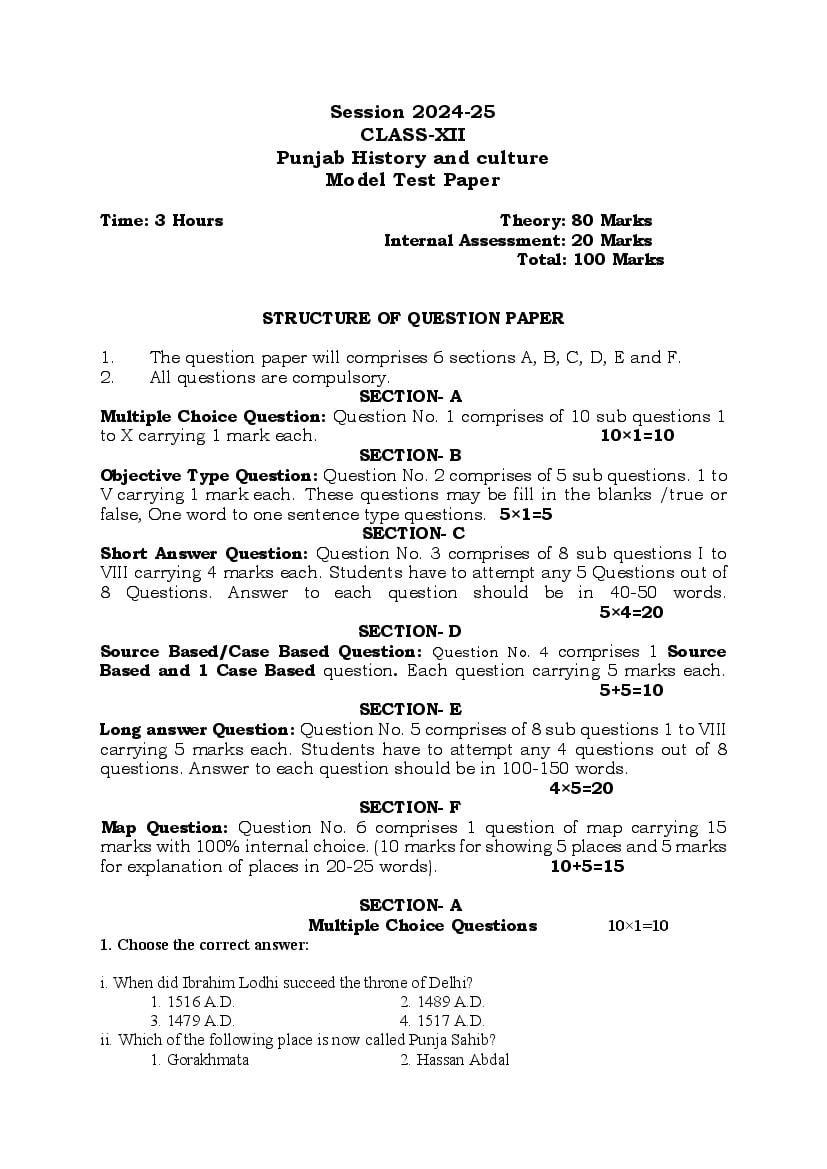
CLASS-XII
Punjab History and culture
Model Test Paper
Time: 3 Hours Theory: 80 Marks
Internal Assessment: 20 Marks
Total: 100 Marks
STRUCTURE OF QUESTION PAPER
1. The question paper will comprises 6 sections A, B, C, D, E and F.
2. All questions are compulsory.
SECTION- A
Multiple Choice Question: Question No. 1 comprises of 10 sub questions 1
to X carrying 1 mark each. 10×1=10
Objective Type Question: Question No. 2 comprises of 5 sub questions. 1 to
V carrying 1 mark each. These questions may be fill in the blanks /true or
false, One word to one sentence type questions. 5×1=5
Short Answer Question: Question No. 3 comprises of 8 sub questions I to
VIII carrying 4 marks each. Students have to attempt any 5 Questions out of
8 Questions. Answer to each question should be in 40-50 words.
5×4=20
Source Based/Case Based Question: Question No. 4 comprises 1 Source
Based and 1 Case Based question. Each question carrying 5 marks each.
5+5=10
Long answer Question: Question No. 5 comprises of 8 sub questions 1 to VIII
carrying 5 marks each. Students have to attempt any 4 questions out of 8
questions. Answer to each question should be in 100-150 words.
4×5=20
Map Question: Question No. 6 comprises 1 question of map carrying 15
marks with 100% internal choice. (10 marks for showing 5 places and 5 marks
for explanation of places in 20-25 words). 10+5=15
SECTION- A
Multiple Choice Questions 10×1=10
1. Choose the correct answer:
i. When did Ibrahim Lodhi succeed the throne of Delhi?
1. 1516 A.D. 2. 1489 A.D.
3. 1479 A.D. 4. 1517 A.D.
ii. Which of the following place is now called Punja Sahib?
1. Gorakhmata 2. Hassan Abdal
Page 2
iii. Give the name the Sikh Guru who is known as Bal Guru?
1. Guru Teg Bahadur Ji 2. Guru Harkishan ji
3. Guru Amar Das Ji 4. Guru Arjan Dev Ji
iv. Where was Guru Gobind Singh met Banda Singh Bahadur?
1. Nanded 2.Anandpur
3. Patna 4. Delhi
v. Who was the chief commander of Dal Khalsa?
1. Jassa Singh Ahluwalia 2.Jassa Singh Ramgarhia
3. NawabKapur Singh 4. Maharaja Ranjit Singh
vi.Write the name of Misl founded by Charat Singh?
1. Kanahia Misl 2.Sukarchakia Misl
3. Nishanwalia Misl 4.Shahid Misl
vii. What was the capital of Punjab at the time of Maharaja Ranjit Singh?
1. Islamabad 2. Ropar
3. Lahore 4. Peshawar
viii. When was Punjab annexed to British Empire?
1.1849 A.D. 2. 1911 A.D.
3. 1793 A.D. 4. 1764 A.D.
ix. Who wrote the famous tale of Pooran Bhagat?
1. Waris Shah 2.Qadir Yar
3. Shah Muhammad 4. Ahmed Yar
x. Who was the court poet of Maharaja Ranjit Singh?
1. Qadaryar 2. Ahmed Yar
3. Hashim Shah 4. Shah Muhammad
2. Objective Type Questions: 5×1= 5
Fill in the blanks.
i. ………………………was sister of Guru Nanak Dev Ji.
ii. The first Anglo-Sikh war began with the battle of ..................
Write True or False.
iii. Two swords called Miri and Piri were worn by Guru Ram Das Ji.
iv. Chuchak was a big landlord of village Takhat Hazara.
One word to one sentence questions.
v. What is meant by Nadar?
3. Answer any 5 questions in 40-50 words. 5x4=20
i. Give the causes of Babur’s invasion.
ii. What professions did Guru Nanak Dev ji adopt in his early life?
iii. Write about Anand Sahib.
iv. How did the Sikh Misls originate?
v. Describe the events of bravery of Maharaja Ranjit Singh's childhood.
vi. Maharaja Ranjit Singh was a secular ruler. How?
vii. Write down the three main causes of First Anglo Sikh War.?
viii. Describe the legend of Heer-Ranjha.
Page 3
(1) The word Sikh is the Punjabi form of Sanskrit Shishya, which means a learner or a
disciple. The Sikhs as a community are the disciples and followers of the Gurus, Nanak to
Gobind Singh, who created out of the disunited and emasculated fabric of society in Northern
India a well-knit homogeneous body of people devoted in a bold and selfless spirit to the service
of their countrymen. Guru Nanak was born at Talwandi Rai Bhoi (now called Nankana Sahib),
to the south-west of Lahore (Pakistan) in April 1469. He was a revolutionary, religious and
social reformer according to whom the political and cultural domination of the people by the
ruling and priestly classes was chiefly responsible for their degeneration. Their emancipation,
he thought could only be brought about by a new consciousness which should instil into them
the unity and fatherhood of God and the equality and fraternity of man. He refused to recognize
the distinctions between man and man and between the sexes created by the old caste systems
and other orthodox social conventions and proclaimed that all women born were equal in the
eyes of God.
Answer the following questions:
i. When was founder of Sikhism born? 1
ii. Explain Guru Nanak Dev Ji as social reformer. 2
iii. Analyse the caste system at the time of Guru Nanak Dev Ji. 2
(2) Guru Gobind Singh had, before his immersing into Enternal Light, reclaimed at Nanded
an ascetic Bairagi, Madho Das, converting him to his faith with the name of Banda Singh and
reluming him with Promethean fire to continue his struggle for freedom of the Punjab from
under the oppressing yoke of the Mughals. The Sikhs under his command soon embarked on a
career of conquest and within a few months of his arrival in the Punjab dislodged the Mughal
power from the Cis-Sutlej territories. Samana, Shahabad and Sadhaura were among the first
important places to fall to Banda Singh who occupied the fort of Mukhlis-garh to the North-
East to Sadhaura to make it his capital. He next moved in the direction of Sirhind whose
governor, Wazir Khan, came out to meet him with a large force and an innumerable host of
Muslim crusaders. The battle was fought on the plain of Chapper Chiri on May 12, 1710. The
cold blooded murder of the young sons of Guru Gobind Singh associated with the town and its
governor was still fresh in the memory of the Sikhs. They made so strong and sweeping an
attack that the enemy could not stand against them. Wazir Khan was killed in the battle and the
capital of Sirhind was occupied on the third day.
Answer the following questions:
i. Who was Madho Das? 1
ii. Where was Madho Das met Guru Gobind Singh? 1
iii. What do you mean by Cis-Sutlej territories? 1
iv. Whereas battle of Sirhind fought? 1
v. When was battle of Sirhind fought? 1
5. Answer any four questions in 100-150 words. 4×5= 20
i. Describe the different sections of Muslim society in Punjab in the 16th century.
ii. Explain teachings of Guru Nanak Dev ji.
iii. Guru Amar Das was a social reformer. Give arguments.
iv. What were the causes of the failure and fall of Banda Singh Bahadur?
v. Write a note on Rakhi system.
vi. Write in detail the Daftars of Maharaja Ranjit Singh?
vii. What do you know about Maharaja Dalip Singh?
Page 4
(Map)
6. Attempt any One Question. 10+5=15
(a) On the given outline map of Punjab, show the five battle places of Guru Gobind Singh
Ji. 10
(b) Explain each battle place in 20-25 words. 5
Or
(a) On the given outline map of Punjab, show the five battle places of Second Anglo-Sikh
War. 10
(b) Explain each battle place in 20-25 words. 5
Document Details
| Board / Org | Punjab Board |
| Exam | Class 12 |
| Type | Sample Paper |
| Pages | 4 |
| Updated | 29 Aug 2026 |