ISC Class 12 Question Paper 2020 for Political Science
Finished viewing? Save it for later —
Download ISC Class 12 Question Paper 2020 for Political Science (PDF · 3 pages)About ISC Class 12 Question Paper 2020 for Political Science
ISC Class 12 Question Paper 2020 for Political Science is available here for free download. Published by CISCE for Class 12, this question paper can be viewed online or downloaded as a PDF (3 pages). Candidates preparing for Class 12 can use ISC Class 12 Question Paper 2020 for Political Science to understand the exam pattern, the type of questions asked, and the overall difficulty level.
Frequently Asked Questions
How can I download ISC Class 12 Question Paper 2020 for Political Science?
Open this page and click the Download button to save ISC Class 12 Question Paper 2020 for Political Science as a PDF. It is completely free on AglaSem Docs.
Is ISC Class 12 Question Paper 2020 for Political Science free to download?
Yes. ISC Class 12 Question Paper 2020 for Political Science can be viewed online and downloaded as a PDF free of cost on AglaSem Docs.
How many pages does ISC Class 12 Question Paper 2020 for Political Science have?
ISC Class 12 Question Paper 2020 for Political Science contains 3 pages, which you can read online or download together as a single PDF.
Where can I find more Class 12 study material?
You can find more Class 12 question papers, sample papers, syllabus, and answer keys on AglaSem Docs.
ISC Class 12 Question Paper 2020 for Political Science – Text
Read the full text of this question paper below — useful to quickly search, copy and reference the content online without downloading the PDF.
📄 View text version (3 pages)
Page 1
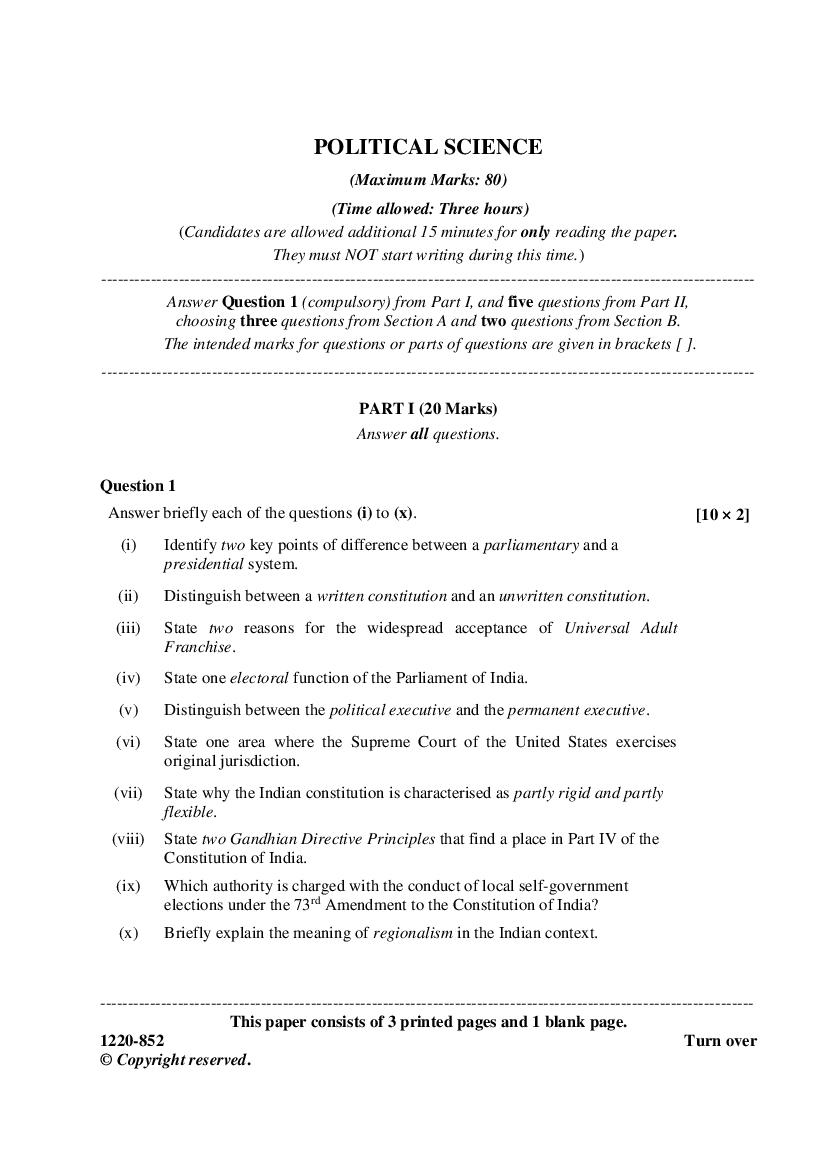
(Maximum Marks: 80)
(Time allowed: Three hours)
(Candidates are allowed additional 15 minutes for only reading the paper.
They must NOT start writing during this time.)
Answer Question 1 (compulsory) from Part I, and five questions from Part II,
choosing three questions from Section A and two questions from Section B.
The intended marks for questions or parts of questions are given in brackets [ ].
PART I (20 Marks)
Answer all questions.
Question 1
Answer briefly each of the questions (i) to (x). [10 2]
(i) Identify two key points of difference between a parliamentary and a
presidential system.
(ii) Distinguish between a written constitution and an unwritten constitution.
(iii) State two reasons for the widespread acceptance of Universal Adult
Franchise.
(iv) State one electoral function of the Parliament of India.
(v) Distinguish between the political executive and the permanent executive.
(vi) State one area where the Supreme Court of the United States exercises
original jurisdiction.
(vii) State why the Indian constitution is characterised as partly rigid and partly
flexible.
(viii) State two Gandhian Directive Principles that find a place in Part IV of the
Constitution of India.
(ix) Which authority is charged with the conduct of local self-government
elections under the 73rd Amendment to the Constitution of India?
(x) Briefly explain the meaning of regionalism in the Indian context.
This paper consists of 3 printed pages and 1 blank page.
1220-852 Turn over
© Copyright reserved.
Page 2
SECTION A
Answer any three questions.
Question 2
(a) Distinguish between totalitarian states and liberal democratic states. [6]
(b) India is described as a federal state with subsidiary unitary features. Explain. [6]
Question 3
(a) Explain three functions of political parties. [6]
(b) Discuss three merits of a multi-party system. [6]
Question 4
(a) Explain three powers of the House of Representatives. [6]
(b) Discuss three ways in which the Lok Sabha exercises control over the executive. [6]
Question 5
(a) Critically examine the role of the President in the Constitution of India. [6]
(b) Briefly explain three functions of the permanent executive (civil service). [6]
Question 6
(a) Critically examine judicial review with reference to India. [6]
(b) With reference to the Supreme Court of the United States, explain three [6]
principles (maxims) of Judicial Review.
2
Page 3
Answer any two questions.
Question 7
(a) Explain any three Salient Features of the Constitution of India. [6]
(b) What rights are conferred under the Right to Freedom of Religion in Articles 25 [6]
to 28 of the Constitution of India?
Question 8
(a) Explain the composition of the Zila Parishads. [6]
(b) Discuss three challenges faced by urban local self-government institutions in [6]
India.
Question 9
[
(a) Explain three ways in which communalism affects the functioning of Indian [6]
democracy.
(b) Critically discuss the role of caste in Indian politics. [6]
--------------------------------------------------------------------------------------------------------------------
3
Document Details
| Board / Org | CISCE |
| Exam | Class 12 |
| Type | Question Paper |
| Pages | 3 |
| Language | english |
| Updated | 22 Jul 2026 |