IICD Entrance Exam 2027 Sample Paper B.Des
Finished viewing? Save it for later —
Download IICD Entrance Exam 2027 Sample Paper B.Des (PDF · 13 pages)About IICD Entrance Exam 2027 Sample Paper B.Des
IICD Entrance Exam 2027 Sample Paper B.Des is available here for free download. Published by IICD for IICD Entrance Exam, this sample paper can be viewed online or downloaded as a PDF (13 pages). Candidates preparing for IICD Entrance Exam can use IICD Entrance Exam 2027 Sample Paper B.Des to understand the exam pattern, the type of questions asked, and the overall difficulty level.
Frequently Asked Questions
How can I download IICD Entrance Exam 2027 Sample Paper B.Des?
Open this page and click the Download button to save IICD Entrance Exam 2027 Sample Paper B.Des as a PDF. It is completely free on AglaSem Docs.
Is IICD Entrance Exam 2027 Sample Paper B.Des free to download?
Yes. IICD Entrance Exam 2027 Sample Paper B.Des can be viewed online and downloaded as a PDF free of cost on AglaSem Docs.
How many pages does IICD Entrance Exam 2027 Sample Paper B.Des have?
IICD Entrance Exam 2027 Sample Paper B.Des contains 13 pages, which you can read online or download together as a single PDF.
Where can I find more IICD Entrance Exam study material?
You can find more IICD Entrance Exam question papers, sample papers, syllabus, and answer keys on AglaSem Docs.
IICD Entrance Exam 2027 Sample Paper B.Des – Text
Read the full text of this sample paper below — useful to quickly search, copy and reference the content online without downloading the PDF.
📄 View text version (13 pages)
Page 1
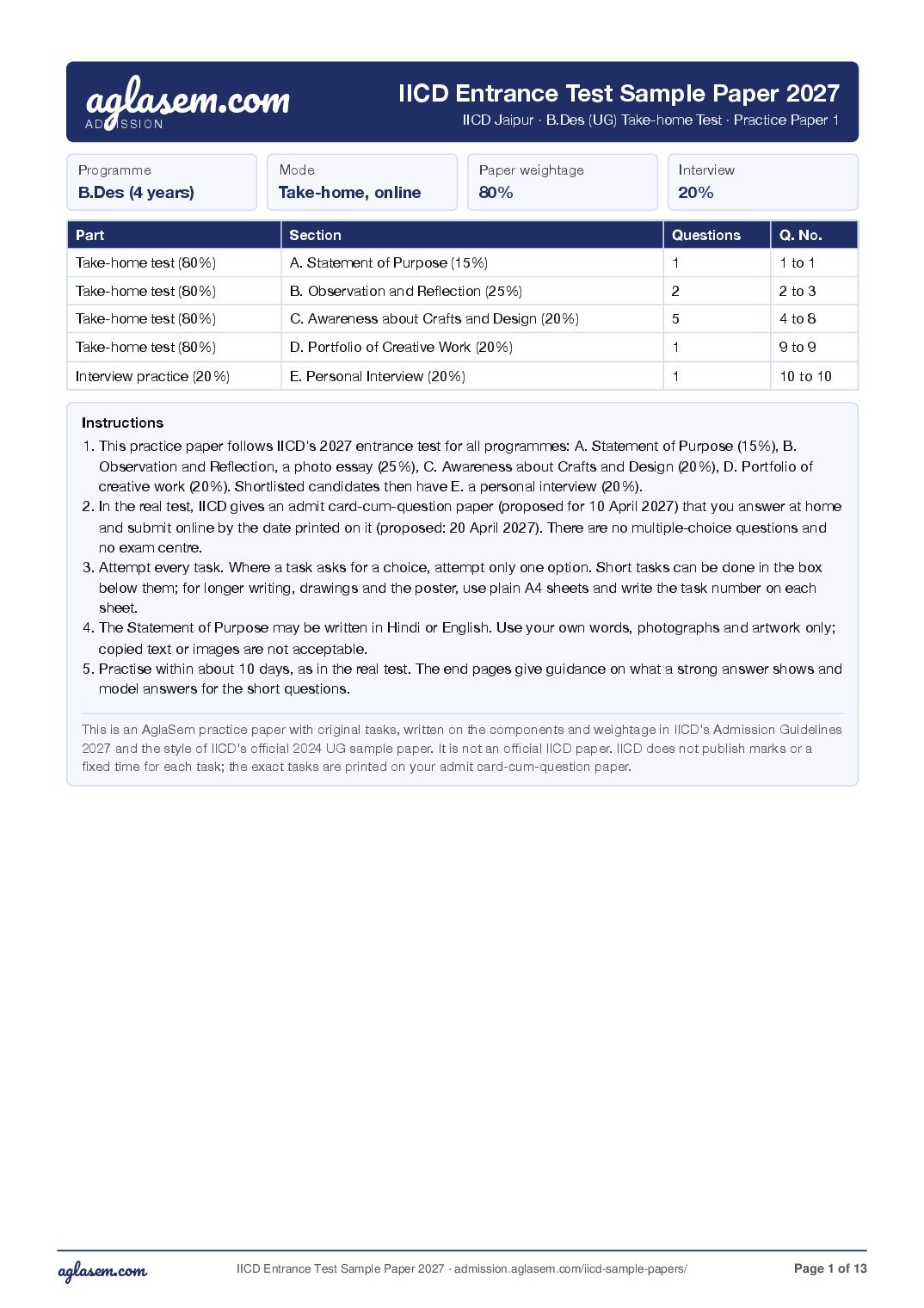
IICD Entrance Test Sample Paper 2027
IICD Jaipur · B.Des (UG) Take-home Test · Practice Paper 1
Programme Mode Paper weightage Interview
B.Des (4 years) Take-home, online 80% 20%
Part Section Questions Q. No.
Take-home test (80%) A. Statement of Purpose (15%) 1 1 to 1
Take-home test (80%) B. Observation and Reflection (25%) 2 2 to 3
Take-home test (80%) C. Awareness about Crafts and Design (20%) 5 4 to 8
Take-home test (80%) D. Portfolio of Creative Work (20%) 1 9 to 9
Interview practice (20%) E. Personal Interview (20%) 1 10 to 10
Instructions
1. This practice paper follows IICD's 2027 entrance test for all programmes: A. Statement of Purpose (15%), B.
Observation and Reflection, a photo essay (25%), C. Awareness about Crafts and Design (20%), D. Portfolio of
creative work (20%). Shortlisted candidates then have E. a personal interview (20%).
2. In the real test, IICD gives an admit card-cum-question paper (proposed for 10 April 2027) that you answer at home
and submit online by the date printed on it (proposed: 20 April 2027). There are no multiple-choice questions and
no exam centre.
3. Attempt every task. Where a task asks for a choice, attempt only one option. Short tasks can be done in the box
below them; for longer writing, drawings and the poster, use plain A4 sheets and write the task number on each
sheet.
4. The Statement of Purpose may be written in Hindi or English. Use your own words, photographs and artwork only;
copied text or images are not acceptable.
5. Practise within about 10 days, as in the real test. The end pages give guidance on what a strong answer shows and
model answers for the short questions.
This is an AglaSem practice paper with original tasks, written on the components and weightage in IICD's Admission Guidelines
2027 and the style of IICD's official 2024 UG sample paper. It is not an official IICD paper. IICD does not publish marks or a
fixed time for each task; the exact tasks are printed on your admit card-cum-question paper.
IICD Entrance Test Sample Paper 2027 · admission./iicd-sample-papers/ Page 1 of 13
Page 2
A. Statement of Purpose (15%)
1. Statement of Purpose (in Hindi or English, 250 to 350 words). Explain why you want to study at IICD
and which B.Des specialisation interests you most (Hard Material, Soft Material, Fired Material, Fashion
Clothing, Jewellery, Craft Communication or Interior Design). Describe one experience with a craft, a
maker or a handmade object that shaped this choice, your career goal for the next five to seven years,
and how working with craft communities fits that goal.
IICD Entrance Test Sample Paper 2027 · admission./iicd-sample-papers/ Page 2 of 13
Page 3
2. Photo essay (planning sheet). Choose ONE theme: (a) Hands at Work: one maker in your area, such as a
tailor, cobbler, potter, carpenter or sweet-maker; (b) Second Life: an object in your home or street that
has been repaired, reused or turned into something else; (c) Colours of the Haat: a local weekly market;
(d) Patterns Around Me: patterns found in floors, grilles, fabrics, leaves or brickwork near your home.
For the real submission you would take 8 to 10 photographs yourself and arrange them as a story. On
paper, draw 8 frames in sequence as quick sketches of the photographs you would take (close-up, wide
view, detail, person, process), give the essay a title, and write a caption of not more than 25 words
under each frame.
IICD Entrance Test Sample Paper 2027 · admission./iicd-sample-papers/ Page 3 of 13
Page 4
why you chose the theme and the subject, what you observed that you had never noticed before, what
surprised you about the people, materials or process, and what a designer could learn from it.
IICD Entrance Test Sample Paper 2027 · admission./iicd-sample-papers/ Page 4 of 13
Page 5
4. Craft profile (about 300 words and one sketch). Choose ONE craft: Blue Pottery of Jaipur, Dhokra metal
casting, Kalamkari, Channapatna wooden toys, Kantha embroidery or Meenakari enamel work.
Describe the region where it is practised, the raw materials and tools, the main steps of the process, the
community of makers and one challenge the craft faces today. Draw one typical product and label its
parts or features.
IICD Entrance Test Sample Paper 2027 · admission./iicd-sample-papers/ Page 5 of 13
Page 6
survive? (b) Repair, reuse, upcycle: what Indian homes can teach the world about the circular economy.
(c) Handmade in a machine age: what does a handmade object offer that a factory product cannot? (d)
How can designers and artisans work together fairly, so that both gain from a new product?
IICD Entrance Test Sample Paper 2027 · admission./iicd-sample-papers/ Page 6 of 13
Page 7
(a) How is a handloom fabric different from a powerloom fabric?
(b) What is a mordant, and why is it used in natural dyeing?
(c) Name the craft in which a carved wooden block is pressed onto cloth to print a design, and name
one centre in Rajasthan known for it.
(d) What is terracotta?
(e) What does the design principle 'form follows function' mean?
(f) Give two differences between a craft product and a mass-produced industrial product.
(g) What is upcycling? Give one example.
(h) What is lac, and name one craft product made with it.
IICD Entrance Test Sample Paper 2027 · admission./iicd-sample-papers/ Page 7 of 13
Page 8
local menders (a tailor, a cobbler, a cycle mechanic and a utensil repairer) will fix old things for visitors.
Show the event name, a day and a place, and make one repair craftsperson the main image. Use not
more than four colours.
IICD Entrance Test Sample Paper 2027 · admission./iicd-sample-papers/ Page 8 of 13
Page 9
a lunch box, a pen stand or a shopping bag). Suggest a replacement made with a traditional craft
material (bamboo, cane, clay, jute, brass, wood or cloth). Draw your design in two views and write 120
to 150 words comparing it with the plastic product on durability, cost, hygiene, impact on the
environment and income for artisans.
IICD Entrance Test Sample Paper 2027 · admission./iicd-sample-papers/ Page 9 of 13
Page 10
9. Portfolio plan. IICD asks for a PowerPoint portfolio of 10 to 15 of your own original works (drawings,
paintings, craft or material work, photography, embroidery, writing, social work and so on), with 50 to
100 words on each work's context, objective and outcome. For practice: (a) list the 10 to 15 works you
would include, in order; (b) write the 50 to 100 word description for any two of them; (c) sketch the
layout of your cover slide and of one inside slide.
IICD Entrance Test Sample Paper 2027 · admission./iicd-sample-papers/ Page 10 of 13
Page 11
E. Personal Interview (20%)
10. Interview practice. The interview (about 20 minutes on a WhatsApp video call) discusses your
submissions. Write short answers (four to five lines each) to these likely questions, then practise saying
them aloud with your portfolio in front of you.
(a) Tell us about one craftsperson you have watched at work. What did you learn?
(b) Which work in your portfolio are you proudest of, and what would you change in it now?
(c) Why did you choose this specialisation, and what will you do if you are offered another one?
(d) Name a handmade object in your home and explain how it is made.
(e) What do you understand by sustainable design? Give an example from daily life.
IICD Entrance Test Sample Paper 2027 · admission./iicd-sample-papers/ Page 11 of 13
Page 12
1 — 2 — 3 — 4 — 5 — 6 — 7 — 8 — 9 — 10 —
Solutions
A. Statement of Purpose (15%)
1. (guidance) A strong SOP is personal and specific. It names one specialisation and gives a real reason for it (for
example time spent with a potter, a family weaving tradition or an object the writer repaired or made), rather than
general praise of 'Indian culture'. It shows awareness that IICD works closely with crafts and artisans, links that to a
clear and realistic career goal (designer for a craft brand, own studio, product development with a cluster, research,
teaching), and ends with what the writer will bring to the class. It stays within 250 to 350 words, is well organised
(opening, experience, goal, fit, closing) and has no copied or template sentences.
B. Observation and Reflection (25%)
2. (guidance) A strong essay has a clear story with a beginning, middle and end (for example raw material, tools,
process, finished object, the maker), not eight similar pictures. Frames vary in distance and angle (wide shots that set
the scene, close-ups of hands, textures and tools), and each frame adds something new. Captions say what we
cannot see in the picture (a name, a time, a sound, a reason) instead of repeating what is shown. The title is short and
thoughtful. In the real test, use only your own photographs, with no heavy filters or downloaded images.
3. (guidance) A strong reflection goes beyond describing the photographs. It records close observation (how a cobbler
holds the awl, how the potter judges the clay by touch, how a repaired object shows wear), notes something
unexpected, and draws one or two design lessons from it, such as respect for materials, the skill hidden in simple tools
or the value of repair. It is honest and in the writer's own voice, and keeps to the word limit.
C. Awareness about Crafts and Design (20%)
4. (guidance) Key facts the answer should get right. Blue Pottery (Jaipur, Rajasthan): made from a body of quartz
powder, powdered glass, Multani mitti (fuller's earth), borax and gum rather than ordinary clay; painted mainly in cobalt
blue with green and white, and fired at a low temperature. Dhokra: non-ferrous (brass or bronze) casting by the lost-
wax method (a clay core, wax threads and design, a clay outer mould, then molten metal replaces the melted wax),
made by tribal metal-smiths in Chhattisgarh (Bastar), Odisha, West Bengal and Jharkhand. Kalamkari (Andhra
Pradesh): designs on cotton with natural dyes, hand-drawn with a bamboo kalam (pen) in the Srikalahasti style and
block-printed in the Machilipatnam style, using myrobalan and alum as mordants. Channapatna (Karnataka): toys
turned on a lathe from soft wood and coloured with lac. Kantha (West Bengal): running-stitch embroidery that layers
old saris or dhotis into quilts and wraps. Meenakari: coloured enamel fused onto gold, silver or copper by firing, with
Jaipur a major centre. Good answers also name a real present-day challenge (cheap machine-made copies, rising raw
material cost, young people leaving the craft, access to markets) and draw a clear, labelled product.
5. (guidance) A strong essay takes a clear position and supports it with specific examples (a named craft, product or
practice) rather than general statements. For (a), it weighs keeping the skill and identity of a craft against new products,
colours or markets. For (b), it uses everyday examples (refilling, darning, kabadiwala recycling, steel tiffins, cloth bags,
old saris turned into quilts). For (c), it discusses uniqueness, the maker's story, repairability and livelihoods, and is
honest about cost and speed. For (d), it addresses credit, fair payment, shared design decisions and respect for the
artisan's knowledge. It has an introduction, developed paragraphs and a conclusion, and stays within the word limit.
IICD Entrance Test Sample Paper 2027 · admission./iicd-sample-papers/ Page 12 of 13
Page 13
power, so it has slight irregularities and is slower to make; a powerloom is driven by electricity and produces uniform
cloth quickly. (b) A mordant is a substance, such as alum or myrobalan (harad), that binds a natural dye to the fibre so
the colour becomes fast and does not wash out; different mordants can also change the shade. (c) Hand block
printing; Sanganer or Bagru (near Jaipur). (d) Terracotta (Italian for 'baked earth') is clay that is shaped and fired at a
fairly low temperature, usually unglazed and reddish-brown, used for pots, tiles, toys and sculpture. (e) The shape of an
object should come from the job it has to do, rather than decoration deciding the form; the phrase is credited to the
architect Louis Sullivan. (f) A craft product is made largely by hand, in small numbers, with variation between pieces
and the maker's skill visible; an industrial product is made by machines in large numbers, with identical pieces and
lower cost per piece. (g) Upcycling turns waste or an old object into something of greater value, such as a quilt or bag
made from old saris, or a lamp made from a glass bottle. (h) Lac is a natural resin secreted by the lac insect; it is used
for lac bangles (lakh ki choodiyan) of Jaipur and Hyderabad and to colour Channapatna toys.
7. (guidance) A strong poster has one striking main image (for example the cobbler's hands stitching a sandal) and a
clear reading order: event name, then the main image, then day and place. Lettering is bold and readable from a
distance, there is enough empty space, and the colours are limited and purposeful (earthy tones for craft, one bright
accent for the title). The poster should make repair look valuable and attractive, not old-fashioned.
8. (guidance) A strong answer chooses a sensible match (a cane or jute shopping bag, a brass or steel lunch box, a
bamboo pen stand, a cloth bread cover) and draws it clearly with joints, handles and finishes labelled. The comparison
is balanced: it admits real drawbacks (higher price, weight, need for care, mould on natural fibres) as well as the
benefits (biodegradable or long-lasting materials, repairability, less microplastic, work for artisans), and suggests how
the design reduces the drawbacks.
D. Portfolio of Creative Work (20%)
9. (guidance) A strong portfolio is selective and varied: it opens and closes with strong pieces, shows range
(observation drawing, colour, material or 3D work, photography) and includes process (rough sketches, trials) as well
as finished work. Each description states the context (where and why it was made), the objective (what the writer was
trying to do) and the outcome (what worked and what was learnt). Slides are clean, with one work per slide, good
photographs on a plain background and consistent fonts. Only original work should be included.
E. Personal Interview (20%)
10. (guidance) The panel looks for aptitude for crafts, clear thinking, communication, awareness of crafts and design,
and achievements. Good answers are honest and specific: a real person, object or process described in detail, an
ability to criticise one's own work calmly, and openness to learning. For (c), show genuine interest in your first choice
but also flexibility, since at IICD the final B.Des specialisation is decided after the foundation year. Keep your submitted
artwork and portfolio within reach during the call.
IICD Entrance Test Sample Paper 2027 · admission./iicd-sample-papers/ Page 13 of 13
Document Details
| Board / Org | IICD |
| Exam | IICD Entrance Exam |
| Type | Sample Paper |
| Pages | 13 |
| Language | english |
| Updated | 27 Oct 2026 |