aglasem.com
Schools Admission Mock Test Playground
ClassChoose class
StateSelect state

AMU Entrance Exam Syllabus for MBA in Agribusiness

Aligarh Muslim University (AMU) Admission Test Syllabus is give here for MBA in Agribusiness. You can also download AMU Entrance Syllabus PDF for MBA in Agribusiness.
AMU Entrance Exam Syllabus for MBA in Agribusiness - Page 1 of 1

Finished viewing? Save it for later —

Download AMU Entrance Exam Syllabus for MBA in Agribusiness (PDF · 1 page)
Downloaded 6 times

About AMU Entrance Exam Syllabus for MBA in Agribusiness

AMU Entrance Exam Syllabus for MBA in Agribusiness is available here for free download. Published by Default for Admission Tests, this syllabus can be viewed online or downloaded as a PDF (1 page). Candidates preparing for Admission Tests can use AMU Entrance Exam Syllabus for MBA in Agribusiness to understand the exam pattern, the type of questions asked, and the overall difficulty level.

Frequently Asked Questions

How can I download AMU Entrance Exam Syllabus for MBA in Agribusiness?

Open this page and click the Download button to save AMU Entrance Exam Syllabus for MBA in Agribusiness as a PDF. It is completely free on AglaSem Docs.

Is AMU Entrance Exam Syllabus for MBA in Agribusiness free to download?

Yes. AMU Entrance Exam Syllabus for MBA in Agribusiness can be viewed online and downloaded as a PDF free of cost on AglaSem Docs.

How many pages does AMU Entrance Exam Syllabus for MBA in Agribusiness have?

AMU Entrance Exam Syllabus for MBA in Agribusiness contains 1 page, which you can read online or download together as a single PDF.

Where can I find more Admission Tests study material?

You can find more Admission Tests question papers, sample papers, syllabus, and answer keys on AglaSem Docs.

AMU Entrance Exam Syllabus for MBA in Agribusiness – Text

Read the full text of this syllabus below — useful to quickly search, copy and reference the content online without downloading the PDF.

📄 View text version (1 page)

Page 1

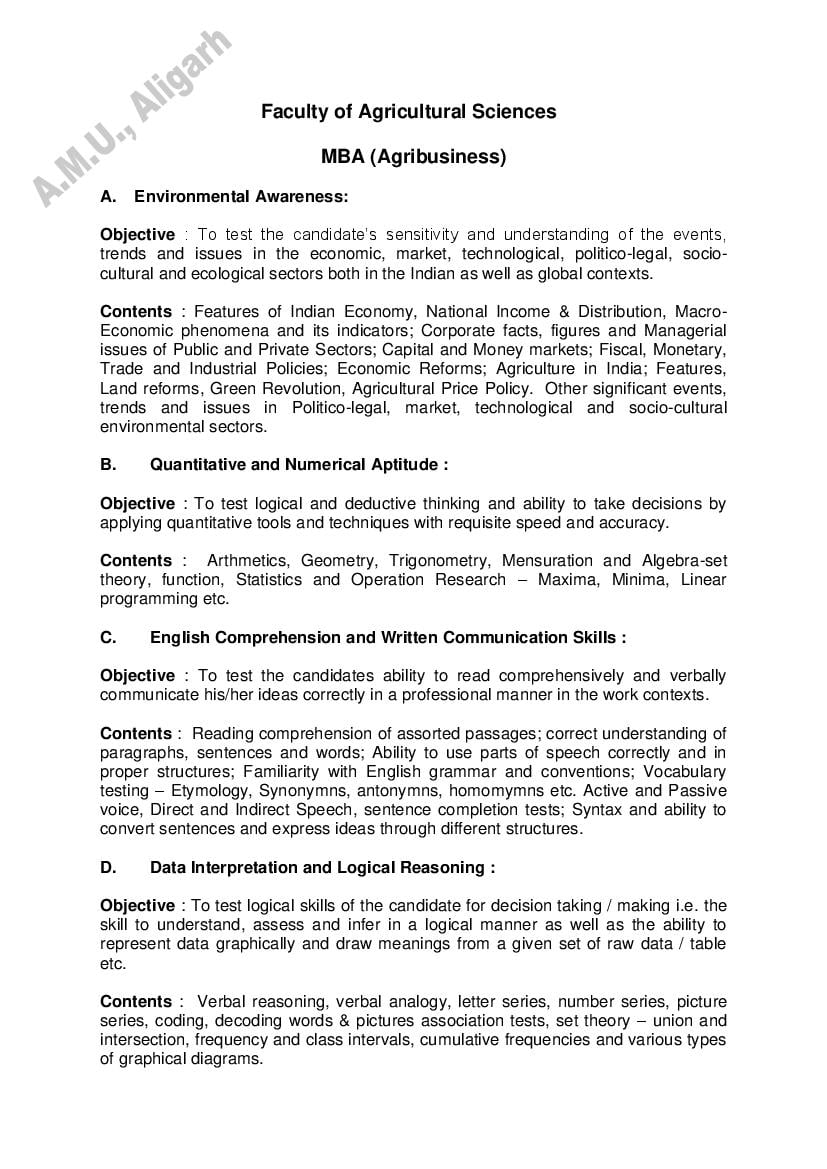
Faculty of Agricultural Sciences MBA (Agribusiness) A. Environmental Awareness: Objective : To test the candidate’s sensitivity and understanding of the events, trends and issues in the economic, market, technological, politico-legal, socio- cultural and ecological sectors both in the Indian as well as global contexts. Contents : Features of Indian Economy, National Income & Distribution, Macro- Economic phenomena and its indicators; Corporate facts, figures and Managerial issues of Public and Private Sectors; Capital and Money markets; Fiscal, Monetary, Trade and Industrial Policies; Economic Reforms; Agriculture in India; Features, Land reforms, Green Revolution, Agricultural Price Policy. Other significant events, trends and issues in Politico-legal, market, technological and socio-cultural environmental sectors. B. Quantitative and Numerical Aptitude : Objective : To test logical and deductive thinking and ability to take decisions by applying quantitative tools and techniques with requisite speed and accuracy. Contents : Arthmetics, Geometry, Trigonometry, Mensuration and Algebra-set theory, function, Statistics and Operation Research – Maxima, Minima, Linear programming etc. C. English Comprehension and Written Communication Skills : Objective : To test the candidates ability to read comprehensively and verbally communicate his/her ideas correctly in a professional manner in the work contexts. Contents : Reading comprehension of assorted passages; correct understanding of paragraphs, sentences and words; Ability to use parts of speech correctly and in proper structures; Familiarity with English grammar and conventions; Vocabulary testing – Etymology, Synonymns, antonymns, homomymns etc. Active and Passive voice, Direct and Indirect Speech, sentence completion tests; Syntax and ability to convert sentences and express ideas through different structures. D. Data Interpretation and Logical Reasoning : Objective : To test logical skills of the candidate for decision taking / making i.e. the skill to understand, assess and infer in a logical manner as well as the ability to represent data graphically and draw meanings from a given set of raw data / table etc. Contents : Verbal reasoning, verbal analogy, letter series, number series, picture series, coding, decoding words & pictures association tests, set theory – union and intersection, frequency and class intervals, cumulative frequencies and various types of graphical diagrams.

Document Details

Board / OrgDefault
ExamAdmission Tests
TypeSyllabus
Pages1
Updated30 Apr 2026