JKBOSE 12th Class Model Paper Economics
Finished viewing? Save it for later —
Download JKBOSE 12th Class Model Paper Economics (PDF · 5 pages)About JKBOSE 12th Class Model Paper Economics
JKBOSE 12th Class Model Paper Economics is available here for free download. Published by JKBOSE for Class 12, this sample paper can be viewed online or downloaded as a PDF (5 pages). Candidates preparing for Class 12 can use JKBOSE 12th Class Model Paper Economics to understand the exam pattern, the type of questions asked, and the overall difficulty level.
Frequently Asked Questions
How can I download JKBOSE 12th Class Model Paper Economics?
Open this page and click the Download button to save JKBOSE 12th Class Model Paper Economics as a PDF. It is completely free on AglaSem Docs.
Is JKBOSE 12th Class Model Paper Economics free to download?
Yes. JKBOSE 12th Class Model Paper Economics can be viewed online and downloaded as a PDF free of cost on AglaSem Docs.
How many pages does JKBOSE 12th Class Model Paper Economics have?
JKBOSE 12th Class Model Paper Economics contains 5 pages, which you can read online or download together as a single PDF.
Where can I find more Class 12 study material?
You can find more Class 12 question papers, sample papers, syllabus, and answer keys on AglaSem Docs.
JKBOSE 12th Class Model Paper Economics – Text
Read the full text of this sample paper below — useful to quickly search, copy and reference the content online without downloading the PDF.
📄 View text version (5 pages)
Page 1
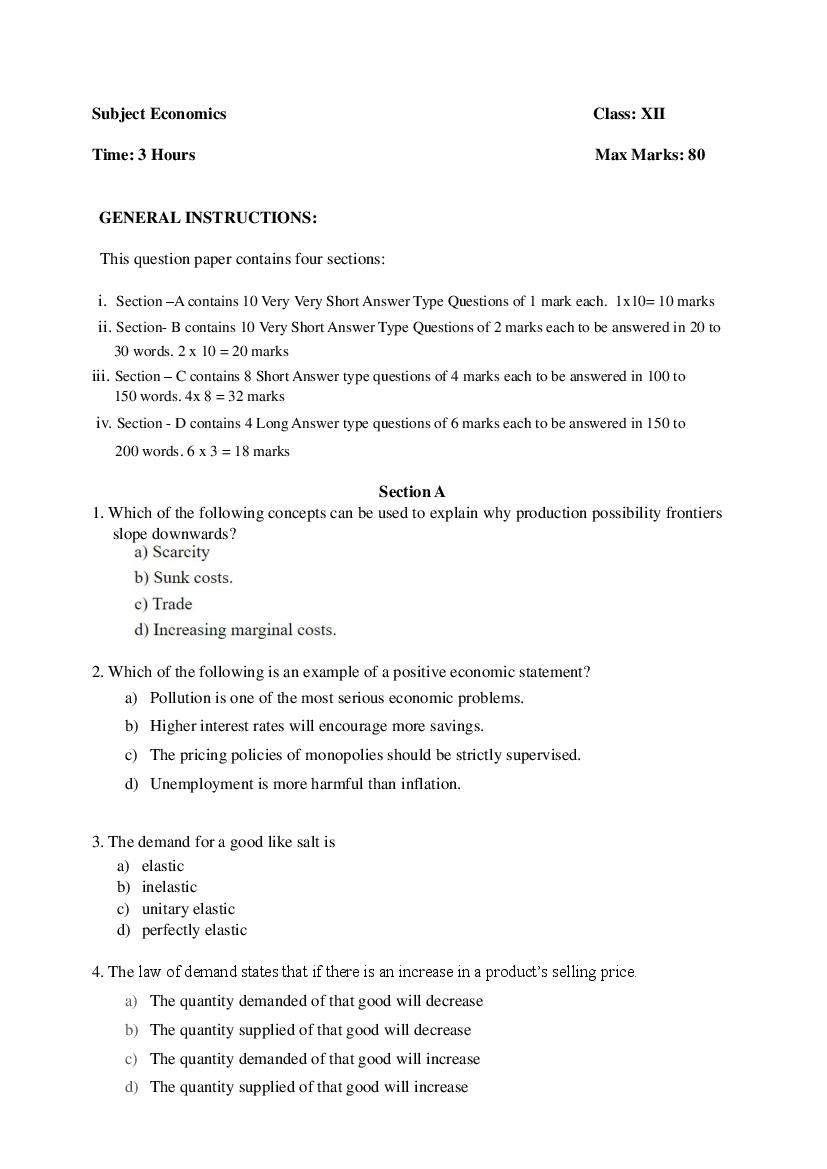
Time: 3 Hours Max Marks: 80
GENERAL INSTRUCTIONS:
This question paper contains four sections:
i. Section –A contains 10 Very Very Short Answer Type Questions of 1 mark each. 1x10= 10 marks
ii. Section- B contains 10 Very Short Answer Type Questions of 2 marks each to be answered in 20 to
30 words. 2 x 10 = 20 marks
iii. Section – C contains 8 Short Answer type questions of 4 marks each to be answered in 100 to
150 words. 4x 8 = 32 marks
iv. Section - D contains 4 Long Answer type questions of 6 marks each to be answered in 150 to
200 words. 6 x 3 = 18 marks
Section A
1. Which of the following concepts can be used to explain why production possibility frontiers
slope downwards?
2. Which of the following is an example of a positive economic statement?
a) Pollution is one of the most serious economic problems.
b) Higher interest rates will encourage more savings.
c) The pricing policies of monopolies should be strictly supervised.
d) Unemployment is more harmful than inflation.
3. The demand for a good like salt is
a) elastic
b) inelastic
c) unitary elastic
d) perfectly elastic
4. The law of demand states that if there is an increase in a product’s selling price.
a) The quantity demanded of that good will decrease
b) The quantity supplied of that good will decrease
c) The quantity demanded of that good will increase
d) The quantity supplied of that good will increase
Page 2
a) Price Ceiling
b) MRP
c) Price Floor
d) Price Control
6. If many sellers are selling an identical product, what is the implication of this scenario?
a) Significant losses for all the sellers
b) The market supply curve is horizontal
c) Chaos in the market
d) The sellers do not have the power to change the price of a product
7. What is the function of the GDP deflator?
a) It is a measure of inflation which evaluates the entire range of goods and services
produced in the economy.
b) It shows real GDP growth on the basis of current production.
c) The GDP deflator is in real terms while the CPI is in nominal terms.
d) None of the above
8. If an economy is to control recession like most of the Euro-Zone nations, which of the
following can be appropriate:
a) Reducing Repo Rate
b) Reducing CRR
c) Both (a) and (b)
d) None of (a) and (b)
9. Which of the following agency is responsible for issuing 1 currency note in India?
a) Reserve Bank of India.
b) Ministry of finance
c) Ministry of Commerce
d) Niti Aayog
10. If the investment falls to zero, national income does not fall to zero because of:
a) Autonomous Consumption
b) Induced Investment
c) Autonomous Investment
d) Multiplier
Page 3
11. Define normative economics, with a suitable example.
12. What do you understand by Law of diminishing Marginal Utility?
13. Why is Total Variable Cost curve inverse S- shaped?
14. Highlight various features of perfect competition.
15. Distinguish between Real and Nominal GDP
16. Differentiate between revenue expenditure and capital expenditure.
17. What are the main components of the Budget?18.Define income effect and substitution
effect
19. What is marginal opportunity cost?
20. What id repo and reverse repo rate?
Section C
21. ‘Higher indifference curve represents higher level of satisfaction to the consumer’.
Explain the statement, also state the underlying assumption related to this property of
indifference curve.
22. Complete the following production schedule:
23. How is the price of a commodity determined in a perfectly competitive market? Explain
with help of a diagram
24. Suppose in a hypothetical economy there are only two Firms A and B, Firm A sold
goods for Rs. 2,000 to Firm B and purchased goods for Rs. 1,000. Firm B exported
goods for Rs. 2,500 and had domestic sales of Rs. 1,500. Calculate Net Domestic
Product at market price, if consumption of fixed capital is Rs. 200.
25. As per the following news published in The Economic Times on 26th December, 2022:
‘Reserve Bank of India has sold government securities worth Rs. 8,710 crore in the
secondary market, over the last four weeks, to drain out excessive liquidity’.
Identify the likely cause and the consequences behind, this type of action plan of the
Reserve Bank.
Page 4
Propensity to Consume is 75%. Estimate the increase in investment required to achieve
the targeted increase in income.
27. The opening up of the Indian Economy has led to a rapid increase in Foreign Direct
Investments and Foreign Exchange Reserves of the country’. Defend or refute the given
statement.
28. The coefficient of elasticity of supply of a commodity is 3. A seller supplies 20 units of
this commodity at a price of Rs. 8 per unit. How much quantity of this commodity will
the seller supply when price rises by Rs. 2 per unit?
Section D
29. State, with valid reasons, which of the following statement are true or false:
i. Average Revenue curve under the Perfect Competition is a downward sloping curve.
ii. AFC curve is a rectangular hyperbola curve.
iii. When MR is falling but positive, TR will also be falling and positive.
OR
A consumer, Mr. Brown is in state of equilibrium consuming two goods X and Y, with
given prices Px and Py. Explain what will happen if:
a. MUx/Px is greater than MUy/Py.
b. Py fall
30. Compute (a) National Income and (b) Personal Disposable Income.
OR
Explain the Law of Variable Proportions with the help of a diagram. In which stage of
the Law a producer finds his equilibrium and why?
Page 5
multiplier with marginal propensity to consume (MPC) and with marginal propensity to
save (MPS).
OR
Distinguish between GNP and GDP. Explain income method of measuring national
income.