DUET Question Paper 2020 for DU MSc Biochemistry
Finished viewing? Save it for later —
Download DUET Question Paper 2020 for DU MSc Biochemistry (PDF · 15 pages)About DUET Question Paper 2020 for DU MSc Biochemistry
DUET Question Paper 2020 for DU MSc Biochemistry is available here for free download. Published by NTA for DUET, this question paper can be viewed online or downloaded as a PDF (15 pages). Candidates preparing for DUET can use DUET Question Paper 2020 for DU MSc Biochemistry to understand the exam pattern, the type of questions asked, and the overall difficulty level.
Frequently Asked Questions
How can I download DUET Question Paper 2020 for DU MSc Biochemistry?
Open this page and click the Download button to save DUET Question Paper 2020 for DU MSc Biochemistry as a PDF. It is completely free on AglaSem Docs.
Is DUET Question Paper 2020 for DU MSc Biochemistry free to download?
Yes. DUET Question Paper 2020 for DU MSc Biochemistry can be viewed online and downloaded as a PDF free of cost on AglaSem Docs.
How many pages does DUET Question Paper 2020 for DU MSc Biochemistry have?
DUET Question Paper 2020 for DU MSc Biochemistry contains 15 pages, which you can read online or download together as a single PDF.
Where can I find more DUET study material?
You can find more DUET question papers, sample papers, syllabus, and answer keys on AglaSem Docs.
DUET Question Paper 2020 for DU MSc Biochemistry – Text
Read the full text of this question paper below — useful to quickly search, copy and reference the content online without downloading the PDF.
📄 View text version (15 pages)
Page 1
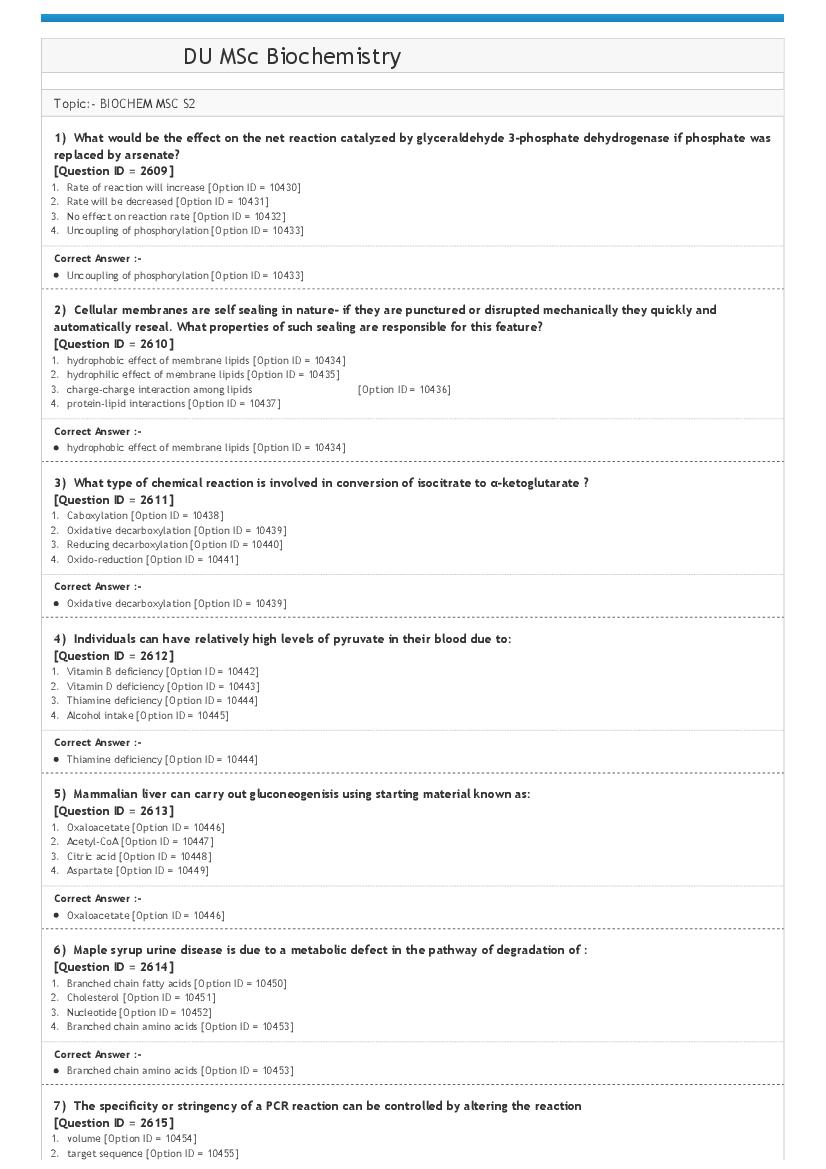
Topic:‐ BIOCHEM MSC S2
1) What would be the effect on the net reaction catalyzed by glyceraldehyde 3‐phosphate dehydrogenase if phosphate was
replaced by arsenate?
[Question ID = 2609]
1. Rate of reaction will increase [Option ID = 10430]
2. Rate will be decreased [Option ID = 10431]
3. No effect on reaction rate [Option ID = 10432]
4. Uncoupling of phosphorylation [Option ID = 10433]
Uncoupling of phosphorylation [Option ID = 10433]
2) Cellular membranes are self sealing in nature‐ if they are punctured or disrupted mechanically they quickly and
automatically reseal. What properties of such sealing are responsible for this feature?
[Question ID = 2610]
1. hydrophobic effect of membrane lipids [Option ID = 10434]
2. hydrophilic effect of membrane lipids [Option ID = 10435]
3. charge‐charge interaction among lipids [Option ID = 10436]
4. protein‐lipid interactions [Option ID = 10437]
hydrophobic effect of membrane lipids [Option ID = 10434]
3) What type of chemical reaction is involved in conversion of isocitrate to α‐ketoglutarate ?
[Question ID = 2611]
1. Caboxylation [Option ID = 10438]
2. Oxidative decarboxylation [Option ID = 10439]
3. Reducing decarboxylation [Option ID = 10440]
4. Oxido‐reduction [Option ID = 10441]
Oxidative decarboxylation [Option ID = 10439]
4) Individuals can have relatively high levels of pyruvate in their blood due to:
[Question ID = 2612]
1. Vitamin B deficiency [Option ID = 10442]
2. Vitamin D deficiency [Option ID = 10443]
3. Thiamine deficiency [Option ID = 10444]
4. Alcohol intake [Option ID = 10445]
Thiamine deficiency [Option ID = 10444]
5) Mammalian liver can carry out gluconeogenisis using starting material known as:
[Question ID = 2613]
1. Oxaloacetate [Option ID = 10446]
2. Acetyl‐CoA [Option ID = 10447]
3. Citric acid [Option ID = 10448]
4. Aspartate [Option ID = 10449]
Oxaloacetate [Option ID = 10446]
6) Maple syrup urine disease is due to a metabolic defect in the pathway of degradation of :
[Question ID = 2614]
1. Branched chain fatty acids [Option ID = 10450]
2. Cholesterol [Option ID = 10451]
3. Nucleotide [Option ID = 10452]
4. Branched chain amino acids [Option ID = 10453]
Branched chain amino acids [Option ID = 10453]
7) The specificity or stringency of a PCR reaction can be controlled by altering the reaction
[Question ID = 2615]
1. volume [Option ID = 10454]
2. target sequence [Option ID = 10455]
Page 2
4. template copies [Option ID = 10457]
temperature and salt concentration [Option ID = 10456]
8) Principle regulation point in the biosynthesis of fatty acids is:
[Question ID = 2616]
1. Acetyl‐CoA carboxylase [Option ID = 10458]
2. β – Ketoacyl‐ACP synthase [Option ID = 10459]
3. Citrate dehydrogenase [Option ID = 10460]
4. β – Lactamase [Option ID = 10461]
Acetyl‐CoA carboxylase [Option ID = 10458]
9) Denaturation of a protein or nucleic acid can be studied by:
[Question ID = 2617]
1. SDS‐PAGE [Option ID = 10462]
2. Isoelectric focusing [Option ID = 10463]
3. Spectrophotometry [Option ID = 10464]
4. Gel filtration [Option ID = 10465]
Spectrophotometry [Option ID = 10464]
10) Folding of a protein is primarily governed by:
[Question ID = 2618]
1. Ionic strength of solution [Option ID = 10466]
2. Presence of branched chain amino acids [Option ID = 10467]
3. Primary structure of a protein [Option ID = 10468]
4. Presence of hydrophobic amino acids [Option ID = 10469]
Primary structure of a protein [Option ID = 10468]
11) The biochemical products obtained after hydrolysis of glycolipids are:
[Question ID = 2619]
1. Sugar, fatty acids, phosphoric acid [Option ID = 10470]
2. Sugar, fatty acids, nitrogen base [Option ID = 10471]
3. Sugar, fatty acid, glycerol [Option ID = 10472]
4. Sugar, fatty acid, sphingosine [Option ID = 10473]
Sugar, fatty acid, glycerol [Option ID = 10472]
12) D‐ glucose and D‐mannose are:
[Question ID = 2620]
1. Anomers [Option ID = 10474]
2. Epimers [Option ID = 10475]
3. Optical isomers [Option ID = 10476]
4. Diastereomers [Option ID = 10477]
Epimers [Option ID = 10475]
13) Collagen is rich in:
[Question ID = 2621]
1. Glutamic acid and glycine [Option ID = 10478]
2. Glycine and glutamine [Option ID = 10479]
3. Glycine and proline [Option ID = 10480]
4. Glycine and alanine [Option ID = 10481]
Glycine and proline [Option ID = 10480]
14) The following amino acid is least likely to be found in a α‐helix structure:
[Question ID = 2622]
1. Alanine [Option ID = 10482]
2. Cystine [Option ID = 10483]
3. Histidine [Option ID = 10484]
4. Proline [Option ID = 10485]
Proline [Option ID = 10485]
Page 3
[Question ID = 2623]
1. 3.0 [Option ID = 10486]
2. 11.0 [Option ID = 10487]
3. 10.0 [Option ID = 10488]
4. 12.0 [Option ID = 10489]
12.0 [Option ID = 10489]
16) A HCl solution of 1 mM was diluted to 106.. What would be the pH of the resulting solution?
[Question ID = 2624]
1. 5.0 [Option ID = 10490]
2. 7.0 [Option ID = 10491]
3. 6.0 [Option ID = 10492]
4. 2.0 [Option ID = 10493]
7.0 [Option ID = 10491]
17) The ligand used for affinity chromatography of RNA containing poly(A) sequence is:
[Question ID = 2625]
1. Avidin [Option ID = 10494]
2. 5’ AMP [Option ID = 10495]
3. Oligo dT [Option ID = 10496]
4. Lysine [Option ID = 10497]
Oligo dT [Option ID = 10496]
18) Signal hypothesis for protein trafficking was proposed by:
[Question ID = 2626]
1. Tom Rapoport [Option ID = 10498]
2. Paul Nurse [Option ID = 10499]
3. Timothy Hunt [Option ID = 10500]
4. Gunter Blobel [Option ID = 10501]
Gunter Blobel [Option ID = 10501]
19) In SDS‐PAGE, the migration of protein is effected by_________.
[Question ID = 2627]
1. Charge of the protein
[Option ID = 10502]
2. Size of the protein
[Option ID = 10503]
3. Both charge and size of the protein
[Option ID = 10504]
4. Number of cysteine residues in protein
[Option ID = 10505]
Size of the protein
[Option ID = 10503]
20) Glycerol is added to protein samples before loading them on the PAGE. What is the role of glycerol‐
[Question ID = 2628]
1. Provide stability to protein [Option ID = 10506]
2. Helps to bind SDS to the protein [Option ID = 10507]
3. Provide density to the protein sample [Option ID = 10508]
4. Helps in denaturing the disulphide bonds [Option ID = 10509]
Provide density to the protein sample [Option ID = 10508]
21) What is the effect of urea and formamide on DNA
[Question ID = 2629]
1. Decrease the Tm of the DNA [Option ID = 10510]
2. Increase the Tm of the DNA [Option ID = 10511]
3. Helps in reannealing of the DNA [Option ID = 10512]
Page 4
Decrease the Tm of the DNA [Option ID = 10510]
22) A low auxin:cytokinin ratio leads to –
[Question ID = 2630]
1. Shoot formation [Option ID = 10514]
2. Root formation [Option ID = 10515]
3. Fruit formation [Option ID = 10516]
4. Increased cell division [Option ID = 10517]
Shoot formation [Option ID = 10514]
23) Megaloblastic anemia is caused due to deficiency of _____________.
[Question ID = 2631]
1. Cobalamin [Option ID = 10518]
2. Pyridoxine [Option ID = 10519]
3. Folic acid [Option ID = 10520]
4. Niacin [Option ID = 10521]
Folic acid [Option ID = 10520]
24) Lineweaver‐Burk plot is also known as______
[Question ID = 2632]
1. Hanes‐Woolf plot [Option ID = 10522]
2. Double reciprocal plot [Option ID = 10523]
3. Eadie‐Hofstee plot [Option ID = 10524]
4. Steady‐state equation [Option ID = 10525]
Double reciprocal plot [Option ID = 10523]
25) Which of the following can be used to construct a linkage map of the Hfr chromosome?
[Question ID = 2633]
1. frequency of recombination [Option ID = 10526]
2. time of entry [Option ID = 10527]
3. locus of mutation [Option ID = 10528]
4. transfer of F factor [Option ID = 10529]
time of entry [Option ID = 10527]
26) Which of the following conditions decreases the level of denitrification?
[Question ID = 2634]
1. Abundance of organic matter [Option ID = 10530]
2. Elevated temperatures [Option ID = 10531]
3. Availability of oxygen [Option ID = 10532]
4. Acidic pH [Option ID = 10533]
Acidic pH [Option ID = 10533]
27) Name the class of immunoglobulin which takes part in hypersensitivity reaction?
[Question ID = 2635]
1. I gG [Option ID = 10534]
2. IgE [Option ID = 10535]
3. I gA [Option ID = 10536]
4. I gM [Option ID = 10537]
IgE [Option ID = 10535]
28) In Phase contrast microscopy, the rate at which light passes through objects is__________
[Question ID = 2636]
1. Inversely proportional to their refractive indices [Option ID = 10538]
2. Constant [Option ID = 10539]
3. Directly proportional to their refractive indices [Option ID = 10540]
4. Exponentially related to their refractive indices [Option ID = 10541]
Inversely proportional to their refractive indices [Option ID = 10538]
Page 5
[Question ID = 2637]
1. aspartic acid [Option ID = 10542]
2. glutamic acid [Option ID = 10543]
3. pyruvic acid [Option ID = 10544]
4. alpha‐keto glutaric acid [Option ID = 10545]
glutamic acid [Option ID = 10543]
30) The density of a solution prepared by dissolving 120 g of urea (mol.mass = 60) in 1000 g of water is 1.15 g/mL. The
molarity of this solution is:
[Question ID = 2638]
1. 1.02 M [Option ID = 10546]
2. 2.05 M [Option ID = 10547]
3. 0.50 M [Option ID = 10548]
4. 1.78 M [Option ID = 10549]
2.05 M [Option ID = 10547]
31) The third strand of triple helix is paired in which scheme?
[Question ID = 2639]
1. Intermolecular base pair scheme [Option ID = 10550]
2. Hoogsteen base pair scheme [Option ID = 10551]
3. Intramolecular base pair scheme [Option ID = 10552]
4. G‐quartet scheme [Option ID = 10553]
Hoogsteen base pair scheme [Option ID = 10551]
32) The first three bases of the 6‐base recognition cleavage site of HindIII are AAG. What is the complete sequence of this
6 bp site?
[Question ID = 2640]
1. AAGAAG [Option ID = 10554]
2. AAGCTT [Option ID = 10555]
3. AAGGAA [Option ID = 10556]
4. AAGCUU [Option ID = 10557]
AAGCTT [Option ID = 10555]
33) What leads to the activation of protein kinase C?
[Question ID = 2641]
1. Release of intracellular Ca+2 + diacylglycerol [Option ID = 10558]
2. Release of intracellular Mg+2 + diacylglycerol [Option ID = 10559]
3. Release of intracellular Ca+2 + glycerol [Option ID = 10560]
4. Release of intracellular Ca+2 + triacylglycerol [Option ID = 10561]
Release of intracellular Ca+2 + diacylglycerol [Option ID = 10558]
34) Trans bilayer diffusion is also called
[Question ID = 2642]
1. Facilitated diffusion [Option ID = 10562]
2. Lateral diffusion [Option ID = 10563]
3. Flip flop [Option ID = 10564]
4. Simple diffusion [Option ID = 10565]
Flip flop [Option ID = 10564]
35) The first step in the payoff phase of glycolysis is
[Question ID = 2643]
1. Reduction of 1, 3‐bisphosphoglycerate to glyceraldehyde 3‐phosphate [Option ID = 10566]
2. Oxidation of glyceraldehyde 3‐phosphate to 1, 3‐bisphosphoglycerate [Option ID = 10567]
3. Reversible conversion of dihydroxyacetone phosphate to glyceraldehyde 3‐phosphate [Option ID = 10568]
4. Irreversible conversion of dihydroxyacetone phosphate to glyceraldehyde 3‐phosphate [Option ID = 10569]
Oxidation of glyceraldehyde 3‐phosphate to 1, 3‐bisphosphoglycerate [Option ID = 10567]
36) What region of antibody binds to proteinA during affinity purification?
[Question ID = 2644]
Page 6
2. Heavy chain within the variable region [Option ID = 10571]
3. Light chain within the Fab region [Option ID = 10572]
4. Light chain within the Fc region [Option ID = 10573]
Heavy chain within the Fc region [Option ID = 10570]
37) If the oxidative phosphorylation was uncoupled in the mitochondria then there is a/an
[Question ID = 2645]
1. Decreased concentration of ADP in the mitochondria [Option ID = 10574]
2. Decreased oxidative rate [Option ID = 10575]
3. Increased inorganic phosphate in the mitochondria [Option ID = 10576]
4. Decreased production of heat [Option ID = 10577]
Increased inorganic phosphate in the mitochondria [Option ID = 10576]
38) The enzyme responsible for the removal of supercoiling in replicating DNA ahead of the replication fork is
[Question ID = 2646]
1. Topoisomerase [Option ID = 10578]
2. Primase [Option ID = 10579]
3. DNA polymerase [Option ID = 10580]
4. Helicase [Option ID = 10581]
Topoisomerase [Option ID = 10578]
39) Which of the following are not DNA viruses?
[Question ID = 2647]
1. Hepatitis B virus [Option ID = 10582]
2. Influenza A virus [Option ID = 10583]
3. CMV virus [Option ID = 10584]
4. Parvovirus [Option ID = 10585]
Influenza A virus [Option ID = 10583]
40) Formation of one molecule of glucose from pyruvate requires
[Question ID = 2648]
1. 4 ATP, 2 GTP and 2 NADH [Option ID = 10586]
2. 3 ATP, 2 GTP and 2 NADH [Option ID = 10587]
3. 4 ATP, 1 GTP and 2 NADH [Option ID = 10588]
4. 2 ATP, 2 GTP and 2 NADH [Option ID = 10589]
4 ATP, 2 GTP and 2 NADH [Option ID = 10586]
41) Cyanogen bromide is used for cleavage of proteins. The target site for cleavage is:
[Question ID = 2649]
1. C‐terminal end of Asparagine residue [Option ID = 10590]
2. C‐terminal end of Methionine residue [Option ID = 10591]
3. C‐terminal end of Glycine residue [Option ID = 10592]
4. C‐terminal end of Proline residue [Option ID = 10593]
C‐terminal end of Methionine residue [Option ID = 10591]
42) Who won the Noble prize in medicine in 2018 for their discovery of cancer therapy by inhibition of negative immune
regulation?
[Question ID = 2650]
1. James P. Allison, Tasuku Honjo [Option ID = 10594]
2. Michael W. Young, Michael Rosbash, Jeffrey C. Hall [Option ID = 10595]
3. William G. Kaelin, Gregg L. Semenza, Peter J. Ratcliffe [Option ID = 10596]
4. Shinya Yamanaka, John Gurdon [Option ID = 10597]
James P. Allison, Tasuku Honjo [Option ID = 10594]
43) The biological role of restriction enzymes in bacteria is to:‐
[Question ID = 2651]
1. repair DNA [Option ID = 10598]
2. induce DNA crossover [Option ID = 10599]
3. cleave foreign DNA [Option ID = 10600]
4. recombine DNA [Option ID = 10601]
Page 7
44) Which of the following DNA sequences contains a 4−8 base palindromic site? (Note: Only one strand is shown.)
[Question ID = 2652]
1. CAGTCC [Option ID = 10602]
2. GCATATGC [Option ID = 10603]
3. CGATTAGC [Option ID = 10604]
4. GAGAGAGA [Option ID = 10605]
GCATATGC [Option ID = 10603]
45) Which of the following components is not a constituent of a typical A‐tailing reaction?
[Question ID = 2653]
1. Klenow exo‐ [Option ID = 10606]
2. ATP [Option ID = 10607]
3. Taq DNA polymerase [Option ID = 10608]
4. Blunt end DNA [Option ID = 10609]
ATP [Option ID = 10607]
46) Presence of salt during gel filtration helps to
[Question ID = 2654]
1. Allow separation of proteins of same molecular weight [Option ID = 10610]
2. Allow separation of proteins on basis of pI along with molecular weight [Option ID = 10611]
3. Reduce non‐specific interaction of proteins with gel matrix [Option ID = 10612]
4. Reduce the proteolytic degradation of proteins during purification [Option ID = 10613]
Reduce non‐specific interaction of proteins with gel matrix [Option ID = 10612]
47) HAT medium used for hybridoma production contains
[Question ID = 2655]
1. Thymidylate synthase [Option ID = 10614]
2. Thymidine kinase [Option ID = 10615]
3. Thymidine [Option ID = 10616]
4. Thiamine [Option ID = 10617]
Thymidine [Option ID = 10616]
48) Which of the following class of antibodies are expected to be immuno‐precipitated predominantly using anti‐J chain
antibodies ?
[Question ID = 2656]
1. I gG [Option ID = 10618]
2. I gM [Option ID = 10619]
3. IgD [Option ID = 10620]
4. IgE [Option ID = 10621]
I gM [Option ID = 10619]
49) Which of the following antibodies is most efficient in causing agglutination?
[Question ID = 2657]
1. I gM [Option ID = 10622]
2. IgD [Option ID = 10623]
3. I gG [Option ID = 10624]
4. IgE [Option ID = 10625]
I gM [Option ID = 10622]
50) An unknown bacteriophage has a base composition of 23 % A, 36 % T, 21 % G, and 20 % C. Its genome is likely to be:
[Question ID = 2658]
1. Single stranded RNA [Option ID = 10626]
2. Single stranded DNA [Option ID = 10627]
3. Double stranded RNA [Option ID = 10628]
4. Double stranded DNA [Option ID = 10629]
Single stranded DNA [Option ID = 10627]
Page 8
the following molecules will be labelled?
[Question ID = 2659]
1. Proteins [Option ID = 10630]
2. DNA [Option ID = 10631]
3. RNA [Option ID = 10632]
4. Glycolipids [Option ID = 10633]
Proteins [Option ID = 10630]
52) An Indian student applied for post doctorate fellowship in Singapore and was asked to undergo test for Tuberculosis.
He went to AIIMS, New Delhi for testing. The Tuberculin skin test (1st test) turned out to be positive, however, culture‐
based confirmation test (2n d test) revealed that he was negative for tuberculosis. What is the most likely reason for this
observation?
[Question ID = 2660]
1. The student had autoimmune antibodies
[Option ID = 10634]
2. The student was vaccinated with BCG
[Option ID = 10635]
3. The 1st test was not performed correctly
[Option ID = 10636]
4. The 2nd test was not performed correctly
[Option ID = 10637]
The student was vaccinated with BCG
[Option ID = 10635]
53) Why are Met and Trp often used to design DNA probes from amino acid sequences?
[Question ID = 2661]
1. They do not have degenerate codons [Option ID = 10638]
2. Met is the first amino acid in the protein chain [Option ID = 10639]
3. Both are used often in proteins [Option ID = 10640]
4. They are hydrophobic [Option ID = 10641]
They do not have degenerate codons [Option ID = 10638]
54) Malaria is caused by :
[Question ID = 2662]
1. Staphylococcus aureus
[Option ID = 10642]
2. H. Influenza
[Option ID = 10643]
3. Plasmodium
[Option ID = 10644]
4. H IV
[Option ID = 10645]
Plasmodium
[Option ID = 10644]
55) The kind of covalent modification that occurs on both histones and DNA is :
[Question ID = 2663]
1. Phosphorylation [Option ID = 10646]
2. Methylation [Option ID = 10647]
3. Acetylation [Option ID = 10648]
4. Sumoylation [Option ID = 10649]
Methylation [Option ID = 10647]
56) A combination vaccine against three infectious diseases is:
[Question ID = 2664]
Page 9
2. BCG [Option ID = 10651]
3. DPT [Option ID = 10652]
4. Dukoral [Option ID = 10653]
DPT [Option ID = 10652]
57) Which of the following is a non‐sulfated glycosaminoglycan?
[Question ID = 2665]
1. Hyaluronan [Option ID = 10654]
2. Vimentin [Option ID = 10655]
3. Collagen [Option ID = 10656]
4. Chondroitin S [Option ID = 10657]
Hyaluronan [Option ID = 10654]
58) Which of the following is the correct combination of marker enzymes used to identify different organelles during
subcellular fractionation of eukaryotic tissue?
[Question ID = 2666]
1. Cytosol‐Lactate Dehydrogenase; Mitochondria‐Succinate Dehydrogenase; Lysosome‐Acid phosphatase; Peroxisome‐Catalase [Option ID = 10658]
2. Cytosol‐Succinate Dehydrogenase; Mitochondria‐Lactate Dehydrogenase; Lysosome‐Acid phosphatase; Peroxisome‐Catalase [Option ID = 10659]
3. Cytosol‐Acid phosphatase; Mitochondria‐Succinate Dehydrogenase; Lysosome‐Lactate Dehydrogenase; Peroxisome‐Catalase [Option ID = 10660]
4. Cytosol‐Catalase; Mitochondria‐Succinate Dehydrogenase; Lysosome‐Acid phosphatase; Peroxisome‐Lactate Dehydrogenase [Option ID = 10661]
Cytosol‐Lactate Dehydrogenase; Mitochondria‐Succinate Dehydrogenase; Lysosome‐Acid phosphatase; Peroxisome‐Catalase [Option ID = 10658]
59) A patient diagnosed with Urticaria will have elevated levels of:
[Question ID = 2667]
1. I gA [Option ID = 10662]
2. I gG [Option ID = 10663]
3. IgE [Option ID = 10664]
4. I gM [Option ID = 10665]
IgE [Option ID = 10664]
60) Dolly sheep was created by:
[Question ID = 2668]
1. Artificial insemination [Option ID = 10666]
2. Somatic cell nuclear transfer [Option ID = 10667]
3. Embryonic stem cell mediated gene transfer [Option ID = 10668]
4. Pronuclear microinjection [Option ID = 10669]
Somatic cell nuclear transfer [Option ID = 10667]
61) Which of the following organisms is exploited for transfer of genes in plants?
[Question ID = 2669]
1. Agrobacterium tumefaciens
[Option ID = 10670]
2. Staphylococcus aureus
[Option ID = 10671]
3. Escherichia coli
[Option ID = 10672]
4. Clostridium perfringens
[Option ID = 10673]
Agrobacterium tumefaciens
[Option ID = 10670]
62) Which of the following is an example of attenuated vaccine?
[Question ID = 2670]
1. Yellow fever [Option ID = 10674]
2. Tetanus [Option ID = 10675]
3. Hepatitis B [Option ID = 10676]
4. Meningococcal [Option ID = 10677]
Page 10
63) Which of the following methods is not employed for affinity maturation of antibodies
[Question ID = 2671]
1. Hotspot mutagenesis [Option ID = 10678]
2. Error‐prone PCR [Option ID = 10679]
3. High fidelity PCR [Option ID = 10680]
4. Chain shuffling [Option ID = 10681]
High fidelity PCR [Option ID = 10680]
64) Intrinsic fluorescence of GFP is contributed by:
[Question ID = 2672]
1. Cyclization and oxidation of residues: Ser‐Tyr‐Gly [Option ID = 10682]
2. Cyclization and oxidation of residues: Ser‐Pro‐Gly [Option ID = 10683]
3. Cyclization and oxidation of residues: Tyr‐Gly‐Pro [Option ID = 10684]
4. Cyclization and oxidation of residues: Ser‐Tyr‐Pro [Option ID = 10685]
Cyclization and oxidation of residues: Ser‐Tyr‐Gly [Option ID = 10682]
65) Which of the following sequences are not palindromic?
[Question ID = 2673]
1. AGCGAATTCGCT [Option ID = 10686]
2. TTAAGGATCCTTAA [Option ID = 10687]
3. GGCCAATTGGCCAA [Option ID = 10688]
4. ATGCATATGCAT [Option ID = 10689]
GGCCAATTGGCCAA [Option ID = 10688]
66) In eukaryotic cells, a protein containing oligosaccharide linked to manose‐6‐phosphate is destined to which of the
following organelle?
[Question ID = 2674]
1. Lysosomes [Option ID = 10690]
2. Nucleus [Option ID = 10691]
3. Mitochondria [Option ID = 10692]
4. Peroxisomes [Option ID = 10693]
Lysosomes [Option ID = 10690]
67) Which of the following describe the phenomenon of antigenic drift in case of influenza virus?
[Question ID = 2675]
1. A series of spontaneous point mutations that occur gradually, resulting in minor changes in HA and NA [Option ID = 10694]
2. Sudden emergence of a new subtype of influenza whose HA and possibly also NA are considerably different from that of the virus present in a
preceding epidemic [Option ID = 10695]
3. A series of mutations that result in loss of antigenic HA and NA [Option ID = 10696]
4. A series of mutations that result in emergence of new antigenic components other than HA and NA [Option ID = 10697]
A series of spontaneous point mutations that occur gradually, resulting in minor changes in HA and NA [Option ID = 10694]
68) Passive administration of antibodies is employed as a mechanism for providing immediate protection against several
toxins and pathogens. Which of the following is treated by passive immunization?
[Question ID = 2676]
1. Tuberculosis [Option ID = 10698]
2. Tetanus [Option ID = 10699]
3. Typhoid [Option ID = 10700]
4. Leprosy [Option ID = 10701]
Tetanus [Option ID = 10699]
69) TA cloning is one of the most commonly employed technique for cloning inserts in desired vectors. Which of the
following enzymes can be employed for preparing inserts for TA cloning?
[Question ID = 2677]
1. Pfu DNA polymerase [Option ID = 10702]
2. Vent DNA polymerase [Option ID = 10703]
3. Adenylate kinase [Option ID = 10704]
4. Klenow exo‐ [Option ID = 10705]
Page 11
70) The three‐dimensional structure of tRNA is
[Question ID = 2678]
1. L‐shape [Option ID = 10706]
2. Cloverleaf [Option ID = 10707]
3. Twisted triple helix [Option ID = 10708]
4. Double helix [Option ID = 10709]
L‐shape [Option ID = 10706]
71) What is the direction of translation of m‐RNA?
[Question ID = 2679]
1. Bidirectional [Option ID = 10710]
2. 5' to 3' [Option ID = 10711]
3. 3' to 5' [Option ID = 10712]
4. C to N terminus [Option ID = 10713]
5' to 3' [Option ID = 10711]
72) The ‘committed step’ in the biosynthesis of cholesterol from acetyl CoA is
[Question ID = 2680]
1. Formation of acetoacetyl CoA from acetyl CoA [Option ID = 10714]
2. Formation of mevalonate from HMG CoA [Option ID = 10715]
3. Formation of HMG CoA from acetyl CoA and acetoacetyl CoA [Option ID = 10716]
4. Formation of squalene by squalene synthetase [Option ID = 10717]
Formation of mevalonate from HMG CoA [Option ID = 10715]
73) Riboflavin is a coenzyme in the reaction catalyzed by the enzyme :
[Question ID = 2681]
1. Acyl CoA synthetase [Option ID = 10718]
2. Acyl CoA dehydrogenase [Option ID = 10719]
3. Beta‐Hydroxy acyl CoA [Option ID = 10720]
4. Enoyl CoA dehydrogenase [Option ID = 10721]
Acyl CoA dehydrogenase [Option ID = 10719]
74) Which of the following pair of amino acids has more than one chiral center?
[Question ID = 2682]
1. Lysine, Arginine [Option ID = 10722]
2. Aspartate, Glutamate [Option ID = 10723]
3. Serine, Tyrosine [Option ID = 10724]
4. Isoleucine, Threonine [Option ID = 10725]
Isoleucine, Threonine [Option ID = 10725]
75) Glucose enters muscle cells mostly by which of the following mechanism ?
[Question ID = 2683]
1. Simple diffusion [Option ID = 10726]
2. Facilitated diffusion using a specific glucose transporter [Option ID = 10727]
3. Co‐transport with sodium [Option ID = 10728]
4. Co‐transport with amino acids [Option ID = 10729]
Facilitated diffusion using a specific glucose transporter [Option ID = 10727]
76) Isoenzymes are
[Question ID = 2684]
1. Chemically, immunologically and electrophoretically different forms of an enzyme [Option ID = 10730]
2. Different forms of an enzyme similar in all properties [Option ID = 10731]
3. Able to catalyse different reactions [Option ID = 10732]
4. Biomolecules with different quaternary structures [Option ID = 10733]
Chemically, immunologically and electrophoretically different forms of an enzyme [Option ID = 10730]
77) Genes cannot be inserted into eukaryotic cells by
[Question ID = 2685]
Page 12
2. Chemical treatment [Option ID = 10735]
3. Microinjection [Option ID = 10736]
4. Splicing [Option ID = 10737]
Splicing [Option ID = 10737]
78) Which of the following promotes glucose and amino acid uptake by muscle?
[Question ID = 2686]
1. Adrenaline [Option ID = 10738]
2. Insulin [Option ID = 10739]
3. Glucagon [Option ID = 10740]
4. Cortisol [Option ID = 10741]
Insulin [Option ID = 10739]
79) Angiotensin converting enzyme inhibitor are used to treat
[Question ID = 2687]
1. Diabetes [Option ID = 10742]
2. Hypertension [Option ID = 10743]
3. Hyperthyroidism [Option ID = 10744]
4. Obesity [Option ID = 10745]
Hypertension [Option ID = 10743]
80) The rate limiting step of urea cycle is mediated by
[Question ID = 2688]
1. Ornithine transcarbamoylase [Option ID = 10746]
2. Carbamoyl phosphate synthetase I [Option ID = 10747]
3. Arginosuccinate synthetase [Option ID = 10748]
4. Arginase [Option ID = 10749]
Carbamoyl phosphate synthetase I [Option ID = 10747]
81) The active site of chymotrypsin consisting of a catalytic triad is composed of which of the following amino acid residues?
[Question ID = 2689]
1. Serine, histidine and aspartate [Option ID = 10750]
2. Serine, histidine and glutamate [Option ID = 10751]
3. Threonine, histidine and aspartate [Option ID = 10752]
4. Methionine, histidine and aspartate [Option ID = 10753]
Serine, histidine and aspartate [Option ID = 10750]
82) Which of the following is a transition mutation?
[Question ID = 2690]
1. A‐T → G‐C [Option ID = 10754]
2. A‐T → C‐G [Option ID = 10755]
3. A‐T → T‐A [Option ID = 10756]
4. G‐C → C‐G [Option ID = 10757]
A‐T → G‐C [Option ID = 10754]
83) Outer and inner membrane of the bacteria can be separated by :
[Question ID = 2691]
1. Electrophoresis [Option ID = 10758]
2. Sucrose density gradient centrifugation [Option ID = 10759]
3. Sonication [Option ID = 10760]
4. Gel filtration chromatography [Option ID = 10761]
Sucrose density gradient centrifugation [Option ID = 10759]
84) Which of the following sequences is inversely palindromic?
[Question ID = 2692]
1. 5′ GCATGC 3′ [Option ID = 10762]
2. 5′ GCAACG 3′ [Option ID = 10763]
3. 5′ GCAT 3′ [Option ID = 10764]
4. 5′ GCAACGC 3′ [Option ID = 10765]
Page 13
85) Which of the following is not a dietary antioxidant?
[Question ID = 2693]
1. Vitamin E [Option ID = 10766]
2. Lipoic acid [Option ID = 10767]
3. Vitamin K [Option ID = 10768]
4. Beta‐carotene [Option ID = 10769]
Vitamin K [Option ID = 10768]
86) The trigger to initiate the contractile process in skeletal muscle is:
[Question ID = 2694]
1. Potassium binding to myosin [Option ID = 10770]
2. Calcium binding to tropomyosin [Option ID = 10771]
3. ATP binding to the myosin cross bridges [Option ID = 10772]
4. Calcium binding to troponin [Option ID = 10773]
Calcium binding to troponin [Option ID = 10773]
87) NADPH:
[Question ID = 2695]
1. Accepts 2 electrons and 2 hydrogen ions [Option ID = 10774]
2. Accepts 2 electrons and 1 hydrogen ions [Option ID = 10775]
3. Accepts 1 electron and 1 hydrogen ion [Option ID = 10776]
4. Transfers electrons in reductive biosynthesis [Option ID = 10777]
Transfers electrons in reductive biosynthesis [Option ID = 10777]
88) Photolysase functions to
[Question ID = 2696]
1. Repair pyrimidine dimers [Option ID = 10778]
2. Remove damaged bases [Option ID = 10779]
3. Ligate single‐strand breaks [Option ID = 10780]
4. Ligate double stranded breaks [Option ID = 10781]
Repair pyrimidine dimers [Option ID = 10778]
89) Which of the following is a vasodilator?
[Question ID = 2697]
1. Norepinephrine [Option ID = 10782]
2. Angiotensin II [Option ID = 10783]
3. Vasopressin [Option ID = 10784]
4. Bradykinin [Option ID = 10785]
Bradykinin [Option ID = 10785]
90) Tachycardia is a condition in which:
[Question ID = 2698]
1. Heart beats slower than normal [Option ID = 10786]
2. Heart beats faster than normal [Option ID = 10787]
3. Heart stops beating [Option ID = 10788]
4. Heart collapses [Option ID = 10789]
Heart beats faster than normal [Option ID = 10787]
91) When the resting membrane potential becomes less negative, the phenomenon is known as:
[Question ID = 2699]
1. Hyperpolarization of the membrane [Option ID = 10790]
2. Depolarization of the membrane [Option ID = 10791]
3. Semi‐polarization of the membrane [Option ID = 10792]
4. Repolarization of the membrane [Option ID = 10793]
Depolarization of the membrane [Option ID = 10791]
92) Gastric inhibitory peptide (GIP) is secreted by:
Page 14
1. Pancreas [Option ID = 10794]
2. Gall bladder [Option ID = 10795]
3. Small intestine [Option ID = 10796]
4. Rectum [Option ID = 10797]
Small intestine [Option ID = 10796]
93) A peptide which acts as potent smooth muscle hypotensive agent is :
[Question ID = 2701]
1. Glutathione [Option ID = 10798]
2. Bradykinin [Option ID = 10799]
3. Tryocidine [Option ID = 10800]
4. Gramicidin‐s [Option ID = 10801]
Bradykinin [Option ID = 10799]
94) RNA polymerase I transcribes the genes for
[Question ID = 2702]
1. mRNA precursors [Option ID = 10802]
2. 18S, 5.8 S, and 28S rRNA [Option ID = 10803]
3. most tRNA [Option ID = 10804]
4. repair enzymes [Option ID = 10805]
18S, 5.8 S, and 28S rRNA [Option ID = 10803]
95) Which of the following is a non reducing sugar
[Question ID = 2703]
1. Maltose [Option ID = 10806]
2. Lactose [Option ID = 10807]
3. Trehalose [Option ID = 10808]
4. Cellobiose [Option ID = 10809]
Trehalose [Option ID = 10808]
96) Caffeine
[Question ID = 2704]
1. Decreases cAMP levels [Option ID = 10810]
2. Increases cAMP levels [Option ID = 10811]
3. Increase potassium ions [Option ID = 10812]
4. Decreases potassium ions [Option ID = 10813]
Increases cAMP levels [Option ID = 10811]
97) What is Phenylketonuria (PKU)?
[Question ID = 2705]
1. A rare metabolic disease that prevents the breakdown of phenylalanine [Option ID = 10814]
2. A rare metabolic disease that prevents the breakdown of all amino acids [Option ID = 10815]
3. A disorder of the skin that causes rashes and blistering [Option ID = 10816]
4. A disease that causes the body to make too much phenylalanine [Option ID = 10817]
A rare metabolic disease that prevents the breakdown of phenylalanine [Option ID = 10814]
98) Which of the following is an example of C3 plants?
[Question ID = 2706]
1. Sugarcane [Option ID = 10818]
2. Cactus [Option ID = 10819]
3. Wheat [Option ID = 10820]
4. Orchids [Option ID = 10821]
Wheat [Option ID = 10820]
99) How many number of ATP molecules are produced by one glucose molecule in aerobic respiration?
[Question ID = 2707]
1. 39 [Option ID = 10822]
2. 45 [Option ID = 10823]
3. 34 [Option ID = 10824]
4. 36 [Option ID = 10825]
Page 15
100) Down syndrome is a genetic disorder caused by the presence of all or part of a third copy of
[Question ID = 2708]
1. Chromosome 21 [Option ID = 10826]
2. Chromosome 20 [Option ID = 10827]
3. Chromosome 18 [Option ID = 10828]
4. Chromosome 14 [Option ID = 10829]
Chromosome 21 [Option ID = 10826]
Document Details
| Board / Org | NTA |
| Exam | DUET |
| Type | Question Paper |
| Pages | 15 |
| Updated | 22 Jul 2026 |