UGC NET 2021 Question Paper Comparative Literature Shift 1
Finished viewing? Save it for later —
Download UGC NET 2021 Question Paper Comparative Literature Shift 1 (PDF · 60 pages)About UGC NET 2021 Question Paper Comparative Literature Shift 1
UGC NET 2021 Question Paper Comparative Literature Shift 1 is available here for free download. Published by NTA for UGC NET, this question paper can be viewed online or downloaded as a PDF (60 pages). Candidates preparing for UGC NET can use UGC NET 2021 Question Paper Comparative Literature Shift 1 to understand the exam pattern, the type of questions asked, and the overall difficulty level.
Frequently Asked Questions
How can I download UGC NET 2021 Question Paper Comparative Literature Shift 1?
Open this page and click the Download button to save UGC NET 2021 Question Paper Comparative Literature Shift 1 as a PDF. It is completely free on AglaSem Docs.
Is UGC NET 2021 Question Paper Comparative Literature Shift 1 free to download?
Yes. UGC NET 2021 Question Paper Comparative Literature Shift 1 can be viewed online and downloaded as a PDF free of cost on AglaSem Docs.
How many pages does UGC NET 2021 Question Paper Comparative Literature Shift 1 have?
UGC NET 2021 Question Paper Comparative Literature Shift 1 contains 60 pages, which you can read online or download together as a single PDF.
Where can I find more UGC NET study material?
You can find more UGC NET question papers, sample papers, syllabus, and answer keys on AglaSem Docs.
UGC NET 2021 Question Paper Comparative Literature Shift 1 – Text
Read the full text of this question paper below — useful to quickly search, copy and reference the content online without downloading the PDF.
📄 View text version (60 pages)
Page 1
Topic:‐ 72CompLit_A
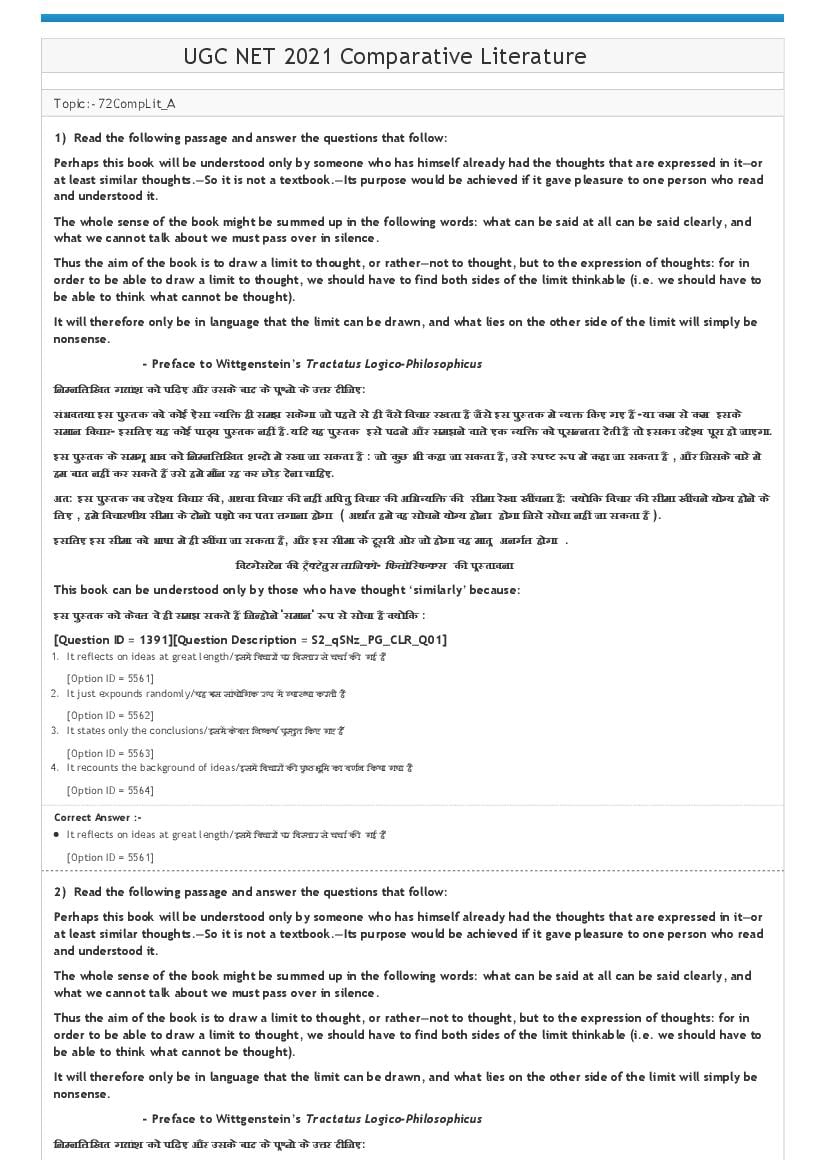
1) Read the following passage and answer the questions that follow:
Perhaps this book will be understood only by someone who has himself already had the thoughts that are expressed in it—or
at least similar thoughts.—So it is not a textbook.—Its purpose would be achieved if it gave pleasure to one person who read
and understood it.
The whole sense of the book might be summed up in the following words: what can be said at all can be said clearly, and
what we cannot talk about we must pass over in silence.
Thus the aim of the book is to draw a limit to thought, or rather—not to thought, but to the expression of thoughts: for in
order to be able to draw a limit to thought, we should have to find both sides of the limit thinkable (i.e. we should have to
be able to think what cannot be thought).
It will therefore only be in language that the limit can be drawn, and what lies on the other side of the limit will simply be
nonsense.
‐ Preface to Wittgenstein’s Tractatus Logico‐Philosophicus
िन निलिखत ग ांश को पिढ़ए और उसके बाद के प के उ र दीिजए:
संभवतया इस पु तक को कोई ऐसा यि ही समझ सकेगा जो पहले से ही वैसे िवचार रखता है जैसे इस पु तक म य िकए गए ह ‐या कम से कम इसके
समान िवचार‐ इसिलए यह कोई पा य पु तक नह है. यिद यह पु तक इसे पढने और समझने वाले एक यि को पस नता देती है तो इसका उ े य पूरा हो जाएगा.
इस पु तक के समग भाव को िन निलिखत श द म रखा जा सकता है : जो कुछ भी कहा जा सकता है, उसे प प म कहा जा सकता है , और िजसके बारे म
हम बात नह कर सकते ह उसे हम मौन रह कर छोड़ देना चािहए.
अत: इस पु तक का उ े य िवचार क , अथवा िवचार क नह अिपतु िवचार क अिभ यि क सीमा रेखा ख चना है: य िक िवचार क सीमा ख चने यो य होने के
िलए , हम िवचारणीय सीमा के दोन प का पता लगाना होगा ( अथात हम वह सोचने यो य होना होगा िजसे सोचा नह जा सकता है ).
इसिलए इस सीमा को भाषा म ही ख चा जा सकता है, और इस सीमा के दूसरी ओर जो होगा वह मात अनगल होगा .
िवटगसटेन क टै टेतुस लािजको‐ िफलोि फकस क प तावना
This book can be understood only by those who have thought ‘similarly’ because:
इस पु तक को केवल वे ही समझ सकते ह िज ह ने 'समान' प से सोचा है य िक :
[Question ID = 1391][Question Description = S2_qSNz_PG_CLR_Q01]
1. It reflects on ideas at great length/इसम िवचार पर िव तार से चचा क गई है
[Option ID = 5561]
2. It just expounds randomly/यह बस सांयोिगक प म या या करती है
[Option ID = 5562]
3. It states only the conclusions/इसम केवल िन कष प तुत िकए गए ह
[Option ID = 5563]
4. It recounts the background of ideas/इसम िवचार क पृ भूिम का वणन िकया गया है
[Option ID = 5564]
It reflects on ideas at great length/इसम िवचार पर िव तार से चचा क गई है
[Option ID = 5561]
2) Read the following passage and answer the questions that follow:
Perhaps this book will be understood only by someone who has himself already had the thoughts that are expressed in it—or
at least similar thoughts.—So it is not a textbook.—Its purpose would be achieved if it gave pleasure to one person who read
and understood it.
The whole sense of the book might be summed up in the following words: what can be said at all can be said clearly, and
what we cannot talk about we must pass over in silence.
Thus the aim of the book is to draw a limit to thought, or rather—not to thought, but to the expression of thoughts: for in
order to be able to draw a limit to thought, we should have to find both sides of the limit thinkable (i.e. we should have to
be able to think what cannot be thought).
It will therefore only be in language that the limit can be drawn, and what lies on the other side of the limit will simply be
nonsense.
‐ Preface to Wittgenstein’s Tractatus Logico‐Philosophicus
िन निलिखत ग ांश को पिढ़ए और उसके बाद के प के उ र दीिजए:
Page 2
समान िवचार‐ इसिलए यह कोई पा य पु तक नह है. यिद यह पु तक इसे पढने और समझने वाले एक यि को पस नता देती है तो इसका उ े य पूरा हो जाएगा.
इस पु तक के समग भाव को िन निलिखत श द म रखा जा सकता है : जो कुछ भी कहा जा सकता है, उसे प प म कहा जा सकता है , और िजसके बारे म
हम बात नह कर सकते ह उसे हम मौन रह कर छोड़ देना चािहए.
अत: इस पु तक का उ े य िवचार क , अथवा िवचार क नह अिपतु िवचार क अिभ यि क सीमा रेखा ख चना है: य िक िवचार क सीमा ख चने यो य होने के
िलए , हम िवचारणीय सीमा के दोन प का पता लगाना होगा ( अथात हम वह सोचने यो य होना होगा िजसे सोचा नह जा सकता है ).
इसिलए इस सीमा को भाषा म ही ख चा जा सकता है, और इस सीमा के दूसरी ओर जो होगा वह मात अनगल होगा .
िवटगसटेन क टै टेतुस लािजको‐ िफलोि फकस क प तावना
This book is not a ‘textbook’ because:
यह पु तक 'पा य पु तक' नह है य िक :
[Question ID = 1392][Question Description = S2_qSNz_PG_CLR_Q02]
1. It does not deal with a discipline/यह िकसी िवषय से संबिं धत नह है
[Option ID = 5565]
2. It expresses only the author’s ideas/इसम केवल लेखक के िवचार य िकए गए ह
[Option ID = 5566]
3. It does not seek to explain the ideas/यह िवचार क या या नह करती है
[Option ID = 5567]
4. It seeks only empathic understanding/यह मात त भ
ु िू तक समझ क मांग करती है
[Option ID = 5568]
It does not deal with a discipline/यह िकसी िवषय से संबिं धत नह है
[Option ID = 5565]
3) Read the following passage and answer the questions that follow:
Perhaps this book will be understood only by someone who has himself already had the thoughts that are expressed in it—or
at least similar thoughts.—So it is not a textbook.—Its purpose would be achieved if it gave pleasure to one person who read
and understood it.
The whole sense of the book might be summed up in the following words: what can be said at all can be said clearly, and
what we cannot talk about we must pass over in silence.
Thus the aim of the book is to draw a limit to thought, or rather—not to thought, but to the expression of thoughts: for in
order to be able to draw a limit to thought, we should have to find both sides of the limit thinkable (i.e. we should have to
be able to think what cannot be thought).
It will therefore only be in language that the limit can be drawn, and what lies on the other side of the limit will simply be
nonsense.
‐ Preface to Wittgenstein’s Tractatus Logico‐Philosophicus
िन निलिखत ग ांश को पिढ़ए और उसके बाद के प के उ र दीिजए:
संभवतया इस पु तक को कोई ऐसा यि ही समझ सकेगा जो पहले से ही वैसे िवचार रखता है जैसे इस पु तक म य िकए गए ह ‐या कम से कम इसके
समान िवचार‐ इसिलए यह कोई पा य पु तक नह है. यिद यह पु तक इसे पढने और समझने वाले एक यि को पस नता देती है तो इसका उ े य पूरा हो जाएगा.
इस पु तक के समग भाव को िन निलिखत श द म रखा जा सकता है : जो कुछ भी कहा जा सकता है, उसे प प म कहा जा सकता है , और िजसके बारे म
हम बात नह कर सकते ह उसे हम मौन रह कर छोड़ देना चािहए.
अत: इस पु तक का उ े य िवचार क , अथवा िवचार क नह अिपतु िवचार क अिभ यि क सीमा रेखा ख चना है: य िक िवचार क सीमा ख चने यो य होने के
िलए , हम िवचारणीय सीमा के दोन प का पता लगाना होगा ( अथात हम वह सोचने यो य होना होगा िजसे सोचा नह जा सकता है ).
इसिलए इस सीमा को भाषा म ही ख चा जा सकता है, और इस सीमा के दूसरी ओर जो होगा वह मात अनगल होगा .
िवटगसटेन क टै टेतुस लािजको‐ िफलोि फकस क प तावना
Which one of the following is a correct inference from the first sentence?
पथम वा य का िन न म से सही अनुमान या है ?
[Question ID = 1393][Question Description = S2_qSNz_PG_CLR_Q03]
1. Silence expresses the inexpressible/मौन अ य ‐ यो य को य करता है
[Option ID = 5569]
2. Thought and words are co‐present/िवचार और श द साथ ‐साथ उपि थत ह
[Option ID = 5570]
3. If there is a thought, it is expressible as well/यिद िवचार है , तो वह य करने यो य भी है
[Option ID = 5571]
Page 3
[Option ID = 5572]
Silence expresses the inexpressible/मौन अ य ‐ यो य को य करता है
[Option ID = 5569]
4) Read the following passage and answer the questions that follow:
Perhaps this book will be understood only by someone who has himself already had the thoughts that are expressed in it—or
at least similar thoughts.—So it is not a textbook.—Its purpose would be achieved if it gave pleasure to one person who read
and understood it.
The whole sense of the book might be summed up in the following words: what can be said at all can be said clearly, and
what we cannot talk about we must pass over in silence.
Thus the aim of the book is to draw a limit to thought, or rather—not to thought, but to the expression of thoughts: for in
order to be able to draw a limit to thought, we should have to find both sides of the limit thinkable (i.e. we should have to
be able to think what cannot be thought).
It will therefore only be in language that the limit can be drawn, and what lies on the other side of the limit will simply be
nonsense.
‐ Preface to Wittgenstein’s Tractatus Logico‐Philosophicus
िन निलिखत ग ांश को पिढ़ए और उसके बाद के प के उ र दीिजए:
संभवतया इस पु तक को कोई ऐसा यि ही समझ सकेगा जो पहले से ही वैसे िवचार रखता है जैसे इस पु तक म य िकए गए ह ‐या कम से कम इसके
समान िवचार‐ इसिलए यह कोई पा य पु तक नह है. यिद यह पु तक इसे पढने और समझने वाले एक यि को पस नता देती है तो इसका उ े य पूरा हो जाएगा.
इस पु तक के समग भाव को िन निलिखत श द म रखा जा सकता है : जो कुछ भी कहा जा सकता है, उसे प प म कहा जा सकता है , और िजसके बारे म
हम बात नह कर सकते ह उसे हम मौन रह कर छोड़ देना चािहए.
अत: इस पु तक का उ े य िवचार क , अथवा िवचार क नह अिपतु िवचार क अिभ यि क सीमा रेखा ख चना है: य िक िवचार क सीमा ख चने यो य होने के
िलए , हम िवचारणीय सीमा के दोन प का पता लगाना होगा ( अथात हम वह सोचने यो य होना होगा िजसे सोचा नह जा सकता है ).
इसिलए इस सीमा को भाषा म ही ख चा जा सकता है, और इस सीमा के दूसरी ओर जो होगा वह मात अनगल होगा .
िवटगसटेन क टै टेतुस लािजको‐ िफलोि फकस क प तावना
Limits of thought cannot be drawn because
िवचार क सीमा नह ख ची जा सकती है य िक :
[Question ID = 1394][Question Description = S2_qSNz_PG_CLR_Q04]
1. We need to stop thinking to see such limits/ऐसी सीमाओं को देखने के िलए हम सोचना बं द करने क आव यकता है
[Option ID = 5573]
2. Of the paradox of thinking unthinkable/िजसे सोचा नह जा सकता है उसके बारे म सोचना िवरोधाभासी है
[Option ID = 5574]
3. We need to know of beyond the limit/हम सीमा प ात के बारे म जानने क आव यकता है
[Option ID = 5575]
4. We need to exit the world of language/हम भाषा क दुिनया से बाहर िनकलने क आव यकता है
[Option ID = 5576]
We need to stop thinking to see such limits/ऐसी सीमाओं को देखने के िलए हम सोचना बं द करने क आव यकता है
[Option ID = 5573]
5) Read the following passage and answer the questions that follow:
Perhaps this book will be understood only by someone who has himself already had the thoughts that are expressed in it—or
at least similar thoughts.—So it is not a textbook.—Its purpose would be achieved if it gave pleasure to one person who read
and understood it.
The whole sense of the book might be summed up in the following words: what can be said at all can be said clearly, and
what we cannot talk about we must pass over in silence.
Thus the aim of the book is to draw a limit to thought, or rather—not to thought, but to the expression of thoughts: for in
order to be able to draw a limit to thought, we should have to find both sides of the limit thinkable (i.e. we should have to
be able to think what cannot be thought).
It will therefore only be in language that the limit can be drawn, and what lies on the other side of the limit will simply be
nonsense.
‐ Preface to Wittgenstein’s Tractatus Logico‐Philosophicus
िन निलिखत ग ांश को पिढ़ए और उसके बाद के प के उ र दीिजए:
Page 4
समान िवचार‐ इसिलए यह कोई पा य पु तक नह है. यिद यह पु तक इसे पढने और समझने वाले एक यि को पस नता देती है तो इसका उ े य पूरा हो जाएगा.
इस पु तक के समग भाव को िन निलिखत श द म रखा जा सकता है : जो कुछ भी कहा जा सकता है, उसे प प म कहा जा सकता है , और िजसके बारे म
हम बात नह कर सकते ह उसे हम मौन रह कर छोड़ देना चािहए.
अत: इस पु तक का उ े य िवचार क , अथवा िवचार क नह अिपतु िवचार क अिभ यि क सीमा रेखा ख चना है: य िक िवचार क सीमा ख चने यो य होने के
िलए , हम िवचारणीय सीमा के दोन प का पता लगाना होगा ( अथात हम वह सोचने यो य होना होगा िजसे सोचा नह जा सकता है ).
इसिलए इस सीमा को भाषा म ही ख चा जा सकता है, और इस सीमा के दूसरी ओर जो होगा वह मात अनगल होगा .
िवटगसटेन क टै टेतुस लािजको‐ िफलोि फकस क प तावना
It is possible to draw limits to language as
भाषा क सीमा ख चना संभव है य िक
[Question ID = 1395][Question Description = S2_qSNz_PG_CLR_Q05]
1. It is made up of discrete entities/यह िविव स व से बनी है
[Option ID = 5577]
2. It has an intrinsic grammar/इसका एक सहज याकरण है
[Option ID = 5578]
3. Its substance, not form, is tangible/इसका प नह , अिपतु सारव तु गोचर है
[Option ID = 5579]
4. It is sequential both in speech and writing/यह बोलने और िलखने म आनुकिमक है
[Option ID = 5580]
It is made up of discrete entities/यह िविव स व से बनी है
[Option ID = 5577]
Topic:‐ 72CompLit_B
1) Read the following passage and answer the questions that follow:
What was after the universe?
Nothing. But was there anything round the universe to show where it stopped before the nothing place began?
It could not be a wall; but there could be a thin thin line there all round everything. It was very big to think about
everything and everywhere. Only God could do that. He tried to think what a big thought that must be; but he could only
think of God. God was God's name just as his name was Stephen. DIEU was the French for God and that was God's name too;
and when anyone prayed to God and said DIEU then God knew at once that it was a French person that was praying. But,
though there were different names for God in all the different languages in the world and God understood what all the
people who prayed said in their different languages, still God remained always the same God and God's real name was God.
James Joyce, A Portrait of the Artist as a Young Man
िन निलिखत ग ांश को पिढ़ए और उसके बाद के प के उ र दीिजए :
ब ा ड के बाद या था ?
कुछ नह . पर तु या ब ा ड के इद ‐िगद कुछ था जो यह दशाए िक कुछ नह थान आरंभ होने से पूव यह कहाँ का था ?
यह कोई दीवार नह हो सकती थी ; पर तु प येक व तु के चार ओर कोई एक महीन महीन रेखा हो सकती थी . प येक व तु और प येक थान के बारे म सोचना
बहत बड़ा काय था .केवल ई र ही यह काय कर सकता था .उसने सोचने का पयास िकया िक यह िकतना बड़ा िवचार रहा होगा ; पर तु वह केवल ई र के बारे म
ही सोच पाया . ई र का नाम ई र था जैसे उसका नाम टीफन था. ई र के िलए ांिससी नाम डीआई ई यू था और वह भी ई र का नाम था ; और जब कोई
ई र क उपासना करते हए डीआई ई यू कहता तो ई र त काल जान जाता िक उपासना करने वाला यि ांिससी था . पर तु, य िप िव भर म अलग अलग
भाषओं म ई र के िलए िभ न नाम थे और ई र समझता था िक अलग अलग भाषओं म पाथना करने वाले लोग या कह रहे ह, िफर भी ई र हमेशा वही ई र रहा
और ई र का वा तिवक नाम ई र था .
जे स जोयस, ए पोटट ऑफ एन आिट ट एज ए यंग मैन
This passage is a reflection on
यह ग ांश िन निलिखत के बारे म मनन है
[Question ID = 1396][Question Description = S2_qSNz_PG_CLR_Q06]
1. The nature of the universe/ब ा ड क पकृित
[Option ID = 5581]
2. The limits of the universe/ब ा ड क सीमाएं
[Option ID = 5582]
3. Different names of God/ई र के िविभ न नाम
[Option ID = 5583]
4. God as creator of the universe/ब ा ड के रचियता के प म ई र
[Option ID = 5584]
Page 5
[Option ID = 5581]
2) Read the following passage and answer the questions that follow:
What was after the universe?
Nothing. But was there anything round the universe to show where it stopped before the nothing place began?
It could not be a wall; but there could be a thin thin line there all round everything. It was very big to think about
everything and everywhere. Only God could do that. He tried to think what a big thought that must be; but he could only
think of God. God was God's name just as his name was Stephen. DIEU was the French for God and that was God's name too;
and when anyone prayed to God and said DIEU then God knew at once that it was a French person that was praying. But,
though there were different names for God in all the different languages in the world and God understood what all the
people who prayed said in their different languages, still God remained always the same God and God's real name was God.
James Joyce, A Portrait of the Artist as a Young Man
िन निलिखत ग ांश को पिढ़ए और उसके बाद के प के उ र दीिजए :
ब ा ड के बाद या था ?
कुछ नह . पर तु या ब ा ड के इद ‐िगद कुछ था जो यह दशाए िक कुछ नह थान आरंभ होने से पूव यह कहाँ का था ?
यह कोई दीवार नह हो सकती थी ; पर तु प येक व तु के चार ओर कोई एक महीन महीन रेखा हो सकती थी . प येक व तु और प येक थान के बारे म सोचना
बहत बड़ा काय था .केवल ई र ही यह काय कर सकता था .उसने सोचने का पयास िकया िक यह िकतना बड़ा िवचार रहा होगा ; पर तु वह केवल ई र के बारे म
ही सोच पाया . ई र का नाम ई र था जैसे उसका नाम टीफन था. ई र के िलए ांिससी नाम डीआई ई यू था और वह भी ई र का नाम था ; और जब कोई
ई र क उपासना करते हए डीआई ई यू कहता तो ई र त काल जान जाता िक उपासना करने वाला यि ांिससी था . पर तु, य िप िव भर म अलग अलग
भाषओं म ई र के िलए िभ न नाम थे और ई र समझता था िक अलग अलग भाषओं म पाथना करने वाले लोग या कह रहे ह, िफर भी ई र हमेशा वही ई र रहा
और ई र का वा तिवक नाम ई र था .
जे स जोयस, ए पोटट ऑफ एन आिट ट एज ए यंग मैन
These are the reflections of a/an
यह िन न म से िकसका मनन है ?
[Question ID = 1397][Question Description = S2_qSNz_PG_CLR_Q07]
1. Studious cosmologist/एकअ ययनशील ब ा ड िव ानी
[Option ID = 5585]
2. Earnest preacher/एक गंभीर उपदेशक
[Option ID = 5586]
3. Comparative linguist/एक तुलना मक भाषा ‐िव ानी
[Option ID = 5587]
4. Thinking mind/एक िवचारशील मि त क
[Option ID = 5588]
Studious cosmologist/एकअ ययनशील ब ा ड िव ानी
[Option ID = 5585]
3) Read the following passage and answer the questions that follow:
What was after the universe?
Nothing. But was there anything round the universe to show where it stopped before the nothing place began?
It could not be a wall; but there could be a thin thin line there all round everything. It was very big to think about
everything and everywhere. Only God could do that. He tried to think what a big thought that must be; but he could only
think of God. God was God's name just as his name was Stephen. DIEU was the French for God and that was God's name too;
and when anyone prayed to God and said DIEU then God knew at once that it was a French person that was praying. But,
though there were different names for God in all the different languages in the world and God understood what all the
people who prayed said in their different languages, still God remained always the same God and God's real name was God.
James Joyce, A Portrait of the Artist as a Young Man
िन निलिखत ग ांश को पिढ़ए और उसके बाद के प के उ र दीिजए :
ब ा ड के बाद या था ?
कुछ नह . पर तु या ब ा ड के इद ‐िगद कुछ था जो यह दशाए िक कुछ नह थान आरंभ होने से पूव यह कहाँ का था ?
यह कोई दीवार नह हो सकती थी ; पर तु प येक व तु के चार ओर कोई एक महीन महीन रेखा हो सकती थी . प येक व तु और प येक थान के बारे म सोचना
बहत बड़ा काय था .केवल ई र ही यह काय कर सकता था .उसने सोचने का पयास िकया िक यह िकतना बड़ा िवचार रहा होगा ; पर तु वह केवल ई र के बारे म
ही सोच पाया . ई र का नाम ई र था जैसे उसका नाम टीफन था. ई र के िलए ांिससी नाम डीआई ई यू था और वह भी ई र का नाम था ; और जब कोई
ई र क उपासना करते हए डीआई ई यू कहता तो ई र त काल जान जाता िक उपासना करने वाला यि ांिससी था . पर तु, य िप िव भर म अलग अलग
Page 6
और ई र का वा तिवक नाम ई र था .
जे स जोयस, ए पोटट ऑफ एन आिट ट एज ए यंग मैन
About the universe we know that
ब ा ड के संबंध म हम जानते ह िक
[Question ID = 1398][Question Description = S2_qSNz_PG_CLR_Q08]
1. It is infinite/यह असीिमत है
[Option ID = 5589]
2. It is nothing/यह कुछ नह है
[Option ID = 5590]
3. It ends somewhere/यह कह समा होता है
[Option ID = 5591]
4. It is a mystery/यह एक रह य है
[Option ID = 5592]
It is infinite/यह असीिमत है
[Option ID = 5589]
4) Read the following passage and answer the questions that follow:
What was after the universe?
Nothing. But was there anything round the universe to show where it stopped before the nothing place began?
It could not be a wall; but there could be a thin thin line there all round everything. It was very big to think about
everything and everywhere. Only God could do that. He tried to think what a big thought that must be; but he could only
think of God. God was God's name just as his name was Stephen. DIEU was the French for God and that was God's name too;
and when anyone prayed to God and said DIEU then God knew at once that it was a French person that was praying. But,
though there were different names for God in all the different languages in the world and God understood what all the
people who prayed said in their different languages, still God remained always the same God and God's real name was God.
James Joyce, A Portrait of the Artist as a Young Man
िन निलिखत ग ांश को पिढ़ए और उसके बाद के प के उ र दीिजए :
ब ा ड के बाद या था ?
कुछ नह . पर तु या ब ा ड के इद ‐िगद कुछ था जो यह दशाए िक कुछ नह थान आरंभ होने से पूव यह कहाँ का था ?
यह कोई दीवार नह हो सकती थी ; पर तु प येक व तु के चार ओर कोई एक महीन महीन रेखा हो सकती थी . प येक व तु और प येक थान के बारे म सोचना
बहत बड़ा काय था .केवल ई र ही यह काय कर सकता था .उसने सोचने का पयास िकया िक यह िकतना बड़ा िवचार रहा होगा ; पर तु वह केवल ई र के बारे म
ही सोच पाया . ई र का नाम ई र था जैसे उसका नाम टीफन था. ई र के िलए ांिससी नाम डीआई ई यू था और वह भी ई र का नाम था ; और जब कोई
ई र क उपासना करते हए डीआई ई यू कहता तो ई र त काल जान जाता िक उपासना करने वाला यि ांिससी था . पर तु, य िप िव भर म अलग अलग
भाषओं म ई र के िलए िभ न नाम थे और ई र समझता था िक अलग अलग भाषओं म पाथना करने वाले लोग या कह रहे ह, िफर भी ई र हमेशा वही ई र रहा
और ई र का वा तिवक नाम ई र था .
जे स जोयस, ए पोटट ऑफ एन आिट ट एज ए यंग मैन
The boundary of the universe, if there is one, could possibly be marked by
यिद इस ब ा ड क कोई सीमा है , तो संभवतया उसक िनशानी होगी
[Question ID = 1399][Question Description = S2_qSNz_PG_CLR_Q09]
1. Lines round the universe /ब ा ड के चार ओर रेखाएं
[Option ID = 5593]
2. Straight thin lines/सीधी महीन रेखाएं
[Option ID = 5594]
3. Circles around the universe/ब ा ड के चार ओर वृत
[Option ID = 5595]
4. Lines round all planets, galaxies etc./सम त गह , आकाशगंगाओं आिद के चार ओर रेखाएं
[Option ID = 5596]
Lines round the universe /ब ा ड के चार ओर रेखाएं
[Option ID = 5593]
5) Read the following passage and answer the questions that follow:
What was after the universe?
Page 7
It could not be a wall; but there could be a thin thin line there all round everything. It was very big to think about
everything and everywhere. Only God could do that. He tried to think what a big thought that must be; but he could only
think of God. God was God's name just as his name was Stephen. DIEU was the French for God and that was God's name too;
and when anyone prayed to God and said DIEU then God knew at once that it was a French person that was praying. But,
though there were different names for God in all the different languages in the world and God understood what all the
people who prayed said in their different languages, still God remained always the same God and God's real name was God.
James Joyce, A Portrait of the Artist as a Young Man
िन निलिखत ग ांश को पिढ़ए और उसके बाद के प के उ र दीिजए :
ब ा ड के बाद या था ?
कुछ नह . पर तु या ब ा ड के इद ‐िगद कुछ था जो यह दशाए िक कुछ नह थान आरंभ होने से पूव यह कहाँ का था ?
यह कोई दीवार नह हो सकती थी ; पर तु प येक व तु के चार ओर कोई एक महीन महीन रेखा हो सकती थी . प येक व तु और प येक थान के बारे म सोचना
बहत बड़ा काय था .केवल ई र ही यह काय कर सकता था .उसने सोचने का पयास िकया िक यह िकतना बड़ा िवचार रहा होगा ; पर तु वह केवल ई र के बारे म
ही सोच पाया . ई र का नाम ई र था जैसे उसका नाम टीफन था. ई र के िलए ांिससी नाम डीआई ई यू था और वह भी ई र का नाम था ; और जब कोई
ई र क उपासना करते हए डीआई ई यू कहता तो ई र त काल जान जाता िक उपासना करने वाला यि ांिससी था . पर तु, य िप िव भर म अलग अलग
भाषओं म ई र के िलए िभ न नाम थे और ई र समझता था िक अलग अलग भाषओं म पाथना करने वाले लोग या कह रहे ह, िफर भी ई र हमेशा वही ई र रहा
और ई र का वा तिवक नाम ई र था .
जे स जोयस, ए पोटट ऑफ एन आिट ट एज ए यंग मैन
Only God can tell about the universe but
ब ा ड के बारे म केवल ई र ही बता सकता है पर तु
[Question ID = 1400][Question Description = S2_qSNz_PG_CLR_Q10]
1. The God of many names/अनेक नाम वाला ई र
[Option ID = 5597]
2. Which or whose God/कौन अथवा िकसका ई र
[Option ID = 5598]
3. God called by what name/िकस नाम से पुकारा जाने वाला ई र
[Option ID = 5599]
4. God whose name is ‘Dieu’/'डीआई ई यू' नाम वाला ई र
[Option ID = 5600]
The God of many names/अनेक नाम वाला ई र
[Option ID = 5597]
Topic:‐ 72CompLit_C
1) Which school of comparative literature is the polysystem theory ascribed to?
बह पणाली िस ांत का तुलना मक सािह य क िकस िवचार ‐प ित से संबंध बताया जाता है ?
[Question ID = 1401][Question Description = S2_qSNz_PG_CLR_Q11]
1. French school/ ांिससी िवचार ‐प ित [Option ID = 5601]
2. German school/जमन िवचार ‐प ित [Option ID = 5602]
3. Tel Aviv school/तेल अबीब िवचार ‐प ित [Option ID = 5603]
4. American school/अमरीक िवचार ‐प ित [Option ID = 5604]
French school/ ांिससी िवचार ‐प ित [Option ID = 5601]
2) Whom are the ideas of Horizon and Horizon of expectation attributed to?
ि ितज और प याशा के ि ितज के िवचार का शेय िकसे िदया जाता है ?
[Question ID = 1402][Question Description = S2_qSNz_PG_CLR_Q12]
1. Gadamer and Heidegger/गदामर और हैड़ेगर [Option ID = 5605]
2. Heidegger and Merleau Ponty/हैड़ेगर और मेल प टी [Option ID = 5606]
3. Gadamer and Jauss/गदामर और जौस [Option ID = 5607]
4. Jauss and Durisin/जौस और दु रिसन [Option ID = 5608]
Gadamer and Heidegger/गदामर और हैड़ेगर [Option ID = 5605]
3) "Indian literature is an interliterary condition". Whom is this statement attributed to?
Page 8
[Question ID = 1403][Question Description = S2_qSNz_PG_CLR_Q13]
1. Amiya Dev/अिमया दे व
[Option ID = 5609]
2. Swapan Majumdar/ व न मजूमदार
[Option ID = 5610]
3. Ayappa Paniker/अय पा पिणकर
[Option ID = 5611]
4. Ganesh Devy/गणेश डेवी
[Option ID = 5612]
Amiya Dev/अिमया दे व
[Option ID = 5609]
4) Which of the following theorists identifies Interliterariness as the basis of comparative studies of literature?
िन निलिखत म से िकस िवचारक ने सािह य के तुलना मक अ ययन के आधार के प म अंत:सािहि यकता क पहचान क है ?
[Question ID = 1404][Question Description = S2_qSNz_PG_CLR_Q14]
1. Marian Galik/म रयन गिलक [Option ID = 5613]
2. Julia Kristeva/जूिलया िक तेवा [Option ID = 5614]
3. Steven Totosy/ टीवन टोतो य [Option ID = 5615]
4. Rene Wellek/रेने वे लेक [Option ID = 5616]
Marian Galik/म रयन गिलक [Option ID = 5613]
5) With which of the following concepts would you associate Edouard Glissant?
आप एदुअद लीसंत को िन न म से िकस अवधारणा के साथ जोड़गे ?
[Question ID = 1405][Question Description = S2_qSNz_PG_CLR_Q15]
1. Hybridity/संकरता [Option ID = 5617]
2. Rhizome/पकंद [Option ID = 5618]
3. Secular Criticism/पंथ‐िनरपे आलोचना [Option ID = 5619]
4. Distant Reading/दूर थ पठन [Option ID = 5620]
Hybridity/संकरता [Option ID = 5617]
6) Which of the following writers is a pioneer of Dalit literature in Telugu?
ु ू म दिलत सािह य का अगणी है ?
िन निलिखत म से कौन सा लेखक तेलग
[Question ID = 1406][Question Description = S2_qSNz_PG_CLR_Q16]
1. Namdeo Dhasal/नामदेव धसाल [Option ID = 5621]
2. Ranganayakamma/रंगनायिकअ मा [Option ID = 5622]
3. Gurram Jashuva/गुरम जोशुआ [Option ID = 5623]
4. Hansda Sowvendra Shekhar/हंसदा सौवद शेखर [Option ID = 5624]
Namdeo Dhasal/नामदेव धसाल [Option ID = 5621]
7) What is a masnavi?
मसनवी या है ?
[Question ID = 1407][Question Description = S2_qSNz_PG_CLR_Q17]
1. A quatrain/एक चतु पदी [Option ID = 5625]
2. A couplet/एक दोहा [Option ID = 5626]
3. A long poem with internally rhyming lines/आ त रक प म तुकबंदी वाली लंबी किवता [Option ID = 5627]
4. A death lament/एक मृ यु शोक गीत [Option ID = 5628]
A quatrain/एक चतु पदी [Option ID = 5625]
8) To which of the following theorists would you attribute a pluralistic idea of history?
इितहास के बहलवादी िवचार का शेय आप िन निलिखत म से िकस िस ांतकार को द गे ?
Page 9
1. Hayden White/हेडन हाईट [Option ID = 5629]
2. Ralph Cohen/रा फ कोहेन [Option ID = 5630]
3. Henri Bergson/हेनरी बगसन [Option ID = 5631]
4. Fernand Braudel/फ़नाड बौदेल [Option ID = 5632]
Hayden White/हेडन हाईट [Option ID = 5629]
9) Which of the following statements form part of the doctrine of syadvad ?
A. Mortals cannot know the truth
B. Knowledge claims can be qualified in many ways
C. There is no truth
D. Truth is conditional
Choose the correct answer from the options given below:
िन निलिखत म से कौन सा कथन यादवाद का अंग है ?
A. न र स य नह जन सकते ह
B. ान के दाव को अनेक प म सीिमत िकया जा सकता है
C. कोई स य नह है
D. स य सपितबंध है
नीचे िदए गए िवक प म से सही उ र चुन :
[Question ID = 1409][Question Description = S2_qSNz_PG_CLR_Q19]
1. A and B only/ केवल A और B
[Option ID = 5633]
2. C and D only/केवल C और D
[Option ID = 5634]
3. B and C only/केवल B और C
[Option ID = 5635]
4. B and D only/केवल B और D
[Option ID = 5636]
A and B only/ केवल A और B
[Option ID = 5633]
10) Which among the following texts deals with poetry and poetics?
A. Ab e hayat
B. Milindapanha
C. Tolkappiyam
D. Padmapuran
Choose the correct answer from the options given below:
िन निलिखत म से कौन सी कृित का य और का यशा त से संबंिधत है ?
A. आबे हयात
B. िमिल दप हा
C. तो कािप यम
D. प पुराण
नीचे िदए गए िवक प म से सही उ र चुन :
Page 10
1. A and B only/केवल A और B
[Option ID = 5637]
2. A and C only/केवल A और C
[Option ID = 5638]
3. B and D only/केवल B और D
[Option ID = 5639]
4. C and D only/केवल C और D
[Option ID = 5640]
A and B only/केवल A और B
[Option ID = 5637]
11) Which among the following are the poets of Dakhni?
A. Wali Aurangabadi
B. Mahlaqa Bai Chanda
C. Sachal Sarmast
D. Bulleshah
Choose the correct answer from the options given below:
िन निलिखत म से दिखनी के किव कौन ह ?
A . वली औरंगाबादी
B . महलका बाई चंदा
C . सचल सरम त
D . बु लेशाह
[Question ID = 1411][Question Description = S2_qSNz_PG_CLR_Q21]
1. A and B only/केवल A और B
[Option ID = 5641]
2. C and D only/केवल C . और D
[Option ID = 5642]
3. A and C only/केवल A और C
[Option ID = 5643]
4. B and D only/केवल B और D
[Option ID = 5644]
A and B only/केवल A और B
[Option ID = 5641]
12) Match List I with List II
List I List II
Philosopher Concept
A. Martin Buber I. Dasein
B. Jean Paul Sartre II. Phenomenal field
C. Maurice Merleau Ponty III. Bad faith
D. Martin Heidegger IV. I‐Thou
Choose the correct answer from the options given below:
सूची ‐I को सूची ‐II से सुमेिलत क िजए :
सूची ‐I सूची ‐II
( दाशिनक ) ( अवधारणा)
Page 11
B. यां पॉल सात II.सांवृितक ेत
C. मा रस मेल प टी III. दुभाव
D. मािटन हैड़ेगर IV. म ‐तुम ( आई‐दाऊ )
नीचे िदए गए िवक प म से सही उ र चुिनए :
[Question ID = 1412][Question Description = S2_qSNz_PG_CLR_Q22]
1. A ‐ IV, B ‐ II, C ‐ I, D ‐ III
[Option ID = 5645]
2. A ‐ IV, B ‐ III, C ‐ II, D ‐ I
[Option ID = 5646]
3. A ‐ II, B ‐ I, C ‐ IV, D ‐ III
[Option ID = 5647]
4. A ‐ I, B ‐ II, C ‐ IV, D ‐ III
[Option ID = 5648]
A ‐ IV, B ‐ II, C ‐ I, D ‐ III
[Option ID = 5645]
13) Match List I with List II
List I List II
Author Language
A. Lankesh I. Ahamiya
B. Indira Goswami II. Hindi
C. Yashpal III. Gujarati
D. Zhaverchand Meghani IV. Kannada
Choose the correct answer from the options given below:
सूची ‐I को सूची ‐II से सुमेिलत क िजए :
सूची ‐I सूची ‐II
( लेखक ) ( भाषा )
A. लंकश े I.अहिमया
B. इंिदरा गो वामी II. िहंदी
C. यशपाल III. गुजराती
D. झेवरचंद मेघानी IV. क नड़
नीचे िदए गए िवक प म से सही उ र चुिनए :
[Question ID = 1413][Question Description = S2_qSNz_PG_CLR_Q23]
1. A ‐II , B ‐III , C ‐I , D ‐IV [Option ID = 5649]
2. A ‐III , B ‐I , C ‐IV , D ‐II [Option ID = 5650]
3. A ‐IV , B ‐I , C ‐II , D ‐III [Option ID = 5651]
4. A ‐I , B ‐IV , C ‐II , D ‐III [Option ID = 5652]
A ‐II , B ‐III , C ‐I , D ‐IV [Option ID = 5649]
14) Arrange the following writers in chronological order
A. Namdev
B. Tulsidas
C. Ghananand
D. Karaikkalamma
Choose the correct answer from the options given below
िन निलिखत लेखक को कालकमानुसार यवि थत क िजए:
A . नामदेव
B . तुलसीदास
C . घनानंद
D . कराइकल मा
Page 12
[Question ID = 1414][Question Description = S2_qSNz_PG_CLR_Q24]
1. A, B, C, D [Option ID = 5653]
2. D, C, B, A [Option ID = 5654]
3. D, A, B, C [Option ID = 5655]
4. C, B, A, D [Option ID = 5656]
A, B, C, D [Option ID = 5653]
15) Arrange the literary movements in chronological order
A. Parnassianism
B. Imagism
C. Symbolism
D. Dadaism
Choose the correct answer from the options given below
िन निलिखत सािहि यक आंदोलन को कालकमानुसार यवि थत क िजए :
A. कलावाद
B. िब बवाद
C. पतीकवाद
D. दादाइ म
नीचे िदए गए िवक प म से सही उ र चुन :
[Question ID = 1415][Question Description = S2_qSNz_PG_CLR_Q25]
1. D, C, B, A [Option ID = 5657]
2. C, B, D, A [Option ID = 5658]
3. A, B, D, C [Option ID = 5659]
4. A, C, B, D [Option ID = 5660]
D, C, B, A [Option ID = 5657]
16) Arrange the playwrights in chronological order
A. Maeterlinck
B. Lessing
C. Jonson
D. Webster
Choose the correct answer from the options given below
िन निलिखत ना यकार को कालकमानुसार यवि थत क िजए:
A. मेटरिलंक
B. लेि संग
C. जोनसन
D.वे टर
नीचे िदए गए िवक प म से सही उ र चुन :
[Question ID = 1416][Question Description = S2_qSNz_PG_CLR_Q26]
1. A, D, C, B [Option ID = 5661]
2. C, D, B, A [Option ID = 5662]
3. B, A, C, D [Option ID = 5663]
4. D, C, B, A [Option ID = 5664]
A, D, C, B [Option ID = 5661]
17) Which among the following poets were devotees of Vishnu?
Page 13
B. Nayanar
C. Alvar
D. Satnami
Choose the correct answer from the options given below:
िन निलिखत म से कौन से किव िव णु के भ ह?
A. वकरी
B. नयनार
C. अ वर
D. सतनामी
नीचे िदए गए िवक प म से सही उ र चुन :
[Question ID = 1417][Question Description = S2_qSNz_PG_CLR_Q27]
1. A and C only/केवल A और C
[Option ID = 5665]
2. B and C only/केवल C और B
[Option ID = 5666]
3. B and D only/केवल D और B
[Option ID = 5667]
4. A and B only/केवल A और B
[Option ID = 5668]
A and C only/केवल A और C
[Option ID = 5665]
18) Given below are two statements
Statement I: Modernity in colonial India was mediated by print culture.
Statement II: Print had the potential to undermine the hierarchies of reading related to caste and class.
In light of the above statements, choose the most appropriate answer from the options given below
नीचे दो कथन िदए गए ह :
कथन ‐ I : औपिनवेिशक भारत म आधुिनकता मुदण सं कृित के मा यम से आई थी
कथन ‐ II : मुदण म जाित और वग से संबंिधत पठन के सोपान को ित पहच
ँ ाने क मता थी
उपयु कथन के आलोक म िन निलिखत िवक प म से सवािधक उपयु उ र चुिनए :
[Question ID = 1418][Question Description = S2_qSNz_PG_CLR_Q28]
1. Both Statement I and Statement II are correct/कथन I और II दोन सही ह [Option ID = 5669]
2. Both Statement I and Statement II are incorrect/कथन I और II दोन गलत ह [Option ID = 5670]
3. Statement I is correct but Statement II is incorrect/कथन I सही है , िक तु कथन II गलत है | [Option ID = 5671]
4. Statement I is incorrect but Statement II is correct/कथन I गलत है , िक तु कथन II सही है [Option ID = 5672]
Both Statement I and Statement II are correct/कथन I और II दोन सही ह [Option ID = 5669]
19) Match List I with List II
List I List II
(Critic) (Concept)
A. Amiya Dev I. Indian Literature: another name for Comparative Literature
B. Gurbhagat Singh II. Literary history from below
C. Nabaneeta Dev Sen III. Death of a discipline
D. Gayatri Chakravorty SpivakIV. Differential multilogue
Choose the correct answer from the options given below:
Page 14
सूची ‐II
सूची ‐I
( अवधारणा )
( आलोचक )
I. भारतीय सािह य : तुलना मक सािह य के िलए एक अ य
A. अिमया देव
नाम
B. गुरभगत िसंह II.नीचे से सािहि यक इितहास
C.नबनीता देव सेन III. एक िवषय का अंत
D. गायती चकवत
IV. िवभेदक बहल‐ कथन
ि पवाक
नीचे िदए गए िवक प म से सही उ र चुिनए :
[Question ID = 1419][Question Description = S2_qSNz_PG_CLR_Q29]
1. A ‐ III, B ‐ I, C ‐ II, D ‐ IV
[Option ID = 5673]
2. A ‐ III, B ‐ II, C ‐ I, D ‐ IV
[Option ID = 5674]
3. A ‐ I, B ‐ II, C ‐ IV, D ‐ III
[Option ID = 5675]
4. A ‐ II, B ‐ IV, C ‐ I, D ‐ III
[Option ID = 5676]
A ‐ III, B ‐ I, C ‐ II, D ‐ IV
[Option ID = 5673]
20) Arrange the following books chronologically in terms of their first publication:
A. Rabindranath Tagore’s Gora
B. Rudyard Kipling’s Kim
C. E M Forster’s A Passage to India
D. Herman Hesse’s Siddhartha
Choose the correct answer from the options given below
िन निलिखत पु तक को उनके पथम पकाशन के कालकमानुसार यवि थत क िजए:
A. रवी दनाथ टैगोर क गोरा
B. डयाड िकपिलंग क िकम
C. ई.एम .फो टर क ऐ पैसेज टू इंिडया
D. हरमन हेस क िस ाथ
नीचे िदए गए िवक प म से सही उ र चुन :
[Question ID = 1420][Question Description = S2_qSNz_PG_CLR_Q30]
1. A, B, C, D [Option ID = 5677]
2. A, D, C, B [Option ID = 5678]
3. B, A, D, C [Option ID = 5679]
4. D, A, C, B [Option ID = 5680]
A, B, C, D [Option ID = 5677]
21) Who, among the following, wrote the novel, Indira Bai?
िन निलिखत म से िकसने इंिदरा बाई शीषक उप यास िलखा ?
[Question ID = 1421][Question Description = S2_qSNz_PG_CLR_Q31]
Page 15
2. Volga/वो गा [Option ID = 5682]
3. G. V. Rao/जी.वी.राव [Option ID = 5683]
4. O. P. Chandu Menon/ओ.पी.चंदू मेनन [Option ID = 5684]
E. V. Ramakrishnan/ई.वी.रामकृ णन [Option ID = 5681]
22) According to Sisir Kumar Das, which of these does the ‘history’ of Comparative Literature in India begin with?
िशिशर कुमार दास के अनुसार भारत म तुलना मक सािह य का 'इितहास' िन निलिखत म से िकसके साथ आरंभ हआ ?
[Question ID = 1422][Question Description = S2_qSNz_PG_CLR_Q32]
1. The Bhakti movement/भि आंदोलन [Option ID = 5685]
2. The use of multiple languages in Kalidasa’s plays/कािलदास के नाटक म बहभािषक पयोग [Option ID = 5686]
3. The setting up of the first university department of Comparative Literature/तुलना मक सािह य के पथम िव िव ालयी िवभाग क थापना [Option ID = 5687]
4. The setting up of the first three universities in India/भारत म पथम तीन िव िव ालय क थापना [Option ID = 5688]
The Bhakti movement/भि आंदोलन [Option ID = 5685]
23) Who is the author of the 1959 essay, “Comparative Literature in India”?
1959 म िलखे गए िनबंध , "भारत म तुलना मक सािह य " के लेखक कौन थे ?
[Question ID = 1423][Question Description = S2_qSNz_PG_CLR_Q33]
1. Rabindranath Tagore/रवी दनाथ टैगोर [Option ID = 5689]
2. Buddhadeva Bose/बु देव बोस [Option ID = 5690]
3. Munshi Premchand/मुश ं ी पेमच द [Option ID = 5691]
4. K. R. S. Iyengar/के.आर.एस.अयंगर [Option ID = 5692]
Rabindranath Tagore/रवी दनाथ टैगोर [Option ID = 5689]
24) Which of the following was suggested by Rabindranath Tagore as an alternative name for Comparative Literature?
तुलना मक सािह य के वैकि पक नाम के प म रवी दनाथ टैगोर ारा िन निलिखत म से िकसका सुझाव िदया गया था ?
[Question ID = 1424][Question Description = S2_qSNz_PG_CLR_Q34]
1. Jatiya sahitya/जातीय सािह य [Option ID = 5693]
2. Sahitya/सािह य [Option ID = 5694]
3. Tulnatmak sahitya/तुलना मक सािह य [Option ID = 5695]
4. Visvasahitya/िव सािह य [Option ID = 5696]
Jatiya sahitya/जातीय सािह य [Option ID = 5693]
25) Which of the following historical processes does Mary Louise Pratt’s essay, written in response to the Bernheimer
Report, hold responsible for changing the way literature and culture were conceived and studied in the academy?
A. Neo‐colonialism
B. Globalisation
C. Democratisation
D. Decolonisation
Choose the correct answer from the options given below:
बनहैमर पितवेदन के प युतर म िलखे गए मेरी लुइस पा के िनबंध म अकादमी म सािह य और सं कृित के अ ययन के िलए िवचा रत तरीके को प रवितत करने
के िलए िन निलिखत म से िकस ऐितहािसक पिकया को उ रदायी ठहराया गया है ?
A. नव‐उपिनवेशवाद
B. वै ीकरण
C. लोकतंतीकरण
D . िव ‐औपिनवेशीकरण
नीचे िदए गए िवक प म से सही उ र चुन :
[Question ID = 1425][Question Description = S2_qSNz_PG_CLR_Q35]
Page 16
[Option ID = 5697]
2. A, C and D only/केवल A, C और D
[Option ID = 5698]
3. B, C and D only/केवल B, C और D
[Option ID = 5699]
4. A, B and D only/केवल A, B और D
[Option ID = 5700]
A, B and C only/केवल A, B और C
[Option ID = 5697]
26) Which of the following is implied by the recommendations of the Levin Commission?
A. Comparative Literature should be offered by all universities
B. Comparative Literature should not be offered by all universities
C. Comparative Literature should assume an interdepartmental form
D. literary works from remote languages should not be studied in translation
Choose the correct answer from the options given below:
लेिवन आयोग क अनुशंसाओं म िन निलिखत म से या‐ या िनिहत है ?
A. सभी िव िव ालय म तुलना मक सािह य िवषय होना चािहए
B. सभी िव िव ालय म तुलना मक सािह य िवषय नह होना चािहए
C. तुलना मक सािह य का प अंत:िवभागीय होना चािहए
D. सुदरू भाषाओं क सािहि यक रचनाओं का अनुवाद म अ ययन नह होना चािहए
नीचे िदए गए िवक प म से सही उ र चुन :
[Question ID = 1426][Question Description = S2_qSNz_PG_CLR_Q36]
1. A and B only/केवल A और B
[Option ID = 5701]
2. B and C only/केवल B और C
[Option ID = 5702]
3. A and C only/केवल A और C
[Option ID = 5703]
4. C and D only/केवल C और D
[Option ID = 5704]
A and B only/केवल A और B
[Option ID = 5701]
27) What is the national association of Comparative Literature in India called?
भारत म तुलना मक सािह य क रा ीय एसोिसएशन को या कहा जाता है ?
[Question ID = 1427][Question Description = S2_qSNz_PG_CLR_Q37]
1. Indian National Comparative Literature Association/भारतीय रा ीय तुलना मक सािह य एसोिसएशन [Option ID = 5705]
2. Comparative Indian Literature Association/तुलना मक भारतीय सािह य एसोिसएशन [Option ID = 5706]
3. Comparative Literature Association of India/भारत क तुलना मक सािह य एसोिसएशन [Option ID = 5707]
4. Indian Comparative Literature Association/भारतीय तुलना मक सािह य एसोिसएशन [Option ID = 5708]
Indian National Comparative Literature Association/भारतीय रा ीय तुलना मक सािह य एसोिसएशन [Option ID = 5705]
28) Which of these languages is taken up for study under ‘Other Indian Languages’ by K M George in his Comparative
Indian Literature (1985)?
Page 17
िलया गया है ?
[Question ID = 1428][Question Description = S2_qSNz_PG_CLR_Q38]
1. Bodo/बोडो [Option ID = 5709]
2. Sindhi/िस धी [Option ID = 5710]
3. Lepcha/लेपचा [Option ID = 5711]
4. Dogri/डोगरी [Option ID = 5712]
Bodo/बोडो [Option ID = 5709]
29) With which of the following can translators who claim they want to make the author speak the way he would have
spoken had he written the work in the Target Language be identified most easily?
A. Moving the author to the reader
B. Moving the reader to the author
C. Intermedial translation
D. Domestication
Choose the correct answer from the options given below:
यह दावा करने वाले अनुवादक को , िक वे लेखक से उस पकार बुलवाना चाहते ह जैसे वह ल य भाषा म िलखने पर बोलता , िन निलिखत म से िकसके साथ
सवािधक सरलतापूवक जोड़ा जा सकता है ?
A. लेखक को पाठक के पास ले जाना
B. पाठक को लेखक के पास ले जाना
C. अंतरवत अनुवाद
D. देशीकरण
नीचे िदए गए िवक प म से सही उ र चुन :
[Question ID = 1429][Question Description = S2_qSNz_PG_CLR_Q39]
1. A and B only/केवल A और B
[Option ID = 5713]
2. B and C only/केवल B और C
[Option ID = 5714]
3. C and D only/केवल C और D
[Option ID = 5715]
4. A and D only/केवल A और D
[Option ID = 5716]
A and B only/केवल A और B
[Option ID = 5713]
30) Which of these does Dryden recommend vis‐à‐vis translation?
A. A translator should be a nice critic in his own language before he undertakes to translate a foreign literature
B. To be a thorough translator, one must be a thorough poet
C. One should never try to translate from one medium into another
D. One should try to focus on exotropic translation more than on endotropic translation
Choose the correct answer from the options given below:
अनुवाद के संबंध म डाईडन िन निलिखत म से कौन कौन सी अनुशंसा करते ह ?
A. िकसी िवदेशी भाषा म अनुवाद का काय हाथ म लेने से पूव अनुवादक को वयं अपनी भाषा म एक बेहतरीन आलोचक होना चािहए
B. एक स पूण अनुवादक होने के िलए एक स पूण किव होना चािहए
C. एक मा यम से दूसरे मा यम म अनुवाद का पयास कदािप नह करना चािहए
D. अंतमुखी अनुवाद क अपे ा बिहमुखी अनुवाद पर केि दत करने का पयास करना चािहए
Page 18
[Question ID = 1430][Question Description = S2_qSNz_PG_CLR_Q40]
1. A and B only/केवल A और B
[Option ID = 5717]
2. B and C only/केवल B और C
[Option ID = 5718]
3. C and D only/केवल C और D
[Option ID = 5719]
4. A and D only/केवल Aऔर D
[Option ID = 5720]
A and B only/केवल A और B
[Option ID = 5717]
31) In which of these is the Lepcha language primarily used?
A. Sikkim
B. Andhra Pradesh
C. Uttar Pradesh
D. West Bengal
Choose the correct answer from the options given below:
इनम से कहां ‐कहां लेपचा भाषा मु यतया पयोग क जाती है ?
A. िसि कम
B. आ ध प देश
C. उ र प देश
D. पि म बंगाल
नीचे िदए गए िवक प म से सही उ र चुन :
[Question ID = 1431][Question Description = S2_qSNz_PG_CLR_Q41]
1. A and B only/केवल A और B
[Option ID = 5721]
2. A and C only/केवल A और C
[Option ID = 5722]
3. B and C only/केवल B और C
[Option ID = 5723]
4. A and D only/केवल A और D
[Option ID = 5724]
A and B only/केवल A और B
[Option ID = 5721]
32) Which of these is used most extensively by Arif Ayaz Parrey and Wasim Helal in their graphic narrative adaptation of
Manto’s “Dog of Tetwal”?
आ रफ एयाज़ पेरी और वािसम हेलाल ने मंटो के 'तेतवाल के कु े' के अपने गाफ य वृतांत पांतर म िन निलिखत म से िकसका पयोग िकया है ?
[Question ID = 1432][Question Description = S2_qSNz_PG_CLR_Q42]
1. Mirroring technique/दपण तकनीक [Option ID = 5725]
2. Diagetic narrative/कथा मक ( दायजेितक) वृतांत [Option ID = 5726]
3. Voice overs/ऊपरी आवाज ( वायस ओवर ) [Option ID = 5727]
4. Use of chorus/गायक वृ द का पयोग [Option ID = 5728]
Page 19
33) Which of the following does the concept of an ‘Indian Nepali literature’ imply?
A. Languages are shared among multiple states in South Asia
B. Literature may be written in the same language but belong to multiple states in South Asia
C. Poetry is written in Nepali language
D. Poetry is not written in India
Choose the correct answer from the options given below:
' भारतीय नेपाली सािह य ' क अवधारणा से िन निलिखत म से या विनत होता है ?
A. दि ण एिशया म एकािधक देश के बीच साझा भाषाएं ह
B. सािह य एक ही भाषा म िलखा हो सकता है पर तु दि ण एिशया म एकािधक देश से संबंिधत हो सकता है
C. किवता नेपाली भाषा म िलखी जाती है
D. भारत म किवता नह िलखी जाती है
नीचे िदए गए िवक प म से सही उ र चुन :
[Question ID = 1433][Question Description = S2_qSNz_PG_CLR_Q43]
1. A and B only/केवल A और B
[Option ID = 5729]
2. C and D only/केवल C और D
[Option ID = 5730]
3. B and D only/केवल B और D
[Option ID = 5731]
4. A and D only/केवल A और D
[Option ID = 5732]
A and B only/केवल A और B
[Option ID = 5729]
34) Which of the following applies to Itamar Even‐Zohar’s stance on translation?
A. Literary polysystem does not include translated works
B. Scholars of translation should go beyond the question of equivalence
C. Literary polysystem does not include masterpieces
D. Scholars of translation should study the translated text in the context of the target polysystem
Choose the correct answer from the options given below:
अनुवाद के संबंध म इतमार इवान ‐जोहर क सोच पर िन निलिखत म से या लागू होता है ?
A. सािहि यक बहपणाली म अनुिदत रचनाय शािमल नह ह
B. अनुवाद के िव ान को समानता के प से आगे जाना चािहए
C. सािहि यक बहपणाली म शे कृितयां शािमल नह ह
D. अनुवाद के िव ान को लि त बहपणाली के स दभ मअनुिदत पाठ का अ ययन करना चािहए
नीचे िदए गए िवक प म से सही उ र चुन :
[Question ID = 1434][Question Description = S2_qSNz_PG_CLR_Q44]
1. A and B only/केवल A और B
[Option ID = 5733]
2. C and D only/केवल C और D
Page 20
3. B and D only/केवल B और D
[Option ID = 5735]
4. A and D only/केवल A और D
[Option ID = 5736]
A and B only/केवल A और B
[Option ID = 5733]
35) Which was the Moliere text that inspired Girishchandra Ghosh to write his play, Jyaisa ka Tyaisa?
मोिलयर क वह कौन सी रचना थी िजसने िगरीशचंद घोष को अपना नाटक जै स ा का तै स ा िलखने के िलए पे रत िकया ?
[Question ID = 1435][Question Description = S2_qSNz_PG_CLR_Q45]
1. Le médecin volant/ला मेिडिसन वोलांत Le médecin volant
[Option ID = 5737]
2. L'Amour médecin/ला आमार मेिडिसन L'Amour médecin
[Option ID = 5738]
3. Le Bourgeois Gentilhomme/ला बुजुआ जित होम Le Bourgeois Gentilhomme
[Option ID = 5739]
4. Le Docteur amoureux/ला डॉ टर अमारा स Le Docteur amoureux
[Option ID = 5740]
Le médecin volant/ला मेिडिसन वोलांत Le médecin volant
[Option ID = 5737]
36) Which of these is an appropriate example of rewriting in a diachronic frame?
िन निलिखत म से या कालकिमक फ े म म पुनलखन का उपयु उदाहरण है ?
[Question ID = 1436][Question Description = S2_qSNz_PG_CLR_Q46]
1. Kathasaritsagar and Thomas Mann’s Transposed Heads/कथास रतसागर और थामस मान क टांसपोसड है स [Option ID = 5741]
2. Superman and Batman/सुपरमेन एंड बैटमैन [Option ID = 5742]
3. Iliad and Ramayana/इिलयड और रामायण [Option ID = 5743]
4. Macbeth and Hamlet/मैकबेथ और हेमलेट [Option ID = 5744]
Kathasaritsagar and Thomas Mann’s Transposed Heads/कथास रतसागर और थामस मान क टांसपोसड है स [Option ID = 5741]
37) Which of these is predicated primarily upon the search for influences?
िन निलिखत म से कौन मु यतया पभाव क खोज से िनधा रत होती है
[Question ID = 1437][Question Description = S2_qSNz_PG_CLR_Q47]
1. French school/ ांिससी िवचारप ित [Option ID = 5745]
2. American school/अमरीक िवचारप ित [Option ID = 5746]
3. Latin American school/लाितन अमरीक िवचारप ित [Option ID = 5747]
4. German school/जमन िवचार प ित [Option ID = 5748]
French school/ ांिससी िवचारप ित [Option ID = 5745]
38) Arrange the following books chronologically in terms of their first publication:
A. Wellek and Warren’s Theory of Literature
B. Susan Bassnett’s Comparative Literature: A Critical Introduction
C. Amiya Dev’s The Idea of Comparative Literature in India
D. Douwe W Fokkema’s Issues in General and Comparative Literature
Choose the correct answer from the options given below
िन निलिखत पु तक को उनके पथम पकाशन के कालकमानुसार यवि थत क िजए:
A. वे लेक और वारेन क योरी ऑफ िलटरेचर
Page 21
C. अिमया देव क द आईिडया ऑफ क पेरिे टव िलटरेचर इन इंिडया
D. डाऊव ड लु फोकेमा क इ यूज इन जनरल एंड क पेरिे टव िलटरेचर
नीचे िदए गए िवक प म से सही उ र चुन :
[Question ID = 1438][Question Description = S2_qSNz_PG_CLR_Q48]
1. A, B, C, D [Option ID = 5749]
2. B, A, D, C [Option ID = 5750]
3. A, C, D, B [Option ID = 5751]
4. D, A, C, B [Option ID = 5752]
A, B, C, D [Option ID = 5749]
39) Identify the correct sequence of the composition of the following works:
A. Chaucer’s Canterbury Tales
B. Boccaccio’s Decameron
C. Cervantes’ Don Quixote
D. Daniel Defoe’s Robinson Crusoe
Choose the correct answer from the options given below
िन निलिखत कृितय क रचना के सही अनुकम क पहचान क िजए
A. चासर क कटरबरी टे स
B. बोकिचओ क देकेमेरोन
C. सवाि तस क डॉन ि व सोटे
D.डेिनयल डेफो क रोिब सन क ू स ो
नीचे िदए गए िवक प म से सही उ र चुन :
[Question ID = 1439][Question Description = S2_qSNz_PG_CLR_Q49]
1. A, B, D, C [Option ID = 5753]
2. A, C, B, D [Option ID = 5754]
3. B, D, A, C [Option ID = 5755]
4. B, A, C, D [Option ID = 5756]
A, B, D, C [Option ID = 5753]
40) Match List I with List II
List I List II
(Text) (Adapted by)
A. Sophocles’ Antigone I. Gerard Depardieu
B. Boccaccio’s Decameron II. Sophie Deraspe
C. Shakespeare's Macbeth III. Justin Kurzel
D. Moliere’s Tartuffe IV. Pier Paolo Pasolini
Choose the correct answer from the options given below:
सूची ‐I को सूची ‐II से सुमेिलत क िजए :
सूची ‐I सूची ‐II
(पु तक) ( ारा पांतरण )
A. सोफो लीज क एंिटगिन I.गेराड देपारिदयू
B.बोकिचयो क देकेमेरान II.सोफ देरा पे
C. शै सिपयर क मैकबेथ III.जि टन कुजल
D. मािलयर क तातु फे IV. िपयर पाओलो पसोिलनी
नीचे िदए गए िवक प म से सही उ र चुिनए :
[Question ID = 1440][Question Description = S2_qSNz_PG_CLR_Q50]
1. A ‐ II, B ‐ IV, C ‐ III, D ‐ I [Option ID = 5757]
2. A ‐ III, B ‐ II, C ‐ I, D ‐ IV [Option ID = 5758]
Page 22
4. A ‐ IV, B ‐ I, C ‐ II, D ‐ III [Option ID = 5760]
A ‐ II, B ‐ IV, C ‐ III, D ‐ I [Option ID = 5757]
41) Which domain of French tradition of Comparative Literature can be related to Jean Marc Moura’s work on “third world”
in French contemporary literature?
तुलना मक सािह य क ांिससी परंपरा के िकस ेत को ांिससी समकालीन सािह य म याँ माक मौरा क 'तीसरी दुिनया' संबंधी रचना से जोड़ा जा सकता है ?
[Question ID = 1441][Question Description = S2_qSNz_PG_CLR_Q51]
1. Myth Studies/िमथक य अ ययन [Option ID = 5761]
2. Image Studies/पितिब ब अ ययन [Option ID = 5762]
3. Reception Studies/गहण अ ययन [Option ID = 5763]
4. Analogy Studies/अनु पता अ ययन [Option ID = 5764]
Myth Studies/िमथक य अ ययन [Option ID = 5761]
42) Which phase of love is associated with the flower mullai?
मु लाई पु प के साथ पम
े का कौन सा वा यांश संब है ?
[Question ID = 1442][Question Description = S2_qSNz_PG_CLR_Q52]
1. Lovers' Union/पिे मय का िमलन [Option ID = 5765]
2. Lover's Unfaithfulness/पिे मय क बेवफाई [Option ID = 5766]
3. Patient waiting/धीरज के साथ पती ा [Option ID = 5767]
4. Separation/िवयोग [Option ID = 5768]
Lovers' Union/पिे मय का िमलन [Option ID = 5765]
43) Which genre was popularized by Ezhuthachan’s Adhyatma Ramayana in Malayalam Literature?
मलयालम सािह य म एज़ुथाचन क अ या म रामायण ारा कौन सी शैली लोकिपय हई ?
[Question ID = 1443][Question Description = S2_qSNz_PG_CLR_Q53]
1. Kilippattu/िक प [Option ID = 5769]
2. Attakatha/अ कथा [Option ID = 5770]
3. Thullakkatha/थु लककथा [Option ID = 5771]
4. Krishnagatha/कृ णगाथा [Option ID = 5772]
Kilippattu/िक प [Option ID = 5769]
44) Who among the following was the first Nobel laureate in literature from Latin America?
िन निलिखत म से लाितन अमरीका म सािह य का पथम नोबल पु कार िवजेता कौन था ?
[Question ID = 1444][Question Description = S2_qSNz_PG_CLR_Q54]
1. Pablo Neruda/पा लो ने दा [Option ID = 5773]
2. Gabriel Garcia Marquez/गेिबयल गािसया मारक ज [Option ID = 5774]
3. Octavio Paz/ऑ ेिवय पाज़ [Option ID = 5775]
4. Gabriela Mistral/गेिबयला िम तल [Option ID = 5776]
Pablo Neruda/पा लो ने दा [Option ID = 5773]
45) Who wrote the essay “The Translators of the Thousand and One Nights”?
" द टांसलेटस ऑफ द थाउजड एंड वन नाइटस " िनबंध िकसने िलखा था ?
[Question ID = 1445][Question Description = S2_qSNz_PG_CLR_Q55]
1. Jean Antoine Galland/ यां ए तोइने ग लंद [Option ID = 5777]
2. Richard Francis Burton/ रचड फांिसस बटन [Option ID = 5778]
3. Jorge Luis Borges/ याज लुई बोिजस [Option ID = 5779]
4. Edgar Allan Poe/एडगर एलन पो [Option ID = 5780]
Jean Antoine Galland/ यां ए तोइने ग लंद [Option ID = 5777]
46) Which among the following series has used Greek and Roman mythologies extensively?
ं ला म यूनानी और रोमन पौरािणक कथाओं का यापक प से पयोग हआ है ?
िन निलिखत म से िकस शख
Page 23
1. Artemis Fowl Series by Eoin Colfer/एओइन को फेर क अतिमस फाउल शख ं ला [Option ID = 5781]
2. Percy Jackson Series by Rick Riordan/ रक रओद क पस जे सन शख ं ला [Option ID = 5782]
3. The Inheritance Cycle by Christopher Paolini/िक टोफर पाओिलनी क द इ हे रटस साईिकल [Option ID = 5783]
4. Harry Potter Series by J. K. Rowling/जे के राऊिलंग क हेरी पॉटर शख
ं ला [Option ID = 5784]
Artemis Fowl Series by Eoin Colfer/एओइन को फेर क अतिमस फाउल शख
ं ला [Option ID = 5781]
47) Which text among the following has reference to the Iliad?
िन निलिखत म से िकस कृित म इिलयड का स दभ आता है ?
[Question ID = 1447][Question Description = S2_qSNz_PG_CLR_Q57]
1. Derek Walcott’s Omeras/डेरक
े वालकोट क ओमेरास [Option ID = 5785]
2. Margaret Laurence's The Stone Angel/मागरेट लारस क द टोन एंजले [Option ID = 5786]
3. Gunter Grass’s The Tin Drum/गुटं र गास क द िटन डम [Option ID = 5787]
4. Jose Saramago’s The Travellor’s Baggage /जोस सरमागो क द तवे लेस बै ग े ज [Option ID = 5788]
Derek Walcott’s Omeras/डेरक
े वालकोट क ओमेरास [Option ID = 5785]
48) Which of the following is claimed to be the source of the first half of Javanese Ramayana Kakawin?
िन निलिखत म से िकस के बारे म यह दावा िकया जाता है िक वह जावा क रामायण ककािवन के पथम भाग का सोत है ?
[Question ID = 1448][Question Description = S2_qSNz_PG_CLR_Q58]
1. Ravanavadham/रावनवधम [Option ID = 5789]
2. Uttararamacarita/उ ररामच रत [Option ID = 5790]
3. Anargha Raghava/अनघ राघव [Option ID = 5791]
4. Ramabhyudaya/रामअ युदय [Option ID = 5792]
Ravanavadham/रावनवधम [Option ID = 5789]
49) What is Bakhar in Marathi Literature?
मराठी सािह य म बखर या है ?
[Question ID = 1449][Question Description = S2_qSNz_PG_CLR_Q59]
1. Novel/उप यास
[Option ID = 5793]
2. Chronicle of Historical Events/ऐितहािसक घटनाओं का वृत
[Option ID = 5794]
3. Ballad/गाथा गीत
[Option ID = 5795]
4. Play/नाटक
[Option ID = 5796]
Novel/उप यास
[Option ID = 5793]
50) Which among the following Hindi films is an adaptation of Shakespeare's play Comedy of Errors?
िन निलिखत म से कौन सी िहंदी िफ म शै सिपयर के नाटक कॉमेडी ऑफ एरस का पांतर है ?
[Question ID = 1450][Question Description = S2_qSNz_PG_CLR_Q60]
1. Angoor/अंगरू [Option ID = 5797]
2. Chhoti Si Baat/छोटी सी बात [Option ID = 5798]
3. Rang Birangi/रंग िबरंगी [Option ID = 5799]
4. Baton Baton Mein/बात बात म [Option ID = 5800]
Angoor/अंगरू [Option ID = 5797]
51) What are the two theories Jauss had used in his essay "Literary History as a Challenge to Literary Theory"?
Page 24
B. Marxism
C. Post ‐ Structuralism
D. Formalism
Choose the correct answer from the options given below:
जौस ने अपने िनबंध " िलटरेरी िह टी एज ए चैलज टू िलटरेरी योरी " म कौन से दो िस ांत का पयोग िकया है ?
A. संरचनावाद
B. मा सवाद
C. उ र‐संरचनावाद
D. औपचा रकतावाद
नीचे िदए गए िवक प म से सही उ र चुन :
[Question ID = 1451][Question Description = S2_qSNz_PG_CLR_Q61]
1. A and B only/केवल A और B
[Option ID = 5801]
2. B and D only/केवल B और D
[Option ID = 5802]
3. A and C only/केवल A और C
[Option ID = 5803]
4. C and D only/केवल C और D
[Option ID = 5804]
A and B only/केवल A और B
[Option ID = 5801]
52) Which among the following are texts written by Vishnudas of Gwalior?
A. Svargarohan
B. Pandav‐Carit
C. Narasardula
D. Hammiramahakavya
Choose the correct answer from the options given below:
िन निलिखत म से िकन कृितय क रचना वािलयर के िव णुदास ने क है ?
A. वगारोहण
B. पांडव‐च रत
C. नरसदुला
D.ह मीरमहाका य
नीचे िदए गए िवक प म से सही उ र चुन :
[Question ID = 1452][Question Description = S2_qSNz_PG_CLR_Q62]
1. A and B only/केवल A और B
[Option ID = 5805]
2. B and C only/केवल B और C
[Option ID = 5806]
3. C and D only/केवल C और D
[Option ID = 5807]
4. A and D only/केवल A और D
[Option ID = 5808]
Page 25
[Option ID = 5805]
53) Who among the following have been named as patrons of Comparative Literature in Saussy Report
A. Madame de Stael
B. Jonathan Swift
C. Voltaire
D. Hugo Meltzl
Choose the correct answer from the options given below:
सासी रपोट म िन निलिखत म से िकनको तुलना मक सािह य के संर क के प म नािमत िकया गया है ?
A. मदाम द तैल
B. जोनाथन ि व ट
C. वोलतेयर
D. ूगो मे त ल
नीचे िदए गए िवक प म से सही उ र चुन :
[Question ID = 1453][Question Description = S2_qSNz_PG_CLR_Q63]
1. A and D only/केवल A और D
[Option ID = 5809]
2. B and C only/केवल B और C
[Option ID = 5810]
3. B and D only/केवल B और D
[Option ID = 5811]
4. A and C only/केवल A और C
[Option ID = 5812]
A and D only/केवल A और D
[Option ID = 5809]
54) Who among the following authors have adopted Shakespeare's The Tempest ?
A. Aime Cesaire
B. Jean Paul Sartre
C. Margaret Atwood
D. Thomas Mann
Choose the correct answer from the options given below:
िन निलिखत लेखक म से िकसने शे सिपयर के नाटक द टे पे ट का पांतर िकया है ?
A.एमे िसजेर
B. यां पॉल सात
C. मागरेट एटवुड
D.थॉमस मान
नीचे िदए गए िवक प म से सही उ र चुन :
[Question ID = 1454][Question Description = S2_qSNz_PG_CLR_Q64]
1. B and D only/केवल B और D
Page 26
2. A and B only/केवल A और B
[Option ID = 5814]
3. B and C only/केवल B और C
[Option ID = 5815]
4. A and C only/केवल A और C
[Option ID = 5816]
B and D only/केवल B और D
[Option ID = 5813]
55) Beside Goethe, which among the following had discussed about world literature?
A. Friedrich Schlegel
B. Immanuel Kant
C. Johann Gottfried Herder
D. Denis Diderot
Choose the correct answer from the options given below:
गेटे के अित र िन निलिखत म से िकस‐ िकस ने िव सािह य के बारे म चचा क है ?
A. फ े ड रक ग
े ल
B.इमेनुअल कांत
C. जॉन गोटफायड हेदर
D.डेिनस िददेरोत
नीचे िदए गए िवक प म से सही उ र चुन :
[Question ID = 1455][Question Description = S2_qSNz_PG_CLR_Q65]
1. A and C only/केवल A और C
[Option ID = 5817]
2. B and D only/केवल B और D
[Option ID = 5818]
3. C and D only/केवल C और D
[Option ID = 5819]
4. B and C only/केवल B और C
[Option ID = 5820]
A and C only/केवल A और C
[Option ID = 5817]
56) Match List I with List II
List I List II
(Book) (Author)
A. Candayan I. Mir Sayyid Manjhan
B. Mirigavati II. Maulana Daud
C. Padmavat III. Qutban
D. Madhumalati IV. Malik Muhammad Jayasi
Choose the correct answer from the options given below:
सूची ‐I को सूची ‐II से सुमेिलत क िजए :
सूची ‐I सूची ‐II
( पु तक ) ( लेखक )
A.का दयाँ I. मीर सै यद मंझन
Page 27
C. पदमावत III. कुतबन
D. मधुमालती IV. मािलक मुह मद जायसी
नीचे िदए गए िवक प म से सही उ र चुिनए :
[Question ID = 1456][Question Description = S2_qSNz_PG_CLR_Q66]
1. A ‐ III, B ‐ IV, C ‐ I, D ‐ II [Option ID = 5821]
2. A ‐ III, B ‐ I, C ‐ II, D ‐ IV [Option ID = 5822]
3. A ‐ II, B ‐ III, C ‐ IV, D ‐ I [Option ID = 5823]
4. A ‐ IV, B ‐ I, C ‐ II, D ‐ III [Option ID = 5824]
A ‐ III, B ‐ IV, C ‐ I, D ‐ II [Option ID = 5821]
57) Match List I with List II
List I List II
(Book) (Author)
A. Coir I. Kamala Das
B. My Grandfather Had an Elephant II. Gulvadi Venkata Rao
C. Indira Bai III. T. S. Pillai
D. My Story IV. Vaikom Muhammad Basheer
Choose the correct answer from the options given below:
सूची ‐I को सूची ‐II से सुमेिलत क िजए :
सूची ‐I सूची ‐II
( पु तक ) ( लेखक )
A. कोयर I. कमला दास
B. माय गडफादर हैड एन एलीफट II. गुलवदी वकट राव
C. इंिदरा बाई III. टी . एस . िप लई
D. माय टोरी IV. वायकोम मुह मद बशीर
नीचे िदए गए िवक प म से सही उ र चुिनए :
[Question ID = 1457][Question Description = S2_qSNz_PG_CLR_Q67]
1. A ‐ II, B ‐ I, C ‐ IV, D ‐ III [Option ID = 5825]
2. A ‐ III, B ‐ IV, C ‐ I, D ‐ II [Option ID = 5826]
3. A ‐ II, B ‐ III, C ‐ IV, D ‐ I [Option ID = 5827]
4. A ‐ III, B ‐ IV, C ‐ II, D ‐ I [Option ID = 5828]
A ‐ II, B ‐ I, C ‐ IV, D ‐ III [Option ID = 5825]
58) Match List I with List II
List I List II
A. Motif I. Blackness
B. Situation II. Phaedra
C. Topos III. Reverence
D. Situational Theme IV. Envy
Choose the correct answer from the options given below:
सूची ‐I को सूची ‐II से सुमेिलत क िजए :
सूची ‐I सूची ‐II
A. अिभपाय I.कािलमा
B. प रि थित II. फेडा Phaedra
C. थलानुकम ( टोपोज ) III. श ा
D. प रि थित आधा रत िवषय IV. ई या
नीचे िदए गए िवक प म से सही उ र चुिनए :
[Question ID = 1458][Question Description = S2_qSNz_PG_CLR_Q68]
1. A ‐ II, B ‐ III, C ‐ IV, D ‐ I
[Option ID = 5829]
2. A ‐ III, B ‐ IV, C ‐ I, D ‐ II
[Option ID = 5830]
3. A ‐ II, B ‐ I, C ‐ IV, D ‐ III
Page 28
4. A ‐ IV, B ‐ I, C ‐ II, D ‐ III
[Option ID = 5832]
A ‐ II, B ‐ III, C ‐ IV, D ‐ I
[Option ID = 5829]
59) Arrange chronologically the following authors
A. Moliere
B. Plautus
C. Aristophanes
D. Oscar Wilde
Choose the correct answer from the options given below
िन निलिखत लेखक को कालकमानुसार यवि थत क िजए
A. मािलयरे
B. लौतुस
C. अ र तोफनीज
D. ऑ कर वाइ ड
नीचे िदए गए िवक प म से सही उ र चुन :
[Question ID = 1459][Question Description = S2_qSNz_PG_CLR_Q69]
1. D, A, B, C
[Option ID = 5833]
2. C, B, A, D
[Option ID = 5834]
3. B, A, D, B
[Option ID = 5835]
4. D, C, B, A
[Option ID = 5836]
D, A, B, C
[Option ID = 5833]
60) Arrange the following texts chronologically according to the publication dates ‐
A. Sula
B. Mrs. Dalloway
C. Wide Sargasso Sea
D. Jane Eyre
Choose the correct answer from the options given below
िन निलिखत पु तक को उनके पकाशन ितिथय के कालकमानुसार यवि थत क िजए
A. सुला
B. िमिसज डालोवे
C. वाईड सरगासो सी
D. जेन आयर
नीचे िदए गए िवक प म से सही उ र चुन :
[Question ID = 1460][Question Description = S2_qSNz_PG_CLR_Q70]
1. B, C, A, D
[Option ID = 5837]
Page 29
[Option ID = 5838]
3. C, A, B, D
[Option ID = 5839]
4. A, C, B, D
[Option ID = 5840]
B, C, A, D
[Option ID = 5837]
61) Arrange the following texts chronologically according to the publication dates ‐
A. Kaghazi Hai Pairahan
B. Pratham Pratishruti
C. Agnisakshi
D. Pinjar
Choose the correct answer from the options given below
िन निलिखत पु तक को उनके पकाशन ितिथय के कालकमानुसार यवि थत क िजए
A. काग़ज़ी ह पैरहन
B. पथम प तुित
C. अि नसा ी
D. िपंजर
नीचे िदए गए िवक प म से सही उ र चुन :
[Question ID = 1461][Question Description = S2_qSNz_PG_CLR_Q71]
1. D, B, C, A
[Option ID = 5841]
2. C, A, B, D
[Option ID = 5842]
3. B, D, C, A
[Option ID = 5843]
4. A, C, B, D
[Option ID = 5844]
D, B, C, A
[Option ID = 5841]
62) Given below are two statements, one is labelled as Assertion A and the other is labelled as Reason R
Assertion A: There cannot be a uniform periodisation model for Indian language ‐ literatures.
Reason R: Multilingualism and multiregionalism prevent a harmonious synchrony or diachrony.
In light of the above statements, choose the correct answer from the options given below
नीचे दो कथन िदए गए ह : एक को अिभकथन (A) और दूसरे को तक (R) कहा गया है
अिभकथन (A) : भारतीय भाषा सािह य के िलए कोई एक समान अविधकरण मॉडल नह हो सकता है
तक (R) : बहभाषावाद और बह त
े वाद सुसंगत समकािलकता अथवा ऐितहािसकता को रोकते ह
उपयु कथन के आलोक म िन नांिकत िवक प म से सही उ र चुन :
[Question ID = 1462][Question Description = S2_qSNz_PG_CLR_Q72]
1. Both A and R are true and R is the correct explanation of A/(A) और (R) दोन सही ह और (R), (A) क सही या या है [Option ID = 5845]
2. Both A and R are true but R is NOT the correct explanation of A/(A) और (R) दोन सही ह पर तु (R), (A) क सही या या नह है [Option ID = 5846]
3. A is true but R is false/(A) सही है पर तु (R) सही नह ह [Option ID = 5847]
4. A is false but R is true/(A) सही नह है पर तु (R) सही ह [Option ID = 5848]
Page 30
63) Which part of India do the stories of Temsula Ao primarily focus on?
भारत के कौन से रा य म ते सुला औ पर मु यतः कद वाली कहािनय का मंचन होता है
[Question ID = 1463][Question Description = S2_qSNz_PG_CLR_Q73]
1. Manipur/मिणपुर [Option ID = 5849]
2. Nagaland/नागालड [Option ID = 5850]
3. Tripura/ितपुरा [Option ID = 5851]
4. Assam/असम [Option ID = 5852]
Manipur/मिणपुर [Option ID = 5849]
64) Who, among the following, recently brought the writings of Sarala Devi to the foreground by editing an anthology of
her writings in English translation called The Lost World of Sarala Devi?
िन निलिखत म से िकसने सरला देवी क रचनाओं को हाल ही म द लॉ ट व ड ऑफ़ सरला देवी के नाम से अंगेजी अनुवाद ारा उनक कृितय के संगह का
संपािदत करके अगभाग तक ले आया ?
[Question ID = 1464][Question Description = S2_qSNz_PG_CLR_Q74]
1. Sachidananda Mohanty/सि चदानंद मोहंती [Option ID = 5853]
2. Jatindra Kumar Nayak/जितंद कुमार नायक [Option ID = 5854]
3. Himanshu Sekhar Mohapatra/िहमांशु शेखर मोहपाता [Option ID = 5855]
4. Animesh Mohapatra/अिनमेश मोहपाता [Option ID = 5856]
Sachidananda Mohanty/सि चदानंद मोहंती [Option ID = 5853]
65) To which country did Bertolt Brecht acknowledge his debt for The Caucasian Chalk Circle?
काकेिशयन चाक सकल अपने ऋण िकस देश को बेट ट ब े ट ने मान िलया
[Question ID = 1465][Question Description = S2_qSNz_PG_CLR_Q75]
1. India/भारत [Option ID = 5857]
2. China/चीन [Option ID = 5858]
3. Japan/जापान [Option ID = 5859]
4. Sri Lanka/शीलंका [Option ID = 5860]
India/भारत [Option ID = 5857]
66) Who, among the following, are writers who wrote primarily in Urdu?
A. Amrita Pritam
B. Ismat Chugtai
C. Bhisham Sahni
D. Kaifi Azmi
Choose the correct answer from the options given below:
िन निलिखत म से कौन से ऐसे लेखक ह िज ह ने मु यतः उदू म लेखन िकये ह ?
A.अमृता पीतम
B.इ मत चुगताई
C.भी म साहनी
D.कैफ़ आज़मी
[Question ID = 1466][Question Description = S2_qSNz_PG_CLR_Q76]
1. A and B/A और B [Option ID = 5861]
2. B and D/B और D [Option ID = 5862]
3. A and C/A और C [Option ID = 5863]
4. C and D/C और D [Option ID = 5864]
A and B/A और B [Option ID = 5861]
67) Who, among the following, are associated with Bangla Dalit literature?
Page 31
B. Kalyani Thakur
C. Manju Bala
D. Omprakash Valmiki
Choose the correct answer from the options given below:
िन निलिखत म से कौन बंगला दिलत सािह य से स बंिधत ह ?
A.सुनील गंगोपा याय
B.क याणी ठाकुर
C.मंजू बाला
D.ओमपकाश वाि मक
[Question ID = 1467][Question Description = S2_qSNz_PG_CLR_Q77]
1. A and B/A और B [Option ID = 5865]
2. A and C/A और C [Option ID = 5866]
3. B and C/B और C [Option ID = 5867]
4. B and D/B और D [Option ID = 5868]
A and B/A और B [Option ID = 5865]
68) Match List I with List II
List I List II
(Story) (Author)
A.“Peshawar Express” I. Bibhutibhusan Bandyopadhyay
B.“We Have Arrived in Amritsar” II. Rajinder Singh Bedi
C. “Lajwanti” III. Krishan Chander
D. “Acharya Kripalani Colony” IV. Bhisham Sahni
Choose the correct answer from the options given below:
सूची ‐I को सूची ‐II से सुमेिलत क िजए :
सूची ‐I(कहानी ) सूची ‐II (लेखक )
A."पेशावर ए सप ेस " I.िवभूितभूसण बंदोपा याय
B."वी हैव एराई ड इन अमृतसर " II.रिजंदर िसंह वेदी
C."लाजव ती " III.कृ न चंदेर
D."आचाय कृपलानी कॉलोनी " IV.भी म साहनी
नीचे िदए गए िवक प म से सही उ र चुिनए :
[Question ID = 1468][Question Description = S2_qSNz_PG_CLR_Q78]
1. A ‐ I, B ‐ II, C ‐ III, D ‐ IV [Option ID = 5869]
2. A ‐ II, B ‐ III, C ‐ IV, D ‐ I [Option ID = 5870]
3. A ‐ III, B ‐ IV, C ‐ II, D ‐ I [Option ID = 5871]
4. A ‐ IV, B ‐ III, C ‐ I, D ‐ II [Option ID = 5872]
A ‐ I, B ‐ II, C ‐ III, D ‐ IV [Option ID = 5869]
69) Match List I with List II
List I List II
(Book) (Author)
A. The Weave of My Life I. Baby Kamble
B. A Life Less Ordinary II. Kamala Das
C. My Story III. Urmila Pawar
D. The Prisons we Broke IV. Baby Halder
Choose the correct answer from the options given below:
सूची ‐I को सूची ‐II से सुमेिलत क िजए :
सूची ‐I (पु तक ) सूची ‐II (लेखक )
A.द वीव ऑफ़ माय लाइफ I.बेबी का बले
B.ए लाइफ लेस आिडनरी II.कमला दास
Page 32
D.द िपजन वी बोक IV.बेबी हलडेर
नीचे िदए गए िवक प म से सही उ र चुिनए :
[Question ID = 1469][Question Description = S2_qSNz_PG_CLR_Q79]
1. A ‐ II, B ‐ III, C ‐ IV, D ‐ I
[Option ID = 5873]
2. A ‐ I, B ‐ II, C ‐ III, D ‐ IV
[Option ID = 5874]
3. A ‐ IV, B ‐ II, C ‐ I, D ‐ III
[Option ID = 5875]
4. A ‐ III, B ‐ IV, C ‐ II, D ‐ I
[Option ID = 5876]
A ‐ II, B ‐ III, C ‐ IV, D ‐ I
[Option ID = 5873]
70) Which of the following theorists conceptualised sahitya as the union of sabda and artha ?
िन निलिखत म से िकस िस ांतवादी ने श द और अथ के मेल के प म सािह य क अवधारणा िदया ?
[Question ID = 1470][Question Description = S2_qSNz_PG_CLR_Q80]
1. Bhartrihari/भतृह र
[Option ID = 5877]
2. Bhamaha/भामह
[Option ID = 5878]
3. Jagannatha/जग नाथ
[Option ID = 5879]
4. Bharata/भरत
[Option ID = 5880]
Bhartrihari/भतृह र
[Option ID = 5877]
71) Which among the following sets is not related to the philosophy of Sufism
िन निलिखत म से कौन सा समु चय सूफ मत के दशन से स बंिधत नह है
[Question ID = 1471][Question Description = S2_qSNz_PG_CLR_Q81]
1. Ishq‐e‐majazi, zahir/इ क ‐ए ‐मजाजी, जािहर [Option ID = 5881]
2. Ijtehad, sul‐e‐qul/इ तेहाद ,सुल‐ए ‐कुल [Option ID = 5882]
3. Batin, ishq‐e‐haqiqi/बाितन ,इ क ‐ए ‐हक क [Option ID = 5883]
4. Ishraq, baqaa/इशराक,ब का [Option ID = 5884]
Ishq‐e‐majazi, zahir/इ क ‐ए ‐मजाजी, जािहर [Option ID = 5881]
72) Arrange in chronological order
A. Mahadvei Akka
B. Lal Ded
C. Bahina Bai
D. Andal
Choose the correct answer from the options given below:
कालकमानुसार कम म यवि थत क िजए ?
A.महा ेई अ का
B.लाल देद
C.बिहना बाई
Page 33
नीचे िदए गए िवक प म से सही उ र का चयन क िजए
[Question ID = 1472][Question Description = S2_qSNz_PG_CLR_Q82]
1. D, A, C, B [Option ID = 5885]
2. A, D, B, C [Option ID = 5886]
3. B, C, A, D [Option ID = 5887]
4. D, A, B, C [Option ID = 5888]
D, A, C, B [Option ID = 5885]
73) Match List I with List II
List I List II
(World Literature Theorists) (Theories)
A. Pascale Casanova I. distant reading
B. Franco Moretti II. uneven development
C. Warwick Collective III. all literature that circulates in the world
D. David Damrosch IV. world republic of letters
Choose the correct answer from the options given below:
सूची ‐I को सूची ‐II से सुमेिलत क िजए :
सूची ‐I( िव सािह य िवचारक ) सूची ‐II ( िसधांत )
A.पा केल कासानोवा I.िड टट रीिडंग
B.फांको मोरे ी II.अनइवन डेवल मट
C.वारिवक कलेि टव III.आल िलटरेचर दैट सरकुलटे इन द व ड
D.डेिवड दमो क IV.व ड रपि लक ऑफ़ लेटस
नीचे िदए गए िवक प म से सही उ र चुिनए :
[Question ID = 1473][Question Description = S2_qSNz_PG_CLR_Q83]
1. A ‐ I, B ‐ III, C ‐ II, D ‐ IV [Option ID = 5889]
2. A ‐ IV, B ‐ I, C ‐ II, D ‐ III [Option ID = 5890]
3. A ‐ III, B ‐ I, C ‐ II, D ‐ IV [Option ID = 5891]
4. A ‐ III, B ‐ II, C ‐ I, D ‐ IV [Option ID = 5892]
A ‐ I, B ‐ III, C ‐ II, D ‐ IV [Option ID = 5889]
74) Which of the following are examples of different styles or “Riti” as proposed by Dandin ?
A. Gaudiya
B. Vaidarbhi
C. Kashmiri
D. Dakhni
Choose the correct answer from the options given below:
िन निलिखत म कौन से दंडीन ारा पितपािदत िबिभ न शैिलय अथवा रीित के उदहारण है ?
A.गौडीय
B.वैदभ
C.क मीरी
D. दखनी
नीचे िदए गए िवक प म से सही उ र का चयन क िजए :
[Question ID = 1474][Question Description = S2_qSNz_PG_CLR_Q84]
1. A and C/A और C [Option ID = 5893]
2. B and C/B और C [Option ID = 5894]
3. B and D/B और D [Option ID = 5895]
4. A and B/A और B [Option ID = 5896]
A and C/A और C [Option ID = 5893]
75) Who among the following had composed Tiru Catakam ?
िन निलिखत म से ित कटकम क रचना िकसने िकया था ?
Page 34
1. Surdas/सूरदास [Option ID = 5897]
2. Bhalan/बहलान [Option ID = 5898]
3. Mannika Vasahar/मि नका वसाहर [Option ID = 5899]
4. Narayan Tirtha/नारायण तीथ [Option ID = 5900]
Surdas/सूरदास [Option ID = 5897]
76) Who among the following had introduced the comparison between literature and other arts?
िन निलिखत म से िकसने सािह य और अ य दूसरे कला के िवषय के बीच तुलना करना पारंभ िकया ?
[Question ID = 1476][Question Description = S2_qSNz_PG_CLR_Q86]
1. Henry Remak/हेनरी रेमक [Option ID = 5901]
2. Paul van Tieghem/पॉल वान िटघेम [Option ID = 5902]
3. Peter Szondi/पीटर ज दी [Option ID = 5903]
4. H. M. Posnett/एच. एम. पो ने [Option ID = 5904]
Henry Remak/हेनरी रेमक [Option ID = 5901]
77) In which language Gathasaptasati was composed ?
गथास सती क रचना िकस भाषा म हई ?
[Question ID = 1477][Question Description = S2_qSNz_PG_CLR_Q87]
1. Sauraseni Prakrit/सौरसेनी पाकृत [Option ID = 5905]
2. Magadhi Prakrit/मागधी पाकृत [Option ID = 5906]
3. Paisaci Prakrit/पैशाची पाकृत [Option ID = 5907]
4. Maharastri Prakrit/महारा ी पाकृत [Option ID = 5908]
Sauraseni Prakrit/सौरसेनी पाकृत [Option ID = 5905]
78) Among the following plays by Bhasa which are based on Udayana story ?
A. Avimaraka
B. Pratijnayaugandharayana
C. Dutavakya
D. Svapnavasavadatta
Choose the correct answer from the options given below:
भास ारा रिचत िन नािलिखत नाटक म से कौन सए नाटक उ ान कहानी पर आधा रत ह ?
A.अिवमारक
B.पित नायौगंधारायण
C.दूतवा य
D. व नवासवद ा
नीचे िदए गए िवक प म से सही उ र चुन :
[Question ID = 1478][Question Description = S2_qSNz_PG_CLR_Q88]
1. A and C only/केवल A और C
[Option ID = 5909]
2. B and D only/केवल B और D
[Option ID = 5910]
3. A and D only/केवल A और D
[Option ID = 5911]
4. B and C only/केवल B और C
[Option ID = 5912]
A and C only/केवल A और C
[Option ID = 5909]
Page 35
A. It is related to qissa
B. It is Arabic in origin
C. It is a narrative form
D. It has a single meter throughout
Choose the correct answer from the options given below:
िन निलिखत म से कौन से कसीदा के एक प िवधान के तौर सही ह ?
A.यह िक सा से संबंिधत है
B.इसक उ पि अरब से हई है
C.यह िववरणा मक पकार का है
D.इसम पूणतया एकल मापी है
नीचे िदए गए िवक प म से सही उ र चुन :
[Question ID = 1479][Question Description = S2_qSNz_PG_CLR_Q89]
1. A and B only/केवल A और B
[Option ID = 5913]
2. B and D only/केवल B और D
[Option ID = 5914]
3. A and D only/केवल A और D
[Option ID = 5915]
4. B and C only/केवल B और C
[Option ID = 5916]
A and B only/केवल A और B
[Option ID = 5913]
80) Match List I with List II
List I List II
(Play) (Dramatist)
A. Madhyama – vyayoga I. Vishakhadatta
B. Mudrarakshasa II. Bhavabhuti
C. Priyadarsika III. Bhasa
D. Malatimadhava IV. SriHarsha
Choose the correct answer from the options given below:
सूची ‐I को सूची ‐II से सुमेिलत क िजए :
सूची ‐I( नाटक ) सूची ‐II (नाटककार )
A.म यमा ‐ यायोग I.िवशाखद
B.मुदारा स II.भावभूित
C.िपयदिशका III.भास
D.मालतीमाधव IV.शीहष
नीचे िदए गए िवक प म से सही उ र चुिनए :
[Question ID = 1480][Question Description = S2_qSNz_PG_CLR_Q90]
1. A ‐ II, B ‐ IV , C ‐ I , D ‐ III [Option ID = 5917]
2. A ‐ III , B ‐ I , C ‐ IV , D ‐ II [Option ID = 5918]
3. A ‐ IV, B ‐ III , C ‐ II , D ‐ I [Option ID = 5919]
4. A ‐ IV , B ‐ I , C ‐ II , D – III [Option ID = 5920]
A ‐ II, B ‐ IV , C ‐ I , D ‐ III [Option ID = 5917]
81) Given below are two statements, one is labelled as Assertion A and the other is labelled as Reason R
Assertion A: A language is but the medium of expression of a people.
Reason R: It is the people who shape the language and give it the impress of their own character and life.
Page 36
नीचे दो कथन िदए गए ह : एक को अिभकथन (A) और दूसरे को तक (R) कहा गया है
अिभकथन (A) : भाषा जन अिभ यि का मा यम है
तक (R) : लोग भाषा को आकार देते ह और अपने वयं के च रत और जीवन क छाप देते ह
उपयु कथन के आलोक म िन नांिकत िवक प म से सही उ र चुन :
[Question ID = 1481][Question Description = S2_qSNz_PG_CLR_Q91]
1. Both A and R are true and R is the correct explanation of A/(A) और (R) दोन सही ह और (R), (A) क सही या या है
[Option ID = 5921]
2. Both A and R are true but R is NOT the correct explanation of A/(A) और (R) दोन सही ह पर तु (R), (A) क सही या या नह है [Option ID = 5922]
3. A is true but R is false/(A) सही है पर तु (R) सही नह ह [Option ID = 5923]
4. A is false but R is true/(A) सही नह है पर तु (R) सही ह [Option ID = 5924]
Both A and R are true and R is the correct explanation of A/(A) और (R) दोन सही ह और (R), (A) क सही या या है
[Option ID = 5921]
82) Given below are two statements
Statement I: Literature adds to reality, it does not simply describe it.
Statement II: There is no such thing as literary fashion.
In light of the above statements, choose the most appropriate answer from the options given below:
नीचे दो कथन िदए गए ह :
कथन ‐ I : सािह य यथाथ का वणन मात ही नह करता है , यह उसम जोड़ता भी है
कथन ‐ II : सािहि यक फैशन जै स ी कोई चीज नह है
उपयु कथन के आलोक म िन निलिखत िवक प म से सवािधक उपयु उ र चुन :
[Question ID = 1482][Question Description = S2_qSNz_PG_CLR_Q92]
1. Both Statement I and Statement II are correct/कथन I और II दोन सही ह [Option ID = 5925]
2. Both Statement I and Statement II are incorrect/कथन I और II दोन सही नह ह [Option ID = 5926]
3. Statement I is correct but Statement II is incorrect/कथन I सही है , िक तु कथन II सही नह है | [Option ID = 5927]
4. Statement I is incorrect but Statement II is correct/कथन I सही नह है , िक तु कथन II सही है [Option ID = 5928]
Both Statement I and Statement II are correct/कथन I और II दोन सही ह [Option ID = 5925]
83) Arrange the following works in their chronological order:
A. Tughluq‐namah
B. Banalata Sen
C. Kayar
D. Tirukkural
Choose the correct answer from the options given below
िन निलिखत रचनाओं को उनके कालकमानुसार यवि थत क िजए:
A. तुगलक‐ नामा
B. वनलता सेन
C. कायर
D. ित कुरल
नीचे िदए गए िवक प म से सही उ र चुन :
Page 37
1. B, D, C, A
[Option ID = 5929]
2. D, A, B, C
[Option ID = 5930]
3. D, B, A, C
[Option ID = 5931]
4. A, C, D, B
[Option ID = 5932]
B, D, C, A
[Option ID = 5929]
84) Match List I with List II
List I List II
(Adaptation) (Director)
A. To Kill a Mocking Bird I. Francis Ford Coppola
B. One Flew Over The Cuckoo’s Nest II. Robert Mulligan
C. Sense and Sensibility III. Milos Forman
D. Apocalypse Now IV. Ang Lee
Choose the correct answer from the options given below:
सूची ‐I को सूची ‐II से सुमेिलत क िजए :
सूची ‐I सूची ‐II
( पांतर) (िनदशक)
A. टू िकल ए मोिकंग बड I. फांिसस फोड कपोला
B. वन लूओवर द कुकज ु ने ट II. रोबट मुिलगन
C. से स एंड सिसिबिलटी III. िमलोस फोमन
D. एपोकेिल स नाऊ IV. एंग ली
नीचे िदए गए िवक प म से सही उ र चुिनए :
[Question ID = 1484][Question Description = S2_qSNz_PG_CLR_Q94]
1. A ‐ I, B ‐ III, C ‐ IV, D ‐ II
[Option ID = 5933]
2. A ‐ III, B ‐ IV, C ‐ II, D ‐ I
[Option ID = 5934]
3. A ‐ II, B ‐ III, C ‐ IV, D ‐ I
[Option ID = 5935]
4. A ‐ IV, B ‐ I, C ‐ II, D ‐ III
[Option ID = 5936]
A ‐ I, B ‐ III, C ‐ IV, D ‐ II
[Option ID = 5933]
85) Who among the following is the source of Chinua Achebe’s title, Things Fall Apart?
िचनुआ अचेबे क िथं स फाल अपाट शीषक पु तक का िन निलिखत म से कौन सोत है?
[Question ID = 1485][Question Description = S2_qSNz_PG_CLR_Q95]
1. William Shakespeare/िविलयम शे सिपयर [Option ID = 5937]
2. Matthew Arnold/मै यू आन ड [Option ID = 5938]
3. W. B. Yeats/ड लु. बी. ये स [Option ID = 5939]
4. T. S. Eliot/टी.एस.इिलयट [Option ID = 5940]
William Shakespeare/िविलयम शे सिपयर [Option ID = 5937]
86) Who among the following wrote a novel entitled Pather Panchali that led to Satyajit Ray’s celebrated film?
Page 38
[Question ID = 1486][Question Description = S2_qSNz_PG_CLR_Q96]
1. Manik Bandopadhyay/मािणक बंदोपा याय [Option ID = 5941]
2. Bibhutibhushan Bandyopadhyay/िवभूितभूषण बंदोपा याय [Option ID = 5942]
3. Premendra Mitra/पमे े द िमता [Option ID = 5943]
4. Narayan Sanyal/नारायण सा याल [Option ID = 5944]
Manik Bandopadhyay/मािणक बंदोपा याय [Option ID = 5941]
87) Where did the devotional poets known as ‘Alwars’ and ‘Nayanmars’ emerge?
'अ वस' और 'नयनमास' के प म ात भि किवय का उदय कहां पर हआ ?
[Question ID = 1487][Question Description = S2_qSNz_PG_CLR_Q97]
1. South India/दि ण भारत [Option ID = 5945]
2. Kashmir/क मीर [Option ID = 5946]
3. Gujarat/गुजरात [Option ID = 5947]
4. Assam/असम [Option ID = 5948]
South India/दि ण भारत [Option ID = 5945]
88) Match List I with List II
List I List II
(Book) (Author)
A. Sirakukal muriyum I. Ismat Chughtai
B. Lihaaf II. Mahasweta Devi
C. Hajar Churashir Maa III. Pratibha Ray
D. Yajnaseni IV. Ambai
Choose the correct answer from the options given below:
सूची ‐I को सूची ‐II से सुमेिलत क िजए :
सूची ‐I सूची ‐II
( पु तक ) ( लेखक )
A. िसराकुकल ु मु रयुम I. इ मत चुगतई
B. िलहाफ II. महा ते ा देवी
C. हज़ार चुरािशर माँ III. पितभा रे
D. य नासेनी IV. अ बाई
नीचे िदए गए िवक प म से सही उ र चुिनए :
[Question ID = 1488][Question Description = S2_qSNz_PG_CLR_Q98]
1. A ‐ IV, B ‐ III, C ‐ II, D ‐ I [Option ID = 5949]
2. A ‐ III, B ‐ IV, C ‐ II, D ‐ I [Option ID = 5950]
3. A ‐ II, B ‐ III, C ‐ IV, D ‐ I [Option ID = 5951]
4. A ‐ IV, B ‐ I, C ‐ II, D ‐ III [Option ID = 5952]
A ‐ IV, B ‐ III, C ‐ II, D ‐ I [Option ID = 5949]
89) Who is the author of Maila Anchal?
मैला आंचल का लेखक कौन है ?
[Question ID = 1489][Question Description = S2_qSNz_PG_CLR_Q99]
1. Agyeya/अ ेय [Option ID = 5953]
2. Phanishwar Nath Renu/फणी र नाथ रेणु [Option ID = 5954]
3. Jayashankar Prasad/जयशंकर पसाद [Option ID = 5955]
4. Premchand/पेमच द [Option ID = 5956]
Agyeya/अ ेय [Option ID = 5953]
90) In which of the following countries the Ramayana is adapted as the Ramakien?
िन निलिखत म से िकस देश म रामायण का रामािकएँ ( Ramakien ) के पम पांतर हआ है ?
[Question ID = 1490][Question Description = S2_qSNz_PG_CLR_Q100]
Page 39
2. The Philippines/िफलीप स [Option ID = 5958]
3. Thailand/थाईलड [Option ID = 5959]
4. Indonesia/इंडोनेिशया [Option ID = 5960]
Myanmar/ यांमार [Option ID = 5957]
Topic:‐ GP_20NOV_A_SH2
1)
The given table presents the percentage distribution of teachers and ratio of male to female teachers working in a
university in six different subjects (A‐F). There is a total number of 1600 teachers in the University. Based on the data in
the table, answer the questions that follow
Subject‐wise Distribution of Teachers
Subjects Percentage (%) of TeachersRatio of Male to Female Teachers
A 13% 1:7
B 18% 5:3
C 12% 1:3
D 21% 3:4
E 14% 9:5
F 22% 7:9
सारणी म िदए गए आँकड़ के आधार पर प के उ र दीिजए :
िन निलिखत सारणी िकसी िव िव ालय म अलग ‐ अलग िवषय म (ए‐एफ) कायरत अ यापक का पितशत बंटन और अ यापक तथा अ यािपकाओं के अनुपात
को प तुत करती है िव िव ालय म कुल अ यापक क सं या 1600 है सारणी म िदये गये आँकड़ो के आधार पर प 1‐5 तक के उ र द :
अ यापक का िवषयवार बंटन :
िवषय अ यापक क पितशतता (%)अ यापक और अ यािपकाओं क पितशतता
A 13% 1:7
B 18% 5:3
C 12% 1:3
D 21% 3:4
E 14% 9:5
F 22% 7:9
Total number of teachers in Subject‐C is approximately what percent of the total number of female teachers in Subject‐D
and Subject‐A together?
िवषय‐C म अ यापक क कुल सं या, िवषय‐D और िवषय‐A म सि मिलत प से अ यािपकाओं क कुल सं या का पितशत है ?
[Question ID = 3626][Question Description = S2_qSNz_PG_GP4_Q01]
1. 58
[Option ID = 14501]
2. 43
[Option ID = 14502]
3. 47
[Option ID = 14503]
4. 51
[Option ID = 14504]
58
[Option ID = 14501]
2)
The given table presents the percentage distribution of teachers and ratio of male to female teachers working in a
university in six different subjects (A‐F). There is a total number of 1600 teachers in the University. Based on the data in
the table, answer the questions that follow
Page 40
Subjects Percentage (%) of TeachersRatio of Male to Female Teachers
A 13% 1:7
B 18% 5:3
C 12% 1:3
D 21% 3:4
E 14% 9:5
F 22% 7:9
सारणी म िदए गए आँकड़ के आधार पर प के उ र दीिजए :
िन निलिखत सारणी िकसी िव िव ालय म अलग ‐ अलग िवषय म (ए‐एफ) कायरत अ यापक का पितशत बंटन और अ यापक तथा अ यािपकाओं के अनुपात
को प तुत करती है िव िव ालय म कुल अ यापक क सं या 1600 है सारणी म िदये गये आँकड़ो के आधार पर प 1‐5 तक के उ र द :
अ यापक का िवषयवार बंटन :
िवषय अ यापक क पितशतता (%)अ यापक और अ यािपकाओं क पितशतता
A 13% 1:7
B 18% 5:3
C 12% 1:3
D 21% 3:4
E 14% 9:5
F 22% 7:9
What is the difference between the total number of teachers in Subject‐F and the total number of male teachers in
Subject‐A and Subject‐B together?
िवषय‐F म कुल अ यापक क सं या और िवषय‐A तथा िवषय‐B म सि मिलत प से अ यापक क सं या के बीच िकतना अंतर है ?
[Question ID = 3627][Question Description = S2_qSNz_PG_GP4_Q02]
1. 192
[Option ID = 14505]
2. 182
[Option ID = 14506]
3. 146
[Option ID = 14507]
4. 136
[Option ID = 14508]
192
[Option ID = 14505]
3)
The given table presents the percentage distribution of teachers and ratio of male to female teachers working in a
university in six different subjects (A‐F). There is a total number of 1600 teachers in the University. Based on the data in
the table, answer the questions that follow
Subject‐wise Distribution of Teachers
Subjects Percentage (%) of TeachersRatio of Male to Female Teachers
A 13% 1:7
B 18% 5:3
C 12% 1:3
D 21% 3:4
E 14% 9:5
F 22% 7:9
सारणी म िदए गए आँकड़ के आधार पर प के उ र दीिजए :
िन निलिखत सारणी िकसी िव िव ालय म अलग ‐ अलग िवषय म (ए‐एफ) कायरत अ यापक का पितशत बंटन और अ यापक तथा अ यािपकाओं के अनुपात
Page 41
अ यापक का िवषयवार बंटन :
िवषय अ यापक क पितशतता (%)अ यापक और अ यािपकाओं क पितशतता
A 13% 1:7
B 18% 5:3
C 12% 1:3
D 21% 3:4
E 14% 9:5
F 22% 7:9
What is the difference between the number of female teachers in Subject‐F and the number of male teachers in Subject‐
C?
िवषय‐F म अ यािपकाओं क सं या और िवषय‐C म अ यापक क सं या के बीच िकतना अंतर है ?
[Question ID = 3628][Question Description = S2_qSNz_PG_GP4_Q03]
1. 156
[Option ID = 14509]
2. 160
[Option ID = 14510]
3. 150
[Option ID = 14511]
4. 153
[Option ID = 14512]
156
[Option ID = 14509]
4)
The given table presents the percentage distribution of teachers and ratio of male to female teachers working in a
university in six different subjects (A‐F). There is a total number of 1600 teachers in the University. Based on the data in
the table, answer the questions that follow
Subject‐wise Distribution of Teachers
Subjects Percentage (%) of TeachersRatio of Male to Female Teachers
A 13% 1:7
B 18% 5:3
C 12% 1:3
D 21% 3:4
E 14% 9:5
F 22% 7:9
सारणी म िदए गए आँकड़ के आधार पर प के उ र दीिजए :
िन निलिखत सारणी िकसी िव िव ालय म अलग ‐ अलग िवषय म (ए‐एफ) कायरत अ यापक का पितशत बंटन और अ यापक तथा अ यािपकाओं के अनुपात
को प तुत करती है िव िव ालय म कुल अ यापक क सं या 1600 है सारणी म िदये गये आँकड़ो के आधार पर प 1‐5 तक के उ र द :
अ यापक का िवषयवार बंटन :
िवषय अ यापक क पितशतता (%)अ यापक और अ यािपकाओं क पितशतता
A 13% 1:7
B 18% 5:3
C 12% 1:3
D 21% 3:4
E 14% 9:5
F 22% 7:9
What is the total number of male teachers in the University?
Page 42
[Question ID = 3629][Question Description = S2_qSNz_PG_GP4_Q04]
1. 696
[Option ID = 14513]
2. 702
[Option ID = 14514]
3. 712
[Option ID = 14515]
4. 668
[Option ID = 14516]
696
[Option ID = 14513]
5)
The given table presents the percentage distribution of teachers and ratio of male to female teachers working in a
university in six different subjects (A‐F). There is a total number of 1600 teachers in the University. Based on the data in
the table, answer the questions that follow
Subject‐wise Distribution of Teachers
Subjects Percentage (%) of TeachersRatio of Male to Female Teachers
A 13% 1:7
B 18% 5:3
C 12% 1:3
D 21% 3:4
E 14% 9:5
F 22% 7:9
सारणी म िदए गए आँकड़ के आधार पर प के उ र दीिजए :
िन निलिखत सारणी िकसी िव िव ालय म अलग ‐ अलग िवषय म (ए‐एफ) कायरत अ यापक का पितशत बंटन और अ यापक तथा अ यािपकाओं के अनुपात
को प तुत करती है िव िव ालय म कुल अ यापक क सं या 1600 है सारणी म िदये गये आँकड़ो के आधार पर प 1‐5 तक के उ र द :
अ यापक का िवषयवार बंटन :
िवषय अ यापक क पितशतता (%)अ यापक और अ यािपकाओं क पितशतता
A 13% 1:7
B 18% 5:3
C 12% 1:3
D 21% 3:4
E 14% 9:5
F 22% 7:9
Which is the ratio of the number of female teachers in Subject‐E to the number of male teachers in Subject‐D?
िवषय‐E म अ यािपकाओं क सं या के पितशत का अनुपात िवषय‐D म अ यापक क सं या का िकतना है ?
[Question ID = 3630][Question Description = S2_qSNz_PG_GP4_Q05]
1. 5 : 9
[Option ID = 14517]
2. 2 : 9
[Option ID = 14518]
3. 3 : 7
[Option ID = 14519]
4. 5 : 3
[Option ID = 14520]
5:9
Page 43
Topic:‐ GP_20NOV_B_SH2
1) The variability or flexibility of delivery during the presentation of a lesson by a teacher is called as
एक अ यापक ारा पाठ के प तुतीकरण के दौरान प तुित के प रवतनशीलता अथवा न यता को िकस प म जाना जाता है ?
[Question ID = 3631][Question Description = S2_qSNz_PG_GP4_Q06]
1. Thinking curriculum/िचंतन पा यकम [Option ID = 14521]
2. Instructional variety/नैिमि क िविवधता [Option ID = 14522]
3. Comprehension/समझ [Option ID = 14523]
4. Procedural knowledge/पिकया मक ान [Option ID = 14524]
Thinking curriculum/िचंतन पा यकम [Option ID = 14521]
2) Ministry of Education, Government of India's, SWAYAM platform for offering MOOCs has how many quadrants for
designing courses?
भारत सरकार के िश ा मंतालय ारा संचािलत एम.ओ.ओ. सी. (MOOCs) पदान करने हेतु वयं (SWAYAM) मंच के कोस को बनाने (िडजाइिनंग) के िलए
िकतने चतुथक है ?
[Question ID = 3632][Question Description = S2_qSNz_PG_GP4_Q07]
1. 2 Quadrants/2 चतुथक [Option ID = 14525]
2. 4 Quadrants/4 चतुथक [Option ID = 14526]
3. 6 Quadrants/6 चतुथक [Option ID = 14527]
4. 8 Quadrants/8 चतुथक [Option ID = 14528]
2 Quadrants/2 चतुथक [Option ID = 14525]
3) Given below are two statements
Statement I: All components of working memory are in place by the age of 4 in a child as a development stage
Statement II: If a child does not continue to pay attention to information, the activation level weakens and finally drops so
low that the information cannot be reactivated and it disappears altogether
In light of the above statements, choose the most appropriate answer from the options given below
नीचे दो कथन िदए गए ह :
कथन ‐ I : िवकास क अव था के प म 4 वष क उम के बालक म िकयाशील मृित के सभी घटक अपने थान पर होते ह
कथन ‐ II : सूचनाओं के पित यिद एक बालक लगातार यान नह देता, तो उ पेरण तर कमजोर होता है और अ त म इतना िगर जाता है िक सूचना को पुनः
उ पे रत नह िकया जा सकता और यह पूण प से िवलु हो जाता है
उपरो कथन के आलोक म, नीचे िदए गए िवक प म से सही उ र का चयन क िजए :
[Question ID = 3633][Question Description = S2_qSNz_PG_GP4_Q08]
1. Both Statement I and Statement II are correct/कथन I और II दोन सही ह [Option ID = 14529]
2. Both Statement I and Statement II are incorrect/कथन I और II दोन गलत ह [Option ID = 14530]
3. Statement I is correct but Statement II is incorrect/कथन I सही है, िक तु कथन II गलत है [Option ID = 14531]
4. Statement I is incorrect but Statement II is correct/कथन I गलत है, िक तु कथन II सही है [Option ID = 14532]
Both Statement I and Statement II are correct/कथन I और II दोन सही ह [Option ID = 14529]
4) Match List I with List II
Neural system of BrainType of Memory
A. Conscious I. Implicit Memory
B. Unconscious II. Procedural Memory
C. Motor skills III. Explicit Memory
D. Own experiences IV. Episodic Memory
Choose the correct answer from the options given below:
सूची ‐I को सूची ‐II से सुमेिलत क िजए :
सूची ‐I सूची ‐II
(मि त क का यूरॉन संबंधी तंत) ( मृित पकार)
Page 44
B. अचेतन II. कायिविधक मृित
C. पेशीय कौशल (मोटर ि क स) III. सु य मृित
D. आ मानुभव IV. सांयोिगक मृित
नीचे िदए गए िवक प म से सही उ र चुिनए :
[Question ID = 3634][Question Description = S2_qSNz_PG_GP4_Q09]
1. A ‐ III, B ‐ I, C ‐ II, D ‐ IV [Option ID = 14534]
2. A ‐ I, B ‐ II, C ‐ IV, D ‐ III [Option ID = 14535]
3. A ‐ II, B ‐ IV, C ‐ III, D ‐ I [Option ID = 14536]
4. A ‐ IV, B ‐ III, C ‐ I, D ‐ II [Option ID = 14533]
A ‐ IV, B ‐ III, C ‐ I, D ‐ II [Option ID = 14533]
5) Cognitive domain for behavioural objectives comprises which of these objectives?
A. Evaluation
B. Valuing
C. Comprehension
D. Precision
E. Knowledge
Choose the correct answer from the options given below:
यवहारवादी उ े य के िलए सं ाना मक ेत म इन उ े य को समािव िकया जाता है :
A. मू यांकन
B. मू य िनधारण करना
C. समझ
D. यथाथता
E. ान
नीचे िदए गए िवक प म से सही उ र चुन :
[Question ID = 3635][Question Description = S2_qSNz_PG_GP4_Q10]
1. A, B and C only/केवल A, B, C
[Option ID = 14537]
2. B, C and D only/केवल B, C, D
[Option ID = 14538]
3. A, C and E only/केवल A, C, E
[Option ID = 14539]
4. C, D and E only/केवल C, D, E
[Option ID = 14540]
A, B and C only/केवल A, B, C
[Option ID = 14537]
6) During research when we avoid speculative and metaphysical approaches and instead concentrate on studying
observable facts, it is called:
शोध के दौरान जब हम मीमांसा मक और ताि वक ि कोण से बचते ह और पे णीय त य पर यान केि दत करते ह तो इसे िन निलिखत म से या कहा जाता है
:
[Question ID = 3636][Question Description = S2_qSNz_PG_GP4_Q11]
1. Feminism/नारीवाद [Option ID = 14541]
2. Ethnomethodology/नृजाितिव ान [Option ID = 14542]
3. Constructionism/संरचना मकता [Option ID = 14543]
4. Positivism/िन या मकता [Option ID = 14544]
Feminism/नारीवाद [Option ID = 14541]
Page 45
perspectives in dealing with a phenomenon is called:
िकसी प रघटना के संबंध म काय करते समय शोध म िविभ न प ितय , अ ययन समूह थानीय और अ थायी िव यास के संयोजन को कहते ह :
[Question ID = 3637][Question Description = S2_qSNz_PG_GP4_Q12]
1. Triangulation/ितभुजन [Option ID = 14545]
2. Content analysis/िवषय सामगी िव ेषण [Option ID = 14546]
3. Corpus/कापस [Option ID = 14547]
4. Mediation/म य थता [Option ID = 14548]
Triangulation/ितभुजन [Option ID = 14545]
8) Identify the CORRECT sequence of steps for the centroid method of factor analysis
A. Work out the sum of coefficients in each column of the correlation matrix
B. Compute a matrix of correlation
C. Obtain the Sum (T) of columns
D. Divide the sum of each column by the square root of (T)
Choose the correct answer from the options given below
फै टर िव े ण क के दक प ित के िलए कदम के सहीकम क पहचान कर :
ष
A. सहसंबंध मैिट स के प येक कालम म गुणांक का योगफल िनकाल
B. सहसंबंध के मैिट स क गणना कर
C. कालम का योगफल (T) पा कर
D. प येक कालम के योगफल को (T) के वगमूल से िवभािजत कर
नीचे िदए गए िवक प म से सही उ र चुन :
[Question ID = 3638][Question Description = S2_qSNz_PG_GP4_Q13]
1. A, C, D, B [Option ID = 14549]
2. C, B, A, D [Option ID = 14550]
3. B, A, C, D [Option ID = 14551]
4. B, C, A, D [Option ID = 14552]
A, C, D, B [Option ID = 14549]
9) Match List I with List II for scale construction techniques
List I List II
A.
I. Number of individual items are developed into
Arbitrary
a test which is given to a group of respondents
approach
B.
Consensus II. Scale is developed on an ad‐hoc basis
approach
C. Item III. Chosen on the basis of their conforming to
Analysis some ranking of items with ascending and
approach descending discriminating power
D.
IV. Panel of Judges evaluate the items chosen
Cumulative
for inclusion in the instrument
scales
Choose the correct answer from the options given below:
सूची ‐I को सूची ‐II से सुमेिलत क िजए :
सूची ‐I सूची ‐II
A. या ि छक I. अलग‐अलग मद क सं या को एक पाठ म िवकिसत िकया जाता है
ि कोण िजसे उ रदाताओं के समूह को िदया जाता है
Page 46
II. तदथ आधार पर पैमाने को िवकिसत िकया जाता है
ि कोण
C. मद िव े ण III. आरोही और अवरोही िवभेदकारी शि
ष सिहत कुछ मद क शेणीकरण
ि कोण क अनु पता के आधार पर चयिनत
D. संचयी IV. िलखत म शािमल करने के िलए चुनी गई मद का मू यांकन करने के
पैमाना िलए िनणायक का पैनल
नीचे िदए गए िवक प म से सही उ र चुिनए :
[Question ID = 3639][Question Description = S2_qSNz_PG_GP4_Q14]
1. A ‐ III, B ‐ II, C ‐ I, D ‐ IV
[Option ID = 14553]
2. A ‐ II, B ‐ IV, C ‐ I, D ‐ III
[Option ID = 14554]
3. A ‐ I, B ‐ III, C ‐ II, D ‐ IV
[Option ID = 14555]
4. A ‐ IV, B ‐ I, C ‐ III, D ‐ II
[Option ID = 14556]
A ‐ III, B ‐ II, C ‐ I, D ‐ IV
[Option ID = 14553]
10) Given below are two statements
Statement I: The base of the binary number system is 2.
Statement II: Binary addition is just like decimal addition except that the rules are much simpler.
In light of the above statements, choose the correct answer from the options given below
नीचे दो कथन िदए गए ह :
कथन ‐ I : ि आधारी सं या पणाली का आधार 2 है
कथन ‐ II : ि आधारी योग, दशमलव जोड़ के समान ही होता है िसवाय इसके िक िनयम काफ सरल ह
उपरो कथन के आलोक म, नीचे िदए गए िवक प म से सही उ र का चयन क िजए :
[Question ID = 3640][Question Description = S2_qSNz_PG_GP4_Q15]
1. Both Statement I and Statement II are true/कथन I और II दोन स य ह [Option ID = 14557]
2. Both Statement I and Statement II are false/कथन I और II दोन अस य ह [Option ID = 14558]
3. Statement I is true but Statement II is false/कथन I स य है , िक तु कथन II अस य है [Option ID = 14559]
4. Statement I is false but Statement II is true/कथन I अस य है , िक तु कथन II स य है [Option ID = 14560]
Both Statement I and Statement II are true/कथन I और II दोन स य ह [Option ID = 14557]
11) More and more informal exchanges within a group to resolve conflicts is an example of
टकराव का समाधान करने के िलए एक समूह के भीतर अिधक से अिधक अनौपचा रक आदान‐पदान उदाहरण है ‐
[Question ID = 3641][Question Description = S2_qSNz_PG_GP4_Q16]
1. Vertical communication/उ वाधर संपषे ण का [Option ID = 14561]
2. Horizontal communication/ िै तज संपष े ण का [Option ID = 14562]
3. Risk communication/जोिखम संपष े ण का [Option ID = 14563]
4. Personal communication/वैयि क संपष े ण का [Option ID = 14564]
Vertical communication/उ वाधर संपष
े ण का [Option ID = 14561]
12) Which of the following are identified as verbal communication skills?
A. Use of aggressive language
B. Assertiveness
C. Opening feedback channels
D. Taking credit for oneself
E. Use of affirmative words
Page 47
िन निलिखत म से िकसक पहचान वािचक संपेषण कौशल के प म क जाती है
A. आकामक भाषा का पयोग
B. आगिहता
C. फ डबैक के चैनल का पावधान
D. वयं को शेय देना
E. वीकारा मक श द का पयोग
नीचे िदए गए िवक प म से सही उ र चुन :
[Question ID = 3642][Question Description = S2_qSNz_PG_GP4_Q17]
1. A, B and C only/केवल A, B और C [Option ID = 14565]
2. B, C and D only/केवल B, C और D [Option ID = 14566]
3. C, D and E only/केवल C, D और E [Option ID = 14567]
4. B, C and E only/केवल B, C और E [Option ID = 14568]
A, B and C only/केवल A, B और C [Option ID = 14565]
13) Given below are two statements
Statement I: Body language is the basis of deceptive communication.
Statement II: Non‐verbal cues have their own shared meanings.
In light of the above statements, choose the correct answer from the options given below
नीचे दो कथन िदए गए ह :
कथन ‐ I : सांकिे तक भाषा, भामक भाषा का आधार होती है
कथन ‐ II : गैर‐वािचक संकेत का अपना साझा अथ होता है
उपरो कथन के आलोक म, नीचे िदए गए िवक प म से सही उ र का चयन क िजए :
[Question ID = 3643][Question Description = S2_qSNz_PG_GP4_Q18]
1. Both Statement I and Statement II are true/कथन I और II दोन स य ह [Option ID = 14569]
2. Both Statement I and Statement II are false/कथन I और II दोन अस य ह [Option ID = 14570]
3. Statement I is true but Statement II is false/कथन I स य है , िक तु कथन II अस य है [Option ID = 14571]
4. Statement I is false but Statement II is true/कथन I अस य है , िक तु कथन II स य है [Option ID = 14572]
Both Statement I and Statement II are true/कथन I और II दोन स य ह [Option ID = 14569]
14) Identify the CORRECT sequence of categories of grapevine communication
A. Cluster chain
B. Probability chain
C. Gossip chain
D. Single strand chain
Choose the correct answer from the options given below
जनपवाद संपेषण क शेिणय के सही कम क पहचान कर :
A. समूह शख
ंृ ला
B. संभा यता शख
ंृ ला
C. गपशप शख
ंृ ला
D. एकल टांड शख
ंृ ला
नीचे िदए गए िवक प म से सही उ र चुन :
[Question ID = 3644][Question Description = S2_qSNz_PG_GP4_Q19]
1. A, B, C, D [Option ID = 14573]
2. B, C, D, A [Option ID = 14574]
3. D, C, B, A [Option ID = 14575]
4. C, D, A, B [Option ID = 14576]
Page 48
15) Match List I with List II
List I List II
Categories of communication Features
A. Lateral I. Touch communication
B. Haptics II. Between equals
C. Semantics III. Interpretation of signs
D. Semiotics IV. Concerned with meanings
Choose the correct answer from the options given below:
सूची ‐I को सूची ‐II से सुमेिलत क िजए :
सूची ‐I सूची ‐II
(संपेषण शेिणयाँ) (िवशेषताएँ)
A. पाि क I. संपेषण पश
B. पश िव ान II. समक के बीच संपेषण
C. अथपूरक III. संकेत क या या
D. सांकिे तक IV. अथ से संबंिधत
नीचे िदए गए िवक प म से सही उ र चुिनए :
[Question ID = 3645][Question Description = S2_qSNz_PG_GP4_Q20]
1. A ‐ II, B ‐ I, C ‐ IV, D ‐ III [Option ID = 14577]
2. A ‐ III, B ‐ II, C ‐ I, D ‐ IV [Option ID = 14578]
3. A ‐ IV, B ‐ III, C ‐ II, D ‐ I [Option ID = 14579]
4. A ‐ I, B ‐ IV, C ‐ III, D ‐ II [Option ID = 14580]
A ‐ II, B ‐ I, C ‐ IV, D ‐ III [Option ID = 14577]
16) What comes next in the following sequence?
8, 6, 4.5, 3.5, ___
8, 6, 4.5, 3.5 के अनुकम म अगला कौन‐सा अंक होगा ?
[Question ID = 3646][Question Description = S2_qSNz_PG_GP4_Q21]
1. 1/1 [Option ID = 14581]
2. 2/2 [Option ID = 14582]
3. 2.5/2.5 [Option ID = 14583]
4. 3/3 [Option ID = 14584]
1/1 [Option ID = 14581]
17) X has one and a quarter times as many as Y, and Z has one and a quarter times as many as X. Altogether, they have 61.
How many do Z, Y and X have, respectively?
X के पास Y का सवा गुना है और Z के पास X का सवा गुना है ये सभी के पास सि मिलत प से 61 ह Z, Y और X के पास कमशः िकतने ह ?
[Question ID = 3647][Question Description = S2_qSNz_PG_GP4_Q22]
1. 25, 16, 20/25, 16, 20 [Option ID = 14585]
2. 20, 16, 12/20, 16, 12 [Option ID = 14586]
3. 25, 20, 16/25, 20, 16 [Option ID = 14587]
4. 16, 20, 25/16, 20, 25 [Option ID = 14588]
25, 16, 20/25, 16, 20 [Option ID = 14585]
18) Showing the man in a photo, Kavita said, "He is the brother of my uncle's daughter".
How is the man realted to Kavita?
एक फोटो म एक यि को िदखाते हए किवता ने कहा, वह मेरे चाचा क बेटी का भाई है उस यि से किवता का या र ता है ?
[Question ID = 3648][Question Description = S2_qSNz_PG_GP4_Q23]
Page 49
2. Cousin/चचेरा भाई (किजन) [Option ID = 14590]
3. Uncle/चाचा [Option ID = 14591]
4. Son/पुत [Option ID = 14592]
Nephew/भतीजा [Option ID = 14589]
19) Given below are two statements
Statement I: In one minute, the minute hand of a clock gains 5° over the hour hand.
Statement II: If both the minute and hour hands start moving together from the same position, both the hands will coincide
after 64 minutes.
In light of the above statements, choose the correct answer from the options given below
नीचे दो कथन िदए गए ह :
कथन ‐ I : एक िमनट म िकसी दीवार घडी क िमनट क सुई, घंटे क सुई से 5° आगे बढ़ जाती है
कथन ‐ II : यिद िमनट और घंटे क सुइयाँ एक ही ि थित म आगे बढ़ना शु करती ह तो दोन सुइयाँ 64 िमनट बाद एक, दूसरे से िमलगी
उपरो कथन के आलोक म, नीचे िदए गए िवक प म से सही उ र का चयन क िजए :
[Question ID = 3649][Question Description = S2_qSNz_PG_GP4_Q24]
1. Both Statement I and Statement II are true/कथन I और II दोन स य ह [Option ID = 14593]
2. Both Statement I and Statement II are false/कथन I और II दोन अस य ह [Option ID = 14594]
3. Statement I is true but Statement II is false/कथन I स य है , िक तु कथन II अस य है [Option ID = 14595]
4. Statement I is false but Statement II is true/कथन I अस य है , िक तु कथन II स य है [Option ID = 14596]
Both Statement I and Statement II are true/कथन I और II दोन स य ह [Option ID = 14593]
20)
[Question ID = 3650][Question Description = S2_qSNz_PG_GP4_Q25]
1. A and B only/केवल A और B [Option ID = 14597]
2. B and C only/केवल B और C [Option ID = 14598]
3. A and C only/केवल A और C [Option ID = 14599]
4. A only/केवल A [Option ID = 14600]
A and B only/केवल A और B [Option ID = 14597]
21) In the context of uses of language, which of the following is the fallacy that pertains to the relationship between a
person's beliefs and his circumstances?
िन निलिखत म से कौन‐सा तक दोष है जो यि के िव ास और प रि थितय के बीच संबंध को य करता है
[Question ID = 3651][Question Description = S2_qSNz_PG_GP4_Q26]
Page 50
ु म (शि ) [Option ID = 14601]
2. Argumentum ad Hominem (circumstantial)/आगुमटम एंड होिमनेम (प रि थितज य) [Option ID = 14602]
3. Argumentum ad lgnorantiam (ignorance)/आगुमटम एंड इ नोरिटयन (अ ानता) [Option ID = 14603]
4. Argumentum ad Verecundiam (authority)/आगुमटम एंडवेरक
े िंु डयन (पािधकार) [Option ID = 14604]
Argumentum and Baculum (force)/आगुमटम एंड बैकल
ु म (शि ) [Option ID = 14601]
22) If 'Some members are not voters' is false in a square of the opposition of proposition, which of the following code can
be correctly picked
A. 'All members are voters' is false
B. 'Some members are voters' is true
C. 'All members are voters' is true
D. 'No members are voters' is true
Choose the correct answer from the options given below:
तक वा य के िवरोधी वग म यिद "कुछ सद य मतदाता नह ह" अस य है, तो िन निलिखत म से िकस कूट को सही माना जा सकता है
A. "सभी सद य मतदाता ह" अस य ह
B. "कुछ सद य मतदाता ह" स य है
C. "सभी सद य मतदाता है" स य है
D. "कोई सद य मतदाता नह ह" स य है
नीचे िदए गए िवक प म से सही उ र चुन :
[Question ID = 3652][Question Description = S2_qSNz_PG_GP4_Q27]
1. A and D only/केवल A और D [Option ID = 14605]
2. A and B only/केवल A और B [Option ID = 14606]
3. B and C only/केवल B और C [Option ID = 14607]
4. C and D only/केवल C और D [Option ID = 14608]
A and D only/केवल A और D [Option ID = 14605]
23) Which of the following codes correctly represents the figure and mood of the argument?
All businessmen are self‐confident
No self‐confident men are religious
Therefore, No religious men are businessmen
Choose the correct answer from the options given below
िन निलिखत कौन‐सा कूट तकवा य के आकार और पकार को सही प म प तुत करता है :
सभी यापारी आ म‐िव ासी होते है
आ म‐िव ास रिहत कोई भी यि धािमक नह होता
इसिलए कोई भी धािमक यि यापारी नह होता
[Question ID = 3653][Question Description = S2_qSNz_PG_GP4_Q28]
1. AEE ‐ I
[Option ID = 14609]
2. AEE ‐ II
[Option ID = 14610]
3. AEE ‐ III
[Option ID = 14611]
4. AEE ‐ IV
[Option ID = 14612]
AEE ‐ I
[Option ID = 14609]
Page 51
is proved by
ाता इि दय क सहायता से पदाथ के बारे म जानकारी पा करता है इि दय का अि त व पमािणत िकया जाता है िन न म से िकसके ारा :
[Question ID = 3654][Question Description = S2_qSNz_PG_GP4_Q29]
1. Anumana Pramana/अनुमान पमाण ारा [Option ID = 14613]
2. Śabda pramana/श द पमाण ारा [Option ID = 14614]
3. Arthapatti Pramana/अथापि ारा [Option ID = 14615]
4. Upamana Pramana/उपमान पमाण ारा [Option ID = 14616]
Anumana Pramana/अनुमान पमाण ारा [Option ID = 14613]
25) Which form of knowledge is NOT derived through the instrumentality of other knowledge?
ान के िकस व प को अ य ान क सहायता से पा नह िकया जाता है
[Question ID = 3655][Question Description = S2_qSNz_PG_GP4_Q30]
1. Perception/प य [Option ID = 14617]
2. Inference/अनुमान [Option ID = 14618]
3. Word‐testimony/श द पमाण [Option ID = 14619]
4. Comparison/उपमान [Option ID = 14620]
Perception/प य [Option ID = 14617]
26) In respect of computer software, features of a typical operating system include:
A. The interface‐allowing communication between the user and the computer
B. Memory management‐allocating internal memory (RAM) to programs and data in use and retrieving and storing data on
the external memory devices
C. Resource handling‐controlling peripheral devices (input and output devices) and handling user requests for peripheral
devices
D. Internet access‐providing connectivity to the services on the Internet
Choose the correct answer from the options given below:
कं यूटर सॉ टवेअर के संबंध म िकसी पितिनिधक आपरेिटंग िस टम क िवशेषताओं म िन निलिखत शािमल होते है
A. िद इंटरफेस ‐ पयो ा व कं यूटर के बीच संपेषण क अनुमित देता है
B. मेमोरी पबंधन ‐ पयोग हो रहे पोगाम और आंकड़ के िलए आतं रक मेमोरी (आर ए एम) का आवंटन और बा मेमोरी डेवाइसेस पर आंकड़ क पुनःपाि
व भंडारण
C. संसाधन संभालना ‐ प रधीय डेवाइस (इनपुट व आउटपुट डेवाइस) को िनयंितत करना व प रघीय डेवाइस के िलए पयो ा अनुरोध को संभालना
D. इंटरनेट पहच
ं ‐ इंटरनेट पर से व ाओं के िलये संपक पदान करना
नीचे िदए गए िवक प म से सही उ र चुन :
[Question ID = 3656][Question Description = S2_qSNz_PG_GP4_Q31]
1. A, C and D only/केवल A, C और D [Option ID = 14621]
2. B, C and D only/केवल B, C और D [Option ID = 14622]
3. A, B and C only/केवल A, B और C [Option ID = 14623]
4. A, B and D only/केवल A, B और D [Option ID = 14624]
A, C and D only/केवल A, C और D [Option ID = 14621]
27) Match List I with List II
List I List II
(Description) (Appropriate Technical Term)
A. Authoring language used to create
documents to be viewed on the World I. Browser
Wide Web
B. Computer that responds to requests
to provide information and services II. HTTP
over the Internet
Page 52
transmitted and formatted over the III. HTML
Internet
D. Software that enables users to
access/view documents and other IV. Internet server
resources on the Internet
Choose the correct answer from the options given below:
सूची ‐I को सूची ‐II से सुमेिलत क िजए :
सूची ‐I सूची ‐II
(िववरण) (उपयु तकनीक पद)
A. डॉ युमट बनाने के िलए ल वेज िलखना िजसे व ड वाइड
I. बाउजर
वेब पर देखा जाए
B. इंटरनेट पर सूचनाएँ एवं सेवाएँ देने के िलए िकए गए आगह
II. एच.टी.टी.पी.
का उ र देने वाले कं यूटर
C. इंटरनेट पर टांसिमट एवं फॉम ट होने वाले मैसेजेज को
III. एच.टी.एम.एल.
प रभािषत करना
D. ऐसा सॉ टवेयर जो पयोगक ा को इंटरनेट पर डॉ यूमट
IV. इंटरनेट सवर
और दूसरे संसाधन को ऐ सेस/देखने के यो य बनाता हो
नीचे िदए गए िवक प म से सही उ र चुिनए :
[Question ID = 3657][Question Description = S2_qSNz_PG_GP4_Q32]
1. A ‐ III, B ‐ IV, C ‐ I, D ‐ II
[Option ID = 14625]
2. A ‐ I, B ‐ IV, C ‐ II, D ‐ III
[Option ID = 14626]
3. A ‐ IV, B ‐ III, C ‐ I, D ‐ II
[Option ID = 14627]
4. A ‐ III, B ‐ IV, C ‐ II, D ‐ I
[Option ID = 14628]
A ‐ III, B ‐ IV, C ‐ I, D ‐ II
[Option ID = 14625]
28) Arrange the following optical storage devices in decreasing order of their storage capacity
A. DVD
B. CD‐ROM
C. Blu‐Ray
Choose the correct answer from the options given below
टोरेज कैपेिसटी के घटते कम म िन नांिकत टोरेज िडवाइसेस को यवि थत क िजए:
A. डी.वी.डी.
B. सी.डी. ‐ रौम
C. लू रे
नीचे िदए गए िवक प म से सही उ र चुन :
[Question ID = 3658][Question Description = S2_qSNz_PG_GP4_Q33]
1. C, B, A [Option ID = 14629]
2. C, A, B [Option ID = 14630]
3. B, C, A [Option ID = 14631]
4. A, C, B [Option ID = 14632]
C, B, A [Option ID = 14629]
29) Given below are two statements
Statement I: An operating system controls peripherals, and allocates memory and processor time.
Page 53
In light of the above statements, choose the correct answer from the options given below
नीचे दो कथन िदए गए ह :
कथन ‐ I : एक ऑपरेिटंग िस टम पे रफेर स को िनयि तत करता है, और मेमोरी और पोसेसर समय का आवंटन करता है
कथन ‐ II : एक ऑपरेिटंग िस टम इंटरनेट ऐ सेस पदान करता है
उपरो कथन के आलोक म, नीचे िदए गए िवक प म से सही उ र का चयन क िजए :
[Question ID = 3659][Question Description = S2_qSNz_PG_GP4_Q34]
1. Both Statement I and Statement II are true/कथन I और II दोन स य ह [Option ID = 14633]
2. Both Statement I and Statement II are false/कथन I और II दोन अस य ह [Option ID = 14634]
3. Statement I is true but Statement II is false/कथन I स य है , िक तु कथन II अस य है [Option ID = 14635]
4. Statement I is false but Statement II is true/कथन I अस य है , िक तु कथन II स य है [Option ID = 14636]
Both Statement I and Statement II are true/कथन I और II दोन स य ह [Option ID = 14633]
30) Which of the following is the appropriate GUI (Graphical User Interface) component used to select one from multiple
alternatives?
िन नांिकत म से कौन उपयु जी.यू.आई. (गैिफकल यूजर इंटरफेस) घटक है जो बह िवक प म से एक को चुनने म पयोग िकया जाता है
[Question ID = 3660][Question Description = S2_qSNz_PG_GP4_Q35]
1. Scroll bar/ कॉल बार [Option ID = 14637]
2. Push button/पुश बटन [Option ID = 14638]
3. Progress bar/पोगसे बार [Option ID = 14639]
4. Radio button/रेिडयो बटन [Option ID = 14640]
Scroll bar/ कॉल बार [Option ID = 14637]
31) Which one among the following diseases is NOT caused due to exposure to ultra‐violet radiation?
िन निलिखत म से कौन‐सा रोग परा बैगनी िविकरण पभावन के कारण नह होता है ?
[Question ID = 3661][Question Description = S2_qSNz_PG_GP4_Q36]
1. Bronchitis/ ासनली शोथ [Option ID = 14641]
2. Melanoma/मेलानोमा [Option ID = 14642]
3. Ocular damage/नेत ित [Option ID = 14643]
4. Erythema/ वकि मा [Option ID = 14644]
Bronchitis/ ासनली शोथ [Option ID = 14641]
32) Match List I with List II
List I List II
Class of water
Example/Explanation
pollutants
A. Disease‐causing I. Organic wastes decomposed by aerobic
agents bacteria
B. Oxygen depleting
II. Acids, salts, compounds of toxic metals
wastes
C. Inorganic plant
III. Bacteria, protozoa, worms etc.
nutrients
D. Water‐soluble IV. Water‐soluble nitrates and phosphate cause
inorganic chemicals excessive growth of algae etc
Choose the correct answer from the options given below:
सूची ‐I को सूची ‐II से सुमेिलत क िजए :
सूची ‐I सूची ‐II
जल पदूषक का वग उदाहरण / या या
A. रोगजनक कारक I. वायुजीवी जीवाणु ारा िवघिटत काबिनक अपिश
Page 54
II. अ ल,लवण, िवषा धातु ओ ं के यौिगक
अपिश
C. पौध के अकाबिनक पोषक
III. जीवाणु, पजीवाणु (पोटोजोआ) कृिम इ यािद
तव
D. जल म घुलनशील IV. जल म घुलनशील नाइटेट और फॉ फेट शैवाल इ यािद
अकाबिनक रसायन क अित वृि करते ह
नीचे िदए गए िवक प म से सही उ र चुिनए :
[Question ID = 3662][Question Description = S2_qSNz_PG_GP4_Q37]
1. A ‐ I, B ‐ IV, C ‐ II, D ‐ III
[Option ID = 14645]
2. A ‐ II, B ‐ III, C ‐ I, D ‐ IV
[Option ID = 14646]
3. A ‐ III, B ‐ I, C ‐ IV, D ‐ II
[Option ID = 14647]
4. A ‐ IV, B ‐ II, C ‐ III, D ‐ I
[Option ID = 14648]
A ‐ I, B ‐ IV, C ‐ II, D ‐ III
[Option ID = 14645]
33) Given below are two statements
Statement I: Nitrification results in an increase in effluent ammonia toxicity
Statement II: Denitrification reduces nitrate to nitrogen gas using bacteria
In light of the above statements, choose the most appropriate answer from the options given below
नीचे दो कथन िदए गए ह :
कथन ‐ I : बिहःसाव क अमोिनया िवषा ता म वृि नाइटीकरण का प रणाम है
कथन ‐ II : िवनाइटीकरण म जीवाणु का पयोग कर नाइटेट को नाइटोजन गै स म अपचियत करते ह
उपरो कथन के आलोक म, नीचे िदए गए िवक प म से सही उ र का चयन क िजए :
[Question ID = 3663][Question Description = S2_qSNz_PG_GP4_Q38]
1. Both Statement I and Statement II are correct/कथन I और II दोन सही ह [Option ID = 14649]
2. Both Statement I and Statement II are incorrect/कथन I और II दोन गलत ह [Option ID = 14650]
3. Statement I is correct but Statement II is incorrect/कथन I सही है , िक तु कथन II गलत है [Option ID = 14651]
4. Statement I is incorrect but Statement II is correct/कथन I गलत है , िक तु कथन II सही है [Option ID = 14652]
Both Statement I and Statement II are correct/कथन I और II दोन सही ह [Option ID = 14649]
34) Flotation is a unit operation, used in wastewater treatment to
A. Remove the lighter suspended solids
B. Concentrate biological sludge
C. Remove oil and grease
D. Remove the temporary hardness of the water
Choose the correct answer from the options given below:
लवन एक इकाई िकया है िजसका उपयोग अपिश जल से या शु करने म िकया जाता है:
A. हिषत िनलंिबत ठोस पदाथ को हटाने म
B. सांद जैिवक य गाढ़े क चड़ के िलए
C. तेल और गीस (गीज) को हटाने म
D. जल के अ थायी कठोरता को हटाने म
नीचे िदए गए िवक प म से सही उ र चुन :
[Question ID = 3664][Question Description = S2_qSNz_PG_GP4_Q39]
Page 55
2. B, C and D only/केवल B, C और D [Option ID = 14654]
3. A, B and D only/केवल A, B और D [Option ID = 14655]
4. A, B, C and D/A, B, C और D [Option ID = 14656]
A, B and C only/केवल A, B और C [Option ID = 14653]
35) Match List I with List II
List I List II
Ozone depleting substanceName
A. C3HF7 I. HCFC
B. C2FH3Cl2 II. Halons
C. C2F4Cl2 III. HFC
D. CF3Br IV. CFC
Choose the correct answer from the options given below:
सूची ‐I को सूची ‐II से सुमेिलत क िजए :
सूची ‐I सूची ‐II
ओजोन रत पदाथ नाम
A. C3HF7 I. HCFC
B. C2FH3Cl2 II. हैलो स
C. C2F4Cl2 III. HFC
D. CF3Br IV. CFC
नीचे िदए गए िवक प म से सही उ र चुिनए :
[Question ID = 3665][Question Description = S2_qSNz_PG_GP4_Q40]
1. A ‐ I, B ‐ III, C ‐ II, D ‐ IV [Option ID = 14657]
2. A ‐ III, B ‐ I, C ‐ IV, D ‐ II [Option ID = 14658]
3. A ‐ II, B ‐ IV, C ‐ III, D ‐ I [Option ID = 14659]
4. A ‐ IV, B ‐ II, C ‐ I, D ‐ III [Option ID = 14660]
A ‐ I, B ‐ III, C ‐ II, D ‐ IV [Option ID = 14657]
36) The country which has the highest number of higher education institutions is:
वह देश जहाँ पर उ च िश ा सं थान क सवािधक सं या है :
[Question ID = 3666][Question Description = S2_qSNz_PG_GP4_Q41]
1. India/भारत [Option ID = 14661]
2. China/चीन [Option ID = 14662]
3. USA/यु.एस.ए. [Option ID = 14663]
4. Russia/ स [Option ID = 14664]
India/भारत [Option ID = 14661]
37) Arrange the following in chronological order of their occurrence
A. Hartog Commission
B. Sadler Commission
C. Macaulay's Minutes
D. Sargent plan
E. Wood's Despatch
Choose the correct answer from the options given below
िन निलिखत को उनके गठन कम कालकमानुसार यवि थत क िजए
A. हाट ग आयोग
B. सेडलर आयोग
C. मैकाले कायवृत (िमन स)
D. साजट योजना ( लान)
E. वुड िड पैच
नीचे िदए गए िवक प म से सही उ र चुन :
Page 56
1. C, E, A, B, D [Option ID = 14665]
2. C, E, B, A, D [Option ID = 14666]
3. C, E, B, D, A [Option ID = 14667]
4. C, B, E, A, D [Option ID = 14668]
C, E, A, B, D [Option ID = 14665]
38) Which of the following are NOT statutory bodies?
A. NAAC
B. NMC
C. NCERT
D. AICTE
E. NCTE
Choose the correct answer from the options given below:
िन निलिखत म से कौन से सांिविधक िनकाय ह :
A. NAAC
B. NMC
C. NCERT
D. AICTE
E. NCTE
नीचे िदए गए िवक प म से सही उ र चुन :
[Question ID = 3668][Question Description = S2_qSNz_PG_GP4_Q43]
1. A and B only/केवल A और B [Option ID = 14669]
2. C and D only/केवल C और D [Option ID = 14670]
3. A and C only/केवल A और C [Option ID = 14671]
4. D and E only/केवल D और E [Option ID = 14672]
A and B only/केवल A और B [Option ID = 14669]
39) UGC is established for:
A. Promoting research and innovations in higher education in the country
B. Coordination, determination and maintenance of standards of university education
C. Increasing access to higher education in the country
D. Disbursing grants to the universities and colleges
E. Serving as a vital link between the Union and State governments and institutions of higher learning
Choose the correct answer from the options given below:
यू जी सी क थापना िकस उ े य के िलए हई है ?
A. देश म उ च िश ा म अनुसंधान और नवपवतन को बढ़ावा देना
B. िव िव ालयी िश ा के मानक का सम वयन, िनधारण और देखभाल
C. देश म उ च िश ा तक पहच
ँ को बढ़ाना
D. िव िव ालय और कॉलेज को अनुदान का िवतरण करना
E. संघ तथा रा य सरकार और उ च िश ा अिधगम सं थान के बीच मह वपूण कड़ी के प म सेवा पदान करना
नीचे िदए गए िवक प म से सही उ र का चयन क िजए :
[Question ID = 3669][Question Description = S2_qSNz_PG_GP4_Q44]
1. A, C and E only/केवल A, C और E [Option ID = 14673]
2. A, B and C only/केवल A, B और C [Option ID = 14674]
3. A, B, C and D only/केवल A, B, C और D [Option ID = 14675]
4. B, D and E only/केवल B, D और E [Option ID = 14676]
A, C and E only/केवल A, C और E [Option ID = 14673]
Page 57
List I List II
A. AICTE I. Promotes research in Philosophy
B. ICHR II. Promotes research in History
C. ICPR III. Promotion of quality in Technical Education
D. ICSSR IV. Promotes research in Social Sciences
Choose the correct answer from the options given below:
सूची ‐I को सूची ‐II से सुमेिलत क िजए :
सूची ‐I सूची ‐II
A. AICTE I. दशनशा त म अनुसंधान को बढ़ाना
B. ICHR II. इितहास म अनुसंधान को बढ़ाना
C. ICPR III. तकनीक िश ा क गुणव ा को बढ़ावा देना
D. ICSSR IV. सामािजक िव ान म अनुसंधान को बढ़ाना
नीचे िदए गए िवक प म से सही उ र चुिनए :
[Question ID = 3670][Question Description = S2_qSNz_PG_GP4_Q45]
1. A ‐ III, B ‐ II, C ‐ I, D ‐ IV [Option ID = 14677]
2. A ‐ III, B ‐ II, C ‐ IV, D ‐ I [Option ID = 14678]
3. A ‐ II, B ‐ III, C ‐ I, D ‐ IV [Option ID = 14679]
4. A ‐ IV, B ‐ II, C ‐ III, D ‐ I [Option ID = 14680]
A ‐ III, B ‐ II, C ‐ I, D ‐ IV [Option ID = 14677]
Topic:‐ GP_20NOV_C_SH2
1) Read the given passage and answer the questions that follow
Social exclusion is a multi‐dimensional concept conceived to capture different aspects of social disadvantage‐economic,
social, political and cultural‐that exist in multiple variations across nations. Stripped to its essence, the term focuses on the
groups excluded in economic, social and cultural terms as well as on the mechanisms that work to relegate them to the
status of social outsiders. Originating mainly in the writings of French sociologists, the concept is receiving growing scholarly
attention in Western Europe. The emergence of the term, in fact, reflects an attempt to reconceptualise the changing
nature of social disadvantage in post‐industrial societies in the face of major technological change and economic
restructuring. The West, for example, has been experiencing an intensifying process of social integration that is occurring
because of long‐term unemployment, increasing migration and the rolling back of the welfare state. Consequently, new
vulnerable social groups have been emerging and are labelled in different ways: 'the new industrial poor', 'immigrants',
'ethnic groups', 'single parents', among others. Interest in social exclusion has grown in relation to the growth of new social
problems in the west. Two important issues are worth considering here. First, does the concept add anything new which
cannot be provided by analysis within a more conventional framework of, say, poverty, inequality, deprivation and so on.
Second and more important, can this concept be extended beyond a European perspective to a development setting? Can it
be exported from the North to the South, from a situation where the majority are well‐off to a situation where the majority
are poor? Clearly, a great deal of attention has been paid, in development analysis, to related issues such as poverty,
inequality, deprivation, entitlements and capabilities.
िदये गए ग ांश को पढ़ और नीचे िदए गए प के उ र द :
सामािजक बिह कार एक बह ‐ आयामी अवधारणा है जो स पूण देश म िविवध प म अि त ववान आिथक, सामािजक, राजनीितक और सां कृितक ‐ सामािजक
किमय के िविभ न पहलुओं को समािव करने क धारणा है इसके स व के िलए खुले हए; यह श द, उन समूह जो आिथक, सामािजक और सां कृितक प से
बिह कृत समूह पर यान किदत करता है और साथ ही यह श द सामािजक प से बाहरी लोग को उनक ि थित से बाहर िनकालने का काय करने वाले तंत पर
यान किदत करता है फाँस के समाज शाि तय के लेख म मु य प उ ूत यह अवधारणा पि मी यूरोप म बढ़ते हए प म िव ान का यान पा कर रही है इस
श द क उ पि , वा तव म मु य तकनीक बदलाव और आिथक पुनसरचना के चलते उ र ‐ आ ोिगक समाज म सामािजक कमी के बदलते व प को
पुनअवधारणा बनाने के एक पयास को पदिशत करती है उदाहरण के िलए पि म सामािजक िवख डन क एक घनीभूत होती पिकया का अनुभव कर रहा है जो
इसिलए हो रहा है य िक वहां लंबे समय क बेरोजगारी, बढ़ता अपवासन और क याणकारी रा य से पीछे हटने क गितिविधयाँ पायी जा रही है फल व प नये
सुभे सामािजक समूह का उ व हो रहा है और वे दूसर के बीच म िविभ न प म जाने जाते ह; 'नव औ ोिगक गरीब', 'अपवासी', 'नृजातीय समूह', 'एकल
अिभभावक' पि म म नयी सामािजक सम याओं के वृि के संबंध म सामािजक बिह कार म िच बढ़ गयी है यहाँ दो मह वपूण मु े मू यवान िवचार के ह पथम
या अवधारणा म नया शािमल होता है जो िव ष े ण ारा गरीबी, असमानता, वंचन इ यािद के जैसे अिधक परंपरागत फ े म वक के तहत नह पदान िकया जा
सकता दूसरा और अिधक मह वपूण, िक या इस अवधारणा का यूरोपीय प रपे य से िवकास यव था (सेिटंग) के अित र िव ता रत िकया जा सकेगा ? या यह
उ र क तरफ से दि ण क तरफ जा सकेगा, एक ऐसी ि थित िजसम बहसं यक लोग धनी ह से एक ऐसी ि थित िजसम बहसं यक लोग गरीब हो ? प प
से गरीबी, असमानता, वंचन हकदारी और मताओं वाले संबंिधत मु पर िवकास िव ष े ण म यापक प से यान िदया गया है
The concept of social exclusion is multidimensional because of:
Page 58
[Question ID = 3671][Question Description = S2_qSNz_PG_GP4_Q46]
1. multiple groups to focus on/िविवध समूह पर किदत [Option ID = 14681]
2. variations in deprivations/वंचना के व प म िभ नता [Option ID = 14682]
3. the prevalent notion about social outsiders/सामािजक प से बाहरी लोग के बारे म पचिलत अवधारणा [Option ID = 14683]
4. social statuses across nations/संपूण देश म सामािजक ि थित [Option ID = 14684]
multiple groups to focus on/िविवध समूह पर किदत [Option ID = 14681]
2) Read the given passage and answer the questions that follow
Social exclusion is a multi‐dimensional concept conceived to capture different aspects of social disadvantage‐economic,
social, political and cultural‐that exist in multiple variations across nations. Stripped to its essence, the term focuses on the
groups excluded in economic, social and cultural terms as well as on the mechanisms that work to relegate them to the
status of social outsiders. Originating mainly in the writings of French sociologists, the concept is receiving growing scholarly
attention in Western Europe. The emergence of the term, in fact, reflects an attempt to reconceptualise the changing
nature of social disadvantage in post‐industrial societies in the face of major technological change and economic
restructuring. The West, for example, has been experiencing an intensifying process of social integration that is occurring
because of long‐term unemployment, increasing migration and the rolling back of the welfare state. Consequently, new
vulnerable social groups have been emerging and are labelled in different ways: 'the new industrial poor', 'immigrants',
'ethnic groups', 'single parents', among others. Interest in social exclusion has grown in relation to the growth of new social
problems in the west. Two important issues are worth considering here. First, does the concept add anything new which
cannot be provided by analysis within a more conventional framework of, say, poverty, inequality, deprivation and so on.
Second and more important, can this concept be extended beyond a European perspective to a development setting? Can it
be exported from the North to the South, from a situation where the majority are well‐off to a situation where the majority
are poor? Clearly, a great deal of attention has been paid, in development analysis, to related issues such as poverty,
inequality, deprivation, entitlements and capabilities.
िदये गए ग ांश को पढ़ और नीचे िदए गए प के उ र द :
सामािजक बिह कार एक बह ‐ आयामी अवधारणा है जो स पूण देश म िविवध प म अि त ववान आिथक, सामािजक, राजनीितक और सां कृितक ‐ सामािजक
किमय के िविभ न पहलुओं को समािव करने क धारणा है इसके स व के िलए खुले हए; यह श द, उन समूह जो आिथक, सामािजक और सां कृितक प से
बिह कृत समूह पर यान किदत करता है और साथ ही यह श द सामािजक प से बाहरी लोग को उनक ि थित से बाहर िनकालने का काय करने वाले तंत पर
यान किदत करता है फाँस के समाज शाि तय के लेख म मु य प उ ूत यह अवधारणा पि मी यूरोप म बढ़ते हए प म िव ान का यान पा कर रही है इस
श द क उ पि , वा तव म मु य तकनीक बदलाव और आिथक पुनसरचना के चलते उ र ‐ आ ोिगक समाज म सामािजक कमी के बदलते व प को
पुनअवधारणा बनाने के एक पयास को पदिशत करती है उदाहरण के िलए पि म सामािजक िवख डन क एक घनीभूत होती पिकया का अनुभव कर रहा है जो
इसिलए हो रहा है य िक वहां लंबे समय क बेरोजगारी, बढ़ता अपवासन और क याणकारी रा य से पीछे हटने क गितिविधयाँ पायी जा रही है फल व प नये
सुभे सामािजक समूह का उ व हो रहा है और वे दूसर के बीच म िविभ न प म जाने जाते ह; 'नव औ ोिगक गरीब', 'अपवासी', 'नृजातीय समूह', 'एकल
अिभभावक' पि म म नयी सामािजक सम याओं के वृि के संबंध म सामािजक बिह कार म िच बढ़ गयी है यहाँ दो मह वपूण मु े मू यवान िवचार के ह पथम
या अवधारणा म नया शािमल होता है जो िव ष े ण ारा गरीबी, असमानता, वंचन इ यािद के जैसे अिधक परंपरागत फ े म वक के तहत नह पदान िकया जा
सकता दूसरा और अिधक मह वपूण, िक या इस अवधारणा का यूरोपीय प रपे य से िवकास यव था (सेिटंग) के अित र िव ता रत िकया जा सकेगा ? या यह
उ र क तरफ से दि ण क तरफ जा सकेगा, एक ऐसी ि थित िजसम बहसं यक लोग धनी ह से एक ऐसी ि थित िजसम बहसं यक लोग गरीब हो ? प प
से गरीबी, असमानता, वंचन हकदारी और मताओं वाले संबंिधत मु पर िवकास िव ष े ण म यापक प से यान िदया गया है
The new reflection on social exclusion has emerged from
सामािजक बिह कार पर नव ‐ िचंतन कहाँ से उ प न हआ है ?
[Question ID = 3672][Question Description = S2_qSNz_PG_GP4_Q47]
1. The industrialisation process in Europe/यूरोप म औ ोगीकरण पिकया [Option ID = 14685]
2. The arrival of new scholarship in sociology/समाजशा त म नये पांिड य ( कालरिशप) का आगमन [Option ID = 14686]
3. The technological impact on societies/समाज पर तकनीक पभाव [Option ID = 14687]
4. The changes in the nature of social inclusion/सामािजक समावेशन के व प म बदलाव [Option ID = 14688]
The industrialisation process in Europe/यूरोप म औ ोगीकरण पिकया [Option ID = 14685]
3) Read the given passage and answer the questions that follow
Social exclusion is a multi‐dimensional concept conceived to capture different aspects of social disadvantage‐economic,
social, political and cultural‐that exist in multiple variations across nations. Stripped to its essence, the term focuses on the
groups excluded in economic, social and cultural terms as well as on the mechanisms that work to relegate them to the
status of social outsiders. Originating mainly in the writings of French sociologists, the concept is receiving growing scholarly
attention in Western Europe. The emergence of the term, in fact, reflects an attempt to reconceptualise the changing
nature of social disadvantage in post‐industrial societies in the face of major technological change and economic
restructuring. The West, for example, has been experiencing an intensifying process of social integration that is occurring
because of long‐term unemployment, increasing migration and the rolling back of the welfare state. Consequently, new
Page 59
'ethnic groups', 'single parents', among others. Interest in social exclusion has grown in relation to the growth of new social
problems in the west. Two important issues are worth considering here. First, does the concept add anything new which
cannot be provided by analysis within a more conventional framework of, say, poverty, inequality, deprivation and so on.
Second and more important, can this concept be extended beyond a European perspective to a development setting? Can it
be exported from the North to the South, from a situation where the majority are well‐off to a situation where the majority
are poor? Clearly, a great deal of attention has been paid, in development analysis, to related issues such as poverty,
inequality, deprivation, entitlements and capabilities.
िदये गए ग ांश को पढ़ और नीचे िदए गए प के उ र द :
सामािजक बिह कार एक बह ‐ आयामी अवधारणा है जो स पूण देश म िविवध प म अि त ववान आिथक, सामािजक, राजनीितक और सां कृितक ‐ सामािजक
किमय के िविभ न पहलुओं को समािव करने क धारणा है इसके स व के िलए खुले हए; यह श द, उन समूह जो आिथक, सामािजक और सां कृितक प से
बिह कृत समूह पर यान किदत करता है और साथ ही यह श द सामािजक प से बाहरी लोग को उनक ि थित से बाहर िनकालने का काय करने वाले तंत पर
यान किदत करता है फाँस के समाज शाि तय के लेख म मु य प उ ूत यह अवधारणा पि मी यूरोप म बढ़ते हए प म िव ान का यान पा कर रही है इस
श द क उ पि , वा तव म मु य तकनीक बदलाव और आिथक पुनसरचना के चलते उ र ‐ आ ोिगक समाज म सामािजक कमी के बदलते व प को
पुनअवधारणा बनाने के एक पयास को पदिशत करती है उदाहरण के िलए पि म सामािजक िवख डन क एक घनीभूत होती पिकया का अनुभव कर रहा है जो
इसिलए हो रहा है य िक वहां लंबे समय क बेरोजगारी, बढ़ता अपवासन और क याणकारी रा य से पीछे हटने क गितिविधयाँ पायी जा रही है फल व प नये
सुभे सामािजक समूह का उ व हो रहा है और वे दूसर के बीच म िविभ न प म जाने जाते ह; 'नव औ ोिगक गरीब', 'अपवासी', 'नृजातीय समूह', 'एकल
अिभभावक' पि म म नयी सामािजक सम याओं के वृि के संबंध म सामािजक बिह कार म िच बढ़ गयी है यहाँ दो मह वपूण मु े मू यवान िवचार के ह पथम
या अवधारणा म नया शािमल होता है जो िव ष े ण ारा गरीबी, असमानता, वंचन इ यािद के जैसे अिधक परंपरागत फ े म वक के तहत नह पदान िकया जा
सकता दूसरा और अिधक मह वपूण, िक या इस अवधारणा का यूरोपीय प रपे य से िवकास यव था (सेिटंग) के अित र िव ता रत िकया जा सकेगा ? या यह
उ र क तरफ से दि ण क तरफ जा सकेगा, एक ऐसी ि थित िजसम बहसं यक लोग धनी ह से एक ऐसी ि थित िजसम बहसं यक लोग गरीब हो ? प प
से गरीबी, असमानता, वंचन हकदारी और मताओं वाले संबंिधत मु पर िवकास िव ष े ण म यापक प से यान िदया गया है
The post‐industrial society and economic restructuring have contributed for
उ र ‐ औ ोिगक समाज और आिथक पुनसरचना ने िकसके िलए योगदान िदया है ?
[Question ID = 3673][Question Description = S2_qSNz_PG_GP4_Q48]
1. The reconsideration of employment issue/रोजगार मु े पर पुनिवचार [Option ID = 14689]
2. Strategies aimed at social integration/सामािजक एक करण हेतु लि त रणनीितयाँ [Option ID = 14690]
3. Fragmentation of welfare state/क याणकारी रा य का िबखराव [Option ID = 14691]
4. Social disintegration into new deprived groups/नव वंिचत समूह म सामािजक िवख डन [Option ID = 14692]
The reconsideration of employment issue/रोजगार मु े पर पुनिवचार [Option ID = 14689]
4) Read the given passage and answer the questions that follow
Social exclusion is a multi‐dimensional concept conceived to capture different aspects of social disadvantage‐economic,
social, political and cultural‐that exist in multiple variations across nations. Stripped to its essence, the term focuses on the
groups excluded in economic, social and cultural terms as well as on the mechanisms that work to relegate them to the
status of social outsiders. Originating mainly in the writings of French sociologists, the concept is receiving growing scholarly
attention in Western Europe. The emergence of the term, in fact, reflects an attempt to reconceptualise the changing
nature of social disadvantage in post‐industrial societies in the face of major technological change and economic
restructuring. The West, for example, has been experiencing an intensifying process of social integration that is occurring
because of long‐term unemployment, increasing migration and the rolling back of the welfare state. Consequently, new
vulnerable social groups have been emerging and are labelled in different ways: 'the new industrial poor', 'immigrants',
'ethnic groups', 'single parents', among others. Interest in social exclusion has grown in relation to the growth of new social
problems in the west. Two important issues are worth considering here. First, does the concept add anything new which
cannot be provided by analysis within a more conventional framework of, say, poverty, inequality, deprivation and so on.
Second and more important, can this concept be extended beyond a European perspective to a development setting? Can it
be exported from the North to the South, from a situation where the majority are well‐off to a situation where the majority
are poor? Clearly, a great deal of attention has been paid, in development analysis, to related issues such as poverty,
inequality, deprivation, entitlements and capabilities.
िदये गए ग ांश को पढ़ और नीचे िदए गए प के उ र द :
सामािजक बिह कार एक बह ‐ आयामी अवधारणा है जो स पूण देश म िविवध प म अि त ववान आिथक, सामािजक, राजनीितक और सां कृितक ‐ सामािजक
किमय के िविभ न पहलुओं को समािव करने क धारणा है इसके स व के िलए खुले हए; यह श द, उन समूह जो आिथक, सामािजक और सां कृितक प से
बिह कृत समूह पर यान किदत करता है और साथ ही यह श द सामािजक प से बाहरी लोग को उनक ि थित से बाहर िनकालने का काय करने वाले तंत पर
यान किदत करता है फाँस के समाज शाि तय के लेख म मु य प उ ूत यह अवधारणा पि मी यूरोप म बढ़ते हए प म िव ान का यान पा कर रही है इस
श द क उ पि , वा तव म मु य तकनीक बदलाव और आिथक पुनसरचना के चलते उ र ‐ आ ोिगक समाज म सामािजक कमी के बदलते व प को
पुनअवधारणा बनाने के एक पयास को पदिशत करती है उदाहरण के िलए पि म सामािजक िवख डन क एक घनीभूत होती पिकया का अनुभव कर रहा है जो
इसिलए हो रहा है य िक वहां लंबे समय क बेरोजगारी, बढ़ता अपवासन और क याणकारी रा य से पीछे हटने क गितिविधयाँ पायी जा रही है फल व प नये
सुभे सामािजक समूह का उ व हो रहा है और वे दूसर के बीच म िविभ न प म जाने जाते ह; 'नव औ ोिगक गरीब', 'अपवासी', 'नृजातीय समूह', 'एकल
अिभभावक' पि म म नयी सामािजक सम याओं के वृि के संबंध म सामािजक बिह कार म िच बढ़ गयी है यहाँ दो मह वपूण मु े मू यवान िवचार के ह पथम
Page 60
े ण ारा गरीबी, असमानता, वंचन इ यािद के जैसे अिधक परंपरागत फ े म वक के तहत नह पदान िकया जा
सकता दूसरा और अिधक मह वपूण, िक या इस अवधारणा का यूरोपीय प रपे य से िवकास यव था (सेिटंग) के अित र िव ता रत िकया जा सकेगा ? या यह
उ र क तरफ से दि ण क तरफ जा सकेगा, एक ऐसी ि थित िजसम बहसं यक लोग धनी ह से एक ऐसी ि थित िजसम बहसं यक लोग गरीब हो ? प प
से गरीबी, असमानता, वंचन हकदारी और मताओं वाले संबंिधत मु पर िवकास िव ष े ण म यापक प से यान िदया गया है
The scholarship on social exclusion has gone beyond
सामािजक बिह कार पांिड य ( कॉलरिशप) इसके परे जा चुका है :
[Question ID = 3674][Question Description = S2_qSNz_PG_GP4_Q49]
1. The reach of governments/सरकार क पहच ँ [Option ID = 14693]
2. The conventional thinking/परंपरागत सोच [Option ID = 14694]
3. The normal issues of deprivation/वंचना के सामा य मु े [Option ID = 14695]
4. Common perspectives of inclusion/समावेशन के सामा य प रपे य [Option ID = 14696]
The reach of governments/सरकार क पहच
ँ [Option ID = 14693]
5) Read the given passage and answer the questions that follow
Social exclusion is a multi‐dimensional concept conceived to capture different aspects of social disadvantage‐economic,
social, political and cultural‐that exist in multiple variations across nations. Stripped to its essence, the term focuses on the
groups excluded in economic, social and cultural terms as well as on the mechanisms that work to relegate them to the
status of social outsiders. Originating mainly in the writings of French sociologists, the concept is receiving growing scholarly
attention in Western Europe. The emergence of the term, in fact, reflects an attempt to reconceptualise the changing
nature of social disadvantage in post‐industrial societies in the face of major technological change and economic
restructuring. The West, for example, has been experiencing an intensifying process of social integration that is occurring
because of long‐term unemployment, increasing migration and the rolling back of the welfare state. Consequently, new
vulnerable social groups have been emerging and are labelled in different ways: 'the new industrial poor', 'immigrants',
'ethnic groups', 'single parents', among others. Interest in social exclusion has grown in relation to the growth of new social
problems in the west. Two important issues are worth considering here. First, does the concept add anything new which
cannot be provided by analysis within a more conventional framework of, say, poverty, inequality, deprivation and so on.
Second and more important, can this concept be extended beyond a European perspective to a development setting? Can it
be exported from the North to the South, from a situation where the majority are well‐off to a situation where the majority
are poor? Clearly, a great deal of attention has been paid, in development analysis, to related issues such as poverty,
inequality, deprivation, entitlements and capabilities.
िदये गए ग ांश को पढ़ और नीचे िदए गए प के उ र द :
सामािजक बिह कार एक बह ‐ आयामी अवधारणा है जो स पूण देश म िविवध प म अि त ववान आिथक, सामािजक, राजनीितक और सां कृितक ‐ सामािजक
किमय के िविभ न पहलुओं को समािव करने क धारणा है इसके स व के िलए खुले हए; यह श द, उन समूह जो आिथक, सामािजक और सां कृितक प से
बिह कृत समूह पर यान किदत करता है और साथ ही यह श द सामािजक प से बाहरी लोग को उनक ि थित से बाहर िनकालने का काय करने वाले तंत पर
यान किदत करता है फाँस के समाज शाि तय के लेख म मु य प उ ूत यह अवधारणा पि मी यूरोप म बढ़ते हए प म िव ान का यान पा कर रही है इस
श द क उ पि , वा तव म मु य तकनीक बदलाव और आिथक पुनसरचना के चलते उ र ‐ आ ोिगक समाज म सामािजक कमी के बदलते व प को
पुनअवधारणा बनाने के एक पयास को पदिशत करती है उदाहरण के िलए पि म सामािजक िवख डन क एक घनीभूत होती पिकया का अनुभव कर रहा है जो
इसिलए हो रहा है य िक वहां लंबे समय क बेरोजगारी, बढ़ता अपवासन और क याणकारी रा य से पीछे हटने क गितिविधयाँ पायी जा रही है फल व प नये
सुभे सामािजक समूह का उ व हो रहा है और वे दूसर के बीच म िविभ न प म जाने जाते ह; 'नव औ ोिगक गरीब', 'अपवासी', 'नृजातीय समूह', 'एकल
अिभभावक' पि म म नयी सामािजक सम याओं के वृि के संबंध म सामािजक बिह कार म िच बढ़ गयी है यहाँ दो मह वपूण मु े मू यवान िवचार के ह पथम
या अवधारणा म नया शािमल होता है जो िव ष े ण ारा गरीबी, असमानता, वंचन इ यािद के जैसे अिधक परंपरागत फ े म वक के तहत नह पदान िकया जा
सकता दूसरा और अिधक मह वपूण, िक या इस अवधारणा का यूरोपीय प रपे य से िवकास यव था (सेिटंग) के अित र िव ता रत िकया जा सकेगा ? या यह
उ र क तरफ से दि ण क तरफ जा सकेगा, एक ऐसी ि थित िजसम बहसं यक लोग धनी ह से एक ऐसी ि थित िजसम बहसं यक लोग गरीब हो ? प प
से गरीबी, असमानता, वंचन हकदारी और मताओं वाले संबंिधत मु पर िवकास िव ष े ण म यापक प से यान िदया गया है
The concept of social exclusion is now
सामािजक बिह कार क आजकल अवधारणा है :
[Question ID = 3675][Question Description = S2_qSNz_PG_GP4_Q50]
1. The focus theme of Europeans/यूरोपीय लोग पर किदत िवषय (थीम) [Option ID = 14697]
2. An issue of developmental capability/िवकासा मक साम य का मु ा [Option ID = 14698]
3. A commodity for export from the North to the South/उ र से दि ण क तरफ िनयात के िलए व तु [Option ID = 14699]
4. Universal in character, going beyond the western hemisphere/वैि क व प वाली, पि मी गोलाध से बाहर जाती हई [Option ID = 14700]
The focus theme of Europeans/यूरोपीय लोग पर किदत िवषय (थीम) [Option ID = 14697]
Document Details
| Board / Org | NTA |
| Exam | UGC NET |
| Type | Question Paper |
| Pages | 60 |
| Updated | 22 Jul 2026 |